

































AI Data Security Platform Development: A CIO’s Guide to Securing Enterprise AI

 Share -


- 01Enterprise AI Security Risks Are Growing Faster Than Visibility
- 02Step-by-Step Process to Build an AI Data Security Platform
- 03How an AI Data Security Platform Works
- 04Technical Architecture of an AI Data Security Platform
- 05Core Components of an AI Data Security Platform
- 06Recommended Technology Stack for an AI Data Security Platform
- 07AI Governance and Compliance in Enterprise AI Security
- 08Enterprise Use Cases of AI Data Security Platforms
- 09How Much Does It Cost to Build an AI Data Security Platform?
- 10Best Practices for Building Enterprise AI Data Security Platforms
- 11Critical Challenges in Building AI Data Security Platforms
- 12Future Trends in AI Data Security Platforms
- 13How Appinventiv Helps Enterprises Build Secure AI Platforms
- 14Frequently Asked Questions

Key takeaways:
- AI systems now expose live enterprise data through prompts, embeddings, APIs, and autonomous agent workflows.
- Traditional DLP and DSPM tools miss runtime AI risks inside RAG pipelines and vector search environments.
- Enterprises now struggle to track thousands of active models, copilots, inference endpoints, and unmanaged AI workloads.
- Prompt injection, retrieval poisoning, and insecure inference APIs now create direct operational and compliance risk.
- Large AI environments require continuous runtime monitoring, policy enforcement, and centralized observability across all clouds.
AI data security platform development has become a core priority as AI systems now sit inside core business operations. Banks use them for fraud checks. Hospitals use them to process patient records. Retail firms run recommendation engines on top of customer behavior data. Most of these systems connect with internal databases, cloud storage, APIs, and third-party models every second.
That creates a security problem that many enterprises did not plan for.
Traditional security tools were built for static environments. AI workloads behave differently. A RAG pipeline can pull data from multiple sources in real time. A vector database stores embeddings that still carry sensitive business context. AI agents can access internal systems and trigger actions across workflows. One weak permission setting can expose confidential data to a public model endpoint.
Security teams now deal with prompt leakage, model exposure, poisoned datasets, insecure inference APIs, and unauthorized retrieval activity across distributed AI environments. Recent reports show 93% of IT leaders worry about AI-driven data exposure.
The pressure is growing from regulators, too. GDPR, HIPAA, PCI DSS, and the EU AI Act now push enterprises to track how AI systems handle sensitive information across training, inference, storage, and retrieval layers.
This shift has changed AI security completely. Enterprises now need dedicated AI data security platforms that can monitor, govern, and protect AI systems at runtime.
Unmonitored prompts, embeddings, and AI agents now expose sensitive enterprise data across live production systems.
Enterprise AI Security Risks Are Growing Faster Than Visibility
An AI security platform for enterprises addresses how AI systems connect with internal documents, cloud storage, APIs, customer records, and business applications every day. Security teams did not face this level of exposure with traditional software systems.
A single RAG workflow can pull data from SharePoint, Salesforce, Slack, or Snowflake in real time. AI agents can trigger actions across connected systems. Many companies still have little visibility into what these models access during inference.
That creates a serious risk. The same reports also show that 77% of organizations discovered AI-powered tools operating outside IT visibility.
Common concerns include:
- Employees using unapproved AI tools
- Sensitive data exposure through prompts
- Weak access controls in vector databases
- AI agents with excessive permissions
- Third-party model endpoints handling enterprise data
- Limited runtime monitoring across AI pipelines
Security incidents now look very different from traditional breaches. Addressing security for AI today means covering not just infrastructure but also models, embeddings, agents, and retrieval pipelines.
| Threat Area | Example |
|---|---|
| Prompt Injection | Hidden instructions manipulate model responses |
| Model Extraction | Attackers copy proprietary model behavior |
| Embedding Leakage | Sensitive business context appears in the vector search |
| Poisoned Datasets | Corrupted training data changes model outputs |
| Insecure Inference APIs | Public endpoints expose internal systems |
Regulators have started paying close attention to these risks. GDPR, HIPAA, PCI DSS, the EU AI Act, and the NIST AI RMF now shape how enterprises govern AI systems, data access, and runtime activity across production environments.
Step-by-Step Process to Build an AI Data Security Platform
AI data security platform development requires much deeper visibility and control than traditional application security approaches provide. Enterprise AI systems process live prompts, embeddings, proprietary datasets, retrieval queries, and inference requests across distributed environments. Security teams need visibility across every layer of the AI lifecycle.
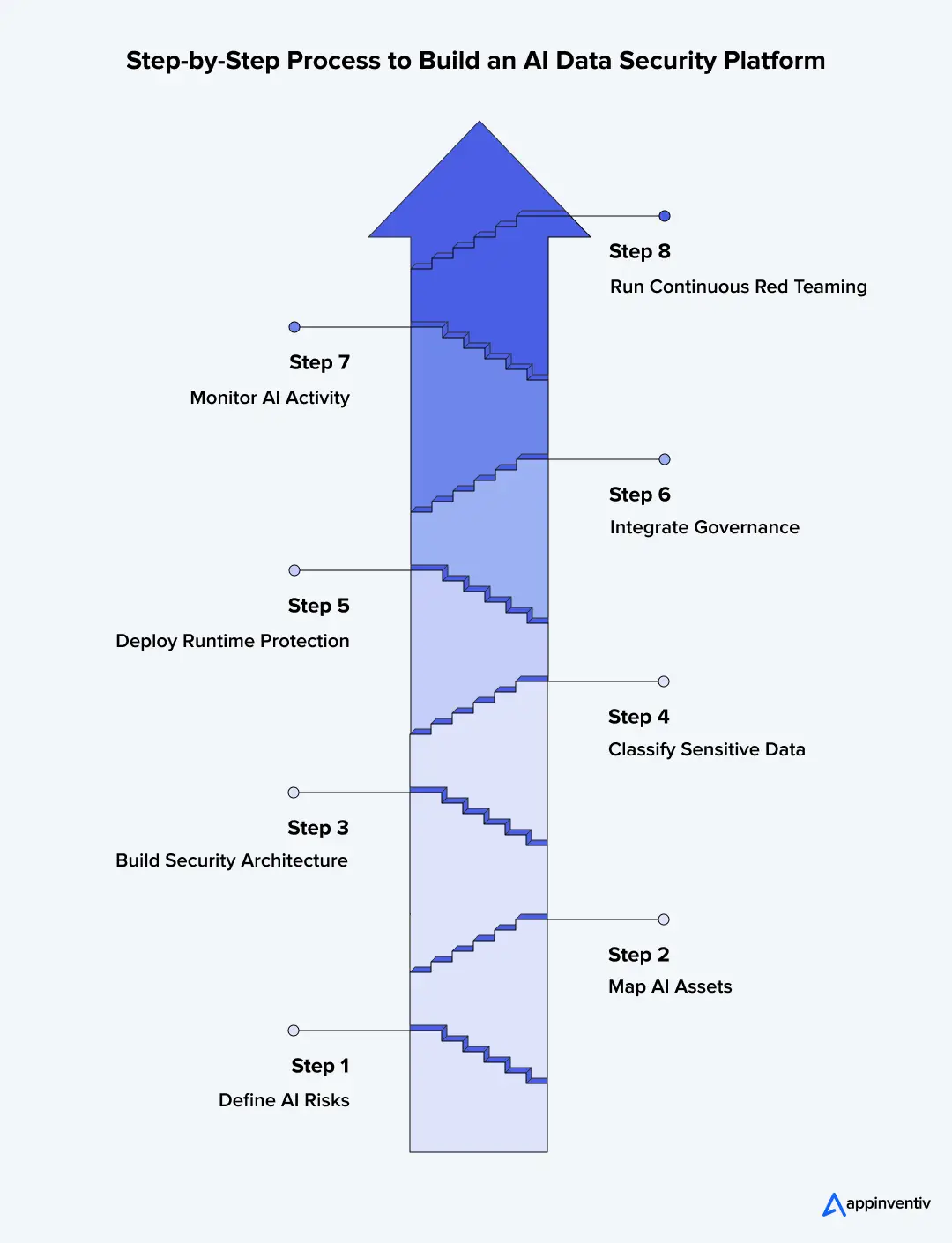
Step 1: Define AI Security Objectives and Risk Boundaries
The first stage to build an AI data security platform focuses on business exposure, regulatory obligations, and AI governance requirements. Enterprises need clear policies for what AI systems can access, process, generate, and store.
Security leaders usually begin by identifying:
- High-risk AI use cases
- Regulated datasets
- Sensitive business workflows
- Cross-border data movement
- Third-party AI dependencies
- Internal AI governance standards
Most enterprises now classify AI workloads into different risk tiers.
| AI Workload Type | Risk Level |
|---|---|
| Internal knowledge assistants | Medium |
| AI financial systems | High |
| Clinical AI copilots | Critical |
| Autonomous AI agents | Critical |
This stage also defines acceptable risk thresholds for hallucinations, unauthorized retrieval activity, and model misuse. AI agent security deserves special attention here, since autonomous agents are classified as the highest risk workload tier.
Step 2: Inventory AI Assets and Data Flows
Many organizations deploy AI for enterprise faster than they document it, some enterprises now manage more than 1,600 production AI models at once. Teams often lose visibility into which models, APIs, vector stores, and SaaS copilots are active inside production systems.
Security teams should map:
- Foundation models
- Fine-tuned LLMs
- Embedding pipelines
- Inference endpoints
- Prompt orchestration layers
- RAG connectors
- Vector databases
- AI agents
- Third-party AI APIs
Data flow mapping is equally important.
Security architects need to track:
- Which datasets enter training pipelines
- Which systems feed the retrieval layers
- Which users interact with inference endpoints
- Which AI agents trigger external actions
This process exposes shadow AI activity and unmanaged inference workflows.
Step 3: Design the Security Architecture
The architecture layer defines how security controls protect AI workloads at runtime. This is where enterprises establish trust boundaries across models, APIs, embeddings, and connected systems.
Modern AI security architectures commonly include:
- Zero Trust access policies
- Network microsegmentation
- Identity federation
- API gateways
- Runtime isolation
- Secrets management
- Encryption for embeddings and vector indexes
Many enterprises now isolate inference environments from training clusters. This reduces lateral movement risks during compromise events.
A typical enterprise AI security stack may look like this:
| Architecture Layer | Security Function |
|---|---|
| IAM layer | User and service authentication |
| API gateway | Traffic inspection and rate limiting |
| Vector security layer | Embedding access protection |
| Runtime security | Prompt and output inspection |
| Governance layer | Audit and policy enforcement |
This stage also defines how AI telemetry integrates with SOC and SIEM systems.
Step 4: Build Data Discovery and Classification Pipelines
AI systems continuously process structured, unstructured, and semi-structured enterprise data. Manual classification methods fail quickly at scale.
Security teams need automated discovery pipelines capable of inspecting:
- Data lakes
- Document repositories
- Vector databases
- Prompt histories
- AI outputs
- Retrieval pipelines
Core classification capabilities include:
- Metadata scanning
- PII and PHI detection
- Data lineage tracking
- Embedding inspection
- Context-aware labeling
- Real-time sensitivity scoring
Vector databases require special attention during classification because embeddings may still expose business context even after raw records are removed.
This risk becomes especially pronounced when a RAG chatbot integration connects to multiple enterprise data sources simultaneously.
For example:
| Raw Data | Hidden Embedding Risk |
|---|---|
| Legal contracts | Semantic retrieval exposure |
| Source code | IP leakage |
| Financial reports | Internal forecasting data |
| Clinical records | Sensitive patient context |
This layer helps enterprises understand exactly where sensitive information appears inside AI workflows.
Step 5: Implement AI Runtime Protection
Runtime protection has become one of the most important layers in enterprise AI security. Nearly 87% of organizations reported AI-powered cyberattacks during the last year, increasing demand for dedicated cybersecurity services that go beyond traditional DLP systems, which rarely inspect live inference activity, prompt behavior, or retrieval context.
AI runtime security focuses on how models behave during active use.
Security controls usually include:
- Prompt inspection
- Output filtering
- Context window analysis
- Token-level monitoring
- Inference anomaly detection
- Runtime behavioral analytics
- Retrieval validation
- Agent activity inspection
Runtime monitoring systems analyze prompts for:
- Prompt injection attempts
- Jailbreak patterns
- Data extraction behavior
- Hidden instruction chains
- Unauthorized retrieval requests
Output filtering engines inspect generated responses before they reach users.
Common checks include:
- PII exposure
- Source code leakage
- Toxic content
- Policy violations
- Hallucinated business actions
| Runtime Threat | Enterprise Impact |
|---|---|
| Prompt injection | Unauthorized data retrieval |
| Jailbreak prompts | Policy bypass |
| Abnormal token spikes | Automated abuse attempts |
| Retrieval poisoning | Manipulated AI responses |
| Hallucinated outputs | Incorrect operational decisions |
Many enterprises now deploy dedicated LLM gateways between users and production models. These gateways inspect prompts, enforce policies, and monitor inference traffic in real time. Inspection on its own rarely holds, so a durable prompt injection defense pairs the gateway with deterministic authorisation on every tool call and a default-deny egress policy, giving the platform something to enforce when a payload gets past the filter.
Step 6: Integrate Governance and Compliance Controls
AI data privacy compliance is central to this step — enterprise AI systems generate massive amounts of operational data that governance teams need complete visibility into. Governance teams need complete visibility into how models access, process, and generate information.
This layer usually includes:
- Policy enforcement engines
- AI usage logging
- Explainability tracking
- Access reviews
- Audit trails
- Data retention controls
- Compliance reporting systems
Security teams also maintain governance evidence for:
- GDPR audits
- HIPAA investigations
- PCI DSS reporting
- EU AI Act compliance reviews
Enterprises increasingly treat AI governance as a continuous operational process instead of a yearly audit exercise.
Step 7: Deploy Monitoring and AI Security Operations
AI workloads require continuous operational monitoring across APIs, inference systems, retrieval pipelines, vector stores, and cloud infrastructure.
Most enterprises integrate AI telemetry into existing SOC workflows.
Monitoring systems typically track:
- Inference traffic
- Prompt patterns
- API activity
- Agent behavior
- Authentication events
- Retrieval anomalies
- GPU workload activity
Security operations teams often connect these feeds into:
- SIEM platforms
- SOAR systems
- Threat intelligence engines
- Runtime observability dashboards
This layer helps teams detect suspicious AI activity before it spreads across connected systems. Some enterprises now deploy AI agents for cybersecurity to automate detection and response across these monitoring feeds.
Step 8: Continuous Validation and Red Teaming
AI systems evolve constantly. New prompts, datasets, agents, and retrieval sources introduce fresh attack paths every week.
Continuous testing is now a core requirement for enterprise AI security programs.
Security teams commonly perform:
- Adversarial testing
- Jailbreak simulations
- Prompt injection testing
- Retrieval abuse testing
- Agent misuse validation
- Model manipulation testing
Red teams also simulate real-world attacks against production AI systems.
Typical scenarios include:
| Simulation Type | Objective |
|---|---|
| Prompt injection attack | Bypass model restrictions |
| Retrieval poisoning | Manipulate generated outputs |
| Agent takeover | Abuse workflow permissions |
| API abuse simulation | Stress inference endpoints |
This process helps enterprises identify weak runtime controls before attackers exploit them.
How an AI Data Security Platform Works
An AI security platform for enterprises tracks, monitors, and protects AI systems across the full AI lifecycle, from data ingestion and model access through inference activity and runtime operations. This includes data ingestion, model access, inference activity, retrieval workflows, and runtime operations.
AI Asset Discovery
The platform first identifies AI assets running across the enterprise environment.
This includes:
- Foundation models
- Fine-tuned LLMs
- Inference endpoints
- Vector databases
- AI agents
- SaaS copilots
- RAG pipelines
Security teams use this layer to map unknown or unmanaged AI workloads across cloud and on-premise systems.
Sensitive Data Classification
The next layer scans and labels sensitive enterprise data connected to AI systems.
Common data categories include:
- PII
- PHI
- Financial records
- Proprietary datasets
- Source code
- Embeddings stored inside vector databases
The system tracks where sensitive information enters training and inference pipelines.
Access Path Mapping
AI security platforms then monitor how users, models, and applications access enterprise data.
This includes:
- IAM roles
- API traffic
- RAG connectors
- Service accounts
- Agent permissions
The goal is to detect weak permissions and unauthorized access paths.
AI Runtime Monitoring
Runtime monitoring focuses on live model behavior.
The platform analyzes:
- Prompts
- Model outputs
- Inference activity
- Abnormal response patterns
- Hallucination indicators
This layer helps security teams detect unsafe or manipulated AI behavior in production systems.
Threat Detection and Response
The platform continuously checks for AI-specific attacks.
Examples include:
- Prompt injection
- Model misuse
- Abnormal inference requests
- Data exfiltration attempts
- Suspicious retrieval activity
Many enterprise platforms connect these alerts with SIEM and SOC workflows.
Continuous Compliance and Auditability
The final layer handles governance and compliance operations.
This includes:
- Policy enforcement
- Data lineage tracking
- Audit logs
- AI activity records
- Governance evidence for regulators
These records help enterprises meet GDPR, HIPAA, PCI DSS, and EU AI Act requirements across AI environments.
Technical Architecture of an AI Data Security Platform
An enterprise AI security platform sits across the full AI stack, monitoring how data moves, how models behave, and how users interact with inference systems in production environments. It monitors how data moves, how models behave, and how users interact with inference systems in production environments.
Each layer handles a separate security function.
| Layer | Primary Coverage |
|---|---|
| Data Layer | Storage systems and vector databases |
| AI Layer | Models and inference engines |
| Security Layer | Identity, DLP, AI workload protection |
| Runtime Layer | Prompt and output monitoring |
| Governance Layer | Policies and audit records |
| Observability Layer | Logs and security telemetry |
Data Layer
This layer stores enterprise data used for training and retrieval operations. Most organizations run a mix of structured and unstructured datasets across cloud and hybrid environments.
Typical systems include:
- Snowflake
- Databricks
- Amazon S3
- Pinecone
- Weaviate
- Milvus
Security controls at this layer focus on encryption, access restrictions, and sensitive data classification.
AI Layer
The AI layer handles model execution and inference traffic. It includes foundation models, fine-tuned LLMs, embedding models, and orchestration frameworks. Scaling language models across enterprise environments through LLMOps practices also determines how observable and governable this layer remains over time.
Common components include:
- Llama
- Claude
- OpenAI APIs
- LangChain
- LangGraph
- NVIDIA Triton
This layer processes prompts, embeddings, retrieved context, and generated outputs.
Security Layer
The security layer controls access across models, APIs, vector stores, and connected applications.
Most enterprises deploy:
- IAM policies
- DSPM scanners
- DLP controls
- API gateways
- Secrets management systems
- AI-SPM tooling
This layer blocks unauthorized access and reduces exposure risks across AI workloads.
Runtime Layer
Runtime security focuses on live inference activity. Security systems inspect prompts, outputs, retrieval requests, and model behavior in real time.
Monitoring systems check for:
- Prompt injection attempts
- Jailbreak patterns
- Suspicious token spikes
- Retrieval abuse
- Unsafe outputs
Many enterprises now place LLM gateways between users and production models to inspect traffic before inference execution.
Governance and Observability Layers
The governance layer manages policy enforcement, audit logs, explainability records, and compliance reporting.
The observability layer tracks:
- API activity
- Inference traffic
- GPU utilization
- Runtime alerts
- Threat telemetry
SOC teams use this data to investigate AI-related incidents across enterprise environments.
Core Components of an AI Data Security Platform
An AI data security platform is made up of several connected security and monitoring layers. Each component handles a different task inside the AI environment. Some focus on data visibility. Others monitor inference activity, user access, retrieval behavior, or policy violations.
| Component | What It Handles |
|---|---|
| AI asset discovery | Finds active AI systems |
| DSPM and classification | Detects sensitive data |
| Vector database security | Protects embeddings and retrieval activity |
| Identity and access control | Manages permissions |
| Runtime security engine | Monitors live model behavior |
| Prompt and output filtering | Inspects prompts and responses |
| Policy enforcement | Applies governance rules |
| Threat detection | Detects attacks and misuse |
| Audit and compliance engine | Stores logs and evidence |
| Security dashboard | Centralizes alerts and telemetry |
AI Asset Discovery Engine
Most enterprises now run dozens of AI workloads across cloud and internal systems. Security teams often struggle to track them all.
Discovery engines help identify:
- LLM endpoints
- AI agents
- SaaS copilots
- Vector databases
- Embedding pipelines
- External AI APIs
This layer helps teams detect unmanaged or unauthorized AI deployments.
DSPM and Data Classification Layer
This component scans enterprise data connected to AI systems. The goal is to identify sensitive records before they enter training or retrieval pipelines.
Common targets include:
- PII
- PHI
- Financial records
- Internal documents
- Source code
- Prompt histories
Many systems now classify data in real time during inference activity.
Vector Database Security
Vector databases store embeddings used by RAG systems and semantic search engines. These embeddings still carry business meaning and sensitive context.
Security controls at this layer include:
- Query monitoring
- Embedding encryption
- Access restrictions
- Tenant isolation
- Retrieval inspection
Runtime Security and Threat Detection
Runtime engines inspect prompts, outputs, token behavior, and inference traffic during live model execution.
Detection systems monitor for:
- Prompt injection
- Jailbreak attempts
- Data leakage
- Abnormal retrieval activity
- Suspicious inference requests
Many enterprises now place LLM gateways between users and production models to inspect traffic before inference execution.
Governance and Security Analytics
Governance systems maintain policy records, audit logs, explainability data, and AI usage history.
Security dashboards give SOC teams visibility into:
- Runtime alerts
- API traffic
- Retrieval events
- Threat telemetry
- Compliance activity
This helps enterprises investigate AI-related security incidents across production systems.
Recommended Technology Stack for an AI Data Security Platform
Most enterprise AI teams build their security stack across cloud infrastructure, inference systems, vector databases, and monitoring platforms. No single tool handles the entire workload. Teams usually combine multiple products across data, runtime security, identity, and observability layers.
| Area | Common Technologies |
|---|---|
| Cloud | AWS, Azure, Google Cloud |
| Data Platforms | Snowflake, Databricks, Redshift |
| Vector Databases | Pinecone, Weaviate, Milvus |
| LLMOps | LangChain, LangGraph, LlamaIndex |
| Security | HashiCorp Vault, CrowdStrike, Wiz |
| Monitoring | OpenTelemetry, Prometheus, Grafana |
| SIEM | Splunk, Microsoft Sentinel |
| Containers | Kubernetes, Docker |
| Identity | Okta, Azure AD |
Weak runtime monitoring and exposed vector databases create direct security and compliance risks inside production environments.

AI Governance and Compliance in Enterprise AI Security
Enterprise AI systems now touch far more than chat interfaces and internal copilots. They access financial records, customer profiles, clinical documents, contracts, and operational data every day. That creates governance problems many companies never faced with older software systems.
Most security teams now need visibility into prompts, retrieval activity, model access, and AI-generated actions across live environments.
Why Governance Has Become a Daily Security Function
Many enterprises no longer treat AI governance as a yearly compliance task. AI systems change constantly. New models, APIs, retrieval sources, and agents appear every month.
Security teams usually monitor:
- Prompt activity
- Inference logs
- Data lineage
- Model permissions
- Retrieval behavior
- User access patterns
That visibility helps teams investigate security incidents and track how sensitive data moves across AI systems.
Enterprise Compliance Areas
| Regulation | Primary Focus |
|---|---|
| GDPR | Personal data protection |
| HIPAA | Patient data security |
| PCI DSS | Payment information controls |
| EU AI Act | AI risk governance |
| NIST AI RMF | AI operational governance |
Common Governance Controls
Most enterprises now deploy governance controls directly inside production AI environments.
Common examples include:
- Runtime audit logs
- Role-based access policies
- Human approval workflows
- AI usage records
- Data retention controls
- Continuous compliance monitoring
Many organizations now face sovereign AI requirements as well. Some industries restrict where AI models run, where inference data moves, and which regions can store enterprise datasets.
That shift is pushing enterprises toward governance-first AI operations built around continuous monitoring instead of periodic audits.
Enterprise Use Cases of AI Data Security Platforms
AI security risks change from one industry to another. A healthcare provider faces very different exposure risks than a telecom operator or a global bank. Enterprise AI security platforms help organizations apply runtime controls, policy enforcement, and data protection based on business context.
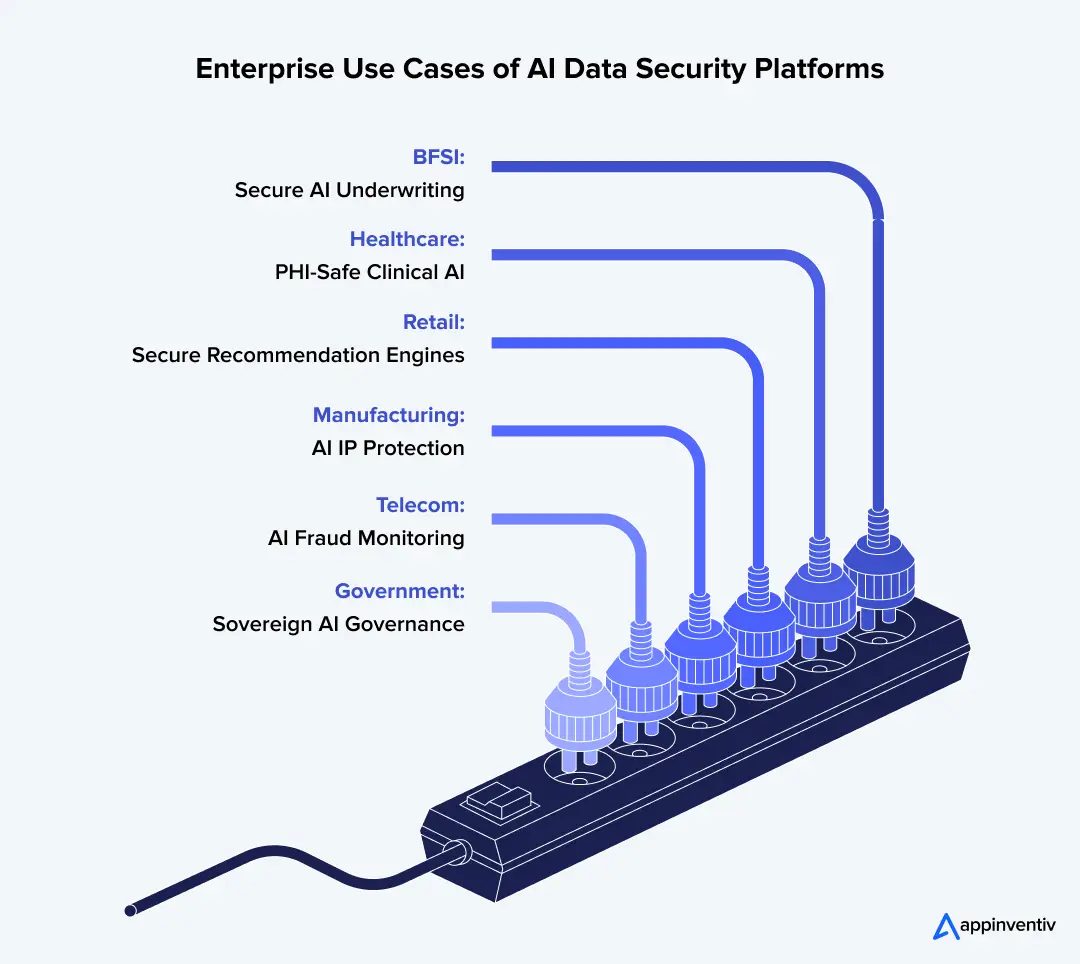
BFSI: AI Underwriting and Fraud Monitoring
The adoption of AI in banking has accelerated across underwriting reviews, fraud checks, and transaction analysis, and these systems process account activity, payment records, customer identities, and risk data across live environments.
These models process account activity, payment records, customer identities, and risk data across live environments. A weak inference endpoint or exposed API can create direct financial risk.
Security teams usually track:
- API traffic
- Prompt activity
- Model permissions
- Suspicious inference requests
- Customer data exposure
RGA has written about how insurers use AI systems to review underwriting information and detect fraud signals across large datasets.
Healthcare: Clinical Copilots and PHI Protection
Hospitals now deploy AI tools for patient summaries, clinical documentation, and diagnosis support. These systems often connect with EHR platforms and internal medical databases.
That creates strict requirements around healthcare data security, particularly PHI access controls and audit visibility across clinical AI systems.
Healthcare security teams focus on:
- PHI monitoring
- Access logging
- Retrieval tracking
- User permissions
- HIPAA audit records
KPMG has documented how healthcare providers are using AI systems across patient care and clinical operations.
Retail: Recommendation Engines and Customer Data Security
Retail AI systems process shopping behavior, payment activity, customer preferences, and loyalty data every day. Recommendation engines and AI search systems often connect with multiple internal platforms at once.
Security teams usually monitor:
- Customer profile access
- Prompt histories
- Retrieval queries
- Third-party AI APIs
- Vector database activity
Google Cloud has published how retailers such as Pernambucanas use AI systems for fraud prevention and customer analytics.
Manufacturing: Protecting Proprietary Engineering Data
Manufacturing firms now run AI systems across predictive maintenance, supply chain analysis, industrial automation, and engineering workflows.
Many organizations now treat embeddings and retrieval indexes as sensitive intellectual property.
Security teams often protect:
- CAD repositories
- Production telemetry
- Engineering records
- Supplier information
- Internal AI models
Microsoft has shared examples of manufacturers using AI systems inside engineering and industrial operations.
Telecom and Government: Sovereign AI Controls
Telecom providers and government agencies often face strict rules around regional hosting and sensitive data movement. Many organizations now run sovereign AI environments inside controlled cloud regions.
Security programs usually include:
- Zero Trust policies
- Runtime inspection
- Regional audit logging
- Threat intelligence feeds
- Restricted model hosting
Microsoft has highlighted AI adoption across telecom and government operations for fraud monitoring and operational analysis.
How Much Does It Cost to Build an AI Data Security Platform?
The cost of building an AI data security platform depends on infrastructure scale, runtime security depth, compliance requirements, and deployment complexity.
| Platform Scope | Estimated Cost |
|---|---|
| Mid-Scale AI Security Layer | $250K–$500K |
| Enterprise-Grade Platform | $500K–$800K+ |
| Advanced Multi-Cloud AI-SPM Platform | $1M+ |
Key Cost Drivers
Several technical factors influence the overall AI data security platform implementation cost.
- Runtime prompt and inference monitoring
- Multi-cloud AI infrastructure support
- Real-time data classification pipelines
- Vector database security controls
- AI agent access governance
- SIEM and SOC integrations
- GPU workload monitoring
- Compliance reporting systems
- Audit logging infrastructure
- API gateway deployment
- LLM gateway and runtime firewall setup
- AI observability tooling
- Encryption and secrets management
- High-volume telemetry storage
- Threat intelligence integrations
Enterprises with regulated AI workloads in banking, healthcare, telecom, or government environments usually require larger security and compliance investments.
Best Practices for Building Enterprise AI Data Security Platforms
A strong AI security platform for enterprises requires continuous monitoring, strict access control, and runtime visibility across every AI workflow. Security teams should treat AI systems like production infrastructure, not isolated experimentation environments.
Strong AI security programs usually follow a few core operational practices.
Apply Zero Trust Across AI Systems
To secure enterprise AI data, every model, API, agent, and retrieval pipeline should require identity validation and policy checks before access is granted.
Core controls include:
- MFA enforcement
- API authentication
- Network segmentation
- Service identity validation
Restrict Access with Least Privilege Policies
AI agents and inference systems should only access the minimum data required for execution.
Security teams usually limit:
- Retrieval permissions
- Vector database access
- Prompt visibility
- Administrative controls
Secure RAG Pipelines and Runtime Workflows
RAG environments often expose sensitive enterprise data through retrieval chains and embeddings, and the risks grow further as agentic RAG implementation adds autonomous decision-making to retrieval workflows.
Protection measures include:
- Prompt inspection
- Retrieval validation
- Output filtering
- Embedding encryption
Maintain Continuous Runtime Visibility
AI security platforms should monitor live inference activity across models, APIs, and connected applications.
Monitoring systems often track:
- Prompt behavior
- Token spikes
- Retrieval anomalies
- Runtime alerts
Build Governance and Validation Into Daily Operations
Governance cannot remain a yearly audit process within AI environments.
Enterprise teams now use:
- AI red teaming
- Human-in-the-loop validation
- Continuous AI risk scoring
- Automated policy enforcement
- Audit logging and lineage tracking
Critical Challenges in Building AI Data Security Platforms
Enterprise AI environments change constantly, making generative AI data security harder to manage as new models, APIs, agents, and retrieval pipelines appear faster than most security teams can track them.
Traditional cloud and application security controls rarely provide enough visibility into inference activity, embeddings, and runtime behavior. Below are some of the most common engineering and security challenges enterprises face during AI security platform development.
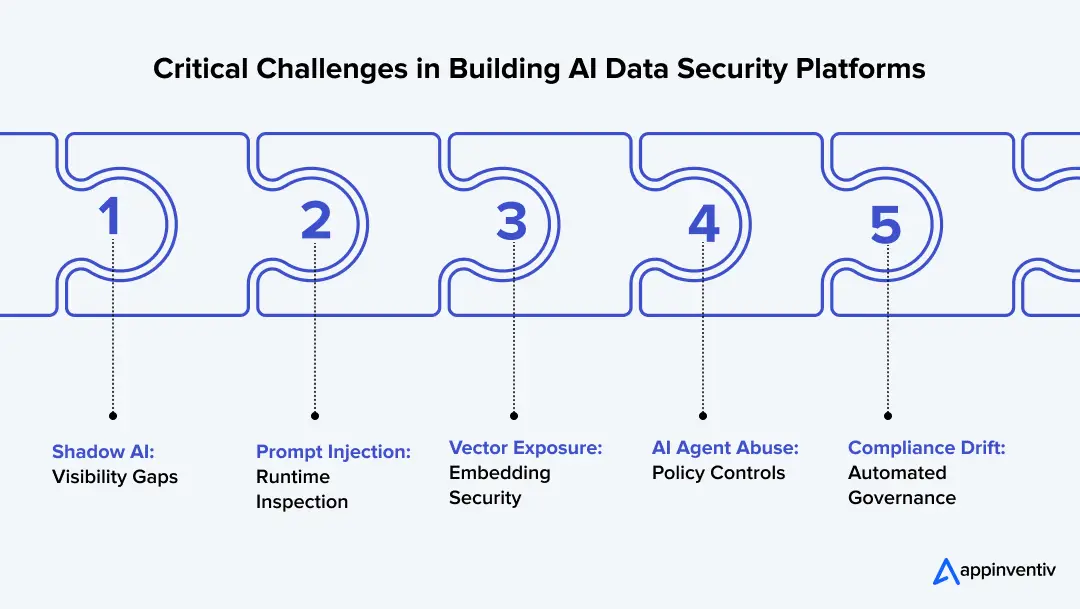
Shadow AI Discovery
Many employees now use external AI tools without security approval. Teams often deploy internal copilots and inference APIs outside standard governance processes.
Solution
- Continuous AI asset scanning
- API discovery monitoring
- SaaS AI usage tracking
- Inference endpoint inventory mapping
Vector Database Visibility Gaps
Vector databases store embeddings that still carry sensitive business meaning. Most legacy DLP systems cannot inspect semantic retrieval activity.
Solution
- Embedding-aware DSPM
- Retrieval query inspection
- Vector index monitoring
- Embedding encryption controls
Prompt Injection Attacks
Prompt injection remains one of the biggest cybersecurity risks inside enterprise AI systems, with AI-generated phishing attacks now exceeding 82% of observed phishing activity. AI-generated phishing attacks now exceed 82% of observed phishing activity. Attackers can manipulate retrieval chains and generate outputs through hidden instructions.
Solution
- Runtime prompt inspection
- Context window validation
- Output filtering
- LLM gateway enforcement
AI Agent Overreach
AI agents often receive broad permissions across workflows, APIs, and enterprise systems. Weak authorization controls increase operational risk.
Solution
- Policy-based authorization
- Least privilege access
- Agent activity logging
- Role-based permission boundaries
Compliance Drift
AI environments change rapidly. Security policies often fail to keep pace with new models, retrieval systems, and data flows, which is why governance must be built into generative AI implementation from the very beginning rather than bolted on later.
Solution
- Automated policy enforcement
- Real-time audit logging
- AI governance workflows
- Continuous compliance validation
Multi-Cloud AI Complexity
Large enterprises now run AI workloads across AWS, Azure, Google Cloud, and private infrastructure. Security visibility becomes fragmented quickly.
Solution
- Unified security orchestration
- Centralized telemetry collection
- Cross-cloud identity controls
- Shared runtime monitoring
Prompt injection, retrieval abuse, and inference attacks now target enterprise AI systems every single day.

Future Trends in AI Data Security Platforms
Enterprise AI security platforms are shifting toward real-time automation, runtime intelligence, and distributed governance models. Analysts expect the AI cybersecurity market to cross $146 billion by 2034.
Security teams no longer focus only on infrastructure protection. They now monitor model behavior, retrieval activity, AI agents, and inference traffic across live production systems.
Several trends are shaping the next generation of AI security platforms.
- AI-native SOCs that correlate inference telemetry, prompt activity, and runtime alerts inside one operational view.
- Autonomous AI defense systems that detect suspicious prompts, abnormal token behavior, and retrieval abuse without manual intervention.
- Agentic AI governance models that apply policy controls to autonomous AI agents across workflows and enterprise applications.
- Confidential AI computing environments that isolate model execution through secure enclaves and hardware-backed encryption.
- Sovereign AI infrastructure for regional hosting, local inference control, and regulated data residency enforcement, often built on private AI models that keep data within controlled enterprise boundaries.
- Runtime AI policy orchestration engines that apply security controls during live inference execution.
- Synthetic data protection systems that track generated datasets and prevent misuse of artificial training data.
- AI security mesh architectures that connect identity systems, runtime monitoring, DSPM platforms, and AI-SPM tooling across distributed environments.
Many enterprises now treat AI runtime security as a continuous operational process instead of a periodic security review.
How Appinventiv Helps Enterprises Build Secure AI Platforms
Most enterprise teams already have AI running somewhere inside the business. A support bot. A fraud model. An internal copilot. A retrieval system connected to the company data. The real problem starts later. Teams cannot see what the models access, which prompts them to enter the system, or how data moves during inference.
As a trusted AI data security platform company, Appinventiv helps fix that gap.
The work usually starts with the existing environment. Some companies already run models on AWS or Azure but lack the runtime controls that come with dedicated AI development services. Others have vector databases connected to internal records without proper monitoring or access restrictions.
| Area | Experience |
|---|---|
| AI-powered systems delivered | 300+ |
| AI engineers and data scientists | 200+ |
| Custom AI models deployed | 150+ |
| Enterprise AI integrations completed | 75+ |
| Fine-tuned LLMs delivered | 50+ |
Enterprises rely on Appinventiv’s AI data security platform services for:
- Secure LLM deployment
- AI runtime monitoring
- Multi-cloud AI infrastructure
- Vector database protection
- AI governance setup
- Retrieval pipeline security
- API and inference protection
- AI observability systems
A large part of the engineering work focuses on visibility. Enterprises need to know which models run in production, who can access them, what data enters retrieval pipelines, and how AI agents behave during execution.
That visibility becomes harder once AI systems scale across departments, regions, and cloud environments, which is why structured AI data security platform development is no longer optional for growing enterprises.
Let’s connect and build a governance-ready ai security platform before regulations tighten.
Frequently Asked Questions
Q. What Is an AI Data Security Platform?
A. AI data security platform development focuses on building systems that protect AI workloads across training, inference, storage, and runtime operations. It monitors model access, vector stores, embeddings, AI agents, and RAG pipelines for unauthorized activity or sensitive data exposure. CSPM focuses on cloud infrastructure security. DSPM scans and classifies sensitive enterprise data. AI-SPM tracks AI workload risks and model posture. An AI data security platform combines all these layers into one security and governance system aligned with MLSecOps practices.
Q. Why do businesses need an AI data security platform?
A. Most companies now connect AI systems with internal documents, customer records, APIs, and business applications. That creates new security gaps. Traditional security tools rarely track prompts, embeddings, retrieval activity, or AI agents properly. An AI data security platform helps teams monitor runtime activity, control data access, detect misuse, and maintain audit visibility across production AI systems.
Q. What industries benefit most from an AI data security platform?
A. Industries handling regulated or sensitive data benefit the most. Banks use these platforms for fraud systems and underwriting models. Hospitals protect patient records inside clinical AI tools. Retail firms secure recommendation engines and customer analytics platforms. Telecom, manufacturing, and government organizations use them to monitor AI workloads, control access, and reduce data exposure across large environments.
Q. Why should enterprises choose Appinventiv for AI data security platform development?
A. Appinventiv helps enterprises build secure AI systems that can operate across real production environments. The team works on runtime monitoring, secure LLM deployment, AI governance, vector database protection, and multi-cloud infrastructure. With experience across 300+ AI-driven products and 150+ deployed AI models, Appinventiv supports enterprises that need stronger visibility, security controls, and compliance readiness across large AI ecosystems.


Fast 2-minute response, fully NDA-protected.

Retrieval Augmented Generation in Australia: Architecture, Implementation and Cost
Key takeaways: RAG grounds LLM answers in approved content, improving reliability without retraining a model. Data quality and access permissions decide production outcomes more than the model. Indicative build costs run from AUD 70,000 to 700,000, driven by data and integrations. Measure value against a pre-deployment baseline, separating realised benefits from projected savings. A general-purpose…
The Multiplier Effect of AI Agents: The Rise of AI Swarms
Key takeaways: AI agent swarms coordinate specialized agents to solve complex problems that may be difficult for a single agent to handle effectively. More agents do not automatically mean better outcomes. Swarms deliver value when work can be divided, executed in parallel, and coordinated toward a shared objective. Enterprise readiness depends on governance. Clear accountability,…

AI Data Integration: How to Connect, Clean and Prepare Data for AI
Key takeaways: AI initiatives fail when fragmented, poor-quality data reaches models without sufficient context, controls or ownership. AI-ready pipelines must connect, clean, enrich, govern and continuously monitor data across its lifecycle. Real-time processing matters when AI decisions depend on current transactions, events, inventory or operational conditions. Data architecture should follow the AI use case, balancing…