






























Vibe Coding vs Traditional Coding: Risks, Security Gaps, and Production Readiness

 Share -


- 01Vibe Coding vs Traditional Development: Core Differences That Matter
- 02Vibe Coding vs Traditional Development Across the Software Development Life Cycle
- 03Hidden Risks and Security Gaps in Vibe Coding (And How to Stay Ahead)
- 04Vibe Coding vs Traditional Development: Why Apps Break at Scale
- 05Vibe Coding vs Traditional Coding: How Technical Debt Builds Over Time
- 06Vibe Coding vs Traditional Coding: Where It Works and Where It Breaks
- 07A Smarter Approach: Combining Vibe Coding with Traditional Development Discipline
- 08Decision Framework: Choosing Between Vibe Coding and Traditional Development
- 09How Appinventiv Helps Build Secure, Production-Ready AI-Driven Systems
- 10FAQs

Key takeaways:
- Vibe coding helps you ship faster, but without structure, it introduces hidden risks in security, scalability, and maintainability.
- Traditional development takes longer upfront, but ensures systems are stable, secure, and production-ready from the start.
- Most issues with vibe coding don’t appear early. They surface later when systems scale, handle real users, or face failures.
- The right approach isn’t choosing one over the other. It’s using vibe coding for speed and traditional practices for long-term reliability.
- Teams that balance both approaches move fast early and avoid costly rework as their systems grow.
Most teams have seen this happen. A feature ships much faster than expected with AI assistance; everything looks stable at first, and progress feels real. Then, as usage grows, edge cases arise, performance dips, and security concerns surface. That’s when the discussion about vibe coding vs. traditional development shifts from excitement to evaluation.
On the surface, vibe coding feels like a clear step forward. It speeds up development, reduces repetitive effort, and helps teams move from idea to execution quickly. When you compare Vibe coding vs traditional programming, the efficiency gains are hard to ignore. But speed alone doesn’t define long-term success, especially when systems need to scale, remain secure, and operate reliably.
A 2026 report brings this into focus. It found that AI-generated code is linked to 1 in 5 security incidents in organizations, highlighting how quickly risks can enter production environments without proper oversight.
This is where the conversation shifts. It’s no longer just about how fast you can build, but how well those systems hold up under real-world conditions. In this blog, you’ll read how vibe coding vs traditional development compares across risks, security gaps, and production readiness.
20% of AI-generated code has been found with serious security flaws. Make sure yours isn’t one of them.

Vibe Coding vs Traditional Development: Core Differences That Matter
When you look closely, the difference isn’t just about speed. It’s about how systems are built, validated, and sustained over time. The contrast between vibe coding vs traditional coding becomes much clearer once you map it across real engineering dimensions.
Here’s a structured comparison:
| Dimension | Vibe Coding | Traditional Development | What It Means in Practice |
|---|---|---|---|
| Development Approach | Prompt-driven, AI generates code iteratively | Engineers design and write code manually | Lower code ownership in Vibe coding can impact clarity and control |
| Code Understanding | Partial understanding of the generated logic | Full visibility and control over the codebase | Debugging becomes harder when logic isn’t fully understood |
| Speed of Delivery | Very high, rapid prototyping and feature release | Moderate, structured development cycles | Faster releases vs long-term stability trade-off |
| Architecture Design | Often implicit or fragmented | Clearly planned and documented | AI struggles with system-level design decisions |
| Security Reliability | Inconsistent, depends on prompts and outputs | Built into SDLC with reviews and testing | Higher risk of vulnerabilities in AI-generated code |
| Debugging Complexity | High, due to unclear logic paths | Structured and predictable debugging | Issues in vibe coding often surface late |
| Scalability | Limited optimization for scale | Designed for performance and load handling | Vibe-coded systems may fail under real traffic |
| Maintainability | Inconsistent patterns, higher technical debt | Clean architecture, modular code | Maintenance cost increases over time with vibe coding |
| Testing Approach | Often minimal or reactive | Dedicated QA cycles and automation | Reduced test coverage in AI-driven workflows |
| Compliance & Governance | Weak traceability and auditability | Strong documentation and version control | Enterprises face higher compliance risks with vibe coding |
The gap between vibe coding vs traditional programming isn’t just technical, it’s operational. Vibe coding accelerates the speed at which something works. Traditional development ensures it continues to work under pressure. In real-world systems, that distinction becomes critical.
Vibe Coding vs Traditional Development Across the Software Development Life Cycle
You usually don’t notice the difference on day one. Both approaches can get a feature out the door. The shift happens later, as the system grows and more people start using it, with small issues piling up. That’s when each stage of the lifecycle starts to matter more.
Here’s how the two approaches play out as things move forward:
| Stage | Vibe Coding | Traditional Development | What This Feels Like in Real Work |
|---|---|---|---|
| Planning & Architecture | You start building quickly with minimal upfront design. | You spend time defining structure, data flow, and system boundaries. | Faster start vs fewer surprises later |
| Development | Code is generated step by step, often changing style across features. | Code follows consistent patterns, with reviews and shared standards. | Quick progress vs easier collaboration |
| Code Quality & Reviews | The focus remains on whether the feature works. | Reviews look at structure, readability, and long-term impact. | Less friction now vs fewer issues later |
| Testing | Basic testing, mostly around expected flows. | Unit, integration, and edge case testing are built in. | Faster releases vs more confidence in production |
| Security | Security checks often come in later, if needed. | Security is built into the design from the start. | Fix later vs prevent early |
| Integration | APIs get connected quickly, sometimes without strict contracts. | Interfaces are clearly defined, versioned, and tested. | Fast setup vs stable integrations |
| Deployment | You can push changes quickly, but pipelines may not be fully structured. | CI/CD pipelines include staging, rollback, and environment control. | Quick releases vs controlled rollouts |
| Monitoring & Observability | Logging and monitoring are added after something breaks. | Metrics, logs, and tracing are already in place. | Reactive fixes vs faster detection |
| Maintenance & Scaling | Things start to slow down as the system grows. | Systems are built to handle growth more smoothly. | Rework later vs steady scaling |
At the start, vibe coding feels like momentum. You move fast, ideas turn into features quickly, and there’s very little friction.
A few months in, things shift. You need better testing, clearer APIs, more visibility into what’s happening, and safer deployments. That’s where the difference becomes more obvious.
This is why vibe coding vs traditional development isn’t really about choosing one over the other. Most teams end up using both. Move fast when you’re exploring. Add structure when the system needs to hold up.
Hidden Risks and Security Gaps in Vibe Coding (And How to Stay Ahead)
You’ll usually spot the problem a few weeks in. The feature works, traffic picks up, and suddenly, debugging takes longer than building did. That’s the shift. The system wasn’t designed to handle what it’s handling now.
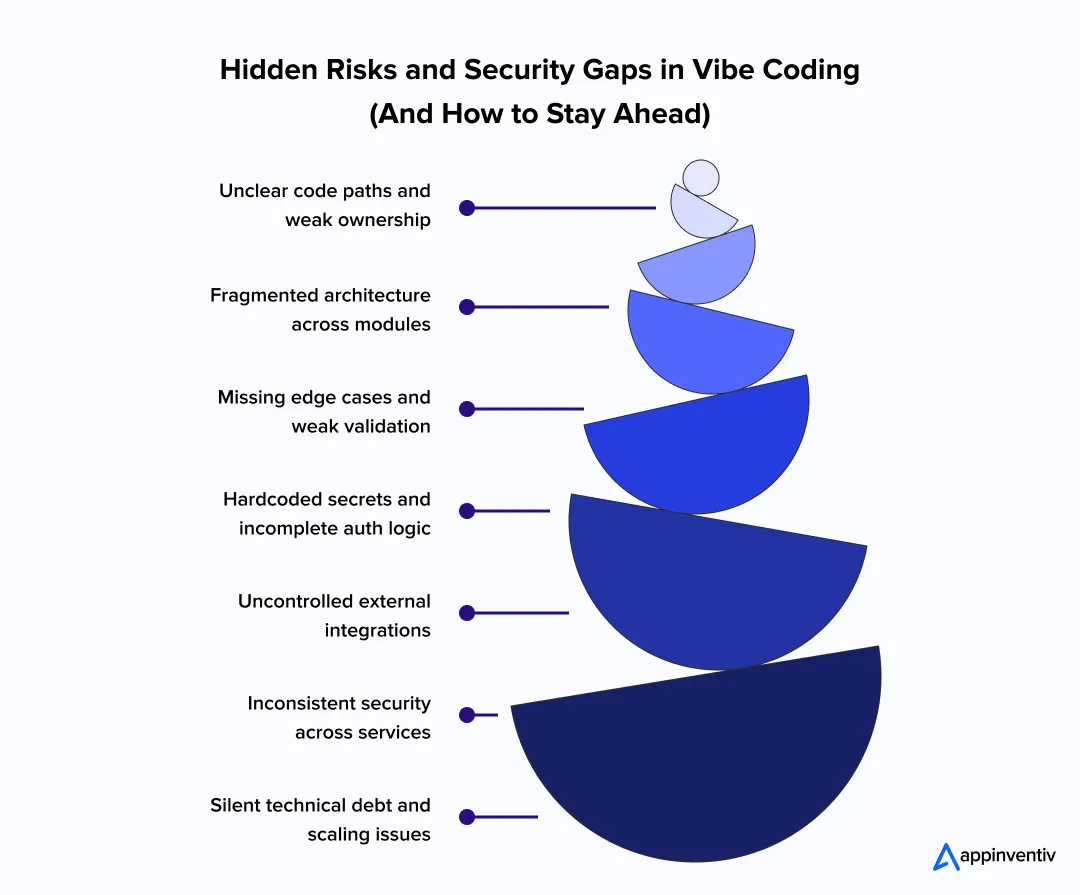
Here’s where things start breaking under the hood, and how to stay ahead without slowing everything down:
- Unclear code paths and weak ownership: Generated code often hides how data flows or where logic actually lives.
What happens: Debugging becomes messy, especially with async calls or across multiple services.
Fix: Add structured logging with trace IDs, enforce clean layers (API → service → data), and use tracing tools early. - Fragmented architecture across modules: Different prompts lead to different patterns, some REST, some tightly coupled, some inconsistent.
What happens: Integrations become brittle, and small changes break multiple parts.
Fix: Define service boundaries, standardize API contracts, and route traffic through an API gateway. - Missing edge cases and weak validation: Most flows handle happy paths, not retries, malformed inputs, or concurrency issues.
What happens: Failures show up only under real load.
Fix: Add schema validation at entry points, use idempotency for critical operations, and design retries with backoff. - Hardcoded secrets and incomplete auth logic: API keys in code, inconsistent token validation, or missing role checks are common.
What happens: Security gaps that aren’t obvious until exposed.
Fix: Use secret managers, centralize authentication, and enforce RBAC across endpoints. - Uncontrolled external integrations: APIs get plugged in fast without timeouts or fallback handling.
What happens: One failing dependency slows down everything.
Fix: Add circuit breakers, timeouts, and monitor third-party dependencies separately. - Inconsistent security across services: One module validates inputs, another skips it. No shared baseline.
What happens: Uneven security posture and compliance risks.
Fix: Define a common security layer, automate checks in CI, and align with standards like OWASP. - Silent technical debt and scaling issues: Early builds skip caching, indexing, or async processing.
What happens: Performance drops as traffic grows, and fixes require rework.
Fix: Introduce caching, queues, and query optimization before load increases.
The tricky part is timing. None of this feels urgent early on. Everything works, releases go out, and progress looks steady. The issues show up later, when fixing them is more expensive and affects real users.
That’s the real gap in vibe coding vs traditional development. You can move fast, but only if you bring in structure, validation, and security before scale forces you to.
Identify security gaps, performance issues, and architecture flaws before they impact production.

Vibe Coding vs Traditional Development: Why Apps Break at Scale
It usually doesn’t show up in the first sprint. Everything works, responses are fast, and even a steady stream of users doesn’t raise concerns. Then traffic increases, maybe after a launch or a new integration, and things start to feel different. Requests slow down, errors are harder to trace, and fixes take longer than expected.
That’s when the way the system was built starts to matter.
Here’s what tends to surface:
- Limited observability across services: Logs are present, but they don’t tell a complete story. There’s no clear way to follow a request across multiple services.
What this means: When something fails mid-request, teams spend time piecing together what happened.
Traditional approach: Systems are set up with structured logs and tracing, so issues can be tracked across services without guesswork. - Weak fault isolation between dependencies: Most integrations are assumed to work reliably, without safeguards for delays or failures.
What this means: A slowdown in one service can affect the entire flow.
Traditional approach: Timeouts, retries, and fallback mechanisms keep failures contained. - Database performance under load: Queries that work early on aren’t always built for higher concurrency.
What this means: As usage grows, response times increase and connection limits get hit.
Traditional approach: Indexing, query tuning, and connection management are considered upfront. - Synchronous handling of heavy operations: User requests trigger time-consuming tasks, such as external calls or file processing.
What this means: Each request waits longer, which reduces overall throughput.
Traditional approach: Background jobs and queues handle heavier tasks, keeping response times stable. - Scaling limitations in the system design: Services are often tightly coupled or rely on in-memory state.
What this means: Adding more instances doesn’t solve the problem easily.
Traditional approach: Stateless services and load balancing make scaling more predictable. - Unstructured deployment practices: Releases move directly to production without enough validation or fallback planning.
What this means: Even small changes can introduce instability, and recovery isn’t always quick.
Traditional approach: Staging environments and controlled pipelines make releases safer.
Nothing here is broken on its own. Each piece works as expected. The challenge shows up when everything runs together under real conditions.
That’s the practical difference in vibe coding vs traditional development. One helps you move quickly at the start. The other makes sure the system keeps working as usage, complexity, and expectations grow.
Vibe Coding vs Traditional Coding: How Technical Debt Builds Over Time
Early on, it feels like everything is working in your favor. Features go out fast, changes are easy to make, and nothing really slows the team down. Then a small update starts taking longer than it should. A quick fix often touches multiple files. That’s usually the point when technical debt starts to show up in a real way.
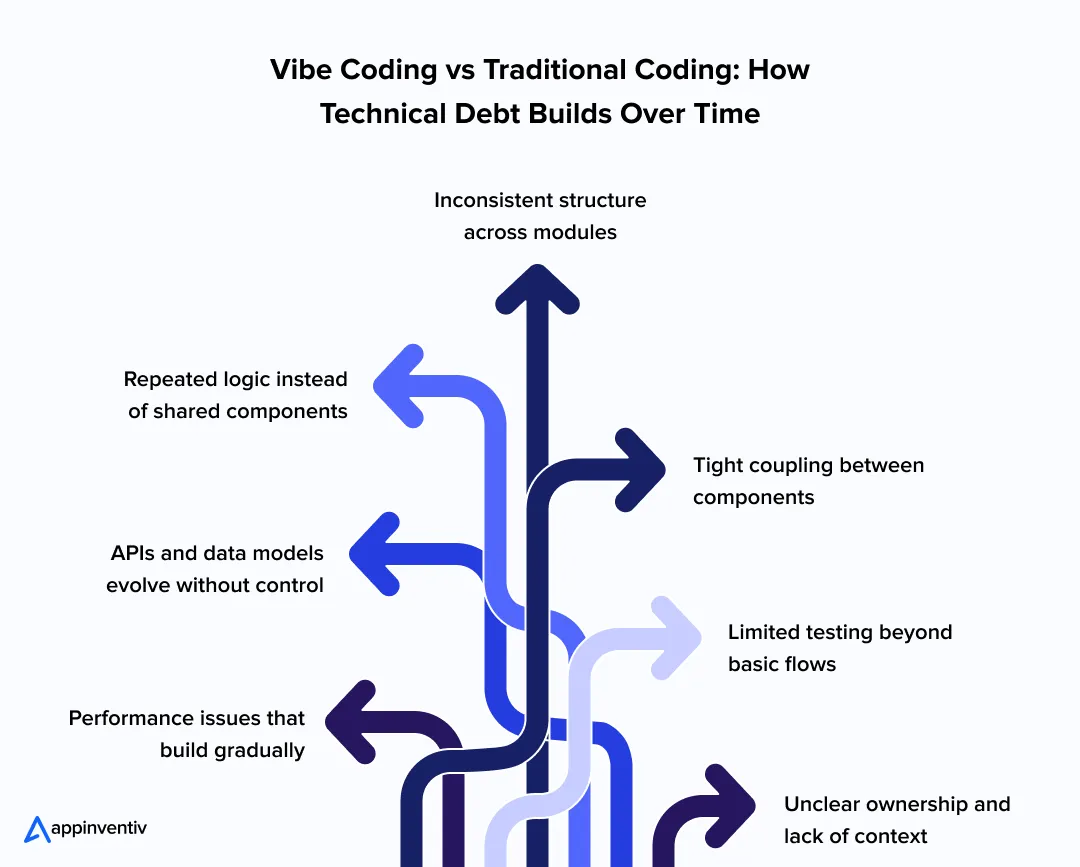
It doesn’t happen all at once. It builds quietly while things are moving fast.
- Inconsistent structure across modules: Different parts of the system are built in different ways. One service is clean and layered, another mixes everything together.
What this means: Every change takes more effort because there’s no predictable structure to follow.
Traditional approach: Teams stick to a consistent architecture, so working across modules feels familiar and faster. - Repeated logic instead of shared components: The same functionality gets written more than once because there’s no central place for it.
What this means: Fixing something in one place doesn’t fix it everywhere, and behavior starts drifting.
Traditional approach: Common logic is pulled into shared services, so updates stay consistent across the system. - Tight coupling between components: Services depend directly on one another rather than through stable interfaces.
What this means: A small change in one area can cause issues elsewhere.
Traditional approach: Clear boundaries and contracts make changes safer and more predictable. - APIs and data models evolve without control: Endpoints and schemas change without versioning or strict validation.
What this means: Integrations break unexpectedly, and fixing them takes time.
Traditional approach: Versioned APIs and validation rules keep things stable as the system grows. - Limited testing beyond basic flows: Most checks focus on whether the feature works, not how it behaves in edge cases.
What this means: Bugs show up later, often in production.
Traditional approach: Testing is layered over time, covering core logic, integrations, and edge scenarios. - Performance issues that build gradually: Early decisions skip things like caching or query optimization because they aren’t needed yet.
What this means: As usage grows, the system starts slowing down in ways that aren’t easy to fix quickly.
Traditional approach: Performance is improved step by step, before it becomes a problem. - Unclear ownership and lack of context: It’s not always obvious why something was built a certain way.
What this means: Debugging takes longer, and new developers need more time to get comfortable.
Traditional approach: Documentation and version history make it easier to understand how the system evolved.
The key thing to notice is this. Nothing feels urgent at the start. The system works, progress looks steady, and everything seems fine. Then the small inefficiencies start adding up.
Vibe coding helps you move quickly in the beginning. Traditional practices are what keep that speed sustainable as the system grows. Most teams don’t pick one. They start fast, then add structure before things get harder to manage.
Vibe Coding vs Traditional Coding: Where It Works and Where It Breaks
Not every build needs the same approach. Sometimes you just need to get something working quickly and test an idea. Other times, you’re building something that has to hold up under real users, real data, and real pressure. That’s where the choice becomes more practical.
Here’s a simple way to think about it:
| Situation | Use Vibe Coding | Avoid It (Go with Traditional Development) | What This Looks Like in Reality |
|---|---|---|---|
| Project stage | Early MVPs, quick prototypes | Live production systems | Fast builds are fine early, but production needs stability |
| System complexity | Simple apps, limited integrations | Microservices architecture, distributed systems | Complex systems need clear structure and planning |
| Data sensitivity | Test data, low-risk use cases | Payments, healthcare and personal data | Sensitive data needs strong security controls |
| User scale | Small teams, internal users | High traffic, customer-facing platforms | More users mean more load, more failure points |
| Compliance needs | No strict regulations | GDPR, HIPAA, SOC2 environments | Compliance requires traceability and control |
| Feature type | Experiments, non-critical features | Core workflows and business logic | Critical paths need reliability, not just speed |
| Team setup | Small teams exploring ideas | Larger teams managing complex systems | Bigger teams need consistency and coordination |
| Long-term plans | Short-term validation | Long-term product growth | What works now may not scale later |
What This Means in Practice:
If you’re testing an idea or building something internal, vibe coding can save a lot of time. You get something working quickly and learn faster.
But once real users come in, expectations change. Systems need to be stable, secure, and predictable. That’s where vibe coding vs traditional development becomes less about speed and more about avoiding problems later.
Most teams end up using a mix. Move fast where it’s safe. Slow down and add structure where it actually matters.
A Smarter Approach: Combining Vibe Coding with Traditional Development Discipline
Most teams don’t stay at one end of the spectrum for long. You might start fast with AI-assisted builds, then a few weeks in, you realize things need more structure. That’s usually the turning point. The goal isn’t to choose between speed and discipline. It’s good to know when to use each.
Instead of treating vibe coding vs traditional development as a trade-off, the better approach is to combine both in a controlled way. This is especially true for teams already investing in AI services and solutions, where the expectation isn’t just faster development but reliable, secure, and ready-for-real-world-use systems.
Here’s how to make that work without slowing everything down:
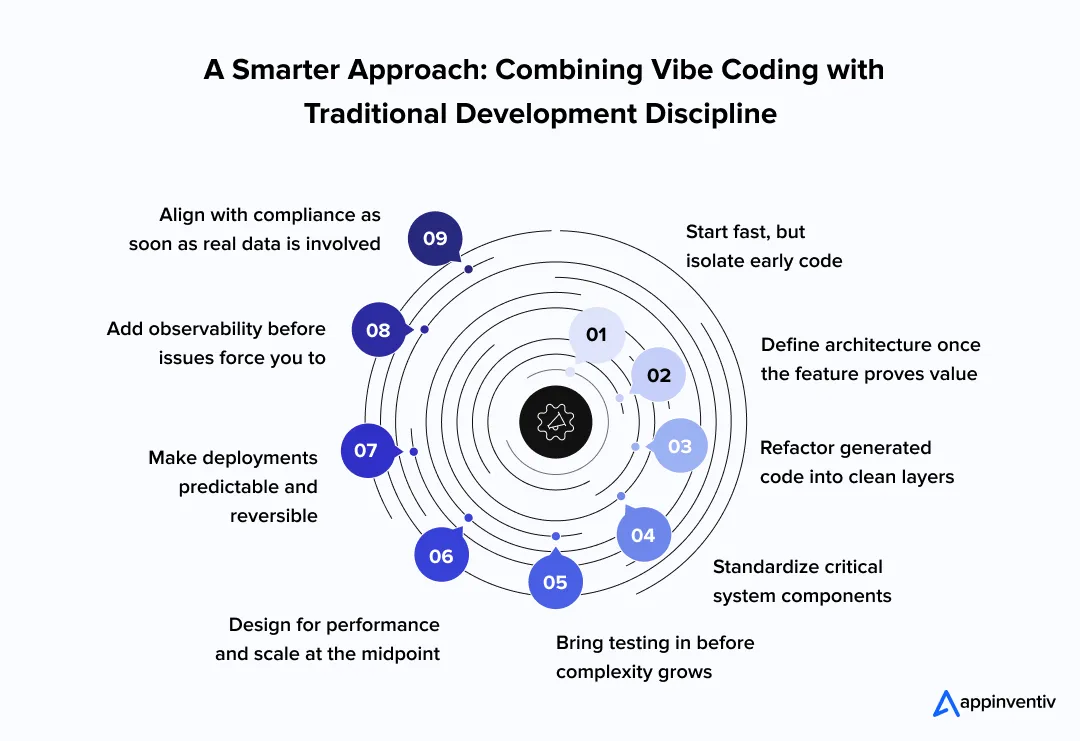
1. Start fast, but isolate early code: Use vibe coding for initial features and prototypes, but don’t let that code spread everywhere.
In practice:
- Keep it in feature branches or separate modules
- Avoid tight coupling with core systems
- Use clear interfaces so they can be replaced or refactored later
2. Define architecture once the feature proves value: When something starts getting real usage, pause and structure it properly.
What to lock in:
- Service boundaries (who owns what logic and data)
- API contracts (REST/GraphQL with versioning)
- Data flow (sync vs async, event-driven where needed)
- Decide early if it stays a modular monolith or moves toward microservices
3. Refactor the generated code into clean layers: AI output often mixes responsibilities. Before scaling, clean that up.
Technically:
- Separate controllers, business logic, and data access
- Introduce dependency injection for flexibility
- Remove duplicated logic and centralize shared functions
4. Standardize critical system components: Some layers should never vary, no matter how fast you build.
Make these consistent:
- Auth flows (JWT, OAuth2, RBAC)
- Input validation (schema-based validation like Zod/Joi)
- Error handling (standard response formats)
- API gateway policies (rate limiting, authentication, logging)
5. Bring testing in before complexity grows: Skipping tests early feels harmless. It isn’t once multiple services are involved.
Add progressively:
- Unit tests for core business logic
- Integration tests for service-to-service communication
- Contract testing to prevent API breakage
- CI pipelines that block merges on failed tests
6. Design for performance and scale at the midpoint: Once traffic starts growing, add the right layers instead of patching issues later.
Introduce:
- Caching (Redis, CDN for static assets)
- Async processing (queues like Kafka, RabbitMQ, SQS)
- Database optimization (indexing, query tuning, connection pooling)
- Horizontal scaling with load balancers and stateless services
7. Make deployments predictable and reversible: Speed shouldn’t come at the cost of stability.
Set up:
- CI/CD pipelines with staging and production environments
- Blue-green or canary deployments
- Rollback strategies for failed releases
- Feature flags to control exposure
8. Add observability before issues force you to: Once multiple services are involved, visibility becomes critical.
Include:
- Centralized logging (ELK, CloudWatch)
- Metrics and alerts (Prometheus, Datadog)
- Distributed tracing (OpenTelemetry) to track request flows
9. Align with compliance as soon as real data is involved: This becomes important earlier than most teams expect.
Build in:
- Audit logs for critical actions
- Encryption technology (TLS in transit, AES at rest)
- Access control policies and least-privilege access
- Data handling aligned with GDPR, SOC2, or industry standards
What This Looks Like in Practice
You don’t stop using vibe coding. You just stop relying on it for everything. Use it to move fast in the beginning. Then gradually introduce structure, contracts, and safeguards as the system grows. That’s how teams avoid the usual slowdown that comes later.
That’s the real takeaway in vibe coding vs traditional software development. Speed helps you get started. The engineering discipline is what keeps the system stable, scalable, and manageable over time.
Decision Framework: Choosing Between Vibe Coding and Traditional Development
At some point, this stops being theoretical. You’re deciding what fits your product today, not in general. The easiest way to approach vibe coding vs traditional development is to look at a few signals and see where your project actually sits.
How to Decide Based on Your Situation:
| Decision Factor | If Your Scenario Looks Like This | Recommended Approach | Why This Matters |
|---|---|---|---|
| Product Stage | MVP, prototype, early validation | Vibe Coding | Speed matters more than structure at this stage |
| Live product, scaling phase | Traditional Development | Stability and predictability become critical | |
| System Complexity | Simple workflows, minimal integrations | Vibe Coding | Less architectural overhead is needed |
| Multiple services, integrations, complex logic | Traditional Development | Requires clear design and coordination | |
| Data Sensitivity | Non-sensitive or test data | Vibe Coding | Lower risk exposure |
| Payments, healthcare, personal data (PII) | Traditional Development | Strong security and compliance are needed | |
| User Scale | Internal users, small traffic | Vibe Coding | System load is manageable |
| High traffic, customer-facing platforms | Traditional Development | Needs performance tuning and resilience | |
| Compliance Needs | No strict regulatory requirements | Vibe Coding | Fewer governance constraints |
| GDPR, HIPAA, SOC2 environments | Traditional Development | Requires auditability and control | |
| Team Structure | Small team, fast iteration | Vibe Coding | Less coordination needed |
| Multiple teams, shared ownership | Traditional Development | Requires consistency and standards | |
| Time Horizon | Short-term experiment or validation | Vibe Coding | Focus on quick outcomes |
| Long-term product with continuous growth | Traditional Development | Needs maintainability and scalability |
How to use this framework:
If most of your scenario aligns with the upper rows, vibe coding will help you move quickly and avoid unnecessary complexity early on.
If you find yourself relating more to the lower rows, that’s usually a sign to bring in structure. That’s where traditional development practices start paying off.
What Most Teams Actually Do
In practice, it’s rarely one or the other.
- Start with vibe coding when you need speed
- Shift toward structured development as complexity, users, and risk increase
That’s the real takeaway in vibe coding vs traditional development. The right choice depends less on preference and more on where your system is today and where it’s heading.
Align speed, scalability, and security with an architecture built for long-term growth.

How Appinventiv Helps Build Secure, Production-Ready AI-Driven Systems
As soon as a product moves beyond early builds, the priorities change. It’s not just about getting features out anymore. It’s about whether the system can handle real users, real data, and ongoing change without breaking. That’s where working with an experienced software development company like Appinventiv matters. The focus remains on building on the right foundation so you’re not fixing core issues later.
With 35+ industries mastered, the team brings context that goes beyond just implementation. Different industries come with different constraints, whether it’s compliance in healthcare or scale in fintech. Backed by 1600+ tech evangelists, the approach leans on strong architecture, clear service boundaries, and secure development practices. This becomes especially useful when teams are navigating Vibe coding vs traditional development and need to move fast without losing control.
Over time, execution is what holds everything together. With 3000+ solutions designed and delivered, the focus is on building systems that can grow without constant rework. That includes setting up reliable deployments, improving performance as usage increases, and making sure data and systems stay secure.
If you’re building something that needs to scale, it helps to get the foundation right early. Talk to our experts and build with clarity from day one.
FAQs
Q. What security gaps exist in Vibe coding in comparison to traditional development?
A. The difference shows up in how security is handled from the start. In many vibe coding setups, security checks aren’t consistently built in. You might see missing validation, weak access control, or loosely handled APIs. With vibe coding vs traditional software development, traditional approaches usually include these checks as part of the process through reviews, testing, and defined standards. So the gap isn’t just technical, it’s about when and how security gets attention.
Q. What is traditional coding in software development?
A. Traditional coding is the process where developers manually write and manage code using programming languages, frameworks, and structured engineering practices. It includes designing system architecture, writing logic, debugging, peer reviews, and testing through unit and integration tests.
In the context of vibe coding vs traditional development, traditional coding offers more control, reliability, and long-term stability, especially for production systems.
Q. What challenges arise when deploying vibe-coded applications?
A. Deployment is where things often get tricky. Features may work in isolation, but once they go live, issues such as unclear logs, missing monitoring, or a lack of rollback options become apparent. In vibe coding vs conventional development, traditional setups usually have structured pipelines and release controls, which make deployments more predictable and easier to manage.
Q. Which approach is more scalable: vibe coding or traditional development?
A. If you’re thinking long-term, traditional development tends to scale better. It’s built around clear architecture, defined data flow, and performance planning. Vibe coding can handle early-stage use cases, but as traffic and complexity increase, its limitations become apparent. That’s where the difference in vibe coding vs traditional software engineering becomes more noticeable.
Q. Is vibe coding suitable for enterprise applications?
A. It can be, but only in specific cases. For internal tools or early experimentation, vibe coding works well. For core systems that handle sensitive data or require compliance, traditional approaches are usually the safer choice. In enterprise scenarios, vibe coding vs structured development approach is less about speed and more about control, governance, and reliability.
Q. What are the workflow differences between Vibe coding and traditional coding?
A. The workflow changes quite a bit. In prompt-based coding vs traditional development, vibe coding is more iterative and prompt-driven, with less upfront planning. Traditional development follows a more structured flow, starting with design and moving through development, testing, and deployment. The result is more consistency and clarity over time.
Q. Which approach is more reliable for long-term projects?
A. For long-term projects, traditional development usually holds up better. It’s easier to maintain, scale, and build on over time. Vibe coding helps you move quickly in the beginning, but without structure, it can lead to rework later. That’s why in vibe coding vs traditional development, most teams use vibe coding early and shift toward more structured practices as things grow.


Fast 2-minute response, fully NDA-protected.
CRM Software for Local Government: From Community Requests to Better Service Delivery
Key takeaways: A council CRM should sit around existing systems as a service layer, not replace them. Integration with ERP, rates, property and GIS systems prevents another data silo and duplicate entry. Start with one high-volume service, pilot it with residents, then scale on measured results. Track resolution time, SLA compliance, self-service rates and cost…

The Ultimate Guide to CRM for Insurance: Features, Cost, Top Platforms, Integration & More
Key takeaways: CRM for insurance connects sales, service, and claims into one governed system, distinct from the policy administration system. Core features span pipeline management, policy visibility, claims tracking, commission management, AI analytics, and compliance controls. Cost ranges from roughly USD 15,000 for configuration to USD 150,000 and beyond for custom development at enterprise scale.…

How to Choose a Technology Partner for Government Software Development
Key takeaways: Evaluate the partner across five layers: procurement eligibility, assurance, engineering, delivery and long-term ownership. Choose a government technology partner on evidence, governance and delivery depth, not development capability alone. Match partner evaluation criteria to the security, integration and operational risks of the programme. Treat data sovereignty, privacy, accessibility and security as architecture decisions…