






























‘I.D.E.A.S.’ – The Five Pillar Framework to Ace AI-Native Enterprise Apps in 2027

 Share -



- 01What is an AI-Native Enterprise App?
- 02First, the market overview
- 03Two, the iphone test
- 04I: Interactive Intent
- 05D: Decisioning Autonomously
- 06E: Experiential System Design
- 07A: Adaptive Execution
- 08S: Security Layered
- 09What does this mean for your next team cadence?
- 10Where AI-native enterprise apps create value
- 11Why agent projects stall: legacy, data, and ROI
- 12Deploying agents is becoming easier. Closing the loop needs us to cover a lot of ground.
- 13Context intelligence and reusable intelligence
- 14Where memory plugs into I.D.E.A.S.
- 15Five scrutiny questions for your next stand-up
- 16Architectural Blueprint: The CIO's Pragmatic Transition Strategy
- 17Remember, the architecture may be machine-led, but the value is still experienced by a human.

Key takeaways:
- AI-native enterprise apps are moving beyond AI agents toward intelligent, adaptive, autonomous and context-aware digital capabilities that can operate across mobile, web, voice, wearables and emerging interfaces.
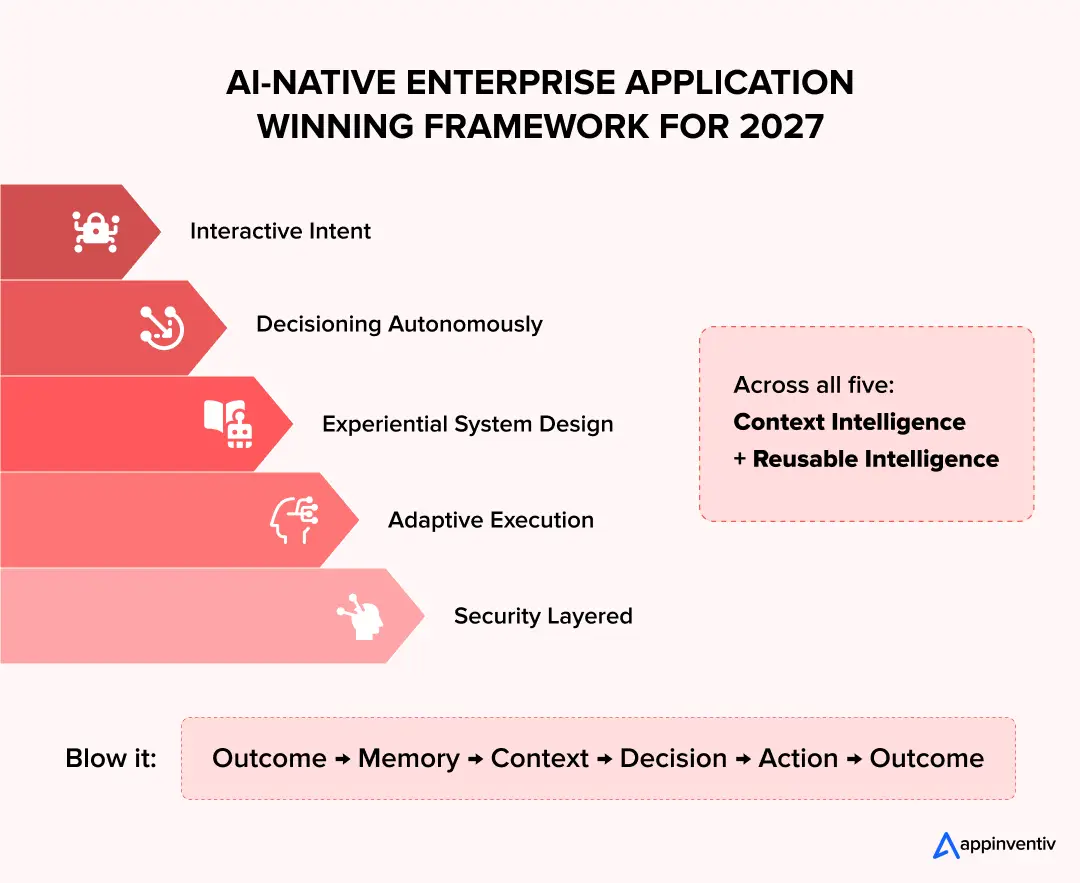
- The I.D.E.A.S. framework for AI enterprise apps in 2027 – Interactive Intent, Decisioning Autonomously, Experiential System Design, Adaptive Execution, and Security Layered.
- Context intelligence and reusable intelligence become critical differentiators, enabling AI agents to understand customer history, preferences, transactions, outcomes, and permissions rather than treating every interaction as a fresh request.
- AI agent memory is not simply storing conversation history. Enterprise memory requires governed facts, preferences, and outcomes, with provenance, confidence, lifecycle management, expiry, deletion, and permission-aware retrieval.
- The future enterprise application needs CIOs to audit the application estate, establish a knowledge and reasoning layer, decouple business logic, enable dynamic experiences, and deploy agentic capabilities domain by domain.
CIOs, your apps already have agents deployed, working in sync. What now? As 2026 draws to a close and planning for 2027 begins, you have to go from today to tomorrow.
Today, a customer opens your mobile app → searches → compares → reads reviews → chooses → purchases.
Tomorrow looks different. A customer uses AI-assisted voice to search: “I need running shoes under ₹8,000 for marathon training. My current shoes are worn out.” → Personal agent → Checks preferences → checks app data → Checks competitors → Checks reviews → Checks inventory → checks delivery → Makes recommendations → User approves → payment transaction happens.
This leads to a fascinating opportunity. That the app does not disappear. It remains one of the most important interfaces a customer touches. But it increasingly becomes one expression of a capability, rather than the capability itself.
The winning mental model for 2027 is not “We need a great AI-powered mobile app.” It is, “We need a great digital capability that can be accessed through every relevant interface.” That includes mobile apps, the web, APIs, chatbots, AI agents, voice interfaces, wearables, cars, TVs, XR and partner ecosystems. The app does not disappear. It remains one of the most important interfaces a customer touches. But it becomes one expression of a capability, rather than the capability itself.
AI-nativity is also key.
What is an AI-Native Enterprise App?
An AI-native enterprise mobile app is not simply an existing application with an AI feature added. AI is part of its core operating model: it interprets intent, reasons over enterprise context, takes governed action, learns from outcomes, and can surface its capabilities across multiple interfaces. The distinction matters because an AI-powered app adds intelligence to an existing workflow; an AI-native app redesigns the workflow around intelligence.
Before investing in another AI app, benchmark your architecture across AI and agent readiness, context and memory, enterprise data accessibility and security. Get your readiness score + the three capabilities you should prioritize first.

It is an AI-native capability that customers and their personal agents can reach from any interface. At Appinventiv, a leader in AI-first product engineering, we build toward that with our I.D.E.A.S. framework: Interactive Intent, Decisioning Autonomously, Exp eriential System Design, Adaptive Execution, and Security Layered. It covers how an app resolves intent, operates within governed autonomy, prioritizes experience over features, learns in production, and earns trust at every layer.
This is the idea behind the future of enterprise apps. Leverage will go to the teams that build such an agentic capability ahead of their competitors, one that is intuitive for humans and engineered around a strong technology foundation.
But a framework needs a force multiplier, and 2026 has revealed it: memory. Memory is not a sixth pillar. It is one mechanism through which contextual continuity can run across all five.
Agents that only execute leave the customer loop open, so the customer re-explains, the system re-fetches, and the enterprise pays for knowledge it already held. The apps that win in 2027 will pair I.D.E.A.S. with context intelligence and reusable intelligence, so every interaction makes the next one better.
First, the market overview
Planning for 2027 means keeping an eye on the app market pulse.
The big shift came in September, when Apple started testing Siri AI in beta. This new assistant can understand context by using a user’s messages, emails, and photos. It also has access to actions across all apps on the system. The details of the design matter more than the headlines. There’s now a Siri app that keeps conversation history synced across devices using iCloud. On the Watch, the Siri Recap feature gives users high-level summaries of full transcripts. It’s been built to exclude data and government-issued identifiers, such as Social Security numbers or passport details.
Apple is showing what enterprise applications will have to deal with often – contextual continuity. (Because you may operationalize superintelligence, machines, AI, and robots, but ultimately the sale, experience, and journey are for a human.)
About two weeks later, Airbnb CEO Brian Chesky told TechCrunch that consumer AI hasn’t been cracked and that “all apps need to become agents.” He added that the Airbnb app will probably evolve into an agent, one interoperable with other agents over MCP.
Put those two together, and the CIO’s question changes. It is no longer “Do we have an AI agent in our app?” Many enterprise apps already do. The harder question is, “Does our agent remember the customer, learn from the outcome, and carry that forward to the next interaction?” AI consulting can become a first step for your enterprise.
Assess your application estate across five dimensions: Intent → Decisioning → Experience → Adaptation → Security

Two, the iphone test
Nobody bought an iPhone for its ARM-based SoC or its sensor-fusion pipeline. People bought it because it just worked. Underneath, thousands of coordinated hardware and software components work together, including the Neural Engine, Secure Enclave, image signal processor, and radio stack.
AI agents are the same bargain. A fleet of orchestrated, tool-calling agents does the heavy lifting behind the glass: retrieval, reasoning, reconciliation, fraud checks. The customer experiences the result as less friction.
So the 2027 design principle is experience over features. Features are what engineers ship. Experience is what ultimately influences adoption, satisfaction, and retention. Everything in our I.D.E.A.S. framework serves that one idea.
I: Interactive Intent
From screens and taps to goals and outcomes.
Your app is becoming a callable service in someone else’s agent’s toolchain. If your capability isn’t machine-discoverable, schema-described, and policy-governed, you won’t lose the screen. You’ll lose the transaction.
The legacy interaction model is deterministic: screen → form → button → API call. The AI-native model is intent-driven. The user states a goal in natural language, voice, or multimodal input, and the system handles intent resolution, slot filling, and disambiguation without a ten-step funnel.
What this takes:
- Multimodal NLU over voice, text, image, and context signals (location, session, device state)
- An LLM orchestration layer with function calling and tool use, mapping utterances to business capabilities
- Capability exposure via MCP-style tool schemas and agent-to-agent (A2A) protocols, so external agents can discover and invoke your services
- RAG pipelines grounded in vector embeddings of your catalog, policies, and customer context, to lower hallucinations and keep answers auditable
What CIOs can expect from such interactivity is shorter funnels, lower drop-off, and higher intent-to-conversion. Your app becomes reachable from surfaces you don’t own.
Turn your application vision into an AI-native blueprint, with architecture, agents, memory, experience, and governance.

D: Decisioning Autonomously
From workflows that wait for humans to agents that act within guardrails.
Most enterprise apps still behave like glorified forms: collect, route, wait, approve. Autonomous decisioning can complement or extend traditional rule engines with agentic decision loops (perceive → reason → plan → act → reflect), bounded by explicit authority.
What this takes:
- Policy-as-code (OPA/Rego-style) that defines what an agent may do, up to what value, and under which risk score
- Tiered autonomy: full automation for low-risk, high-frequency decisions, and human-in-the-loop (HITL) escalation above a confidence or monetary threshold
- Real-time feature stores and event-driven streaming architectures, using platforms such as Kafka or Pulsar, so decisions use live context rather than yesterday’s batch
- Saga patterns and idempotent APIs, so multi-step agent actions can be compensated when a later step fails
Achieve this and expect decision latency to fall substantially, while cost per decision also decreases for suitable high-volume, low-risk workloads. Operations scale without linear headcount, and every action carries a decision lineage that an audit can replay. The objective is not maximum autonomy. It is appropriate autonomy!
E: Experiential System Design
From feature factories to experience architecture.
Design here goes well beyond UI polish. It is system design for experience: latency budgets, graceful degradation, personalization, and trust, treated as architectural requirements rather than afterthoughts.
What this takes:
- Composable, headless, and API-first architecture (MACH principles), so one capability serves every channel without re-implementation
- On-device SLM inference on NPUs where hardware and workload characteristics support low-latency interactions, with cloud LLMs reserved for heavy reasoning
- Server-driven UI and design-token systems, so experiences change without an app-store release cycle
- Experience observability: Core Web Vitals-inspired experience metrics for mobile (time-to-first-intent-resolution, agent task success rate, escalation rate), not just crash-free sessions
Such app design systems can help achieve higher NPS and retention, and a codebase in which a new channel (wearable, car, XR) is a configuration problem rather than a rebuild.
A: Adaptive Execution
From annual release trains to continuously learning systems.
An adaptive app senses context, learns from outcomes, and reconfigures itself: UI, flows, pricing logic, recommendations. This is also where time-to-market is won or lost.
What this takes:
- Continuous delivery with feature flags, canary releases, and progressive rollouts, so you ship small and often with a controlled blast radius
- LLMOps/MLOps pipelines: automated evals, drift detection, shadow deployments, prompt and model versioning, rollback
- Closed feedback loops (implicit signals, reinforcement from outcomes, A/B and multi-armed bandit experimentation) feed the next model iteration
- FinOps for inference: token budgeting, model routing (small model first, large model on escalation), semantic caching, so unit economics don’t collapse at scale
This helps threefold:
- Release cadence moves from quarters to days
- DORA metrics (deployment frequency, lead time, change-failure rate, rework rate) improve
- Innovation compounds because the product learns in production
S: Security Layered
From perimeter defense to defense-in-depth for an agentic attack surface.
This is the pillar that keeps CIOs awake, and it should. Autonomy multiplies capability and attack surface together. The agent that can book, pay, and negotiate can also be prompt-injected, tool-poisoned, or confused-deputy’d.
What this takes:
- Zero-trust architecture with scoped, short-lived, delegated credentials (OAuth 2.0 with 2.1 best practices-based authorization, where appropriate, with fine-grained consent and token exchange), so agents act on a user’s behalf and never with blanket access
- Guardrails at every layer: input sanitization, prompt-injection and jailbreak detection, output filtering, PII redaction, and tool-call allow-lists
- Data minimization aligned with applicable requirements under the DPDP Act, GDPR, and relevant sector regulations
- Agent identity and non-repudiation: signed actions, immutable audit trails, SBOMs, and, where applicable, AI/ML bills of materials for software and model supply-chain visibility
- Runtime behavioral monitoring to catch anomalous agent behavior, such as unusual tool-call chains and privilege escalation patterns, before it becomes an incident
With this, you can say yes to autonomy because you can prove control. Trust is what makes the other four pillars shippable. And when it comes to enterprise app security, governance should be handled by trusted AI governance experts.
What does this mean for your next team cadence?
| Pillar | The question to ask your team |
|---|---|
| Interactive Intent | Can an external agent discover and invoke our top five capabilities today? |
| Decisioning Autonomously | Which decisions can we safely hand to an agent, and what’s the escalation threshold? |
| Experiential System Design | Is our architecture channel-agnostic, or is every new surface a rebuild? |
| Adaptive Execution | How long from a validated insight to production, and can we roll back in minutes? |
| Security Layered | If an agent is compromised, what is its maximum blast radius? |
If you can’t answer three of five with confidence, that is your 2027 roadmap.
Where AI-native enterprise apps create value
- Banking: agents resolve service requests, assess context and initiate governed transactions.
- Insurance: claims agents gather documents, assess policy context, and route or resolve straightforward claims.
- Retail: personal agents combine customer preferences, inventory, pricing, and fulfillment to complete purchases.
- Healthcare: administrative agents coordinate scheduling, eligibility, and patient workflows within strict access controls.
- Enterprise operations: agents coordinate procurement, maintenance, onboarding, and other multi-step workflows across legacy systems.
The opportunity is not to put an agent everywhere. It is to identify workflows where autonomous execution can materially reduce cycle time, exception rates, or cost.
Why agent projects stall: legacy, data, and ROI
A framework is only useful if it survives contact with the enterprise. Gartner predicts that over 40% of agentic AI projects will be canceled by the end of 2027, driven by escalating costs, unclear business value and inadequate risk controls. Security is covered above. The other two causes tend to trace back to three unglamorous problems that no model upgrade will fix.
- Legacy integration: In many enterprises, core processes still run on batch jobs, undocumented endpoints, and tightly coupled monoliths. An agent placed on top of that can describe a customer’s problem beautifully, only to fail to resolve it. The fix is rarely a rewrite. It is a capability layer that wraps legacy functions behind well-described, governed APIs and retires the old logic, so agents have stable tools to call. AI integration must, thus, be done by experts; learn more here.
- Data readiness: The quality of retrieval depends entirely on the quality of the data being retrieved. Before scaling agents, make sure you know who is responsible for each data area, how you measure freshness, and what data the agent is allowed to access.
- Cost and ROI: many pilots are selected because they look impressive in demos, not because they actually improve business outcomes. Without a baseline (such as cost per resolution, cycle time, conversion rate, or handling time), you can’t measure real value. Meanwhile, inference costs keep rising quietly. Choose workflows that have a starting point. Set a budget upfront for tokens and unit economics. Decide in advance what results would justify scaling the project, or when to stop. Discover how much an AI development cost would be incurred by your enterprise.
Notice how the five pillars address each of these. Capability exposure in Interactive Intent forces the legacy question. Real-time context in Decisioning forces the data question. FinOps in Adaptive Execution forces the cost question. I.D.E.A.S. is as much a diagnostic as a design framework: the pillars you can’t answer for are usually where a project is quietly at risk.
Deploying agents is becoming easier. Closing the loop needs us to cover a lot of ground.
Gartner forecasts that 40% of enterprise applications will feature task-specific AI agents by the end of 2026, up from less than 5% in 2025. After 20 years of watching platform cycles, we see the same pattern again – that most deployed agents are stateless executors. They resolve an intent, call a tool, and forget. The customer journey is a loop of intent, decision, action, outcome, learning, and next intent. A stateless agent closes only the action leg. The customer re-explains, the agent re-fetches, and the enterprise pays in tokens, latency, and churn for knowledge it already held.
An agent that closes the loop is the one that:
- Captures what happened, who the customer is, and what they prefer
- Consolidates that into governed knowledge
- Reuses it in the next interaction, on any channel
That is where the two terms below come in.
Context intelligence and reusable intelligence
Context intelligence is the runtime ability to assemble the minimum sufficient, authorized context for the interaction at hand. It draws on memory, CRM and transactional data, live session signals and unstructured knowledge through RAG and graph retrieval. It helps determine what to retrieve and what the agent is authorized to access, subject to the application’s policy and access-control layer.
Reusable intelligence is what persists afterward. Raw transcripts are not memory. Memory can include distilled episodic, semantic, and procedural information (what worked), with provenance, confidence, and expiry attached.
Staleness is the one thing CIOs should worry about. A memory that was correct last quarter, such as an employer, an address, or a risk profile, can quietly become the wrong thing to act on. Your agent needs a memory lifecycle (extract, update, expire, delete) and not just a vector store.
Where memory plugs into I.D.E.A.S.
Memory is not a sixth pillar. It is the substrate that makes the five work as a loop.
| Pillar | Without memory | With context and reusable intelligence |
|---|---|---|
| Interactive Intent | Every utterance is resolved cold | Intent resolution can be informed by preferences, history, and the open task |
| Decisioning Autonomously | Decisions use the current session plus static rules | Decisioning draws on outcome history (what was offered, accepted, refunded, or escalated), so autonomy thresholds can be earned instead of hard-coded |
| Experiential System Design | Personalization is a feature | Personalization is an architectural property that persists across mobile, voice, wearable, and partner agents |
| Adaptive Execution | The model improves only on your release cadence | Outcomes can feed back into memory continuously, allowing the experience to adapt between releases |
| Security Layered | Guardrails protect the session | Guardrails protect the memory: permission-aware retrieval, data policies, and access controls associated with the record |
Five scrutiny questions for your next stand-up
- Continuity: If a customer starts on mobile and finishes in voice or via a partner agent, does the second agent know what the first one did?
- Distillation: Are we storing transcripts or governed facts, preferences, and outcomes?
- Context budget: What is our average token spend per interaction, and how much of it is re-fetching things we already knew?
- Lifecycle: Who owns memory staleness, expiry, and erasure, and can we prove it to an auditor?
- Interoperability: Can OS-level assistants and third-party agents invoke our capabilities with scoped, revocable authority?
If you can’t answer three of five, you have agents. You don’t yet have a loop.
Architectural Blueprint: The CIO’s Pragmatic Transition Strategy
The most dangerous impulse for any enterprise leader reading this perspective is to propose a ‘rip-and-replace’ modernization program. Replacing legacy core ledgers is rarely successful, extraordinarily expensive, and strategically unnecessary.
Reimagination is not a replacement. It is decoupling.
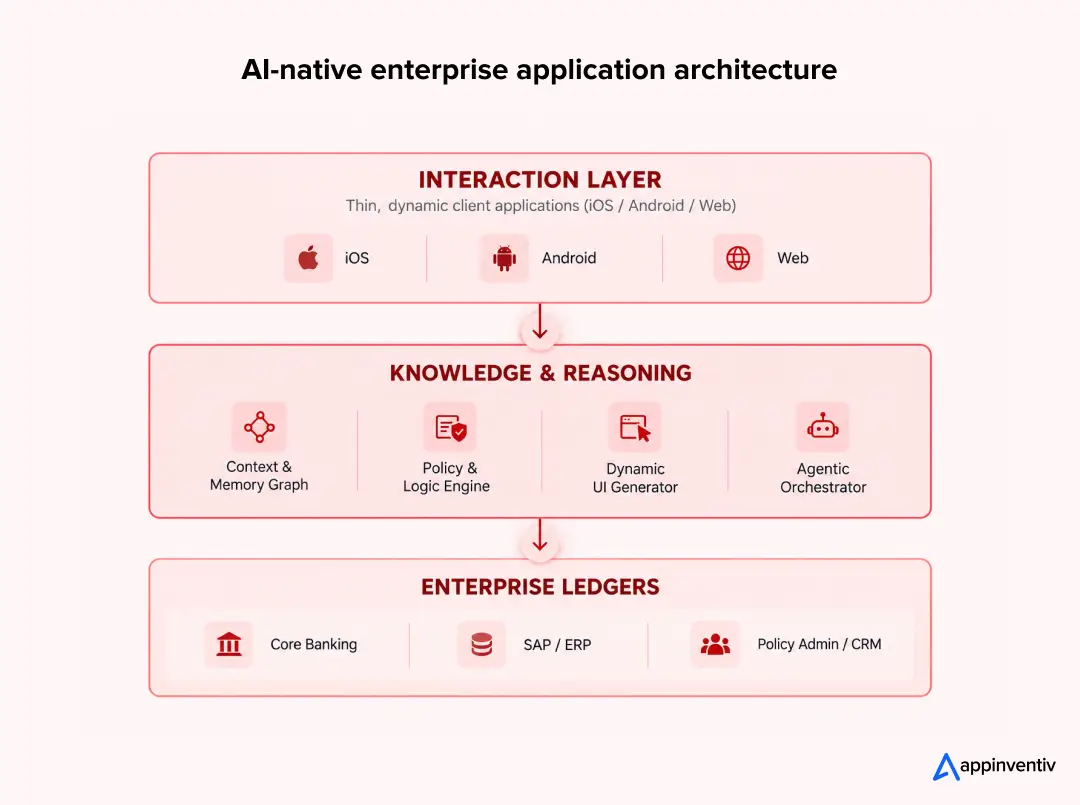
The path to an AI native + Data Core app is an additive, domain-by-domain migration that extracts business logic out of static screens and into a centralized intelligence layer.
How CIOs Can Start the AI-Native Transition
The transition does not begin with selecting an LLM. It begins by selecting the right business capability.
- Audit the Reconciliation Tax: Map your top five mobile application estates. Identify where business logic is split between client-side code, API layers, and manual employee overrides (comment boxes, off-app spreadsheets). Quantify the engineering hours spent keeping these layers in sync.
- Establish the Knowledge and Reasoning Layer: Build a centralized knowledge graph that holds institutional rules, regulatory constraints, and domain policies in machine-readable formats. Decouple these rules from individual client application codebases.
- Transition to Dynamic UI Rendering: Replace hard-coded screen flows with server-driven, componentized design systems that render interfaces based on payloads from your AI reasoning layer.
- Isolate First-Wave Decision Domains: Select a high-variance operational domain (such as claims adjudication, asset maintenance, or corporate onboarding) and deploy an agentic core on top of existing legacy systems. Measure success not by app release frequency, but by decision cycle time and exception reduction.
Remember, the architecture may be machine-led, but the value is still experienced by a human.
We have witnessed the evolution from WAP sites to mobile apps and, in some markets, from apps to super-apps, and now from apps to capabilities. Each shift punished the teams that defended the old unit of value. The unit of value in 2027 is not just the app. It is the outcome the customer reaches with the least effort, through whatever interface they happen to be using. The app remains one of those interfaces, arguably the most important, but it is now the front door to a capability, not the capability itself.
Whoever builds governed, reusable intelligence into the product first will compound with every interaction. The iPhone didn’t win because of its parts list. It won because it felt like it knew what you meant. The 2027 product has to feel the same way, and that takes memory.
That is the work we do at Appinventiv. The goal is to help enterprises turn applications into governed, AI-native capabilities, from exposing legacy functions as agent-ready services to designing memory and autonomy with controls a CIO can defend to engineering the mobile, web, and voice experiences on top. And AI-native does not mean chat-native.
A useful first step is simple: take the five questions in this article to your next team meeting, and see how many you can answer with confidence.
Build the capability. Govern the autonomy. Obsess over the experience. Then take your I.D.E.A.S. to the boardroom with something already working behind them!


Fast 2-minute response, fully NDA-protected.

Automated Decision-Making in Australia: Benefits, Cost and Implementation
Key takeaways: Automated decision-making combines rules, algorithms, AI and human oversight to improve high-volume decisions. ADM programmes require privacy, security, auditability and accountability to be designed into architecture. ADM implementation costs typically range from AUD 70,000 to AUD 700,000 or more. Implementation starts with decision mapping, then moves through development, testing, controlled pilots and monitoring.…
AI Red Teaming Attack Strategies: Jailbreak, Crescendo, Base64 & More Explained
Key takeaways: Jailbreak testing must follow the full execution path from prompt and context to retrieval, tools, and enterprise APIs. Crescendo and adaptive attacks expose failures that single-turn testing misses by exploiting conversation history and model feedback loops. Base64 and Unicode tests probe gaps in normalization, tokenization, filtering, and decoding before adversarial input reaches model…

AI Agent Protocols: MCP, A2A, ACP & More Explained
Key takeaways: MCP connects agents to enterprise tools, while A2A lets independent agents delegate tasks without exposing internal logic. The protocol stack now spans agent access, collaboration, UI interaction, open networking, commerce, and machine-to-machine payments. A2A had support from 150+ organizations by April 2026, with 22,000+ GitHub stars and five production-ready SDK languages. Enterprise agent…