

































How to Integrate AI in Inventory Management: Steps, Cost, and Challenges

 Share -



- 01What’s the position of AI in inventory management today?
- 02How do you approach integrating AI in inventory management?
- 03Which AI applications in inventory management actually move the needle?
- 04What technologies power AI inventory management software?
- 05How does AI inventory forecasting work, and why is it sharper than the old way?
- 06Where does generative AI in inventory management fit?
- 07What challenges slow AI implementation, and how do you clear them?
- 08What is the ROI of AI in inventory management, and what does it cost?
- 09Implementation of AI in inventory management across multiple industries
- 10What does the future of AI in inventory management look like?
- 11How can Appinventiv help you out?
- 12FAQs

- Start with one high-impact use case, usually demand forecasting, before scaling AI across inventory operations.
- AI delivers the most value through better forecasting, dynamic replenishment, inventory visibility, and dead-stock reduction.
- Clean, connected data is critical; poor data quality is the leading cause of AI implementation failure.
- Integrate AI with existing ERP, OMS, and warehouse systems through APIs instead of replacing core infrastructure.
- Successful AI inventory programs can reduce inventory costs, improve service levels, and achieve ROI within the first year.
Your competitors are quietly pulling inventory down 20% to 30% while holding service levels steady. That is not a projection. It is what McKinsey‘s 2024 distribution research found among companies already running AI in inventory management. Every quarter you wait, the gap widens. It shows up as cash you cannot reinvest and orders you cannot fill.
So treat this as a build plan, not a primer. We will walk through what actually pays off, what the technology costs, how to wire it into the order management system (OMS) and ERP you already run, and the return you can model before anyone signs a budget. The aim is to move you from “we should look into this” to a system that earns its keep.
Talk to us, and we will build a safe AI-powered inventory management solution for you that thinks and verifies before responding.
What’s the position of AI in inventory management today?
Old systems count. They sit there, wait for a stockout or an overstock or a reorder somebody forgot, and then your team scrambles to clean it up. Adopting AI for inventory management flips that. It reads demand before it lands, positions stock ahead of it, and keeps adjusting as conditions move. Reacting versus orchestrating. One bleeds margin. The other defends it.
The money is moving fast. The space sat near $9.5 billion in 2025 and is tracking toward roughly $30 billion by 2030, a 24.8% compound annual growth rate. North America holds about 35% of that spend. In the US alone, the market climbs from around $2 billion in 2024 toward $7.3 billion over the next decade.
Here is the opening. Roughly 95% of distributors are poking at AI, but fewer than 10% have a real roadmap. Almost everyone is talking. Hardly anyone is shipping. That gap is your window, and it will not stay open forever. The teams building working systems right now are setting the bar that everybody else spends the next three years chasing.
How do you approach integrating AI in inventory management?
Integration is not a switch you flip. It is a sequence, and the order matters. Each phase carries its own success metric, and each one earns the budget for the next. Here is the path that holds up:
- Start narrow. Pick one high-value problem where the pain is real, and the data already exists, usually demand forecasting for a high-volume category, and win it in three to four months. That first win is what loosens the budget for everything after it.
- Fix the data before the model. Real money goes into data cleansing, pulling together scattered data sources, and standardizing records. Garbage in, garbage out, every single time.
- Wire it into what you already run. The model has to read from and write to your ERP and OMS to trigger AI-driven workflows like reorder suggestions. This is where timelines slip, so scope it honestly and budget for it.
- Set the scoreboard first. Agree on target forecast error, stockout reduction, and recovered warehouse space before kickoff. No baseline means no proof of ROI, and an unproven win is the first thing cut at the next budget review.
- Roll out, then widen. Once the first use case hits its numbers, push into more categories, locations, and decisions. That is when inventory management AI solutions stop being a project and start being a capability.
- Manage the people. Planners have to understand why the system says what it says, or they will quietly route around an expensive tool. Earn the buy-in and adoption takes care of itself.
The smart play layers AI onto your existing stack through APIs instead of ripping it out, which is how supply chain automation tends to land without a full system replacement. You upgrade the brain. You leave the body alone.
Which AI applications in inventory management actually move the needle?
Not every use case earns its budget. Some are demos dressed up as strategy. A handful, though, move real money:
| The problem | What AI does | What you get |
|---|---|---|
| Demand you cannot call | Reads historical sales data, seasonality, pricing, and outside factors to forecast at the SKU level | Tighter forecasts, less guesswork, fewer write-offs |
| Stock that just sits | Flags slow movers and dead stock through pattern recognition | Cash freed from inventory that nobody is buying |
| Reorders that lag sales | Sets dynamic reorder points and safety stock that track real-time demand | Replenishment that keeps pace instead of trailing it |
| Shrinkage and errors | Catches anomalies early with computer vision and constant monitoring | Losses are caught in days, not at the quarterly count |
| Stock scattered everywhere | Unifies one AI-powered view across channels and locations | Faster calls, full visibility, no blind spots |
| Wasted warehouse space | Models demand to right-size what sits where | Better warehouse space utilization, lower holding costs |
Notice the pattern. Get the forecast right and everything downstream gets cheaper, which is why mature programs start with AI demand forecasting before they touch replenishment or warehouse automation. Botch the forecast, and a slick dashboard just shows you the problem in higher resolution.
What technologies power AI inventory management software?
Each layer does one job. Knowing the stack tells you what to build, what to buy, and what to skip.
- Machine learning algorithms are the forecasting engine. They read historical sales data and sharpen predictions every time fresh numbers land.
- Internet of Things (IoT) sensors and RFID tags are used to track real-time stock visibility, not yesterday’s snapshot.
- Computer vision swaps manual counts for cameras and barcode scanning that verify what is physically on the shelf.
- Natural language processing lets a planner ask a question in plain English instead of fighting query syntax.
- Predictive and prescriptive analytics close the gap between “demand will spike” and “order exactly this much, by Thursday.”
Here is where most of the value actually lives: integration. The system has to read from and write to your ERP, order management, and warehouse software in real time, or those insights die in a report nobody opens. Inventory never sits alone.
It is tangled up with sourcing, logistics, and fulfillment, which is exactly why AI in supply chain analytics pays off more once the data flows connect end-to-end.
How does AI inventory forecasting work, and why is it sharper than the old way?
Old forecasting draws a line from last year and hopes. It leans on historical averages and a planner’s gut, so it misses the nonlinear stuff that actually wrecks a number: a heat wave, a competitor’s price cut, a promo that pops off way bigger than anyone planned.
AI treats demand as a moving target. It reads dozens of signals at once, historical sales as the base, then seasonality, pricing, weather, and local events stacked on top. Under the hood, models like gradient boosting and recurrent neural networks figure out which signals drive which products, then adapt on their own as things shift.
The result is money. One building products distributor lifted fill rates 5% to 8% after rolling out an AI control tower, per McKinsey, and tighter forecasts let you carry less stock without dropping service. One caveat, said plainly: none of this works without hard backtesting against real history first. Skip it, and you have just automated a bad guess.
Where does generative AI in inventory management fit?
This is the newest piece, and the one most people get wrong. Generative AI does not replace your forecasting models. It sits on top of them and changes who can actually use the system.
- Scenario planning in plain language. Ask a what-if and get a modeled answer back, instead of booking a meeting to build one by hand.
- Conversational access to stock positions, forecasts, and exceptions, with no SQL and no waiting on an analyst’s queue.
- Synthetic data for cold starts, so a brand-new SKU with zero history is not forecasting blind on day one.
Just keep it in proportion. Generative AI is a force multiplier, not a rescue. Point it at weak demand models and messy data, and all you get is a friendlier wrapper around the same bad answers. The math tracks closely with how generative AI development is priced, so it is worth understanding that before you scope this layer.
What challenges slow AI implementation, and how do you clear them?
The brutal truth is that most AI inventory projects do not die on the math. They die on dirty data, brittle integrations, and people digging in their heels.
Name the obstacle up front, and it stops being the thing that sinks you.
| The challenge | Impact | How to clear it |
|---|---|---|
| Poor data quality | Models trained on messy records produce forecasts nobody trusts | Cleanse and consolidate first; treat data as the foundation, not a footnote |
| Legacy systems | Old IT does not talk to modern AI out of the box | Connect through APIs and middleware instead of forcing a rip-and-replace |
| Skills gap | Talent shortages stall anything that depends on in-house expertise | Pair your team with an outside partner and transfer knowledge as you go |
| Data privacy and security | Inventory data touches suppliers, customers, and pricing | Build access controls and encryption from day one, not after launch |
| Regulatory compliance | Regulated industries demand audit trails and explainable calls | Use explainable AI so every recommendation can be traced and defended |
| Resistance to change | Planners distrust a black box telling them what to order | Show the reasoning, pilot with a willing team, let results earn trust |
Compliance is where it gets serious. In a regulated shop, explainable AI is not a nice-to-have; it is the line between passing an audit and failing one.
The same discipline that goes into building hospital inventory management, full audit trails and reasoning a human can actually read, is what any regulated operation should demand before it hands stock decisions to a model.
We have compliance experts who will help ensure your AI solutions are legally compliant in your target markets and industries.

What is the ROI of AI in inventory management, and what does it cost?
Let’s be specific. The savings come from three places: cash freed by trimming excess stock, revenue you stop losing to stockouts, and plain operational efficiency. In mature programs, logistics costs drop 5% to 20%, and procurement spend falls another 5% to 15%, per McKinsey.
Now the spend: A focused, single-use-case system runs around $40,000. A full enterprise platform can hit $300,000 or more, scaling with data complexity and how many systems you are integrating.
The wider cost of AI development moves with model choice, data readiness, and how much autonomy you build in. Autonomous setups land in a similar band, since the cost generally runs from about $40,000 up to $250,000 and beyond, depending on how many decisions you hand off.
| Approach | Best when | The tradeoff |
|---|---|---|
| Build custom | You need a real edge and full control over the model and roadmap | Higher upfront cost and a longer timeline, but it fits your operation exactly |
| Buy off-the-shelf | Speed matters more than differentiation, and your needs are fairly standard | Fast to deploy and lower risk, but you bend your process to fit the tool |
| Hybrid | You want a proven core with custom logic where it actually counts | Buy the commodity layers, build the parts that differentiate, and balance both |
For high-volume operations, payback usually lands inside the first year. Cutting inventory frees cash now, and the forecasting gains compound month after month.
The discipline that separates winners from cautionary tales is boring, but it works: right-size the first build to one use case, prove the return, then scale, whether you are rolling it out in Chicago or building inventory management software in LA. If those numbers map to your operation, that is the conversation worth having this quarter.
Implementation of AI in inventory management across multiple industries
AI inventory management has evolved from a competitive advantage into a business necessity across industries. Whether organizations are managing life-saving medical supplies, perishable goods, or thousands of spare parts, AI helps improve forecasting accuracy, optimize stock levels, and reduce operational inefficiencies. While the technology foundation remains similar, each industry applies AI differently based on its inventory challenges and business objectives.
Healthcare and Pharmaceuticals
Healthcare providers, pharmaceutical manufacturers, and medical distributors use AI to monitor inventory levels of medicines, surgical supplies, and critical equipment. AI analyzes historical consumption patterns, patient demand, seasonal disease trends, and expiration dates to ensure essential products remain available when needed.
Key benefits:
- Reduced wastage from expired medications
- Improved availability of critical medical supplies
- Enhanced compliance and audit readiness
- Better emergency inventory planning
Retail and eCommerce
Retailers use AI to forecast customer demand, optimize replenishment schedules, and maintain inventory visibility across physical stores, warehouses, and online channels. By analyzing purchasing behavior, promotions, market trends, and seasonality, AI helps ensure products are available where and when customers want them.
Key benefits:
- Fewer stockouts and overstocks
- Improved inventory turnover
- Better omnichannel inventory visibility
- Higher customer satisfaction
Manufacturing
Manufacturers rely on AI to balance raw materials, work-in-progress inventory, and finished goods. By combining production schedules, supplier performance metrics, and market demand forecasts, AI helps organizations minimize disruptions while controlling inventory costs.
Key benefits:
- Lower inventory carrying costs
- Reduced production downtime
- Improved supplier coordination
- Greater operational efficiency
Consumer Electronics
Consumer electronics companies operate in a fast-moving market where product lifecycles are short and demand can change rapidly. AI helps forecast product demand, optimize inventory allocation, and reduce the risk of excess stock becoming obsolete.
Key benefits:
- Reduced dead and obsolete inventory
- Improved product launch planning
- Better inventory distribution across regions
- Higher inventory profitability
Food and Beverage
Food manufacturers, distributors, and retailers use AI to manage perishable inventory and predict demand fluctuations. AI can identify purchasing trends, monitor shelf-life data, and optimize replenishment decisions to reduce spoilage and waste.
Key benefits:
- Reduced product spoilage
- Improved demand forecasting
- Lower storage and disposal costs
- Better inventory turnover rates
Logistics and Warehousing
Logistics providers and warehouse operators use AI to improve inventory accuracy, optimize storage allocation, and streamline fulfillment operations. AI-powered systems continuously monitor inventory movement and identify bottlenecks before they affect delivery performance.
Key benefits:
- Improved warehouse space utilization
- Faster order fulfillment
- Reduced inventory discrepancies
- Higher operational productivity
Automotive and Spare Parts
Automotive manufacturers, dealerships, and aftermarket suppliers often manage thousands of SKUs across multiple locations. AI helps predict parts demand, optimize inventory placement, and ensure critical components remain available while minimizing excess stock.
Key benefits:
- Improved spare parts availability
- Lower inventory holding costs
- Faster maintenance and repair operations
- Increased supply chain resilience
Across these industries, AI enables organizations to move beyond reactive inventory management and toward predictive, data-driven decision-making. The result is lower operational costs, improved service levels, stronger supply chain resilience, and more efficient use of working capital.
What does the future of AI in inventory management look like?
The next wave is agentic AI in inventory management, systems that do not just suggest a move, they make it, watch what happens, and adjust inside guardrails you set.
Gartner has noticed that 40% of enterprise applications are including task-specific AI agents in 2026, up from under 5% in 2025. Picture it on the floor. An agent watches demand and supply signals, drafts a purchase order the moment stock hits a dynamic threshold, checks it against budget and supplier reliability, then either fires it off or flags a human.
Chain those agents across procurement, logistics, and fulfillment, and the routine decisions start running themselves, which is exactly where AI in logistics is already headed. Your people get to focus on the calls that actually need judgment.
But go in clear-eyed. Gartner also expects more than 40% of agentic AI projects to get scrapped by 2027, usually over fuzzy ROI and sloppy execution. By 2028, it sees roughly a third of enterprise software running agentic capabilities and about 15% of routine work decisions made autonomously.
The winning move never really changes: start where the value is obvious, and the decisions are small and reversible. That is why teams that bring in seasoned AI experts clear the common failure modes faster. They have already seen where this breaks.
How can Appinventiv help you out?
A good model is the easy part. The hard part is shipping secure, compliant AI into production and living with it afterward. As an AI development company with more than a decade in the field and 400+ AI projects delivered, we have built inventory and supply chain systems for regulated industries, the kind where a wrong number triggers an audit, not just an apology.
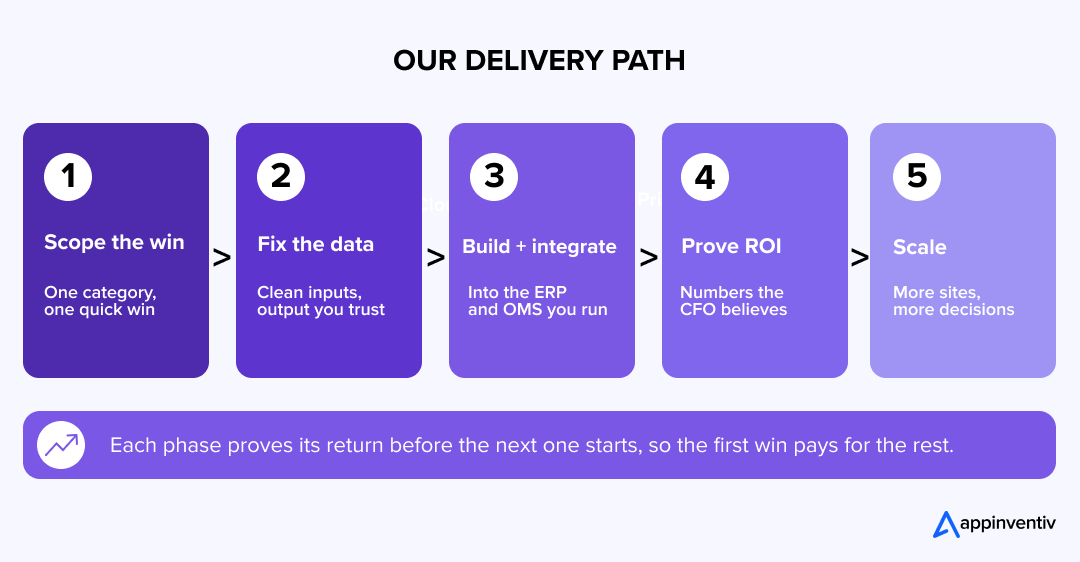
Our approach is deliberately unflashy, and that is the point. We find the one or two use cases with the clearest return, get the data foundation solid, and plug into the ERP and OMS you already run. Explainability goes in from day one, so your planners trust the output, and your auditors can follow the logic. Then we right-size each build to its return, so phase one pays for phase two.
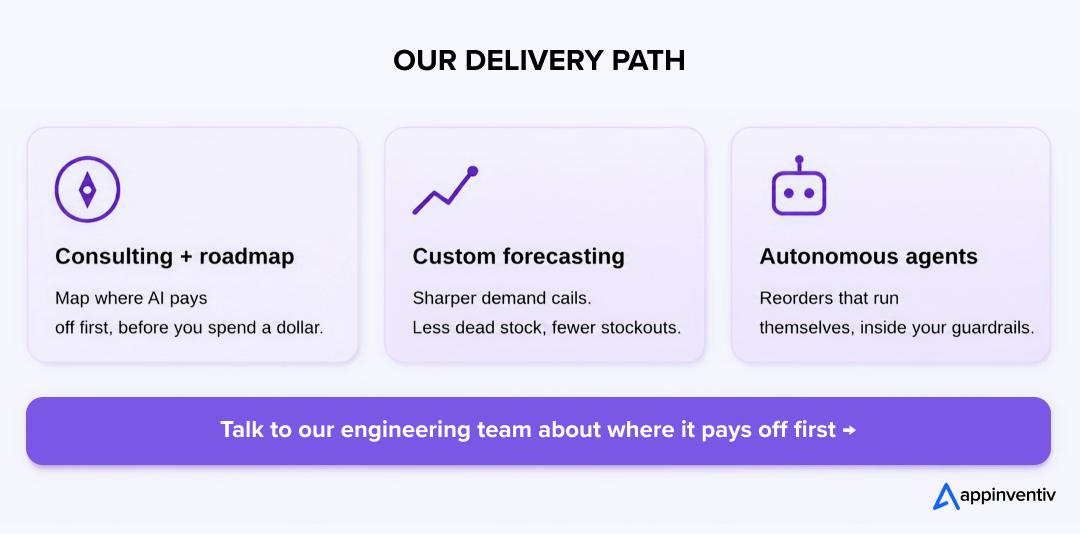
Wherever you are starting, there is a door in. AI consulting and development to map the roadmap. A custom forecasting engine. Autonomous agents for the replenishment grind. We run the whole path from strategy to production.
So before another quarter of overstock and stockouts quietly eats your margin, talk to our engineering team about where AI in inventory management would pay off first.
FAQs
Q. How much does it cost to integrate AI in inventory management?
A. It depends on the scope, but here are real ranges. A focused, single-use-case system starts around $40,000. An enterprise-grade platform runs $300,000 or more. The big drivers are data complexity, the number of integrations, and whether you are building autonomous agents. Most teams keep phase one lean to prove ROI before scaling.
Q. What are the main use cases for AI in inventory management?
A. The high-value ones cluster in a few areas. Demand forecasting at the SKU level. Dynamic reorder points and safety stock that move with real sales. Dead-stock detection that surfaces capital you cannot recover.
Shrinkage and error spotting through computer vision. And unified stock visibility across channels and locations, so nothing sits stranded in the wrong place. Most teams start with forecasting because once that is sharp, everything downstream gets easier.
Q. What are the benefits of AI in inventory management?
A. Three of them land on the balance sheet. Less cash trapped in excess stock, with inventory dropping 20% to 30% in programs that run it well, per McKinsey. Fewer lost sales, since stockouts get caught before they happen.
And lower operating cost, with logistics spend falling 5% to 20%. The softer gains matter too: planners stop firefighting, decisions speed up, and forecasts turn into something the team actually trusts.
Q. What are the latest AI inventory management trends?
A. The clearest shift is toward agentic AI, systems that act on their own inside set guardrails instead of just flagging what to do. Gartner expects 40% of enterprise applications to include task-specific AI agents by the end of 2026, up from under 5% in 2025.
Generative AI is the other big move, turning forecasts conversational so a planner can ask a question in plain English. And live IoT data is replacing the overnight batch update. The throughline is simple: less watching, more deciding.
Q. How can a custom AI inventory management solution support business growth?
A. By letting you handle more volume without adding headcount at the same rate. A custom solution frees up working capital stuck in excess stock, stops the revenue bleed from stockouts, and scales with demand instead of capping it. It becomes infrastructure for growth, not a bottleneck.
Q. How to integrate AI into existing inventory systems?
A. Start with one high-value use case. Clean up the underlying data, then connect the AI layer to your existing ERP, OMS, and warehouse systems through APIs rather than replacing them. Set clear success metrics before you begin, pilot with a team that is actually on board, and expand once that first use case hits its targets.
Q. How does Appinventiv help businesses build AI-powered inventory management solutions?
A. We run the full journey, from strategy to production. That means finding the highest-return opportunities, building a solid data foundation, developing custom forecasting and agentic systems, then integrating them securely with what you already run. The focus throughout is explainable, auditable AI that your planners trust, and your auditors can follow.
Q. How are AI and IoT used in inventory management?
A. Internet of Things (IoT) sensors, RFID tags, and smart shelves feed real-time stock data from every location. AI takes that constant stream and forecasts demand, triggers replenishment, and flags anomalies like shrinkage or misplaced inventory. IoT supplies the eyes. AI makes the call.


Fast 2-minute response, fully NDA-protected.

Retrieval Augmented Generation in Australia: Architecture, Implementation and Cost
Key takeaways: RAG grounds LLM answers in approved content, improving reliability without retraining a model. Data quality and access permissions decide production outcomes more than the model. Indicative build costs run from AUD 70,000 to 700,000, driven by data and integrations. Measure value against a pre-deployment baseline, separating realised benefits from projected savings. A general-purpose…

The Multiplier Effect of AI Agents: The Rise of AI Swarms
Key takeaways: AI agent swarms coordinate specialized agents to solve complex problems that may be difficult for a single agent to handle effectively. More agents do not automatically mean better outcomes. Swarms deliver value when work can be divided, executed in parallel, and coordinated toward a shared objective. Enterprise readiness depends on governance. Clear accountability,…

AI Data Integration: How to Connect, Clean and Prepare Data for AI
Key takeaways: AI initiatives fail when fragmented, poor-quality data reaches models without sufficient context, controls or ownership. AI-ready pipelines must connect, clean, enrich, govern and continuously monitor data across its lifecycle. Real-time processing matters when AI decisions depend on current transactions, events, inventory or operational conditions. Data architecture should follow the AI use case, balancing…