

































Why Australian Retailers Are Investing in Unified Commerce Platforms in 2026

 Share -



- 01Omnichannel vs Unified Commerce: Why Unified Commerce Platform Development in Australia Has Become the New Retail Standard
- 02The 7 Core Pain Points Driving Unified Commerce Investment by C-Suite Executives
- 03The Financial Imperative: A $44 Billion Opportunity
- 04Blueprint of a 2026 Unified Commerce Platform
- 05How AI Is Making Unified Commerce Platforms Smarter
- 06Real-World Examples of Retailers Leveraging the Power of Unified Commerce in Australia
- 07How to Build a Unified Commerce Platform for Australian Retail: A CTO’s Roadmap for 2026
- 08How Much Does Unified Commerce Platform Development Cost in Australia?
- 09Why Choose Appinventiv for Unified Commerce Platform Development
- 10FAQs

Key takeaways:
- Unified commerce platform development in Australia is now central to peak trading resilience, not a discretionary upgrade.
- The Australian unified commerce opportunity is valued at AUD 44 billion, with early adopters seeing revenue growth of 20% or more.
- Real-time inventory and customer data are prerequisites for reliable AI deployment in retail.
- Addressing governance and change management early materially reduces the challenges of unified commerce implementation.
Australian retail is operating under growing pressure. Extended sales events, rising fulfilment costs, evolving customer expectations, and tighter margins are exposing the limits of disconnected retail systems. What was once considered an effective omnichannel strategy is now creating operational friction.
This shift is reflected in consumer spending. Australians spent $23.8 billion during the 2024 Black Friday and Cyber Monday sales period, making peak trading a sustained operational challenge rather than a single shopping weekend.
However, many retailers still manage separate POS, ERP, CRM, inventory, and eCommerce platforms. As order volumes increase, these disconnected systems create inventory discrepancies, inconsistent pricing, delayed fulfilment, and fragmented customer data. They also make it harder to deploy AI across retail operations.
As a result, unified commerce platform development in Australia has become a strategic investment rather than a technology upgrade. By connecting inventory, customer data, payments, and fulfilment on a single platform, retailers gain greater operational visibility while preparing for future growth.
This blog explores why Australian retailers are making this shift, the business challenges driving investment, and what it takes to build a unified commerce platform in Australia.
Modernise your retail operations with a unified commerce platform designed for scalability, operational efficiency, and AI-driven growth.

Omnichannel vs Unified Commerce: Why Unified Commerce Platform Development in Australia Has Become the New Retail Standard
Most Australian retail organisations describe themselves as omnichannel. A few of them are running unified commerce. The two terms get used interchangeably in board decks, but they describe fundamentally different technical realities, and the gap between them is where margin and customer trust quietly leak away.
Omnichannel architecture connects channels through integration layers, APIs and middleware bolted onto separate systems built at different times. Data moves between systems on a delay, sometimes seconds, sometimes hours.
Unified commerce removes the translation layer entirely, with one data model feeding every channel simultaneously.
What Is The Difference Between Unified Commerce and Omnichannel Commerce?
| Capability | Legacy Omnichannel | Unified Commerce |
|---|---|---|
| System Architecture | Multiple disconnected systems synced via batch processes or APIs. | A single, centralised platform handling all front and backend operations. |
| Inventory Visibility | Delayed. Prone to overselling during peak traffic events. | Real-time. Absolute accuracy across stores, warehouses, and transit. |
| Data Governance | High risk of duplicate records and privacy compliance breaches. | Centralised governance making Consumer Data Right compliance straightforward. |
| Customer Identity | Fragmented profiles across online, in-store, and loyalty applications. | A unified, 360-degree view of the customer across every interaction. |
| Cost of Ownership | High technical debt due to maintaining multiple vendor licences. | Lower total cost through vendor consolidation and streamlined maintenance. |
For enterprise retailers weighing up the benefits of unified commerce in Australia, the operational case is straightforward. Fewer integration points mean fewer failure points, and a single data layer means decisions are made on accurate, current information rather than yesterday’s snapshot.
The 7 Core Pain Points Driving Unified Commerce Investment by C-Suite Executives
Australian retail enterprises face unique geographic and operational hurdles. High supply chain costs, isolated legacy systems, and disconnected data silos prevent brands from achieving efficient scale. Addressing these specific pain points requires a systemic overhaul which drives widespread investment in unified platforms.
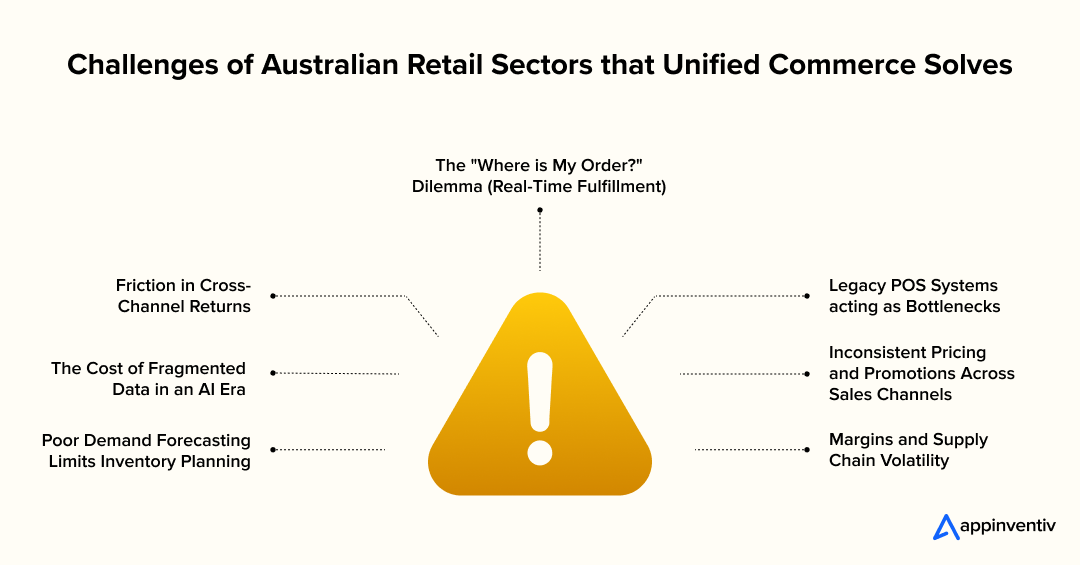
1. The “Where Is My Order?” Dilemma
Australian shoppers now spread a single purchase journey across a retailer’s website, app and platforms like TikTok Shop. Without a unified inventory layer, retailers cannot promise accurate delivery windows or safely turn physical stores into micro-fulfilment centres. Ship-from-store and buy-online-pickup-in-store models only work when stock counts are trustworthy in real time, not batch-updated overnight.
How Unified Commerce Helps
A single, real-time inventory layer lets retailers safely promise stock across every channel, enabling accurate ship-from-store and BOPIS fulfilment without ever overselling.
2. Legacy POS Systems Acting as Bottlenecks
Traditional registers that only process a transaction are no longer fit for purpose. Store associates need visibility into a customer’s online cart, loyalty tier and return history at the counter. Mobile-first POS platforms that function as omnichannel hubs are becoming the baseline expectation, not a competitive differentiator.
How Unified Commerce Helps
Mobile POS connected to unified data gives store staff instant access to a customer’s online cart, loyalty status and return history at checkout.
3. The Cost of Fragmented Data in an AI Era
2026 is the year Australian retail brands move generative AI from pilot projects into daily operations. Dynamic pricing engines and AI-driven customer service cannot run on siloed, inconsistent data. Unified commerce provides the clean, centralised data foundation AI models need to produce reliable output rather than compounding existing data quality problems.
How Unified Commerce Helps
A centralised, clean data foundation lets AI models generate reliable pricing, personalisation and service outputs instead of compounding existing data errors further.
4. Margins and Supply Chain Volatility
Australia’s vast geography and exposure to global supply chain volatility make inventory precision a margin issue, not just an operational one. Consolidating fragmented technology debt reduces IT maintenance overhead and allows smarter, dynamic order allocation across a national footprint.
How Unified Commerce Helps
Consolidated technology and real-time data reduce IT overhead and support dynamic order allocation, protecting margins across Australia’s dispersed retail footprint nationally.
5. Friction in Cross-Channel Returns
Customers increasingly expect the flexibility to purchase through one channel and return through another. Many retailers, however, continue to rely on disconnected systems that require manual inventory updates and refund processing.
How Unified Commerce Helps
A unified backend reconciles inventory and payment instantly, regardless of where the original transaction took place, which matters directly to customer retention.
6. Inconsistent Pricing and Promotions Across Channels
Many Australian retailers still manage pricing independently across stores, websites, marketplaces and apps. This creates pricing disputes and erodes trust the moment a customer notices a discrepancy.
How Unified Commerce Helps
Centralised pricing, promotion and loyalty rules ensure every channel reflects the same offer, removing disputes and rebuilding customer trust and confidence.
7. Poor Demand Forecasting Limits Inventory Planning
Disconnected sales, inventory and customer data make accurate demand forecasting close to impossible. The result is excess inventory sitting in warehouses alongside stockouts on the shop floor.
How Unified Commerce Helps
A single source of truth across channels enables AI-powered demand forecasting, smarter replenishment and more accurate, better-informed inventory management decisions overall.
Whether you’re modernising legacy retail systems or launching a new commerce ecosystem, our specialists can help you plan, design, modernise and deliver a scalable solution.

The Financial Imperative: A $44 Billion Opportunity
Adyen’s Australia Retail Report puts the unified commerce opportunity in the local retail sector at AUD 44 billion. This translates directly into board-level ROI conversations rather than abstract technology upgrades. Let’s see how:
| Business Area | Legacy Omnichannel Challenge | Unified Commerce ROI |
|---|---|---|
| Inventory | Buffer stock required due to data lags | Real-time accuracy reduces dead stock and over-ordering |
| Loyalty | Fragmented profiles across in-store and online | 360-degree customer view enabling targeted marketing |
| IT overhead | High cost maintaining point-to-point integrations | Single platform reduces vendor bloat and technical debt |
This is where the benefits of unified commerce in Australia move from theoretical to measurable. Retail finance teams evaluating a build should treat inventory accuracy and integration maintenance cost as leading indicators, since both shift within the first two trading cycles after go-live.
Blueprint of a 2026 Unified Commerce Platform
The technical architecture underneath a unified commerce platform determines how quickly a retailer can adapt to new channels, regulatory obligations and customer expectations. Getting this right early avoids an expensive re-platforming exercise eighteen months later.
Headless Commerce Architecture
Decoupling the frontend from the backend lets retailers launch new customer touchpoints, including conversational commerce, without rebuilding core systems each time. This is one of the more consequential unified commerce platform features for any retailer planning multi-year channel expansion.
Also Read: Headless Commerce for Omnichannel Retail in Australia
Composable Tech Stacks
Moving from monolithic legacy ERPs toward modular, cloud-native microservices allows individual components, payments, inventory, loyalty, to be replaced or upgraded independently, without a full-platform rebuild.
Centralised Retail Management System
Merging point-of-sale, order management and CRM into one continuous loop removes the reconciliation lag that causes most cross-channel data disputes.
Advanced Data Security and Privacy
Australian retailers operate under strict privacy obligations and rising expectations around consent-aware data collection. Architecture decisions, not policy documents, determine whether a retailer can demonstrate compliance during an audit. Data residency, encryption standards and consent management need to sit inside the platform layer from day one, not get retrofitted after a breach or a regulatory inquiry.
How AI Is Making Unified Commerce Platforms Smarter
Unified data is the precondition for reliable AI in retail, not an optional add-on. Retailers attempting to deploy AI on top of fragmented systems typically see inconsistent output and slow adoption from frontline teams.
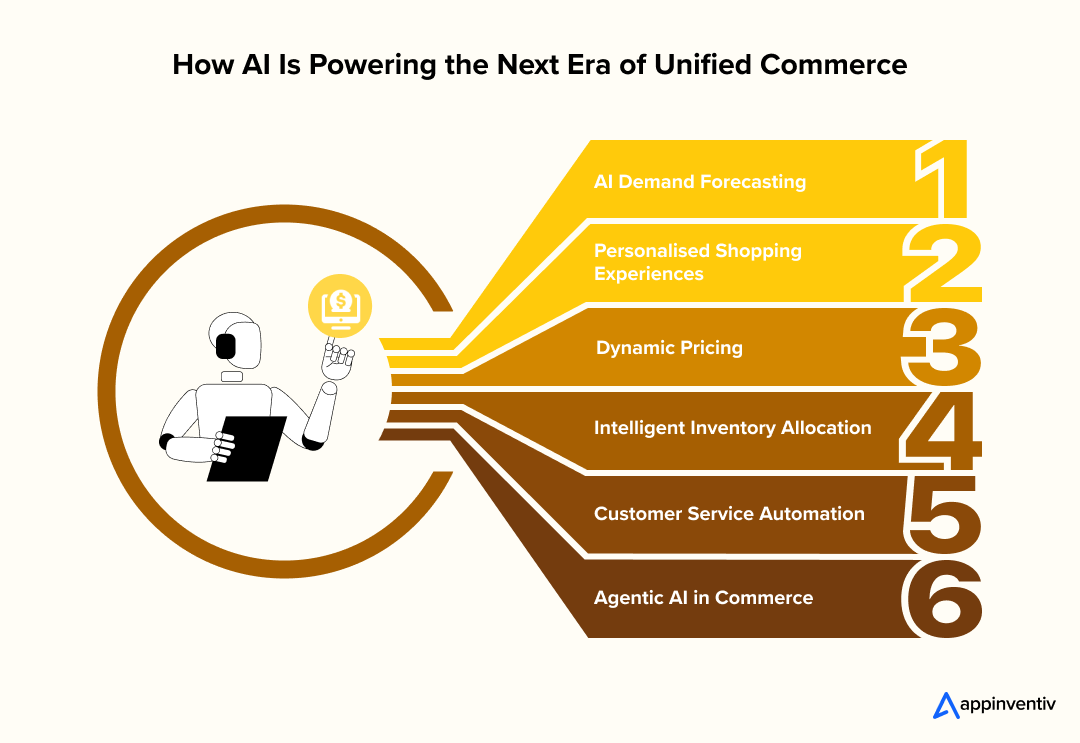
AI Demand Forecasting
AI in Australian retail combines sales, inventory and customer data into a single layer. This allows forecasting models to work from complete information rather than partial, channel-specific data.
Personalised Shopping Experiences
A unified customer profile means recommendations reflect a shopper’s full history across web, app and in-store interactions, not just their most recent channel.
Dynamic Pricing
Centralised data lets pricing engines adjust in near real time across markets and channels, without the delay of manual reconciliation between systems.
Intelligent Inventory Allocation
AI models in Australian retail can route stock to where demand is highest, provided they are working from accurate, current inventory positions rather than end-of-day batch reports.
Customer Service Automation
Support agents and AI chat tools resolve queries faster when they can see a customer’s full order and return history in one place, rather than switching between systems.
Agentic AI in Commerce
Unified data is the foundation autonomous retail agents need to operate reliably, whether that means automated replenishment decisions or AI-led customer interactions that hand off cleanly to a human when required.
Real-World Examples of Retailers Leveraging the Power of Unified Commerce in Australia
Local precedent matters more than international case studies when boards are weighing execution risk. Several Australian retailers are already treating their physical footprint and digital architecture as one connected system rather than two parallel operations.
JB Hi-Fi
JB Hi-Fi continues to strengthen its omnichannel capabilities by integrating digital and physical retail operations. This enables customers to move seamlessly between online purchasing and in-store fulfilment.
Myer
Myer has invested in digital transformation initiatives that improve inventory visibility, customer engagement, and fulfilment efficiency across its national store network.
Country Road Group
Country Road Group continues to modernise its retail platforms to deliver more consistent customer experiences while supporting multiple brands through shared digital capabilities.
The Iconic
As one of Australia’s largest digital-first retailers, THE ICONIC has invested in technology that connects inventory, fulfilment, and customer experiences across online shopping, delivery, and returns. Its focus on flexible fulfilment and seamless post-purchase experiences reflects many of the principles of unified commerce.
These organisations demonstrate that sustainable retail growth is increasingly driven by connected operations rather than adding more standalone technologies. Unified commerce provides the operational foundation required to support future AI adoption, faster fulfilment, and continuous digital innovation.
How to Build a Unified Commerce Platform for Australian Retail: A CTO’s Roadmap for 2026
Navigating the unified commerce implementation process in Australia demands strong technical leadership. The following phases outline how to execute this transformation securely.
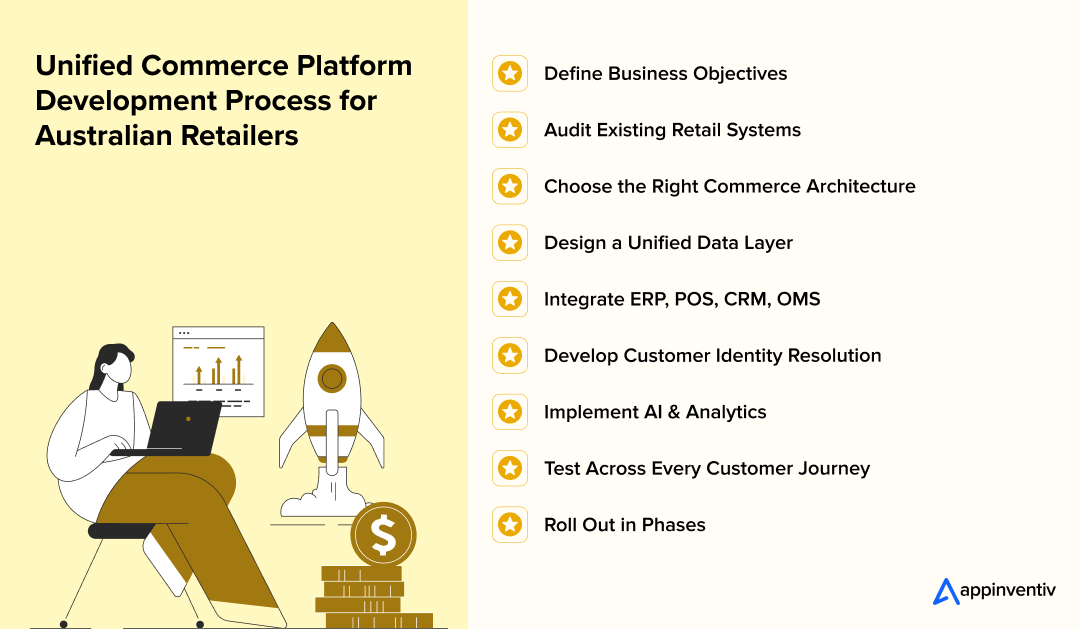
Define Business Objectives
Establish strict parameters regarding what success looks like. Whether the primary goal is reducing average fulfilment costs, increasing customer retention rates, or cutting inventory management costs, clear metrics must guide every architectural decision.
Audit Existing Retail Systems
Map out the entire current technology stack. Identify data silos, undocumented API connections, and legacy hardware that will create bottlenecks. This audit must include a thorough review of data privacy compliance to ensure current practices align with local regulations.
Choose the Right Commerce Architecture
Decide on the structural foundation. Evaluate the trade-offs between Microservices, API-first, Cloud-native, and Headless (MACH) architectures. For most large enterprises, composable commerce provides the necessary flexibility to scale operations without vendor lock-in.
Design a Unified Data Layer
Establish a single source of truth. This data layer must capture and standardise inputs from every operational channel in real time. It is critical to ensure this layer respects data sovereignty requirements, keeping sensitive information securely within Australian borders.
Integrate ERP, POS, CRM, and OMS
Connect the core operational pillars. This step moves beyond basic API syncing. It requires deep, native integration where the point-of-sale system, customer relationship management tool, and order management system function as a single, cohesive unit.
Develop Customer Identity Resolution
Implement logic that accurately identifies a single customer across multiple devices and offline interactions. Merging guest checkout data, in-store receipts, and loyalty app usage into one definitive profile is essential for accurate marketing attribution.
Implement AI and Analytics
Layer intelligent processing on top of the clean data foundation. Deploy demand forecasting algorithms and dynamic pricing models only after the core data pipelines are proven to be stable and accurate.
Test Across Every Customer Journey
Conduct rigorous user acceptance testing. Simulate complex scenarios, such as a customer buying an item via a social media link, applying a loyalty discount, and attempting to return it at a physical retail location.
Roll Out in Phases
Never execute a complete systemic switch overnight. Transition specific geographic regions or individual brands within the portfolio first. This phased approach allows engineering teams to identify and resolve edge cases before full enterprise deployment. You must manage the risk carefully to protect daily revenue streams. If you intend to build a unified commerce platform in Australia safely, phased rollouts are non-negotiable.
How Much Does Unified Commerce Platform Development Cost in Australia?
Unified commerce platform development cost in Australia varies significantly based on the number of brands involved, the depth of legacy system integration required, and how much of the existing technology stack can be retained versus replaced. Cost planning should also account for which unified commerce platform features are mandatory and which can be avoided.
On average the cost to build a unified commerce platform in Australia ranges between AUD 70,000 and AUD 700,000 or more. Here is an estimated breakdown of development cost and timeline based on the different project complexities.
| Project Type | Estimated Cost (AUD) | Timeline |
|---|---|---|
| Startups | 70,000 – 150,000 | 3-6 months |
| Mid-sized retailer | 150,000 – 300,000 | 6–9 months |
| Enterprise retail chain | 300,000 – 450,000 | 9–12+ months |
| Multi-brand enterprise | 450,000 – 700,000 | 12–18+ months |
These ranges reflect the realities of the Australian market, including compliance obligations around data handling and the integration depth needed for national fulfilment networks. A short scoping conversation with a retail-focused technology partner will get most CTOs a realistic figure within days, rather than a generic estimate.
Understand the investment, architecture, and delivery timeline required to build a future-ready unified commerce platform in Australia

Why Choose Appinventiv for Unified Commerce Platform Development
Adding more disconnected point solutions does not solve the underlying problem. What Australian retailers need is a connected retail operating system, built by an eCommerce app development company in Australia who understands both the technology and the compliance environment it needs to operate in.
Appinventiv in Australia treats unified commerce as a business transformation exercise rather than a like-for-like systems swap. Our team of 1600+ tech experts modernises legacy POS, ERP, CRM and OMS platforms in place wherever that limits disruption and technical debt, with new composable, API-first architecture layered in only where it earns its place.
The same approach carries through to building AI-ready retail data platforms, securing integrations to enterprise standards, and supporting systems after go-live, since the harder part of unified commerce is usually the eighteen months after launch rather than the build itself.
Our 11+ years of retail and eCommerce delivery experience extends well beyond Australia. We have built and modernised digital commerce platforms for established international brands, including:
- Adidas – a mobile shopping experience for Adidas that acquired 500,000 new users and 2M+ downloads.
- 6th Street – A fashion retail app for 6th Street rebuilt to load in under three seconds after crossing three million-plus iOS downloads and 1M+ Android downloads.
- IKEA – An in-store ERP and product catalogue platform for IKEA which is now live across 7+ UAE stores.
- Edamama – A personalised eCommerce platform for mothers, scaled past 100,000 customers on a dynamic product engine built to auto-generate SKUs. the platform also raised $5M funding.
- Y.K. Almoayyed & Sons – A diversified Bahrain retail and distribution group, cut storage costs by 32 per cent and doubled data retrieval speed through a cloud data modernisation programme.
On the Australian side, this experience is now extending into local retail, Wardrobe, an Australian retail brand, with further detail to follow as that programme matures.
In Australia specifically, this track record translates into 3000+ digital assets deployed, a 90% client retention rate across 35+ industries, and delivery through 5+ agile centres nationally, backed by ISO 27001, ISO 9001 and SOC2 certification with a 99.5% security compliance SLA, a material consideration for retailers handling sensitive customer and payment data at scale.
We have also been recognised among APAC’s High-Growth Companies by Statista and the Financial Times for three consecutive years, and holds government procurement approvals including the Queensland Government ICTSS Panel and Local Buy pre-qualification.
Whether your objective is replacing fragmented retail systems or building a future-ready commerce ecosystem for unified commerce platform development in Australia, our focus stays on measurable business outcomes delivered with minimal operational disruption.
Are your retail systems ready for the 2026 peak trading season? Schedule a technical consultation with Appinventiv’s retail architects to map out your transition to a unified commerce platform.
FAQs
Q. Why are Australian retailers moving away from traditional omnichannel strategies?
A. Traditional omnichannel connects systems through delayed integrations rather than a single data layer, which creates inventory blind spots and inconsistent customer experiences that unified commerce is designed to remove.
Q. What role does Generative AI play in unified commerce?
A. The implementation of Generative AI in retail depends on clean, centralised data to produce reliable output. Unified commerce platforms provide that foundation, enabling accurate demand forecasting, dynamic pricing and personalised customer service at scale.
Q. How does unified commerce solve the “Ship-from-Store” challenge?
A. By maintaining real-time inventory visibility across every location, unified commerce lets retailers safely promise stock from any store without the risk of double-selling the same item online and in-store.
Q. How long does unified commerce implementation take?
A. The timelines for unified commerce platform development in Australia range from 6 months for a mid-sized retailer to 18+ months for a multi-brand enterprise, depending on the depth of legacy integration and the number of brands or regions involved.
Q. How do unified commerce platforms integrate with ERP, CRM, POS and eCommerce systems?
A. Modern platforms connect these systems through a unified data layer and API-first architecture, rather than point-to-point integrations, which reduces the technical debt that accumulates with each additional connection.
Q. What is the ROI of implementing a unified commerce platform?
A. Beyond resolving the immediate challenges of unified commerce implementation, the ROI includes reduced software licensing fees, lower supply chain freight costs through optimal routing, and measurable top line revenue growth driven by hyper-personalised marketing. The unified commerce platform development cost in Australia is often recouped rapidly through these operational efficiencies.
Q. What is the difference between unified commerce and omnichannel commerce?
A. Omnichannel connects separate systems through integration layers with data lags. Unified commerce operates from a single source of truth across every channel in real time.


Fast 2-minute response, fully NDA-protected.

eCommerce Integration: Connecting ERP, CRM, PIM, and Other Core Business Systems
Key takeaways: Centralized eCommerce architecture distributes accurate product data simultaneously across all your global sales channels. ERP, CRM, PIM, OMS, POS, etc. are the core integration types forming your eCommerce architecture. Security and compliance must anchor your payment architecture when operating across multiple regulatory jurisdictions. The cost of eCommerce platform integration ranges between $40,000 and…

How Much Does It Cost to Build an eCommerce Marketplace App Like Poshmark?
Key takeaways: Poshmark-like marketplaces enable unlocking new sources of revenue through transforming social interaction into low-capital-intensity repeat purchases. A marketplace app would cost between $40,000 and $400,000 to develop, depending on its features, platform and enterprise scalability needs. Special implementation, beginning with tests or single categories, confirms supply, demand, and monetization in 6-12 months. Trust,…

How Much Does It Cost to Build a Fashion Marketplace App Like Depop in the UK?
Key takeaways: A Depop-style fashion marketplace in the UK usually costs £32,000 to £320,000, depending on how simple or advanced you want the app to be. The UK’s resale-fashion scene is growing quickly, so demand for social, pre-loved fashion apps is only going up. Costs increase when you add things like AI recommendations, logistics integrations,…