


































How Much Does It Cost to Develop an eCommerce Platform Like The Iconic in Australia?

 Share -



- 01Why Do Platforms Like The Iconic Dominate the Australian Retail Landscape?
- 02A Comprehensive Look at the Time and Cost to Develop an eCommerce Platform in Australia
- 03What Are the Core Factors That Influence the Cost to Build an eCommerce Platform Like The Iconic
- 04What Are the Hidden Costs Required to Build an eCommerce App like The Iconic?
- 05ROI of eCommerce App Development: Is It Worth the Investment?
- 06How to Build an eCommerce Platform in Australia?
- 07Why Do Leading eCommerce Brands Partner with Appinventiv for eCommerce Platform Development
- 08FAQs

Key takeaways:
- Building an eCommerce platform like The Iconic in Australia costs anywhere from AUD 70,000 to AUD 700,000+ depending on scale and sophistication.
- Prioritise a governance-led roadmap with local cloud hosting to meet Australian data residency and security standards.
- Opt for Headless or Microservices to ensure elastic scalability during peak Australian retail events like Click Frenzy.
- Focus on deep integrations with local fintech and logistics to reduce friction and increase customer lifetime value.
Building a high-performance retail ecosystem in the Australian market requires navigating a complex intersection of high consumer expectations and rigorous regulatory demands. The success of platforms like The Iconic is not merely a result of a slick interface; it is driven by sophisticated logistics integration, real-time inventory synchronisation, and a focus on reducing friction at the checkout.
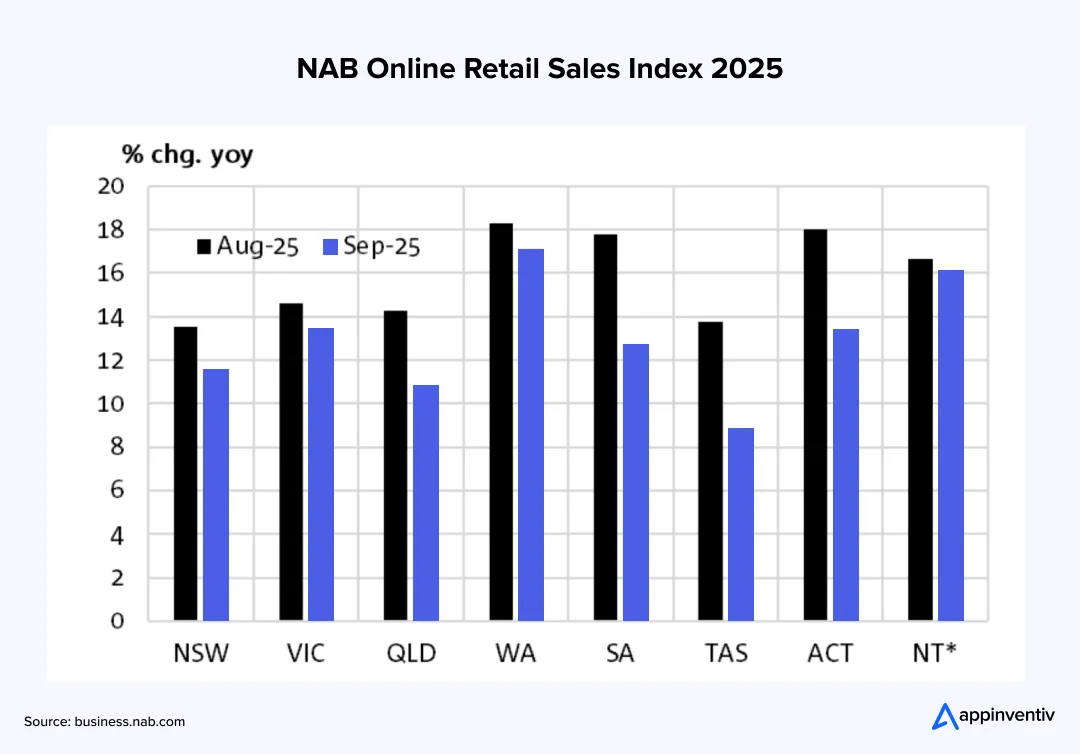
For Australian businesses, a custom platform represents a move toward long-term asset ownership and operational sovereignty. This investment is framed by a thriving digital economy. According to the NAB Online Retail Sales Index 2025, Australians spent approximately $66.23 billion on online retail in the year leading up to early 2024, in the 12 months to September 2024, a level that is around 14.9% of the total retail trade estimate.
However, as market participation grows, so does the technical baseline required to compete. The cost to develop an eCommerce platform in Australia is now heavily influenced by a sharper focus on data security and privacy following high-profile domestic breaches, moving cyber resilience from a “feature” to a foundational expense.
Given these variables, Aussie entrepreneurs typically see a capital outlay ranging from AUD 70,000 to AUD 700,000+, depending on several critical components (details later).
A baseline estimation formula to estimate the total eCommerce app development cost in Australia is:
Total Cost = (Total Estimated Development Hours) x (Average Hourly Rate of Development Team)
This blog breaks down the strategic cost to build a scalable, audit-ready platform that mirrors the reliability of Australia’s retail giants. Whether you want to make an app like The Iconic or create your own category leader, this will help you validate your eCommerce app idea before committing serious investment.
Gain cost clarity, compliance alignment, and a scalable architecture tailored to your business model.

Why Do Platforms Like The Iconic Dominate the Australian Retail Landscape?
The market dominance of The Iconic is not a byproduct of a wide product catalogue alone. From an engineering perspective, the platform excels because it addresses the “last mile” of user experience through high-concurrency architecture and a deeply localised supply chain. The brand has raised $92 million in funding from JPMorgan and Verlinvest, signaling strong faith in its long-term potential and business model.
For an Australian business, the goal is to replicate this seamless orchestration between front-end browsing and back-end fulfilment.
Several core pillars define this level of architectural excellence:
- Regional Fintech Integration: Native support for the Australian “buy now, pay later” ecosystem, including Zip and Afterpay, directly addresses local spending habits.
- Logistics Precision: Sub-second inventory syncing and native API handshakes with local couriers enable reliable same-day delivery across major Australian hubs.
- Elastic Scalability: A decoupled microservices foundation ensures the platform stays online during high-pressure events like Click Frenzy or Black Friday.
- Sovereign Security: Data handling is built around the Privacy Act 1988, ensuring that customer information remains secure and the brand remains audit-ready.
- High Engagement Interface: A mobile-first design that attracts approximately 7.5 million visits monthly with over 93% of traffic originating from Australia.
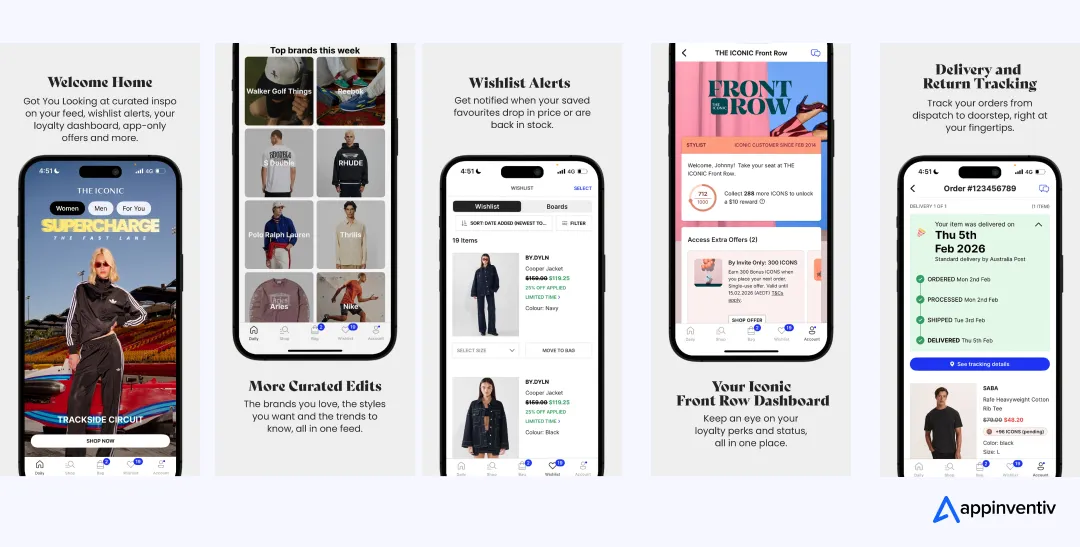
This regional specificity, combined with a data-driven personalisation engine, creates a high-trust environment that drives the customer lifetime value necessary to offset high acquisition costs in the domestic market.
A Comprehensive Look at the Time and Cost to Develop an eCommerce Platform in Australia
Estimating the capital to build ecommerce app like The Iconic requires a move away from “per-feature” pricing toward a holistic view of ecosystem maturity. In the Australian market, where engineering talent and compliance overheads are significant, the time and cost to develop an eCommerce platform in Australia typically scales based on the application complexity and the development stages. Let’s dissect these layers of investment.
Cost Breakdown by Complexity Levels:
The following table outlines the investment tiers for custom builds. We focus on “Custom Build” scenarios, as these provide the ownership and scalability required to match a leader like The Iconic.
| Complexity Level | Typical Cost (AUD) | Typical Timeline | Key Characteristics |
|---|---|---|---|
| Basic Platform (MVP) | $70,000 – $150,000 | 3-6 months | Custom UI/UX, basic ERP integration, standard AU payment gateways. |
| Mid-Range Platform | $150,000 – $400,000 | 6-9 months | Microservices, advanced loyalty engines, multi-warehouse logic. |
| Enterprise-Grade Platform)\ | $400,000 – $700,000+ | 9-12+ months | AI-driven personalisation, headless architecture, 24/7 sovereign support. |
Cost Breakdown by Development Stages:
Costs are not distributed evenly across the lifecycle. A significant portion of the budget in a professional Australian delivery is front-loaded into discovery and back-loaded into quality assurance to mitigate vendor risk. Let’s uncover the typical actions and investment required at each stage.
Discovery & Strategic Architecture (10%): Defining the technical roadmap, data flow diagrams, and compliance mapping (Privacy Act, PCI-DSS).
Estimated Cost: AUD $7,000 – AUD $70,000
Time: 2–4 weeks
UI/UX Design & Prototyping (15%): Creating high-fidelity, mobile-first interfaces tailored to Australian consumer behaviour and accessibility standards.
Estimated Cost: AUD $10,500 – AUD $105,000
Time: 4–8 weeks
Engineering & Integration (50%): This involves the core build including backend logic, API development, and synchronising with local eCommerce logistics (e.g., Australia Post, StarTrack).
Estimated Cost: AUD $35,000 – AUD $350,000
Time: 6–12+ months
Quality Assurance & Penetration Testing (15%): Rigorous testing cycles, including load testing for peak events like Click Frenzy and security vulnerability assessments.
Estimated Cost: AUD $10,500 – AUD $105,000
Time: 4–6 weeks (concurrent with development)
Deployment & Governance Setup (10%): Cloud infrastructure provisioning (AWS/Azure Sydney regions) and establishing DevOps pipelines.
Estimated Cost: AUD $7,000 – AUD $70,000
Time: 2–3 weeks
Post-Launch Maintenance & Support: Critical investment for bug fixes, security patches, OS compatibility, and continuous feature enhancements.
Estimated Annual Cost: Typically 15–20% of the initial development cost.
Time: Ongoing
What Are the Core Factors That Influence the Cost to Build an eCommerce Platform Like The Iconic
Before fixing a budget, Australian retailers need to understand one core reality. The cost to build an eCommerce platform like The Iconic is not decided by design screens alone. It is shaped by operational logic, inventory movement, customer behaviour, compliance frameworks, and how well the platform performs when traffic spikes.
So, if you are planning to build an eCommerce app like The Iconic for the Australian market, these are the real factors that determine the investment behind the platform development.
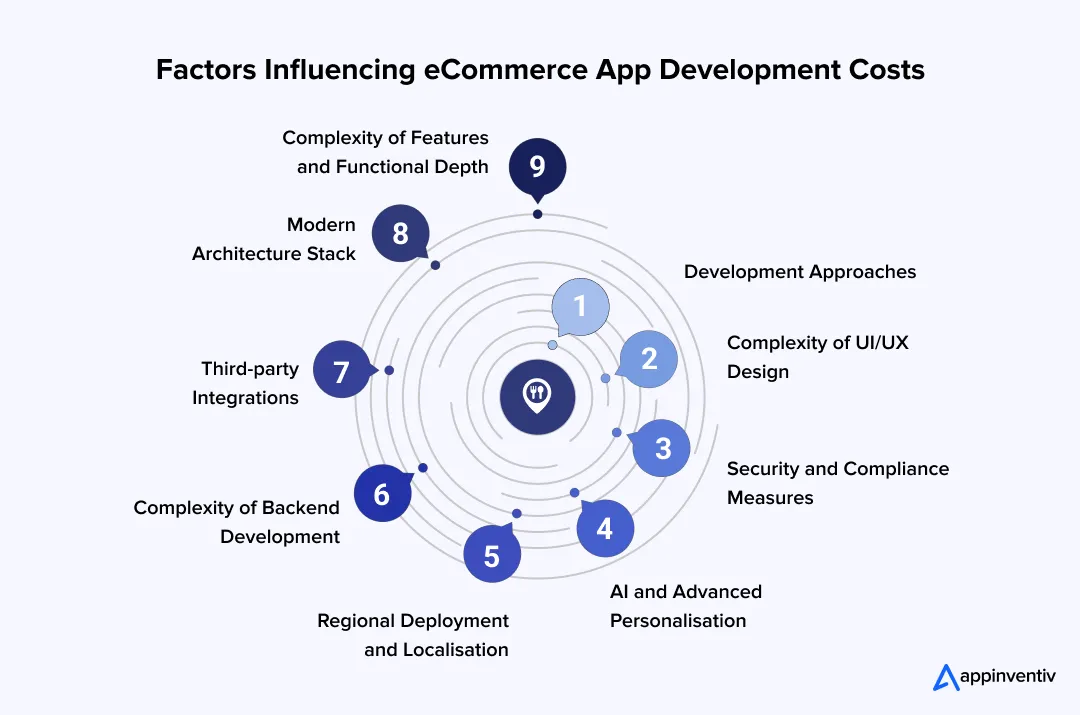
Development Approaches
When evaluating the cost to develop an eCommerce platform in Australia, the choice of development approach is a primary driver of both your initial capital outlay and your long-term operational agility.
| Approach | Estimated Impact | Rationale |
|---|---|---|
| Native Development | Higher Upfront | Building separate apps for iOS and Android using Swift/Kotlin. |
| Cross-Platform | Mid-Range | Using frameworks like React Native or Flutter to maintain a single codebase for both platforms. |
| Hybrid / PWA | Lower Upfront | Web-based applications that run in a container. While cost-effective, they often lack the fluid “app-like” feel and offline capabilities required for premium retail brands. |
Complexity of UI/UX Design
A platform like The Iconic relies on a high-fidelity interface that reduces “cognitive load” for the shopper. Professional UI/UX in Australia isn’t just about aesthetics; it’s about accessibility compliance (WCAG 2.1) and conversion rate optimisation (CRO).
| UI/UX Design Component | Estimated Cost (AUD) |
|---|---|
| User Flow Mapping & Wireframing | 5,000 – 8,000 |
| Visual Design System Creation | 4,000 – 8,000 |
| Interactive Prototyping | 6,000 – 14,000 |
Security and Compliance Measures
Security and government regulations for eCommerce in Australia are non-negotiable. Given the increasing focus from the Australian Signals Directorate (ASD) and the Essential Eight framework, security measures are deeply integrated into the development cost.
“Australian organisations must move beyond compliance-as-a-box. Cyber resilience is now a functional requirement that dictates the underlying architecture of any customer-facing digital asset.” — Security Lead Perspective
| Factor | Governance Requirement | Cost Influence |
|---|---|---|
| Data Residency | Hosting in AWS/Azure Sydney Regions | Infrastructure premiums for sovereign data storage. |
| PCI-DSS Level 1 | Tier 1 payment security standards | Ongoing auditing and specialized encryption layers. |
| Identity Management | Multi-Factor Authentication (MFA) & SSO | Complex user authentication flows to prevent account takeovers. |
AI and Advanced Personalisation
The “Iconic experience” often includes AI-driven features in eCommerce like visual search (Snap to Shop) or hyper-personalised recommendation engines, which add a layer of complexity. This involves training models on your specific SKU data and ensuring real-time processing, which elevates both the development time and the cloud consumption costs.

Regional Deployment and Localisation
Australia has its own taxation, fulfilment, and privacy landscape. Platforms tailored for the local market reduce friction and improve retention. Supporting postcode-based delivery logic, GST handling, and compliance workflows increases build effort but is unavoidable.
Complexity of Backend Development
The “engine” of an enterprise platform must handle massive concurrency, especially during Australian retail peaks like Black Friday or Click Frenzy. This involves:
- Database Architecture: Implementing distributed databases to ensure sub-second query times across millions of SKUs.
- Serverless Orchestration: Utilising AWS Lambda or Azure Functions to handle tasks like image processing or invoice generation without maintaining idle server capacity.
- Middleware Development: Creating custom integration layers to connect modern frontends with “on-premise” legacy systems, ensuring secure data flow without compromising performance.
Third-Party Integrations
In the Australian market, “Standard” integrations rarely suffice for enterprise needs. Costs scale when custom business logic is required to bridge the gap between global software and local providers.
| Integration Category | Critical Third Party Australian Providers | Strategic Complexity |
|---|---|---|
| Fintech & Payments | Afterpay, Zip, Apple Pay, BPAY | Requires complex “split-payment” and automated refund logic that aligns with Australian Consumer Law. |
| Last-Mile Logistics | Australia Post, StarTrack, Sherpa | Real-time API handshakes for live shipping quotes, automated label generation, and “Same Day” tracking. |
| Inventory & ERP | MS Dynamics 365, SAP, NetSuite | Bi-directional, real-time syncing to prevent “overselling” across multiple physical warehouses. |
| Marketing & CRM | Salesforce, Braze, Klaviyo | Deep-linking customer data for personalised SMS/Email triggers based on local time zones and shopping habits. |
Modern Architecture Stack
For a platform intended to last 5+ years, the selection of tech stack for an eCommerce app development in Australia is a strategic investment in future-proofing. Australian enterprises are increasingly moving toward an MACH (Microservices, API-first, Cloud-native, Headless) architecture, which influences costs.
- Microservices: Independent services (checkout, inventory, profiles) ensure system-wide resilience and “Always-On” availability during high-traffic Australian sales events.
- API-First Ecosystems: Ensures seamless, secure integrations with third-party providers like Afterpay or StarTrack, allowing rapid expansion into new digital touchpoints.
- Cloud-Native Infrastructure: Hosting in AWS (Sydney) or Azure (Melbourne/Sydney) ensures 100% data residency compliance with the Privacy Act 1988 and instant auto-scaling.
- Headless & Composable: Decouples the frontend from backend logic, enabling superior mobile performance and the flexibility to swap components without a full system rebuild.
Also Read: Headless Commerce for Omnichannel Retail in Australia
Complexity of Features and Functional Depth
Building a platform that rivals The Iconic requires a careful balance between the core utility required for daily operations and the sophisticated features that drive high customer lifetime value. Each additional layer of functional depth adds to the engineering hours, testing cycles and development costs. The following table categorises the investment required for the advanced and must-have features in Australian eCommerce apps:
| Features for Developing an eCommerce Platform like the Iconic | Estimated Cost (AUD) |
|---|---|
| Core Shopping Cart & Multi-Step Checkout | 5,000 – 15,000 |
| Standard Inventory & Product Catalogue Management | 6,000 – 8,000 |
| Advanced Search & Discovery (AI-powered, Typo-tolerance) | 10,000 – 15,000 |
| Customer Accounts & Order History Portal | 5,000 – 8,000 |
| Loyalty & Rewards Engine (Tiered Memberships) | 7,000 – 10,000 |
| Automated Returns & Exchange Portal (Self-Service) | 3,000 – 8,000 |
| AI Personalisation in Retail & Recommendation Engine | 6,000 – 10,000 |
| Multi-Warehouse Inventory Orchestration | 10,000 – 15,000 |
| Real-Time Logistics Tracking (Last-Mile Sync) | 5,000 – 6,000 |
| Hyper-Localised Checkout (BNPL, Apple Pay, BPAY) | 4,000 – 6,000 |
| Augmented Reality (AR) Virtual Try-On | 7,000 – 12,000 |
What Are the Hidden Costs Required to Build an eCommerce App like The Iconic?
When calculating the eCommerce mobile app development cost in Australia, focusing solely on the “build” phase can lead to significant budgetary friction post-launch. For an enterprise-grade asset, the initial development is often only 60% of the first-year capital requirement. The remaining 40% is absorbed by the operational, legal, and technical “glue” that keeps the platform viable.
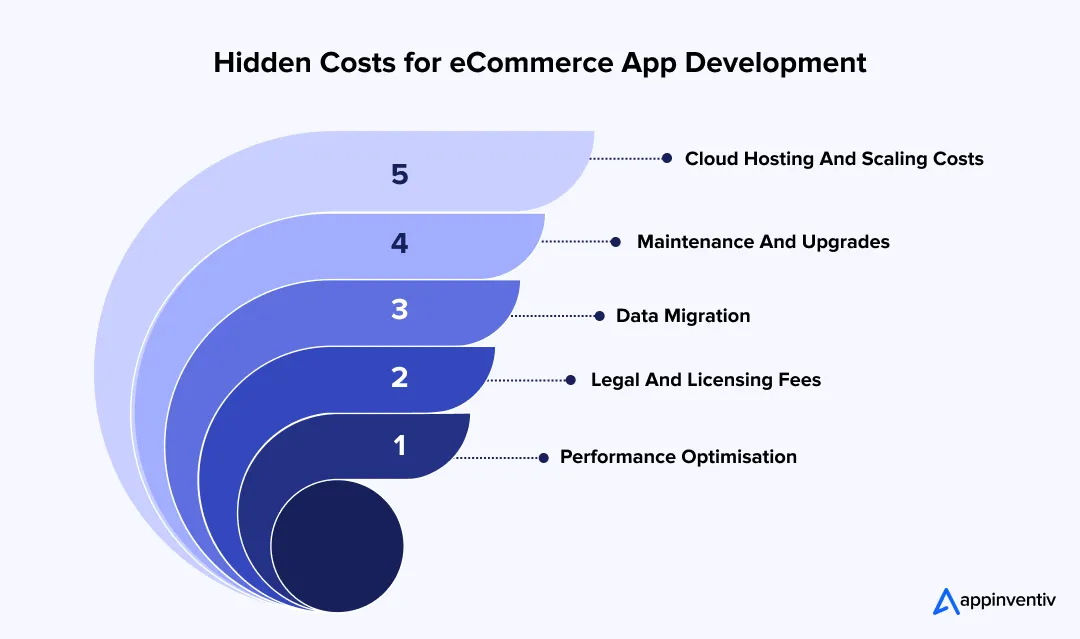
Cloud Hosting and Sovereign Scaling: Ensuring 100% data residency in AWS Sydney or Azure Melbourne involves premium regional pricing and costs for elastic scaling during peak periods like Click Frenzy.
Maintenance and Governance Upgrades: Software is a depreciating asset. We recommend allocating 15–20% of the initial build cost annually for maintenance. This covers security patches, OS updates for mobile apps, and “Essential Eight” compliance audits required to satisfy board-level risk assessments.
Data Migration & Clean-up: Complex cloud migrations for historical customer and order data can cost between AUD 40,000 and AUD 200,000 depending on sanitisation needs.
Legal and Licensing Fees: Beyond the code, you must account for Australian-specific legal frameworks. This includes drafting “Terms of Service” that align with Australian Consumer Law and ensuring your privacy policy satisfies the latest amendments to the Privacy Act 1988.
Performance Optimisation & SEO: Post-launch, a platform requires continuous tuning. This includes “Core Web Vitals” monitoring to ensure Google ranks your site effectively in the Australian search landscape and A/B testing to refine checkout conversion rates.
ROI of eCommerce App Development: Is It Worth the Investment?
The decision to invest between AUD 70,000 and AUD 700,000 in a custom platform is rarely about immediate cost recovery. It is a strategic move toward long-term asset value and operational autonomy. When evaluating the eCommerce website development cost in Australia, the ROI is measured through the lens of lowered technical debt and increased market share.
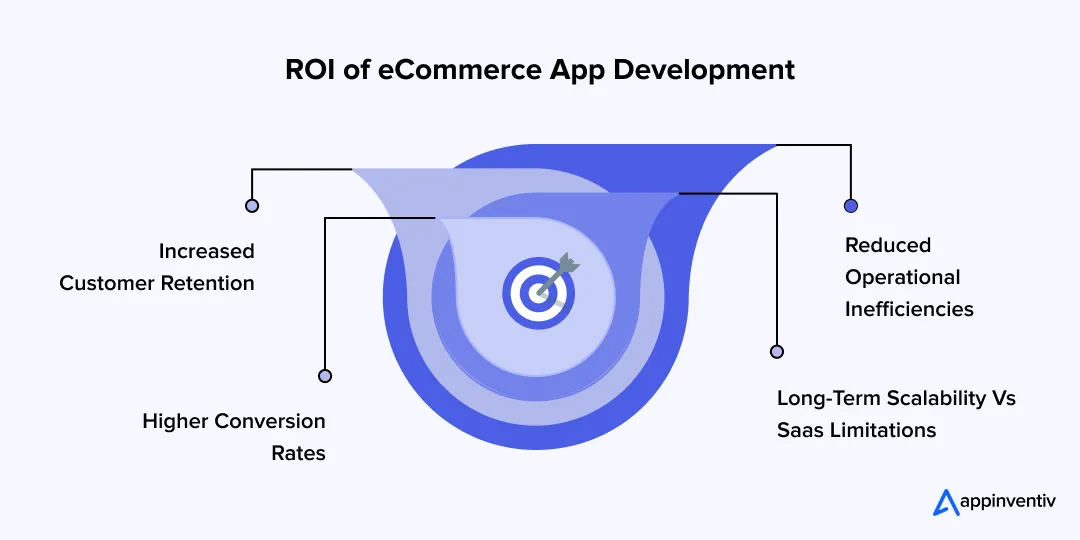
Increased Customer Retention
High-performance platforms like The Iconic thrive on repeat business. A custom-built loyalty engine and seamless UX can improve retention rates by up to 30%, significantly reducing the high cost of customer acquisition in the competitive AU retail space.
Higher Conversion Rates
Every 100ms of latency can lead to a 7% drop in conversions. By investing in a high-speed, modern architecture, enterprises capture revenue that is typically lost on slower, generic SaaS templates.
Reduced Operational Inefficiencies
Automating the “Single Source of Truth” across inventory, logistics (Australia Post/StarTrack), and finance (Xero/MYOB) eliminates manual data entry, leading to estimated efficiency gains of 35% for Australian enterprises.
Scalability vs. SaaS Limitations
While off-the-shelf tools are cheaper initially, they often charge “success taxes” through GMV-based transaction fees. A custom platform offers flat-cost scalability, ensuring that as your volume grows, your margins improve rather than shrink.
Partner with the team that delivered digital excellence for retail giants Adidas, IKEA, and 6th Street.

How to Build an eCommerce Platform in Australia?
The path to a market-leading platform development is a structured transition from high-level vision to a hardened, audit-ready digital asset. In the Australian context, this requires a heavy focus on governance and local integration. Here are the critical steps to build an eCommerce app like The Iconic:
- Discovery & Compliance Mapping: Define the functional requirements while ensuring alignment with the Privacy Act 1988 and PCI-DSS standards.
- Architecture Design: Choose between Native, Cross-Platform, or PWA approaches based on your target audience’s device habits.
- Agile Engineering: Develop in iterative sprints, prioritising a “Minimum Viable Product” (MVP) that handles core transactions with high reliability.
- Localised Integration: Connect with Australian fintech (Afterpay/Zip) and logistics (StarTrack/Australia Post) early in the build.
- Rigorous UAT & Pentesting: Conduct thorough user testing with Australian focus groups and execute security audits to ensure “Essential Eight” maturity.
- Sovereign Deployment: Launch on local cloud nodes (AWS Sydney) to ensure low latency and data sovereignty.
Why Do Leading eCommerce Brands Partner with Appinventiv for eCommerce Platform Development
Choosing a mobile app development company in Australia for a high-concurrency retail platform development requires more than just technical proficiency; it requires a partner who understands the friction of global scale and the precision of Australian local requirements.
Appinventiv, with 11+ years of APAC delivery experience in delivering eCommerce app development services, specialises in engineering retail ecosystems that drive sovereign growth.
Our proven track record in the eCommerce space is defined by our work with global retail leaders like Adidas, IKEA, 6th Street, and Edamama, helping them navigate the complexities of multi-region inventory, hyper-personalisation, and seamless checkout flows. In the Australian and broader APAC landscape, this experience translates into a clinical approach to delivery.

We have deployed more than 3000 digital assets across Australia, maintaining a 96% client retention rate that speaks to our focus on long-term value over short-term gains. Our presence is grounded in the region, with 5+ agile delivery centres across Australia ensuring that your project is backed by local accountability and real-time collaboration.
We understand that for an Australian CEO or CTO, security and efficiency are the primary benchmarks of success. This is why our operations are built on a 99.50% Security Compliance SLA (ISO, SOC2), ensuring your customer data remains protected under the most rigorous standards.
Our clients typically see efficiency gains of 35% through our automation-first approach to backend orchestration. Recognised as one of APAC’s High-Growth Companies by Statista and the Financial Times for two consecutive years, we bring a proven, high-velocity delivery model to the Australian enterprise market.
Ready to build a secure and scalable eCommerce platform in Australia? Share your vision with us and get a detailed quotation involving the timeline and cost to develop an eCommerce platform in Australia
FAQs
Q. How much does it cost to build an ecommerce platform like The Iconic in Australia?
A. The cost to develop an eCommerce platform in Australia typically ranges from AUD 70,000 for a mid-market solution to AUD 700,000+ for a high-concurrency, enterprise-grade ecosystem. The final investment depends on the complexity of the architecture, the depth of eCommerce logistics integrations, and the level of AI-driven personalisation required to compete at scale.
Q. How long does it take to develop a platform like The Iconic?
A. A robust, custom platform generally requires 3 to 12 months for full-scale development. This timeline accounts for the discovery of business logic, UI/UX design, core engineering, and the rigorous security and penetration testing required to meet Australian enterprise standards.
Q. What compliance and payment systems are must-haves for AU-based ecommerce apps?
A. At a minimum, platforms must comply with the Privacy Act 1988 and PCI-DSS. Essential payment integrations for the Australian market include “Buy Now, Pay Later” (BNPL) providers like Afterpay and Zip, alongside standard gateways such as Apple Pay and local credit card processing through providers like Westpac or CommBank.
Q. How to validate an ecommerce app idea in Australia?
A. Validation involves a structured “Discovery Phase” where we map technical feasibility against the competitive landscape. This includes prototyping the user journey for local shoppers and conducting a “Proof of Concept” (PoC) for complex integrations, such as real-time inventory syncing with Australian third-party logistics (3PL) providers.
Q. What should CTOs consider when building eCommerce apps?
A. CTOs must prioritise data sovereignty (hosting in Sydney/Melbourne regions), “Essential Eight” cybersecurity alignment, and the choice between a Monolithic or Headless architecture. Long-term technical debt and the platform’s ability to auto-scale during massive traffic spikes like Click Frenzy are critical considerations for board-level approval.
Q. How to choose an app development company?
A. Look for a partner with a proven track record in the APAC region who understands Australian consumer law and data privacy regulations. Evaluate their portfolio for high-concurrency projects such as our work with Adidas or IKEA, and ensure they can provide local, sovereign support and audit-ready documentation.
Q. How to keep app development costs within budget?
A. Start with a clearly defined “Product Discovery” phase to eliminate mid-project scope creep. Prioritise a modular, API-first architecture that allows you to launch core commerce features first, then layer in advanced AI-driven recommendations or loyalty modules once the platform has demonstrated a clear ROI.
Q. What are the key benefits of developing an eCommerce app?
A. Here are the key benefits of mobile eCommerce development for Australian retailers:
- Superior User Retention: Mobile apps allow for bi-directional engagement through push notifications, driving 3x higher conversion rates compared to mobile web.
- Enhanced Performance: Native or cross-platform builds leverage device hardware for sub-second load times, a critical factor in eCommerce application development in Australia where speed defines market leaders.
- Hyper-Local Personalisation: Integration with GPS and local payment methods (Afterpay, Zip) allows for tailored shopping experiences that increase average order value.
- Offline Functionality: Unlike websites, apps can offer limited offline access to catalogues and saved carts, ensuring the shopping journey isn’t interrupted by connectivity issues.
- Direct Marketing Channel: By bypassing crowded inboxes and social algorithms, apps provide a “single source of truth” for your most loyal Australian customer base.


Fast 2-minute response, fully NDA-protected.

eCommerce Integration: Connecting ERP, CRM, PIM, and Other Core Business Systems
Key takeaways: Centralized eCommerce architecture distributes accurate product data simultaneously across all your global sales channels. ERP, CRM, PIM, OMS, POS, etc. are the core integration types forming your eCommerce architecture. Security and compliance must anchor your payment architecture when operating across multiple regulatory jurisdictions. The cost of eCommerce platform integration ranges between $40,000 and…

Why Australian Retailers Are Investing in Unified Commerce Platforms in 2026
Key takeaways: Unified commerce platform development in Australia is now central to peak trading resilience, not a discretionary upgrade. The Australian unified commerce opportunity is valued at AUD 44 billion, with early adopters seeing revenue growth of 20% or more. Real-time inventory and customer data are prerequisites for reliable AI deployment in retail. Addressing governance…

How Much Does It Cost to Build an eCommerce Marketplace App Like Poshmark?
Key takeaways: Poshmark-like marketplaces enable unlocking new sources of revenue through transforming social interaction into low-capital-intensity repeat purchases. A marketplace app would cost between $40,000 and $400,000 to develop, depending on its features, platform and enterprise scalability needs. Special implementation, beginning with tests or single categories, confirms supply, demand, and monetization in 6-12 months. Trust,…