
























AI in Retail in Australia: Use Cases, Examples, Cost & Challenges

 Share -



- 01Understanding the Role and ROI of Retail AI in Australia?
- 02How Businesses Are Using AI for Retail: Top 16 Use Cases and Real World Examples
- 03The 5 Stages of Retail AI Maturity Framework
- 04How to Implement AI in Retail in Australia? A Step-by-Step Process
- 05Challenges with AI Adoption in Retail Industry and How to Overcome Them
- 06How Much Does It Cost to Implement AI in Retail in Australia?
- 07The Future of AI in Retail: What Lies in the Coming Years
- 08Implement AI in Retail Stores with Appinventiv
- 09FAQs

Key takeaways:
- AI in retail in Australia is transitioning from pilot programmes to enterprise-wide deployment across security, operations, supply chain, and customer engagement.
- Businesses implementing artificial intelligence in retail in Australia are achieving measurable outcomes, including 10–30% uplift in conversion and 20–40% reduction in inventory costs.
- Recent data confirms retail is outperforming every other Australian sector in AI adoption, with 47% of businesses now viewing AI as core to their operations.
- Successful retailers are bridging the “Australian Trust Gap” by shifting from “Black Box” automation to Benefit-led AI that delivers immediate cost-of-living relief to shoppers.
Picture this: You’re walking through a Woolworths “smart store” in Sydney. You grab a six-pack of Coopers and some barramundi fillets, and you simply… walk out. No queue, no manual scanning, just a seamless digital handshake. Or perhaps you’re at Coles, where a smart trolley is nudging you with a recipe for tonight’s dinner based on what’s actually on the shelves and what’s on special.
This isn’t a “Project 2030” vision board. It’s the sharp end of artificial intelligence in retail in Australia right now.
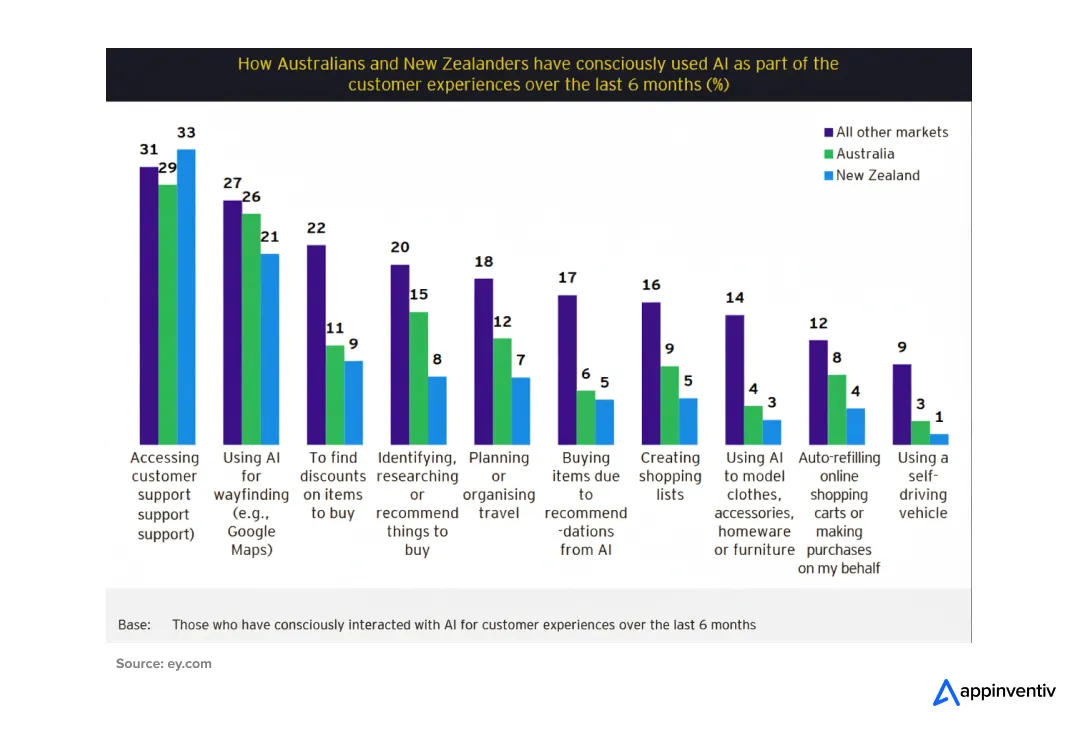
However, there is a fascinating paradox at play in the local market. According to the 2025 EY AI Sentiment Index, Australians are globally some of the most sceptical when it comes to AI. Yet, retail is the one sector where we are “all in.” While only 38% of us are excited about AI generally, a massive 58% of shoppers are already comfortably using it to find better deals and faster checkouts.
Retail is officially the “fast lane” for rebooting Australia’s AI mindset.
Data from the National AI Centre (NAIC) reveals that retail is outstripping every other sector, with 45% of SMEs already actively deploying AI for retail in Australian businesses. But as any technology leader knows, the secret isn’t just the tech; it’s moving from “Invisible AI” (automation the customer never sees) to “Benefit-led AI” (value the customer actually feels).
However, adoption alone is not enough. The real challenge lies in execution, compliance, and measurable ROI. But worry not, this blog is here to help.
In this comprehensive blog, we will explore how artificial intelligence in retail in Australia is reshaping everything from customer experiences to supply chain optimisation.
Over 45% of Australian SMEs in retail are already embracing AI. Don’t let your competitors pull ahead. Take the leap today and position your business for success!

Understanding the Role and ROI of Retail AI in Australia?
AI in retail in Australia uses advanced technologies such as machine learning, computer vision, natural language processing, Generative AI and agentic AI to automate operations, analyse large volumes of data and deliver more personalised and efficient customer experiences across both physical and digital channels.
In practical terms, this includes:
- Predicting demand more accurately using historical and real-time data
- Automating inventory and supply chain decisions
- Personalising product recommendations and marketing campaigns
- Enabling faster, more responsive customer service
For enterprise retailers, the value of artificial intelligence in retail in Australia lies not just in automation, but in improving the quality and speed of decision-making across the organisation.
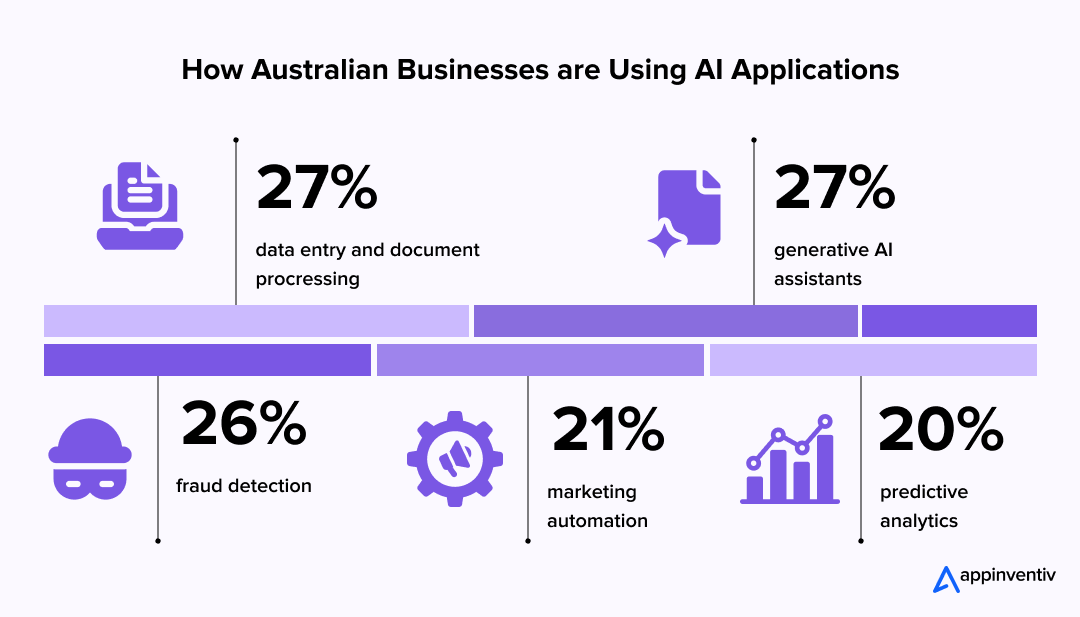
The expected ROI from AI in retail in Australia includes
- 10–30% increase in conversion rates
- 20–40% reduction in inventory costs
- 25–50% faster fulfilment cycles
- Significant reduction in operational overheads
How Businesses Are Using AI for Retail: Top 16 Use Cases and Real World Examples
Australian retailers are adopting AI to transform the entire retail landscape. They use AI to redefine how they interact with customers, manage inventory, drive profitability, and do a lot more. In short, AI use cases in retail are already ringing up sales and making customers happier. From hyper-personalised shopping experiences to smart logistics solutions, AI applications are reshaping the future of retail in Australia.
AI use cases in retail in Australia can be broadly grouped into four operational pillars: Customer Experience, Operations and Supply Chain, Risk and Security and Store Automation and Sustainability.
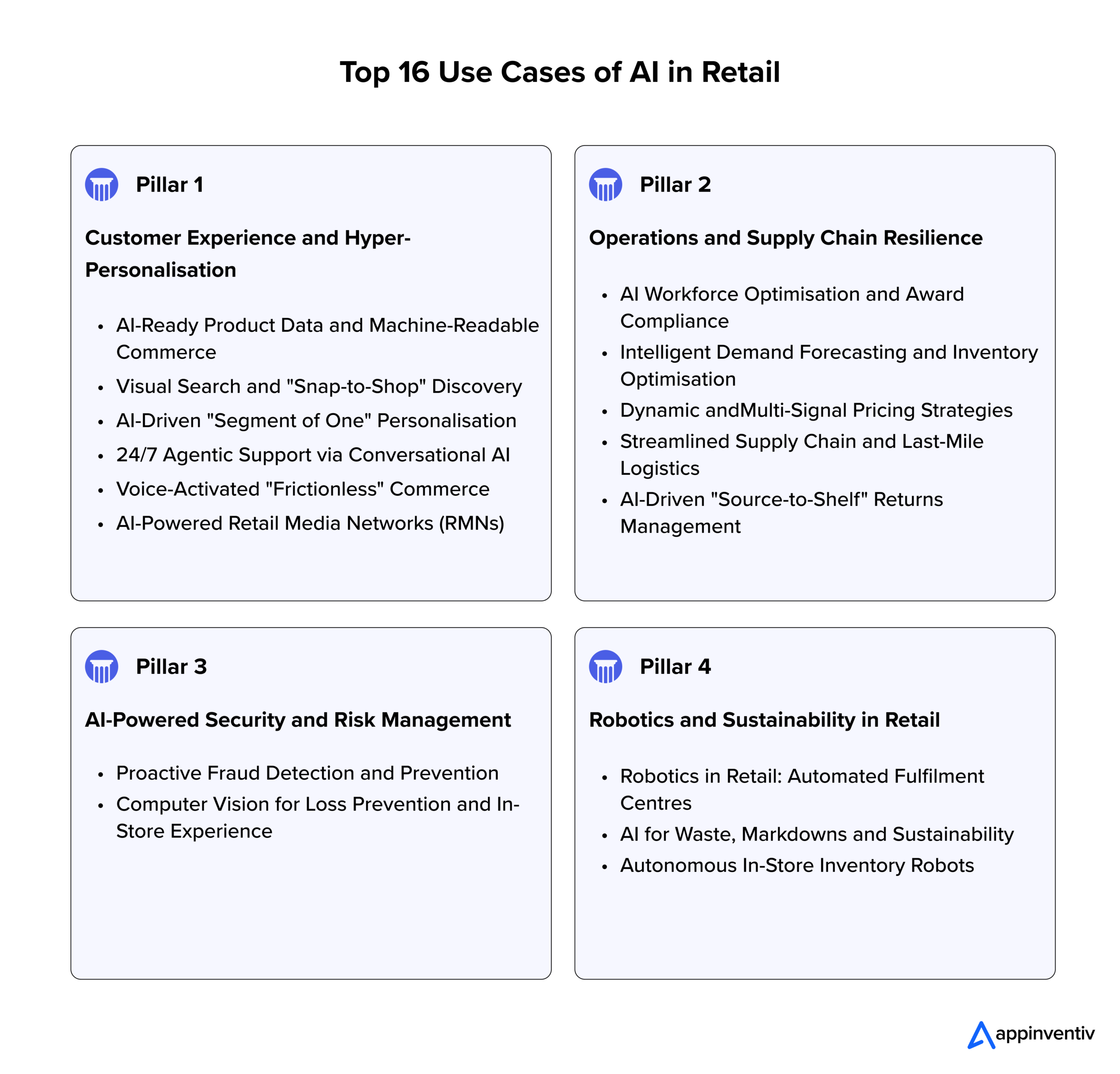
Pillar 1: Customer Experience & Hyper-Personalisation
This pillar focuses on eliminating digital friction and fostering deep brand intimacy. By leveraging first-party data and natural language processing, retailers can transform generic transactions into high-value, bespoke shopping journeys.
1. AI-Ready Product Data and Machine-Readable Commerce
As AI agents increasingly search, compare, and buy on behalf of consumers, traditional SEO is failing. Retailers must structure their catalogs into clean, machine-readable data, explicitly linking variants, real-time inventory, and return policies, so AI systems can seamlessly parse and recommend them.
Real World Example: An Australian electronics retailer restructures its PIM system to output standardized JSON-LD feeds. When a shopper asks an AI agent for a “waterproof smartwatch under $300 available for Melbourne click-and-collect,” the agent instantly parses and recommends their machine-readable SKU over competitors.
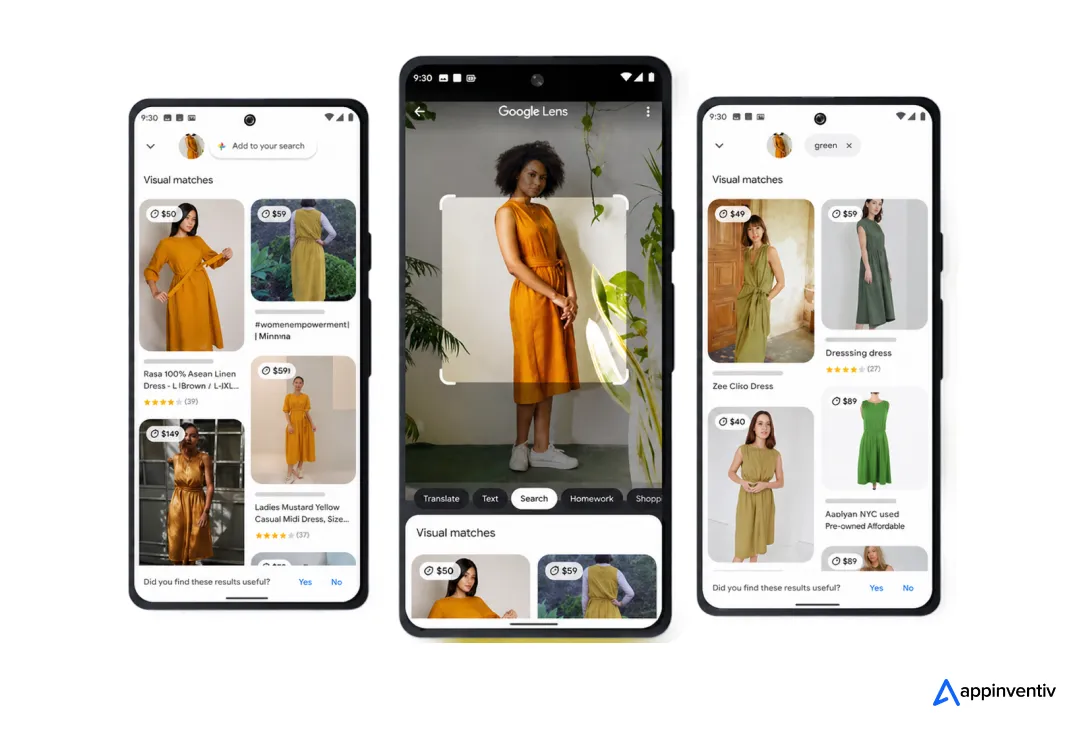
2. Visual Search and “Snap-to-Shop” Discovery
Removing the “friction of description” is critical for mobile conversion. AI driven visual search allows users to find products simply by capturing a photo, bypassing the traditional search bar entirely.
Real-World Example: The Iconic uses multimodal search to allow shoppers to find specific styles or “beach-themed” outfits from photos, significantly reducing “zero-result” searches and increasing conversion.
3. AI-Driven “Segment of One” Personalisation
Instead of generic “Everyday Rewards,” AI creates bespoke shopping journeys. Systems analyse first-party data to predict which families in Western Sydney need value-packs versus which inner-city professionals want premium convenience.
Real World Example: A classic brand, Woolies, uses AI to enhance its customers’ shopping experiences. Their AI is constantly learning. It knows you prefer organic produce, remembers you’re trying to eat healthier, and understands you usually shop for a family of four. Every interaction makes the next one better.
4. 24/7 Agentic Support via Conversational AI
With local labour costs at a premium, AI-powered retail solutions in Australia must handle the “heavy lifting.” These agents move beyond answering FAQs to autonomously resolving logistics issues or processing returns.
Real-World Example: Woolworths’ chatbot, “Olive,” manages thousands of daily interactions, successfully diverting high-volume queries away from human agents to maintain service standards during peak demand.
5. Voice-Activated “Frictionless” Commerce
As smart speakers become a staple in Australian homes, voice technology enables effortless reordering of staples without the customer needing to open an app.
Real-World Example: Lite N’ Easy uses AI to allow users to view and manage their weekly meal orders, providing easy access to nutritional information.
meal orders, providing easy access to nutritional information.
6. AI-Powered Retail Media Networks (RMNs)
Retailers leverage AI algorithms to analyze vast first-party loyalty data, enabling brand partners to deliver hyper-targeted in-store and digital advertisements. Machine learning segmentations maximize advertising yields and ad relevance, turning historical customer purchasing data into a profitable, high-margin media business.
Real World Example: Australian supermarket networks like Woolworths (Cartology) and Coles (Coles 360) utilise machine learning models to serve personalised digital screen ads and sponsored app search results to shoppers based on their real-time buying histories and loyalty profiles.
Pillar 2: Operations and Supply Chain Resilience
This pillar targets the “back-end” efficiencies required to manage Australia’s complex geography. It covers everything from workforce rostering to real-time logistics, turning the supply chain into a predictive asset.
7. AI Workforce Optimisation andAward Compliance
AI-driven rostering platforms analyse historical store footfall, weather patterns, and sales forecasts to automatically build optimal staff schedules. Crucially, built-in compliance algorithms cross-check shifts against Australia’s complex Fair Work awards to prevent costly underpayment errors and penalty-rate overruns.
Real World Example: A major multi-store Australian fashion retailer deploys predictive AI scheduling tools to align floor staff availability with peak shopping hours, automatically calculating complex penalty rates and break entitlements in real time to ensure strict local labor law compliance.
8. Intelligent Demand Forecasting and Inventory Optimisation
In an economy influenced by interest rate volatility and snap weather events, “guessing” inventory is no longer an option. AI for demand forecasting and intelligent inventory management in Australian businesses now ingests variables like BoM (Bureau of Meteorology) data to predict stock needs. This helps prevent the overstock and stockout issues.
Real-World Example: Coles processes over 1.6 billion predictions daily across its 850 stores, using AI to ensure fresh barramundi and seasonal produce are available exactly where and when they are needed.
9. Dynamic & Multi-Signal Pricing Strategies
Price leadership in Australia is a constant struggle. AI retail allows them to adjust prices in real-time based on competitor moves and local demand shifts.
Real-World Example: JB Hi-Fi, one of Australia’s leading electronics and entertainment retailers, utilises sophisticated pricing engines that monitor competitors like Harvey Norman every hour, adjusting margins to ensure they remain the price-leader across electronics and gaming.
10. Streamlined Supply Chain and Last-Mile Logistics
The “last mile” is the most expensive part of the Australian supply chain. AI identifies the most fuel-efficient routes, bypassing Sydney’s traffic or Melbourne’s snap rail closures.
Real-World Example: Toll Group uses AI to bring the supply chain to life at a granular level, empowering the visibility and real-time decision-making that drives trust between retailers and their customers.
11. AI-Driven “Source-to-Shelf” Returns Management
In Australia, where reverse logistics costs are roughly 3x higher than forward shipping, managing returns is a major profit-leak. AI now predicts “return probability” at the point of purchase and automates the grading of returned goods to get them back on the shelf faster.
Real-World Example: The Iconic uses AI to analyse return patterns, identifying “serial returners” or sizing inconsistencies in specific brands to reduce logistics overheads and improve stock turn.
Pillar 3: AI-Powered Security and Risk Management
This pillar addresses the critical need for asset protection and data integrity. It outlines how AI serves as an invisible layer of defence against both physical shrinkage and digital cyber-threats.
12. Proactive Fraud Detection and Prevention
Digital fraud costs Australian retailers millions annually. Advanced machine learning acts as a digital bouncer, analysing over 1,000 variables such as typing rhythm, device fingerprints, and geolocation to intercept suspicious transactions before they clear.
Real-World Example: Westpac’s SaferPay system utilises AI to monitor retail transactions in real-time, protecting millions of shoppers from sophisticated account takeovers and the rising concern of “friendly fraud.”
13. Computer Vision for Loss Prevention and In-Store Experience
Shrinkage is a major drain on EBIT margins. AI-integrated camera systems now identify “non-scanning” behaviour at self-checkouts or suspicious activity in high-value aisles. This allows retailers to optimise store layouts by analysing how people move through the aisles.
Real-World Example: Woolworths has rolled out AI-powered overhead cameras at self-checkouts across hundreds of stores to detect mis-scanned items, significantly reducing stock loss while maintaining a fast checkout flow.
Pillar 4: Robotics and Sustainability in Retail
This pillar covers the intersection of automation and corporate responsibility. It demonstrates how autonomous hardware and waste-reduction algorithms align retail operations with modern environmental standards.
14. Robotics in Retail: Automated Fulfilment Centres
To meet the “next-day delivery” expectation in a country as large as Australia, robotics are essential. High-speed automated picking systems allow retailers to process thousands of orders per hour with near-zero error rates.
Real-World Example: Woolworths Group has invested heavily in Micro-Fulfilment Centres (MFCs) powered by robotics, allowing them to dispatch online grocery orders with surgical precision and speed from local hubs.
15. AI for Waste, Markdowns and xSustainability
Today’s consumers increasingly reward brands that care for the planet. AI manages “Dynamic Markdowns,” automatically discounting perishable items (like barramundi or bakery goods) as they approach their expiry date to ensure they are sold rather than tossed. This use case is a critical lever in helping retailers align with the Australian Government’s goal of halving food waste by 2030.
Real-World Example: Coles reported a significant reduction in food waste by using machine learning to predict optimal markdown timings, keeping perfectly good food out of landfills and protecting gross margins.
16. Autonomous In-Store Inventory Robots
Manually checking thousands of shelf price-tags and stock levels is a massive labour sink. Autonomous robots now roam aisles after hours, using computer vision to identify out-of-stock items and incorrect pricing labels.
Real-World Example: Wesfarmers-owned Kmart has trialled “Tory,” an RFID-reading robot that navigates stores overnight to provide a 99% accurate view of inventory, ensuring customers never find an empty shelf for popular “Kmart-hack” items.
Whether it’s pricing optimisation, fraud detection, or personalised shopping, our expert AI team in Australia is here to guide you through the AI adoption lifecycle.
The 5 Stages of Retail AI Maturity Framework
Not every retailer needs to move directly to autonomous AI or deploy multiple use cases at once. The right starting point to implement AI in the retail sector depends on the quality of existing data, system integration, governance, and the business problem being addressed. A maturity-based approach helps retailers move from controlled pilots to AI-driven operations without scaling capabilities before the underlying foundations are ready.
| Stage | What it means | Typical focus |
|---|---|---|
| 1. Pilot | Test AI against one defined business problem | Chatbots, recommendations, forecasting |
| 2. Integrate | Connect AI to business systems and reliable data | CRM, ERP, POS, ecommerce, PIM |
| 3. Operationalise | Put AI into repeatable business workflows | Replenishment, pricing, service, workforce |
| 4. Scale | Extend successful AI capabilities across functions and channels | Enterprise AI platforms, shared data, governance |
| 5. Autonomous Commerce | AI starts executing defined commercial tasks with appropriate controls | AI shopping agents, automated decisions, agentic workflows |
How to Implement AI in Retail in Australia? A Step-by-Step Process
Implementing AI in the Australian retail context isn’t just a technical rollout; it’s a compliance and cultural mission. With the 10 December 2026 deadline for the new Privacy Act reforms looming, your AI implementation strategy for Australian retailers must be as much about governance as it is about code.
Below is a practical step by step process that reflects how leading enterprises are approaching AI adoption in Australian retail industry.
Map Friction and Select Use Cases
Avoid “technology for technology’s sake.” Start by identifying the high-friction “leaks” in your P&L.
Audit your operations for “manual bottlenecks” whether it’s the 15 hours a week your category managers spend on manual price matching or the high rate of “phantom stock” in your Perth distribution centres.
Audit Data Hygiene and Sovereignty
AI is only as good as the data it’s fed. In Australia, you must also consider Data Sovereignty. Centralise your fragmented data into a Unified Commerce Platform. Ensure your customer data resides in local Australian data centres (AWS Sydney or Azure Melbourne) to comply with evolving sovereignty expectations.
Also, for retailers collaborating with global FMCG suppliers, implementing Data Clean Rooms is now essential. This allows for the secure sharing of consumer insights without moving raw data, enabling sophisticated joint-marketing strategies while remaining 100% compliant with evolving sovereignty laws.
Establish Governance and ADM Frameworks
Under the 2026 reforms, you must be transparent about Automated Decision-Making (ADM). Establish an AI Ethics Committee. If your AI decides which customers get a “VIP discount,” you must be able to explain the logic behind that decision if a regulator (or customer) asks.
Partner with Local Technical Experts
Leverage retail software development services to avoid the prohibitive costs of in-house labs. Selecting an AI development company in Australia ensures an API-first approach that plugs into existing ERPs (like SAP or Oracle) without disruptive “rip-and-replace” overheads.
Foster Culture and Upskilling
The biggest barrier to AI isn’t the software; it’s the staff’s fear of obsolescence. Frame AI as an “Augmentation Tool.” Train your floor staff on how to use AI tablets for “Endless Aisle” selling. When employees see AI as a tool that removes the “grunt work” rather than a threat to their job, adoption rates skyrocket.
Move from pilot to production with a structured rollout plan tailored to your retail business.

Challenges with AI Adoption in Retail Industry and How to Overcome Them
Rolling out AI isn’t always a plug-and-play game. There are definitely some challenges with AI for Australian retail businesses. But none of them are deal-breakers if you know how to overcome them.
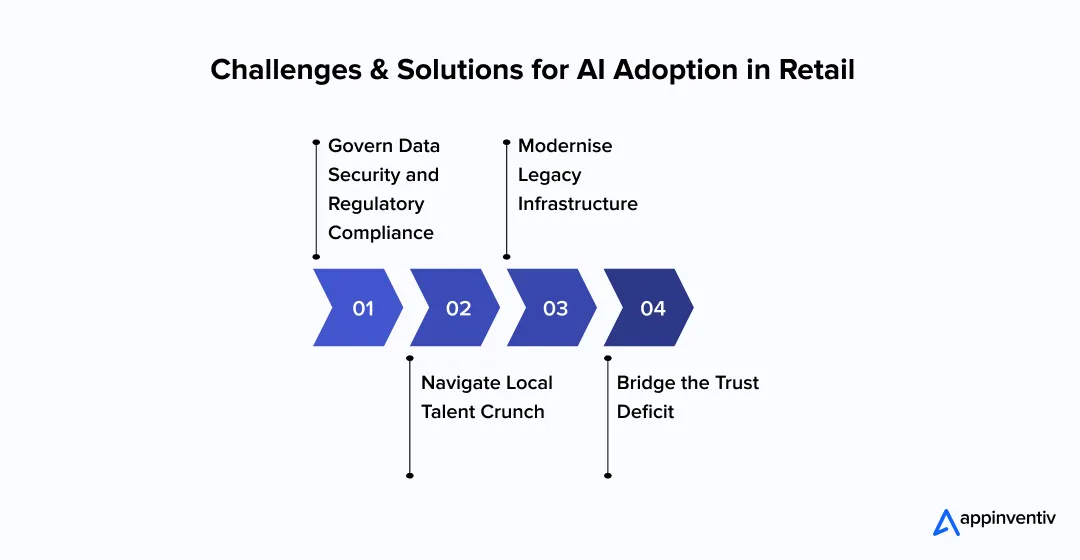
Govern Data Security and Regulatory Compliance
Challenge: Australian retailers operate under the intensifying scrutiny of the Privacy Act 1988 and the impending 2026 transparency mandates. Protecting sensitive consumer profiles from sophisticated cyber-threats while ensuring a “right to explanation” for automated pricing is a primary obstacle.
The Smart solution: Success requires robust encryption and local data residency to satisfy the Office of the Australian Information Commissioner (OAIC).
Major ASX-listed retailers now deploy AI-driven cybersecurity mesh architectures to safeguard their “Everyday” or “Flybuys” databases, ensuring compliance with the OAIC.
Modernise Legacy Infrastructure
Challenge: Many Australian retailers struggle with disconnected POS and warehouse systems that were never designed for real-time data streaming.
The Smart Solution: Outsource high-level services for developing AI agents in retail that focus on bridging these silos and upgrading legacy systems. This will ensure your technology stack can actually support advanced machine learning without incurring massive technical debt.
Bridge the Trust Deficit
With only 38% of Australians initially excited about AI, the primary challenge is building consumer confidence.
The Smart Solution: Success depends on moving from “black box” algorithms to transparent, value-led systems that demonstrate immediate benefit to the shopper. Retailers must align with the Australian Government’s National AI Plan, which emphasises ethical frameworks and consumer safety.
Navigate the Local Talent Crunch
Challenge: Competition for specialists is fierce, with ACS Australia’s Digital Pulse highlighting a gap of over 60,000 tech workers annually.
The Smart Solution: By partnering with a specialised custom AI development company in Australia, retailers can access world-class expertise and scale their operations without the $500k+ annual overhead of an in-house R&D team.
How Much Does It Cost to Implement AI in Retail in Australia?
The cost of implementing AI in retail in Australia typically ranges between AUD 70,000 and AUD 700,000 or more. Budgetary requirements fluctuate based on the depth of the technology stack integration and the complexity of the custom logic required.
| Project Scope | Estimated Cost (AUD) | Typical Use Cases |
|---|---|---|
| Basic | $70,000 – $150,000 | Smart Chatbots, Simple Recommendation Engines, Basic Demand Forecasting. |
| Intermediate | $150,000 – $350,000 | Custom Personalisation Engines, Multi-Channel Inventory Sync, Predictive Markdown Logic. |
| Enterprise | $350,000 – $700,000+ | Autonomous Agentic Systems, Computer Vision for Smart Stores, Full Supply Chain Orchestration. |
Cost Drivers and Incentives
- Data Preparation: Expect to allocate 20-30% of the budget to cleaning and structuring legacy data before it is “AI-ready.”
- On-Shore Compliance: Hosting data in local Sydney/Melbourne regions to meet sovereignty requirements can add a 10-15% premium to cloud infrastructure costs.
- R&D Incentives: Businesses should leverage the 43.5% R&D Tax Incentive provided by the Federal Government to offset development costs for novel, high-risk AI solutions.
Understand budget requirements, timelines, and expected ROI before you invest.
The Future of AI in Retail: What Lies in the Coming Years
The future of AI in the retail industry is shifting from simple predictive tools to “Agentic” systems that operate with true autonomy. According to Grand View Research, the Australian artificial intelligence in the retail market generated a revenue of $310.9 million in 2024 and is projected to soar to $1,990.6 million by 2030. This whopping market growth is driven by some core AI trends.
Agentic AI Age
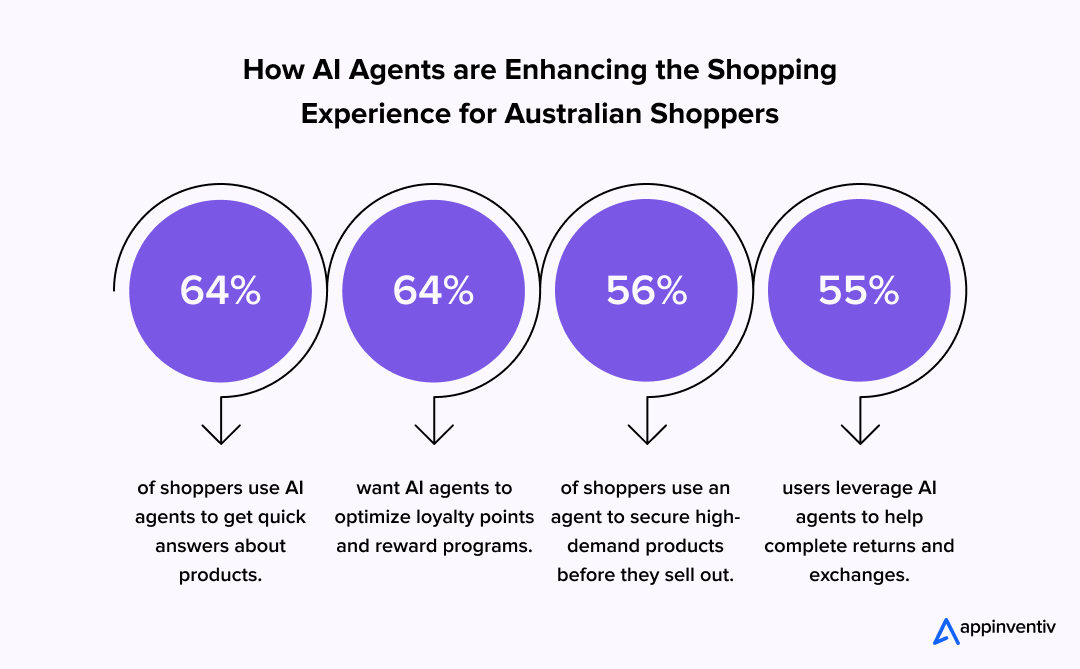
The Rise of Agentic AI in Retail
Moving beyond basic assistants, Agentic AI in retail Australia involves autonomous agents capable of negotiating with suppliers, managing stock reconciliations, and executing marketing pivots without human intervention.
As a 2025 Salesforce report notes, Australian and New Zealand (ANZ) retailers expect AI agents to transform customer engagement and growth, with 77% of respondents believing they’ll be essential for competition within a year. In response, 74% plan to increase their AI spending this year.
The Generative AI Revolution
Moving beyond simple text, Generative AI in retail in Australia is revolutionising content at scale. 91% of ANZ retailers are now investing in Generative Al use cases in retail to create hyper-realistic virtual showrooms, automated high-fidelity product photography, and interactive 3D demos. This technology allows boutique brands to produce professional-grade marketing assets at a fraction of traditional costs, effectively democratising high-end digital presence.
AI Meets AR/VR
Retailers like Bunnings are expected to merge AI with Augmented and Virtual Reality (AR), allowing customers to “visualise” complex home projects or tech setups with real-time AI guidance on fit and compatibility.
Blockchain-Verified Authenticity
To meet the demands of the “Conscious Consumer,” AI will integrate with blockchain to provide immutable proof of ethical sourcing and carbon-neutral logistics, turning sustainability from a marketing claim into a verified data point.
AI with Internet of Things
The integration of AI with Internet of Things devices will create seamless omnichannel experiences. Customers will interact with retailers through voice, text, and visual interfaces across all touchpoints, with AI maintaining context and preferences throughout the journey.
Human + AI: The Future of Retail Work
AI in retail stores is not here to replace employees; it’s here to empower them. The future of retail in Australia is about humans and AI working together to deliver better results. Australian retailers who embrace this “human + AI” approach will build more resilient, innovative, and customer-centric businesses.
Implement AI in Retail Stores with Appinventiv
The transformation of artificial intelligence in retail in Australia isn’t a distant prospect; it is the current standard for market leadership. At Appinventiv, we bridge the gap between ambitious concepts and enterprise-grade execution. We provide end-to-end retail software development services designed to navigate the complexities of the Australian market, ensuring your transition to AI is seamless, compliant, and highly profitable.
Why Retail Giants Partner with Us:
- Proven Expertise: 1,600+ tech experts and a decade of delivering 3000+ digital assets, including 300+ AI-driven solutions and 400+ eCommerce platforms.
- Retail Pedigree: A portfolio including IKEA, Adidas, Edamama, 6th Street, Lite N’ Easy and YK Almoayyed, proving our ability to scale complex retail ecosystems.
- Award-Winning Innovation: Ranked Among APAC’s High-Growth Companies (by Statista & FT) for Two Consecutive Years
Ready to lead the AI revolution in Australian retail?
Don’t wait for the competition to define the next decade of your industry. Contact our Australian team today to discover how we can implement these proven AI strategies for your retail business.
FAQs
Q. How is AI used in retail in Australia?
A. In the Australian market, AI functions as a “performance multiplier” across the entire value chain. Major retail players use it for demand forecasting to reduce perishable waste, while others deploy it for dynamic pricing and automated inventory replenishment.
Beyond the back-end, it powers personalisation engines that tailor loyalty rewards and “Everyday” specials to individual shopping habits, ensuring marketing spend is hyper-targeted.
Q. What are the biggest AI use cases in Australian retail?
A. The highest-impact AI use cases in retail in Australia currently include:
- Intelligent Inventory Management: Synchronising source-to-shelf logistics to avoid “out-of-stocks.”
- Predictive Markdown Optimisation: Using machine learning to determine the exact discount needed to clear stock.
- Agentic Customer Service: Deploying autonomous agents that can resolve returns and delivery issues without human intervention.
- Fraud Mitigation: Leveraging real-time anomaly detection to secure high-volume digital transactions.
Q. How does AI improve customer experience in retail?
A. AI enhances the shopper’s journey by providing “Indispensability” and “Intimacy.” It removes friction through Visual Search (finding products via photos) and Voice Commerce. It also ensures customers only receive relevant offers, reducing “promo fatigue.”
In-store, it powers smart trolleys and mirrors, creating a seamless “phygital” experience that merges the convenience of online shopping with the tactile nature of physical stores.
Q. How can AI be used in retail stores in Australia?
A. AI in retail examples for Australian businesses often focus on physical store optimisation. Retailers use Computer Vision to monitor shelf health and analyse customer footfall heatmaps to improve store layouts. Additionally, AI-driven Workforce Management tools predict peak shopping hours (based on local events or weather) to ensure rosters are perfectly aligned with customer volume, reducing wait times at the checkout.
Q. What are the benefits of AI in retail for Australian businesses?
A. AI acts as a “performance multiplier” for Australian retailers by addressing high local operating costs and vast logistics distances. Key benefits include:
- Margin Protection: Reduces waste through precise demand forecasting and automated markdown logic.
- Operational Efficiency: Offsets high labour costs by automating warehouse picking and staff rostering.
- Customer Loyalty: Drives “segment-of-one” personalisation, increasing basket sizes and repeat purchases.
- Supply Chain Resilience: Optimises “last-mile” delivery routes to bypass congestion in major hubs like Sydney and Melbourne.
- Loss Prevention: Uses computer vision to reduce in-store shrinkage at self-checkouts without adding friction for shoppers.
Q. What are the current AI trends impacting Australian retail businesses?
A. Australian retail AI trends focus on driving margin growth, combatting retail shrinkage, and capturing automated sales. Key trends of AI for retail include deploying computer vision for self-checkout loss prevention, launching AI-powered Retail Media Networks to monetise loyalty data, and adopting machine-readable product catalogs for emerging AI shopping agents. Furthermore, businesses rely heavily on AI in retail commerce for predictive workforce scheduling to maintain strict compliance with complex Fair Work awards.


Fast 2-minute response, fully NDA-protected.
The AI ROI Crisis: Why Enterprises Are Struggling to Prove Value and How to Fix It
Key takeaways: AI ROI is a capital-allocation question. Boards want payback periods and P&L impact. AI ROI challenges rarely have a single cause. Data, legacy systems, use-case choice, ownership and stalled pilots compound each other. Choose two or three outcome metrics per use case, set the baseline first, and report in dollars. Make every further…

Retrieval Augmented Generation in Australia: Architecture, Implementation and Cost
Key takeaways: RAG grounds LLM answers in approved content, improving reliability without retraining a model. Data quality and access permissions decide production outcomes more than the model. Indicative build costs run from AUD 70,000 to 700,000, driven by data and integrations. Measure value against a pre-deployment baseline, separating realised benefits from projected savings. A general-purpose…

The Multiplier Effect of AI Agents: The Rise of AI Swarms
Key takeaways: AI agent swarms coordinate specialized agents to solve complex problems that may be difficult for a single agent to handle effectively. More agents do not automatically mean better outcomes. Swarms deliver value when work can be divided, executed in parallel, and coordinated toward a shared objective. Enterprise readiness depends on governance. Clear accountability,…