































AI in Saudi Healthcare: Benefits, Use Cases, and Costs

 Share -


- 01AI-Driven Healthcare Vision in Saudi Arabia
- 02Core Pillars of Saudi AI-Healthcare Platforms
- 03Benefits of AI-Powered Healthcare Platform Development in Saudi Arabia
- 04Essential Features of an AI Healthcare Platform
- 05AI Use Cases Across Saudi Arabia's Healthcare Ecosystem with Real-Life Examples
- 06The Cost of AI Healthcare Platform Development in Saudi Arabia
- 07Factors That Influence AI Healthcare Platform Development Costs in the Saudi Region
- 08Challenges in AI Healthcare Platform Development and How to Overcome Them
- 09Initiate Your AI-Powered Healthcare Journey in the Saudi Kingdom With Appinventiv
- 10FAQs

Key takeaways:
- Saudi Arabia is moving AI from experimentation to enterprise healthcare transformation, backed by Vision 2030, SDAIA, MOH, and national digital health goals.
- Successful AI healthcare platforms in Saudi Arabia need PDPL compliance, secure data handling, and responsible AI principles from the start.
- AI platforms must connect with EHRs, HIS, PACS, labs, insurers, and NPHIES to create a unified healthcare ecosystem.
- From faster diagnosis and remote monitoring to workflow automation and claims efficiency, AI can support both clinical and operational outcomes.
- In Saudi Arabia, AI healthcare platform development typically ranges from 80,000 (approx. SAR 300,000) for an MVP to $2,000,000+ (approx. SAR 7.5M+) for a large enterprise ecosystem, depending on complexity, integrations, and compliance needs.
Saudi Arabia is approaching healthcare modernization with a long-term vision. Rather than treating AI as a standalone innovation, the Kingdom is embedding it into the next generation of healthcare infrastructure, from clinical decision support and diagnostics to hospital operations and patient engagement.
That is why AI healthcare solutions have emerged as a global tech priority. In the context of Saudi Vision 2030, the country is making significant efforts to advance artificial intelligence in public services, particularly in the healthcare sector.
The push for intelligent healthcare technologies, spearheaded by the Saudi Data and AI Authority (SDAIA), the Ministry of Health, and the National Strategy for Data and AI, is driving the implementation of these technologies to enhance diagnosis, automate clinical workflows, and improve patient outcomes.
For healthcare organizations, it’s more than just a technology change. It is a chance to create smarter, more connected platforms that can make tangible differences across every aspect of care and meet the Kingdom’s long-term digital healthcare goals.
Let’s define the right AI strategy, implementation roadmap, and technology stack for your enterprise.

AI-Driven Healthcare Vision in Saudi Arabia
Saudi Arabia is taking a different path to healthcare AI than many countries around the world. The Kingdom is not adding another layer of innovation to the healthcare landscape with AI, but rather integrating it into its healthcare systems of tomorrow.
AI is emerging as a strategic capability, from national health data platforms to AI-powered medical diagnosis and intelligent hospital operations, helping to realize the nation’s long-term healthcare goals. This government-led momentum is creating unprecedented opportunities for AI healthcare platform development in Saudi Arabia.
Building healthcare AI in Saudi Arabia comes with its own set of expectations. Working with an experienced AI healthcare development company helps organizations address regulatory requirements while creating solutions that fit the needs of the Kingdom’s healthcare sector.
This has created a strong push towards the adoption of advanced healthcare AI solutions that must not only deliver better clinical outcomes but also meet national requirements for security, governance, and healthcare innovation.
Here are some of the key government initiatives driving AI healthcare in Saudi Arabia:
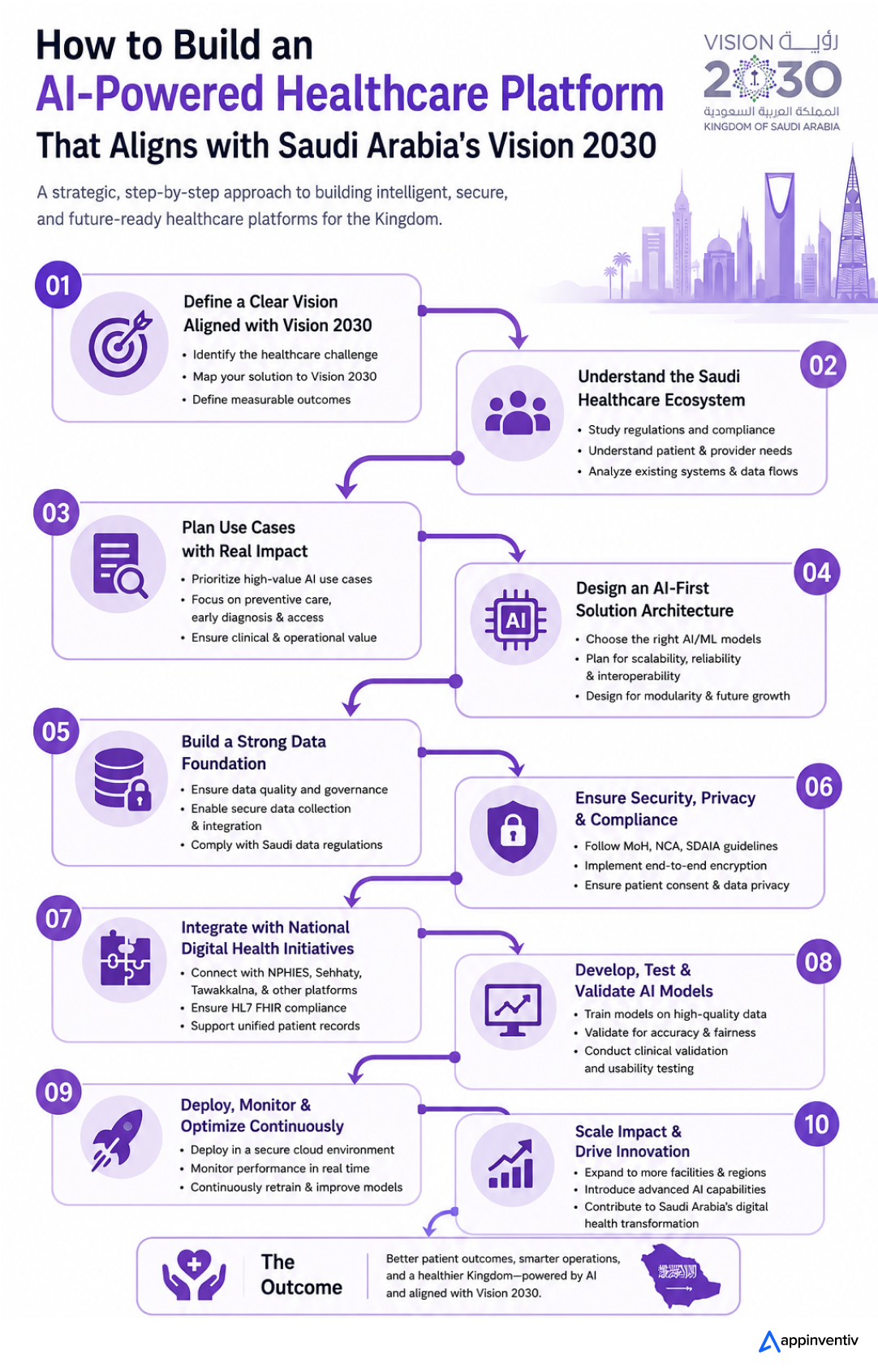
Vision 2030
Vision 2030 places health at the center of national transformation, accelerating investments in AI, digital health infrastructure, preventive care, and patient-centric health services. Appinventiv drives Saudi Vision 2030 with SaaS solutions by developing secure, scalable, and AI-enabled healthcare platforms that support the Kingdom’s digital health ambitions.
National Strategy for Data & AI (NSDAI)
Healthcare is one of the priority sectors the NSDAI focuses on developing and enhancing AI adoption, ensuring proper data governance, and boosting AI innovation in the Kingdom over the long term.
Saudi Data & AI Authority (SDAIA)
The Kingdom’s policy and framework for AI governance are defined by SDAIA’s Responsible AI Principles and data governance policies. Explainability, security, fairness, and accountability must be built into the AI healthcare software development process.
Ministry of Health (MOH)
The Ministry of Health leads the way on digital healthcare through programs on interoperability and connected AI-based health services. Apps designed for Saudi healthcare must be compatible with the MOH’s digital health ecosystem and with developing interoperability regulations.
Saudi FDA Innovative Medical Devices Pathway
AI software that performs clinical diagnosis, patient monitoring, or patient decision support can be considered Software as a Medical Device (SaMD). The SFDA’s Innovative Medical Devices Pathway is designed to help companies navigate this regulatory landscape to ensure that these AI-powered devices are available for clinical application.
Data Localization & PDPL Compliance
Saudi Arabia’s Personal Data Protection Law (PDPL) and the applicable data residency requirements must be followed by the applications used in healthcare. It impacts application architecture, cloud deployment, data storage, data encryption, user consent and cross-border data transfers.
MOH Healthcare Sandbox
Healthcare Sandbox by the Ministry of Health enables technology companies to pilot AI health tech applications in a safe environment prior to commercialization. It aids in the validation of interoperability, security, clinical performance and regulatory readiness and the mitigation of implementation risks.
What stands out about Saudi Arabia’s AI healthcare strategy is that policy, regulation, infrastructure and investments are moving in tandem. This integrated approach streamlines innovation obstacles and provides healthcare organizations with a well-defined course to create robust, intelligent platforms that are primed for the next era of healthcare transformation in the Kingdom.
Core Pillars of Saudi AI-Healthcare Platforms
The Saudi AI-healthcare platforms are designed around a few core pillars that strengthen the healthcare operations, patient care management and staff coordination in the major medical units. Here’s a detailed look at those key pillars of AI healthcare solutions.
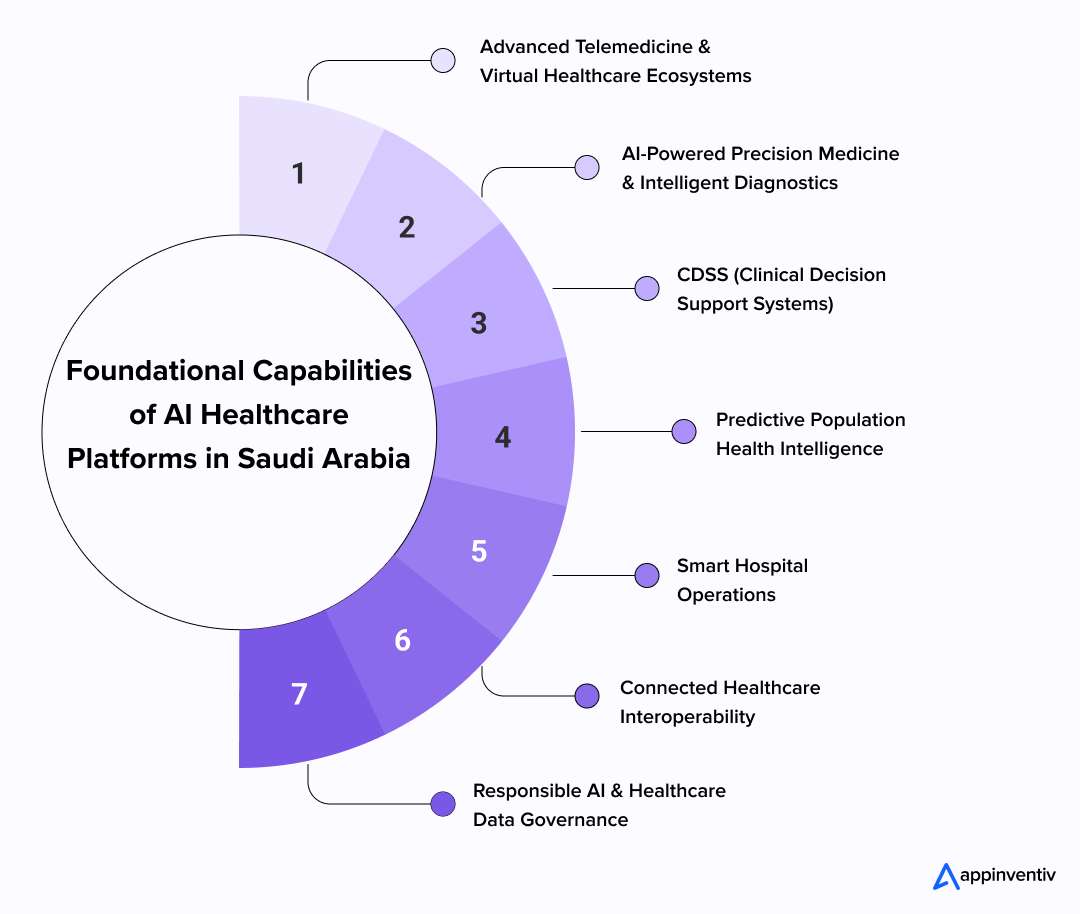
Advanced Telemedicine & Virtual Healthcare Ecosystems
Through virtual appointments, remote patient monitoring, AI triage, and intelligent care coordination, AI is extending care beyond hospital walls to improve access to health care and patient care throughout the Kingdom.
AI-Powered Precision Medicine & Intelligent Diagnostics
AI tools are used to analyze genomic information, imaging, laboratory results, and patient histories to enable personalized treatment, early disease detection, and improved clinical decisions.
CDSS (Clinical Decision Support Systems)
AI supports physicians in making evidence-based recommendations, assessing patient risks, providing drug interaction alerts, and treatment planning, all of which help to ensure that the physician makes all decisions.
Predictive Population Health Intelligence
AI uses vast health information to detect patterns in disease, forecast patient needs and enhance preventative health initiatives in line with Vision 2030.
Smart Hospital Operations
AI powers resource utilization, staff scheduling, operating theatres, inventory management, and patient flow, contributing to healthcare organizations’ operational efficiency.
Connected Healthcare Interoperability
Modern platforms seamlessly connect with NPHIES, EHRs, HIS, PACS, laboratory systems, insurers and wearable devices, thereby forming an integrated healthcare environment.
Responsible AI & Healthcare Data Governance
AI platforms are built with the principles of PDPL and SDAIA’s Responsible AI Principles, alongside SFDA regulations, to safeguard patient information and promote trust in the healthcare landscape.
Benefits of AI-Powered Healthcare Platform Development in Saudi Arabia
The Saudi healthcare industry is on the brink of an AI-first era, driven by Vision 2030, NSDAI, NPHIES, PDPL, and the Ministry of Health’s digital health strategies. For organizations planning this shift, choosing the right AI healthcare development company is an important first step. Hiring the right partner can offer you a host of benefits as you initiate your AI healthcare solution development.
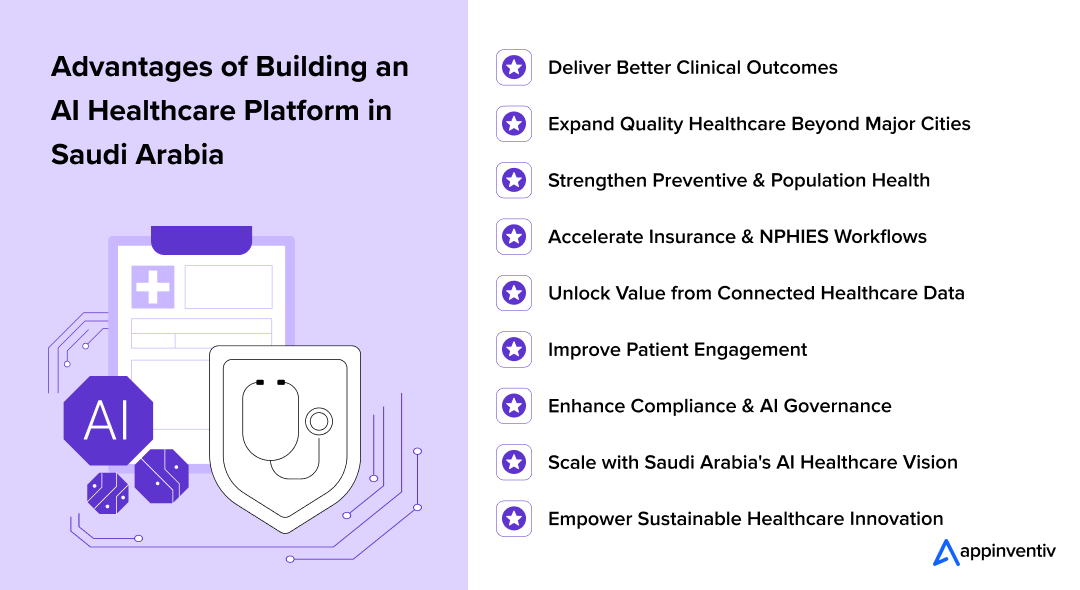
Deliver Better Clinical Outcomes
AI can help doctors process medical records, diagnostics, and patient information more quickly, potentially leading to earlier disease detection, more precise diagnoses, and tailored treatment plans.
Expand Quality Healthcare Beyond Major Cities
Specialist care is more readily available throughout the Kingdom, with the help of AI-driven telemedicine, remote monitoring and virtual health assistants, which help patients see specialists outside the large city health centres.
Strengthen Preventive & Population Health
In line with the 2030 vision of enhancing the health outcomes of the community, predictive analytics can help healthcare providers identify high-risk populations, predict disease trends, and enable prevention-focused healthcare.
Accelerate Insurance & NPHIES Workflows
Healthcare organizations can leverage AI to streamline the claims process, reduce coding and verification time, detect fraud, and facilitate payer-provider interactions within Saudi Arabia’s NPHIES ecosystem.
Unlock Value from Connected Healthcare Data
AI healthcare solutions can connect with EHRs, HIS, laboratories, pharmacies, imaging systems and wearable devices to bridge fragmented clinical data and provide actionable insights for speeding up decision-making.
Improve Patient Engagement
AI-powered assistants offer the benefits of appointment scheduling, medication reminders, post-discharge follow-ups, and Arabic-language assistance, enhancing the patient journey and promoting a more connected and personalized healthcare experience.
Enhance Compliance & AI Governance
The AI platforms for healthcare in the modern era are developed with regard to Saudi regulatory requirements that include PDPL, NPHIES, and SDAIA’s Responsible AI Principles, while supporting the regional requirements of other healthcare ecosystems within the GCC region.
Scale with Saudi Arabia’s AI Healthcare Vision
Platforms equipped with AI will allow for the flexibility to leverage new technologies and maintain the Kingdom’s healthcare vision and ambitions moving forward, such as SEHA Virtual Hospital, smart hospitals in Riyadh, digital health initiatives in Jeddah and innovation projects in NEOM.
Empower Sustainable Healthcare Innovation
AI is increasingly not just a competitive edge for building healthcare software in the Middle East, but it’s a necessity. It serves as the backbone for providing scalable, data-informed healthcare that meets national AI goals, changing patient needs, and the investments being made in intelligent healthcare infrastructure in the region.
Partner with specialists who can turn your AI vision into secure, compliant healthcare solutions.
Essential Features of an AI Healthcare Platform
Healthcare platforms are likely to be more than mere repositories of patient data as Saudi Arabia invests more in implementing AI in health and wellness under Vision 2030. Below are some of the features that every modern AI healthcare platform should have.
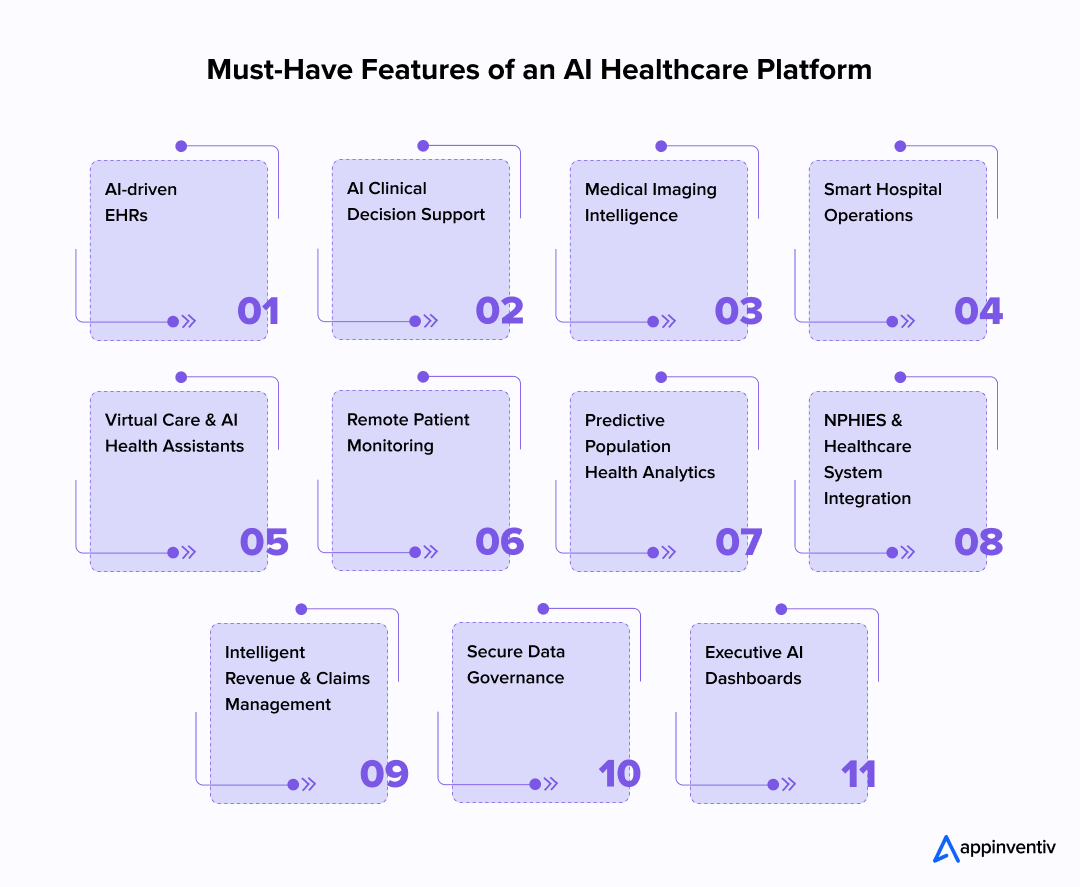
AI-Driven EHRs: Transform patient records into intelligent clinical profiles, with AI-powered summaries, contextual insights, and quick access to medical history.
AI Clinical Decision Support: Assist doctors in real-time diagnostics, treatment recommendations and patient risk scoring, helping them to make informed decisions.
Medical Imaging Intelligence: Use AI to analyze X-rays, CT scans, and MRIs that aids radiologists in quickly identifying abnormalities and prioritizing urgent cases.
Smart Hospital Operations: Leverage AI demand forecasting and workflow automation for optimized appointments, occupancy, staffing, and resource planning.
Virtual Care & AI Health Assistants: Utilize AI-powered virtual assistants to schedule appointments, remind patients of their medication schedules, evaluate symptoms, and communicate with patients in Arabic.
Remote Patient Monitoring: Connect wearables and medical devices to help track chronic conditions, ensuring proactive care beyond the hospital walls.
Predictive Population Health Analytics: Access real-time clinical and population information to detect disease patterns, predict health service needs, and assist in the provision of preventive health services.
NPHIES & Healthcare System Integration: Provide smooth integration with NPHIES, EHRs, HIS, labs, pharmacies, insurance companies and other healthcare applications.
Intelligent Revenue & Claims Management: Use automation to process insurance verification, insurance coding, and claim validation, and to ease financial operations and administration.
Secure Data Governance: Protect sensitive patient data using enterprise-grade security, AI governance, and compliance with Saudi PDPL and healthcare regulations.
Executive AI Dashboards: Empower healthcare leaders with real-time insights into clinical performance, hospital operations, patient outcomes, and resource usage through AI-powered analytics.
AI Use Cases Across Saudi Arabia’s Healthcare Ecosystem with Real-Life Examples
From quicker diagnosis and virtual consultations to hospital management and population health, AI is providing healthcare providers with practical solutions to enhance patient care and improve operational efficiency. Let’s see some of the top use cases with real-life examples:
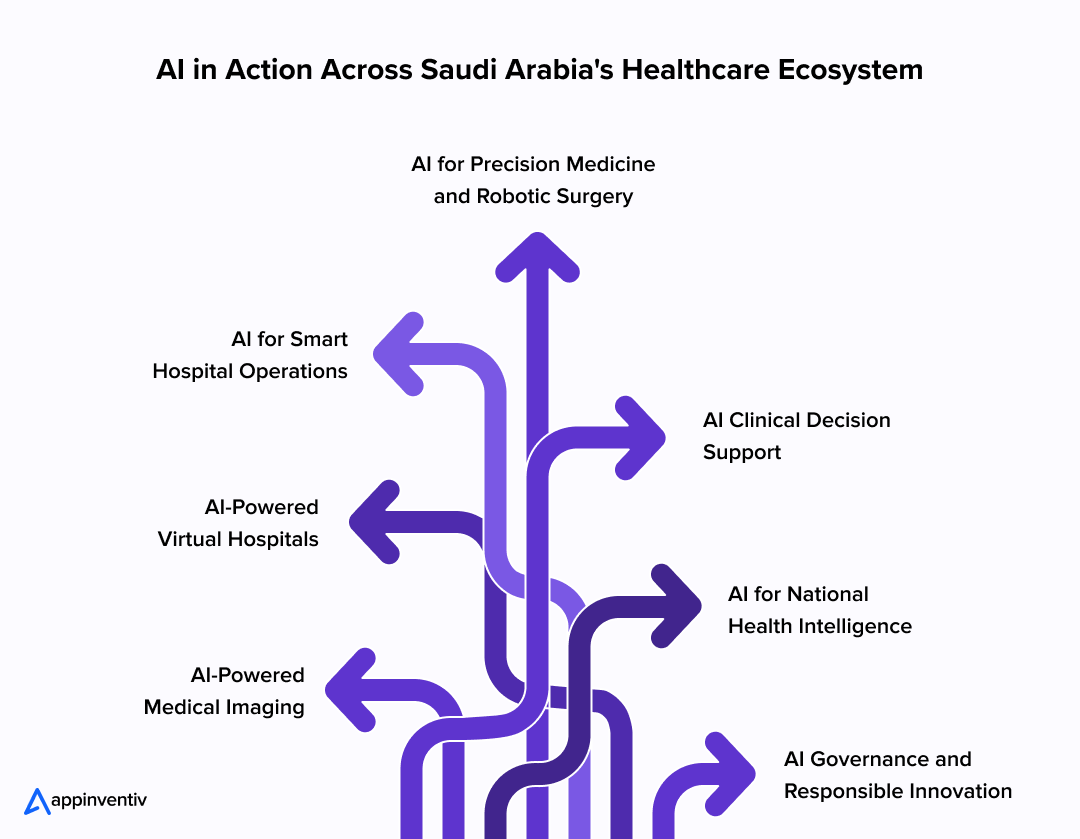
AI-Powered Medical Imaging
Thousands of images are produced daily in medical imaging, requiring processing with the utmost accuracy and at high speed. AI provides a helpful assist by flagging up any possible abnormalities, prioritizing urgent cases, and adding another dimension to the radiologist’s clinical knowledge. It accelerates the review process and facilitates consistency, particularly during peak patient load periods.
Real-Life Example: Makkah Health Cluster implemented the AI-based i-Selfie system, a contactless ECG and vital sign assessment system, during the Hajj. The technology enabled medical teams to screen pilgrims faster and reduce screening delays.
AI-Powered Virtual Hospitals
Specialists are not always available in all parts of the Kingdom. AI-powered virtual hospitals are filling that void by bringing doctors, doctors’ associates, and patients together in one digital platform. This way, complex cases can be seen remotely, and patients do not have to make a long journey.
Real-Life Example: Seha Virtual Hospital connects over 240 healthcare facilities across Saudi Arabia, leveraging AI and telemedicine for remote patient consultations in various medical areas.
AI for Precision Medicine and Robotic Surgery
Patients don’t always react to treatment in the same way. AI aids in analyzing genomic data, clinical history, and diagnostic information to create more accurate treatment plans for clinicians. It also aids in robotic surgeries, enhancing the precision and surgical planning for complex procedures.
Real-Life Example: King Faisal Specialist Hospital & Research Centre (KFSHRC) leverages AI in various applications, including precision medicine, genomics, digital pathology, and advanced robotic surgery, solidifying its reputation as a premier specialized care hub in the Kingdom.
AI for Smart Hospital Operations
Every day, hospitals have thousands of moving parts. There needs to be a seamless integration of patient admissions, bed availability, staff schedules and operating rooms. The AI healthcare solutions constantly review operational data to identify bottlenecks, forecast demand and assist administrators in making faster decisions, not just based on manual planning.
Real-Life Example: Ministry of National Guard Health Affairs (MNGHA) has implemented AI-based disease prediction models, digital twins, and intelligent hospital systems to enhance planning and day-to-day hospital management.
AI Clinical Decision Support
Physicians frequently have to scan through vast amounts of patient data in a short time. AI aggregates medical records, lab results, imaging data, clinical guidelines, and more into one view, enabling doctors to detect potential hazards and aiding in quicker clinical choices. The ultimate decision will always be with the care team.
Real-Life Example: The Ministry of Health announced its AI Physician program to help physicians with accurate diagnosis and enhance clinical decisioning in Saudi hospitals.
AI for National Health Intelligence
Data in the healthcare industry is much more valuable when it’s linked. AI technology can detect disease patterns, track healthcare trends, and offer insights to aid in disease prevention and long-term healthcare planning. These inputs also assist policymakers in better distribution of health resources in the Kingdom.
Real-Life Example: The Saudi Health Council is developing a connected health data ecosystem, leveraging national health data initiatives, which will enable improved planning and integrated care.
AI Governance and Responsible Innovation
In an era where AI is increasingly emerging in healthcare, good governance is just as important as innovation. The importance of having well-defined policies regarding data privacy, model transparency, and responsible AI usage in healthcare settings to foster trust and comply with regulatory standards. The need for clear policies in healthcare organizations on data privacy, model transparency, and responsible AI usage to ensure trust and regulatory compliance.
Real-Life Example: The Saudi Data and AI Authority (SDAIA) has developed a set of national AI governance frameworks and data policies to direct the responsible application of AI in various sectors, such as healthcare.
The Cost of AI Healthcare Platform Development in Saudi Arabia
The AI-powered healthcare platform development cost in Saudi Arabia ranges from $80,000 (approx. SAR 300,000) for an MVP to $2,000,000+ (approx. SAR 7.5M+) for a major enterprise healthcare ecosystem. Final investment would rely on AI capacities, clinical workflows, integrations with hospitals, insurance, and national healthcare systems, interoperability requirements, cloud infrastructure, and cybersecurity.
Below is an approximate cost breakdown for each stage of the development process.
| Platform Type | Common Scope | Typical Investment |
|---|---|---|
| AI Healthcare MVP | For startups and healthcare providers testing a new idea. Usually includes patient registration, appointment scheduling, telemedicine, an AI chatbot, basic EHR integration, and an admin dashboard. | USD: $80,000-$150,000 SAR: 300,000-560,000 |
| AI-Enabled Healthcare Platform | Includes remote patient monitoring, AI-assisted clinical workflows, patient portals, analytics dashboards, and integrations with hospital systems. | USD: $150,000-$350,000 SAR: 560,000-1.31M |
| Enterprise Healthcare Platform | Designed for hospitals, healthcare groups, and insurance providers requiring AI clinical decision support, multilingual support, role-based access, advanced reporting, and enterprise integrations. | USD: $350,000-$700,000 SAR: 1.31M-2.63M |
| National-Scale AI Healthcare Ecosystem | Ideal for multi-hospital networks, government healthcare programs, or enterprise health systems. Includes custom AI models, medical imaging AI, predictive analytics, population health management, interoperability, and enterprise-grade security. | USD: $700,000-$2M+ SAR: 2.63M-7.5M+ |
Note: The SAR figures are approximations based on 1 USD = 3.75 SAR. The real project costs may differ according to the complexity of the AI implementation, the integration needs, the deployment model, and the size of the healthcare organization. By connecting with a reliable AI healthcare development company in the region, you can get a complete cost estimate.
Also Read: Cost to Build a Healthcare App Like Sehhaty
Factors That Influence AI Healthcare Platform Development Costs in the Saudi Region
The development cost of an AI healthcare platform varies depending on the technical complexity, AI functionality, and the needs of the dynamic healthcare landscape in Saudi Arabia. The following factors have the greatest impact on the overall investment.
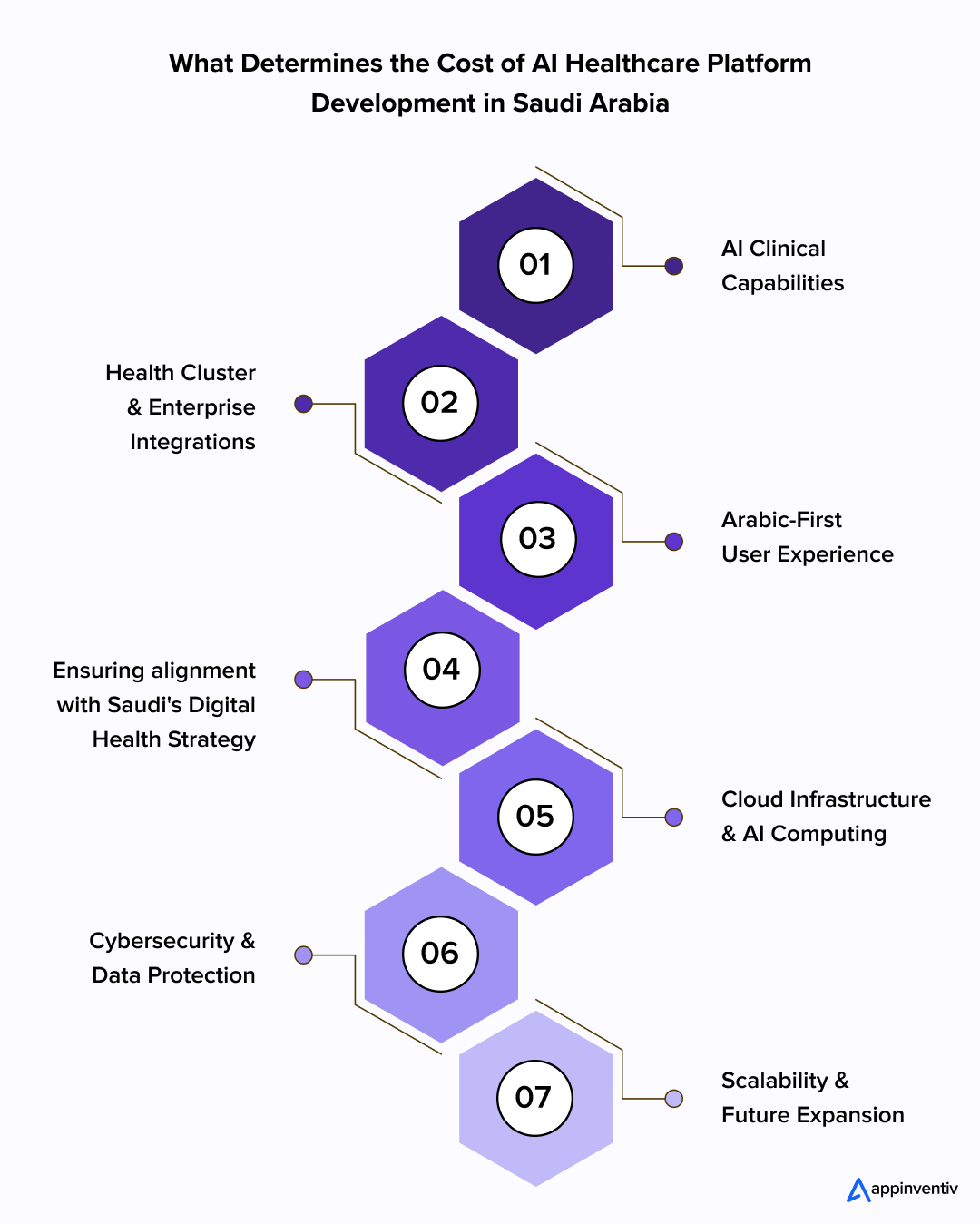
AI Clinical Capabilities
The greater the complexity of the AI capability (e.g., clinical decision support, medical imaging, predictive analytics, precision medicine, etc.), the higher the development, validation, and infrastructure costs.
Health Cluster & Enterprise Integrations
Integrating AI platforms with Health Clusters, EHRs, HIS, PACS, labs, pharmacies, and insurance systems involves a significant amount of planning, testing, and integration.
Arabic-First User Experience
Bilingual workflows, Arabic medical terms, right-to-left (RTL) interfaces, and multilingual AI assistants increase design and AI creation time.
Ensuring alignment with Saudi’s Digital Health Strategy
These platforms are typically more complex in terms of workflow and system architecture and are used to facilitate virtual care, preventive health, and connected health services.
Cloud Infrastructure & AI Computing
Scalable cloud infrastructure, GPU resources, and monitoring are essential for various AI models to be hosted, for healthcare data to be processed in real time, and for high availability.
Cybersecurity & Data Protection
The integration of advanced security features, such as encryption, secure APIs, and identity management, among others, which are crucial for healthcare platforms, adds to the implementation costs.
Scalability & Future Expansion
The potential for future AI use, further healthcare facilities, and an increasing number of patients will necessitate a more extensive initial engineering effort, but will also save redevelopment costs.
Let’s evaluate your project scope, NPHIES integrations, and AI capabilities to determine the expected investment.

Challenges in AI Healthcare Platform Development and How to Overcome Them
Not only are you training accurate models with AI, but you are also building an AI healthcare platform. Clinical usability, compliance, interoperability, and adoption all need to come together, and that takes the experience of a capable AI development company in Saudi Arabia. Some of the most frequent challenges that healthcare organizations encounter, along with practical solutions to handle these.
| Challenge | How to Overcome It |
|---|---|
| Integrated Healthcare Data | Integrate and connect EHRs, HIS, Laboratory, Imaging, Wearables, and third-party applications through standards like HL7 FHIR and NPHIES to create a single data architecture. |
| Legacy System Integration | Create API-first systems that support legacy infrastructure and integrate seamlessly with existing hospital platforms while maintaining the continuity of clinical operations. |
| AI Model Accuracy & Bias | Train AI models using diverse, high-quality clinical datasets and validate them regularly. Maintain a continuous feedback loop between AI models and clinicians, with physicians reviewing AI recommendations to improve reliability over time. |
| Regulatory Compliance | Integrate compliance requirements, such as PDPL, SDAIA’s Responsible AI Principles, and SFDA regulations, into the software development lifecycle instead of treating compliance as a post-development activity. |
| Secure Patient Data Privacy & Security | Protect sensitive health data through encryption, role-based access control, audit logs, secure APIs, and continuous threat monitoring across the platform. |
| Clinical Adoption | Design AI systems that fit naturally into clinical workflows, provide explainable recommendations, and keep physicians in control of all medical decisions. |
Initiate Your AI-Powered Healthcare Journey in the Saudi Kingdom With Appinventiv
Saudi Arabia’s journey of healthcare innovation is not just about implementing individual AI solutions but about creating a network of intelligent, connected care. AI technologies like multimodal AI, agentic AI, digital twins, ambient clinical intelligence, federated learning, and GenAI-powered clinical copilots will transform the landscape of diagnosis, care coordination, hospital operations, and population health.
As these evolve, healthcare platforms will require a fusion of responsible AI governance, scalable infrastructure, secure interoperability and clinical intelligence.
Appinventiv is the trusted partner that empowers healthcare firms to create future-ready platforms that support Saudi Arabia’s digital health goals, Vision 2030 goals, and the evolving healthcare landscape. We bring together cross-functional teams of AI engineers, healthcare domain experts, cloud architects, and regulatory specialists to provide intelligent, scalable solutions.
Our expertise is reflected in successful digital healthcare projects such as Soniphi, Health-e-People, and DiabeticU, where we have delivered AI-driven innovation across complex, enterprise-grade environments.
For instance, for DiabeticU, we built an AI-powered diabetes management platform around the way people actually manage the condition, bringing together glucose monitoring, medication reminders, activity tracking, and conversational support in a single experience.
Backed by our end-to-end app development services in Saudi Arabia, we help organizations transform ambitious healthcare ideas into secure, intelligent, and high-performing AI healthcare solutions.
Ready to build the next generation of AI healthcare platforms in Saudi Arabia? Connect with our experts to start your journey.
FAQs
Q. Why is Saudi Arabia investing heavily in AI-powered healthcare platforms?
A. Here are some of the reasons why the Saudi Kingdom is investing in AI-powered healthcare systems:
Vision 2030 Goals: Take digital transformation to a new speed and create a smarter and more resilient health care system.
Preventive Healthcare: Move beyond the “reactive treatment” to “early diagnosis and proactive patient care.
Better Access to Care: Expand specialist services through virtual healthcare and remote consultations.
Healthcare Efficiency: Enhance hospital processes, resource use and clinical workflow through AI.
Innovation & Investment: Make Saudi Arabia a place for digital health and AI innovations in the region.
Improved Patient Outcomes: Leverage data to enable quicker diagnoses and tailored treatment.
Q. Which healthcare sectors in Saudi Arabia benefit the most from AI?
A. Here are the top healthcare sectors in Saudi Arabia that have highly benefited from the utilization of AI technologies:
- Radiology and medical imaging
- Oncology and cancer care
- Cardiology
- Primary healthcare
- Virtual hospital and telemedicine
- Emergency and critical care
- Pathology, laboratory diagnosis
- Pharmacy and medication management
- Management and administration of hospitals
- Data analytics for population health and public health
- Claims handling and health insurance
- Remote patient monitoring
Q. How much does it cost to develop an AI-powered healthcare app in Saudi Arabia?
A. The AI-powered healthcare platform development cost in Saudi Arabia typically ranges from $80,000 (SAR 300,000) for an MVP to $2 million+ (SAR 7.5 million+) for an enterprise-grade platform. The final investment depends on AI capabilities, healthcare integrations, multilingual support, cloud infrastructure, cybersecurity, and the overall complexity of the platform.
Q. How long does it take to develop an AI healthcare platform in Saudi Arabia?
A. The timeline of our industry-leading software development services in Saudi Arabia varies based on the scope and AI maturity of the platform. Basic AI healthcare solutions for healthcare range from 4 to 6 months, whereas for enterprise-class solutions that include advanced AI models, hospital integrations, patient portals, and analytics, the time spans from 10 to 18 months.
Q. Which advanced AI technologies are shaping the future of healthcare in Saudi Arabia?
A. Here’s the list of the top advanced AI technologies that are transforming healthcare sector in the Kingdom:
- Generative AI (GenAI)
- Agentic AI
- Multimodal AI
- Clinical Decision Support Systems (CDSS)
- Ambient Clinical Intelligence
- AI-powered Medical Imaging
- Digital Twins
- Federated Learning
- Predictive Analytics
- Natural Language Processing (NLP)
- Computer Vision
- AI-powered Remote Patient Monitoring
Q. Why choose Appinventiv for AI healthcare platform development in Saudi Arabia?
A. Here’s why you can rely on Appinventiv for software development services in Saudi Arabia:
- Healthcare-Focused AI Expertise: We create smart healthcare solutions for intricate clinical and operational processes.
- Saudi Market Understanding: Our solutions fit in with the Kingdom’s digital health goals and changing healthcare landscape.
- End-to-End Development: Whether it’s AI strategy or UX design, deployment or long-term support, we handle the entire product lifecycle.
- Enterprise-Grade Engineering: We build safe and scalable platforms that seamlessly integrate with current healthcare systems.
- Advanced AI Capabilities: Our teams are focused on Generative AI, predictive analytics, medical imaging AI, intelligent automation, and intelligent automation copilots.
- Long-Term Technology Partner: Our approach to AI healthcare platform development in Saudi Arabia extends beyond launch, helping organizations continuously enhance AI capabilities as healthcare needs evolve.


Fast 2-minute response, fully NDA-protected.

Automated Decision-Making in Australia: Benefits, Cost and Implementation
Key takeaways: Automated decision-making combines rules, algorithms, AI and human oversight to improve high-volume decisions. ADM programmes require privacy, security, auditability and accountability to be designed into architecture. ADM implementation costs typically range from AUD 70,000 to AUD 700,000 or more. Implementation starts with decision mapping, then moves through development, testing, controlled pilots and monitoring.…
AI Red Teaming Attack Strategies: Jailbreak, Crescendo, Base64 & More Explained
Key takeaways: Jailbreak testing must follow the full execution path from prompt and context to retrieval, tools, and enterprise APIs. Crescendo and adaptive attacks expose failures that single-turn testing misses by exploiting conversation history and model feedback loops. Base64 and Unicode tests probe gaps in normalization, tokenization, filtering, and decoding before adversarial input reaches model…

AI Agent Protocols: MCP, A2A, ACP & More Explained
Key takeaways: MCP connects agents to enterprise tools, while A2A lets independent agents delegate tasks without exposing internal logic. The protocol stack now spans agent access, collaboration, UI interaction, open networking, commerce, and machine-to-machine payments. A2A had support from 150+ organizations by April 2026, with 22,000+ GitHub stars and five production-ready SDK languages. Enterprise agent…