


































Automotive Software Development in the UAE: Solutions, Costs, and Use Cases

 Share -



- 01Why Is Automotive Software Development in the UAE Growing So Fast?
- 02What Are the Core Automotive Software Solutions in the UAE?
- 03What Automotive Software Features Actually Move the Needle?
- 04Which Automotive Software Development Technologies Power These Platforms?
- 05What Does the Automotive Software Development Process Look Like?
- 06How Much Does it Cost to Develop Automotive Software in the UAE?
- 07What Are the Top Automotive Software Development Use Cases in the UAE?
- 08What Are the Biggest Automotive Software Development Challenges?
- 09How Do You Keep Connected Vehicle Software Compliant and Secure in the UAE?
- 10How Should UAE Automotive Businesses Choose the Right Software Solution?
- 11How Can Appinventiv Help You Out?
- 12FAQs

Key takeaways:
- UAE smart mobility and EV initiatives are accelerating automotive software adoption across the region.
- The automotive software development cost typically ranges from AED 330,000 to over AED 1.8 million, depending on project scope.
- Telematics, EV charging, fleet management, and predictive maintenance deliver the highest business impact.
- AI, IoT, 5G, and cloud technologies are powering secure, connected, and software-defined vehicles.
- Building with UAE PDPL, ISO, and UNECE compliance from day one ensures scalable and future-ready automotive platforms.
Take a look at Sheikh Zayed Road. Most of those cars are software on wheels now. That shift isn’t coming; it’s here, and it’s already sorting the winners from the also-rans across the Emirates. Which is exactly why automotive software development in the UAE has gone from nice-to-have to a boardroom line item.
The numbers back it up. Worldwide, the automotive software and electronics market is heading for roughly AED 1.7 trillion by 2030. Closer to home, the UAE automotive retail market was worth about AED 25.9 billion in 2023 and is on course for AED 92.4 billion by 2032. So yes, the money is moving, and the window to get ahead is open right now.
This one is for the decision-makers who have no patience for theory. You’ll get the solutions that actually earn their keep, honest cost ranges in dirhams, how the build really goes, the use cases paying off today, and the compliance you cannot skip. No filler. Let’s dig in.
Why Is Automotive Software Development in the UAE Growing So Fast?
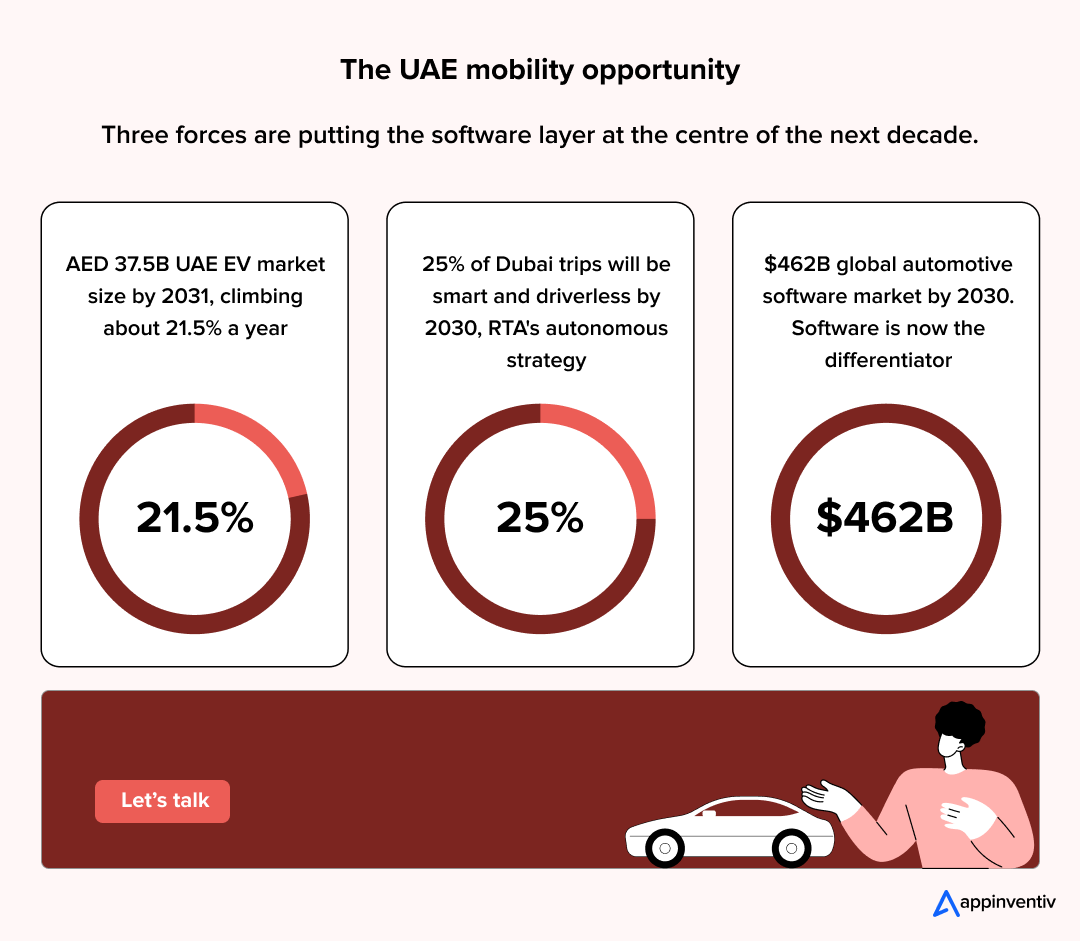
The push is coming from the very top. Dubai’s Roads and Transport Authority wants 25% of all trips to be smart and driverless by 2030, a target expected to unlock AED 22 billion in annual economic benefits. That single policy is pulling autonomous systems, connected infrastructure, and a whole stack of software onto roads that carried none of it a decade ago.
Electrification is the second engine. The UAE hybrid and electric vehicle market stood at about AED 11.6 billion in 2025 and is on course for AED 37.5 billion by 2031, growing at roughly 21.5% a year. Every one of those vehicles needs charging software, battery management, and telematics tuned for Gulf conditions, where 50-degree summers punish batteries in ways European code never planned for.
There is a national tailwind too. The country wants its digital economy to climb from 12% to 20% of non-oil GDP by 2030, and mobility is a headline sector in that plan. Clearly, the ground is fertile. The operators who build now will own the customer relationship long before the market matures.
What Are the Core Automotive Software Solutions in the UAE?
Before you spend a single dirham, you need clarity on what you are actually building. The automotive software solutions in the UAE fall into a handful of categories, and most serious platforms blend two or three of them.
| Solution type | What it does | Who needs it |
|---|---|---|
| Telematics and connected car | Real-time vehicle data, GPS, driver behaviour, remote diagnostics | Fleets, insurers, OEMs |
| Fleet management | Route optimisation, fuel and energy tracking, maintenance scheduling | Logistics, taxi, delivery |
| EV charging and energy | Charge scheduling, load balancing, billing and roaming | Charge point operators, EV fleets |
| Dealer and inventory | Livestock, pricing, sales workflows, service booking | Dealerships, distributors |
| Infotainment and in-car apps | Navigation, media, payments, connectivity | OEMs, mobility ventures |
| ADAS and autonomous | Sensor fusion, perception, decision logic | AV programmes, R&D units |
Two categories deserve a closer look for local operators. The first is automotive inventory management software, which has quietly become the backbone of a profitable dealership. When your showroom in Deira and your service centre in Abu Dhabi share one live view of stock, parts, and pricing, you stop bleeding sales to guesswork. That is precisely where Dealer Management Systems earn their keep.
The second is electric vehicle software. Charging, billing, and fleet coordination sit at the centre of the transition, and getting them right is what separates a smooth rollout from a stalled one. Purpose-built Electric Vehicle Software Development Services are now a competitive weapon rather than a back-office cost.
What Automotive Software Features Actually Move the Needle?
Feature lists get bloated fast. In practice, these automotive software features carry the most weight for UAE operators, and we would prioritise them in roughly this order.
- Real-time telematics and remote diagnostics so problems surface before a vehicle strands your customer.
- Over-the-air (OTA) updates so you can patch and improve without recalling the whole fleet.
- Role-based access and multi-language support, Arabic and English at a minimum.
- Predictive maintenance powered by machine learning cuts downtime and parts waste.
- Secure payments and billing tuned to local gateways and VAT rules.
- Geofencing and route intelligence built around Salik zones and Emirates-wide logistics.
- Battery and thermal management for EVs, sized honestly for Gulf heat.
- Compliance-ready logging and audit trails, because regulators here do ask.
The real differentiator is rarely one feature. It is how cleanly they talk to each other. Look for a competitive area to find the right teams of experts.
For instance, an AI development company in Dubai can help you build the thread that ties predictive maintenance, driver scoring, and energy optimisation into a single system that keeps learning from your own data.
But that applies to Abu Dhabi, Sharjah, or any other area you find accessible as long as your development partners are qualified.
Which Automotive Software Development Technologies Power These Platforms?
The stack has matured, and the choices you make here decide how far your platform can stretch. These are the automotive software development technologies forming the modern backbone.
| Technology | Role in the build |
|---|---|
| Artificial intelligence and ML | Perception, prediction, personalisation, anomaly detection |
| Internet of Things (IoT) | Sensor networks, V2X, continuous real-time vehicle data |
| 5G connectivity | Low-latency V2X, OTA at scale, live streaming from vehicles |
| Cloud and edge computing | Central intelligence with on-vehicle processing for split-second calls |
| Digital twins | Virtual testing of vehicles and networks before physical rollout |
| Blockchain | Tamper-proof service history, parts provenance, secure payments |
| Software-defined architecture | Decoupling features from hardware for continuous upgrades |
A quick word on where this is heading. The industry is leaning hard on Automotive IoT for sensing, 5G and beyond in Automotive for the connective tissue, and Software-Defined Vehicles so features live in code and roll out over the air. Designing for that model now saves a painful re-platforming later.
What Does the Automotive Software Development Process Look Like?
A predictable automotive software development process is what keeps budgets honest and timelines real. Here is the sequence and what each stage is actually for.
| Phase | Focus | Typical duration |
|---|---|---|
| 1. Discovery and feasibility | Requirements, market fit, compliance mapping, architecture | 2 to 4 weeks |
| 2. UX and technical design | Wireframes, data models, security design, integration plan | 3 to 6 weeks |
| 3. Development and integration | Coding, hardware integration with ECUs and sensors, API work | 3 to 6 months |
| 4. Testing and validation | Functional, security, HIL, SIL and compliance checks | 4 to 8 weeks, in parallel |
| 5. Deployment | Phased rollout, OTA setup, monitoring | 2 to 4 weeks |
| 6. Support and iteration | Updates, scaling, new features | Ongoing |
Do not skimp on stage four. Testing and validation are where compliance is won or lost, and in this industry, a shortcut is a shortcut to a recall. To speed up, find a firm that uses AI-powered efficiency.
We have a proven strategy in place that has helped clients achieve the best digital products in a significantly lesser time.
How Much Does it Cost to Develop Automotive Software in the UAE?
Now, the question every board asks first. The automotive software development cost in the UAE depends on scope, complexity, integrations, and the team you build with. There is no flat rate, but there are honest ranges.
The budget typically ranges between $90,000 and $500,000+ (roughly AED 330,000 to over AED 1.8 million). The final investment depends on several factors, including the software’s complexity, the features and integrations required, and the geographic location of the development team you choose.
Here is how the cost to develop automotive software in the region tends to break down by build type, in dirhams.
| Build type | Indicative cost (AED) | Notes |
|---|---|---|
| Basic to mid-complexity | 130,000 to 185,000 | Single-purpose apps, limited integrations |
| Fleet or telematics platform | 330,000 to 920,000 | Real-time data, dashboards, multiple integrations |
| EV charging and energy | 370,000 to 1.1 million | Billing, load balancing and roaming |
| Automotive ERP or inventory | 185,000 to 3.7 million+ | Scales with modules and sites |
| Autonomous or ADAS stack | 1.1 million to 1.85 million+ | Safety-critical, heavy validation |
Cost by phase is worth planning around, too, so nobody is surprised halfway through.
| Phase | Indicative cost (AED) |
|---|---|
| Planning and discovery | 18,000 to 92,000 |
| UX and technical design | 55,000 to 147,000 |
| Development and integration | 147,000 to 551,000 |
| Testing and validation | 73,000 to 220,000 |
| Deployment and support | Ongoing, scoped per release |
Two levers quietly decide your final number. Integration depth is the first because tying software into legacy dealer systems, payment gateways, and government platforms is real engineering, not a plug-in.
The second is your build model. For operators thinking across the wider network, the Automotive Supply Chain Software Development cost picture follows a similar shape.
What Are the Top Automotive Software Development Use Cases in the UAE?
These use cases are where local operators are already banking returns.
- EV fleet and charging coordination. Charge point operators and taxi fleets schedule charging around tariffs and demand, trimming energy costs while keeping vehicles on the road. This is the heart of the region’s Electric Fleet Vehicle Transition, and it gets especially sharp when you run EV Management Software for Taxi Fleets.
- Connected car and telematics. Insurers and fleets pull live data to price risk, score drivers, and drive accident rates down.
- Dealership and inventory intelligence. Real-time stock and service platforms lift showroom conversion and keep parts moving across the Emirates.
- Predictive maintenance. AI flags a failing component before it fails, and in the Gulf climate, that foresight is worth serious money. It is one of the clearest wins from AI in Electric Vehicles.
- Autonomous and smart mobility pilots. Aligned with Dubai’s driverless targets, R&D units are building perception and control stacks on local roads.
- Automotive commerce. Online car sales and service booking are reshaping how vehicles are bought here, which is where Automotive eCommerce Platform Development comes in.
What Are the Biggest Automotive Software Development Challenges?
Every serious build hits friction. Knowing the automotive software development challenges up front is how you price and plan for them, instead of getting ambushed mid-project.
| Challenge | Why it bites | How we handle it |
|---|---|---|
| Cybersecurity | Connected vehicles are a fast-growing target | Security by design, continuous monitoring |
| Regulatory compliance | Local and international rules overlap | Compliance mapping from day one |
| System integration | Legacy dealer and OEM systems resist | API-first architecture |
| Data quality and volume | Sensors flood you with raw data | Edge filtering, strong data pipelines |
| Talent and continuity | Specialist skills are scarce | Blended local and offshore teams |
| Scalability | Pilots that cannot grow | Cloud-native, software-defined design |
Cybersecurity tops the list for good reason. A breach in the wider Middle East now costs an average of about AED 26.8 million; security stops being a line item you trim to hit a deadline.
How Do You Keep Connected Vehicle Software Compliant and Secure in the UAE?
This is the part that keeps veteran operators up at night, and rightly so. Compliance here is layered, with local law sitting beside international automotive standards. Keep your house in order early, and you move faster later.
On the local side, the UAE Personal Data Protection Law, Federal Decree-Law No. 45 of 2021, governs how you collect and process personal data, with fines reaching AED 5 million per violation.
Connected vehicles generate exactly the location and behavioural data this law was built to protect. Layer on the TDRA’s security requirements for connected IoT devices, and you have a clear local baseline to design against.
On the international side, three frameworks matter most.
| Standard | What it covers | Why it matters here |
|---|---|---|
| UNECE WP.29 R155 and R156 | Cybersecurity and software update management systems | Mandatory for new vehicle types in major markets |
| ISO/SAE 21434 | Cybersecurity engineering across the vehicle lifecycle | The engineering backbone for R155 |
| ISO 26262 | Functional safety of electrical and electronic systems | Non-negotiable for safety-critical features |
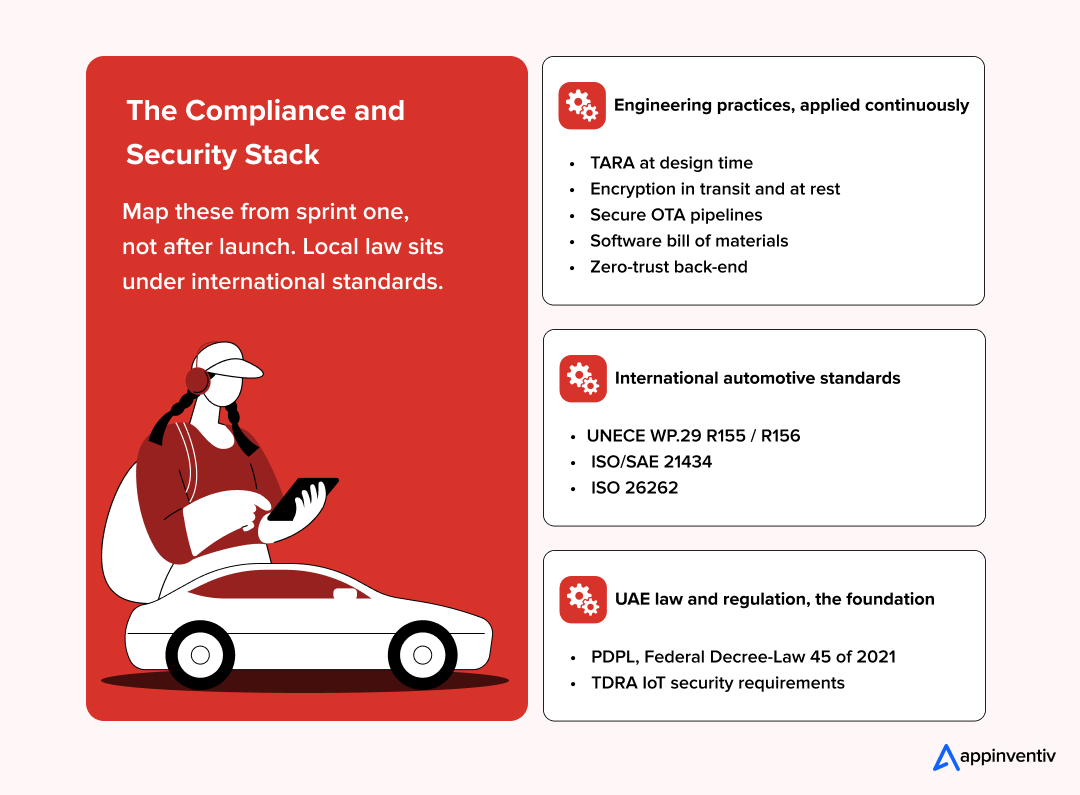
The practical playbook stays consistent: threat analysis and risk assessment at design time, encryption in transit and at rest, secure OTA pipelines, a software bill of materials for every release, and a zero-trust posture across your back-end. IBM’s data shows AI-driven security and encryption ranked among the top factors that cut breach costs, which is why we bake them in rather than bolt them on at the end.
How Should UAE Automotive Businesses Choose the Right Software Solution?
Choosing how you build matters as much as what you build. Most operators weigh three routes, and each carries a trade-off.
| Build model | Pros | Cons |
|---|---|---|
| In-house team | Full control, deep domain knowledge | Slow to staff, costly, hard to scale |
| Offshore-only vendor | Lower day rates | Time-zone gaps, weak local compliance grip |
| Local plus specialist partner | Regional compliance, proximity, technical depth | Needs the right partner fit |
For most UAE businesses, the third route is often the preferred one. However, this applies to folks who understand local rules quite well. Whether you shortlist a software development company in Dubai or in Abu Dhabi, press hard on the essentials: proven mobility work, a real security and compliance track record, Arabic and English delivery, and the ability to scale from pilot to production without rebuilding.
A serious software development company in any major region should put evidence on the table, not just slides.
A quick checklist before you sign anything:
- Have they shipped compliance-heavy, connected systems before?
- Can they map UAE PDPL and WP.29 requirements without hand-holding?
- Do they own security end-to-end, from risk assessment to OTA?
- Will they support you after launch, or vanish at handover?
- Can they prove local delivery?
How Can Appinventiv Help You Out?
This is where experience does the talking. For over a decade, we have built secure, compliance-heavy, AI-powered transportation systems for operators who cannot afford to get it wrong. We have delivered platforms across the Middle East, and we understand the UAE’s rules, climate, and market pressures because we work in this region, not just from afar.
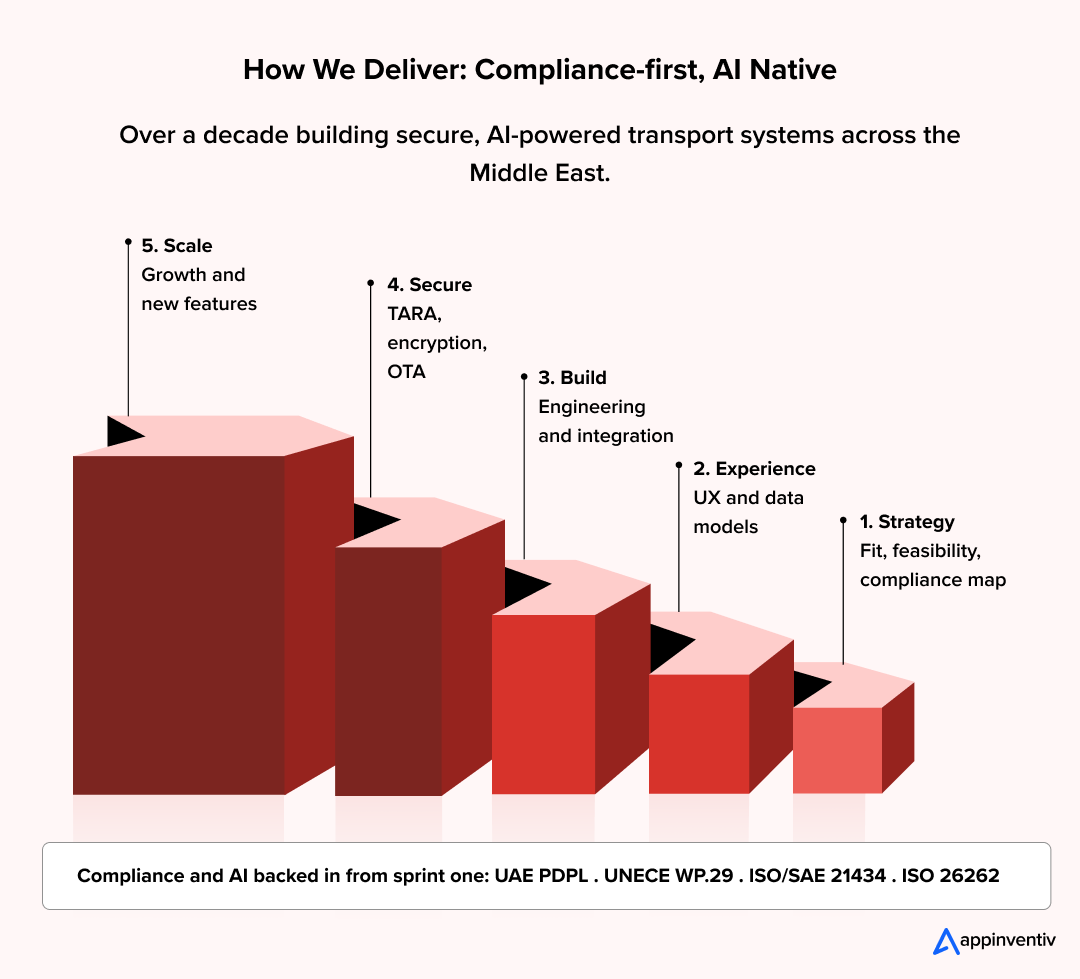
Our teams cover the full journey, from strategy and UX through development, security, and post-launch scaling. Whether you need Automotive Software Development Services end-to-end, or a mobile-first build from a proven Mobile App Development Company in Dubai, we bring the technical depth and the local grounding to match.
What sets our work apart is the compliance-first, AI-native approach. We design for UAE PDPL, WP.29, and ISO standards from the first sprint; we build security by default, and we use AI to squeeze genuine efficiency out of your data. That is how you launch quickly without leaving gaps that a regulator or an attacker can walk straight through.
If you are ready to move, we are ready to build. Let us turn your automotive software vision into a platform that ships, scales, and stays compliant.
FAQs
Q. How much does automotive software development cost in the UAE?
A. Honestly, it depends. A basic build kicks off near AED 130,000. Go complex and safety-critical, and you’re at AED 1.8 million, sometimes more. Most fleet and telematics work lands between, call it AED 330,000 to AED 920,000. The rest are features and integrations.
Q. What factors affect automotive software development costs in the UAE?
A. Complexity, mostly. The deeper your integrations and the heavier the stack, the faster it climbs. Compliance adds to it. Anything safety-critical or real-time is where budgets blow out, and who you build with swings it either way.
Q. How long does it take to develop automotive software?
A. Give or take, 6 to 12 months for a first real release. Something simple? Maybe seven or eight. But go autonomous or safety-critical, and you’ll push past a year, mostly because testing and compliance eat the calendar.
Q. What are the most common automotive software use cases in the UAE?
A. Loads. EV fleets and charging coordination lead, then connected-car telematics and dealership inventory tools. Predictive maintenance is climbing, driverless pilots are early, and car buying keeps moving online.
Q. How can automotive software support EV businesses in the UAE?
A. Quite a bit, actually. It sorts charging schedules, keeps the grid load balanced, and handles billing and roaming. In our heat, watching battery health isn’t optional. Get it right, and your vehicles spend less time parked, more time earning.
Q. What are the main challenges of developing automotive software?
A. Security first, then compliance, no question. After that, it’s a slog: bolting onto legacy systems, wrangling too much sensor data, finding people who know this stuff, and scaling past the pilot.
Q. How do you ensure cybersecurity in connected vehicle software?
A. You build it in from day one, never bolt it on after. Threat modelling up front, encryption everywhere, locked-down over-the-air updates, a software bill of materials, zero-trust throughout. It all lines up with ISO/SAE 21434 and UNECE R155.
Q. How can UAE automotive businesses choose the right software solution?
A. Start from your goals, then grill the partner. Have they shipped mobility work? Do they hold up on security and compliance? Can they work in Arabic and English, and scale you from pilot to production without a rebuild?


Fast 2-minute response, fully NDA-protected.

Beyond Customer Portal Development: Building Connected Digital Services
Key takeaways: A portal without CRM, ERP and billing integration leaves your staff doing the connecting. Start with customer tasks, then integrate only the systems those tasks actually need. Name one system of record for each data type before choosing APIs or middleware. Plan integration, security and privacy obligations at the start, not after the…

CRM Software for Local Government: From Community Requests to Better Service Delivery
Key takeaways: A council CRM should sit around existing systems as a service layer, not replace them. Integration with ERP, rates, property and GIS systems prevents another data silo and duplicate entry. Start with one high-volume service, pilot it with residents, then scale on measured results. Track resolution time, SLA compliance, self-service rates and cost…

The Ultimate Guide to CRM for Insurance: Features, Cost, Top Platforms, Integration & More
Key takeaways: CRM for insurance connects sales, service, and claims into one governed system, distinct from the policy administration system. Core features span pipeline management, policy visibility, claims tracking, commission management, AI analytics, and compliance controls. Cost ranges from roughly USD 15,000 for configuration to USD 150,000 and beyond for custom development at enterprise scale.…














