
































Building a Successful Website with Optimizely: From Strategy to Continuous Improvement

 Share -


- 01The Three Tiers of Redesign: Where Are You Aiming?
- 02Engineering the Optimizely Website for Two Audiences: Humans and AI
- 037 Signs Your Website Needs a Strategic Redesign
- 04Workflow Modelling and Sustainable Governance: The Operational Engine of Your Site
- 05What Does a Successful Optimizely Website Look Like?
- 06How to Build a Website with Optimizely: 10 Structured Steps
- 07Continuous Improvement: What Happens After Your Optimizely Website Launches?
- 08Common Mistakes to Avoid When Building an Optimizely Website
- 09How to Choose the Right Optimizely Development Partner?
- 10How Appinventiv Helps Build and Evolve Optimizely Websites
- 11FAQs

Key takeaways:
- Structural website redesigns outlast visual updates by resolving underlying operational and architecture inefficiencies.
- Generative engine optimisation ensures large language models accurately ingest and cite your enterprise platform data.
- Strict data governance and privacy compliance are non-negotiable foundations for website development with Optimizely.
- Continuous experimentation workflows maximise the long term commercial outcome of your digital asset investments.
Most website redesigns fail before a single wireframe is drawn. Why? Because the brief is built for a web that no longer exists. We have entered an AI first age where generative AI tools like ChatGPT and Perplexity read, summarise, and answer buyer questions directly. If your site isn’t structured to be cited by AI, you lose market visibility before a user even clicks a link.
Building a website with Optimizely goes far beyond a superficial visual presentation. It demands absolute harmony between user experience, system architecture, AI readability, and ongoing governance.
To unlock true commercial return on investment, organisations must shift their mindset from executing a surface redesign to implementing an operational redesign. This transformation
requires a technology partner capable of guiding the entire journey from initial vision to robust continuous improvement that moves through four connected stages:
Strategy → Architecture → Delivery → Continuous improvement
The objective is not simply to launch a better website. It is to create a digital platform that can keep getting better without repeatedly starting from scratch.
Identify gaps across your Optimizely CMS, customer journeys, and conversion paths, then turn them into measurable improvements.
The Three Tiers of Redesign: Where Are You Aiming?
A website redesign can range from a visual refresh to a complete operational transformation. Surface redesign changes appearance, structural redesign changes the underlying digital system, while operational redesign changes workflows, governance and optimisation practices. For Australian organisations, identifying the required level early prevents expensive technology work from solving only visible symptoms.
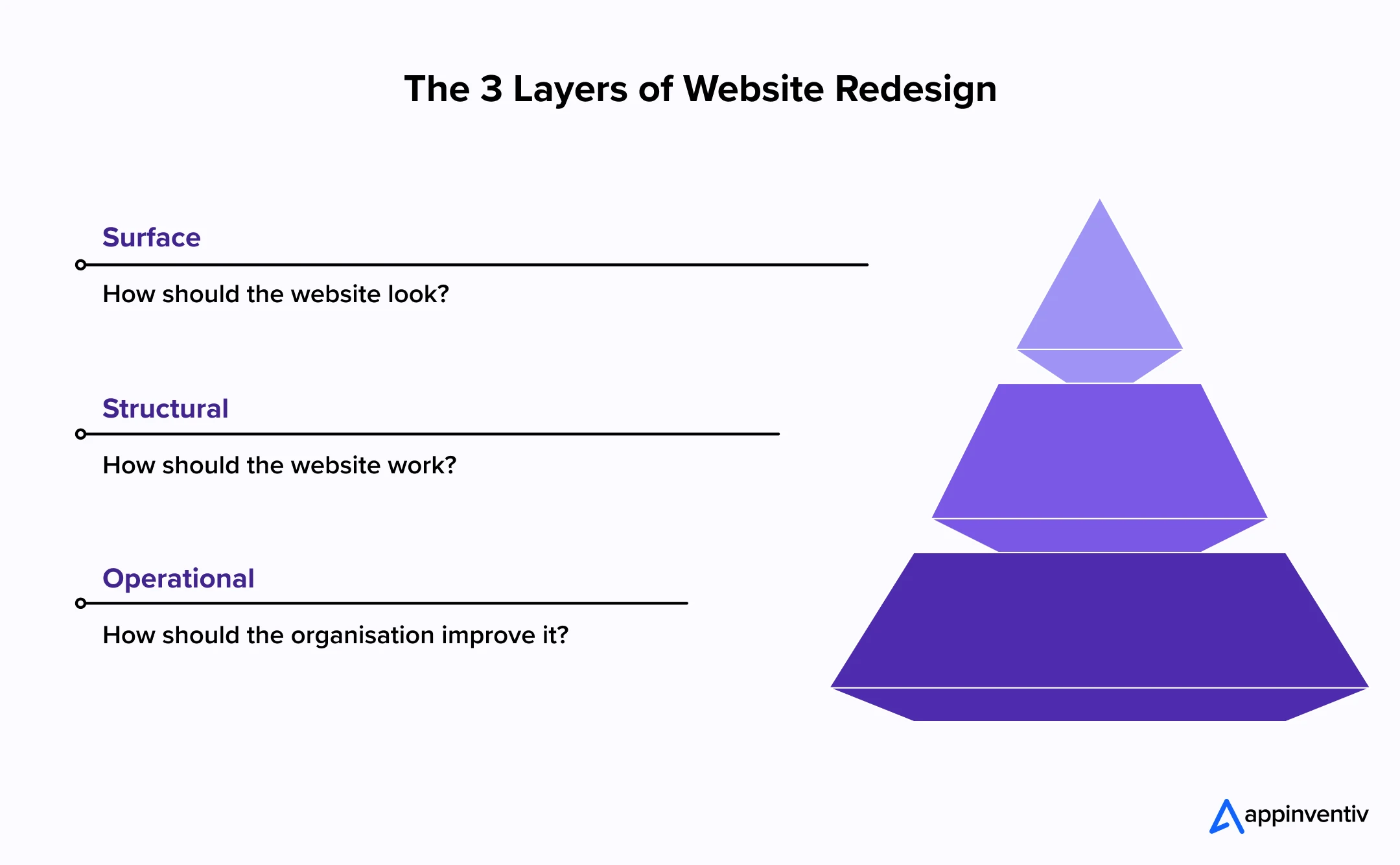
Surface Redesign (The Trap)
Many organisations fall into the trap of merely updating the visual layer and marketing copy. The site looks modern at launch but rapidly decays within a year. Underlying operational processes remain broken. The CMS remains cluttered, integrations fail to scale, and editorial bottlenecks persist.
Structural Redesign (The Standard)
This tier moves beyond visuals. A structural redesign incorporates meaningful changes to content architecture, search engine visibility, and the underlying technology stack. Implementing the Optimizely digital experience platform (DXP) at this level provides robust headless capabilities and scalable infrastructure, addressing significant technical debt.
Operational Redesign (The Goal)
The operational tier represents the complete picture. It absorbs the structural upgrades and adds workflow modelling, AI structured content delivery, and a strict enterprise governance framework. An operational redesign ensures the platform compounds in value over time, transforming the website from a static brochure into an active business asset.
Engineering the Optimizely Website for Two Audiences: Humans and AI
A modern website has two discovery environments to account for: human visitors and AI systems in Australia. Human users need clear journeys, accessible interfaces and relevant information. AI systems need structured, authoritative and machine-readable content that can be retrieved, interpreted and attributed correctly.
Design for Human Users
Customer journeys should shape the information architecture before page templates are finalised.
For example, an insurance organisation may have separate audiences for policyholders, brokers, claims teams and prospective customers. Each group arrives with a different task. A navigation structure organised around internal departments may make sense to the business but create unnecessary friction for users.
The website should therefore be organised around meaningful user tasks and business outcomes.
Design for AI and Generative Engine Optimisation (GEO)
Search engines crawl pages. Generative systems increasingly retrieve, interpret and synthesise information from them.
This creates a different requirement for content architecture.
Answer-first sections, descriptive headings, structured data, schema markup, authoritative sources, clear entities and reusable content models make information easier for machines to interpret. This does not replace conventional SEO. It extends the technical foundation needed for search and generative discovery.
Optimizely’s current CMS architecture supports structured content and API-based delivery, including GraphQL through Optimizely Graph for headless use cases.
Integration and Architecture: Exposing Structured Content
Your digital platform cannot operate in a silo. True enterprise capability relies on how well Optimizely connects with the rest of your technology stack, including CRM systems, ERPs, and data warehouses. Your content management system must expose structured content via API to remain visible to both internal systems and external AI agents.
The Non-Negotiables: Accessibility, Security, and Performance
Australian enterprises operate under strict regulatory conditions. Security standards aligned with APRA CPS 234 and the Privacy Act 1988 must be embedded into the platform architecture from day one. Furthermore, digital accessibility aligned with WCAG 2.2 guidelines ensures compliance with the Disability Discrimination Act, protecting the organisation from legal and reputational risk.
7 Signs Your Website Needs a Strategic Redesign
A website redesign makes sense when the existing experience, technology or business strategy is creating measurable friction. Before committing to a major rebuild, look for signals that the underlying problem goes beyond outdated visuals.
The user experience is creating friction
Confusing navigation, broken journeys, competing calls to action or poor mobile usability can indicate that the current structure no longer reflects how customers use the site.
The business has changed
New markets, services, products or positioning can quickly make an older website inaccurate. The digital experience should reflect the organisation customers are actually dealing with today.
Performance is declining
Falling conversions, higher abandonment or weak engagement can point to deeper issues across content, UX, performance or architecture.
The CMS is slowing the business down
When content teams struggle to publish, reuse or govern content, the constraint may be the platform rather than the page design. A new visual layer will not fix that.
The technology no longer supports the roadmap
Legacy integrations, limited APIs, poor scalability or difficult maintenance can make future changes unnecessarily expensive.
The site is difficult for AI systems to understand
Being crawlable does not necessarily mean being useful to generative search systems. Weak content structure, unclear entities and poorly organised information can reduce the likelihood of content being retrieved or cited.
The website no longer supports continuous improvement
If every change requires a large development cycle and there is no practical way to test, measure and iterate, the operating model may need to change alongside the website.
Workflow Modelling and Sustainable Governance: The Operational Engine of Your Site
Without defined operational workflows, even the most advanced platforms degrade rapidly post launch. Establishing clear content governance, editorial accountability, and integration protocols ensures long term platform health. Let’s learn how mapping internal processes before technical implementation prevents delivery bottlenecks and embeds sustainable management practices directly into your digital operating model.
Workflow Modelling First
Start with the current process.
Brief → Draft → Review → Legal/Compliance → Approval → Publish → Measure → Update
Then identify where work actually stops.
A financial services website, for example, may require marketing, legal, risk and compliance approval. If those dependencies are not reflected in the platform design, publishing delays will simply move into the new CMS.
Integrating AI into the Editorial Workflow
AI can assist with translation, content adaptation, metadata, accessibility checks, summarisation and content audits. It should not automatically become the final publishing authority.
Editorial teams should also structure content for generative search. A Princeton-led study of 10,000 queries found that tested optimisation techniques improved visibility in generative-engine responses by up to 40%.
For regulated organisations, define where AI can act independently, where human approval is mandatory, and what evidence needs to be retained for audit purposes.
Sustainable Content Governance
Governance should answer practical questions, such as:
- Who owns each content type?
- Who approves regulated claims?
- Who manages permissions?
- Who retires outdated content?
- Who owns integrations?
- Who reviews experimentation results?
- Who approves major architecture changes?
Without these answers, a website gradually becomes difficult to control.
What Does a Successful Optimizely Website Look Like?
A successful Optimizely website is measurable, governable and adaptable. It should meet defined user needs while supporting commercial objectives, structured content, reliable integrations and controlled publishing. The CMS is only one component. Long-term value comes from the experience model, architecture, operating processes and optimisation roadmap surrounding it.
A successful Optimizely website deployment should:
- Solve defined customer and employee needs
- Support measurable business objectives
- Provide accessible and intuitive experiences
- Perform reliably across devices and locations
- Protect customer and business information
- Connect with the wider technology ecosystem
- Give content teams appropriate publishing control
- Use reusable and structured content
- Define clear ownership and governance
- Maintain a roadmap beyond launch
Think Beyond the CMS
Optimizely provides a powerful technological foundation, but the ultimate success of the website depends entirely on the experience, architecture, operating model, and optimisation strategy built around it. Software alone solves nothing without an execution strategy.
How to Build a Website with Optimizely: 10 Structured Steps
Developing a successful website involves a series of well-defined steps. The sequence matters because decisions made early affect migration effort, technical debt, operating costs and the ability to experiment after launch. The following 10 step framework provides a comprehensive checklist to guide your digital transformation strategy, ensuring successful website development.
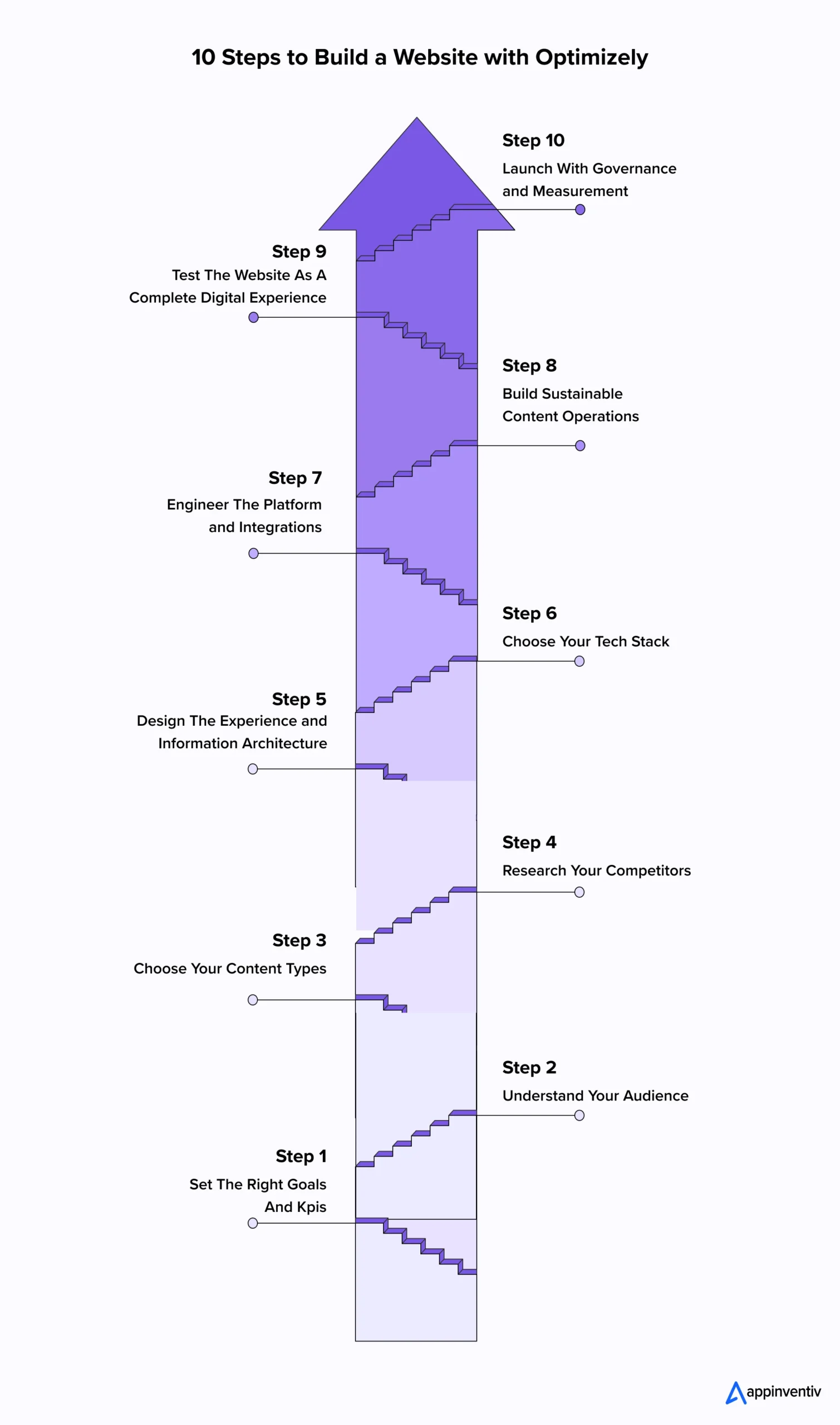
1. Set Business Goals and KPIs
Define what the website must achieve.
Examples include qualified leads, digital service completion, self-service adoption, ecommerce revenue, reduced contact-centre demand or faster content publication.
Avoid measuring everything. Select indicators connected to business outcomes.
2. Understand Your Audiences
Map the audiences, their intent and the tasks they need to complete.
Use analytics, customer research, service data and existing search behaviour rather than relying only on stakeholder assumptions.
3. Define Content Types
Determine what types of content exists and how it should be reused.
Product information, locations, people, services, articles, case studies and FAQs should have clear models rather than becoming collections of manually formatted pages.
4. Research the Competitive Environment
Review competitors for more than visual inspiration.
Assess their information architecture, content depth, digital journeys, search visibility, accessibility, performance and conversion paths.
The objective is to identify market expectations and gaps, not replicate another website.
5. Design the Experience and Information Architecture
Create navigation around user intent.
Then map templates, components, journeys and content relationships. This is where UX decisions begin to influence CMS structure.
6. Choose the Tech Stack
Decide what belongs in Optimizely and what belongs elsewhere. A typical website tech stack may include:
| Layer | Typical responsibility |
|---|---|
| Optimizely CMS | Structured content and publishing |
| Frontend | Website experience and presentation |
| CRM | Customer and lead records |
| ERP | Enterprise and operational data |
| PIM | Product information |
| DAM | Digital assets |
| Analytics | Behaviour and performance measurement |
| Identity | Authentication and access |
| Integration layer | Data exchange and orchestration |
7. Engineer the Platform and Integrations
Integration design should establish system ownership before APIs are built.
For example, if customer information exists in the CRM, the website should not quietly create a second source of truth.
Optimizely supports both managed SaaS and PaaS deployment models, with different levels of infrastructure control and operational responsibility.
8. Build Sustainable Content Operations
When rethinking your website with Optimizely, create publishing roles, approval paths, content standards and retirement rules.
A website with thousands of pages needs lifecycle management, not simply a migration plan.
9. Test the Complete Digital Experience
Move beyond simply asking if a page loads correctly. Enterprise testing requires deep technical validation across multiple aspects, such as.
| Testing Area | What It Validates |
|---|---|
| Functional testing | Validates that forms, user portals and transactional elements operate correctly without errors. |
| Integration testing | Ensures data moves securely between the CMS, CRM and payment gateways without loss or corruption. |
| Accessibility testing | Confirms the interface aligns with WCAG 2.2 through automated checks and manual screen-reader audits. |
| Performance testing | Stress-tests the infrastructure to assess stability and responsiveness during unexpected traffic spikes. |
| Security testing | Uses penetration testing to identify vulnerabilities across API endpoints, authentication and other critical controls. |
| Content and migration testing | Audits migrated content to confirm formatting, metadata, links and SEO structures remain intact. |
| Real-user journey testing | Observes users completing critical journeys to uncover friction that may not appear through technical testing alone. |
10. Launch with Measurement and Governance
The launch should activate analytics, ownership, dashboards, support processes and the optimisation backlog.
The website becomes a managed product from this point onward.
Identify the UX, performance, and conversion gaps holding your website back, then turn them into measurable improvements.

Continuous Improvement: What Happens After Your Optimizely Website Launches?
Launch should mark the beginning of the optimisation cycle, not the end of the project. Sustained commercial outcome relies on rigorous experimentation, continuous backlog prioritisation, and iterative roadmap execution. This section explains how to transition from a project delivery mindset to a continuous optimisation model, ensuring your platform adapts to shifting market conditions.
Measure What Users Actually Do
Track meaningful behaviour across users’ journeys.
Look beyond page views. Examine search exits, form abandonment, navigation paths, conversion steps, content engagement and task completion.
The objective is to identify friction rather than simply report traffic.
Test Assumptions Instead of Opinions
Stakeholder preferences should not become permanent product decisions. Your decision should follow a structured path:
Observation → Hypothesis → Experiment → Result → Decision
Optimizely web experimentation can be used to test changes across web pages, including layouts, content, calls to action and other experience elements. Optimizely distinguishes Web Experimentation, which is suited to web-page changes, from Feature Experimentation, which operates through application code and SDKs.
Create an Optimisation Backlog
Each opportunity should be assessed against:
User impact + Business impact + Evidence + Effort
This makes prioritisation more defensible.
A minor headline change may require little effort but offer limited value. A redesigned application journey may require substantial engineering but address a significant source of abandonment.
Build a 12 to 18 Month Website Roadmap
A continuous improvement website strategy requires a structured timeline.
| Phase | Timeline | Focus Area |
|---|---|---|
| Stabilisation | 0 to 3 months | Measure baseline analytics and resolve post launch integration issues. |
| Enhancement | 3 to 6 months | Improve UX friction points, refine content structures, and streamline conversion journeys. |
| Expansion | 6 to 12 months | Deepen third party integrations, launch experimentation campaigns, and scale personalisation. |
| Innovation | 12 to 18 months | Introduce entirely new digital capabilities based on validated business needs. |
The Optimisation Lifecycle
The optimisation process works as a continuous loop, with each stage informing the next decision:
Measure → Identify → Prioritise → Hypothesise → Test → Learn → Implement → Measure again
That loop is what turns a website into an evolving digital product.
Common Mistakes to Avoid When Building an Optimizely Website
The most expensive website mistakes usually begin as planning shortcuts. Starting with templates, postponing security, migrating every legacy page or launching without ownership can create costs that continue long after implementation. Avoiding these issues requires treating the website as an enterprise system with defined dependencies, governance and measurable outcomes.
Starting with the CMS
Selecting Optimizely before understanding business and user requirements can lead to unnecessary customisation. The CMS should support the strategy, not become the strategy.
Treating the project as a visual redesign
A new interface cannot repair poor content governance, fragmented integrations or unclear ownership.
Building integrations without system ownership
Every critical data object needs a defined source of truth. Otherwise, integration complexity grows with every new feature.
Leaving security and accessibility until the end
Security, accessibility and performance need architectural consideration from the start.
This is particularly relevant in Australia, where cyber risk and third-party exposure remain significant concerns. ASD reported that the average self-reported cost of cybercrime per business report reached $80,850 in FY2024–25.
Migrating everything
Legacy content should be assessed, not automatically transferred. Retain content that has a defined purpose. Consolidate duplication. Rewrite outdated information. Retire pages that no longer serve users.
Launching without governance
If nobody owns the website after launch, quality will gradually decline. Clear ownership, publishing controls, content review cycles and performance reporting keep the platform accountable as business evolves.
Having no post-launch roadmap
The absence of an optimisation backlog often means the next major website project begins before the previous investment has reached maturity.
How to Choose the Right Optimizely Development Partner?
Choosing a digital engineering partner for Optimizely website development should involve more than checking platform credentials. Enterprise delivery requires the ability to connect strategy, UX, architecture, integrations, content operations, security and optimisation. Here is a checklist to find the right tech partner for your next website project.
Look for Strategy and Implementation Capability
A right partner connects business goals directly to UX, system architecture, integration mapping, content delivery, and ongoing governance. They should not operate strictly as order takers.
Assess Their Enterprise Architecture Capability
Ask prospective vendors direct questions regarding infrastructure. How will they approach your existing legacy systems? What specific data should live inside Optimizely versus the CRM? How will the architecture support future regulatory changes?
Ask How Accessibility, Security, and Performance are Handled
These elements represent core operational requirements. Your partner should build them into the continuous delivery pipeline, rather than treating them as separate, billable auditing services.
Ask What Happens After Launch
Look for a partner equipped to support long term platform evolution. They must offer post launch services for optimisation, new functionality deployment, integration maintenance, and rigorous roadmap planning.
Choose a Partner Willing to Challenge the Brief
A valuable technology partner must be confident enough to say when a requested feature is unnecessary or introduces unacceptable risk. Their role is to challenge assumptions, identify architectural trade offs, and translate a high level digital vision into a practical, secure delivery plan.
How Appinventiv Helps Build and Evolve Optimizely Websites
Building an Optimizely website is not only about implementing a CMS. It requires the right architecture, integrations, user experience, experimentation, and ongoing optimisation to support changing business goals. That’s where Appinventiv steps in.
As an experienced digital transformation partner with 11+ years of experience, we leverage the full power of Optimizely’s Digital Experience Platform (DXP) to craft highly personalised, scalable, and high-performing websites.
Our team of 1700+ tech experts doesn’t just deploy technology; we align Optimizely’s vast capabilities, from its agile CMS and commerce solutions to its industry-leading experimentation tools, directly with your core business objectives.
We bridge the gap between strategy and execution. From the initial architecture and seamless third-party integrations to post-launch optimisation, we act as a dedicated extension of your team. By heavily utilising Optimizely’s advanced data and A/B testing frameworks, we ensure your website never remains static. Instead, we continuously refine user journeys, boost conversion rates, and drive measurable ROI based on real customer behavior.
Whether you are migrating to Optimizely for the first time or looking to scale an existing platform, our experts are equipped to navigate the complexities of enterprise-grade web development. With experience across 35+ industries and work with enterprise brands, the focus remains on creating maintainable digital platforms rather than treating website development as a one-time project.
Ready to unlock the true potential of your digital presence? Partner with Appinventiv to turn your website into a dynamic engine for long-term growth. Contact our experts today to start building a digital experience that continuously evolves with your customers.
FAQs
Q. How does Optimizely CMS vs Sitecore for enterprise websites compare?
A. Optimizely CMS and Sitecore, both are leading enterprise platforms, but they differ in deployment philosophy. Optimizely is frequently favoured for its rapid time to market, highly intuitive editorial interface, and deep native experimentation capabilities. Sitecore offers massive structural complexity which suits specific monolithic enterprise environments, but often requires higher ongoing developer overhead to maintain and upgrade.
Q. Can you ever over-optimise a website, or is there a ceiling to testing gains?
A. Yes, a website optimisation strategy can hit diminishing returns if teams focus solely on micro conversions, like button colours, rather than testing broader user journeys. Once baseline friction is removed, testing should pivot toward larger architectural or proposition tests to unlock new commercial value.
Q. How do you build a sustainable, long-term experimentation program instead of one-off tests?
A. A sustainable program requires decoupling testing from the IT release cycle. Establish a cross functional team of marketers, analysts, and developers who manage a prioritised testing backlog. Secure executive buy in for a testing budget that runs continuously, ensuring decisions are driven by user data over the entire lifecycle of the platform.
Q. What’s the best way to plan a new website structure in Optimizely before development starts?
A. The best way to plan a new website structure in Optimizely starts with business objectives, audience needs and content relationships rather than page templates. Map the information architecture, content types, taxonomy, reusable components and publishing permissions first. Then define how these structures will connect with CRM, ERP, PIM, DAM and other systems. This reduces rework during the Optimizely CMS implementation and gives content teams a clearer operating model from day one.
Q. What is the Optimizely optimisation methodology and how do the five stages work?
A. Optimizely’s optimisation approach provides a structured way to turn evidence into website improvements. The five-stage cycle can be understood as Explore, Ideate, Prioritise, Test and Analyse. Teams first identify user or business problems, develop potential solutions, prioritise opportunities, run controlled experiments and analyse the results. The important point is that testing becomes part of a repeatable decision process rather than a series of disconnected website changes.
Q. How does Optimizely CMS compare to other DXPs like Sitecore?
A. The comparison should be based on the enterprise’s architecture and operating requirements rather than feature counts alone. Assess content modelling, authoring, personalisation, experimentation, headless capabilities, integrations, deployment options, security, governance, migration complexity and total cost of ownership. Optimizely and Sitecore both support enterprise digital experience scenarios, but the appropriate choice depends on existing systems, delivery capabilities, content complexity and the organisation’s long-term roadmap.


Fast 2-minute response, fully NDA-protected.

How Much Does it Cost to Build a Web App in Australia?
Key takeaways: The average cost of web app development in Australia ranges from AUD 60,000 to AUD 4500,000 for basic to complex projects. Web app development is growing in Australia, driven by industries like e-commerce, fintech, healthcare, and education. Australia’s tech talent pool is competitive, with an increasing number of developers in cities like Perth…
How Much Does It Cost to Develop a Web App like Hukoomi?
According to a report, out of 8.1 billion of the estimated global population (measured on 14th Sept 2023), approximately 5.18 billion are internet users, meaning over 65% of the world's population uses web apps for various purposes. So, in an era where digital transformation is revolutionizing almost every aspect of the modern business world, the…
Website Development Cost Estimation in 2026: A Closer Analysis
Are you a budding entrepreneur looking forward to kickstarting your digital business or an enterprise looking to enhance its online presence through a well-performing website? If yes, you have landed at the right place. Being one of the most powerful marketing channels, a website can drive higher sales and enhance customer retention. It can further…