
































Geopatriation and Sovereign AI Infrastructure in the Middle East: Why Enterprises Are Rethinking AI Infrastructure

 Share -


- 01Which Enterprise AI Workloads Need Sovereign Infrastructure the Most?
- 02Which Sovereign AI Strategy Fits Your Middle Eastern Enterprise?
- 03What Enterprises Must Control Before Deploying Sovereign AI Infrastructure in the Middle East
- 04Why Custom Sovereign AI Development Makes More Sense for Middle Eastern Enterprises
- 05How to Choose a Custom Sovereign AI Development Partner in the Middle East
- 06What Shapes the Investment and ROI of Sovereign AI Infrastructure in the Middle East?
- 07How Appinventiv Helps Middle Eastern Enterprises Build Sovereign AI With Greater Control
- 08FAQs





Key takeaways:
- Regional hosting alone does not guarantee sovereign control over AI processing, logs, backups, encryption keys, or administrative access.
- Sovereign infrastructure creates the most value for regulated data, critical operations, proprietary knowledge, and AI agents connected to enterprise systems.
- Geopatriation brings sensitive AI workloads closer to their country of origin, reducing regulatory and geopolitical exposure.
- GCC enterprises should apply different levels of sovereignty based on workload risk instead of placing every AI application inside the most restrictive environment.
- Custom development offers greater flexibility than ready-made platforms for country-specific controls, Arabic AI, legacy integration, and multi-market operations.
- The right sovereign AI partner should provide regional expertise, technology independence, model portability, business continuity, and a clear path from architecture to production.
AI investment across the Middle East is moving into a more demanding phase. Enterprises have tested copilots, automated service workflows, connected business data with large language models, and begun placing AI inside core operations. Now they face a harder question: does the infrastructure behind these systems offer enough control?
For many organisations, the honest answer is still unclear.
A model may be available through a regional cloud, while prompts, logs, backups, or support requests usually cross another jurisdiction. Sensitive records may remain locally stored, yet inference happens through an external endpoint. The enterprise may control its application but not the encryption keys, model weights, administrative access, or underlying compute.
These gaps are pushing Sovereign AI infrastructure in the Middle East higher on boardroom and technology agendas. Businesses are no longer deciding only which model performs best. They are examining where workloads run, who can access them, which laws apply, and whether critical AI services can continue if a foreign dependency becomes unavailable.
The timing matters too. The Middle East is rapidly expanding its domestic digital capacity. PwC Middle East expects regional data-centre capacity to increase from 1 GW in 2025 to 3.3 GW by 2030. Saudi Arabia announced $14.9 billion in technology investments at LEAP 2025, including commitments related to AI, cloud services, and data centres. The UAE, meanwhile, continues to strengthen its position through new computing infrastructure, regional cloud capacity, and locally developed models such as Falcon Arabic.
The growing capacity gives enterprises more deployment options. It also raises the standard for infrastructure decisions. Keeping data in the region is no longer enough on its own. Businesses must consider model governance, administrator access, encryption control, backup locations, hardware availability, vendor dependency, and the movement of data between GCC markets.
This is also why Geopatriation in the Middle East is gaining ground. Instead of moving every application away from global cloud environments, enterprises are identifying the workloads that deserve stronger regional or national control. Customer information, financial records, government data, industrial intelligence, healthcare records, and proprietary knowledge often sit at the top of that list.
According to CIO, Gartner recorded a 305% increase in requests about reducing exposure to global providers during the first half of 2025. It also expects 75% of European and Middle Eastern enterprises to geopatriate virtual workloads by 2030, compared with 5% in 2025. The shift suggests that infrastructure location is moving from a compliance concern to a wider business-risk decision.
These figures point to a strategic reset rather than a retreat from international technology. Middle Eastern enterprises still need access to advanced models, global platforms, and specialised providers. The priority is to decide where that dependence remains commercially acceptable and where greater regional control has become necessary.
For technology and business leaders, the question is therefore no longer whether sovereign AI matters. They must determine how much sovereignty each workload needs, which deployment model can provide it, and whether the additional control justifies the investment.
This blog examines the infrastructure gaps driving this shift, the workloads Middle Eastern enterprises should prioritise, and the choices available across sovereign cloud, private cloud, on-premise, edge, and hybrid environments. It also covers provider evaluation, expected costs, build-versus-buy considerations, migration risks, and a practical roadmap for moving sensitive AI workloads without slowing enterprise adoption.
Build a custom AI environment that protects regional data, integrates with core systems, and remains ready for future GCC growth.
Which Enterprise AI Workloads Need Sovereign Infrastructure the Most?
Sovereign AI does not create equal value across every business function. The strongest case exists where an AI system handles sensitive data, supports essential operations, or affects access to regulated markets.
For Middle Eastern enterprises, greater infrastructure control can protect more than compliance. It can strengthen procurement readiness, service continuity, intellectual property ownership, and confidence in scaling AI across the business.
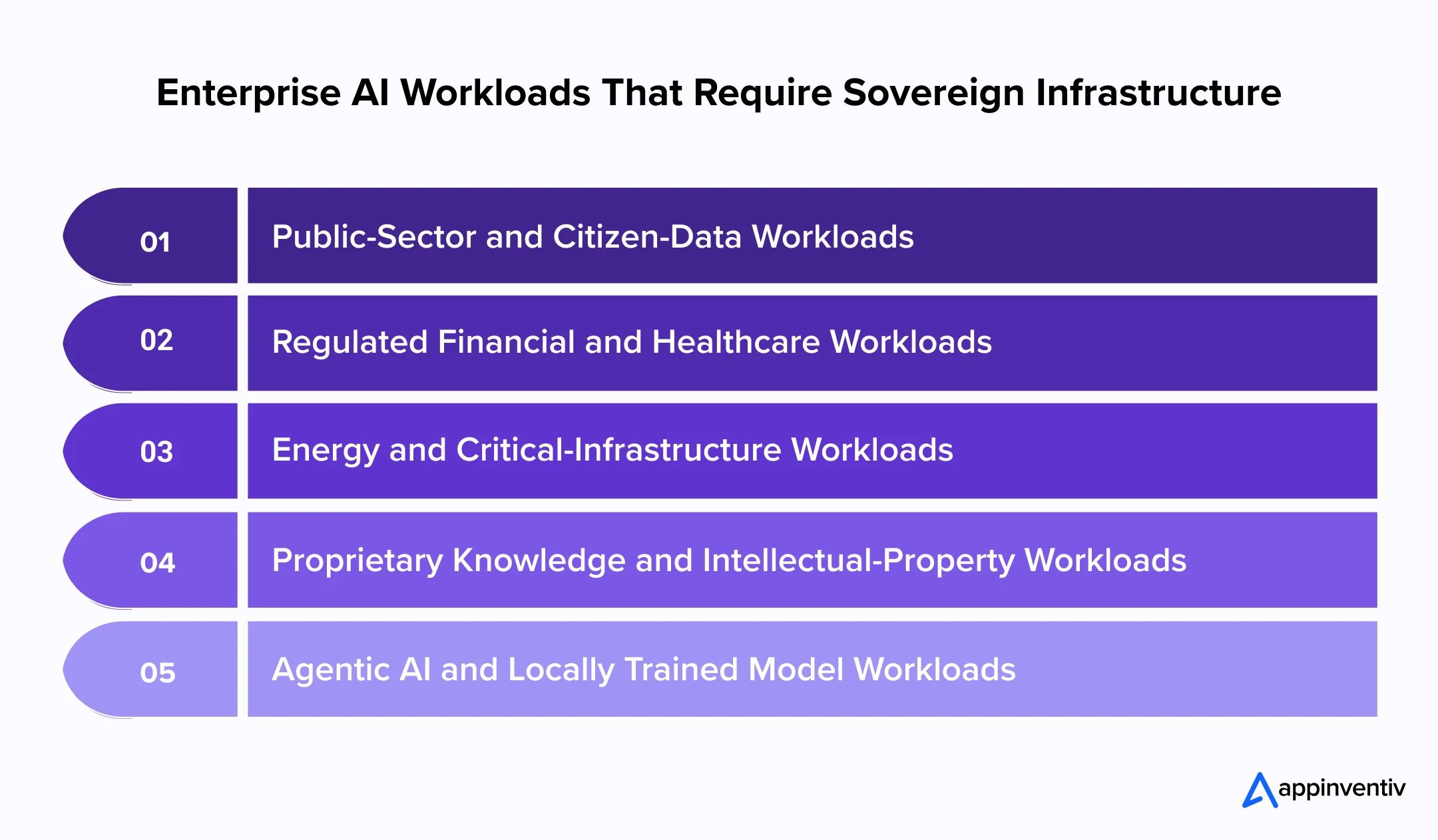
Public-Sector and Citizen-Data Workloads
Government AI platforms may process identity data, legal records, citizen requests, and confidential departmental information. Sovereign infrastructure helps public entities retain control over how this information is processed, accessed, and stored.
The same capability matters to technology companies pursuing government contracts. An AI product built around clear national data boundaries, local recovery, and auditable access can enter procurement with fewer infrastructure concerns.
Regulated Financial and Healthcare Workloads
Financial and healthcare organisations cannot scale AI confidently when customer, transaction, claims, or patient data moves through unclear processing routes.
Maintaining AI data sovereignty across the GCC requires enterprises to govern prompts, embeddings, inference, logs, and backups, not merely the location of their primary databases.
A sovereign environment allows these enterprises to introduce AI into higher-value workflows without sending sensitive information to unapproved locations. Fraud detection, underwriting, clinical documentation, record summarisation, and regulated customer service can then operate under stronger data and model controls.
This makes sovereignty a route to broader AI adoption and not merely another compliance expense.
Energy and Critical-Infrastructure Workloads
Across the Middle East, AI is moving into power systems, utilities, transport networks, industrial facilities, and large infrastructure projects. As these systems become more intelligent, the cloud environment supporting them also becomes part of the operational risk.
MIT Sloan Management Review Middle East reports that Gulf enterprises are reassessing their dependence on a single provider, region, or operating model. Disruption across telecommunications, energy, or several sites can expose weaknesses in infrastructure designed mainly around efficiency.
For asset-heavy businesses, this shifts the investment case from cloud efficiency to operational resilience. Local edge computing can keep essential AI functions closer to the asset, reduce dependence on uninterrupted external connectivity, and limit the movement of sensitive engineering data.
Predictive maintenance, infrastructure monitoring, and operational digital twins create greater value when the enterprise can keep them available during the events in which their intelligence matters most.
Proprietary Knowledge and Intellectual-Property Workloads
An internal enterprise AI copilot may access contracts, board documents, source code, pricing models, product designs, or investment plans. This information may not always face strict residency rules, but its commercial value makes uncontrolled external processing risky.
Enterprises adopting Sovereign AI in the Middle East get access to greater authority over proprietary data, model logs, embeddings, and fine-tuned assets. It also reduces the likelihood that a provider change will leave essential corporate knowledge trapped inside one platform.
Agentic AI and Locally Trained Model Workloads
AI agents raise the stakes because they do more than generate responses. They may retrieve customer information, update records, initiate workflows, or interact with financial and operational systems.
The pressure to move is already visible. Deloitte Middle East that more than 80% of regional organisations feel intense pressure to adopt AI, while 69% plan to increase investment. Yet nearly half identify talent shortages and insufficient technological capability as barriers to scaling it.
This gap between ambition and readiness makes the infrastructure decision more important. Middle Eastern enterprises need environments that limit which systems an agent can enter, what data it can retrieve, which actions it can complete, and when human approval is required. Custom development support can help establish these controls without delaying the wider AI programme.
The same need for control applies when an enterprise adapts Arabic models using proprietary conversations, documents, or regional terminology. A Sovereign LLM Middle East deployment can help the organisation retain ownership of its model weights, training artefacts, and local knowledge.
For Middle Eastern enterprises, the strongest commercial case exists where AI touches regulated information, critical operations, or business-owned intelligence. Better control can remove adoption barriers and turn previously restricted AI ideas into production-ready initiatives.
Which Sovereign AI Strategy Fits Your Middle Eastern Enterprise?
The right infrastructure decision is rarely “public cloud or on-premise.” Most enterprises need different levels of control for different AI workloads.
A regional retailer may keep its marketing assistant on public cloud while moving customer analytics into a controlled environment. A Saudi bank may retain transaction processing within the Kingdom but use external models for public information. An energy company may combine central cloud services with edge AI at remote sites.
The choice to implement Sovereign AI infrastructure in the Middle East should follow the business risk and not a preference for one technology.
| Business requirement | Suitable approach | Commercial consideration |
|---|---|---|
| Launch low-risk AI quickly | Regional public cloud | Offers speed and mature services, but data flows and provider access still need verification |
| Process regulated or sensitive data locally | Sovereign cloud | Provides stronger jurisdictional control without requiring the enterprise to own all infrastructure |
| Apply organisation-specific security and integration controls | Private cloud | Offers greater flexibility but requires more investment and operational support |
| Run highly restricted or disconnected workloads | On-premise or edge AI | Provides maximum control and continuity, with higher ownership and maintenance costs |
| Support workloads with different risk levels | Hybrid AI | Keeps sensitive processing controlled while retaining public-cloud flexibility |
| Operate across several GCC countries | Federated architecture | Preserves national data boundaries while supporting shared regional services |
For many regional businesses, hybrid AI offers the most practical starting point. It avoids the cost of placing every workload inside dedicated infrastructure while providing stronger control where data, regulation, or operational continuity demands it.
A federated model becomes more relevant for groups operating across the UAE, Saudi Arabia, Qatar, Bahrain, Oman, or Kuwait. Shared applications can support the wider organisation while restricted data and inference remain within the appropriate national environment.
The decision should ultimately answer four commercial questions:
- Which workloads would create material damage if data left the approved boundary?
- Which AI services must remain available during an external disruption?
- How much infrastructure can the enterprise operate and support internally?
- Can the workload move if regulations, providers, or commercial terms change?
An effective enterprise AI infrastructure strategy for GCC organisations should not pursue the highest level of control across every workload. It should apply sovereignty where necessary while preserving performance, flexibility, and return on investment.
Build the right mix of sovereign, private, hybrid, and regional cloud around your enterprise priorities.
What Enterprises Must Control Before Deploying Sovereign AI Infrastructure in the Middle East
Selecting a local or sovereign cloud does not complete the job. Enterprises must control the entire route between business data, the model, and the final AI action.
If any part of that route remains unclear, sensitive information may still leave the approved environment.
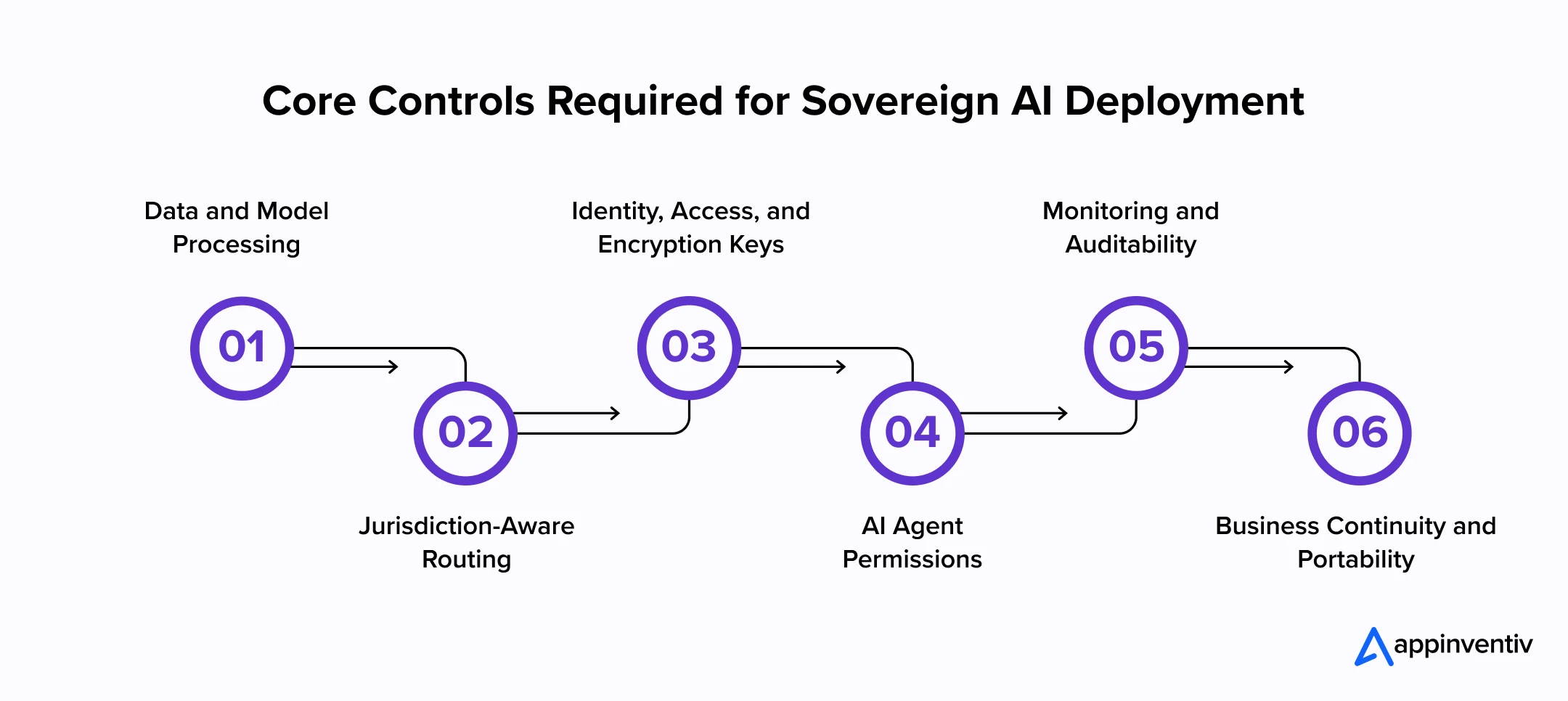
Data and Model Processing
The enterprise should know where prompts, documents, embeddings, responses, and fine-tuned models are processed and stored.
This requires more than checking the location of the primary database. Connected model APIs, vector stores, monitoring platforms, and backup services must follow the same approved boundaries.
Jurisdiction-Aware Routing
Regional enterprises may need different processing rules for the UAE, Saudi Arabia, and other GCC markets.
Effective cross-border AI data governance allows regional groups to share approved AI services while keeping restricted data, inference, and access within the required national boundaries.
An AI gateway can inspect each request and direct it to an approved model or environment. Saudi data may remain within the Kingdom, while a UAE workload uses infrastructure approved for that market.
This allows the enterprise to operate one AI ecosystem without treating every country’s information in the same way.
Identity, Access, and Encryption Keys
The business should control who can access the environment, which models they can use, and what actions they can perform.
Customer-managed encryption keys, role-based permissions, and recorded administrator sessions provide stronger protection than relying entirely on provider controls. The same rules should apply to employees, technical teams, service accounts, and AI agents.
AI Agent Permissions
An AI agent may access several systems and complete actions without waiting for a new instruction at each step.
Enterprises must set limits around:
- Which systems the agent can enter
- What information it can retrieve
- Which records it can change
- How much money or value it can move
- When human approval is mandatory
- How every action is recorded
These controls become essential when agents support banking, insurance, healthcare, government, or infrastructure operations.
Monitoring and Auditability
Security and compliance teams need a reliable record of how the AI system behaves.
Monitoring should capture model usage, access attempts, data routes, errors, unusual activity, and agent actions. Audit records must remain searchable without exposing sensitive information through the monitoring platform itself.
Business Continuity and Portability
Implementing Sovereign AI infrastructure in the Middle East’s business environment should not create a new form of dependency.
AI compute sovereignty gives enterprises greater control over where critical models run and how computing capacity remains available during provider outages, network disruption, or geopolitical restrictions. This may involve reserved regional capacity, local fallback infrastructure, or the ability to move workloads between approved environments.
The enterprise must be able to recover workloads within an approved jurisdiction and replace a model or provider when required. Data, prompts, model artefacts, integrations, and audit records should remain portable.
These controls distinguish genuine sovereignty from local hosting. They also explain why Sovereign cloud infrastructure in the UAE and Saudi Arabia require coordinated work across AI engineering, cloud architecture, cybersecurity, integration, governance, and business continuity.
Why Custom Sovereign AI Development Makes More Sense for Middle Eastern Enterprises
Middle Eastern enterprises can build sovereign AI internally, purchase a ready platform, or work with a custom development partner. For regulated and multi-country organisations, custom development usually offers the strongest balance of control, speed, integration, and long-term ownership.
| Approach | Where it may work | Key limitations | Commercial suitability |
|---|---|---|---|
| Internal development | Organisations with established AI, cloud, cybersecurity, integration, and regulatory teams | Requires significant investment, scarce specialist talent, longer delivery cycles, and full responsibility for model operations and infrastructure | Suitable when sovereign AI infrastructure is already an internal core capability |
| Ready-made sovereign platform | Standard workloads with limited integration and country-specific requirements | May restrict model choice, complicate legacy integration, create vendor lock-in, and offer limited support for separate GCC data boundaries | Suitable for narrow or standardised deployments |
| Custom sovereign AI development | Banks, insurers, healthcare groups, government entities, energy companies, and enterprises operating across several GCC markets | Requires an experienced partner with enterprise AI, cloud, security, and regional delivery capabilities | Best suited to complex enterprise deployments requiring country-specific controls, system integration, Arabic AI, model portability, and long-term ownership |
Custom AI development does not require every technology component to be built from scratch. Enterprises can still use approved cloud infrastructure, foundation models, and security products.
The custom layer brings these components together around the organisation’s own data boundaries, workflows, agent permissions, integrations, and recovery requirements. This gives the enterprise greater control over the capabilities that carry regulatory or competitive value without adding unnecessary development cost.
Build custom controls for regional data, legacy systems, Arabic AI, and cross-border workflows.

How to Choose a Custom Sovereign AI Development Partner in the Middle East
A sovereign cloud provider supplies infrastructure. A custom development partner must turn that infrastructure into a secure AI environment connected with the enterprise’s data, applications, and operating processes.
For enterprises that need to turn sovereign AI architecture into production-ready applications and integrations, working with a software development company in Dubai can help connect AI infrastructure with existing enterprise systems while addressing scalability, security, and regional requirements.
Growth in the sovereign AI infrastructure market across the GCC will expand enterprise choice, but buyers must still compare providers on control, portability, capacity, and operating responsibility.
Middle Eastern businesses should evaluate potential partners against the following capabilities:
| Evaluation area | What the partner should demonstrate | Why it matters |
|---|---|---|
| GCC regulatory understanding | Experience designing around UAE, Saudi, and sector-specific data requirements | Prevents the use of one generic architecture across different jurisdictions |
| Custom AI architecture | Ability to combine sovereign cloud, private cloud, edge, and on-premise environments | Ensures each workload receives the appropriate level of control |
| Enterprise integration | Experience connecting AI with ERP, CRM, EHR, data platforms, identity systems, and operational software | Prevents sovereign AI from becoming an isolated system |
| Data and model control | Clear ownership of enterprise data, prompts, fine-tuned models, embeddings, and generated artefacts | Protects intellectual property and reduces future disputes |
| Arabic AI capability | Experience adapting and evaluating models for Arabic, regional dialects, and industry terminology | Improves performance across customer, employee, and government use cases |
| AI agent security | Controls for agent identities, system access, transaction limits, approvals, and audit trails | Reduces the risk of unauthorised actions across connected systems |
| Technology independence | Ability to work across models, cloud providers, and infrastructure platforms | Limits dependence on one technology ecosystem |
| Regional resilience | Local recovery, provider fallback, and business-continuity planning | Keeps critical AI services available during external disruption |
| Delivery capability | Proven ability to move from assessment and architecture into integration and production | Reduces the risk of receiving a strategy that cannot be implemented |
| Exit readiness | Portable applications, exportable data, documented ownership, and clear transition support | Allows the enterprise to change providers without rebuilding the entire system |
The best partner will not begin by recommending a particular cloud or model. It will first identify which workloads require national control, which can remain on approved managed services, and where existing infrastructure can be reused.
That distinction is critical. Enterprises across the region need a partner capable of developing a practical enterprise AI infrastructure strategy for GCC operations that can scale, not another vendor selling an isolated sovereign product.
[Also Read: Steps To Identify The Right AI Implementation Consultant In ME]
What Shapes the Investment and ROI of Sovereign AI Infrastructure in the Middle East?
Sovereign AI investment depends on how much control the enterprise needs and how prepared its existing technology environment is. A customer-service assistant running on an approved regional cloud will cost far less than an AI platform processing financial records across several GCC markets.
The main cost drivers include:
- Sensitivity and volume of the data
- Required AI compute capacity
- Sovereign, private, hybrid, edge, or on-premise deployment
- Number of GCC jurisdictions involved
- Condition of existing data and applications
- Legacy-system integration requirements
- Arabic model adaptation or fine-tuning
- Security, monitoring, and audit controls
- Backup and regional recovery arrangements
- Ongoing model and infrastructure management
Costs often rise when enterprises begin implementation without classifying their workloads. They may reserve expensive computing capacity, build unnecessary isolation, or attempt to move applications that could safely remain on regional managed services.
A custom approach keeps the investment focused. Restricted workloads receive stronger controls, while lower-risk applications continue using cost-efficient cloud services. Existing platforms, models, and security tools can also be reused where they meet the required standard.
The return should not be measured only through infrastructure savings. Sovereign AI can help Middle Eastern enterprises:
- Move regulated AI pilots into production
- Reduce delays during security and procurement reviews
- Protect commercially valuable data and model assets
- Maintain critical services during external disruption
- Qualify for government and regulated-sector opportunities
- Avoid expensive dependence on one model or cloud provider
- Scale AI across the UAE, Saudi Arabia, and other GCC markets
The business case is strongest when sovereignty removes a specific barrier to growth. A bank may gain approval to use AI with customer records. A healthcare group may extend clinical automation without moving patient data through unapproved services. An infrastructure operator may maintain local intelligence when connectivity fails.
Enterprises should therefore assess ROI at the workload level. The objective is not to achieve maximum sovereignty across the entire technology estate. It is to invest where greater control unlocks measurable operational, regulatory, or commercial value.
How Appinventiv Helps Middle Eastern Enterprises Build Sovereign AI With Greater Control
Sovereign AI cannot be delivered by moving an existing application to a regional server. The enterprise must align its data, models, infrastructure, integrations, security controls, and operating processes with the requirements of each Middle Eastern market.
Appinventiv helps organisations build this foundation through custom AI development. We begin by identifying which workloads need greater national control, which can remain on approved regional cloud services, and where the existing technology stack creates unnecessary exposure.
Our sovereign AI capabilities include:
- AI workload and data-flow assessment
- UAE and Saudi-focused infrastructure planning
- Sovereign, private, hybrid, edge, and on-premise AI architecture
- Jurisdiction-aware model and data routing
- Custom AI gateway development
- Enterprise data-platform modernisation
- ERP, CRM, EHR, and legacy-system integration
- Arabic and industry-specific model development
- Retrieval-augmented generation and private knowledge systems
- AI agent identity, permission, and approval controls
- Customer-managed encryption and access architecture
- Model monitoring, auditability, and MLOps
- Regional backup and business-continuity planning
- Model, cloud, and infrastructure migration
- Compute and inference-cost optimisation
Our custom approach gives enterprises control without forcing them to build every component from scratch. As a cloud consulting services company, we can combine approved cloud infrastructure, regional models, existing security platforms, and enterprise systems within one architecture designed around the organisation’s requirements.
For businesses operating across several GCC markets, we can build a shared AI foundation while maintaining separate national data and processing boundaries. Saudi workloads can remain within their approved environment, while UAE operations follow their own infrastructure and access policies.
We also design for portability from the beginning. The enterprise retains control over its data, business logic, integrations, model artefacts, and monitoring records. This reduces dependence on one model or cloud provider and protects the organisation’s ability to respond when regulations, prices, or infrastructure needs change.
For enterprises adopting Sovereign AI infrastructure in the Middle East, the result is not simply a locally hosted AI platform. It is a production-ready environment that supports regulatory confidence, business continuity, and expansion into higher-value AI use cases.
As an IT consulting company in Dubai, we give enterprises a local partner for navigating complex technology decisions, coordinating stakeholders, and turning sovereign AI investment into measurable business value.
FAQs
Q. What is geopatriation, and how is it different from data residency?
A. Geopatriation is the movement of selected data and workloads from globally distributed platforms to domestic or regionally controlled infrastructure. Enterprises use it to reduce geopolitical, regulatory, and provider-related exposure.
Data residency only identifies where data is stored but Geopatriation also considers where it is processed, who can access it, which jurisdiction controls the infrastructure, and whether the workload can operate without a foreign dependency.
Data residency requirements in the UAE may influence where certain information is stored or processed, but they represent only one part of a broader geopatriation strategy.
Q. Why are Middle East enterprises moving AI workloads to sovereign infrastructure?
A. Middle Eastern enterprises are moving sensitive AI workloads to gain greater control over data, model inference, encryption keys, administrative access, and business continuity.
The shift is particularly relevant to government, banking, healthcare, energy, insurance, and critical infrastructure, where unclear cross-border processing can delay procurement, increase regulatory exposure, or place essential services at risk.
Q. What regulations are driving sovereign AI adoption in the UAE and Saudi Arabia?
A. In the UAE, enterprises must consider the federal Personal Data Protection Law, applicable free-zone frameworks, and additional rules governing sectors such as healthcare, finance, government, and critical infrastructure.
In Saudi Arabia, key requirements include the Personal Data Protection Law, its implementing regulations, national data governance controls, cloud regulations, and sector-specific cybersecurity obligations.
Sovereign architecture should therefore be based on the organisation’s data, industry, processing purpose, and transfer routes. Local hosting is not a universal compliance guarantee.
Q. What is the difference between a sovereign cloud and a traditional public cloud?
A. Traditional public cloud provides shared infrastructure and managed services across the provider’s global ecosystem. A sovereign cloud adds controls designed around a defined national or regional jurisdiction.
Depending on the arrangement, those controls may cover data location, local operations, administrator access, encryption-key ownership, support access, and continuity. Enterprises should verify these capabilities because providers do not all use the term “sovereign cloud” in the same way.
Q. How can enterprises assess whether they need sovereign AI infrastructure?
A. Enterprises should assess the sensitivity of their data, applicable regulation, operational criticality, provider dependency, and cross-border processing.
Sovereign infrastructure may be justified when an AI workload:
- Processes regulated or confidential data
- Supports an essential business operation
- Must remain available during external disruption
- Requires nationally controlled inference
- Contains valuable intellectual property
- Serves government or regulated buyers
- Cannot be moved easily from its current provider
Lower-risk workloads can often remain on approved regional public-cloud services. Sovereign AI infrastructure in the Middle East is most valuable where local control directly reduces regulatory, operational, or commercial risk.
Q. What role do local LLMs like Falcon and ALLaM play in sovereign AI strategy?
A. Models such as Falcon and ALLaM provide Middle Eastern enterprises with options designed around Arabic language, regional terminology, dialects, and cultural context.
They can support customer service, government communication, document analysis, and enterprise knowledge applications. When deployed within an approved environment, local models may also give organisations greater control over inference, fine-tuning data, and model assets.
However, using a regional model does not make the complete system sovereign. Enterprises must still govern infrastructure, data flows, access, logging, integrations, and recovery.


Fast 2-minute response, fully NDA-protected.

Retrieval Augmented Generation in Australia: Architecture, Implementation and Cost
Key takeaways: RAG grounds LLM answers in approved content, improving reliability without retraining a model. Data quality and access permissions decide production outcomes more than the model. Indicative build costs run from AUD 70,000 to 700,000, driven by data and integrations. Measure value against a pre-deployment baseline, separating realised benefits from projected savings. A general-purpose…
The Multiplier Effect of AI Agents: The Rise of AI Swarms
Key takeaways: AI agent swarms coordinate specialized agents to solve complex problems that may be difficult for a single agent to handle effectively. More agents do not automatically mean better outcomes. Swarms deliver value when work can be divided, executed in parallel, and coordinated toward a shared objective. Enterprise readiness depends on governance. Clear accountability,…
AI Data Integration: How to Connect, Clean and Prepare Data for AI
Key takeaways: AI initiatives fail when fragmented, poor-quality data reaches models without sufficient context, controls or ownership. AI-ready pipelines must connect, clean, enrich, govern and continuously monitor data across its lifecycle. Real-time processing matters when AI decisions depend on current transactions, events, inventory or operational conditions. Data architecture should follow the AI use case, balancing…