













The Multiplier Effect of AI Agents: The Rise of AI Swarms

 Share -


- 01What is an AI agent swarm?
- 02The concept of swarm, explained
- 03Role of AI Agent Swarms in an Enterprise Setup
- 04The Hard Part Is Not Creating Agents. It Is Governing Their Collaboration.
- 05Building for an Agentic Enterprise
- 06How can AI Agent Swarms Become Your ROI Multiplier: A practical decision framework for AI swarms
- 07Now, AI Agents Have Their Army, and You Could Too!

Key takeaways:
- AI agent swarms coordinate specialized agents to solve complex problems that may be difficult for a single agent to handle effectively.
- More agents do not automatically mean better outcomes. Swarms deliver value when work can be divided, executed in parallel, and coordinated toward a shared objective.
- Enterprise readiness depends on governance. Clear accountability, controlled permissions, traceability, and human intervention are essential as agent autonomy increases.
- Integration is as important as intelligence. Agents must work reliably with enterprise applications, data, APIs, and existing security controls.
- Start with a business problem. Pilot a workflow, compare swarm performance.
When injected or infused into the world, capital, technology, and demand can do more than create immediate value; they can trigger a multiplier effect. The ripple effect in the case of AI agents is now being widely discussed as ‘AI Swarms.’
As the scope of work for AI agents within corporations and enterprises expanded, coordinated efforts among these agents became necessary.
What is an AI agent swarm?
When grouped, it is called a beehive, a bouquet of flowers, or a fleet of ships. Similarly, when AI agents are grouped together, much like a multi-agent system working in sync to accomplish tasks, they are referred to as an AI agent swarm.
In this concept, each AI agent handles its own role, and the swarm operates as a single unit, with the workload divided among multiple agents. AI agent swarms draw inspiration from nature, particularly insect colonies, where individual agents work collectively to solve complex problems and achieve shared goals.
Identify workflows where multi-agent collaboration could improve speed, decision quality, or operational efficiency.
The concept of swarm, explained
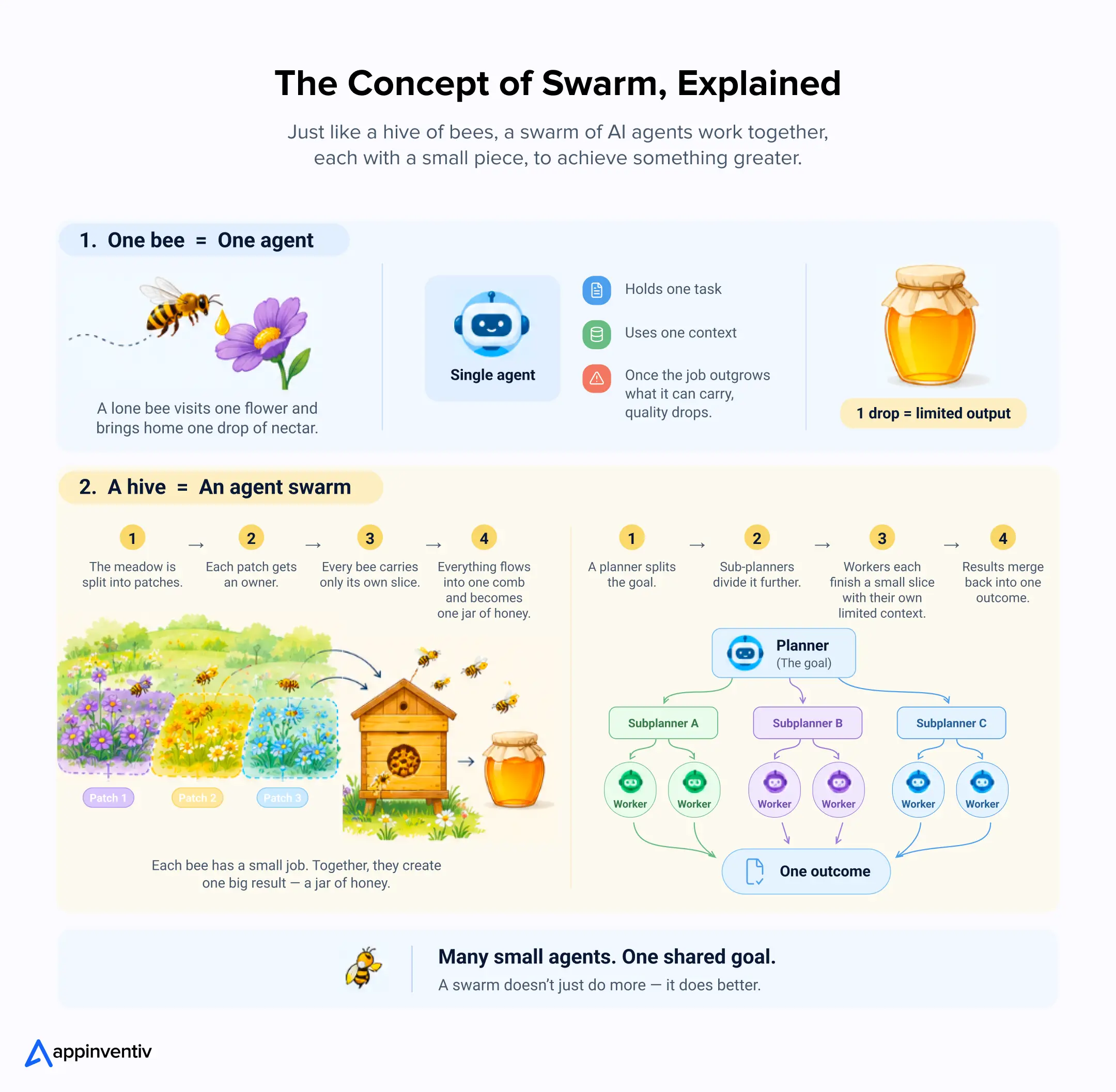
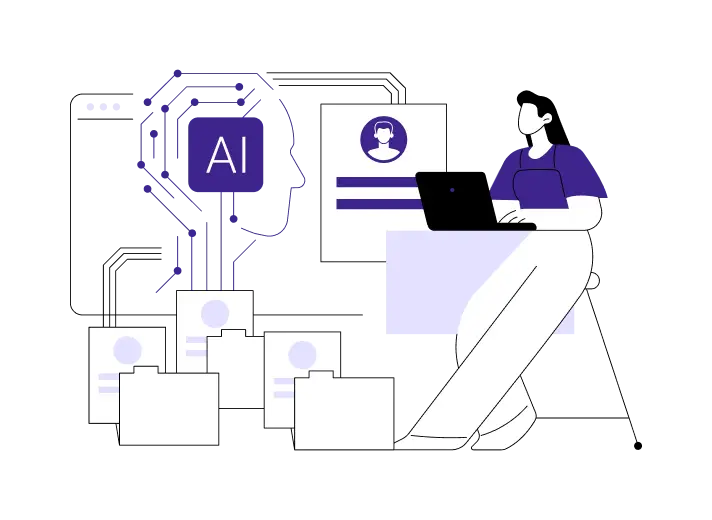
Look at the infographic above. It shows how a lone bee visits a flower and brings home a single drop of nectar. It is skilled and fast, but it can only carry so much. A single AI agent works the same way: it holds one task and one context, and once the job outgrows what it can carry, quality drops.
A hive turns the same bees into a system. The meadow is split; each patch gets an owner, and every bee carries only its own slice. Everything flows into one comb and becomes one jar of honey. In an agent swarm, a planner splits the goal, sub-planners divide it further, and workers each finish a small slice with their own limited context. The results merge into a single outcome.
For instance, one agent may be summarizing information, another may be reviewing the first agent’s work, and a third could be sequencing this by automatically deciding on the next best action. The information exchange, delegation of tasks, and shared signals occur simultaneously.
Increasing the agent count does not yield proportional performance gains. Multi-agent frameworks entail increased communication, coordination, and computational overhead. Consequently, swarm deployment is advantageous only when functional gains surpass the associated complexity.
Role of AI Agent Swarms in an Enterprise Setup
An enterprise rarely struggles because it lacks software. It struggles because its software, data, and teams do not always work together.
A customer request may require a CRM update, an inventory check, a pricing decision, a compliance review, and a transaction. Each system may perform its assigned function perfectly, yet the overall process remains slow because coordination still depends on people moving information between systems.
AI agent swarms offer a different way to approach this problem.
Rather than asking one AI system to handle an entire process, enterprises can bring together multiple specialized agents that divide the work, exchange findings, validate decisions and coordinate actions toward a shared business outcome. The opportunity is not simply to automate more tasks. It is to rethink how work moves across the enterprise.
Develop them with aim and purpose. Make AI agent swarms if your business requires.
Where the Advantages are Real
Think of AI agent swarms less as a smarter employee and more as a well-run department. They can possibly create a beneficial setup, in terms of:
- Speed on divisible work/task funneling: Consider a retailer preparing for a sudden increase in festive/seasonal demand. One agent analyses sales patterns, another checks inventory, a third assesses supplier availability, and another evaluates delivery constraints. Their findings can be coordinated into a proposed replenishment plan. Instead of waiting for each analysis to finish before beginning the next, independent tasks can run in parallel. This can shorten decision cycles where the work genuinely benefits from parallel execution. Tasks that can be split into independent parts finish sooner when agents run concurrently.
- Agent specialization: Research, analysis, and review can each get the tools and instructions that suit them, rather than one generalist doing everything.
- Stronger quality checks and assurance: Independent reviewers catch errors a single pass would miss, especially when they see the work through different lenses.
- Human expertise can be directed towards more important kinds of decisions: Agents can handle tasks such as collecting information, performing routine analysis, and executing bounded actions, thereby enabling employees to concentrate on judgment, negotiation, customer relationships, and decisions with significant consequences. The aim is not to eliminate human involvement in all processes but rather to focus human attention on the decisions where it is most important.
- Enterprise systems can be more closely connected in their operations: Since most organizations have already made considerable investments in ERP platforms, CRM systems, data warehouses, cloud infrastructure, and custom applications, it is neither practical nor necessary to replace them. Agents can obtain information through authorized interfaces, leverage existing business capabilities, and coordinate processes across multiple systems. The benefit comes from linking the capabilities the company already possesses, not from adding another separate technology layer.
- Better economics, if designed well: Cursor’s SQLite experiment illustrates the potential of assigning different models to different roles. Its hybrid configuration, using a more capable model for planning and a less expensive model for execution, costs substantially less than its GPT-5.5-only configuration while achieving comparable test-suite results. The lesson is not that execution is always cheap, but that model selection, task allocation, and orchestration can materially influence the economics of agentic systems.
The evidence also asks for honesty. Anthropic’s own testing found that the largest gain came from moving from one agent to ten, with much smaller returns thereafter. Often, the swarm delivers the same result faster rather than a better one. Treat it as an accelerator before you treat it as a miracle.
What It Could Mean for Your Enterprise Landscape
Swarms could be integrated into enterprise products or deployed within existing workflows to coordinate complex, high-volume processes.
Think of claims triage, procurement review, compliance checks, legacy code modernization, test coverage, and security remediation. These are high-volume, decomposable processes where coordination creates value.
AI Agent Swarms in Different Use Cases: How They Could Play Out
In financial services, agents could coordinate document collection, fraud screening, policy checks, and claims assessment, while reserving consequential decisions for authorized professionals.
In healthcare, they could help coordinate administrative workflows, retrieve relevant information, and flag inconsistencies without replacing clinical judgment.
In manufacturing, agents could connect production schedules, supplier signals, inventory levels, and maintenance information to recommend operational adjustments.
In software engineering, a development agent could implement a defined requirement while testing, code-review, and security agents independently examine the output. Their findings could feed into a controlled development pipeline, with deterministic tests and human approval governing release.
These are potential architectures, not guaranteed outcomes. Their effectiveness depends on data quality, integration, workflow design, and the reliability of the agents involved.
Keep this in mind: You must know your enterprise and its environment. Not every problem needs a swarm. Where a single agent can handle the workload traditionally, it will be easier to govern it and also afford the same. A pilot can help you ascertain the ROI of an AI agent swarm.
The Hard Part Is Not Creating Agents. It Is Governing Their Collaboration.
A swarm introduces risks that a standalone AI assistant may not present to the same degree.
An incorrect assumption made by one agent can influence several others. Conflicting recommendations can create circular reasoning or unnecessary retries. Additional model calls, inter-agent communication, and repeated validation can increase latency and operating costs.
Security also becomes more complicated. Each agent needs an identifiable purpose, narrowly scoped permissions, and controlled access to enterprise data and tools. A research agent should not automatically inherit the transaction privileges of an execution agent.
The decision-makers of the C-suite should establish five foundations before scaling:
- Clear accountability: Assign a business owner to the outcome, a technical owner to the system, and explicit responsibility for consequential decisions.
- Controlled autonomy: Define which actions agents can perform independently, which require approval, and which are prohibited.
- Reliable enterprise context: Make relevant data accessible, current, and permission-aware. More information does not automatically mean better decisions.
- End-to-end observability: Record task assignments, decisions, tool calls, handoffs, costs, failures, and final outcomes.
- Measurable economics: Compare the complete workflow against its existing baseline, including integration, inference, monitoring, human review, and exception handling.
A single agent may remain the better choice for a simple, bounded task. A swarm earns its complexity only when coordination creates measurable value. Identifying where that value is likely to emerge requires assessing the workflow, business objectives, and operational constraints before choosing an architecture. This is where AI consulting can help frame the problem before selecting the technology.
Also, be cautious about the entire setup failing. If agents share the same blind spots and work on a similar model, they may tend to collapse together as well. One wrong task/bad judgment call and the ripple effect follows. The multiplier effect can be your biggest opportunity or threat. But Anthropic notes that identical agents can turn isolated errors into systemic ones. Diverse models, distinct agent identities, and independent review are the countermeasures.
Controls need to be part of the system’s operating model, not added after deployment. Clear decision rights, risk-based safeguards, and ongoing monitoring help enterprises maintain oversight as AI systems become more autonomous. These considerations are central to AI governance as a discipline.
Building for an Agentic Enterprise
For organizations exploring this model, the first investment should not necessarily be in building more agents. It should be in identifying where fragmented work creates material business friction.
That requires AI consulting to assess suitable use cases, redesign workflows, and define autonomy boundaries. Software engineering must then connect agents to existing applications, APIs, data platforms, and security controls. AI services and solutions bring these elements together into a system that can be tested, monitored, and improved under real operating conditions.
This is also where architecture decisions matter. Modular components, reusable integration patterns, and independent governance controls make it easier to evolve the system as models and orchestration approaches change.
The sensible starting point is one meaningful workflow, a defined baseline, a limited pilot, and clear criteria for production readiness. Scale should follow evidence, not enthusiasm.
How can AI Agent Swarms Become Your ROI Multiplier: A practical decision framework for AI swarms
For your AI swarm to be an ROI multiplier, you need to have positive answers to these 4 metrics:
1. Decomposability
Can the business outcome be divided into distinct tasks with clear boundaries, or do the tasks depend heavily on one another?
2. Coordination value
Does collaboration among agents improve coverage, decision quality, or cycle time enough to justify the additional coordination?
3. Control and accountability
Can the enterprise enforce permissions, trace decisions, validate outputs, and retain human authority over consequential actions?
4. Net economic value
Does the swarm improve the end-to-end business outcome after inference, integration, monitoring, rework, and human review costs?
Find out where multi-agent AI can deliver measurable business impact.
Now, AI Agents Have Their Army, and You Could Too!
The question for the next planning cycle is not whether to adopt swarms. It is where coordinated agents would genuinely outperform a single one, and whether your architecture, governance, and teams are ready to support them. The answers usually come from three places: an honest readiness assessment, engineering foundations built for agent-driven workloads, and a pilot small enough to learn from and measured tightly enough to trust.
Swarms will reward leaders who treat them as an organizational design decision rather than a technology purchase.


Fast 2-minute response, fully NDA-protected.
AI Data Integration: How to Connect, Clean and Prepare Data for AI
Key takeaways: AI initiatives fail when fragmented, poor-quality data reaches models without sufficient context, controls or ownership. AI-ready pipelines must connect, clean, enrich, govern and continuously monitor data across its lifecycle. Real-time processing matters when AI decisions depend on current transactions, events, inventory or operational conditions. Data architecture should follow the AI use case, balancing…

AI-Native SDLC: Foundational 90-Day, 5R AI SDLC Adoption Playbook
Key takeaways: Why AI coding tools accelerate coding and software delivery How AI-native SDLC shifts engineering from code to intent, context, and outcomes The role of specifications, AI agents, and continuous verification in enterprise delivery How to redesign engineering teams for human–agent collaboration The platform, governance, and guardrails required to scale AI-native development A practical…
AI Agent Governance: How to Govern Autonomous AI Across Business Systems
Key takeaways: AI agents require controls at the action, identity, data, tool, and workflow levels. Every enterprise agent should have a registered owner, an approved purpose, and a defined risk tier. Access must be based on the agent’s task rather than inherited from a human user or shared service account. High-impact actions need real-time policy…