
































How Much Does it Cost to Build a Medical Scheduling Software?

 Share -


- 01Medical Scheduling Software Market Overview
- 02Key Features of Medical Scheduling Software
- 03Breaking Down Development Costs for Medical Scheduling Software
- 04How to Estimate Your Development Costs
- 05Time and Team Size Estimates
- 06Key Factors That Influence the Cost of Medical Scheduling Software Development
- 07Hidden Costs in Medical Scheduling Software Development: What You Need to Watch Out For
- 08Smart Ways to Cut Medical Scheduling Software Development Costs
- 09How to Develop Medical Scheduling Software: A Step-by-Step Roadmap
- 10Smart Ways to Make Your Medical Scheduling Software Stand Out
- 11How to Make Money with Medical Scheduling Software
- 12Additional Monetization Avenues to Enhance the Profitability of Your Medical Scheduling Software
- 13Build Your Next-Gen Medical Scheduling Software with Appinventiv
- 14FAQs

Key takeaways:
- Medical scheduling software streamlines appointment booking, reduces no-shows, and optimizes staff schedules, benefiting both healthcare providers and patients.
- The cost to build medical scheduling software ranges from $30,000 to $300,000, depending on the complexity and features required.
- Features like automated reminders, real-time availability, and telemedicine integration create a seamless and user-friendly experience for patients, improving satisfaction and retention.
- You can generate income through subscription models, pay-per-use systems, or offering premium features such as telemedicine integration, advanced analytics, and enterprise licensing.
Medical scheduling software development has become a strategic priority for healthcare providers looking to cut no-shows, ease staff workload, and give patients the on-demand booking they now expect. So what does it cost to build one?
Well, the budget can range anywhere from $30,000 to $300,000, depending on the features, integrations, scale, and compliance requirements (such as HIPAA or GDPR) involved. To target larger markets and build super complex solutions, it can even cross a million dollars. So, plan accordingly.
This guide will help you plan well. It breaks down exactly what drives that cost, from essential features and stage-by-stage budgets to hidden expenses and smart ways to save, so you can plan with confidence. First, let’s look at what’s fueling demand in this market.
Build Your Medical Scheduling Software with Us

Medical Scheduling Software Market Overview
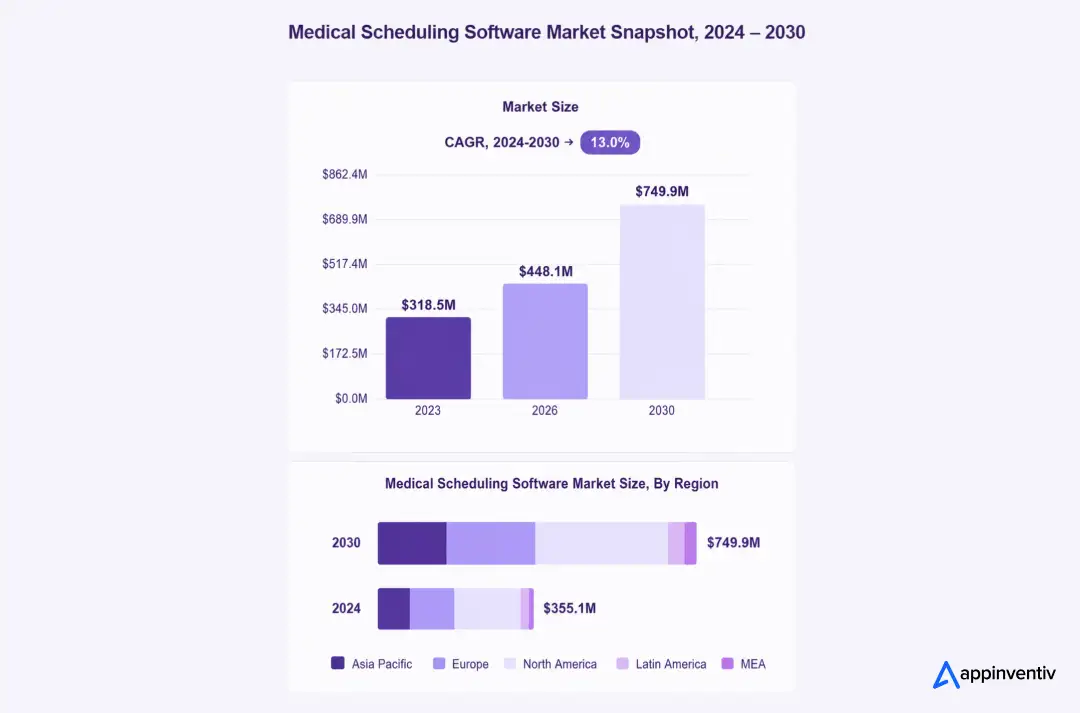
The numbers demonstrate the significant demand for these solutions. According to GVR’s report, the medical scheduling software market is projected to reach $749.9 million by 2030, representing a solid 13% annual growth rate from 2024 to 2030. What’s driving this expansion? Healthcare facilities seek digital tools that streamline their operations, minimize missed appointments, and enable more effective resource utilization.
The move toward putting patients at the center of care is also pushing providers to embrace smarter, automated scheduling systems. These platforms need to juggle different appointment types, work across multiple locations, and integrate telehealth services seamlessly.
Key Features of Medical Scheduling Software
Medical scheduling software needs the right mix of features to work effectively for both patients and healthcare staff. Here are the essential features that make medical scheduling software truly valuable for healthcare organizations.
- Appointment Scheduling: Lets patients book, reschedule, or cancel visits online without calling the front desk. Real-time slot management prevents double-booking and keeps provider calendars accurate around the clock.
- Automated Reminders & Notifications: Sends automatic SMS, email, and voice reminders ahead of each appointment. This minimizes no-shows and keeps patients informed about confirmations, changes, and follow-ups.
- EHR/EMR Integration: Connects with systems like Epic, Cerner, or Athenahealth through secure APIs (HL7/FHIR). Scheduling data flows straight into patient records, eliminating duplicate entry and improving care coordination.
- Patient Profiles: Stores patient details, medical history, and contact information in one secure place. Providers get quick access to the context they need before every appointment.
- Real-Time Availability & Calendar Integration: Displays open slots instantly and syncs with Google and Outlook calendars, so both patients and staff always see an accurate, up-to-date schedule.
- Telemedicine Integration: Connects with video platforms so patients can book and join virtual visits. This expands access to care and supports hybrid in-person and remote workflows.
- Digital Intake: Lets patients complete medical history, consent forms, and insurance verification before they arrive. This streamlines check-in, cuts waiting-room time, and reduces paperwork errors.
- Waitlist & Resource Management: Automatically notifies patients when earlier slots open and coordinates rooms, equipment, and staff. Dynamic waitlists fill cancellations fast and keep resources fully utilized.
- Multi-Location Support: Allows patients to book across different offices or clinics from a single system, while administrators manage every location’s schedule in one unified dashboard.
- Online Payment Integration: Enables patients to pay securely through the software via Stripe, PayPal, or cards. Integrated billing speeds up collections and reduces manual reconciliation.
- AI-Powered Scheduling: Suggests optimal appointment times based on availability, history, and demand. Smart automation balances provider workloads and helps predict and prevent no-shows.
- Reporting & Analytics: Surfaces appointment patterns, no-show rates, and performance metrics in clear dashboards, helping practices optimize staffing and improve operations.
- Customizable Booking Forms: Lets practices create tailored forms to collect the exact patient information they need, ensuring providers are prepared for each visit type.
- Customizable Interface: Adapts the platform’s look and feel to match your practice’s branding, giving patients a consistent, professional experience that reinforces trust.
- Secure Patient Messaging: Provides HIPAA-compliant messaging so patients can reach providers about appointments. Encrypted communication protects privacy while improving responsiveness.
- Multi-Language Support: Offers the interface in multiple languages to serve diverse patient populations, widening access and making booking easier for non-native speakers.
- Patient Self-Service Portal: Gives patients a single portal to book, manage, and update their appointments and details. Self-service reduces front-desk calls and puts patients in control of their care.
Breaking Down Development Costs for Medical Scheduling Software
When determining the cost to build medical scheduling software, the most effective approach is to examine each development stage separately. This way, you can budget properly and avoid any nasty surprises along the way. Each phase requires different skills and resources, and costs will vary depending on the complexity of your software and the compliance rules you need to follow.
The percentages we’re showing here are what most companies in the industry typically spend. Getting the planning right from the start really pays off—it keeps you from going over budget later on.
Here’s a quick overview of how feature complexity maps to the overall cost to build medical scheduling software, before we break the budget down stage by stage:
| Complexity Level | Features Included | Estimated Cost Range |
|---|---|---|
| Basic Complexity | Appointment scheduling, patient profiles, reminders | $30,000 to $50,000 |
| Intermediate Complexity | Payment system integration, email/SMS notifications, polished UI | $60,000 to $150,000 |
| Advanced Complexity | AI-driven features, predictive scheduling, complex backend integrations, HIPAA compliance | $200,000 to $300,000 |
Planning and Discovery (5-10% of Total Budget)
This is where everything starts. You’ll research your market, determine if your idea is viable, and define what your software needs to accomplish. Getting this right means your final product will actually solve real problems for your users.
Timeline: 2-4 weeks
Cost Range: $3,000 – $7,000
- Market research and checking if it’s doable
- Figuring out the technical setup
- Planning for regulations and compliance
- Putting together your team
Design Phase (15-20% of Total Budget)
Here’s where your medical appointment booking system starts taking shape visually. Your team will create wireframes, design interfaces that people actually want to use, and plan out your database structure. Good UI/UX design means the users will actually stick around and use your app.
Timeline: 3-6 weeks
Cost Range: $10,000 – $25,000
- Creating interfaces for both web and mobile
- Planning your database structure
- Designing security frameworks
- Making sure everything flows smoothly
Development Phase (60-70% of Total Budget)
This is the big one—where most of your money goes. Your developers will build both the front-end (what users see) and back-end (what makes it work), plus connect everything to payment systems, medical records, and other tools your practice uses.
Timeline: 3-12 months
Cost Range: $50,000 – $250,000
- Building both frontend and backend systems
- Connecting to payment gateways and medical records
- Making sure everything meets HIPAA requirements
- Creating APIs for real-time scheduling
Launch and Deployment (10-15% of Total Budget)
Your medical software for scheduling is ready to go live. This phase encompasses final security checks, training materials, and the actual release of your software for use by the public. It’s the finish line, but there’s still important work to do.
Timeline: 2-6 weeks
Cost Range: $10,000 – $20,000
- Moving everything to live servers
- Final security audits
- Training materials and documentation
- Launch strategy execution
Maintenance (15-25% Annually)
Once your online medical scheduling software development is complete and live, you’ll need ongoing maintenance. This covers bug fixes, security updates, performance improvements, and adding new features as your practice grows.
Ongoing Cost: $5,000 – $30,000 per year
- Fixing bugs and updating features
- Monitoring security threats
- Keeping performance optimized
- Adding new capabilities
How to Estimate Your Development Costs
Here’s a simple formula that works pretty well:
Total Cost = (Team Hourly Rate × Development Hours) + Infrastructure + Compliance Costs
Real Example:
- Team of 5 developers at $100/hour
- 1,200 total development hours
- Infrastructure costs: $15,000
- Compliance work: $20,000
- Total: $155,000
Time and Team Size Estimates
The time and personnel you’ll need depend on the level of ambition in your project. A basic scheduling software might only need a few developers for a couple of months, while a full enterprise system could take a year with a bigger team.
| Project Type | Team Size | Development Hours | Timeline |
|---|---|---|---|
| Simple Scheduling App | 3-4 developers | 800-1,200 hours | 2-4 months |
| Intermediate Scheduling App | 5-6 developers | 1,500-2,500 hours | 4-6 months |
| Enterprise Scheduling System | 8-10 developers | 3,500-6,000 hours | 6-12 months |
The key is being realistic about what you need and planning accordingly. Most practices find that starting with a solid intermediate solution gives them room to grow without breaking the bank.
Key Factors That Influence the Cost of Medical Scheduling Software Development
Developing a medical scheduling software involves multiple cost variables, from design complexity to technology stack. Understanding these factors helps you plan your budget wisely and estimate the medical scheduling software development cost more accurately.
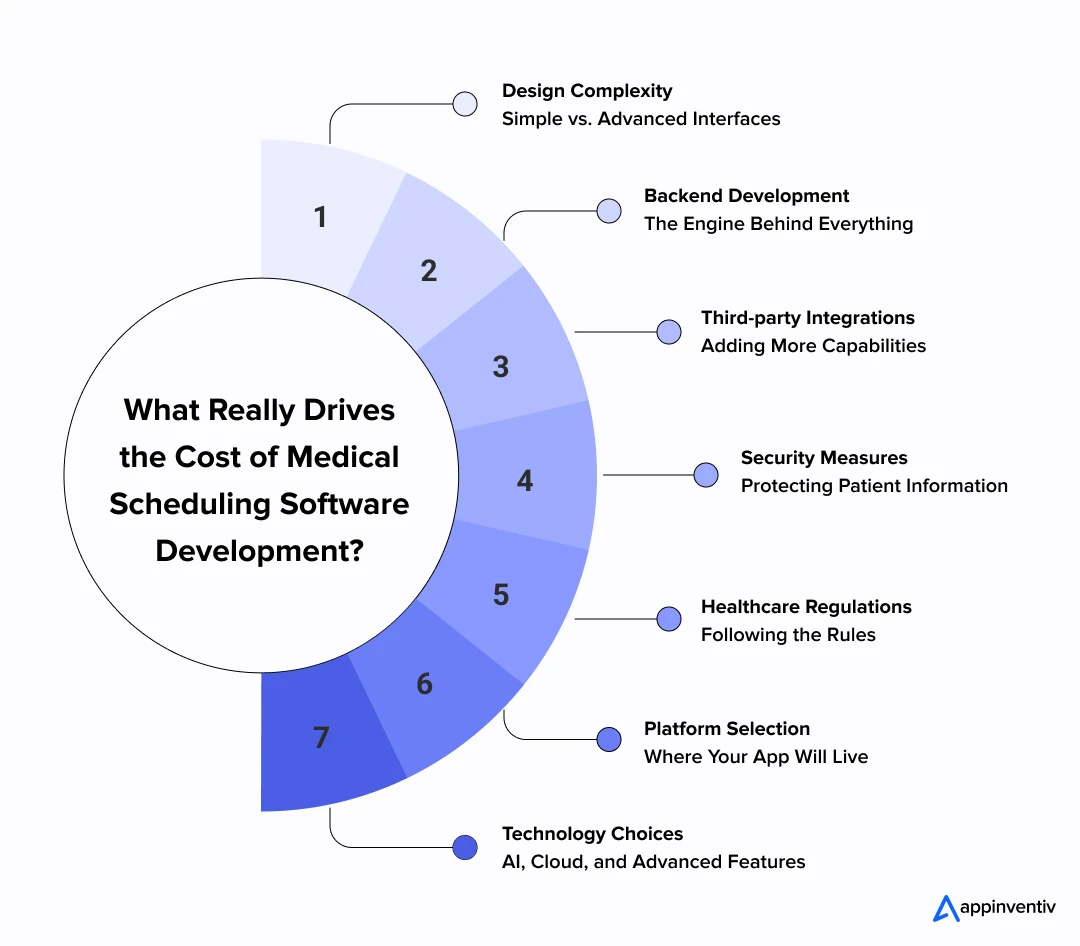
Design Complexity: Simple vs. Advanced Interfaces
A basic interface with minimal design elements will cost around $3,000–$6,000, while a comprehensive design with custom branding, animations, and accessibility features can increase costs to $10,000–$15,000.
When building medical software for scheduling, having a user-friendly design isn’t only essential, but it’s also crucial for helping patients navigate without frustration. The catch? The more sophisticated and interactive you make the design, the more you’ll spend on design work and testing.
Backend Development: The Engine Behind Everything
A simple backend that handles basic appointment management might cost $5,000–$8,000, but if you want a robust system with real-time updates, secure APIs, and the ability to scale, you’re looking at $15,000–$30,000.
For online medical scheduling software development, adding cloud integration, data encryption, and connections to EMRs/EHRs makes things way more complex. This is why backend development often becomes the biggest chunk of your entire project budget.
Third-party Integrations: Adding More Capabilities
Each integration, whether it’s telemedicine platforms, payment gateways, or insurance APIs, typically adds $2,000–$5,000 per feature. If you want a fully integrated system with multiple external services, you may incur an additional $10,000–$20,000 on top of your base cost.
In patient scheduling software development, these integrations definitely make life easier for users, but they also come with licensing fees, extra testing, and security checks that all add to your final bill.
Security Measures: Protecting Patient Information
Basic security features, such as HTTPS encryption and secure logins, will cost around $3,000–$5,000. However, if you require advanced HIPAA-compliant solutions with end-to-end encryption, multi-factor authentication, and regular security audits, expect to pay $8,000–$15,000.
When you’re creating automated patient scheduling software, investing in strong security isn’t optional—it’s absolutely necessary to protect sensitive patient data and avoid massive regulatory penalties.
Healthcare Regulations: Following the Rules
Getting compliant with standards like GDPR or HIPAA involves legal consultations, extra development work, and extensive testing, typically costing $5,000–$12,000 on average. For regions with stricter rules, it can go beyond $15,000.
This is a major factor when estimating medical scheduling software development cost because failing to comply can lead to heavy fines and serious operational problems. You’ll also need ongoing compliance monitoring and regular updates as regulations change, which adds to your long-term maintenance costs.
Platform Selection: Where Your Software Will Live
Building a native software for just one platform (iOS or Android) typically runs $20,000–$35,000, while developing for both platforms can range from $35,000–$60,000. Cross-platform frameworks like Flutter or React Native may save you some money.
The cost to build medical scheduling software depends on whether you want to develop a single-platform MVP to test the market or a multi-platform enterprise solution that reaches a broader audience. Keep in mind that native apps usually perform better and feel more polished, but they take longer to develop and maintain
Technology Choices: AI, Cloud, and Advanced Features
Basic scheduling functionality without advanced technology can stay within $15,000–$25,000, but adding AI-driven automation, predictive analytics, and cloud infrastructure can increase costs to $40,000–$70,000.
AI-powered medical software for scheduling can dramatically improve efficiency, but it requires a specialized development team that is knowledgeable, making it significantly more expensive than traditional scheduling apps. The upside is that these advanced features often pay for themselves through reduced staff workload and better resource utilization.
Hidden Costs in Medical Scheduling Software Development: What You Need to Watch Out For
When planning a patient scheduling software development project, most healthcare providers only consider the upfront development costs. But there are plenty of ongoing expenses that can sneak up on you and seriously impact your budget down the road.
From keeping your software running smoothly to hosting, staying compliant, and promoting your brand, these hidden costs can make or break your long-term success. Let’s dig into what you’re really looking at.
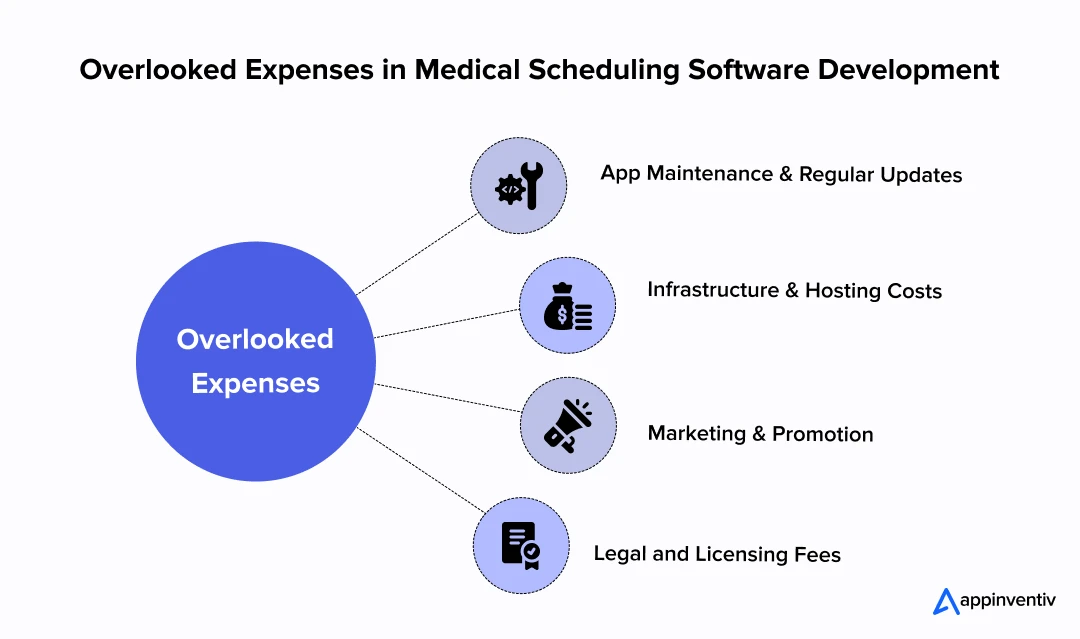
Software Maintenance and Regular Updates
Once your software is deployed, the work doesn’t stop—you’ll need ongoing maintenance to keep it secure, reliable, and actually useful for patients. Regular upkeep typically runs about 15–20% of your initial development cost each year and covers bug fixes, performance improvements, and updates to work with new devices.
Major upgrades, which usually cost 5–10% annually, might include adding new features, streamlining workflows, and incorporating new technologies. For automated patient scheduling software, staying up-to-date with updates is crucial to keep appointments running smoothly, maintain patient trust, and meet changing healthcare requirements.
Infrastructure and Hosting Costs
Where you host your software makes a huge difference in how well it performs, how secure it is, and whether it stays online when patients need it. A basic cloud setup may work fine for small practices, but costs can quickly escalate as more patients begin using your system. HIPAA-compliant medical scheduling software typically requires more secure and scalable hosting, which can significantly increase your monthly bills.
| Hosting Type | Monthly Cost (USD) | Description |
|---|---|---|
| Basic Cloud Hosting | $400 – $1,500 | Works for small clinics with moderate appointment traffic |
| Enterprise Hosting | $2,000 – $5,000 | Better for larger practices needing superior performance and security |
| High-Availability Setup | $5,000+ | Built for critical healthcare systems that can’t afford downtime |
As your software grows to handle more patients, hosting costs can really add up fast.
Marketing and Promotion
Having the best scheduling software in the world won’t matter if nobody knows about it. For patient self-scheduling software, you’ll need to invest in awareness campaigns, SEO, social media, and educational content that teaches patients how to use it effectively.
Marketing budgets typically range from $5,000 to $20,000 per month, covering brand awareness, content creation, and maintaining patient engagement. Consistent marketing ensures patients are aware they can book appointments online, improving adoption rates and helping you achieve a better return on your investment.
Legal and Licensing Fees
Healthcare software has to meet incredibly strict rules and regulations. Legal and licensing fees can run $5,000 to $20,000 annually, covering HIPAA audits, licensing for medical APIs, and protecting your intellectual property.
If you’re building EMR-integrated medical scheduling software, legal costs might also include contracts with EMR vendors, integration certifications, and compliance with local healthcare laws. These expenses keep your softwareon the right side of regulations and help you avoid expensive penalties that could put you out of business.
Smart Ways to Cut Medical Scheduling Software Development Costs
Building a medical scheduling software can significantly impact your budget, but with some smart planning, you can trim unnecessary expenses without compromising quality. Here are some tried-and-true strategies that actually work:
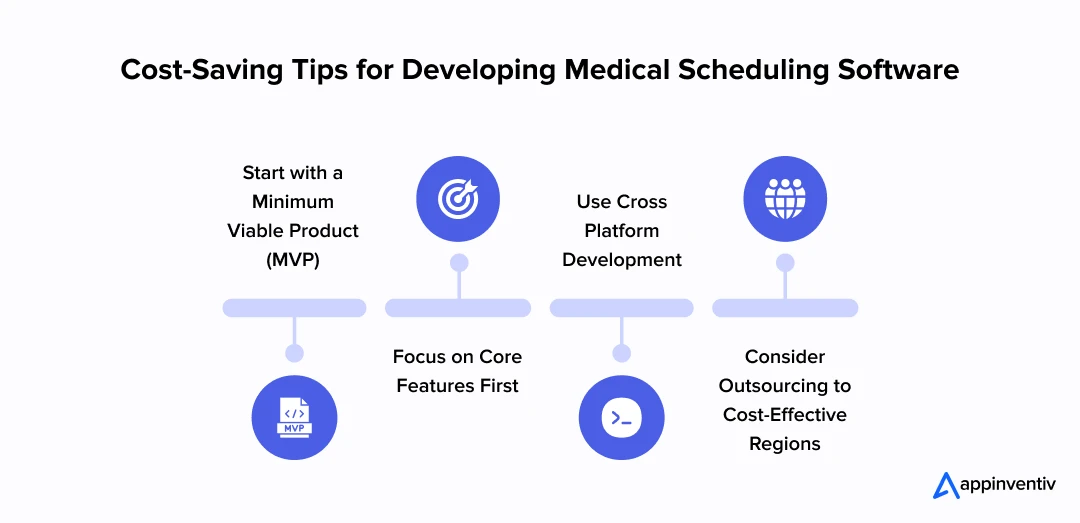
Start with a Minimum Viable Product (MVP)
Don’t try to build everything at once; start with an MVP that covers just the essential scheduling features. A basic patient self-scheduling software with appointment booking, calendar integration, and simple notifications can prove your concept works before you spend money on fancy features.
This approach reduces your initial medical scheduling software development cost and provides real user feedback to guide future improvements. Once you validate that patients actually use and like your basic app, you can invest confidently in additional features that add real value.
Focus on Core Features First
Focus on the features that patients and healthcare providers need most. Think secure appointment booking, automated reminders, and straightforward calendar management. You can always add advanced stuff like AI-driven scheduling or detailed analytics later.
By keeping things focused, you avoid the scope creep that usually drives up the cost to build medical scheduling software and get to market much faster. This phased approach also lets you spread costs over time rather than paying for everything upfront.
Use Cross-Platform Development
Rather than building separate native apps for iOS and Android, consider cross-platform frameworks like Flutter or React Native. This significantly reduces your development time and costs while maintaining consistent performance across devices.
For clinics seeking to scale quickly, cross-platform development makes medical appointment scheduling software development more budget-friendly without compromising usability or functionality. You’ll also save money on maintenance since you’re updating one codebase instead of two separate apps.
Consider Outsourcing to Cost-Effective Regions
Working with experienced developers in regions with competitive pricing can significantly reduce costs while maintaining high quality. Many offshore teams specialize in automated patient scheduling software and offer HIPAA-compliant solutions at rates much lower than local providers.
Ensure your outsourcing partner has a solid track record in healthcare compliance, security, and data privacy; this isn’t the place to take shortcuts. The time zone differences can actually work in your favor, giving you nearly round-the-clock development progress.
How to Develop Medical Scheduling Software: A Step-by-Step Roadmap
Creating a reliable scheduling solution requires a structured medical scheduling software development process that prioritizes usability, compliance, and seamless integration with healthcare systems. Whether you’re building for a small clinic or a large hospital network, here’s a practical roadmap on how to create an efficient medical scheduling system:
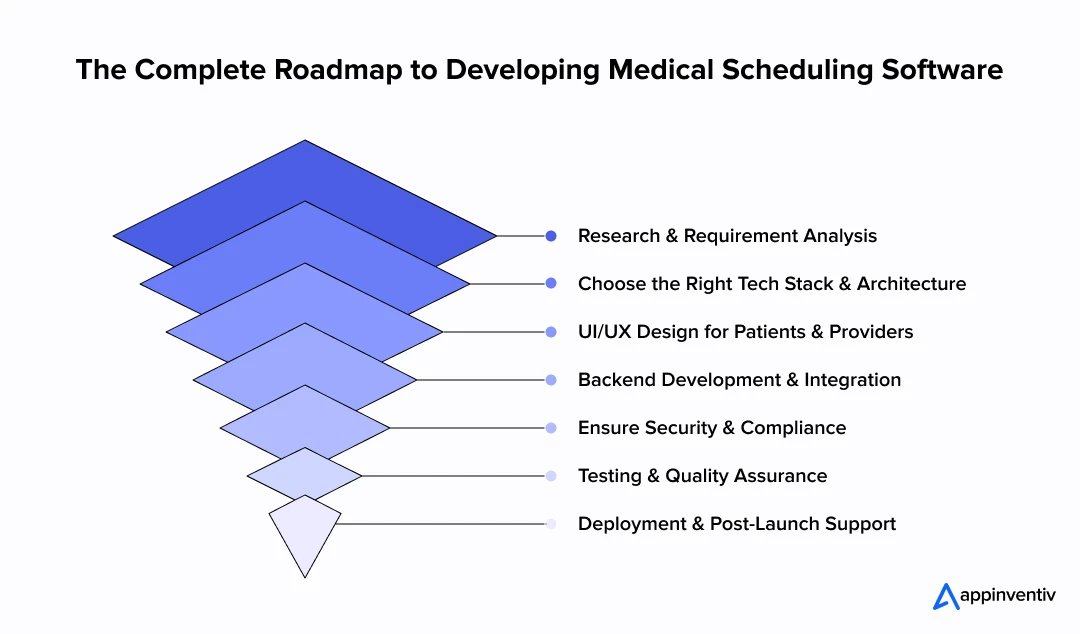
Research and Requirement Analysis
Begin by delving into what patients, doctors, and administrative staff truly require from a scheduling system. Speak with real users, conduct surveys, and observe current workflows to pinpoint areas of pain. Focus on essential features such as appointment booking, automated reminders, patient record management, and EMR interoperability.
This stage also involves evaluating the scope, timeline, and budget for your medical appointment scheduling software development project. Proper research prevents costly changes later and ensures you’re building something people will actually use.
Choose the Right Tech Stack and Architecture
When choosing the right tech stack in medical scheduling software, it’s crucial to select technologies that are both secure and scalable, specifically designed for healthcare environments. You’ll need HIPAA-compliant frameworks, reliable cloud hosting, and APIs that play well with other healthcare systems.
If you’re planning online medical scheduling software development, make sure your architecture can handle real-time updates without lag and integrate smoothly with EMRs, telemedicine platforms, and billing systems. Consider future growth too; what works for 100 patients might crash with 10,000, so plan for scalability from day one.
UI/UX Design for Patients and Providers
Design interfaces that feel intuitive for both tech-savvy millennials and less tech-comfortable older patients. The patient-facing side should make booking appointments as easy as ordering food online, while the provider interface needs to handle complex scheduling scenarios efficiently.
A well-structured interface reduces frustration and increases adoption rates. This is especially critical when building patient self-scheduling software because if patients can’t figure out how to book appointments, they’ll just call your office instead, defeating the whole purpose.
Backend Development and Integration
Build a rock-solid backend that can handle appointment data, send notifications reliably, and manage secure user authentication without breaking a sweat. Integration is key here—your system needs to talk to EMRs, payment gateways, insurance verification systems, and other third-party services your practice uses.
For more advanced solutions, consider implementing AI-driven scheduling automation that can optimize appointment slots, predict no-shows, and automatically suggest the best times based on historical data. This reduces administrative workload and improves resource utilization significantly.
Ensure Security and Compliance
Before launching, ensure your software meets all relevant healthcare data protection standards, such as HIPAA, GDPR, or local regulations. This isn’t optional, it’s mandatory. Implement strong encryption for data at rest and in transit, multi-factor authentication, and comprehensive audit trails that track every action in the system. Get legal and compliance experts involved early because fixing security issues after launch is exponentially more expensive and damaging to your reputation.
Testing and Quality Assurance
Run your software through rigorous testing scenarios that simulate real-world usage patterns. Test everything—functionality, security vulnerabilities, performance under heavy load, and user experience across different devices and browsers.
Don’t just test the happy path; try to break things intentionally to find weak spots. Include actual healthcare staff and patients in your testing process because they’ll use the system differently than your development team expects.
Deployment and Post-Launch Support
Deploy your software across chosen platforms and set up comprehensive monitoring to track performance, uptime, and user behavior. Launch isn’t the finish line—it’s just the beginning of your app’s lifecycle.
Plan for regular updates, bug fixes, security patches, and feature enhancements based on user feedback and changing healthcare needs. Establish a support system for users and maintain detailed documentation to help with troubleshooting and onboarding new practices.
Smart Ways to Make Your Medical Scheduling Software Stand Out
The healthcare tech market is pretty crowded these days, so you need more than just basic appointment booking to get noticed. To truly make a difference, your software must offer genuine value, work seamlessly for everyone, and evolve in response to your users’ changing needs.
By focusing on innovation, staying compliant, and prioritizing user needs, you can create a solution that healthcare providers and patients genuinely want to use. Here’s how to set your product apart:
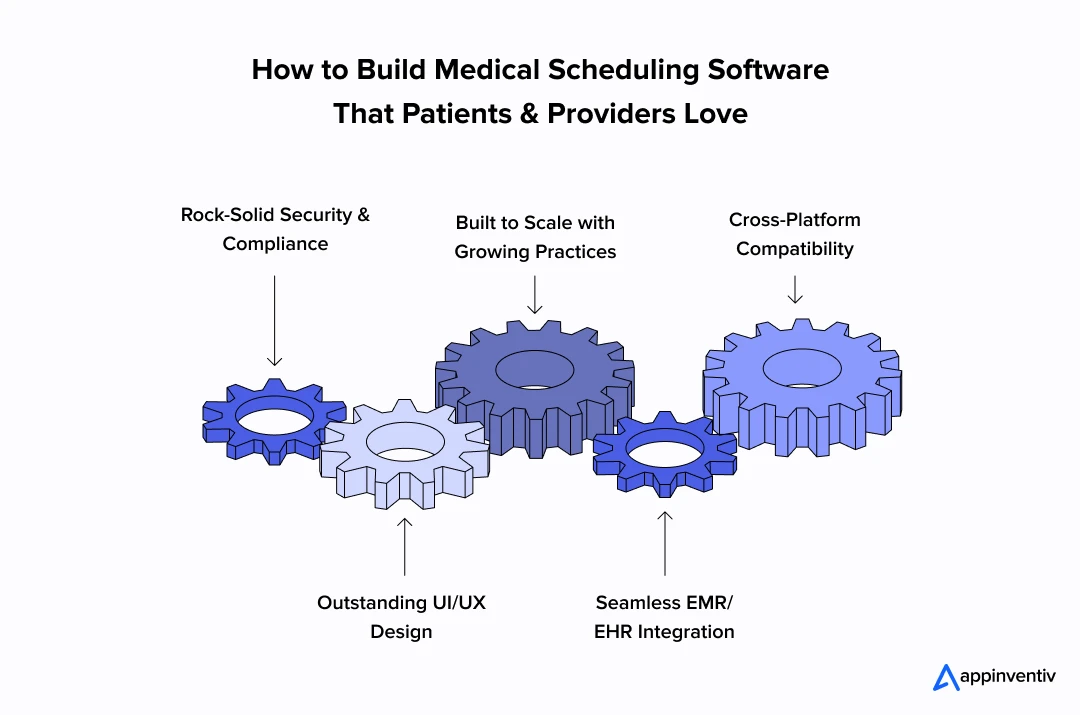
Rock-Solid Security & Compliance
When it comes to healthcare software, security isn’t something you can compromise on. You need HIPAA-compliant encryption, multi-factor authentication, and secure cloud hosting to keep patient data locked down tight. Getting security right with HIPAA-compliant medical scheduling software doesn’t just build trust with clinics and hospitals—it also saves you from expensive penalties and legal headaches that could sink your business.
Outstanding UI/UX Design
A clean, intuitive interface can make or break your adoption rates. Patients should be able to book, reschedule, or cancel appointments with ease, without confusion or frustration. Doctors and admin staff need dashboards that actually make their jobs easier, not harder. When you nail the design for patient self-scheduling software, you’ll see higher engagement rates and much happier users who actually stick around.
Built to Scale with Growing Practices
Your software needs to grow along with your users’ practices, from small clinics to large hospital networks. A solid backend and cloud infrastructure mean your system can handle thousands of users at once without crashing or slowing down. Building scalability into your online medical scheduling software development from the start saves you from expensive rebuilds later and keeps your users happy as your business expands.
Seamless EMR/EHR Integration
Connecting with existing electronic medical records systems adds serious value by automatically syncing appointment data with patient records. EMR-integrated medical scheduling software eliminates duplicate data entry, reduces staff workload, and enhances care coordination throughout the practice. This kind of integration makes your software a no-brainer choice for modern healthcare providers who want everything to work together smoothly.
Also Read: EHR vs EMR in Healthcare: Key Differences
Cross-Platform Compatibility
Building your software to work on both iOS and Android with a single codebase is just smart business. This approach speeds up development, reduces maintenance headaches, and ensures consistent performance regardless of the device being used. For medical appointment scheduling software development, cross-platform tools like Flutter or React Native can get you to market much faster while keeping costs reasonable.
How to Make Money with Medical Scheduling Software
Having a solid revenue model is crucial for keeping your medical scheduling software profitable and sustainable over the long haul. When you look at successful medical scheduling software examples, you’ll notice they use several different approaches to generate income:
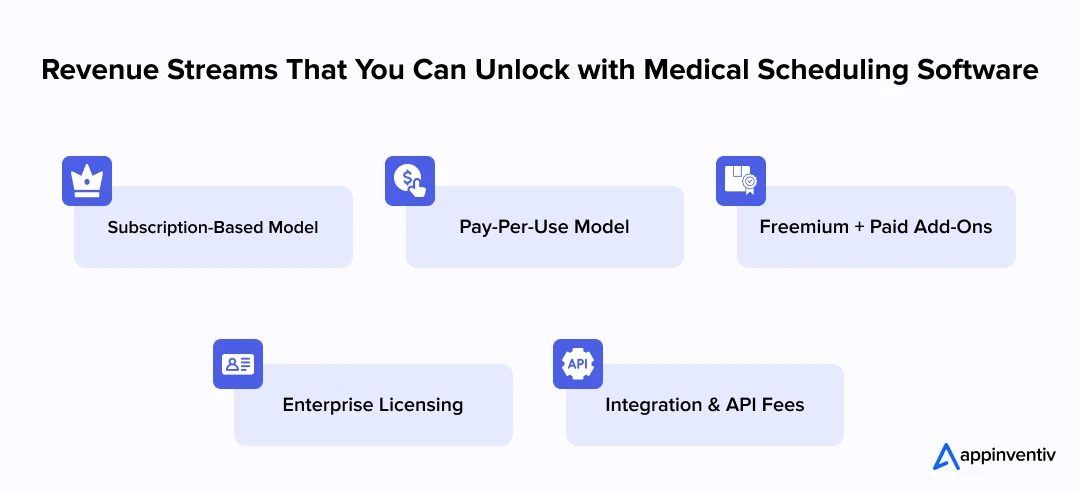
Subscription-Based Model: Clinics and hospitals pay monthly or yearly fees to access your platform. You can create different pricing tiers—basic scheduling for smaller practices versus advanced analytics, telemedicine, and EMR integration for larger facilities.
Pay-Per-Use Model: Smaller clinics often prefer paying only for what they actually use, like a set fee for each appointment booked through your app. This works great for seasonal practices or those with lower patient volumes.
Freemium + Paid Add-Ons: Give away basic appointment scheduling for free, then charge for premium features like automated patient scheduling software, detailed reporting, or telehealth integration.
Enterprise Licensing: Large healthcare networks can buy enterprise licenses that include unlimited usage, custom branding, and features tailored specifically to their needs.
Integration & API Fees: When your software connects with EMRs, billing systems, or telehealth services, you can charge clinics extra for these valuable integrations.
Let us help you choose a revenue model that drives growth and long-term success

Additional Monetization Avenues to Enhance the Profitability of Your Medical Scheduling Software
Beyond your main income sources, there are plenty of other ways to monetize your medical scheduling solution and increase profitability:
- Telemedicine Partnerships: Team up with telehealth platforms and earn commissions for virtual consultations booked through your software.
- Value-Added Services: Offer marketing tools for clinics as add-ons, like patient reminder campaigns or online reputation management services.
- Data Analytics & Insights: Provide anonymized patient flow and scheduling analytics to help clinics optimize their resources.
- White-Label Solutions: Sell customizable white-label versions of your software to healthcare providers who want their own branded medical appointment scheduling software development solution.
Build Your Next-Gen Medical Scheduling Software with Appinventiv
The future of medical scheduling software is rapidly evolving toward AI-driven automation, predictive analytics, telemedicine integration, and seamless EMR/EHR connectivity. As patients demand more convenience and healthcare providers seek operational efficiency, the next generation of scheduling solutions will focus on personalized experiences, real-time availability, automated workflows, and enhanced security. Scalability, HIPAA compliance, and cross-platform accessibility will no longer be optional—they’ll be essential.
To succeed in this dynamic landscape, you need a technology partner with deep healthcare domain expertise, a strong innovation mindset, and proven experience in building compliant, scalable solutions.
Here’s where Appinventiv makes a difference as a medical software development firm focused on innovation, compliance, and scalability.
With a strong track record in medical appointment scheduling software development and digital healthcare innovation, we delivered several impactful projects like:
- Health-e-people, a comprehensive personal health management platform connecting patients and providers.
- Soniphi, an advanced wellness software leveraging bio-acoustic technology for preventive healthcare.
- DiabeticU, an AI-driven solution helping diabetic patients monitor, track, and improve their health outcomes.
Our custom software development services combine cutting-edge technologies like AI, cloud computing, secure APIs, with healthcare compliance expertise to create solutions that improve patient engagement and streamline clinic operations. Whether it’s automated patient scheduling software, patient self-scheduling software, or fully EMR-integrated medical scheduling software, we ensure your product is future-ready, scalable, and user-centric.
If you’re looking to build or enhance your medical scheduling solution, Appinventiv can help you transform your vision into a secure, compliant, and profitable healthcare app.
FAQs
Q. How long does it take to develop medical appointment scheduling software?
A. The development timeline for medical appointment scheduling software depends on its complexity. A basic MVP with simple scheduling, notifications, and calendar sync takes around 2–3 months. A mid-level solution with EMR/EHR integration, role-based dashboards, and HIPAA compliance requires 4–6 months, while an enterprise-grade solution with AI-driven automation, analytics, telemedicine integration, and multi-clinic support can take 6–9+ months.
Additionally, factors like the tech stack, regulatory compliance, and third-party integrations can further extend the development timeline.
Q. What scheduling methods are used in healthcare?
A. Healthcare facilities use different scheduling methods based on their workflow and patient volume:
- Time-Slot Scheduling (Fixed Appointments): Patients are given specific time slots to reduce wait times.
- Wave Scheduling: Multiple patients are scheduled at the same time, and seen in order of arrival.
- Double-Booking: Two patients booked at the same time, usually when one appointment is expected to be short.
- Open Booking: Patients are given a time window rather than a fixed slot (e.g., between 9–11 AM).
- Cluster Scheduling: Groups patients with similar needs or conditions for efficient resource usage.
- Automated Scheduling: AI-driven systems optimize appointment times based on provider availability and patient preferences.
Q. What are some of the top medical scheduling software use cases?
A. Medical scheduling software can serve various healthcare scenarios, including:
- Patient Self-Scheduling: Allowing patients to book, reschedule, or cancel appointments online.
- Clinic & Hospital Resource Management: Managing doctors, rooms, and equipment scheduling efficiently.
- Telemedicine Scheduling: Booking virtual consultations and syncing with video conferencing tools.
- Integrated Care Coordination: Syncing appointments with EMRs/EHRs for seamless medical record access.
- Group Appointment Management: Scheduling wellness programs, therapy sessions, or vaccination drives.
- Multi-Location Healthcare Networks: Managing schedules across multiple clinics or hospitals.
Q. What are some of the major challenges in medical scheduling software development?
A. Here are some of the major challenges and solutions of developing medical appointment scheduling software:
Challenge: Ensuring Data Privacy and Compliance
In healthcare, protecting sensitive patient information is critical. Data privacy and compliance in medical scheduling software must meet HIPAA or GDPR regulations, which can be complex and time-consuming.
Solution: Implement strong data encryption, multi-factor authentication, and regular compliance audits to ensure all legal and regulatory requirements are met.
Challenge: Integration with EMRs/EHRs and Existing Systems
Many clinics already use electronic health records or hospital management systems, making integration a major hurdle in medical appointment scheduling software development. Without smooth data flow, staff face duplicate work and inefficiencies.
Solution: Use standardized healthcare APIs like HL7 or FHIR to ensure seamless interoperability between the scheduling software and existing medical systems.
Challenge: Creating an Intuitive UI/UX for Different Users
Patients, doctors, and administrative staff all have different needs, making it hard to design a simple yet powerful interface. Poor usability can lead to low adoption and scheduling errors.
Solution: Conduct user research, design role-specific dashboards, and focus on a clean, intuitive layout that simplifies the booking and management process for every user.
Challenge: Scalability to Handle Growing Demand
As patient volume and clinic locations grow, the system must handle thousands of concurrent bookings without delays or downtime. Lack of scalability can disrupt operations and impact patient care.
Solution: Use cloud-based infrastructure and a scalable backend architecture that can expand with increasing traffic and usage.
Q. How to create efficient medical scheduling software?
A. Building efficient medical scheduling software starts with understanding the real workflows of patients, providers, and administrative staff, then prioritizing the features that remove friction, such as online self-booking, automated reminders, real-time availability, and EHR/EMR integration.
Choose a secure, scalable, HIPAA-compliant tech stack, design clean role-based interfaces, and connect the system to your existing records, payment, and telehealth tools through standardized APIs like HL7 or FHIR. Start with an MVP covering core scheduling, validate it with real users, and expand into AI-driven optimization and analytics once adoption is proven.
Rigorous testing, strong encryption, and ongoing maintenance keep the platform fast, reliable, and compliant as your practice grows.
Q. How is AI revolutionizing medical scheduling software development?
A. AI is transforming medical scheduling software development by turning static calendars into intelligent, self-optimizing systems. Machine learning models analyze historical booking data to predict no-shows, trigger targeted reminders or smart overbooking, and recommend the best appointment times for each patient and provider.
AI-driven scheduling balances provider workloads, dynamically fills cancellations from waitlists, and optimizes rooms and equipment across locations. Natural language chatbots and voice assistants let patients book and reschedule conversationally, while predictive analytics help administrators forecast demand and staff accordingly.
The result is fewer gaps, shorter wait times, and lower administrative overhead, though these capabilities require specialized expertise, which is why they add to overall development cost.
Q. What are some additional ways to monetize medical scheduling software?
A. Beyond core subscription or licensing revenue, medical scheduling software offers several ways to boost profitability:
Telemedicine Partnerships: Team up with telehealth platforms and earn commissions on virtual consultations booked through your software.
Value-Added Services: Offer clinics add-ons such as patient reminder campaigns or online reputation management tools.
Data Analytics & Insights: Provide anonymized patient-flow and scheduling analytics that help clinics optimize their resources.
White-Label Solutions: Sell customizable, white-labeled versions of your platform to providers who want their own branded scheduling software.


Fast 2-minute response, fully NDA-protected.

Wearable Data Integration: Connecting Multiple Devices to a Unified Health Platform
Key takeaways: Device support should reflect the measurements your service needs, the people using it, and the decisions those readings inform. A unified health data platform must preserve source, timing, and measurement context while resolving duplicate records. Phone health platforms, manufacturer APIs, and direct device connections serve different integration needs. Clinical workflows require agreed review…
Sleep Tracker App Development: Features, Wearable Integration, AI, and Compliance
Key takeaways: Sleep tracking presents opportunities across consumer wellness, fitness, healthcare, employee wellness, senior care, and infant-care markets. Successful products combine actionable insights, wearable connectivity, user-friendly reports, privacy controls, and clearly differentiated experiences. HealthKit, Health Connect, and direct device APIs provide different data depths, costs, limitations, and maintenance requirements. AI supports sleep-stage estimation and personalization,…

Diet and Nutrition App Development: Process, Features, Cost, and Technology Stack
Key Takeaways Diet and nutrition tracking app development goes past basic calorie counters with verified food databases, custom meal schedules, AI tools, wearable device links, and corporate manager tools. Structure database models around raw food items, serving portions, nutrient facts, recipes, software links, and regional diet rules. Pair computer vision models, recommendation algorithms, language engines,…