



















Ways Electronic Health Records Will Continue to Improve in 2026

 Share -



- 01Key Technologies Transforming Electronic Health Records
- 02Key Challenges of Electronic Health Records and How to Overcome Them
- 03Real-World Applications of Advanced EHR Technologies With Real-Life Examples
- 04What Does the Future of EHR Behold in 2026?
- 05Initiate Your EHR Journey with Appinventiv
- 06FAQs

Key takeaways:
- AI, voice recognition, and mobile access are among the technological advances that are enhancing the usability and efficiency of EHR systems in healthcare.
- Improved interoperability and cloud adoption are facilitating real-time data sharing among health organizations, which helps improve the quality of patient care.
- The AI-powered EHR interfaces and virtual assistants reduce physician burnout and enable increased patient interaction.
- However, as EHRs become more common, security and privacy remain essential issues, and rigorous measures must be implemented to protect sensitive health information.
- The future of EHR continues to be defined by ongoing innovations, such as predictive analytics and 5G, which can help to create smarter healthcare solutions.
The purpose of Electronic Health Records (EHRs) was to replace paper records, but the function of EHRs in healthcare has grown a lot over the years. Currently, the technology impact on EHR extends far beyond digital recordkeeping, it affects how many practice documents are coordinated, how patients are engaged and involved, and how many practice operations are conducted efficiently.
With the increasing generation and management of large volumes of patient data in healthcare, due to diagnostics, imaging, wearable devices and connected applications, EHR systems have become the backbone of modern healthcare delivery.
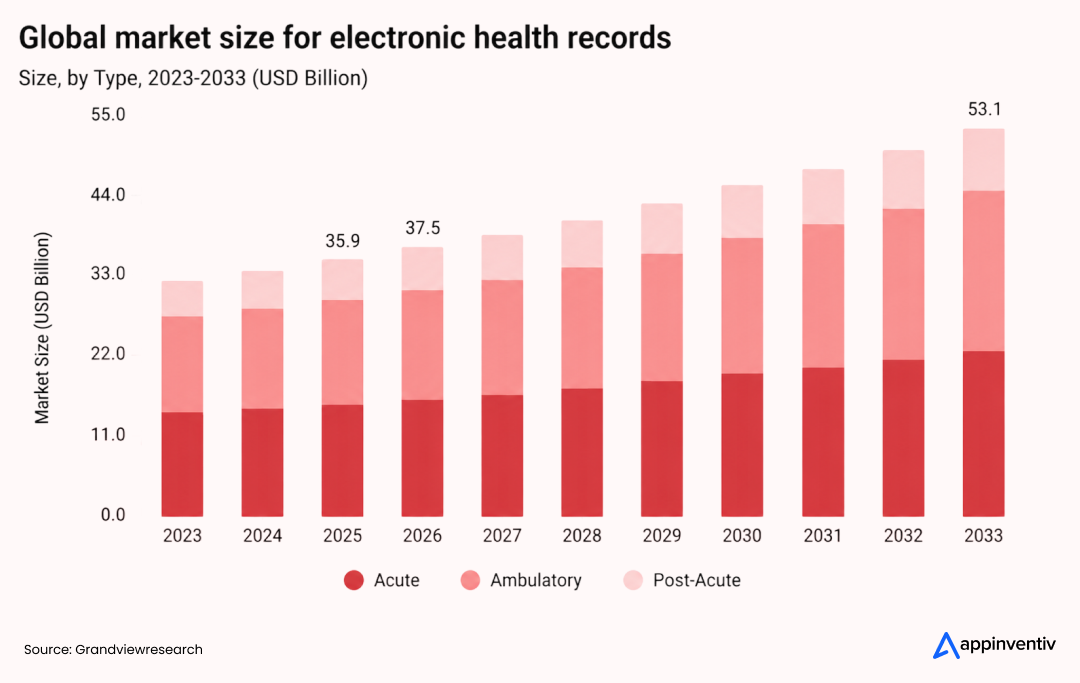
The estimated global market size for electronic health records is estimated to reach $53.11 billion by 2033, growing at a CAGR of 5.10% from 2026 to 2033. (Source: GVR). The market is witnessing steady growth, driven by advancements in healthcare technology and the increasing digitization of medical records, and the adoption and integration of EMR worldwide.
Electronic health record systems are a perfect solution for better patient care. These days, as more patient data is getting digital and an increasing number of consumers are aspiring to have mobile access to health records, this points towards the technology’s impact on EHR. The EHR improvements have led to better patient outcomes, paving a great future of electronic health records.
In this blog, we will talk about how to improve the EHR system, the EHR implementation challenges over the years, and how technology in EHR can help streamline healthcare operations.
With the facts and statistics stated above, it’s evident that EHRs are expected to improve even more in 2026 and beyond for both providers and patients. But there are still some limitations that are being faced in the current situation. Let’s discuss the challenges of electronic health records next.
Invest in a powerful EHR platform that improves workflows, compliance, and patient experiences.
Key Technologies Transforming Electronic Health Records
Numerous healthcare systems have started paying closer attention to technological developments, such as data standards, artificial intelligence in healthcare, and predictive analytics, in order to create EHR processes that are both more effective and to return the systems to their original purpose: improving patient care.
In addition to having a significant effect on society as a whole, technology development is also having an impact on the medical industry and, more specifically, electronic health records (EHRs).
The technology impact on EHR is accelerating, making continuous system updates essential for maintaining security, compliance, interoperability, and performance. This also directly adds to the cost of developing an EHR software.

1. EHR Optimization to Increase Usability
The EHR’s user interface will be the factor that has the greatest influence on optimization.
Patient safety, clinic operations, and burnout are all significantly impacted by how providers use the tool in their daily work. This is due to interface navigation.
A poorly designed or optimized EHR product will have a cluttered user UI or a complicated medication list. For reducing duplicate order input, an EHR-based reminder could be a helpful substitute for intrusive post-order alerts.
2. Amplification of Interoperability Through Artificial Intelligence
Electronic Health Records (EHRs) have long faced criticism for creating data silos, slowing clinician workflows, and limiting interoperability. But the healthcare landscape is shifting fast—AI in EHR is no longer just a future possibility, it’s the real deal now. AI is actively transforming EHR systems by improving data sharing, enhancing clinical decision-making, and delivering faster, more accurate diagnoses.
Despite the advent of digital health records, doctors continue to struggle with the interoperability of health data. It’s challenging for providers to use the EHR to enhance patient care because the majority of technology suppliers don’t make it simple to share patient information.
However, very few of these respondents claimed to be using cutting-edge tools like blockchain in healthcare, and application programming interfaces (APIs) to boost interoperability.
3. Virtual Assistants to Help with Documentation
The way doctors record their time with patients is being targeted by new technologies. Clinicians frequently experience brain load as a result of hopping from patient to patient. When providers must play catch-up on documentation at the close of the day, they run into difficulties. Implementing a well-designed EHR scribe tool into the EHR workflow is one method to address this problem.
Hop on to the article, How to build an EHR system? Features and cost breakdown, to know how you can build one successfully for your business.
4. Combining EHR With Voice Recognition
Voice recognition technology is a great asset for EHR systems as it helps clinicians to enter information and patient data hands-free. It reduces inaccuracy and errors by dictating records in EHR, which further speeds up the information recording process.
There’s a track record of Artificial Intelligence transforming the healthcare sector by helping doctors in recognizing historical trends about the condition of a patient and making diagnoses. That’s why several companies are trying to incorporate AI into EHR with the help of voice recognition technology.
For instance, a physician would be able to ask the EHR system about the last recorded iron levels from a blood test of a patient by using voice-enabled technology. After giving the commands, the system will notify the doctors about the health status of the patient.
5. Making More Informed Care Decisions with Predictive Analysis
The healthcare industry is also influenced highly by predictive analytics applications. From impacting cancer treatments to optimizing emergency staffing, predictive analytics technology is being used in a wide range of applications and will soon be adopted even more.
Specific healthcare app development services use AI-powered analytic methods such as statistics, data mining, and modeling in compliance with AI to provide clinical outcome predictions based on real-time device data and EHR to enhance the patient experience and care delivery.
6. Preparing Extensively for the 5G Network
It’s a no-brainer that the 5G network will capture the major share of the healthcare market in the future. There are several infrastructural updates going on in many residential areas to check the performance of the network.
While most industries have already embraced 5G and other emerging technologies, many healthcare organizations are still working toward the infrastructure needed to fully realize the technology impact on EHR systems and connected care environments. The major reason for this incapability is likely to be the lack of compatibility between the 5G network and EHR optimization strategies. In case the shortcoming never resolves, there’s no use for the benefits and speed offered by the 5G network in the medical field.
However, not all preparations are dependent on EHR optimizations. For example, there’s a 5G network tower installed in the Rush University Medical Centre of Chicago just because it didn’t want to manage the outdated wiring.
The scope for 5G in the healthcare sector is immense with offerings like real-time data monitoring, telemedicine, and so forth. That is why people are looking out for the best healthcare app developers to enable better healthcare delivery.
The preparations for the arrival of the 5G network are expected to pace up very shortly. As it happens, the authorities also need to determine in what way it will affect EHR and several other aspects of patient care.
7. Moving to the Mobile and Cloud
As you may already know that the major benefit of having an EHR system in place is the ease of accessibility of patient data, it completely makes sense that the data will become more complex as the population rises.
The projected growth of the global healthcare cloud computing market is substantial, with an estimated size of $320.9 billion anticipated by 2034, boasting a notable CAGR of 17.9%.
This calls for the need for mobile-computing and cloud-based infrastructure to store and access data in a safe manner. This will allow healthcare professionals to access the data with a tablet or a smartphone and helps them be more productive in their clinical environment and provide mobility solutions for long-term success.

Moreover, as privacy and security challenges start solving, a major portion of electronic health records will be stored in the cloud. With that said, the mhealthcare sector will also use gadgets such as smartwatches to upload and track patient information automatically and allow remote monitoring of the patients.
Partner with experts to develop and integrate EHR solutions that streamline workflows and improve care delivery.

Key Challenges of Electronic Health Records and How to Overcome Them
With the healthcare sector moving towards technology at a fast pace, the industry also needs to be aware of the risks associated with it. Despite all the potential benefits that it provides, physicians still have a hard time adopting EHRs. Let’s check out some of the challenges associated with EHR implementation in healthcare centers.
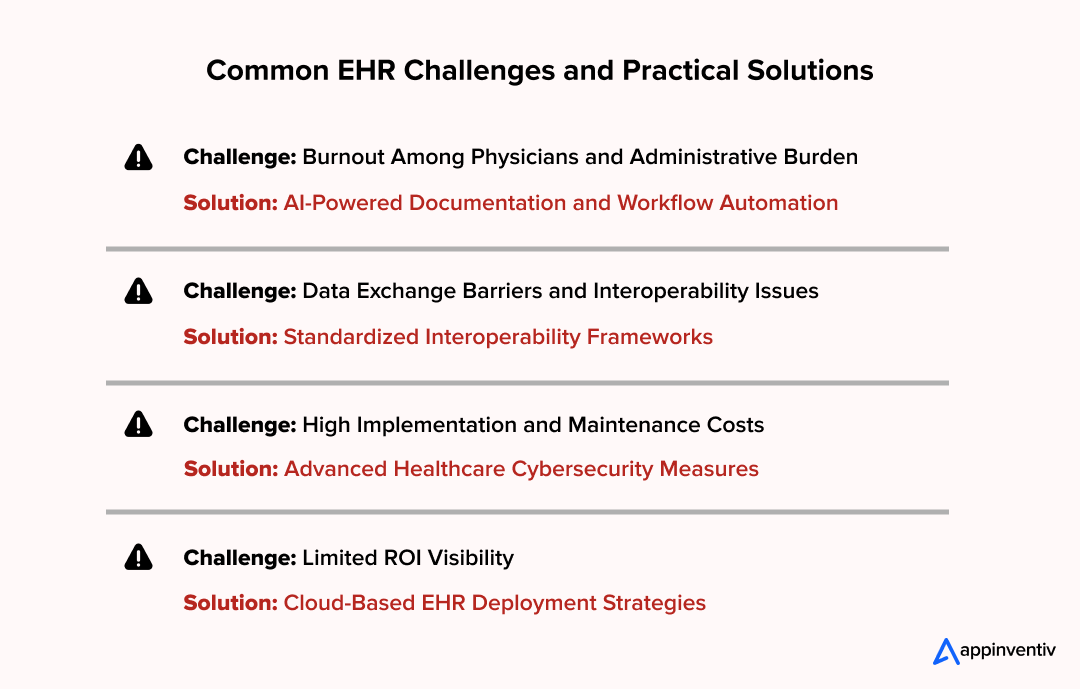
Burnout Among Physicians and Administrative Burden
Clinicians’ fear of burden is one of the more prevalent worries around EHR systems. Doctors have to dedicate a lot of their time to recording patient interactions, updating their records, and working with complicated interfaces, limiting their time spent with patients and thus contributing to doctor burnout.
Solution: To overcome this challenge, healthcare organizations can deploy user-friendly EHR interfaces, AI tools for clinical notes, speech recognition systems, and automate workflows to minimize manual data entry and boost clinician efficiency.
Data Exchange Barriers and Interoperability
Many healthcare organizations continue to have difficulty sharing patient information easily between hospitals, clinicians, labs, pharmacies and insurance systems. Data silos can slow down treatment decisions and even prevent a full picture of a patient’s medical history.
Solution: Leveraging interoperability standards like HL7 and FHIR, as well as API integrations, facilitates secure and standardized data exchange within healthcare ecosystems, enhancing care coordination and clinical decision-making.
Risks of Data Security and Privacy Issues
Patient information in EHR systems can be extremely sensitive, making them appealing targets for cybercrime. Financial loss, reputation damage, and a multitude of potential issues, such as data breaches, ransomware attacks, unauthorized access, and compliance violations, are possible.
Solution: Healthcare organizations should adopt comprehensive cybersecurity measures, such as end-to-end encryption, multi-factor authentication, role-based access controls, regular security audits, and ongoing monitoring.
High Implementation and Maintenance Costs
The implementation of an EHR system can be expensive, involving software, hardware, system setup, training, and system maintenance. These expenses can be a major challenge for smaller healthcare organizations.
Solution: Cloud-based EHR systems can lower initial infrastructure costs and provide flexible pricing options. Long-term cost can also be managed with careful planning, phased realisation and the right technology partner.
Real-World Applications of Advanced EHR Technologies With Real-Life Examples
By implementing advanced technologies, businesses are making EHR systems more intelligent and effective. These examples illustrate the various ways in which technology is being utilized to increase efficiency, improve patient outcomes, and reduce administrative burden on healthcare organizations.
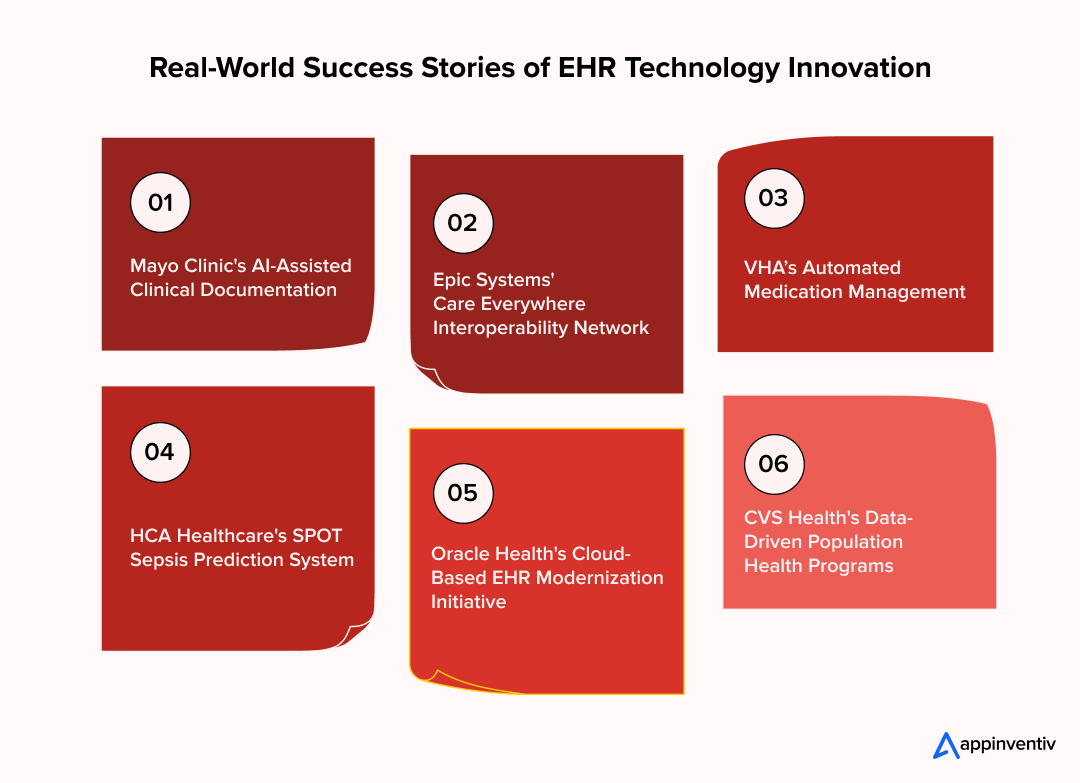
Mayo Clinic’s AI-Assisted Clinical Documentation
AI is also being utilized by physicians and other health professionals to allow them to spend less time on administrative tasks by creating clinical documentation and abstracting information from conversations with patients.
Example: Mayo Clinic is using ambient AI to evaluate its use of automated clinical documentation solutions. The technologies capture doctor/patient interactions and use them to create a structured written record that can then be integrated into the EHR workflow, saving clinicians significant time by eliminating the need for manual data entry.
Epic Systems’ Care Everywhere Interoperability Network
Interoperability facilitates the safe and simple exchange of patient records from multiple healthcare systems and across multiple areas of practice; this makes it possible to find vital records about patients who may have received treatment at many different facilities.
Example: Epic Systems has an interoperability program called Care Everywhere, in which multiple healthcare facilities that are participating can share patient information with each other regardless of where treatment was provided.
VHA’s Automated Medication Management
Clinician decision support systems (part of EHR Systems) reduce the risk of drug-related errors by warning clinicians of the possibility of adverse drug reactions, conflicting units of measurement, high doses and drug allergies.
Example: The Veterans Health Administration (VHA) implemented its Barcode Medication Administration (BCMA) system alongside its electronic health records infrastructure to improve medication safety. The system requires healthcare providers to scan both the patient’s identification and medication before administration, helping reduce medication errors and improve patient safety.
HCA Healthcare’s SPOT Sepsis Prediction System
Predictive Analytics allows healthcare organizations to identify who is at risk earlier and take proactive steps to prevent the situation from worsening.
Example: HCA Healthcare developed the Sepsis Prediction and Optimization of Therapy (SPOT) system, a real-time analysis tool that uses patient data to identify who is at risk for sepsis. The system enables a quicker response from clinicians, which can lead to better treatment results and patient safety.
Oracle Health’s Cloud-Based EHR Modernization Initiative
Cloud technology offers healthcare companies scalable infrastructure, better access and assistance for virtual care.
Example: Since Oracle Health acquired Cerner, it has been working on cloud-based healthcare platforms in the real world. The company is looking to modernize EHR infrastructure by enhancing data accessibility, scalability and system performance with the help of cloud technologies.
CVS Health’s Data-Driven Population Health Programs
EHR analytics can be leveraged to pinpoint care gaps, optimize chronic disease management, and enhance the results of preventive care at an organizational level, especially when applied to large patient populations.
Example: CVS Health uses data analytics throughout its healthcare ecosystem to help with population health programs, chronic disease management programs, and preventative healthcare approaches for millions of patients.
What Does the Future of EHR Behold in 2026?
The future of EHR platforms seems bright with the implementation of advanced technologies that will make EHR platforms smarter, more contextually aware, and better able to deliver individualized health care experiences.
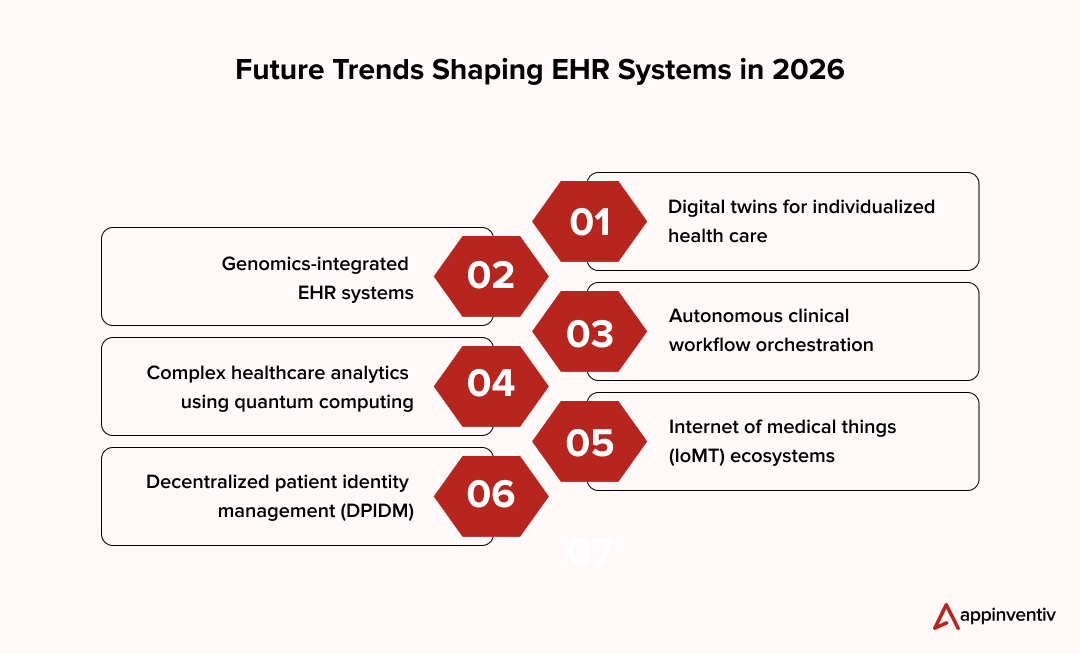
Digital Twins for Individualized Health Care
Digital twin technology in healthcare refers to creating a digital representation of a patient using data from electronic health records, medical imaging, genomics, wearable devices and the patient’s clinical history. With the global digital twins market in healthcare projected to reach $101.19 billion by 2031, this trend is expected to see thriving growth within the sector.
Future use of the digital twin could enable healthcare professionals to model the outcomes of treating an individual or to see how a disease will progress in order to develop tailored treatment options for individuals, prior to providing those treatments to the person in their physical form.
Genomics-Integrated EHR Systems
With the growing availability of genetic testing, EHRs will be more likely to include genomic data in patient records. Clinicians will be able to use this information to suggest different drugs for a person, to help determine if they might have an inherited disease, and adjust treatment according to the genetic makeup of an individual.
Autonomous Clinical Workflow Orchestration
A new generation of EHRs could eventually become smart workflow managers that can coordinate administrative and clinical workflows without human intervention. These platforms can schedule appointments, make referrals, request prior authorization, and handle routine workflows with minimal human involvement.
McKinsey estimates that AI and clinical automation could generate between $200 billion and $360 billion in value by improving efficiency and reducing healthcare costs across the U.S. healthcare system.
Complex Healthcare Analytics Using Quantum Computing
While still in its infancy, quantum computing has the potential to revolutionize the way healthcare organizations process vast amounts of medical data. With the global quantum computing healthcare market expected to reach $1.32 billion by 2031, the technology is poised to play an increasingly important role in healthcare innovation and advanced clinical analytics.
Applications such as drug discovery, modeling complex diseases and advanced population health analysis are among the areas that may benefit from faster EHR ecosystems beyond what is currently possible with traditional computing.
Internet of Medical Things (IoMT) Ecosystems
Today, wearable integration is possible, but the future will be shaped by more, wider Internet of Medical Things ecosystems in which all kinds of connected diagnostic devices, hospital equipment, implantable sensors and home monitoring systems will constantly share information with EHR platforms. This may allow for unprecedented patient monitoring on a near real-time basis.
Decentralized Patient Identity Management (DPIDM)
Future EHR systems could gravitate towards more decentralized digital identities that give patients more control over who can access their health records. Rather than having to manage access permissions at each of the healthcare organizations, patients might be able to easily allow data to be shared across providers via a unified digital identity framework.
Initiate Your EHR Journey with Appinventiv
It’s evident that EHRs have already come a long way in the industry. However, there’s still a lot more to achieve, and the future holds numerous benefits for electronic health record systems, with a huge technological impact on EHR.
As a reputed EHR/EMR integration services provider, Appinventiv’s expertise is centered on connecting existing systems in a way that makes them secure, scalable, and compliant. The goal is simple: reduce the friction between platforms, smooth out clinical workflows, and give patients a more connected experience. Working on numerous healthcare projects such as Soniphi, Health-e-People, DiabeticU, YouComm, and others, we have successfully delivered interoperable healthcare solutions for more than a decade.

Whether it’s linking legacy EMRs with modern applications, enabling real-time data exchange with labs and pharmacies, or aligning records with new regulatory standards, we help providers turn fragmented systems into one interoperable network.
Healthcare mobile app developers will soon be seen using the model of value-based health care to answer how to prepare for EHR optimization. Do you have an idea about EHR improvements and making it future-proof? Share it with our EHR software developers experts.
FAQs
Q. What are some of the top EHR features?
A. EHRs not only integrate with every aspect of the patient experience, from the front desk of the clinic to the pharmacy where the patient picks up their medicine, but they also use data analytics to provide critical insights.
There are many companies offering EHR software, so you should be able to find apps for both large and small healthcare practices. But most of these methods have the following characteristics in common:
Automated scheduling
- Managing tasks
- Generating support documentation
- Processing claims
- Digital chart
- Voice and handwriting recognition
- Generating reports
Q. What are some of the specific problems with electronic health records?
A. When the time comes for you to implement and use your own EHR system, it will be helpful for you to know the EHR implementation challenges or problems with electronic health records listed below.
You must take precautions against data hacking when switching from a paper-based system to electronic health records because there is an intrinsic risk of computer hackers stealing information.
You should choose an EHR that has been created by experts committed to efficiency and usability because one with a poorly designed interface can make staff work seem like a dull grind.
Your employees might need to undergo training as you switch from paper records to EHR. Consider sending your most tech-savvy employees to training so they can mentor amateur staff.
Q. How EHR usability improves healthcare outcomes?
A. Here are some of the ways in which EHR usability can drastically improve healthcare conditions:
- Improve the capacity of doctors to deliver high-quality patient care
- Support collaborative treatment
- Bolster coordination of service
- Offer flexibility and configurability in your products
- Lessen the mental burden
- Encouraging statistics liquidity
- Encourage patient involvement through digital and mobile channels
- Expedite customer feedback after product implementation and user input during product design
Q. What are the benefits of technology on EHR?
A. There are several perks of EHR usability in hospitals and medical care practices. One of the main benefits of technology on EHR is the massive improvization that it has brought to the healthcare systems. Here are the other pros:
- Boosting healthcare data interoperability with AI
- Optimization of EHR interface to scale EHR usability
- Implementation of virtual assistance for streamlining documentation
Q. How to prepare for EHR optimization?
A. All you need to do is prepare EHR optimization strategies that lead to increased adoption of EHR in healthcare centers. Here are some of the top ways on how to prepare for EHR optimization:
- EHR usability maintenance through testing and optimization
- Patient safety problems can be combated by improving EHR accessibility
- A user-friendly device is simple to use and efficient
Q. What role do FHIR APIs play in modern EHR systems?
A. In the current EHR system landscape, FHIR APIs (Fast Health Interoperability Resources) provide a standardized way to securely transfer data between EHR systems, medical applications, labs, pharmacies, and medical devices.
By enabling these disparate systems to share patient information through real-time connectivity, FHIR helps increase efficiency, reduce data fragmentation, and enable more effective third-party integration; this leads to greater patient care connectivity and improved quality and efficiency across many aspects of care delivery.


Fast 2-minute response, fully NDA-protected.

Diet and Nutrition App Development: Process, Features, Cost, and Technology Stack
Key Takeaways Diet and nutrition tracking app development goes past basic calorie counters with verified food databases, custom meal schedules, AI tools, wearable device links, and corporate manager tools. Structure database models around raw food items, serving portions, nutrient facts, recipes, software links, and regional diet rules. Pair computer vision models, recommendation algorithms, language engines,…
eCOA Software Development Guide: Enterprise Architecture, Tech Stack, Development Process, and Cost
Key takeaways: Build an enterprise eCOA platform using cloud servers, AI tools, and compliant system design. Map the full eCOA development process, from trial workflow analysis to live system maintenance. Connect your platform with EDC, CTMS, eConsent, HL7 FHIR, and wearables to simplify trial data sharing. Compare custom software against off-the-shelf platforms to make smart…
Pharmacy Software Development in the UAE: Cost, Features, Architecture & Compliance
Key takeaways: Pharmacy software in the UAE must support prescriptions, inventory, billing, and compliance in one system. Enterprise pharmacy platforms need secure architecture, role-based access, and audit trails. UAE-specific integrations like e-prescriptions, insurance, and health exchanges are critical. Custom pharmacy software development in the region typically costs AED 80,000 to AED 800,000+, depending on features,…