























How Long Does It Take to Develop an App? Timeline, Factors & Real Estimates

 Share -



- 01Average App Development Timeline by Complexity
- 02The 6 Core Phases of App Development and Their Timelines
- 03App Development Timeline by App Type
- 04Feature-Level Timeline Breakdown for Modern Mobile Apps
- 05Key Factors Affecting App Development Timelines
- 06External Factors Affecting App Development Time
- 07Examples of App Development Timelines
- 08How to Reduce App Development Time Without Compromising Quality
- 09Why Enterprise App Development Projects Often Take Longer Than Expected
- 10How Appinventiv Helps Enterprises Accelerate App Development Timelines
- 11FAQs

Key takeaways:
- Most enterprise app delays start after approvals, integrations, and infrastructure reviews pile up across different teams.
- Real-time features, AI systems, and legacy integrations usually add more time than frontend development work.
- A mobile app may launch quickly, but scaling it for production traffic takes much longer.
- Teams that release faster usually fix delivery gaps early, not just increase developer headcount.
- Enterprise apps often spend months in testing, security validation, and production readiness before public launch.
Building an app can take anywhere from 2 months to more than 18 months. So, how long does it take to develop an app in real business conditions?
The answer changes with product scope, engineering complexity, infrastructure requirements, and long-term business goals, especially as the global mobile app market is expected to cross $1.2 trillion by 2035. The timeline depends on the product scope, engineering complexity, infrastructure requirements, and business goals.
A simple mobile app with basic workflows and limited backend logic may launch within 8–12 weeks. A mid-size application with APIs, payment systems, analytics, and admin dashboards often takes 4–8 months. Enterprise platforms usually require 9–18+ months.
AI-powered applications with LLM integration, vector databases, real-time inference, and model testing can take even longer to develop.
Most businesses underestimate the amount of work outside coding. Modern app development includes cloud architecture planning, API orchestration, DevSecOps setup, QA automation, compliance validation, and scalability testing.
A healthcare app handling HIPAA-regulated data will follow a very different delivery cycle than a retail loyalty app. The same applies to banking platforms with PCI DSS requirements or AI copilots that require hallucination testing and continuous model monitoring.
The fastest projects are not always the best projects. Long-term performance, security, uptime, and maintainability matter just as much as launch speed.
Slow product delivery today can cost enterprise market share, retention, and customer growth tomorrow.

Average App Development Timeline by Complexity
Understanding how long does it take to develop an app depends on engineering scope, infrastructure complexity, integrations, and scalability requirements, all of which also directly shape mobile app development cost. The table below provides a rough estimate for different application categories.
| App Complexity | Estimated Timelines by App Complexity |
|---|---|
| Simple Apps | 2 to 4 Months |
| Mid-Complexity Apps | 4 to 8 Months |
| Enterprise-Grade Applications | 9 to 18+ Months |
| AI-Powered Applications | 10 to 20+ Months |
The 6 Core Phases of App Development and Their Timelines
No two apps follow the exact same timeline, and the stages of app development can vary based on team structure, compliance requirements, and product complexity. A lightweight booking app moves much faster than a banking platform connected to legacy systems and compliance workflows. Most projects still pass through six core phases before launch.
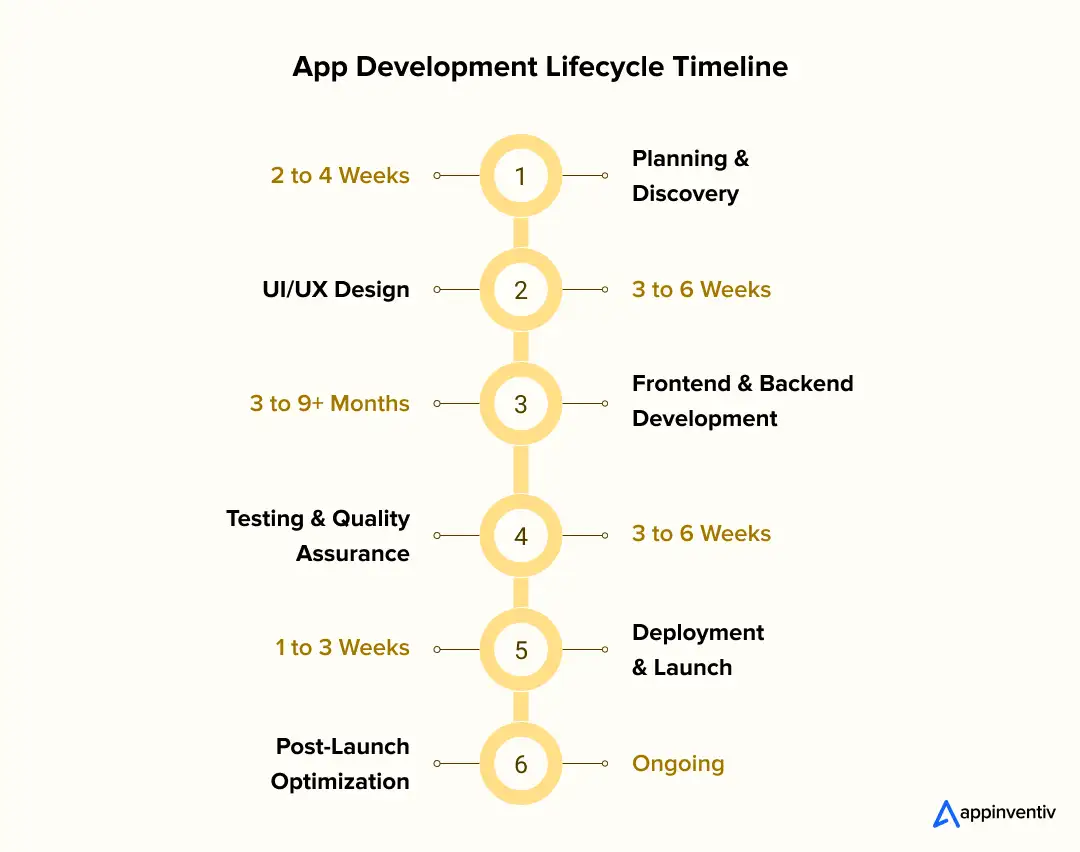
Phase 1 – Planning and Discovery Phase (2 to 4 Weeks)
This phase lays the groundwork for the product. Teams define business goals, map system requirements, estimate workloads, and identify technical risks before writing production code. Following a structured mobile app development guide during this stage helps avoid costly gaps later
Key Activities:
- Business requirements gathering
- Technical feasibility analysis
- Product roadmap planning
- Architecture and infrastructure planning
- Stakeholder workshops
- Risk assessment
Typical Outputs
| Deliverable | Purpose |
|---|---|
| Product Requirement Document (PRD) | Defines workflows and features |
| Technical Architecture Plan | Defines backend systems and infrastructure |
| API Requirement Mapping | Identifies third-party dependencies |
| Delivery Roadmap | Defines sprint timelines and milestones |
Technical Considerations:
- SQL vs NoSQL database selection
- Cloud provider selection
- API orchestration strategy
- Scalability planning
- Compliance scope definition
Decisions around mobile app architecture, whether monolithic or microservices, made during discovery directly shape how long the development and scaling phases will take.
Large organizations usually spend more time here. Internal approvals, procurement reviews, and infrastructure checks often slow early planning.
Phase 2 – UI/UX Design Phase (3 to 6 Weeks)
The design stage shapes how users interact with the product. Clear navigation and fast workflows reduce onboarding issues and lower support overhead after launch.
Key Activities:
- Wireframing
- User flow mapping
- Interactive prototyping
- Design system creation
- Accessibility validation
- Responsive design testing
Common Design Deliverables
| Deliverable | Purpose |
|---|---|
| Wireframes | Layout structure |
| Clickable Prototypes | Workflow validation |
| Design Systems | UI consistency |
| Component Libraries | Faster frontend development |
Technical Considerations
- Responsive breakpoints
- Gesture interactions
- Accessibility standards
- Cross-platform UI behavior
- Design token systems
- Animation rendering performance
Enterprise teams often review designs against employee workflows, customer journeys, and internal process requirements before development starts.
Phase 3 – Frontend and Backend Development Phase (3 to 9+ Months)
Much of how long does it take to build an app comes down to this stage; teams build the interface, backend services, APIs, infrastructure layers, databases, and security systems during this phase.
Frontend Development
Front-end engineers build everything users see and interact with inside the application, and the skills of mobile app developers on the team directly affect how fast and cleanly this layer comes together.
Common Frontend Tasks
- Mobile UI development
- State management
- API consumption
- Real-time data rendering
- Offline synchronization
- Cross-device responsiveness
Common Frontend Technologies
| Layer | Common Technologies | Estimated Timeline |
|---|---|---|
| iOS Development | Swift, SwiftUI | 4 to 10 Months |
| Android Development | Kotlin, Jetpack Compose | 4 to 10 Months |
| Cross-Platform | Flutter, React Native | 3 to 8 Months |
| Web Frontend | React, Angular, Vue | 2 to 6 Months |
Also Read: Speed Up Android App Development
Backend Architecture Development
Backend systems handle application logic, data processing, notifications, authentication, and API communication. Understanding mobile app backend development in depth helps teams scope this phase more accurately from the start.
Common Backend Tasks
- API development
- Database modeling
- Queue processing
- File storage setup
- Notification services
- Workflow orchestration
Common Backend Technologies
| Layer | Common Technologies |
|---|---|
| Backend Frameworks | Node.js, .NET, Django, Spring Boot |
| Databases | PostgreSQL, MongoDB, MySQL |
| Caching | Redis |
| Message Queues | Kafka, RabbitMQ |
Also Read: MongoDB vs MySQL: Which Database is Better For Your Business
API and Third-Party Integrations
Most enterprise apps connect with outside systems.
Common Integrations
- Payment gateways
- ERP systems
- CRM platforms
- Identity providers
- Analytics platforms
- AI services
- Geolocation APIs
Integration work often slows timelines due to:
- Unstable APIs
- Rate limits
- Authentication conflicts
- Outdated legacy systems
Cloud Infrastructure and DevOps Setup
Modern apps need deployment automation and infrastructure management from the beginning, and teams investing in cloud application development typically see faster provisioning and more stable production environments.
Common DevOps Tasks
- CI/CD pipeline setup
- Containerization
- Kubernetes orchestration
- Infrastructure as Code (IaC)
- Environment provisioning
- Monitoring setup
Common Infrastructure Technologies
| Infrastructure Layer | Common Technologies |
|---|---|
| Cloud Platforms | AWS, Azure, Google Cloud |
| Containers | Docker |
| Orchestration | Kubernetes |
| CI/CD | GitHub Actions, Jenkins, GitLab CI |
Authentication and Security Implementation
Security work starts during development, not before release.
Common Security Tasks
- OAuth 2.0 implementation
- JWT token management
- MFA setup
- Role-based access control
- Encryption setup
- Secure API gateways
Security Standards Often Required
AI-powered applications often add extra security layers, including:
- Prompt filtering
- Hallucination testing
- Model access controls
- Vector database protection
Phase 4 – Testing and Quality Assurance Phase (3 to 6 Weeks)
How long it takes to do development and testing depends on system complexity. This phase checks stability, performance, and release readiness before rollout. Teams identify bugs, security issues, and infrastructure weaknesses before rollout.
Key Activities
- Functional testing
- Regression testing
- Device compatibility testing
- Performance testing
- Penetration testing
- User acceptance testing
Common QA Types
| Testing Type | Purpose |
|---|---|
| Functional Testing | Verifies feature behavior |
| Load Testing | Measures traffic handling |
| Penetration Testing | Identifies vulnerabilities |
| UAT | Validates business workflows |
Technical Considerations
- API latency
- Memory leaks
- Concurrency handling
- Crash analytics
- Infrastructure failover
- Database query performance
Enterprise platforms often go through several approval cycles before production release.
Phase 5 – Deployment and Launch Phase (1 to 3 Weeks)
How long does it take to launch an app? Deployment typically takes 1 to 3 weeks and moves the app into production infrastructure. Teams finalize release settings, monitor systems, and prepare rollback plans before public launch.
Key Activities
- Production environment setup
- App Store submission
- Release validation
- Rollout management
- Backup verification
- Incident response preparation
Common Deployment Tasks
| Deployment Task | Purpose |
|---|---|
| Production Build Creation | Final release packaging |
| App Store Submission | Platform approval |
| Blue-Green Deployment | Safer rollout strategy |
| Monitoring Activation | Production visibility |
Technical Considerations
- CDN configuration
- DNS propagation
- Release rollback planning
- Autoscaling setup
- Production logging
Apple App Store reviews alone can delay launches by several days.
Phase 6 – Post-Launch Optimization and Scaling (Ongoing)
Release day is not the finish line. Production systems need ongoing monitoring, tuning, and infrastructure updates after launch.
Key Activities:
- Infrastructure scaling
- Monitoring and analytics
- Feature iteration
- Bug fixing
- Performance tuning
- Security patching
Common Monitoring Areas
| Monitoring Area | Purpose |
|---|---|
| Crash Reporting | Detect runtime failures |
| APM Monitoring | Track backend performance |
| User Analytics | Measure engagement |
| Infrastructure Metrics | Track CPU, memory and scaling |
Technical Considerations
- Database scaling
- Caching strategies
- API optimization
- Observability tooling
- AI model retraining
- Release versioning
Product teams often rely on telemetry data and usage analytics to decide which updates ship next. Mobile users now spend around 3.5 hours per day inside apps on average.
App Development Timeline by App Type
Different app categories require different engineering workloads. A fintech platform with fraud detection and PCI DSS compliance takes much longer than a basic ecommerce app with standard checkout flows.
| App Type | Typical Timeline | Example |
|---|---|---|
| Fitness App | 8 to 12 weeks | Soniphi |
| eCommerce App | 16 to 24 weeks | Adidas |
| Social Media App | 20 to 30 weeks | Vyrb |
| Food Delivery App | 16 to 22 weeks | KFC |
| Healthcare App | 20 to 32 weeks | DiabeticU |
| Enterprise SaaS Platform | 6 to 12 months | ILITY |
| AI-Driven Business App | 12 to 24 weeks | MyExec |
| Logistics / Transit App | 4 to 8 months | TrackMyShuttle |
| Large Enterprise Platform | 8 to 14 months | Americana ALMP |
| Unified Enterprise System | 6 to 12 months | HIPP |
How long does it take to make an app like a food delivery platform versus a banking app or an AI assistant? The workload changes significantly once complex systems and sensitive data enter the picture.
For teams building on Android specifically, Android app development cost and time estimates shift considerably depending on whether the app handles payments, compliance workflows, or real-time data.
- Healthcare apps include EHR systems and compliance checks.
- Fintech apps need payment security and fraud monitoring.
- Social apps manage feeds, uploads, and notifications. Global app downloads are forecasted to reach 292 billion in 2026.
- Enterprise apps connect with CRMs, ERP tools, and internal systems.
- AI apps require LLM integration and model testing.
Complex backend systems and integrations usually increase delivery time.
Feature-Level Timeline Breakdown for Modern Mobile Apps
How to estimate your specific timeline starts with understanding feature-level effort; a login screen does not take the same effort as a live chat system or an AI assistant. Some features are small frontend tasks. Others need backend services, database work, testing, and infrastructure setup.
| Feature/Component | Estimated Development Time |
|---|---|
| User Authentication and Login Systems | 1 to 2 Weeks |
| User Profiles and Account Management | 1 to 2 Weeks |
| Push Notifications | 3 to 5 Days |
| Search and Filtering Functionality | 1 to 2 Weeks |
| Payment Gateway Integration | 1 to 3 Weeks |
| Real-Time Messaging and Chat | 3 to 6 Weeks |
| Media Upload and Video Streaming | 2 to 5 Weeks |
| Social Sharing and Engagement Features | 1 to 3 Weeks |
| Geolocation and Live Tracking | 2 to 4 Weeks |
| AI Chatbots and Recommendation Engines | 4 to 10 Weeks |
| Multilingual Support | 1 to 2 Weeks |
| Analytics Dashboards and Reporting | 2 to 4 Weeks |
| Role-Based Access Control | 1 to 3 Weeks |
| Third-Party API Integrations | 1 to 4 Weeks |
| Admin Panel Development | 2 to 5 Weeks |
| Security and Compliance Features | 2 to 6 Weeks |
Real-time systems, AI workloads, and large-scale integrations usually push timelines higher. Consumer app spending crossed $41 billion during Q2 2025 alone, which increased pressure on companies to improve stability and performance early in development.
Infrastructure issues and unstable integrations usually surface late, then slow production readiness across the platform.

Key Factors Affecting App Development Timelines
The timeline of an app changes with the amount of engineering work behind it. A basic mobile app with standard screens moves much faster than a platform tied to internal systems, cloud infrastructure, and large datasets.
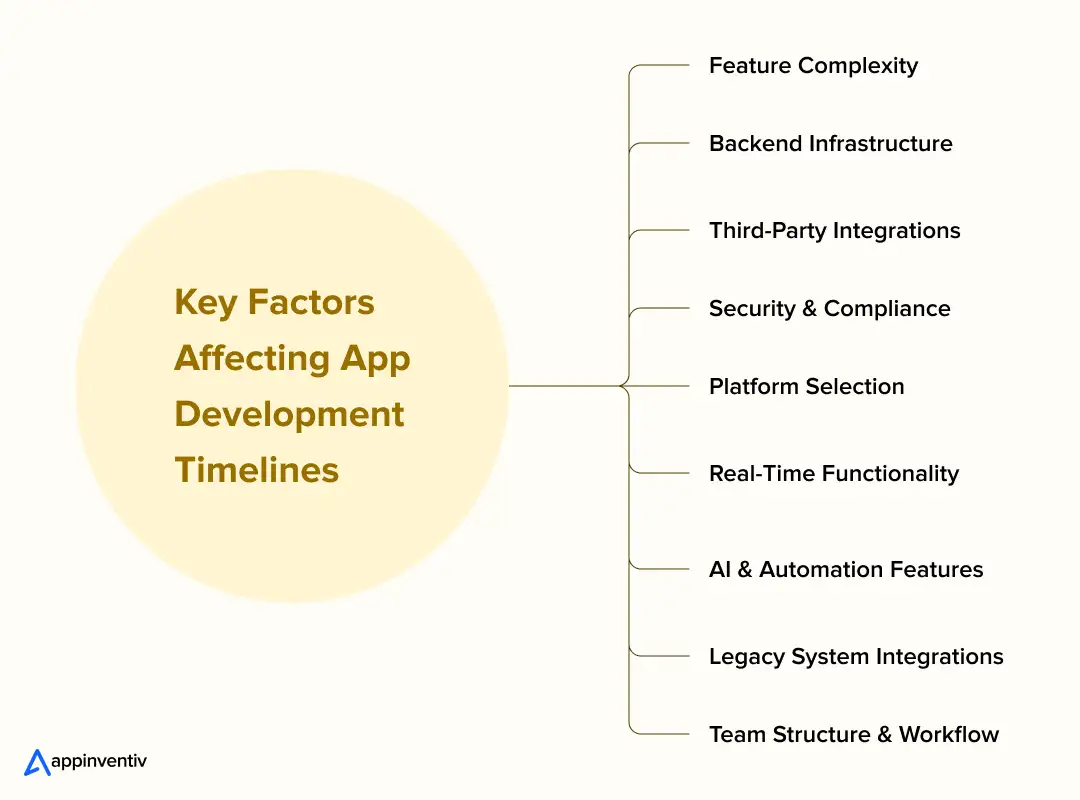
Feature Complexity
Simple features like login pages or profile sections take less time to build. Real-time chat, video processing, recommendation systems, and advanced dashboards add much more development work.
Backend Infrastructure Requirements
Some apps only need a lightweight backend. Others need distributed databases, caching layers, queue systems, and autoscaling infrastructure to support large traffic volumes.
Third-Party Integrations
Many projects connect with payment gateways, ERP software, CRMs, analytics tools, and external APIs. Delays often happen once teams start handling authentication conflicts or outdated systems.
Security and Compliance Requirements
Banking, healthcare, and enterprise apps usually pass through extra security reviews. Teams may need encryption, audit logging, access controls, and penetration testing before release approval.
Platform Selection
Native iOS and Android apps often take more time than cross-platform builds. Teams considering the native iOS route should review a dedicated iOS app development guide to understand the full scope of effort involved.
Also Read: React Native vs Native Apps
Real-Time Functionality
Live chat, location tracking, and instant notifications increase backend workload. These systems rely on stable, low-latency communication and continuous data synchronization.
AI and Automation Features
AI features add another layer of complexity, and this workload continues to grow as mobile app development trends push toward more sophisticated automation and LLM use cases.
Legacy System Integrations
Older enterprise systems slow projects down, particularly when ERP connections are involved. Missing APIs, outdated documentation, and custom workflows in an ERP system build usually create extra engineering work that few teams budget for upfront.
Team Structure and Development Methodology
Delivery speed also depends on how teams work together, which is why many companies choose to outsource app development to partners with established sprint planning and QA processes already in place.
External Factors Affecting App Development Time
A project can lose weeks without a single engineering issue. Many delays happen during approvals, coordination, procurement, or external reviews.
- Leadership teams may take time to approve budgets, product changes, or release plans.
- Legal and compliance reviews often slow healthcare, fintech, and enterprise projects.
- Vendor onboarding can delay access to payment gateways, cloud systems, or third-party APIs.
- Procurement teams sometimes hold projects during contract negotiations and license approvals.
- Different departments may work on separate schedules, which slows feedback and decision-making.
- Distributed teams across regions often face slower communication and delayed sprint reviews.
- Apple and Google may reject production builds over privacy policies or payment rule violations.
- External APIs sometimes change during development, forcing teams to rebuild integrations.
- Scope discussions and budget cuts can pause development midway through the release cycle.
- Internal security reviews may delay production deployment even after development finishes.
Enterprise projects usually slow down due to coordination gaps rather than coding alone.
Examples of App Development Timelines
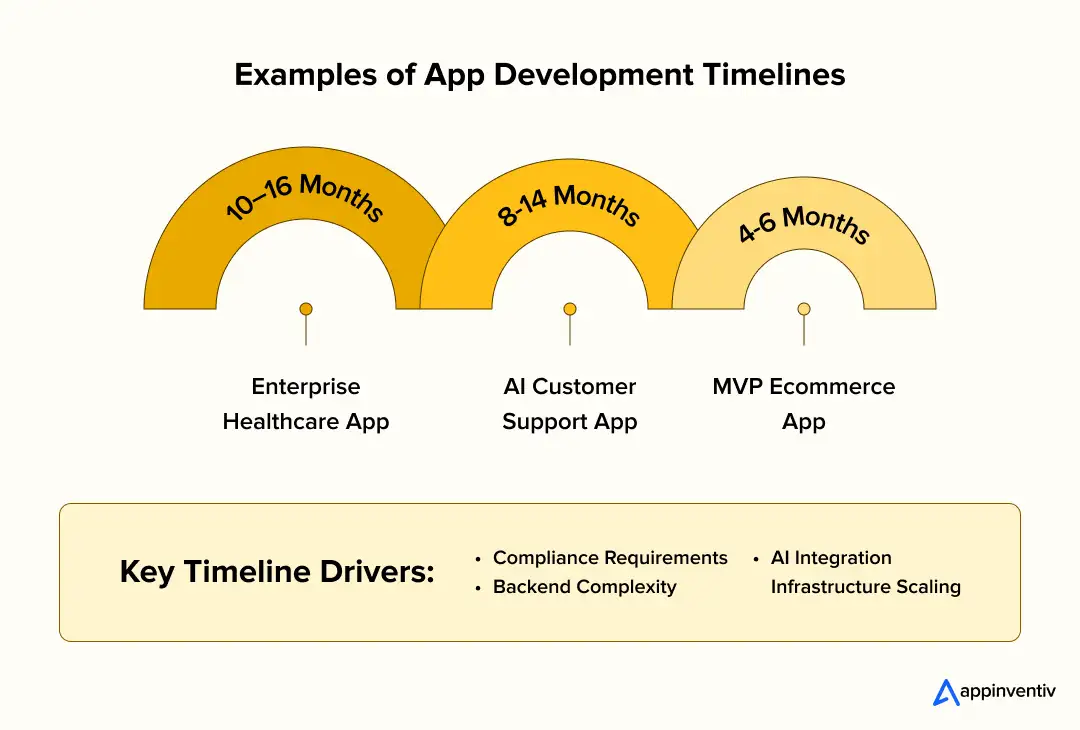
Two apps can look similar on the surface and still take very different amounts of time to build. The difference usually comes from backend systems, integrations, compliance work, infrastructure scale, and release requirements.
Example 1: MVP Ecommerce App Timeline
Example Similar To: Shopify seller storefronts or early-stage Amazon marketplace modules
| Phase | Estimated Timeline |
|---|---|
| Discovery and Planning | 2 Weeks |
| UI/UX Design | 3 Weeks |
| Development | 10–12 Weeks |
| Testing and Deployment | 3 Weeks |
Total Timeline: 4 to 6 Months
Typical features include:
- Product catalog
- Payment gateway integration
- Order management
- Push notifications
- Search and filtering
- Admin dashboard
Most development time goes into payment workflows, inventory systems, and API integrations.
Example 2: Enterprise Healthcare App Timeline
Example Similar To: Epic Systems patient platforms or Cerner healthcare management systems
| Phase | Estimated Timeline |
|---|---|
| Compliance Planning and Architecture | 4 Weeks |
| UI/UX Design | 5 Weeks |
| Backend and Integration Development | 5–7 Months |
| Security and Performance Testing | 6 Weeks |
| Deployment and Validation | 3 Weeks |
Total Timeline: 10 to 16 Months
These projects often involve:
- EHR integrations
- HIPAA compliance
- Audit logging
- Encrypted patient records
- Appointment systems
- Role-based access control
Security reviews and healthcare integrations usually take the most time.
Example 3: AI-Powered Customer Support App Timeline
Example Similar To: Intercom AI copilots or Zendesk AI support systems
| Phase | Estimated Timeline |
|---|---|
| AI Strategy and Architecture Planning | 3 Weeks |
| Conversational UX Design | 3 Weeks |
| LLM Integration and Backend Development | 4–6 Months |
| AI Testing and Optimization | 4–6 Weeks |
| Deployment and Monitoring Setup | 2 Weeks |
Total Timeline: 8 to 14 Months
Common engineering work includes:
- LLM integration
- Vector database setup
- Retrieval pipelines
- Prompt testing
- Conversation memory
- AI response monitoring
Testing AI accuracy and reducing hallucinations often adds extra development time.
How to Reduce App Development Time Without Compromising Quality
Knowing how long does it take to build an app is only part of the picture; most enterprise apps do not fall behind schedule from coding alone.
A delay usually starts somewhere smaller. QA receives the build too late. Product teams change workflows during development. Security reviews happen near release week instead of earlier in the cycle. These small gaps slowly add more time.
These strategies for speeding up app delivery help teams release faster without adding technical risk, and align closely with established mobile app development best practices.
- Adopting Agile Development Methodologies: Smaller sprint cycles help teams review features earlier and catch issues before they spread across the product.
- Using Cross-Platform Development Frameworks: Choosing React Native for mobile app development, for example, reduces repeated frontend work across iOS and Android builds and can meaningfully shorten overall delivery time.
- Leveraging DevOps and CI/CD Automation: Automated testing and deployment pipelines reduce manual release work and shorten production rollout time.
- Prioritizing MVP-First Development: Many companies launch the core workflow first, a strategy covered in depth in this minimum viable product guide, then expand the platform after gathering feedback from real users.
- Building with Reusable Components and Accelerators: Shared UI libraries, login modules, and API templates save engineering hours across projects.
- Using AI-Assisted Development Workflows: Some teams now use AI coding tools during debugging, unit testing, and documentation work.
- Leveraging Cloud-Native Infrastructure: Managed databases, Kubernetes services, and autoscaling systems to reduce infrastructure setup and deployment effort.
Scope changes, review cycles, and scaling issues often push launches far beyond original estimates.

Why Enterprise App Development Projects Often Take Longer Than Expected
How long does app development take for enterprise projects? Usually longer than expected. Enterprise mobile app development comes with approval layers, legacy system dependencies, and compliance requirements that no initial roadmap fully accounts for.
- Enterprise Governance and Approval Layers: Large companies rarely approve releases through one team alone. Security, compliance, operations, and leadership groups often review the same deployment.
- Legacy System Modernization Challenges: Older internal systems can create problems quickly. Some still run on outdated databases or undocumented APIs.
- Scalability and Performance Engineering: Production traffic changes everything. Teams spend extra time testing load handling, failover systems, caching layers, and database scaling.
- Security Hardening and Compliance Validation: Healthcare and fintech apps usually pass through security audits, penetration testing, and compliance checks before release approval.
- Continuous Scope Expansion During Development: A project may start with one feature list, then new workflows and reporting requirements appear halfway through development.
How Appinventiv Helps Enterprises Accelerate App Development Timelines
Enterprise projects usually start slipping long before launch.
A security review takes extra time. An old ERP system refuses to sync cleanly. The mobile app works fine in staging, then breaks under production traffic. Most teams run into these problems somewhere during development.
Appinventiv’s mobile app development services are built for companies that need faster delivery without creating more technical debt later.
| Experience Snapshot | Numbers |
|---|---|
| Applications Delivered | 2000+ |
| Industries Served | 35+ |
| Global Offices | 5+ |
| Average MVP Delivery | 3 Weeks |
| Client Satisfaction | 95% |
| Repeat Clients | 90% |
Teams usually bring Appinventiv in for:
- Srchitecture planning
- Cloud migration work
- AI integration
- Flutter and React Native development
- DevOps setup
- ERP and CRM integrations
- Modernization of older enterprise systems
A healthcare company may need HIPAA-ready infrastructure before release. A fintech platform may need stronger fraud controls and PCI DSS validation. Retail apps often struggle with scaling during traffic spikes.
The engineering team works across healthcare, fintech, logistics, retail, and enterprise SaaS platforms.
Many engagements begin with a timeline discussion or an architecture review. For teams still evaluating their approach, understanding the most effective way of mobile app development can help set realistic goals before work begins.”
Let’s connect and build an app with scalable architecture decisions.
FAQs
Q. What is the ideal timeline for mobile app development?
A. How long does it take to develop an app? Most mobile apps take around 4 to 12 months from planning to launch. A smaller MVP usually moves faster. Enterprise platforms need more time once backend systems, integrations, compliance reviews, and production infrastructure become part of the project. The timeline grows with the complexity of the product.
Q. How long does it take to develop a mobile app from scratch?
A. An app built from scratch can take anywhere from 2 months to more than a year. A simple product with limited workflows ships faster. Enterprise apps often require cloud setup, API integrations, QA testing, scalability planning, and security validation before the production release begins.
Q. How fast can an MVP be developed and launched?
A. A focused MVP can often launch within 6 to 10 weeks. That usually happens once the product scope stays controlled and the team focuses only on core workflows. Most companies release the first usable version early, then expand features after gathering feedback from real users.
Q. What stage of app development takes the longest?
A. When considering how long does it take to develop an application, development usually consumes the largest part of the timeline. Backend engineering, integrations, cloud infrastructure setup, and testing continue for months in many enterprise projects. Teams also spend extra time fixing edge cases and stabilizing the platform before the final production rollout begins.
Q. Why do companies work with Appinventiv for app development projects?
A. Many companies approach Appinventiv once internal delivery timelines start slipping or systems become difficult to scale. The team works across mobile apps, enterprise software, AI platforms, cloud migration projects, and backend modernization initiatives. Businesses often start with architecture planning or timeline estimation discussions.


Fast 2-minute response, fully NDA-protected.

How Much Does It Cost to Develop a Remote Patient Monitoring App in the UAE?
Key takeaways: Feature scope and system integrations, not the app itself, determine your final development cost. DHA, DOH, and MOHAP compliance must be built into your architecture from day one. Wearables, EHRs, and health information exchanges are the biggest technical cost drivers. A successful RPM platform combines continuous monitoring, clinical workflows, and secure interoperability. Early…
How Much Does It Cost to Develop an App Like Herfy in 2026?
Key takeaways: Herfy-like app development costs SAR 150,000 to SAR 1,500,000 ($40,000 to $400,000). Costs rise with rider tracking, POS sync, kitchen displays, loyalty, and branch controls. Saudi apps need Arabic UX, Mada, STC Pay, VAT, and ZATCA-ready invoice flows. Peak loads during Ramadan, Eid, and weekends need strong backend and load testing. A phased…

Key takeaways: The operating model determines survival. The code does not. Compliance under PDPL in the UAE and SDAIA in Saudi Arabia must be engineered into architecture, not added before launch. A serious build costs between AED 147,000 and AED 1,470,000 (USD 40,000 to USD 400,000), depending on scope. The single largest cost most operators…