






























Why Enterprise Application Security is Mission Critical and How to Get it Right

 Share -



- 01Where Enterprise Applications Are Most Exposed to Cyberattacks
- 02How Enterprise Application Security Architecture Protects the Technology Environment
- 03How to Test Enterprise Applications for Security Weaknesses
- 04Why Continuous Application Security Testing Matters
- 05How to Implement Enterprise App Security Across the Software Lifecycle
- 06Enterprise AppSec Challenges and Their Solutions
- 07Enterprise Application Security Best Practices
- 08How Appinventiv Helps Enterprises Secure Applications at Every Layer
- 09FAQs

Key Takeaways
- Enterprise applications expose multiple attack paths across code, APIs, identities, cloud infrastructure, third-party components, and CI/CD pipelines.
- Layered security architecture limits unauthorized access, lateral movement, data exposure, and the impact of a compromised component.
- Combining SAST, DAST, SCA, API testing, penetration testing, and runtime validation provides broader security coverage.
- Risk-based prioritization helps teams address exploitable vulnerabilities instead of treating every scanner finding equally.
- Secure development, clear ownership, continuous monitoring, and defined remediation deadlines strengthen application security at scale.
- Experienced security partners can help enterprises validate real attack paths and embed protection throughout the software lifecycle.
Enterprise applications have become prime targets for cyberattacks because of the systems and information they connect. A successful compromise may expose customer records, payment data, intellectual property, internal communications, or privileged access to other business platforms.
The way attackers gain entry is changing as well. The Verizon 2026 Data Breach Investigations Report found that software vulnerabilities initiated 31% of breaches. For the first time in the report’s 19-year history, vulnerability exploitation overtook credential abuse as the leading entry point. Credential abuse accounted for 13%.
Enterprises are also finding it difficult to close serious vulnerabilities quickly. Only 26% of critical vulnerabilities listed in CISA’s Known Exploited Vulnerabilities catalog were fully remediated during 2025, according to the same report. The median time required for full resolution increased from 32 to 43 days.
Much of this exposure sits outside an organization’s own source code. A business application may use dozens of cloud services, hundreds of open-source packages, and several external APIs. It may also exchange data with payment gateways, identity platforms, SaaS products, mobile clients, and partner systems. Verizon found third-party involvement in 48% of breaches, representing a 60% increase over the previous dataset.
The financial stakes continue to rise. According to the IBM Cost of a Data Breach Report 2026, the global average cost of a breach reached a record $4.99 million, up 12% from the previous year. Investigation and recovery make up only part of that amount. Lost business, service disruption, legal action, regulatory penalties, and contract disputes can continue after the immediate incident has been contained.
These conditions have changed the role of enterprise application security. An annual penetration test or a security review shortly before launch no longer provides sufficient assurance. Protection has to influence architecture, coding, identity, API design, cloud configuration, dependency management, deployment, and production monitoring.
This blog looks at where enterprise applications are exposed, how their security architecture should work, which testing methods deliver useful results, and how organizations can build a security program that keeps pace with software delivery.
Close application gaps before attackers turn them into entry points.

Where Enterprise Applications Are Most Exposed to Cyberattacks
A modern enterprise application is rarely one system operating inside a controlled network. It may use a public cloud for hosting, another platform for authentication, external services for payments, open-source packages for core functions, and multiple databases for customer and operational information.
Each connection supports an important business function. It also creates another identity, interface, component, or data flow that attackers may attempt to compromise.
The OWASP Top 10:2025 illustrates where these weaknesses commonly appear. Broken access control remains the leading web application security risk, followed by security misconfiguration and software supply chain failures.
Enterprise security teams must therefore look beyond source code and assess the complete application environment. The main areas of exposure include:
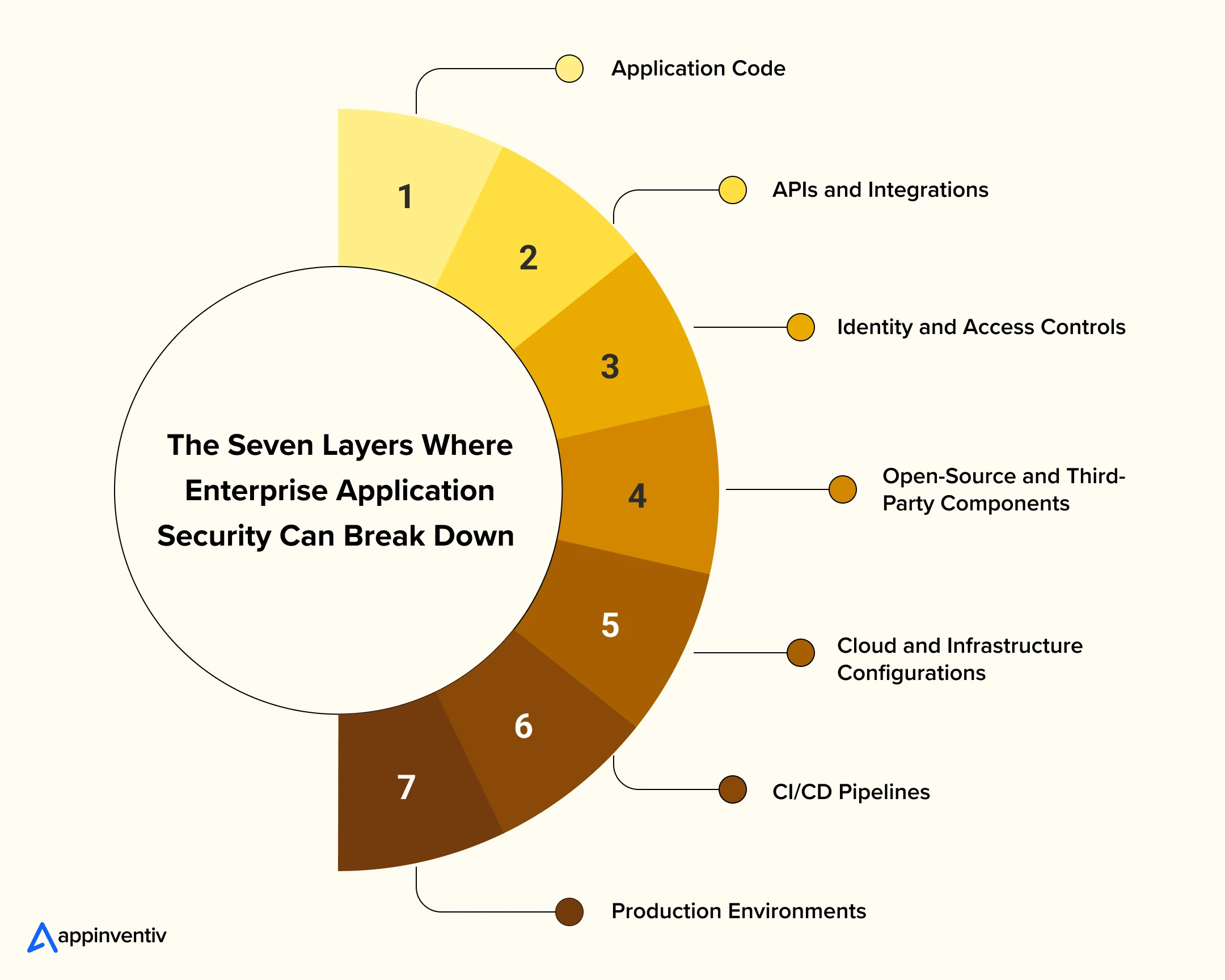
Application Code
Code may contain injection flaws, weak input validation, unsafe data handling, insecure error responses, or poor cryptographic implementation. Attackers can use these weaknesses to manipulate application behaviour, retrieve data, or execute unauthorized commands.
Business logic errors are often harder to find. An application may verify that a user is signed in but fail to check whether the user owns the account, order, or record being requested. The feature may work correctly during routine testing while still allowing unauthorized activity.
APIs and Integrations
APIs connect applications with mobile clients, cloud services, vendors, partners, and internal platforms. They often expose data and business functions in a format that can be queried automatically.
Weak object-level authorization can allow one user to access another user’s records by changing an identifier. Poor rate limiting can support automated abuse. Excessive API responses may disclose information the requesting user does not need.
Older and undocumented endpoints create further risk. They may remain connected to live systems without receiving the same monitoring or security updates as current APIs.
[Also Read: Enterprise Application Integration – How It Works and Why It Matters to Your Business]
Identity and Access Controls
A successful login does not always represent a legitimate user. Credentials may be stolen, sessions may be hijacked, and accounts may remain active after an employee or vendor leaves.
Privilege creates the greater concern after entry. A compromised account with excessive access may be able to export records, change security settings, or reach administrative functions unrelated to its normal role.
Machine identities also require control. Service accounts, API tokens, automated scripts, and cloud workloads often carry powerful permissions without the protections applied to human users.
Open-Source and Third-Party Components
Modern software contains a significant amount of externally developed code. Frameworks, packages, plug-ins, container images, and vendor software all shorten development time, but they also introduce dependencies that the enterprise does not control directly.
When a serious vulnerability becomes public, security teams need to know where the affected component is being used. Without a reliable dependency inventory, the same vulnerable library may remain active across several products.
Third-party integrations present a similar problem. A partner with weak authentication or poorly governed access can provide an indirect route into an otherwise protected environment.
Cloud and Infrastructure Configurations
Secure source code can still run in an insecure environment. Public storage, exposed administrative interfaces, broad cloud permissions, weak network rules, and unprotected secrets may undermine controls inside the application.
Infrastructure-as-code can increase the scale of the problem. One unsafe template may reproduce the same configuration error across enterprise app development, testing, and production.
Attackers actively search for unmanaged resources, default settings, exposed management ports, and credentials stored in configuration files. These weaknesses may provide access without requiring a complex software exploit.
CI/CD Pipelines
Build and deployment pipelines hold a trusted position in software delivery. They may have access to source code, signing keys, cloud credentials, production environments, and software repositories.
A compromised CI/CD pipeline can allow an attacker to alter code or build artifacts before release. The malicious output may then reach customers as part of an apparently legitimate update.
Protected repositories, controlled approvals, secure secrets management, and verified build artifacts are therefore part of application protection, not separate operational concerns.
Production Environments
Application risk continues after deployment. New vulnerabilities appear, configurations change, permissions accumulate, and integrations that were once secure may become compromised.
Production environments also face credential stuffing, API abuse, bots, privilege escalation, and abnormal transaction activity. Useful monitoring needs to identify suspicious behaviour without overwhelming teams with routine events.
The complete attack path matters more than an individual weakness. A minor information leak may become serious when combined with poor account recovery. A compromised service may become a breach when flat network access provides a route to customer data.
Enterprise application security must account for these connections. Protecting the visible application while leaving identities, APIs, dependencies, or delivery pipelines exposed simply directs the attacker towards another route.
How Enterprise Application Security Architecture Protects the Technology Environment
Security architecture defines how trust is established and where it ends. It decides who may access a resource, which systems can communicate, how sensitive data moves, and what happens when a control fails.
An enterprise application security architecture should assume that credentials can be stolen, dependencies can be compromised, and attackers may gain access to one part of the environment. Its purpose is to prevent that initial access from becoming an unrestricted compromise.
This approach aligns with the NIST Zero Trust Architecture. NIST recommends protecting users, assets, services, and resources instead of relying on a fixed network perimeter.
The main layers include:
| Security layer | Controls to establish | Exposure reduced |
|---|---|---|
| Identity | MFA, SSO, adaptive authentication and privileged access management | Account takeover and privilege abuse |
| Application | Secure design, input validation and business logic controls | Injection and unauthorized actions |
| API | Authentication, granular authorization, validation and rate limiting | Data exposure and automated abuse |
| Data | Classification, encryption, masking and key management | Theft and unauthorized disclosure |
| Infrastructure | Secure configurations, segmentation and workload protection | Cloud exposure and lateral movement |
| Software supply chain | Dependency inventories, SBOMs and artifact signing | Vulnerable packages and malicious updates |
| CI/CD | Protected repositories, secrets management and release approvals | Pipeline compromise and code tampering |
| Runtime | Monitoring, behavioural analysis and response workflows | Active attacks and abnormal behaviour |
Treat Identity as a Control Point
Network location should not determine whether a request is trusted. Users, devices, workloads, service accounts, and automated processes need a verified identity before accessing an application resource.
Permissions should match the activity being performed. A support employee may need to view an account without receiving the ability to export the complete customer database. A deployment service may need permission to update one environment without holding permanent administrative access across the cloud estate.
Sensitive actions can require stronger controls. Step-up authentication, additional approval, device checks, and time-limited privileges reduce the damage one compromised identity can cause.
Permissions also need regular review. Employees change roles, temporary accounts outlive projects, and unused API tokens remain active. These small exceptions can gradually form attack paths that no one intended to create.
Contain Compromised Components
A flat environment gives attackers room to move after compromising one service. Segmentation restricts that movement by separating public interfaces, business services, databases, administrative functions, and sensitive workloads.
Communication between these areas should be allowed only where the application requires it. A public-facing service, for example, may need access to a specific business function but not direct access to the complete customer database.
Microservices also need to authenticate each other. Traffic should not be accepted simply because it comes from another service inside the same cloud environment. Service identities, encrypted communication, and granular policies make it harder for a compromised workload to impersonate a trusted component.
Give APIs Independent Security Controls
APIs should be treated as security boundaries rather than invisible links between systems.
Effective API security for enterprise applications covers authentication, object-level authorization, token expiry, endpoint inventories, request validation, rate limits, and response filtering. An API gateway can apply common policies, but it cannot correct missing authorization inside the application’s business logic.
Older API versions require particular attention. An outdated endpoint may no longer appear in current product documentation while remaining connected to live records. Discovery and traffic analysis help identify these shadow APIs before attackers do.
Protect Data According to Its Sensitivity
Not every dataset requires the same protection. Public product descriptions and patient records do not carry comparable financial, legal, or operational consequences.
Data classification gives architects a basis for applying encryption, masking, tokenization, export restrictions, and detailed access monitoring. It also helps the business concentrate stronger controls around information that would cause the greatest damage if exposed.
Encryption protects stored and transmitted information, but it cannot prevent misuse by an authorized account. Sensitive data needs both cryptographic protection and strict access control.
Keys, certificates, database passwords, and API secrets should remain outside application code. Centralized storage, controlled retrieval, rotation, and usage logs reduce the likelihood that one exposed secret will remain useful to an attacker.
Verify the Software Supply Chain
External code should be identified and checked before it reaches production. This includes open-source libraries, container images, development tools, plug-ins, and vendor components.
A Software Bill of Materials gives teams an inventory of the dependencies included in an application. When a vulnerability becomes public, that inventory shows which products and versions need attention.
Protected branches, signed commits, controlled build environments, artifact signing, and provenance checks provide additional assurance. They help confirm that the software approved for release is the same software deployed to production.
Security requirements must also cover vendors and development partners. Agreements should define access restrictions, patching responsibilities, vulnerability disclosure, and incident notification timelines before the integration goes live.
Plan for Detection and Containment
Preventive controls reduce the likelihood of compromise, but they cannot stop every attack. The architecture also needs to provide a clear view of what is happening inside the application.
Useful logs cover authentication, authorization failures, administrative changes, sensitive data access, unusual API activity, exports, and changes to security settings. This information becomes more valuable when security teams can correlate it with cloud, network, identity, and endpoint events.
Response actions should be agreed in advance. Depending on the event, the system may revoke a session, disable a token, block an endpoint, isolate a workload, or require fresh authentication.
A layered architecture earns its value when something fails. One vulnerable service may still be compromised, but restricted permissions limit access, segmentation prevents movement, monitoring reveals unusual behaviour, and response controls help contain the incident.
How to Test Enterprise Applications for Security Weaknesses
Architecture describes how protection is meant to work. Testing shows whether it works under realistic conditions.
A well-designed application can still contain an overlooked authorization check, an exposed secret, an outdated library, or a configuration error introduced during deployment. The security testing of enterprise applications must cover these different sources of risk.
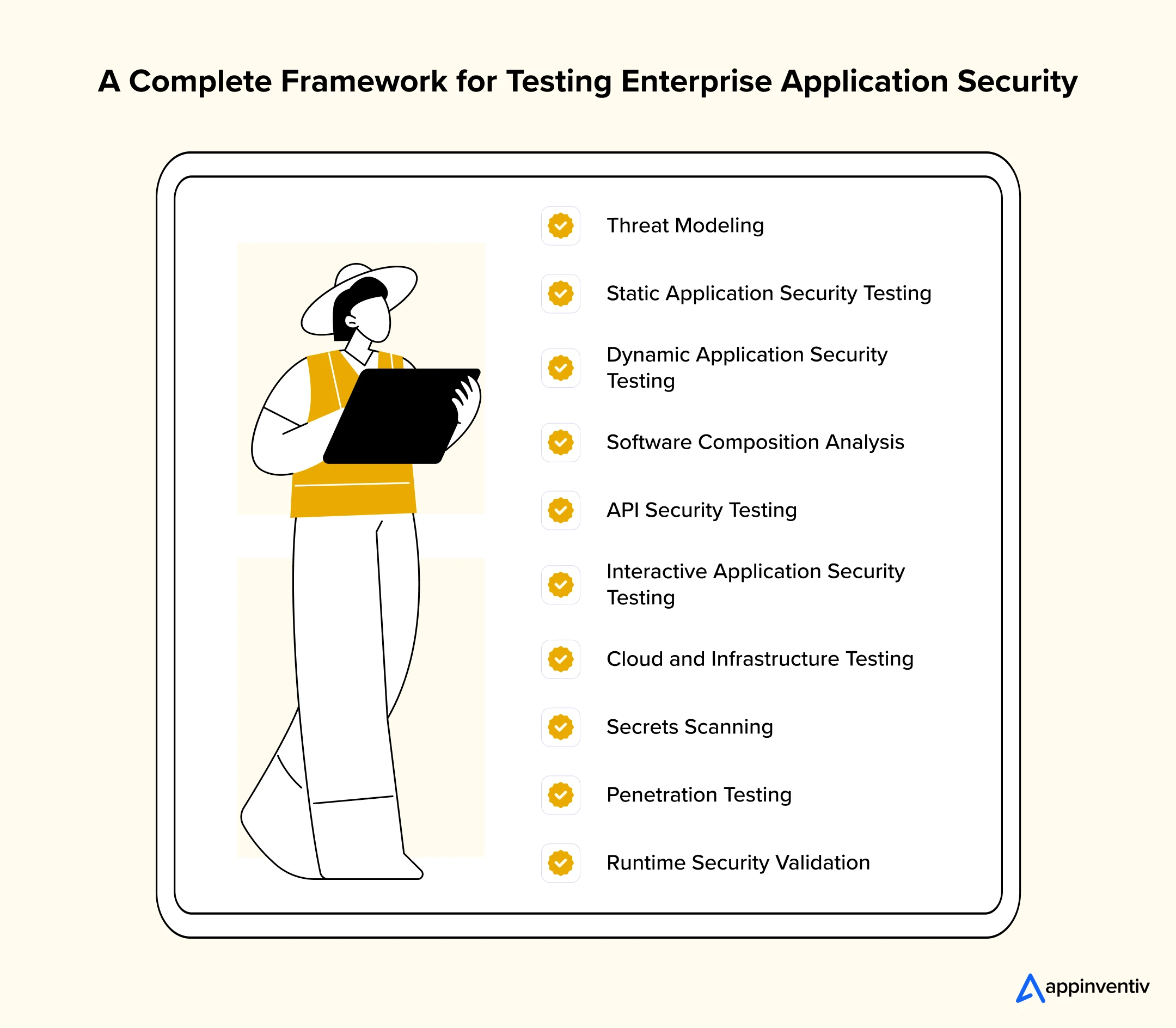
Threat Modeling
Threat modeling begins before there is a finished application to test. Security architects, developers, and business teams map sensitive data, trust boundaries, user roles, integrations, and critical workflows. They then consider how each area could be misused.
Questions may include:
- Which information would cause the greatest damage if exposed?
- Where does data cross a trust boundary?
- Can one user retrieve or change another user’s records?
- What could an attacker do with a stolen API token?
- Could one compromised service reach a sensitive workload?
- Which vendors have access to business or customer information?
The answers influence architecture and security requirements before risky decisions become embedded in the software.
Static Application Security Testing
Static Application Security Testing examines source code, bytecode, or binaries without running the application. It can uncover injection risks, insecure functions, weak cryptographic implementation, and unsafe coding patterns during development.
SAST produces the best results when it sits inside the developer workflow. A finding raised during code review is easier to understand and correct than one delivered several weeks later.
Tool configuration is important. A scanner that produces large numbers of irrelevant alerts will eventually be ignored. Rules should reflect the application’s languages, frameworks, coding standards, and risk profile.
Dynamic Application Security Testing
Dynamic Application Security Testing examines a running application from the outside. It sends requests to available interfaces and looks for exploitable behaviour.
DAST can identify injection vulnerabilities, authentication problems, server misconfigurations, and sensitive information exposed through application responses. It plays an important role in enterprise web application security testing because it assesses the deployed system rather than the source code alone.
A dynamic scanner may identify a suspicious response without showing the developer where the underlying problem sits. The result therefore requires investigation and validation.
Software Composition Analysis
Software Composition Analysis identifies open-source packages, frameworks, and libraries. It can flag known vulnerabilities, unsupported versions, and licensing concerns.
The quality of the result depends on the accuracy of the inventory. Dependencies may be hidden inside container images, build tools, and indirect packages that developers did not install themselves.
Combining SCA with a Software Bill of Materials allows security teams to identify affected products quickly when a new vulnerability is disclosed.
API Security Testing
API testing examines whether a requesting identity has permission to perform an action and access the information returned.
Testing should cover object-level authorization, function-level authorization, token expiry, rate limits, input validation, data exposure, and workflow misuse.
Manual analysis remains important. An automated scanner may confirm that an endpoint works as expected while missing that changing one identifier returns another customer’s record.
Interactive Application Security Testing
Interactive Application Security Testing observes an application while functional or security tests are running. It connects runtime behaviour with the code path responsible for it.
This context can help developers locate a weakness without spending hours reproducing it. IAST is particularly useful in large applications where a request passes through several services before producing a visible result.
Cloud and Infrastructure Testing
Application testing needs to include the environment supporting the software. Cloud configurations, containers, Kubernetes clusters, infrastructure-as-code templates, network policies, and workload permissions can all create exploitable weaknesses.
Configuration scanning can identify public resources, unencrypted storage, open management ports, broad cloud roles, and unsafe container settings.
Testing infrastructure templates before deployment also prevents one mistake from being repeated across several environments.
Secrets Scanning
Repositories, build logs, container images, and configuration files may accidentally contain API keys, passwords, certificates, or access tokens.
Secrets scanning helps identify these exposures. Once a secret is found, deleting it from the latest version of the code is not enough. The credential needs to be revoked or rotated, and the repository history should be reviewed to determine how long it remained accessible.
Penetration Testing
Penetration testing explores whether separate weaknesses can be combined into a practical attack path. Testers may attempt to bypass authentication, escalate privileges, retrieve restricted data, or move from one connected system to another.
This form of testing is particularly useful for finding business logic flaws. A minor information disclosure may appear harmless by itself but become serious when paired with weak password recovery.
The scope should reflect the application’s actual exposure. A public financial platform requires different attack scenarios from an internal workforce application.
Runtime Security Validation
Testing continues after release. Runtime validation checks whether monitoring and response controls recognize behaviour that falls outside normal application activity.
Teams may simulate unusual account actions, excessive API traffic, unauthorized service communication, or attempts to alter protected configurations. The objective is to confirm that an alert appears, contains useful context, and reaches the correct team.
A mature enterprise application security testing program combines these methods. Automated scanning provides coverage and speed. Manual testing supplies business context. Runtime validation confirms that detection continues after the application goes live.
Why Continuous Application Security Testing Matters
Finding more vulnerabilities is not the only objective of continuous testing. The larger goal is to identify serious weaknesses early, assign ownership, and reduce the time available for exploitation.
The benefits of application security testing become clearer when findings influence release decisions, remediation plans, and business risk reporting.
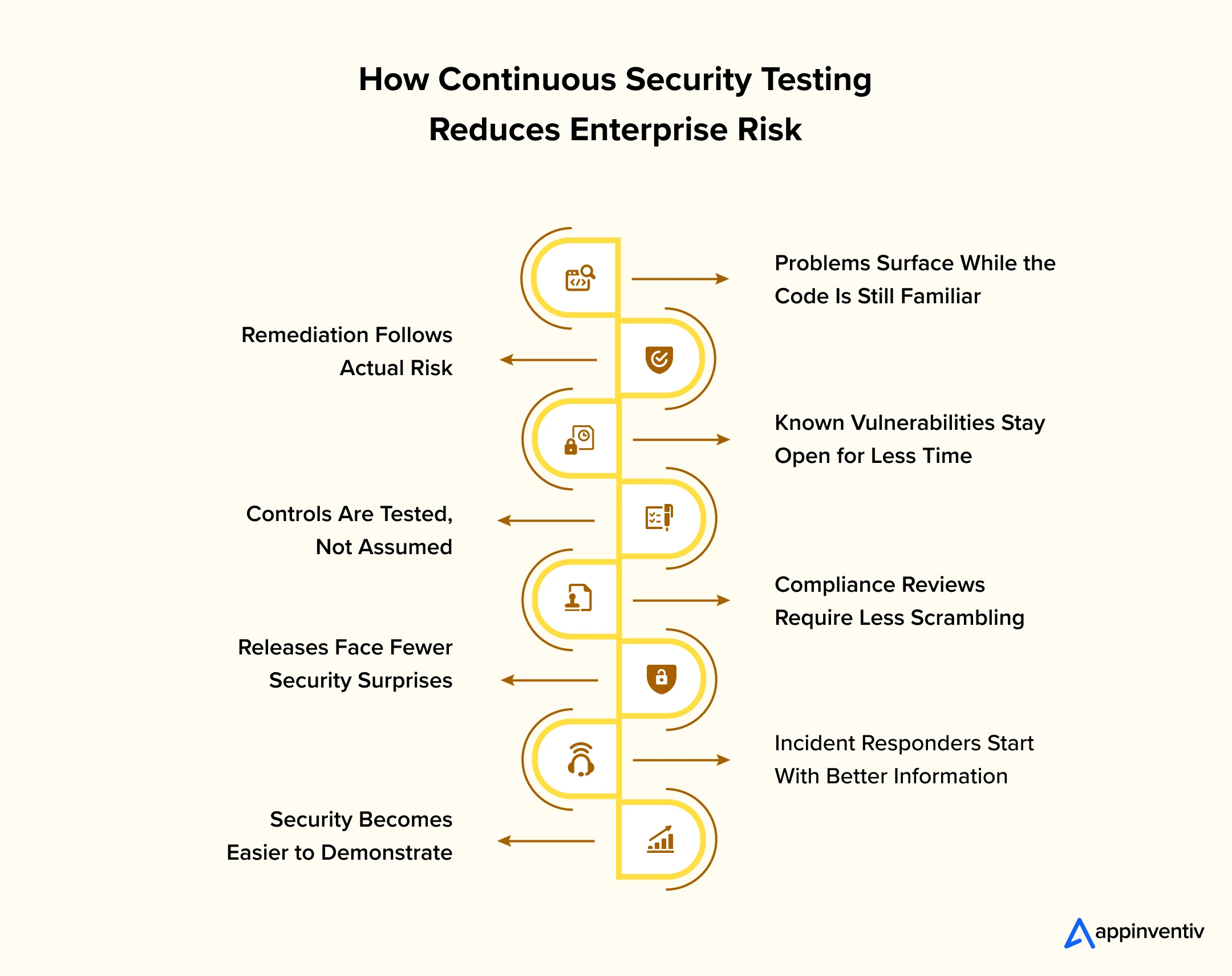
Problems Surface While the Code Is Still Familiar
Developers can resolve a weakness more efficiently while working on the feature involved. Months later, the same correction may require investigation, regression testing, release coordination, and production downtime.
Early testing can also reveal when one insecure coding pattern has been repeated across several services. Teams can correct the common cause rather than patch every instance separately.
Remediation Follows Actual Risk
A long list of findings does not tell a security leader what to fix first. Technical severity provides a starting point, but it does not capture the complete business context.
A high-rated flaw in an isolated test system may present less immediate danger than a medium-rated authorization weakness in a public payment API.
Prioritization should consider:
- Internet exposure
- Data sensitivity
- Access required for exploitation
- Availability of a working exploit
- Importance of the affected process
- Legal and contractual consequences
- Other weaknesses that could be chained with the finding
This approach gives engineering teams a defensible order of work rather than treating every scanner alert as equally urgent.
Known Vulnerabilities Stay Open for Less Time
Attackers often move quickly after exploit details become public. Enterprise remediation usually takes longer because teams must identify affected applications, confirm ownership, test the patch, coordinate downtime, and approve the release.
The CISA Known Exploited Vulnerabilities Catalog helps teams distinguish vulnerabilities already used in attacks from weaknesses that present a less immediate risk.
That intelligence should be combined with application exposure, business criticality, and data sensitivity. A known exploited vulnerability in an internet-facing system deserves a different response from the same flaw inside an isolated development environment.
Continuous testing supports this process by detecting vulnerable components as applications change and routing the finding to the team responsible for remediation.
Controls Are Tested, Not Assumed
A written policy may require MFA, encryption, and restricted administrative access. Testing determines whether those controls cover every relevant route.
A legacy endpoint may bypass MFA. A service account may retain permanent administrator permissions. Sensitive fields may be encrypted in the primary database but copied into unprotected logs.
These are implementation gaps. They rarely appear in policy documents, but they become visible when teams examine how the application actually behaves.
Compliance Reviews Require Less Scrambling
Regulations and assurance frameworks often require evidence that applications are assessed and vulnerabilities are tracked through remediation.
A continuous program maintains that record as part of everyday delivery. Scan results, penetration testing reports, risk exceptions, remediation dates, and release approvals remain available instead of being assembled shortly before an audit.
This evidence can support PCI DSS, HIPAA, GDPR, SOC 2, and ISO 27001 obligations. Passing an audit, however, should not be treated as proof that the application cannot be breached. Compliance establishes a baseline, while testing needs to follow realistic risk.
Releases Face Fewer Security Surprises
Finding a serious vulnerability after deployment can force an emergency patch, rollback, or service interruption. It also pulls developers away from planned work and places security teams under pressure to make decisions with incomplete information.
Security checks within the delivery pipeline provide more time to respond. Critical findings can stop a release. Lower-risk issues can proceed with a documented owner and remediation date.
The objective is not to block software delivery. It is to make the risk visible before the business accepts it.
Incident Responders Start With Better Information
During an incident, teams need to know what the application contains, where its data moves, which identities can reach it, and which systems depend on it.
Threat models, dependency inventories, test reports, and architecture records provide this context. They help responders establish whether an event is isolated or part of a broader compromise.
Testing also reveals weaknesses in detection. Missing logs, unclear alerts, and uncertain response ownership can be corrected before the organization faces a real attack.
Security Becomes Easier to Demonstrate
Customers and partners increasingly request evidence of secure development and testing before connecting systems or sharing sensitive information.
Penetration test summaries, vulnerability management processes, security certifications, and remediation records often form part of enterprise procurement reviews.
A consistent testing program provides credible answers to those questions. More importantly, it shows that weaknesses move through a defined remediation process instead of remaining unresolved until the next audit.
Continuous testing does not remove application risk. It gives the organization enough visibility and time to manage that risk before it becomes an incident.
How to Implement Enterprise App Security Across the Software Lifecycle
A workable security program begins with the applications that carry the greatest business risk. Trying to apply every control to every system at once usually creates a large backlog without improving protection where it matters most.
The implementation process should connect security requirements with application ownership, development workflows, cloud operations, and executive risk decisions.
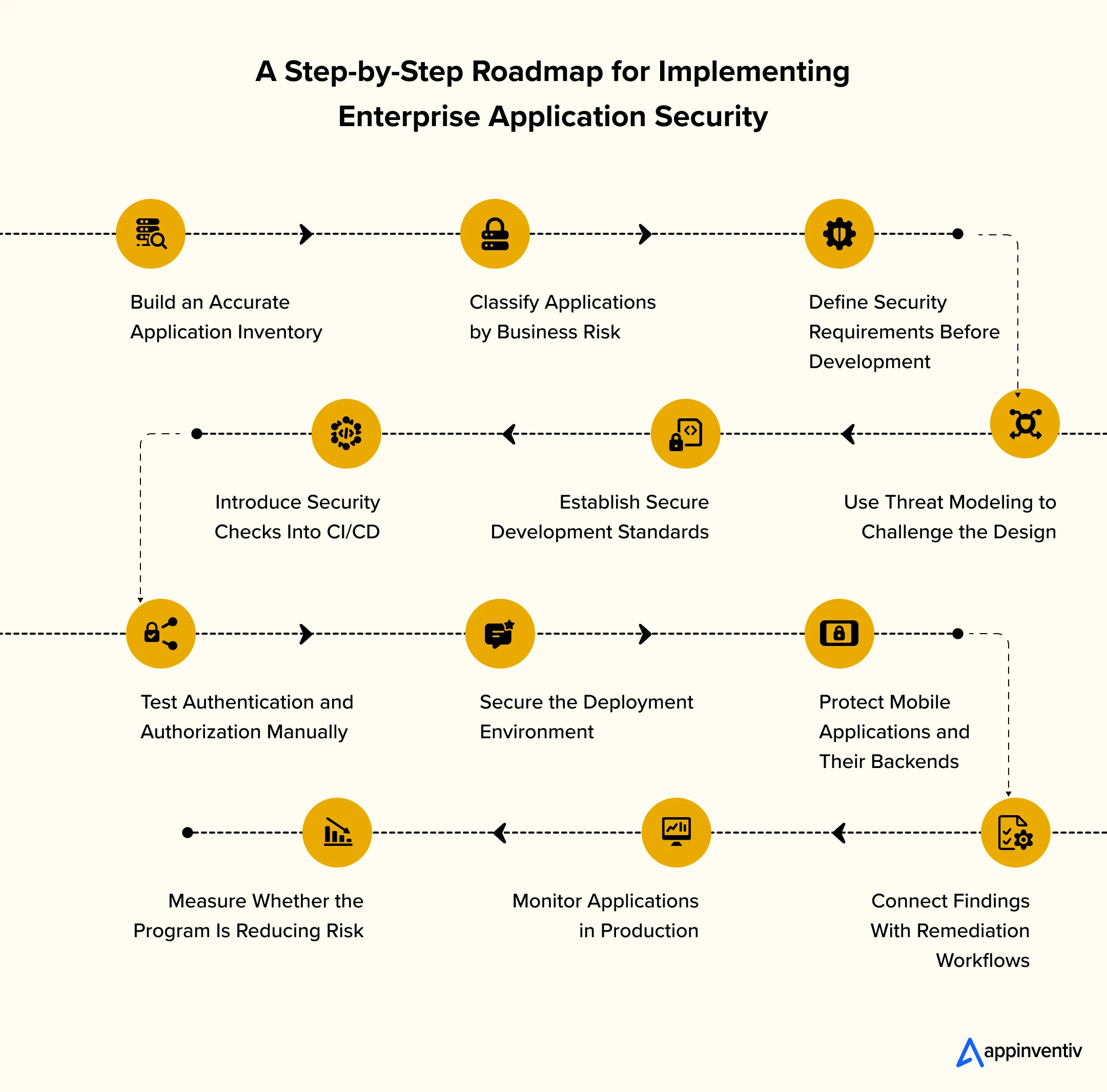
1. Build an Accurate Application Inventory
Start by identifying the applications, APIs, databases, cloud workloads, and third-party services operating across the organization.
The inventory should record:
- Business and technical owners
- Application purpose
- Data classification
- Internet exposure
- Technology stack
- Hosting environment
- Connected APIs and databases
- Open-source dependencies
- External vendors
- Regulatory requirements
- Current support status
Discovery tools can locate cloud assets, domains, APIs, and repositories, but automated results need validation. A technically visible service may no longer be in use, while a critical departmental application may sit outside central IT records.
The inventory also needs a maintenance process. Application ownership, integrations, and exposure can change quickly, making a one-time assessment outdated within months.
2. Classify Applications by Business Risk
Not every application needs the same depth of protection. A public banking platform handling financial transactions carries a different risk from an internal scheduling tool.
Classification should consider the sensitivity of the information, the importance of the supported process, public accessibility, number of users, and potential impact of downtime or compromise.
A practical classification may include:
- Critical: Applications supporting regulated data, financial transactions, essential operations, or privileged administration
- High: Customer-facing or externally accessible applications with sensitive information
- Moderate: Internal applications with limited sensitive data or operational impact
- Low: Isolated applications with minimal data and restricted access
The classification determines testing frequency, approval requirements, monitoring depth, and remediation timelines. It also prevents security teams from spending equal effort on systems with very different consequences.
3. Define Security Requirements Before Development
Security requirements should be established alongside functional and performance requirements. Waiting until testing begins leaves developers to interpret security expectations after the architecture and workflows have already been decided.
Requirements should cover:
- Authentication and session management
- User and service authorization
- Data collection and retention
- Encryption and key management
- API access
- Audit logging
- Third-party integrations
- Secrets management
- Error handling
- Availability and recovery
- Regulatory obligations
Requirements need to be specific enough to test. “The application must use strong access control” leaves room for interpretation. “Administrative actions require MFA, role-based authorization, and an immutable audit record” provides a measurable outcome.
For organizations using enterprise software development services, these requirements should form part of the initial project scope. Development partners must understand the application’s data sensitivity, access model, compliance obligations, and integration risks before architecture and engineering decisions are finalized. This prevents security from becoming a separate remediation exercise after the software has already been built.
4. Use Threat Modeling to Challenge the Design
Threat modeling brings security, engineering, architecture, and business teams into the same discussion. The group identifies sensitive assets, entry points, trust boundaries, and ways legitimate features could be abused.
The exercise should focus on realistic business scenarios. Could a support employee export more customer data than required? Could a user alter the value of a transaction after approval? Could an external service submit requests on behalf of another account?
Findings should lead to design changes, new security requirements, or explicit risk decisions. A threat model that ends as an unread document has little value.
Models also need updating when the application adds a major integration, changes its identity system, moves to a different cloud environment, or begins handling new categories of data.
5. Establish Secure Development Standards
Developers need practical guidance that reflects the technologies they use. A generic security policy will not explain how to implement authorization in a specific framework or manage secrets within a particular cloud platform.
Secure development standards should address:
- Input validation and output encoding
- Authentication and authorization
- Secure session handling
- Cryptographic implementation
- Database access
- API design
- File uploads
- Logging and error responses
- Dependency selection
- Secret storage
- Secure default configurations
Reusable libraries and approved components can make these standards easier to follow. A centrally maintained authorization module, for example, reduces the need for every team to design access control independently.
Training should use examples taken from the organization’s own technology stack and recurring findings. Developers gain more from seeing how a familiar code pattern creates risk than from receiving a generic annual awareness course.
6. Introduce Security Checks Into CI/CD
Security testing should run at points where teams can still act on the results. Source code scans, dependency checks, secrets detection, infrastructure scans, and container analysis can all operate within the delivery pipeline.
Not every finding should stop a release. Gates should reflect the application’s risk classification and the severity of the issue.
A critical vulnerability in an internet-facing application may block deployment immediately. A low-risk finding may proceed with an assigned owner and remediation date. Exceptions should require documented approval rather than informal agreement.
The pipeline also needs protection. Repositories, runners, signing keys, deployment credentials, and build artifacts should have restricted access and clear audit trails.
7. Test Authentication and Authorization Manually
Automated tools are useful for detecting common coding and configuration weaknesses. They are less reliable at understanding business roles and complex authorization rules.
Manual testing should confirm:
- Whether users can access records belonging to other accounts
- Whether lower-privileged roles can reach administrative functions
- Whether hidden interface options remain accessible through direct requests
- Whether inactive or terminated accounts still work
- Whether tokens expire and become invalid as expected
- Whether service accounts hold unnecessary permissions
- Whether sensitive actions require additional verification
Authorization testing should include APIs, mobile backends, internal tools, and administrative interfaces. Testing only the public web interface leaves several access paths unchecked.
8. Secure the Deployment Environment
Application controls can be undermined by the environment in which the software runs. Cloud accounts, containers, Kubernetes clusters, databases, storage, and network policies need their own security baselines.
Teams should remove default credentials, restrict administrative interfaces, encrypt sensitive resources, and prevent direct public access where it is unnecessary.
Infrastructure-as-code templates should be reviewed and scanned before use. Approved templates give development teams a secure starting point and reduce variation between environments.
Production access should remain limited and auditable. Engineers should not need permanent administrator permissions simply because they occasionally investigate operational issues.
9. Protect Mobile Applications and Their Backends
Mobile clients operate on devices the enterprise does not fully control. Application packages can be inspected, modified, or run on compromised devices.
Security controls may include:
- Secure device storage
- Protection against sensitive screenshots
- Certificate validation
- Application integrity checks
- Code obfuscation
- Root or jailbreak risk controls
- Restricted inter-app communication
- Secure session and token handling
- Careful management of application logs
The server must still enforce every sensitive authorization decision. Values submitted by the mobile application should be treated as untrusted input, even when the official application generated them.
Testing should cover the application package, device storage, network traffic, APIs, and backend authorization as one connected system.
10. Connect Findings With Remediation Workflows
A vulnerability report is not a completed security outcome. Each confirmed finding needs an owner, severity, affected asset, remediation deadline, and current status.
Findings should enter the same work-management systems used by development teams. This keeps remediation visible alongside feature and maintenance work.
Service-level targets can define expected response times. A known exploited vulnerability in a public critical application may require immediate action. A lower-risk issue in an isolated environment may receive a longer deadline.
Overdue findings need escalation. The escalation path should identify who can accept the risk when remediation cannot happen within the required period.
11. Monitor Applications in Production
Production monitoring should focus on activity that could signal account compromise, application abuse, or unauthorized access.
Relevant events include:
- Repeated authentication and authorization failures
- New administrative accounts
- Sudden permission changes
- Unusual data exports
- Unexpected API request volumes
- Access from unfamiliar locations or devices
- Service-to-service communication outside normal patterns
- Changes to application security settings
- Attempts to disable logging or monitoring
Alerts need application context. A security team should be able to identify the affected user, service, data, business process, and application owner without beginning a lengthy investigation from scratch.
Response playbooks should define when to revoke sessions, block requests, isolate workloads, disable integrations, or involve legal and compliance teams.
12. Measure Whether the Program Is Reducing Risk
Counting the number of scans performed says little about whether security is improving. Measures should show how quickly teams identify and resolve meaningful weaknesses.
Useful metrics include:
- Critical vulnerabilities by application
- Time taken to remediate by severity
- Percentage of internet-facing applications under continuous testing
- Applications without confirmed owners
- Overdue findings and risk exceptions
- Repeated vulnerability categories
- Coverage of repositories, APIs, and cloud assets
- Time taken to detect and contain suspicious activity
- Percentage of releases meeting security gates
- Third-party access without an active business need
Leadership reporting should connect these measures with business exposure. A reduction in low-risk findings is less important than closing an exploitable path into a critical customer platform.
The process of implementing enterprise application security tools should support this operating model rather than define it. Scanners, gateways, monitoring platforms, and testing products provide visibility and enforcement. The organization still needs to decide which applications matter most, who owns each risk, and how quickly serious weaknesses must be resolved.
Enterprise AppSec Challenges and Their Solutions
Large enterprises often have security tools in place, but inconsistent ownership, fragmented visibility, and complex technology environments still leave applications exposed. The table below outlines the most common enterprise AppSec challenges and the practical steps required to address them.
| Challenge | How It Creates Security Risk | Recommended Solution |
|---|---|---|
| Incomplete application and API inventory | Unknown applications, shadow APIs, abandoned cloud resources, and test environments may remain outside security testing and monitoring. | Maintain a continuously updated inventory covering ownership, business criticality, data sensitivity, internet exposure, dependencies, APIs, and hosting environments. |
| Excessive security findings | Multiple tools may generate duplicate alerts and false positives, making it difficult for developers to identify urgent issues. | Use risk-based prioritization and Application Security Posture Management to consolidate findings, remove duplication, and connect vulnerabilities with application context. |
| Security disconnected from development | Findings delivered late or through separate dashboards are harder for developers to investigate and resolve. | Integrate code scanning, dependency checks, secrets detection, and infrastructure testing into repositories, CI/CD pipelines, and existing ticketing workflows. |
| Weak authorization controls | Users, administrators, service accounts, and APIs may retain more access than their roles require. | Apply least privilege, role-based access, MFA, time-limited permissions, regular access reviews, and detailed logging for sensitive actions. |
| Legacy application limitations | Older systems may use unsupported frameworks, shared credentials, weak encryption, and tightly coupled architectures. | Apply temporary controls such as restricted access, gateway authentication, virtual patching, segmentation, and enhanced monitoring while creating a phased modernization plan. |
| Third-party and open-source exposure | Vulnerable packages, vendor integrations, and external access can introduce attack paths outside internally developed code. | Maintain SBOMs, scan dependencies, assess vendors, restrict third-party permissions, and define patching and incident-notification obligations contractually. |
| Inconsistent cloud configurations | Public storage, excessive permissions, open administrative interfaces, and configuration drift can expose otherwise secure applications. | Establish secure cloud baselines, scan infrastructure-as-code, restrict production access, encrypt sensitive resources, and monitor configuration changes. |
| Unprotected CI/CD pipelines | Compromised repositories, exposed secrets, or altered build artifacts can allow malicious code to enter trusted releases. | Protect branches, isolate build environments, use managed secrets, verify dependencies, sign artifacts, and require approval for high-risk production changes. |
| Different web and mobile risks | Mobile applications face local storage, reverse engineering, and device-level threats, while web platforms face browser, session, and server-side attacks. | Test web and mobile channels separately while validating the shared APIs, backend authorization, data handling, and identity controls connecting them. |
| Slow vulnerability remediation | Findings may remain open because ownership, deadlines, and escalation procedures are unclear. | Assign every confirmed vulnerability an owner and resolution date. Define remediation targets by exploitability and business impact, with formal approval for delayed fixes. |
| Limited production visibility | Weak logging and poorly configured alerts may allow attackers to remain active without detection. | Monitor authentication failures, privilege changes, unusual exports, API abuse, and security-setting changes. Connect alerts with application and business ownership. |
| Unclear security ownership | Development, cloud, security, compliance, and business teams may assume another group owns the risk. | Define who identifies, validates, remediates, accepts, and reports each category of application risk. Use security champions to coordinate work within development teams. |
Addressing these challenges requires more than adding another scanner. Enterprises need connected security processes that make application ownership visible, place findings inside development workflows, and ensure that serious vulnerabilities remain tracked until remediation is verified.
Bring hidden APIs, unresolved vulnerabilities, and scattered security controls into one accountable program.
Enterprise Application Security Best Practices
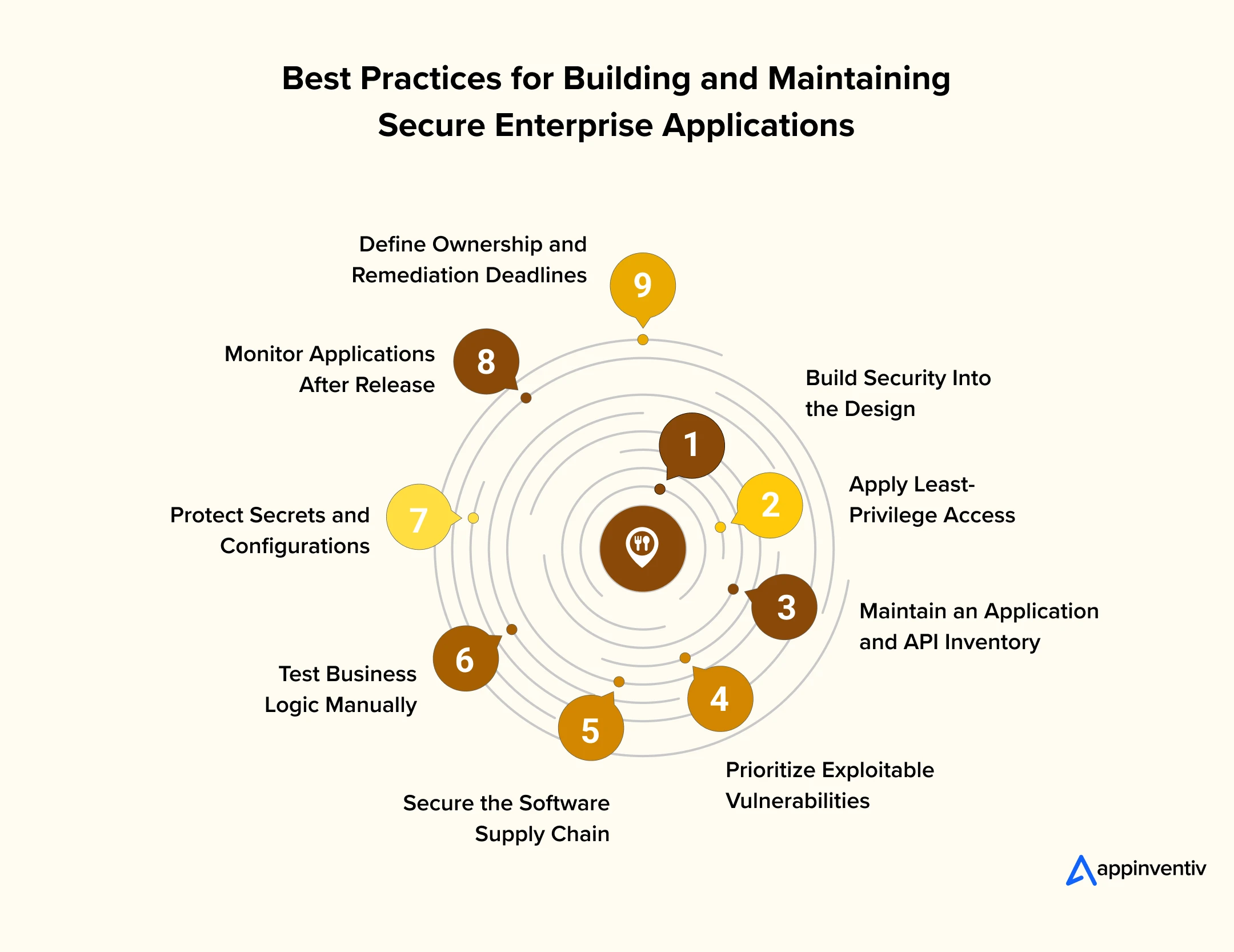
Strong application security depends on consistent decisions across design, development, deployment, and production. The following enterprise application security best practices help enterprises manage risk without making security a bottleneck.
Build Security Into the Design
Define security requirements before development begins. Threat modeling should identify sensitive data, trust boundaries, user roles, integrations, and possible attack paths. Review the model whenever the application adds a major feature, integration, or data source.
Apply Least-Privilege Access
Give users, administrators, APIs, service accounts, and workloads only the permissions they need. Review access regularly and remove inactive accounts, outdated roles, and unused tokens. Sensitive actions should require stronger authentication and generate audit records.
Maintain an Application and API Inventory
Track applications, APIs, repositories, cloud resources, data sensitivity, internet exposure, dependencies, and ownership. Deprecated and undocumented endpoints should also be included because they may remain connected to production data.
Prioritize Exploitable Vulnerabilities
Severity scores should not determine remediation order alone. Consider whether the application is public, what data it handles, whether active exploits exist, and what access an attacker could gain. This helps teams focus on weaknesses with a credible path to business damage.
Secure the Software Supply Chain
Scan open-source packages, container images, and external components before release. Maintain dependency inventories and SBOMs so affected applications can be identified quickly when new vulnerabilities emerge. Protect repositories and verify build artifacts before deployment.
Test Business Logic Manually
Automated scanners may miss workflow abuse and authorization errors. Manual testing should check whether users can access another account’s data, bypass approvals, alter transaction values, repeat restricted actions, or reach administrative functions through APIs.
Protect Secrets and Configurations
Store credentials, certificates, and API keys in a managed vault instead of source code or configuration files. Rotate exposed secrets immediately. Scan infrastructure templates and cloud environments for public resources, weak encryption, and excessive permissions.
Monitor Applications After Release
Record failed authorization, privilege changes, unusual data exports, API abuse, and changes to security settings. Alerts should include enough context to identify the affected application, account, data, and responsible team.
Define Ownership and Remediation Deadlines
Every confirmed finding needs an owner and resolution date. Delayed remediation should require documented risk acceptance, temporary controls, and an expiry date. This prevents security issues from remaining indefinitely in development backlogs.
Applied consistently, these practices strengthen enterprise app security while giving development teams clear and workable expectations.
Strengthen application architecture, validate real attack paths, and keep critical risks from reaching production.
How Appinventiv Helps Enterprises Secure Applications at Every Layer
Application security becomes difficult when architecture, testing, cloud controls, and remediation sit with different teams. Appinventiv brings these areas into one coordinated engagement, helping enterprises find exploitable gaps without disrupting software delivery.
Our enterprise application security services cover:
Application Security Assessment
We review application architecture, source code, APIs, access controls, cloud configurations, and third-party connections. The assessment shows where weaknesses exist and how attackers could use them to reach sensitive data or critical business functions.
Application Penetration Testing
Our application penetration testing services combine automated scanning with manual attack simulation. Security specialists test authentication, authorization, APIs, business logic, session handling, and connected infrastructure to confirm which weaknesses can be exploited.
Findings are prioritized according to exposure, data sensitivity, and business impact rather than technical severity alone.
Secure Development Support
We help teams establish a Secure Software Development Lifecycle, or SSDLC, by introducing threat modeling, secure coding standards, automated CI/CD checks, secrets management, and controlled release processes. This allows developers to address security risks throughout delivery instead of waiting for a final-stage review.
[Also Read: Why Appinventiv is an Ideal Choice for Enterprise Software Development]
Cloud and API Security
Our experts assess cloud permissions, configurations, workloads, API authentication, authorization, and data flows. Controls are aligned with the application’s actual architecture across public cloud, private infrastructure, and hybrid environments.
Continuous Monitoring and Remediation
We help enterprises establish application logging, actionable alerts, remediation workflows, and incident response procedures. Confirmed findings reach the right owners, while security teams gain clearer visibility into suspicious activity after deployment.
Appinventiv supports web, mobile, cloud, and enterprise applications through a combination of security assessment, penetration testing, secure engineering, and continuous risk management. The result is stronger protection built around practical attack paths and measurable remediation.
FAQs
Q. What is enterprise application security?
A. Enterprise application security protects business software and connected systems from unauthorized access, data exposure, malicious activity, and operational disruption. It covers the complete application environment, including:
- Source code and business logic
- User and machine identities
- APIs and third-party integrations
- Cloud infrastructure and databases
- Open-source dependencies
- CI/CD pipelines
- Production monitoring
Q. How often should enterprise application security testing be conducted?
A. Testing should continue throughout the software lifecycle rather than follow a fixed annual schedule. Enterprises should conduct testing:
- During application design and development
- Before major production releases
- After architecture or infrastructure changes
- When adding APIs or third-party integrations
- Following cloud migrations
- After significant security incidents
- Periodically for critical and public applications
Q. What are some examples of enterprise application security tools?
A. Various examples of tools offering enterprise application security include platforms that examine code, dependencies, APIs, cloud configurations, and runtime activity. Common tool categories include:
- Static Application Security Testing tools
- Dynamic Application Security Testing tools
- Software Composition Analysis tools
- API security testing platforms
- Secrets and credential scanners
- Cloud configuration scanners
- SIEM and runtime protection platforms
The right combination depends on the application architecture, technology stack, exposure, and data sensitivity.
Q. What does enterprise web application security testing cover?
A. Enterprise web application security testing examines the parts of a web application that attackers could access or manipulate. Testing typically covers:
- Authentication and session management
- User and administrator authorization
- Input validation and injection risks
- Business logic and transaction flows
- API endpoints
- Server and cloud configurations
- Sensitive data exposure
- Security logging and error handling
Automated scans provide broad coverage, while manual testing helps uncover workflow abuse and complex authorization flaws.
Q. How is enterprise mobile application security tested?
A. Mobile application testing covers both the application installed on the device and the services supporting it. A complete assessment of enterprise mobile application security should examine:
- Local data storage
- Application permissions
- Network communication
- Certificate validation
- Hard-coded keys and credentials
- Application tampering and reverse engineering
- API authentication and authorization
- Backend data exposure
Testing only the mobile package is not sufficient because attackers can bypass the interface and send requests directly to the backend APIs.
Q. How should enterprises prioritize application vulnerabilities?
A. Organizations should combine technical severity with the actual business and attack context. Priority should depend on:
- Internet exposure
- Evidence of active exploitation
- Data sensitivity
- Required attacker privileges
- Application criticality
- Available compensating controls
- Potential regulatory impact
- Ability to combine the weakness with other flaws
This prevents teams from spending equal effort on vulnerabilities with very different consequences.
Q. What should businesses look for in enterprise application security services?
A. A capable provider should offer more than automated vulnerability scanning. For businesses, the enterprise application security checklist should cover the following areas:
- Architecture and code reviews
- Manual penetration testing
- Web, mobile, API, and cloud assessments
- Business logic testing
- Risk-based prioritization
- Practical remediation guidance
- Retesting after corrections
- Support for secure development processes
The provider should explain how a weakness could affect the business, not simply share a technical finding.
Q. What should an application penetration testing report include?
A. A useful penetration testing report should help both security and development teams understand what needs attention. It should include:
- A clear description of the vulnerability
- The affected application or component
- Evidence that the weakness is exploitable
- The likely attack path
- Technical and business impact
- Severity and remediation priority
- Recommended corrective action
- Retesting results after remediation
The report should separate confirmed vulnerabilities from unverified scanner alerts.
Q. How can enterprises measure the success of an application security program?
A. Success should be measured through risk reduction rather than the number of scans completed. Useful indicators include:
- Open critical vulnerabilities
- Average remediation time
- Repeat vulnerability categories
- Testing coverage across applications and APIs
- Overdue risk exceptions
- Applications without confirmed owners
- Time taken to detect suspicious activity
- Time taken to contain an application incident
These measures show whether exposure is decreasing and whether teams are resolving the weaknesses that matter most.


Fast 2-minute response, fully NDA-protected.
Key takeaways: State regulations shape your cloud choices, security configurations, and system layouts long before code is written. Saudi laws demand built-in protections across mobile applications, cloud software, machine learning platforms, and corporate tools. Early design planning cuts code rewrites, network threats, buyer procurement delays, and long-term engineering budgets. Separate business sectors require distinct technical…
Enterprise Regulatory Risk Management in Australia: Challenges, Strategies, and Solutions
Key takeaways: Policy documents no longer protect you. Regulators now demand hard technical proof that your operational controls actually work. Manual spreadsheets and yearly audits create dangerous blind spots. Legacy setups simply break under intense CPS 230 and FAR pressure. High-performing enterprise risk management frameworks in Australia hardwire boardroom strategy directly into the technical architecture…

Digital Maturity Assessment for Australian Enterprises: Where You Are, Where You Need to Be
Key takeaways: Digital maturity has evolved from a transformation metric into a core indicator of operational resilience, governance readiness, and long-term enterprise scalability across Australia. AI adoption is exposing weaknesses in data quality, governance, and operational agility that digitisation spending alone cannot fix. CPS 230, CPS 234, the SOCI Act, and Privacy Act reforms are…