






















eCommerce API Integration: A 6-Step Guide to Connecting Storefront, ERP and Marketplaces

 Share -



- 01What Disconnected Commerce Systems Really Cost Your Business
- 02Which eCommerce APIs Your Commerce Stack Actually Needs
- 03Choosing Among API Integration Solutions for eCommerce
- 04How to Integrate an API Into an eCommerce Website in Six Steps
- 05The eCommerce Platform API Integration Challenges Most Teams Underestimate
- 06Security and Compliance Rules for Payment and Customer Data
- 07What eCommerce API Integration Cost and Timelines Look Like
- 08Is Your Integration Layer Ready for Agentic Commerce?
- 09How Appinventiv Approaches eCommerce Integration
- 10FAQs

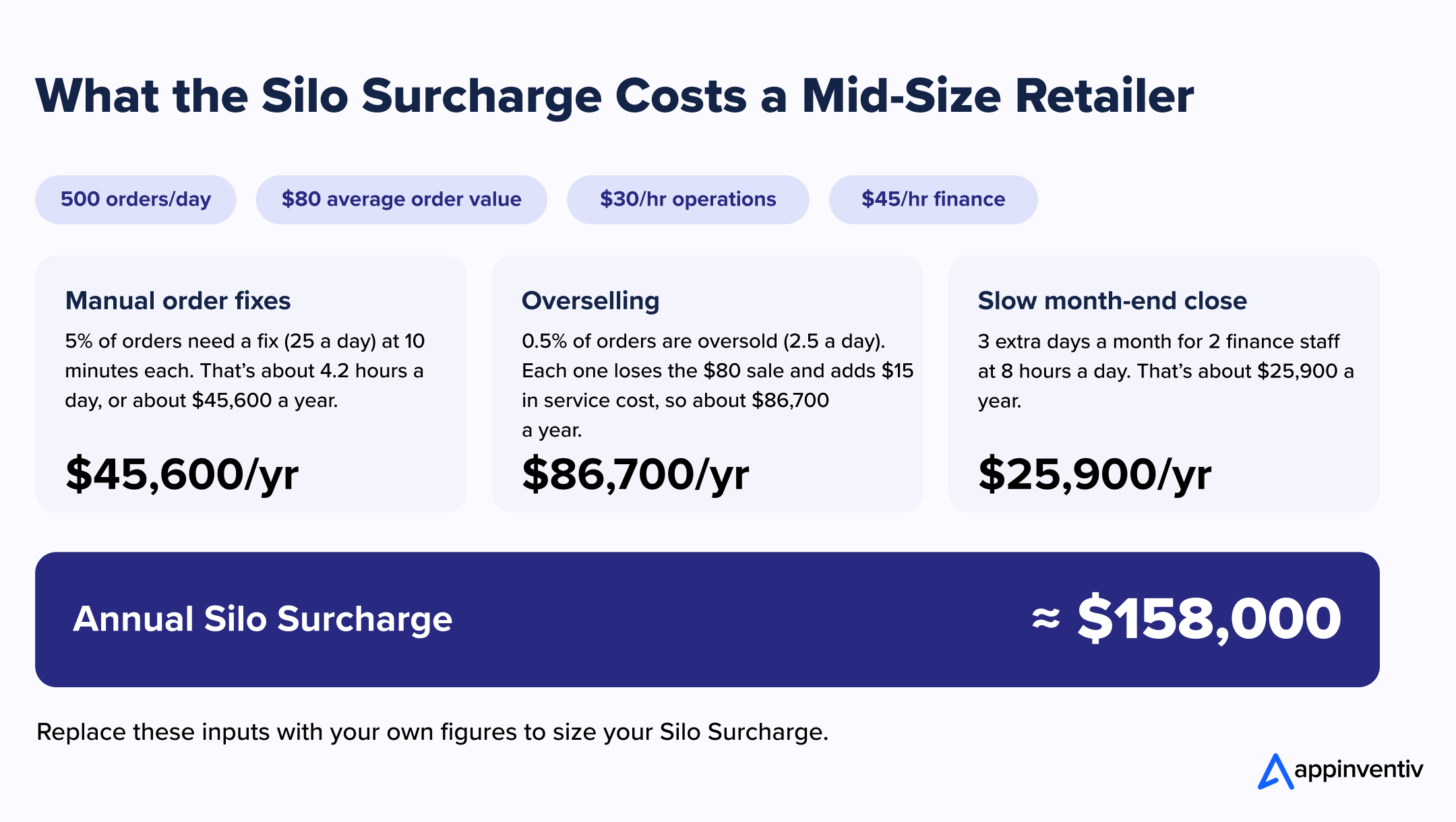
eCommerce API integration connects your storefront to the systems behind it, including ERP, order management, payments, shipping and marketplaces. It does that so stock, orders and money move between them automatically and in near real time. For a CTO running a legacy ERP that syncs in nightly batches, it decides whether the website shows what the warehouse actually holds. Most retailers already pay for disconnected systems without seeing the bill. We, at Appinventiv, call that bill the Silo Surcharge, the recurring cost of overselling, manual fixes and slow month-end closes, and it grows with every channel you add.
Key takeaways:
- Enterprises run 897 applications on average, and only 29% are connected, so most commerce data still moves by export, email or rekeying.
- Inventory distortion costs retailers $1.73 trillion a year, and stale stock data across channels is one cause integration can fix.
- Choose between point-to-point, iPaaS, unified API and a custom layer based on channel count and the control you need, not on vendor pitch.
- Name a system of record for each object (SKU, price, stock, order) before anyone writes code.
- Budget for upkeep every year, not just the first build, because vendor API changes never stop.
Appinventiv maps your commerce data flows and shows where disconnected systems are costing you stock, hours and revenue.
What Disconnected Commerce Systems Really Cost Your Business
Disconnected commerce systems cost money in four places: inventory that is wrong across channels, staff hours spent reconciling orders by hand, a financial close that waits on spreadsheets, and catalog errors that reach customers. None of these shows up as an integration line item, which is why most budgets underestimate them.
Think of an airport where every airline runs its own departure board. Each board is accurate for its own flights, yet no passenger can find one true gate. Your storefront, ERP, warehouse system and marketplaces behave the same way.
| Silo Surcharge Line Item | How It Shows Up |
|---|---|
| Inventory Distortion | Overselling on one channel while stock sits unsold on another |
| Manual Reconciliation | Teams rekey orders, refunds and returns between OMS and ERP |
| Delayed Financial Close | Payment and refund data arrives in batches, so month-end waits |
| Catalog and Price Drift | A price change reaches the website but not the marketplace listing |
The scale of the problem is larger than most budgets assume. IHL Group puts global inventory distortion, the combined cost of out-of-stocks and overstocks, at $1.73 trillion a year, about 6.5% of retail sales.
The 2025 MuleSoft Connectivity Benchmark found IT teams spend 39% of their time building custom integrations, which is engineering capacity not spent on customers. Our guide to eCommerce integration maps where that time usually goes.
Not every silo deserves a connection, though. Start with the flows that touch money and stock, because those are where a stale record turns into a refund or a lost order. A link between your loyalty tool and your survey platform can wait a quarter.
Which eCommerce APIs Your Commerce Stack Actually Needs
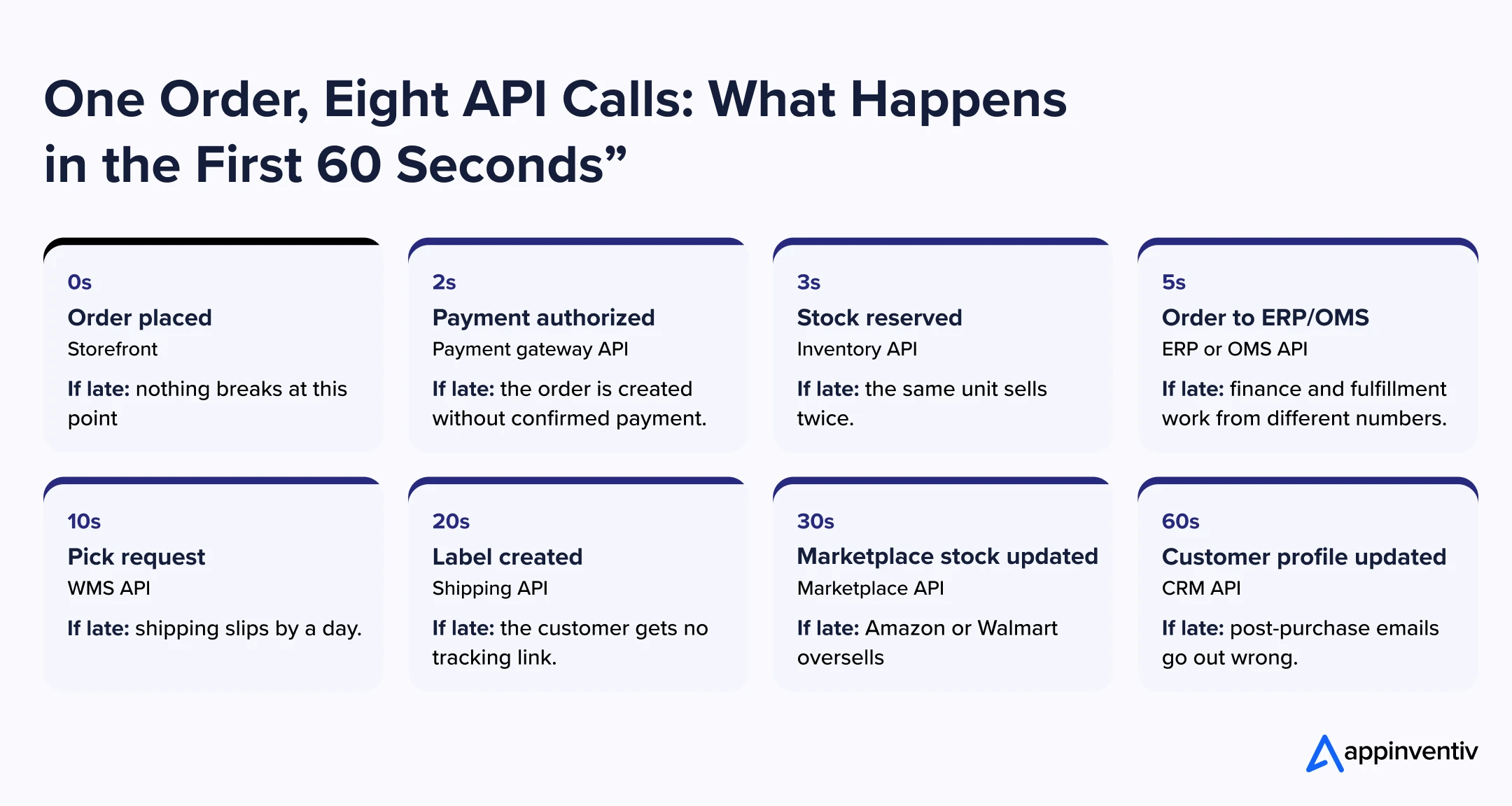
Most commerce stacks need APIs in eight areas, but not all require real-time sync. Payments, inventory and orders need event-level speed because errors there cost money within minutes. Catalog, tax, CRM and marketing data can usually sync on a short schedule without hurting customers.
| API Type | What It Moves | Example Providers | Sync Priority |
|---|---|---|---|
| Catalog and PIM | Products, variants, attributes, media | Shopify Admin API, Akeneo | Near real time |
| Inventory Management | Stock by location, reservations, reorder points | ERP or WMS APIs, Shopify Inventory | Real time |
| Order Management and ERP | Orders, returns, invoices | SAP S/4HANA, NetSuite, Dynamics 365 | Real time |
| Payment Gateway | Authorizations, captures, refunds, tokens | Stripe, Adyen, Razorpay | Real time |
| Shipping and Logistics | Rates, labels, tracking events | UPS, FedEx, Shippo, Shiprocket | Real time for rates, event-based for tracking |
| Marketplace | Listings, orders, fees, stock | Amazon SP-API, Walmart Marketplace API | Near real time |
| Tax and Accounting | Tax rates, ledgers, settlements | Avalara, QuickBooks | Scheduled |
| CRM and Marketing | Customers, segments, events | Salesforce, HubSpot, Klaviyo | Scheduled or event-based |
Inventory management API integration for eCommerce decides whether you oversell, so it needs stock reservations at checkout, not just periodic counts. Well-built inventory management software only helps if its numbers reach every channel. Marketplace API integration for eCommerce adds another party’s rules, since Amazon and Walmart each set their own listing schemas, rate limits and fee reports.
eCommerce shipping API integration pays back fastest at checkout, where live carrier rates replace flat-rate guesses.
B2B eCommerce API integration adds objects most B2C stacks never touch: contract pricing per account, quote approvals, purchase order numbers, credit limits and punch-out catalogs tied to a buyer’s procurement system. The ERP usually owns these rules, so plan them with your ERP eCommerce integration team from day one. Ranking each flow by sync priority before choosing tools keeps you from paying real-time prices for data that can wait.
Payment, Inventory and PIM APIs in Practice
Payment gateway API integration in eCommerce usually means connecting several narrower APIs. Square, for example, splits its platform into:
- a Payments API for charges and refunds
- a Cards API for stored cards
- a Customers API for buyer profiles
- a Gift Cards API
- a Web Payments SDK for browser checkout
- an In-App Payments SDK for mobile apps
Stripe and PayPal follow a similar pattern under their own names.
On the catalog side, an inventory API reports stock by location, while product information management (PIM) APIs keep descriptions, attributes and media consistent across channels. Map each one to its system of record before you connect it.
Choosing Among API Integration Solutions for eCommerce
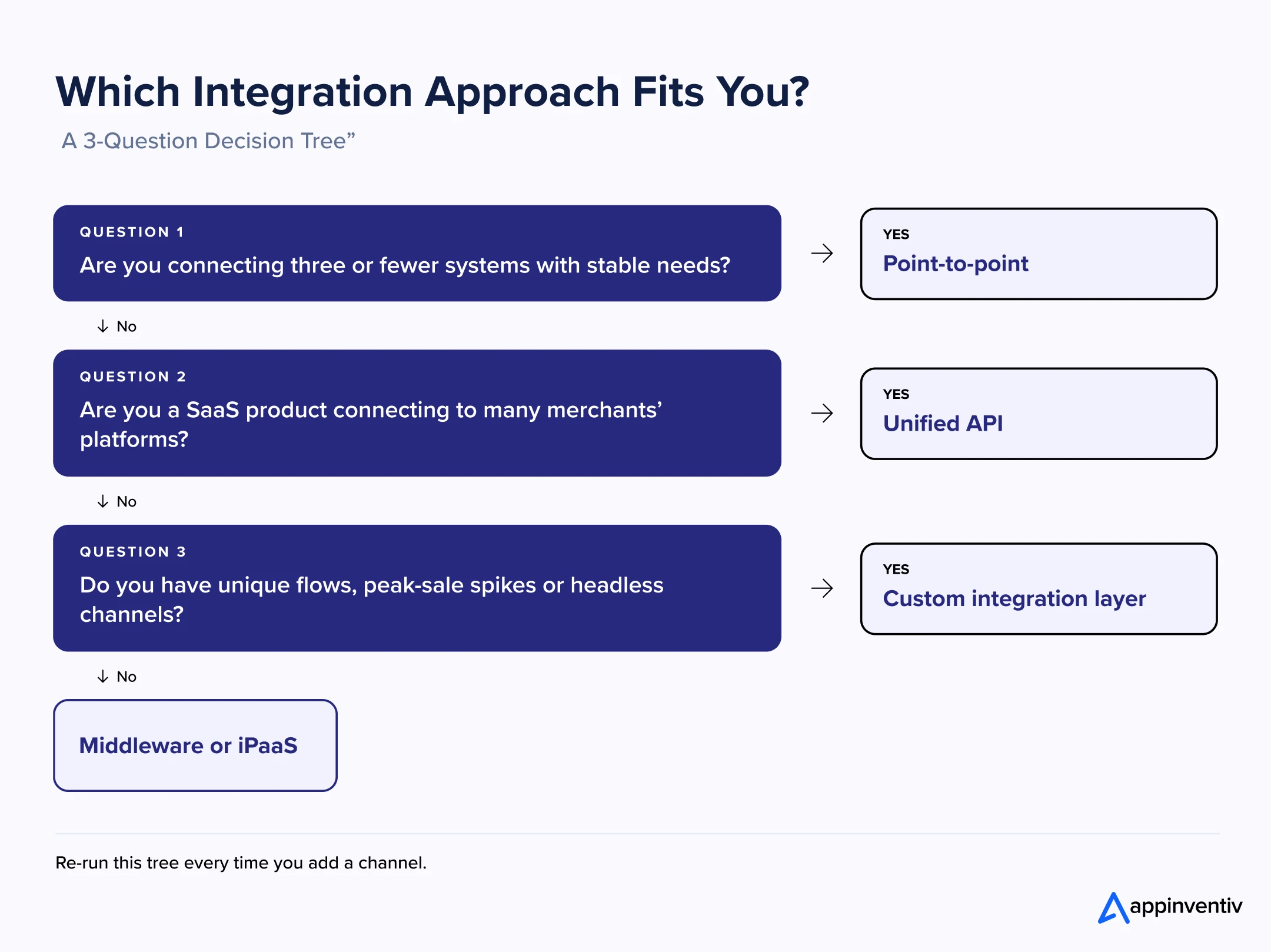
API integration solutions for eCommerce come in four shapes: point-to-point connections, middleware or iPaaS, unified APIs and a custom integration layer. The right one depends on how many systems you connect, how much platform-specific behavior you need and who will maintain it after launch.
| Approach | Best For | Control | Time to Launch | Long-Term Cost | Lock-In Risk |
|---|---|---|---|---|---|
| Point-To-Point | Two or three systems with stable needs | Full | Fast for the first link | Rises sharply with every new link | Low |
| Middleware or iPaaS (MuleSoft, Boomi, Celigo) | Many internal systems with workflow logic | High | Moderate | Subscription plus connector fees | Medium |
| Unified API | SaaS products connecting to many merchant platforms | Limited to common fields | Fastest | Per-connection pricing | High |
| Custom Integration Layer | Unique flows, high volume or headless storefronts | Full | Slowest | Highest upfront, lowest per change later | Low |
Connecting five systems means up to 10 separate links, and each link breaks on its own schedule. The cheapest integration to build is rarely the cheapest one to own.
Also Read: Enterprise Application Integration – How It Works and Why It Matters to Your Business
Where Headless Commerce API Integration Changes the Math
Headless commerce API integration separates the storefront from the commerce engine, so the website, app, kiosk and marketplace feeds all read from the same APIs. In a composable or MACH setup (microservice architecture, API-first, cloud-native, headless), the integration layer stops being plumbing and becomes the product your teams build on. Retailers moving to this model should treat API design, versioning and observability as first-class work, because every channel now depends on them.
Build, Buy or Partner for eCommerce API Development.
Partner on eCommerce API development when you want to own the code but lack engineers with experience handling ERP batch windows and peak-sale rate limits. Whichever route you pick, a gateway from the open-source API management platforms gives you one place to govern traffic.
Appinventiv’s eCommerce teams design API layers that keep storefronts, ERP systems, payments and marketplaces in sync at peak volume.
How to Integrate an API Into an eCommerce Website in Six Steps
To integrate an API into an eCommerce website, decide who owns each piece of data, audit the API contract, choose a sync model, secure access, build and test the field mappings, then roll out in phases with monitoring. The order of these steps matters more than the tooling. Teams that start with endpoints usually rebuild their data model months later.
Step 1: Name a System of Record for Every Object
Decide which system owns each object before any code is written. The ERP usually owns price and cost, the WMS owns physical stock, the order management software (OMS) owns order status, and the PIM owns product content. When two systems both claim to own stock, you get the overselling the integration was meant to fix.
Decision to make: which system wins when two records disagree.
Step 2: Audit Each API Contract Before You Commit
Check each provider’s protocol, rate limits, versioning and deprecation policy. Modern platforms use REST or GraphQL with JSON, while many older ERPs and carriers still expose SOAP and XML. Contracts also change under you. Shopify made its GraphQL Admin API mandatory for new public apps from April 2025 and now treats REST as legacy, so a REST-first build there starts life as technical debt.
Decision to make: which APIs are stable enough to build on directly.
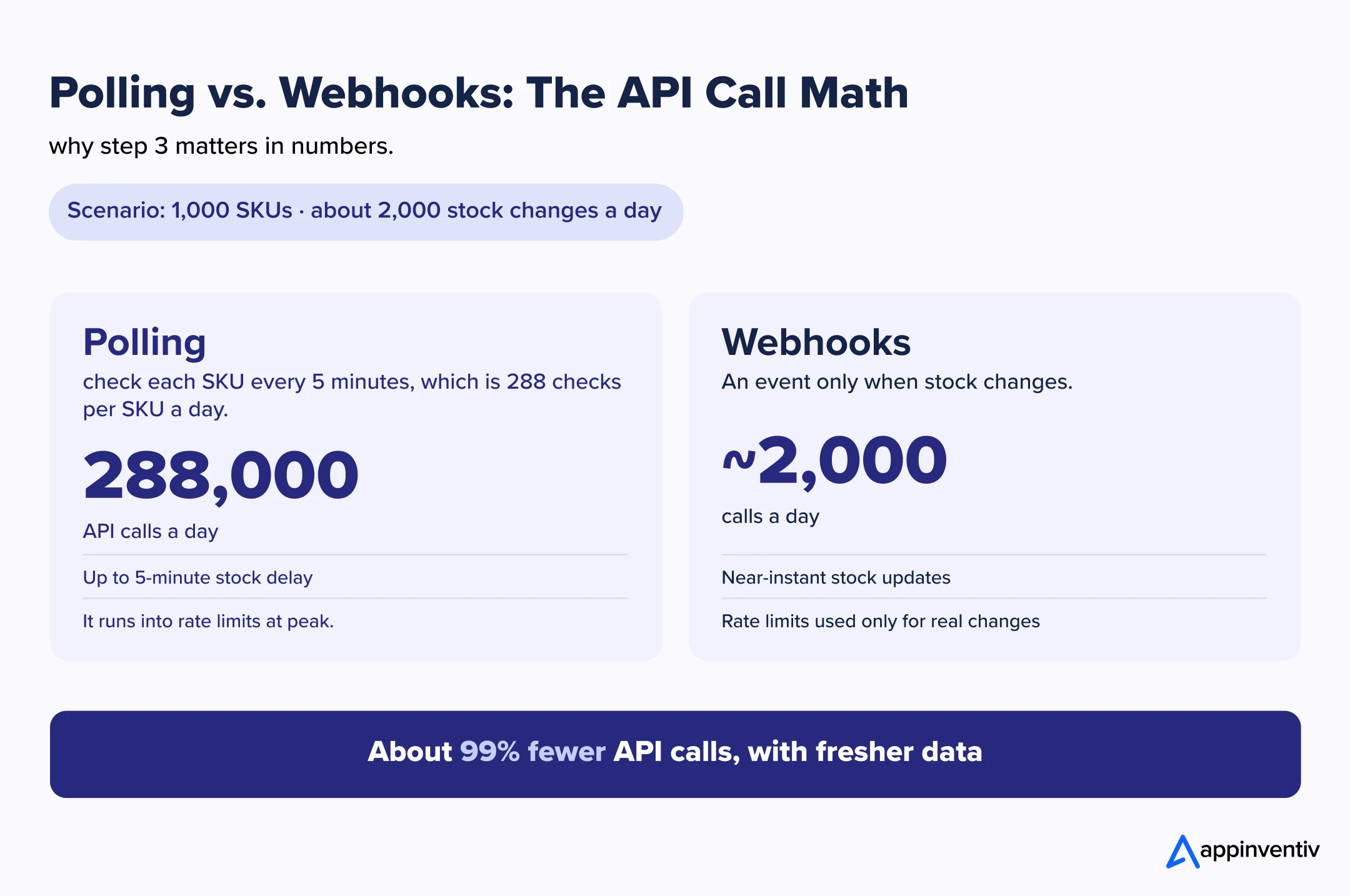
Step 3: Choose Webhooks First and Polling Only as a Fallback
Use webhooks for orders, payments and stock, and keep a scheduled reconciliation job to catch missed events. Give every write an idempotency key, a unique ID that lets the receiving system ignore duplicates when a webhook retries.
Decision to make: the maximum delay each flow can tolerate.
Step 4: Secure Access With Scoped, Rotating Credentials
Use OAuth 2.0 where the platform supports it and request only the scopes each flow needs, since loose permissions are among the most common API security risks. Store tokens in a Secrets Manager, never in code or config files, and rotate them on a schedule. Keep sandbox and production credentials separate so a test run can never touch live orders.
Decision to make: who owns credential rotation after launch.
Step 5: Map, Normalize and Test Against Failure
Map fields between systems, then normalize units, currencies, time zones, and SKU formats so “prod_ID” in one system matches “productId” in another. Test failure cases, not just happy paths: a webhook that arrives twice, an order that lands before its customer record, a carrier API that times out.
Decision to make: what the system does when a call fails mid-order.
Step 6: Roll Out in Phases and Watch for Drift
Launch one flow or one channel first, compare its numbers against the old process for two to four weeks, then expand. Monitor latency, error rate and retry volume and record mismatches between systems, alerting on drift and outages.
Decision to make: the mismatch rate that triggers a rollback.
The eCommerce Platform API Integration Challenges Most Teams Underestimate
The eCommerce platform API integration challenges that hurt most are rarely in the project plan. Duplicate and out-of-order events, peak-sale rate limits, silent field-mapping drift, legacy batch windows and vendor deprecations cause most production incidents, and each one has a known fix.
| Challenge | What Goes Wrong | How We Fix It |
|---|---|---|
| Out-of-order and duplicate webhooks | A refund lands before its order, or one order is created twice | Idempotency keys, event timestamps and a dead-letter queue for failed events |
| Rate limits at peak sales | The integration throttles exactly when order volume peaks | Queues, exponential backoff, cost-aware GraphQL queries and pre-sale load tests |
| Field-mapping drift | A vendor renames a field, and data quietly goes missing | Schema validation on every payload and contract tests in CI |
| Legacy ERP batch windows | The ERP accepts updates every few hours, so stock goes stale | A caching layer that holds reservations until the batch posts |
| Vendor deprecations | An API version retires, and the connector stops working | A version calendar per provider and quarterly upgrade sprints |
The assumption worth challenging is that integration is a project with an end date. It behaves more like a product with a release cycle, because every connected vendor ships changes on its own schedule. MuleSoft’s 2025 benchmark found 95% of organizations struggle to integrate AI into existing processes, and brittle point-to-point plumbing is a common root cause.
See how Appinventiv handled a US retailer’s legacy modernization without disrupting live operations.
Security and Compliance Rules for Payment and Customer Data
Every integration that carries card or customer data extends your compliance scope, so security design belongs in step one, not in the audit. Three frameworks apply to most global retailers: PCI DSS v4.0.1 for payments, GDPR for EU customers, and US state privacy laws.
- PCI DSS v4.0.1: Its future-dated requirements became mandatory on March 31, 2025, including tighter control of payment page scripts. Tokenization during payment gateway integration keeps raw card numbers out of your systems and shrinks audit scope.
- GDPR: Pass only the personal data each flow needs, log who accessed it, and route deletion requests to every connected system, not just the storefront.
A connector that copies full customer records into a marketing tool can quietly double your breach exposure. Ask your team which integrations move personal data and whether each one needs all of it, then pair the answer with your eCommerce fraud prevention controls.
What eCommerce API Integration Cost and Timelines Look Like
eCommerce API integration costs typically range from $40,000 for a focused integration on a modern platform to $400,000+ for a custom integration layer spanning ERP, marketplaces and headless channels. Timelines range from three weeks to nine months.
| Scope | Example | Indicative Cost | Timeline | Main Cost Drivers |
|---|---|---|---|---|
| Simple | Payment gateway, shipping carrier or marketplace connector on a modern platform | $40,000 to $80,000 | 3 to 8 weeks | Testing, edge cases, certification |
| Mid-level | Storefront to ERP and OMS with two-way inventory and order sync | $80,000 to $200,000 | 2 to 5 months | Data mapping, legacy protocols, ownership rules |
| Complex | Custom layer across ERP, WMS, marketplaces and headless channels | $200,000 to $400,000+ | 5 to 9 months | Event architecture, volume, compliance, observability |
After launch, plan a separate yearly budget for monitoring, version upgrades and new connectors, because vendor APIs keep changing.
These ranges are indicative and assume a blended global delivery team. Two costs hide outside most build quotes.
- The first is data cleanup, since mismatched SKUs and duplicate customers must be corrected before any sync can work.
- The second is yearly upkeep; ask any partner to price both, and treat a quote that leaves them out as incomplete.
For broader budgeting, weigh these figures against your ERP implementation costs, since the ERP side often needs work as well.
Also Read: Cost to Build an eCommerce App: Breaking Down Based on Complexity, Types, and More
Is Your Integration Layer Ready for Agentic Commerce?
AI shopping agents buy through APIs, not through your homepage. An agent that compares products, checks stock and places an order for a shopper needs real-time inventory, structured product data and a checkout it can call. Hence, the integration layer you build now decides whether agents can sell your catalog at all.
| Question to Ask Your Team | 0 Points | 1 Point | 2 Points |
|---|---|---|---|
| Does every object have one named system of record? | No | Partly | Yes, documented |
| How old is the stock figure a shopper sees? | Hours | Minutes | Seconds |
| Do order and payment flows run on webhooks with idempotency? | No | Some flows | All flows |
| Can a new channel connect without new point-to-point code? | No | With effort | Yes, through a shared layer |
| Do you alert on data drift, not only outages? | No | Manual checks | Automated alerts |
Score 8 to 10 and your stack is ready for agent traffic. Score 4 to 7 and fix the lowest-scoring row first. Below 4, an agentic pilot will expose data problems before it earns revenue. Our guide to agentic commerce covers what comes after the plumbing.
Retailers with real-time, agent-readable APIs will capture agent-led orders first. Find out where your integration layer stands today.

How Appinventiv Approaches eCommerce Integration
As an eCommerce development company, Appinventiv begins integration work with the data ownership map rather than the connector list. Across nine years and 30+ retailers and brands, one pattern holds: projects that settle ownership and sync rules first ship faster and break less at peak.
| What We Bring | Figure |
|---|---|
| eCommerce platforms delivered | 400+ |
| Commerce integrations across ERP, CRM, payments, OMS and logistics | 50+ |
| Payment gateway partnerships | 25+ |
| SLA on transaction reliability | 99.5% |
| Client satisfaction rate | 96% |
For The Body Shop, our headless commerce build unified the website, app, loyalty program and inventory, driving 10 million new users in 12 months, 55% faster page loads and 70% less manual effort.
For IKEA, our custom ERP platform connects onboarding, promotions and in-store operations across seven-plus stores. When standard flows and few channels make an iPaaS subscription the better answer, we say so.
Disconnected systems behave like an airport where every airline runs its own departure board. Start by asking your team to map who owns SKUs, prices, stock, and orders, and where two systems claim the same record. That map shows where your Silo Surcharge is highest and where eCommerce API integration should start, and we are glad to review it with you.
Let’s connect to find where disconnected systems are leaking revenue today.
FAQs
Q. What are eCommerce APIs and what benefits do they offer?
A. eCommerce APIs are protocols and tools that let your store share data with payment gateways, customer relationship management (CRM), inventory and shipping systems. Real-time data sharing enables centralized management of inventory, orders, and customer data, supporting multi-channel selling, scalability, and improved efficiency. Well-documented APIs also add expanded functionality, enhanced security and an improved customer experience without building every feature from scratch.
Q. How much does eCommerce API integration cost?
A. Most eCommerce API integration projects cost between $40,000 and $400,000+. A focused connector, such as a payment gateway or shipping carrier, costs $40,000 to $80,000. Two-way ERP and OMS sync runs $80,000 to $200,000, and a custom layer across many channels reaches $200,000 to $400,000+. Budget separately for data cleanup and yearly upkeep, since both usually sit outside the build quote.
Q. How is B2B eCommerce API integration different from B2C?
A. B2B eCommerce API integration handles objects most B2C stacks never touch: account-specific contract pricing, quote approvals, purchase orders, credit limits and punch-out catalogs linked to buyers’ procurement systems. The ERP usually owns these rules, so B2B projects depend more on the depth of ERP integration than B2C projects do. Plan these flows with the ERP and finance teams before any storefront work starts.
Q. How do you keep payment gateway API integrations PCI DSS compliant?
A. Use the gateway’s tokenization or hosted payment fields so raw card numbers never touch your servers, which shrinks your PCI DSS v4.0.1 scope considerably. Then protect payment page scripts, as the 2025 requirements demand, enforce TLS on every call, limit credential scopes and keep audit logs of every payment event. Review the setup each year, since gateway updates can quietly widen your compliance scope.
Q. How do you maintain and monitor eCommerce API integrations over time?
A. Treat logging and monitoring as permanent work. Track API logs and API response codes to catch API integration failures early, and subscribe to security alerts so API updates and deprecated protocols never surprise you. Run performance, functional, regression, and security testing in a test environment before each release to expose environment-specific issues. Regular security audits keep your security protocols up to date as vendors change.
Q. How do you choose the right eCommerce APIs for your business?
A. Start with required functionality and technical requirements, then check compatibility with your stack and scalability for peak traffic. Look for security best practices such as strong authentication, payment gateway support for your markets and compliance with local regulations. Weigh customization against ease of use, compare initial and hidden costs, and use a free trial period to test the API before you commit.
Q. What best practices keep eCommerce API integrations reliable?
A. Review documentation before building and design around your business logic, not the vendor’s defaults. Use a consistent data format, robust error handling, retry mechanisms and fallback mechanisms, and test failure scenarios on purpose. Comprehensive logging and monitoring, along with performance monitoring, catch problems early, while data recovery mechanisms restore lost records. Plan for versioning and updates, and schedule regular security audits.


Fast 2-minute response, fully NDA-protected.

eCommerce Integration: Connecting ERP, CRM, PIM, and Other Core Business Systems
Key takeaways: Centralized eCommerce architecture distributes accurate product data simultaneously across all your global sales channels. ERP, CRM, PIM, OMS, POS, etc. are the core integration types forming your eCommerce architecture. Security and compliance must anchor your payment architecture when operating across multiple regulatory jurisdictions. The cost of eCommerce platform integration ranges between $40,000 and…

Why Australian Retailers Are Investing in Unified Commerce Platforms in 2026
Key takeaways: Unified commerce platform development in Australia is now central to peak trading resilience, not a discretionary upgrade. The Australian unified commerce opportunity is valued at AUD 44 billion, with early adopters seeing revenue growth of 20% or more. Real-time inventory and customer data are prerequisites for reliable AI deployment in retail. Addressing governance…

How Much Does It Cost to Build a Fashion Marketplace App Like Depop in the UK?
Key takeaways: A Depop-style fashion marketplace in the UK usually costs £32,000 to £320,000, depending on how simple or advanced you want the app to be. The UK’s resale-fashion scene is growing quickly, so demand for social, pre-loved fashion apps is only going up. Costs increase when you add things like AI recommendations, logistics integrations,…