


































Agentic Commerce Development: Architecture, AI Agents, and 20–40% Faster Conversion Workflows

 Share -



- 01Step-by-Step Agentic Commerce Development Process
- 02Architecture & Core Components of Agentic Commerce Systems
- 03How AI Agents Drive 20–40% Faster Conversion Workflows
- 04Use Cases of Agentic Commerce
- 05Integration with Existing Enterprise Commerce Ecosystems
- 06Governance, Security, and Compliance in Agentic Commerce
- 07Payments and Fraud Prevention in Agentic Commerce
- 08Challenges Enterprises Must Solve
- 09Cost of Developing Agentic Commerce Systems
- 10Future of Agentic Commerce
- 11Why Choose Appinventiv for Agentic Commerce Development?
- 12Frequently Asked Questions

Key takeaways:
- Agentic commerce replaces static workflows with real-time decision systems, reducing friction and accelerating conversions across complex enterprise customer journeys.
- Multi-agent architectures enable faster discovery, dynamic pricing, and automated checkout, driving measurable improvements in conversion speed and revenue outcomes.
- Enterprise success depends on strong data foundations, API-driven integration, and orchestration layers that support real-time, cross-system decision execution.
- Early adoption creates a competitive edge, as agent-driven systems increasingly control discovery, pricing, and purchase decisions across digital commerce channels.
- Scaling agentic commerce requires balancing speed with governance to ensure secure, compliant, and traceable decision-making across autonomous workflows.
Enterprises investing in agentic commerce development spend heavily on personalization. Product recommendations improve. Campaign targeting gets sharper. Yet conversion rates often stall. The problem is how decisions happen. Most commerce systems still follow fixed rules and pre-built funnels. Customer intent does not stay fixed. It shifts with context, timing, and need.
This gap slows everything down. A user searches, compares, hesitates, and drops off. Systems react after the fact. They do not act at the moment.
A new model is taking shape, driven by ecommerce AI agents development. Commerce is moving from reactive systems to autonomous decisioning. Instead of waiting for user input at each step, AI agents take part in the journey. They read context, evaluate options, and act in real time.
These agents can:
- Understand user behavior and intent
- Make decisions across pricing, recommendations, and checkout
- Execute actions without manual triggers
At the core sits a simple loop. Perception leads to reasoning. Reasoning drives action. Each action feeds learning.
This shift changes how conversions happen. It reduces delay, removes friction, and moves users from intent to purchase faster.
Recent estimates suggest agentic commerce could drive between $3 trillion and $5 trillion in global revenue by 2030. At the same time, nearly half of online shoppers are expected to rely on AI agents for part of their purchase journey.
The blog breaks this down in detail. They explain how to build agentic commerce systems, how AI agents operate, and how enterprises can deploy them to increase conversion rates by 20 to 40 percent.
Nearly half of shoppers will rely on AI agents for purchase decisions, shifting control away from traditional funnels.

Step-by-Step Agentic Commerce Development Process
Enterprises are pushing toward agentic commerce for a clear reason. Customer journeys now span web, mobile, marketplaces, voice, and chat. Each channel adds delay and drop-off. At the same time, customer expectations rise. Users expect instant answers, relevant offers, and quick checkout.
This creates pressure on decision speed. Static workflows cannot keep up. Customer acquisition costs rise. Abandonment rates stay high.
Agentic systems address this by shifting decision-making into real time. They reduce friction at each step. They automate key actions. They compress the path from intent to purchase. This is where the 20 to 40 percent faster conversion cycles come from.
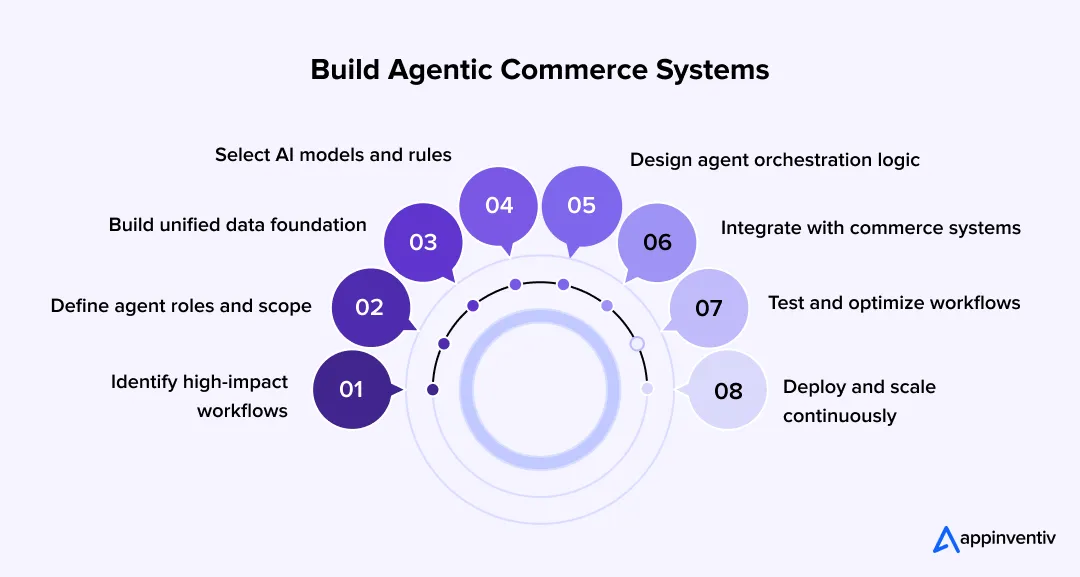
Below is how to build agentic commerce systems in practice.
Step 1: Identify High-Impact Commerce Workflows
Start with workflows that directly affect revenue and drop-offs. Understanding common ecommerce customer pain points helps prioritize where agents will create the most impact.
Focus areas:
- Checkout flows with multi-step validation and payment friction
- Product discovery across large catalogs with weak filtering
- Pricing and promotion logic that does not adapt in real time
- Cart recovery where follow-ups rely on static rules
Map each workflow into:
- Entry point
- Decision points
- Exit or drop-off points
Then measure:
- Time spent per step
- Abandonment rate
- Conversion lag
This baseline defines where agents will create the most impact.
Step 2: Define Agent Roles and Responsibilities
Deploying AI agents in an enterprise starts with clear role separation. Each agent must have a defined goal and action scope.
Core agent types:
- Customer-facing agents
- Guide product discovery
- Answer queries using product and policy data
- Adjust recommendations based on live behavior
- Backend agents
- Update pricing based on demand signals
- Manage inventory visibility
- Trigger recommendations using user context and catalog data
- Transaction agents
- Handle checkout steps
- Select payment methods
- Apply discounts, taxes, and shipping logic
Each agent operates with:
- Defined inputs
- Action boundaries
- Access to specific tools or APIs
This avoids overlap and reduces the risk of conflicting decisions.
Step 3: Build Data and Context Foundation
Agents depend on accurate and fast data access. A fragmented data layer breaks decision quality.
Core data setup includes:
- Customer data platform (CDP)
- Unifies user identity across channels
- Stores attributes such as preferences, history, and segmentation
- Behavioral data
- Clickstreams
- Session events
- Search queries
- Transactional data
- Orders
- Payments
- Returns
- Real-time event streams
- Kafka or similar systems to process live events
- Event triggers such as cart updates or price changes
Add a context layer:
- Session memory for short-term decisions
- Historical memory for long-term patterns
Agents query this layer before every action.
Step 4: Select AI Models and Decision Systems
Agent decisions rely on a mix of models. No single model handles all tasks.
Typical stack:
- Large language models
- Interpret user queries
- Plan actions
- Generate responses
- Machine learning in ecommerce models
- Predict purchase probability
- Rank products
- Estimate price sensitivity
- Rules engine
- Enforce constraints such as pricing limits or compliance rules
Combine them into a decision pipeline:
- LLM interprets intent
- ML models score options
- Rules validate the final action
This hybrid setup improves control and accuracy.
Step 5: Develop Agent Orchestration Logic
Single agents handle narrow tasks. Real systems require coordination across agents.
Orchestration layer handles:
- Task breakdown
- Agent selection
- Execution order
Common patterns:
- Planner-executor model
- Planner agent creates a task sequence
- Executor agents perform each task
- Event-driven triggers
- Agents activate based on events such as cart updates or search queries
- Shared context bus
- Agents exchange state through a central memory layer
Each agent connects to tools:
- Product catalog APIs
- Pricing engines
- Payment gateways
The orchestration layer manages these tool calls and resolves conflicts.
Step 6: Integrate with Commerce Stack
Agents must connect with existing systems. This requires clean API access.
Core integrations:
- Catalog systems
- Product data
- Attributes
- Availability
- Pricing engines
- Dynamic pricing rules
- Discount logic
- Inventory systems
- Stock levels
- Fulfillment options
- Payment systems
- Gateways
- Fraud checks
- Tokenized payments
Use:
- REST or GraphQL APIs
- Middleware for orchestration
- Event-driven updates for real-time sync
Legacy systems often need API wrappers to enable agent access.
Step 7: Test, Simulate, and Optimize
Agent behavior must be tested before full deployment.
Testing methods:
- Simulation environments
- Replay user sessions
- Test agent responses under different scenarios
- A/B testing
- Compare agent-driven flows with existing flows
- Measure conversion lift
- Offline evaluation
- Validate model outputs against historical data
This stage relies heavily on ecommerce analytics to track:
- Conversion rate
- Time to purchase
- Drop-off reduction
This stage identifies weak decision paths and improves agent logic.
Step 8: Deploy and Continuously Improve
Deployment does not end development. Agents require constant tuning.
Monitor key metrics:
- Conversion rate per workflow
- Latency of decisions
- Cost per interaction or inference
Set up feedback loops:
- Capture user responses
- Feed outcomes back into models
- Update decision rules
Introduce:
- Incremental rollouts
- Region-based deployments
- Feature flags for agent actions
This allows controlled scaling without risking core revenue flows. Working with the right team matters here, and knowing how to hire an AI agent company can make the difference between a smooth rollout and a stalled one.”
This step-by-step process shows how to build agentic commerce from a concept into a working system. The next section breaks down the architecture and core components that support these agents at scale.
Architecture & Core Components of Agentic Commerce Systems
Agentic ecommerce architecture operates on a layered system in which each layer handles a specific function. The goal is simple. Reduce decision time and execute actions without delay. This requires tight coordination between agents, data, and enterprise systems.
Below is a breakdown of how these systems are structured in production environments.
High-Level Architecture Layers
Each layer handles a specific part of the system, from user interaction to decision execution and control.
Experience Layer
This is where users interact with the system, and where the AI shopping assistant architecture begins.
Channels include:
- Web storefronts
- Mobile apps
- Voice assistants
- Conversational commerce platforms and AI chatbots for ecommerce interfaces
Each interface streams user actions as events. These events include clicks, searches, scroll depth, and cart updates. The system sends these events to the orchestration layer with minimal delay.
Low latency matters here. A delay of even 200–300 milliseconds can reduce interaction quality. This layer must support real-time event capture and session tracking.
Agent Layer
This layer contains task-specific AI ecommerce agents. Each operates with a defined goal and limited scope.
Examples:
- Discovery agents
- Interpret search intent
- Rank products using context and past behavior
- Pricing agents
- Adjust prices using demand signals, inventory levels, and user segments
- Checkout agents
- Handle address validation
- Select payment methods
- Apply offers and taxes
Agents do not operate in isolation. They share context and act in sequence or in parallel, depending on the workflow.
Each agent includes:
- Input parser
- Decision logic
- Action executor
Orchestration Layer
This layer manages how agents work together.
Core functions:
- Break down tasks into smaller actions
- Assign tasks to the right agents
- Manage execution order
Two common patterns:
- Hierarchical agents
- A central planner agent defines the workflow
- Worker agents execute each step
- Event-driven agents
- Agents activate based on triggers such as cart updates or product views
The orchestration engine maintains a shared state. It tracks what has been done and what comes next. This avoids duplicate actions and conflicting decisions.
It also handles retries and fallback logic when an agent fails.
Intelligence Layer
This layer powers decision-making.
It combines three systems:
- Large language models, which are central to generative AI in ecommerce
- Parse user intent
- Generate action plans
- Handle conversational commerce AI queries
- Machine learning models
- Predict conversion probability
- Rank products
- Estimate price sensitivity
- Decision engines
- Apply constraints such as pricing limits, discount rules, and compliance policies
A typical flow:
- LLM interprets the request
- ML models score possible actions
- The decision engine validates the final output
This layered decision flow improves reliability and control.
Data and Memory Layer
Agents rely on both real-time and historical data.
Two types of memory are required:
- Short-term memory
- Session-level context
- Current cart state
- Recent interactions
- Long-term memory
- Purchase history
- Preferences
- Lifetime value
Data systems include:
- Vector databases power semantic search and retrieval, a capability also central to agentic RAG in ecommerce where agents retrieve context dynamically before making decisions.
- Transactional databases for orders and payments
- Event streams for real-time updates
Agents query this layer before making decisions. Fast retrieval is critical. Latency above 100 milliseconds can affect real-time execution.
Integration Layer
This layer connects agents to enterprise systems.
Key integrations:
- ERP systems for order and finance data
- CRM systems for customer profiles
- Supply chain systems for inventory and fulfillment
- Payment gateways for transaction processing
APIs expose these systems to agents.
Common patterns:
- REST or GraphQL APIs for synchronous access
- Event-driven pipelines for real-time updates
- Middleware to manage data transformation
Legacy systems often lack direct API access. In such cases, wrapper services expose required endpoints.
Governance Layer
Autonomous systems require strict control.
This layer enforces:
- Security
- Authentication and access control
- Data encryption
- Compliance
- Data handling policies
- Payment regulations
- Explainability
- Decision logs
- Action traceability
Each agent action must be recorded. This creates an audit trail for debugging and compliance checks.
Policy engines sit here. They block actions that violate business rules or regulatory constraints.
Core Components Breakdown
Beyond layers, a few core components define system behavior.
- AI Agents (Goal-Driven Execution)
Each agent operates with a defined objective. It receives input, processes context, and executes actions through APIs. - Context Engines (Real-Time Personalization)
These engines aggregate session, historical, and external signals, functioning as AI personalization agents that provide a unified runtime context. - Decision Systems (AI + Rules Hybrid)
They combine probabilistic outputs from models with deterministic rules. This balance prevents unsafe or invalid actions. - Tooling Layer (API Execution)
Agents interact with systems through tools. These include APIs for catalog access, pricing updates, and payment processing. - Feedback Systems (Learning Loops)
Every action generates feedback. Systems capture outcomes such as conversions, failures, or delays. This data feeds back into models and rules for continuous improvement.
This architecture supports real-time decisioning at scale. It allows agents to act quickly and with control across complex commerce environments. The next section explains how these systems connect with existing enterprise commerce ecosystems.
How AI Agents Drive 20–40% Faster Conversion Workflows
Ecommerce AI agents development shows that faster conversion does not come from a single feature. It comes from removing delays at each step of the journey. Early multi-agent commerce systems have already shown up to a 30% increase in conversion rates for complex purchase journeys where decision time is usually longer.
AI agents for ecommerce workflows act at the moment of intent. They reduce back-and-forth, cut manual steps, and complete actions in real time.
Discovery → Decision Compression
Users often spend time searching, filtering, and comparing. This creates friction early in the journey.
AI agents for ecommerce conversion optimization reduce this gap by:
- Interpreting intent from search, clicks, and session behavior
- Ranking products using real-time context and history
- Updating results as user behavior changes
Impact:
- Time saved: Fewer search and filter steps
- Drop-offs reduced: Less fatigue during discovery
- Conversion uplift: Faster movement from search to selection
Dynamic Bundling and Pricing
Static pricing and fixed bundles limit flexibility. Users leave when offers do not match their needs.
AI sales automation agents respond in real time by:
- Creating bundles based on cart contents and preferences
- Adjusting prices within defined limits
- Applying discounts based on user value or urgency
Impact:
- Time saved: No need for manual offer comparison
- Drop-offs reduced: Relevant offers at the right moment
- Conversion uplift: Higher cart value and acceptance rate
Autonomous Checkout Execution
Autonomous commerce workflows, such as checkout, often include multiple steps where address entry, payment selection, and validation slow users down.
Agents handle this flow by:
- Auto-filling details using stored data
- Selecting the best payment method based on the success rate
- Applying taxes, shipping, and discounts in one step
Impact:
- Time saved: Fewer manual inputs
- Drop-offs reduced: Lower checkout friction
- Conversion uplift: Higher completion rates
Cross-Channel Continuity
Users switch between devices and channels. Context often gets lost, which resets the journey.
Agents maintain continuity by:
- Syncing session data across web, mobile, and other interfaces
- Preserving cart state and preferences
- Resuming workflows without repeating steps
Impact:
- Time saved: No need to restart sessions
- Drop-offs reduced: Fewer interruptions
- Conversion uplift: Higher return-to-cart completion
Post-Purchase Optimization
The journey does not end after checkout. AI ecommerce automation ensures missed follow-ups no longer reduce lifetime value.
Agents extend the process by:
- Triggering upsell offers based on purchase history
- Automating reorders using usage patterns
- Sending timely reminders and recommendations
Impact:
- Time saved: Automated repeat actions
- Drop-offs reduced: Better retention
- Conversion uplift: Increased repeat purchases
Use Cases of Agentic Commerce
Most companies are still in transition. The broader shift in AI for ecommerce has moved from assisting decision-making to full agent-driven execution, which is just starting to appear in controlled environments. The shift is visible in how workflows are changing.
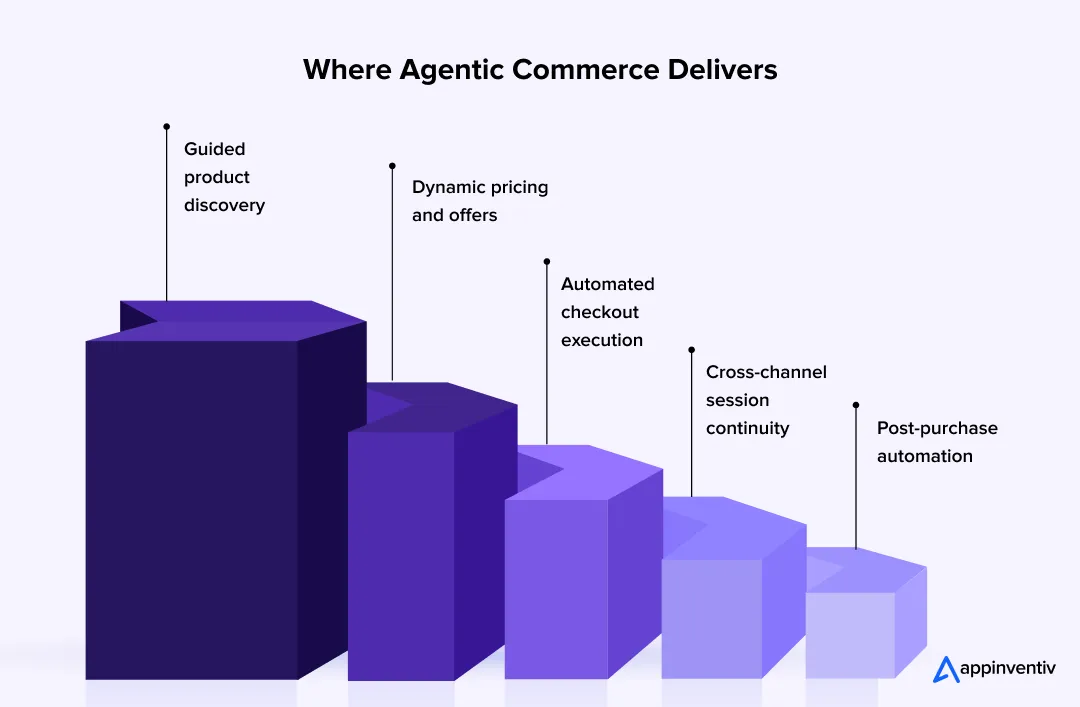
Guided Product Discovery
Large retailers now use AI-powered shopping assistants to narrow choices based on user intent. Instead of browsing dozens of pages, users get a short list that updates in real time.
What is changing:
- Fewer search steps
- Faster product selection
- Less reliance on filters
Agents are starting to take this further by preparing the next action rather than just showing options.
Dynamic Pricing and Offers
Pricing systems already react to demand and inventory. The next step is user-level adjustment during a session.
What is changing:
- Offers adapt while the user is active
- Bundles form based on cart behavior
- Discounts apply at the right moment
This reduces hesitation during decision-making.
Checkout Execution
Checkout remains one of the biggest drop-off points. AI systems now reduce manual steps by filling in details and selecting payment options.
What is changing:
- Fewer fields and steps
- Faster payment selection
- Lower failure rates
Early agent systems are beginning to complete parts of checkout within set limits.
Cross-Channel Continuity
Users switch devices often. Sessions break, and carts get lost.
What is changing:
- Sessions carry across devices
- Cart state remains intact
- Users’ resumes without restarting
Agents maintain this continuity in the background.
Post-Purchase Actions
After a purchase, most systems rely on scheduled campaigns. This creates delays.
What is changing:
- Reorders trigger based on usage
- Upsell offers align with past behavior
- Follow-ups happen closer to the event
These use cases show a clear pattern. Systems are moving from assisting decisions to acting on them.
Fragmented data and disconnected systems stop AI agents from scaling. We build the data and integration foundation they need to act in real time.

Integration with Existing Enterprise Commerce Ecosystems
Autonomous ecommerce workflow systems work best when they extend existing platforms rather than replace them. Most enterprises already run complex stacks. Integration must connect agents with these systems without breaking core operations.
Headless Commerce Alignment
Headless architectures, a core part of modern ecommerce app development, separate frontend and backend systems and allow agents to operate through APIs without changing user interfaces.
- Agents plug into the backend services
- Frontend experiences remain unchanged
- Faster rollout across channels
API-First Integration Strategy
Agents depend on direct system access. Clean APIs are required for real-time execution.
- Expose catalog, pricing, and inventory through APIs
- Provide secure endpoints for payments and transactions
- Maintain low latency for critical calls
Compatibility with Core Systems
Agents must work across existing enterprise platforms.
- CDPs: Access unified customer profiles and behavior
- Payment gateways: Execute transactions and fraud checks
- Supply chain systems: Fetch inventory, delivery timelines, and fulfillment options
Legacy Modernization Approach
Many enterprises still rely on older systems that lack modern interfaces.
- Wrapper APIs expose legacy functions as services
- Event-driven systems push updates in real time
- Gradual rollout reduces disruption to existing workflows
Strong integration allows agents to act across systems without delay. This is what enables real-time decisioning and faster conversions at scale.
Governance, Security, and Compliance in Agentic Commerce
Agentic commerce systems act autonomously. They read data, make decisions, and execute actions in real time. This speed improves conversions, but it creates new failure points. A wrong decision can affect pricing, payments, or customer trust within seconds.
Enterprises need strong control layers before scaling these systems. Governance must run with every agent action, not after it.
Key Risks
These risks appear when agents act across systems without strict boundaries.
- Autonomous decision errors
- Incorrect price updates
- Wrong product recommendations
- Failed or duplicated checkout steps
- Data privacy concerns
- Customer data moving across multiple systems
- Exposure during real-time processing
- Unauthorized actions
- Agents triggering discounts or transactions outside limits
- Access to systems beyond the assigned scope
Governance Mechanisms
Controls must be built into the execution flow. Each action should undergo validation before reaching external systems.
- Human-in-the-loop approvals
- Applied to high-value actions such as large discounts or bulk orders
- Used during early deployment to verify agent behavior
- Policy-based constraints
- Rules for pricing, discount caps, and transaction limits
- Every action is checked before execution
- Role-based access control
- Each agent gets access only to the required tools and data
- Limits system exposure and reduces risk
Compliance Requirements
Compliance depends on how data is stored, processed, and shared across systems. Agentic systems must follow the same standards as core platforms.
- GDPR: User consent and controlled data usage
- PCI-DSS: Secure handling of payment data and transactions
- Regional data laws: Data storage and processing based on location
Data must be encrypted in transit and at rest. All access must be logged and monitored.
Explainability and Auditability
Enterprises need clear visibility into decision-making. This is required for audits, debugging, and internal trust.
- Decision logs
- Record inputs, context, and final actions
- Audit trails
- Track each step taken by agents across systems
- Transparent outputs
- Show reasoning behind decisions and data used
These layers allow systems to act quickly while maintaining control.
Payments and Fraud Prevention in Agentic Commerce
Agentic systems do not just recommend. They complete transactions. This shifts payments from a final step to an active part of the decision-making process. Each transaction must be fast, accurate, and risk-aware.
Payment Execution Inside Agent Workflows
Agents handle payments as part of the flow, not as a separate stage.
- Tokenized payments replace raw card data during transactions
- Shared payment tokens support repeat purchases without re-entry
- Accelerated wallets reduce checkout steps
Agents choose payment methods based on:
- Historical success rates
- User preference
- Transaction context
For high-value transactions, approval steps can be triggered before execution.
Real-Time Fraud Detection During Transactions
Fraud checks must run alongside agent decisions, not after them.
- Fraud signals include device data, location mismatch, and behavior patterns
- AI models score each transaction before it is processed
- Risk thresholds decide whether to approve, block, or escalate
Platforms such as Stripe apply real-time fraud scoring at checkout using machine-learning systems like Stripe Radar.
Why This Layer Is Critical
Agents reduce the time between intent and payment. This also reduces the window for manual checks. Fraud detection must operate at the same speed as execution.
Strong payment design allows systems to stay fast without increasing risk.
Challenges Enterprises Must Solve
Agentic commerce systems depend on clean data, fast processing, and tight system coordination. This gap is already visible in the market. Around 71% of merchants report little to no measurable impact from AI investments, often linked to fragmented data and disconnected systems.
Most enterprises do not start from this state. Adopting AI automation for ecommerce operations means existing systems, teams, and workflows must be realigned. These challenges must be addressed before scaling agent-based decisioning.
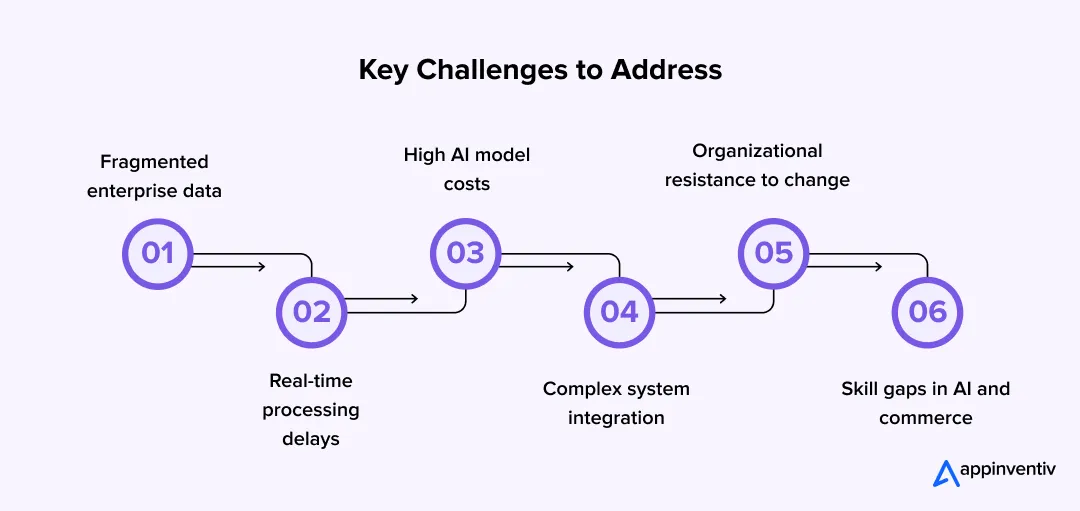
Data Fragmentation Across Systems
Data often sits in separate systems. Customer, product, and transaction data do not align in real time. This breaks context for agents.
Solutions:
- Build a unified data layer using a CDP
- Stream events from all channels into a central pipeline
- Standardize data formats across systems
Real-Time Processing Latency
Agent decisions require fast responses. Delays in data access or model execution slow down workflows and affect conversions.
Solutions:
- Use event-driven systems for real-time updates
- Deploy low-latency APIs for critical services
- Process time-sensitive decisions closer to the user with edge nodes
High LLM Inference Costs
Large models increase compute costs, especially at scale. Frequent calls during user sessions can drive up expenses.
Solutions:
- Route simple tasks to smaller models
- Cache frequent queries and responses
- Limit full model calls to high-impact decisions
Integration Complexity
Enterprises run multiple systems across commerce, payments, and supply chain. Connecting agents to all systems can be difficult.
Solutions:
- Use API gateways to manage access
- Introduce middleware for data transformation
- Extend systems through microservices instead of direct changes
Organizational Resistance
Teams accustomed to rule-based systems often resist change. Digital transformation in ecommerce has shown that moving to autonomous decisioning raises concerns around control and reliability that must be addressed early.
Solutions:
- Start with controlled pilot use cases
- Use approval layers for critical actions
- Share performance data to build trust
Skill Gaps in AI and Commerce
Building agent systems requires knowledge of AI, data engineering, and commerce platforms. Many teams lack this mix.
Solutions:
- Train internal teams on agent workflows and data systems
- Hire specialists for key roles
- Work with experienced partners offering AI consulting services for faster deployment
Addressing these challenges early reduces risk and improves system performance. The next section breaks down the cost of agentic commerce development at scale.
Cost of Developing Agentic Commerce Systems
Understanding how to build agentic commerce systems starts with scoping cost, data readiness, and system complexity. A small pilot focuses on one or two workflows, like checkout or product discovery. Larger deployments cover multiple agents, real-time data pipelines, and full system integration.
Below is a simple breakdown of the AI agent development cost based on typical enterprise projects.
| Stage | Scope Description | Estimated Cost |
|---|---|---|
| Pilot / MVP | Single workflow, limited agents, basic integrations | $50,000 – $120,000 |
| Mid-scale Deployment | Multiple workflows, multi-agent setup, core integrations | $120,000 – $250,000 |
| Enterprise-wide Implementation | Full system rollout, advanced orchestration, real-time data pipelines | $250,000 – $500,000+ |
Conversion outcomes now depend on how fast systems act, not just how well they recommend or predict.

Future of Agentic Commerce
After working on large-scale AI systems and deploying agent-based solutions across industries, a clear pattern is emerging. Enterprises are moving beyond assisted experiences. Systems are starting to act as intelligent shopping assistants that decide and transact with minimal user input.
The next phase of commerce will focus on speed, autonomy, and continuous decision-making. Below are the shifts already taking shape.
Agent-to-Agent Commerce Ecosystems
Agents will not just interact with users. They will interact with other agents.
- Buyer agents negotiate with seller agents
- Pricing and offers adjust in real time
- Transactions are complete without manual steps
Autonomous Purchasing Systems
Repeat purchases and routine decisions will move to full automation.
- Agents reorder products based on usage patterns
- Subscriptions adjust based on demand and behavior
- Approval layers apply only to high-value transactions
Voice and Multimodal Commerce
Interfaces will expand beyond screens.
- Voice commands trigger discovery and purchase
- Visual inputs, such as images, guide product selection
- Agents combine inputs from text, voice, and behavior
AI-Native Marketplaces
Marketplaces will be built for agents, not just users.
- Listings structured for machine interpretation
- Real-time pricing and availability updates
- Faster matching between demand and supply
Also Read: How Agentic AI is Transforming Business Operations
Hyper-Personalized, Zero-Friction Journeys
User journeys will shrink from multiple steps to a few actions.
- Agents predict intent before explicit input
- Checkout steps reduce or disappear
- Decisions happen in the background
These changes point in one direction. Commerce systems will shift from guiding users to acting on their behalf.
Why Choose Appinventiv for Agentic Commerce Development?
Agentic commerce needs more than model integration. It needs systems that act in real time, connect across platforms, and stay within strict business rules. Execution quality decides outcomes.
Appinventiv builds agent-based systems for enterprise workflows, not isolated demos. Our approach to enterprise agentic AI focuses on developing scalable, secure, and well-governed systems that deliver measurable business results.
Experience in numbers:
- 100+ autonomous AI agents deployed
- 200+ data scientists and AI engineers
- 150+ custom AI models trained and deployed
- Work across 35+ industries
Business impact delivered:
- 50% reduction in manual processes
- 90%+ agent task accuracy
- 2x increase in system scalability
Appinventiv covers system design, AI agent development services, integration, and deployment. Each system includes control layers, audit trails, and performance tracking.
A focused consultation can map agentic commerce development to your current stack and identify the right starting workflows. Let’s connect and capture demand before it shifts away.
Frequently Asked Questions
Q. How do AI agents improve ecommerce conversions?
A. AI agents act at the moment of intent. They reduce search time, adjust offers in real time, and complete checkout steps automatically. They track user behavior, update recommendations, and remove delays across the journey. Fewer steps and faster decisions lead to higher completion rates and lower cart abandonment.
Q. What technologies are used in agentic commerce platforms?
A. Ecommerce AI agents development relies on large language models for reasoning, machine learning models for prediction, and rules engines for control. They connect through APIs to CRM, inventory, and payment systems. Event streaming tools, vector databases, and orchestration layers support real-time decisions and agent coordination.
Q. What are the benefits of agentic commerce systems?
A. They reduce friction across discovery, pricing, and checkout. This leads to faster conversions and fewer drop-offs. They increase average order value through dynamic offers and bundling. They also automate routine decisions, which improves efficiency and reduces manual effort across teams.
Q. How long does it take to develop an agentic commerce platform?
A. One workflow pilot can take 6 to 10 weeks. A mid-scale system with multiple agents may take 3 to 5 months to deploy. A full enterprise rollout can take 6 to 12 months. Timelines depend on data readiness, system complexity, and the scope of agentic commerce development.
Q. How can Appinventiv help build an agentic commerce platform?
A. Appinventiv designs and deploys solutions for teams looking to learn how to build agentic commerce systems tailored to enterprise workflows. This includes model development, system integration, and real-time orchestration. The team works with existing platforms and builds control layers for security and compliance. Engagement starts with identifying high-impact workflows and mapping them to a scalable architecture.


Fast 2-minute response, fully NDA-protected.

Retrieval Augmented Generation in Australia: Architecture, Implementation and Cost
Key takeaways: RAG grounds LLM answers in approved content, improving reliability without retraining a model. Data quality and access permissions decide production outcomes more than the model. Indicative build costs run from AUD 70,000 to 700,000, driven by data and integrations. Measure value against a pre-deployment baseline, separating realised benefits from projected savings. A general-purpose…
The Multiplier Effect of AI Agents: The Rise of AI Swarms
Key takeaways: AI agent swarms coordinate specialized agents to solve complex problems that may be difficult for a single agent to handle effectively. More agents do not automatically mean better outcomes. Swarms deliver value when work can be divided, executed in parallel, and coordinated toward a shared objective. Enterprise readiness depends on governance. Clear accountability,…

AI Data Integration: How to Connect, Clean and Prepare Data for AI
Key takeaways: AI initiatives fail when fragmented, poor-quality data reaches models without sufficient context, controls or ownership. AI-ready pipelines must connect, clean, enrich, govern and continuously monitor data across its lifecycle. Real-time processing matters when AI decisions depend on current transactions, events, inventory or operational conditions. Data architecture should follow the AI use case, balancing…