




































eCommerce Fraud Prevention: Best Practices, Strategies, and Future Trends

 Share -



- 01Introduction
- 02Understanding Today's eCommerce Fraud Threat Landscape
- 03Common Types of eCommerce Fraud
- 04Essential Challenges Business Organizations Encounter in Preventing Fraud
- 05Core Prevention Strategies for Enterprise eCommerce
- 06Best Practices to Avoid Fraud in the E-Commerce Industry
- 07Key Indicators and Red Flags To Look For
- 08Technologies Powering Modern eCommerce Fraud Prevention
- 09Building an Enterprise Fraud Prevention Framework
- 10Emerging Fraud Risks and Future Trends
- 11How Appinventiv Helps Enterprises Build Secure eCommerce Platforms
- 12Frequently Asked Questions

Key takeaways:
- Global eCommerce fraud losses are expected to exceed $107 billion by 2029.
- Digital growth, Buy Now Pay Later features, and rising automation are all opening up new avenues for fraudsters to exploit.
- First-party abuse and refund abuse have ended up being the greatest source of pain globally, affecting nearly half of all online merchants.
- Detecting fraud at enterprise scale these days involves utilizing AI-powered detection, aligning policies, and harmonizing everything in real time across your payment rails, CRM, and ERP systems.
- A phased 30/60/90-day plan, beginning with audits and gradually leading to full operations, provides organizations with a pragmatic means to effectively put fraud detection and governance in place.
- The eCommerce fraud prevention of the future will be about making AI-driven decisions transparent, data-sharing between industries, and being prepared for more stringent compliance under regimes such as PSD3 and DORA.
Introduction
The crisis of fraud management for eCommerce businesses is no longer a situation that can overlooked. Juniper Research cites a concerning trend: eCommerce fraud losses worldwide are projected to exceed $107 billion by 2029. Why? A perfect storm of digital growth acceleration, cross-border payments, and cybercriminals who quite frankly, are getting smarter at their jobs.
For business retailers, the threat environment has moved far beyond stolen credit cards or fake chargebacks. Businesses are now working with account takeovers, synthetic identities, and malicious bots that test payment systems for weaknesses.
With each innovation that the industry brings—whether it’s growing into international markets, implementing omnichannel shopping, or providing Buy Now, Pay Later—there are new chances for nefarious actors. And legacy infrastructure? It wasn’t even designed to handle this complexity.
But here’s the thing: the harm is deeper than mere monetary loss. When a breach occurs, your brand is damaged. Customer information is leaked. Regulatory fines mount up. Recovery can take years, not months.
And with regulations such as PCI DSS, PSD3, and GDPR bolstering their hold, businesses are caught in the dilemma of how to secure their business without making the checkout process feel like an interrogation.
The solution is found in what innovative companies are already doing— adopting AI-powered fraud detection software development that is compliance-oriented. These solutions gather risk information from all touchpoints, take milliseconds to decide, and continuously learn as threats evolve and change.
Today’s fraud management in eCommerce is no longer only about preventing losses. It’s about embedding resilience and trustworthiness into the very fabric of every transaction you process.
Fraud attacks are growing faster than most enterprise defenses. Close security gaps before they become costly.

Understanding Today’s eCommerce Fraud Threat Landscape
Enterprise fraud has become far more difficult to predict and control. The most common types of eCommerce fraud now range from account takeovers and credential stuffing to synthetic identities, refund abuse, and card-not-present (CNP) attacks. What used to be a payment problem now affects revenue, customer trust, and compliance.
First-Party Abuse Is Growing Fast
The 2025 Global Fraud Report found that first-party abuse, often called friendly fraud, is now the biggest fraud challenge for online merchants. Nearly half of merchants report refund or policy abuse, and 62% say the problem has increased over the past year.
That shift has forced many organizations to rethink fraud management for eCommerce businesses. The challenge is simple. Genuine customer complaints and intentional abuse often look almost identical.
New Risks Follow New Payment Methods
Buy Now Pay Later services, real-time payments, and advances in secure digital wallet development have made online purchases faster. They have also created new opportunities for fraud. Research shows that 82% of merchants introduced new payment methods in recent years, increasing pressure on existing controls.
This is one reason enterprises continue investing in eCommerce fraud prevention programs that can monitor activity across multiple channels and payment systems.
Fraud Is Costly Even When Transactions Are Blocked
Account takeover attacks remain a major concern, and synthetic identity fraud continues to challenge traditional verification processes. Many retailers now rely on advanced fraud detection solutions for eCommerce to spot unusual behavior before an order is approved.
The financial impact is substantial. Fraud costs merchants an estimated 3% of their annual eCommerce revenue. Another 6% of orders are declined over fraud concerns, yet Cybersource and MRC data show that 6% to 10% of those rejected orders are legitimate purchases.
This explains the growing focus on real-time fraud prevention for eCommerce and long-term eCommerce fraud prevention strategies that reduce losses without driving away genuine customers.
Common Types of eCommerce Fraud
eCommerce fraud takes many forms, and each type targets a different weakness in the buying journey. Some attacks focus on stolen payment data, while others exploit customer accounts, return policies, or refund processes. Understanding these risks is the first step toward building stronger fraud prevention controls.
| Fraud Type | Description |
|---|---|
| Card-Not-Present (CNP) Fraud | Stolen card details are used for unauthorized online purchases. |
| Account Takeover (ATO) | Fraudsters gain access to customer accounts using stolen credentials. |
| Refund & Return Fraud | Abuse of refund policies through false claims or manipulated returns. |
| Gift Card Fraud | Stolen or compromised gift cards are used to make purchases. |
| Phishing & Identity Fraud | Criminals steal personal or financial information through deceptive tactics. |
| Chargeback Fraud | Customers dispute legitimate transactions to obtain refunds. |
Enterprises often face multiple fraud types at the same time, making continuous monitoring and risk assessment critical.
Essential Challenges Business Organizations Encounter in Preventing Fraud
For enterprise-class eCommerce, the real issue isn’t a lack of technology; it is a lack of leadership. Multiple systems, channels, and teams create gaps fraudsters use to their advantage.
Here are the top challenges eCommerce fraud prevention teams face:
- Scaling Detection without Blocking Orders: A delicate balance to be made between fraud detection and the seamless checkout experience. Overly restrictive filters block valid customers, leading to lost sales and support headaches.
- Broken Technology Systems: Disconnected systems like old CRMs and payment gateways make it hard to see a unified view of the transactions. Prioritizing retail legacy modernization is essential to avoid leaving businesses reactive to fraud.
- Handling Large Amounts of Data Requires Real Time: Advanced AI and machine learning to manage such vast amounts of data-transactions, activity, and location. Integrated systems are necessary for fraud to be fought effectively.
- Governance and Compliance Gaps: Compliance frameworks such as PCI DSS, GDPR, and PSD3 are in a constant state of evolution. A single slip in governance can bring about legal and reputational damage.
- Balancing Risk and Customer Experience: Fraud controls are important, but too much friction chases customers away. You must simplify checkout process steps while maintaining adaptive authentication to balance security with convenience.
- Insufficient Fraud Analyst Talent: Expertise in fraud management, analytics, cybersecurity, and compliance remains hard to come by. Without skilled analysts, fraud detection and innovation would come to a grinding halt.
Also Read: Top 10 Pain Points of Ecommerce Customers and Their Possible Technology Solutions
Core Prevention Strategies for Enterprise eCommerce
Large organizations require more than a simple rulebook that states “block this, permit that.” Inactive rules are no longer sufficient. The fraud detection solutions for eCommerce that work today rely heavily on sophisticated analytics and, frankly, cross-company learning from what other businesses are observing as well.
1. Device Fingerprinting and Behavioural Biometrics
Fraudsters figured out how to slip past traditional security checks years ago, so now tracking device behaviour’s and user interactions at a detailed level became non-negotiable. Device fingerprinting looks at unique device traits—browser quirks, device type, IP address—to spot sketchy activity.
- How It Works: Behavioural biometrics digs even deeper by watching how people actually use your site. How fast they type. How their mouse moves. Which pages they jump between. Everything gets monitored.
- Why It Matters: Someone’s typing rhythm suddenly changes? Their location doesn’t line up with past behaviour? System flags it immediately. These subtle behaviour patterns catch fraud without forcing legitimate customers through those maddening extra verification steps everyone hates.
2. Velocity Checks and Anomaly Detection
Fraudsters operate at speed. Five transactions in ten minutes, bizarre order amounts, frantic activity bursts. Velocity checks track how fast things happen—how quickly someone places orders, for example—and catch weird patterns based on what normally happens.
- How It Works: Real-time algorithms watch for changes in transaction speed or sudden location jumps. User logs in from Thailand when they’ve always been in Texas? Places a $5,000 order after six months of zero activity? System tags these for review.
- Why It Matters: Velocity checks beat static rules because they adapt. High-risk transactions get flagged instantly, stopping fraud before it snowballs into bigger losses.
3. AI and Machine Learning-Based Scoring Models
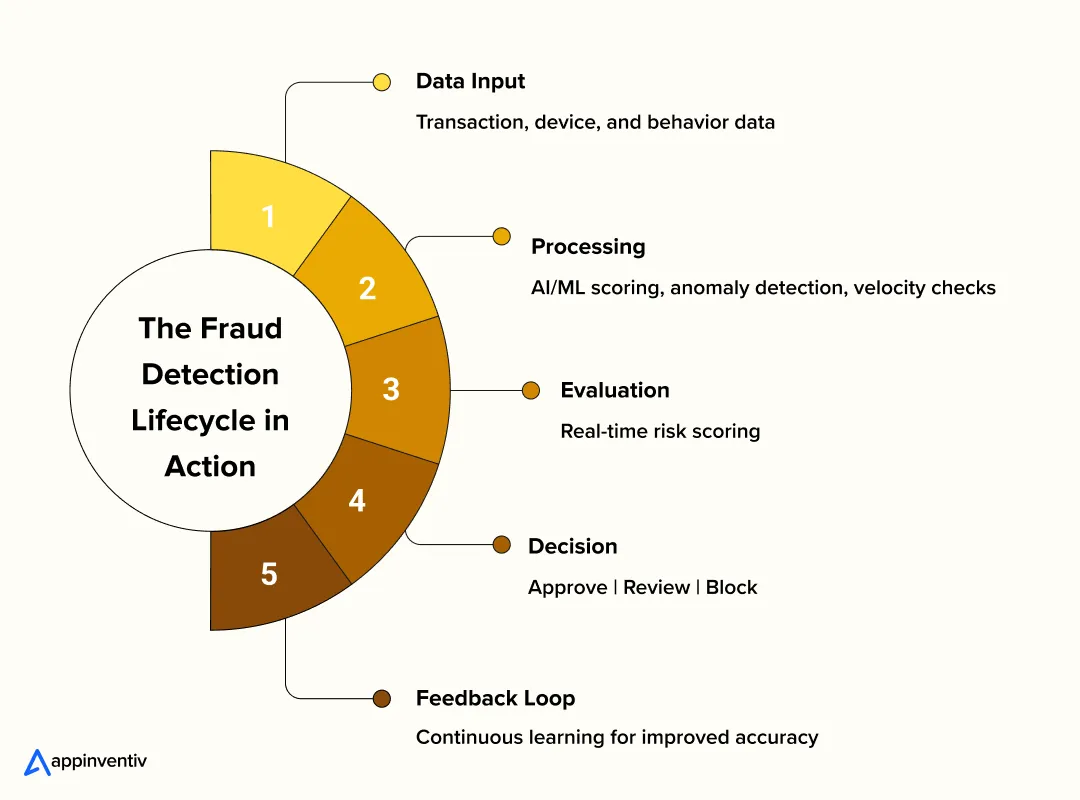
The use of ML and AI in eCommerce scoring models became absolutely critical for fraud detection because they predict risk using mountains of historical data. These models automatically tag each transaction with a risk level by analyzing patterns from thousands of past orders.
- How It Works: Feed these models more data and they get sharper. They learn to separate legitimate purchases from fraudulent ones with scary accuracy. The models adapt to brand-new fraud tactics constantly and keep refining how they catch bad actors.
- Why It Matters: This predictive setup keeps businesses ahead of fraudsters instead of always playing catch-up. Decisions happen in milliseconds based on smart insights, not some rulebook written three years ago. Manual review needs to drop dramatically.
4. Consortium Data Sharing and Network-Level Intelligence
Spotting fraud patterns requires way more than just your company’s data. Consortium data sharing lets businesses tap into network-level intelligence where information from entire merchant networks—think Visa Risk Manager, Mastercard Decision Intelligence—gets pooled together and analyzed.
- How It Works: Combining data from hundreds of sources reveals fraud patterns that individual transaction histories would never show. This shared intelligence helps catch fraud earlier and predict threats based on what’s hitting other companies right this minute.
- Why It Matters: Collective intelligence provides a massively broader view of what fraudsters are doing and supercharges detection capabilities. Companies can respond to emerging scams that wouldn’t appear in their own data for weeks or months.
5. Account Takeover (ATO) Detection
Account takeovers pose a huge threat to enterprise eCommerce. Fraudsters swipe login credentials and hijack accounts. Automated ATO detection monitors behaviour to spot weird login activity—attempts from strange devices, dodgy IP addresses, login times totally different from normal patterns.
- How It Works: The system watches the whole login process, looking for shifts in device, IP reputation, or timing that break from typical behaviour. Catching this early blocks unauthorized access before fraudsters can rack up fraudulent orders.
- Why It Matters: Early ATO detection stops criminals from stealing money through compromised accounts and protects both customers and company revenue from getting hammered.
When businesses bake these eCommerce fraud prevention techniques directly into their payment infrastructure, they can catch issues at the edge, long before revenue starts to slip and customers begin to distrust.
What you’re actually creating here is an adaptive ecosystem. One that doesn’t merely detect bad behaviour but learns from each and every transaction, continuously improving how it reacts to threats.
Best Practices to Avoid Fraud in the E-Commerce Industry
Fraud prevention in eCommerce for modern businesses is not something you work on and then leave behind. It’s a continuous practice that combines good governance, effective processes, and intelligent automation.
As payments become quicker and more diverse online, the emphasis has changed. It’s no longer merely about blocking suspicious transactions but creating an environment for fraud management for eCommerce businesses that actually learns from what it observes, grows alongside new attacks, and expands with your company.
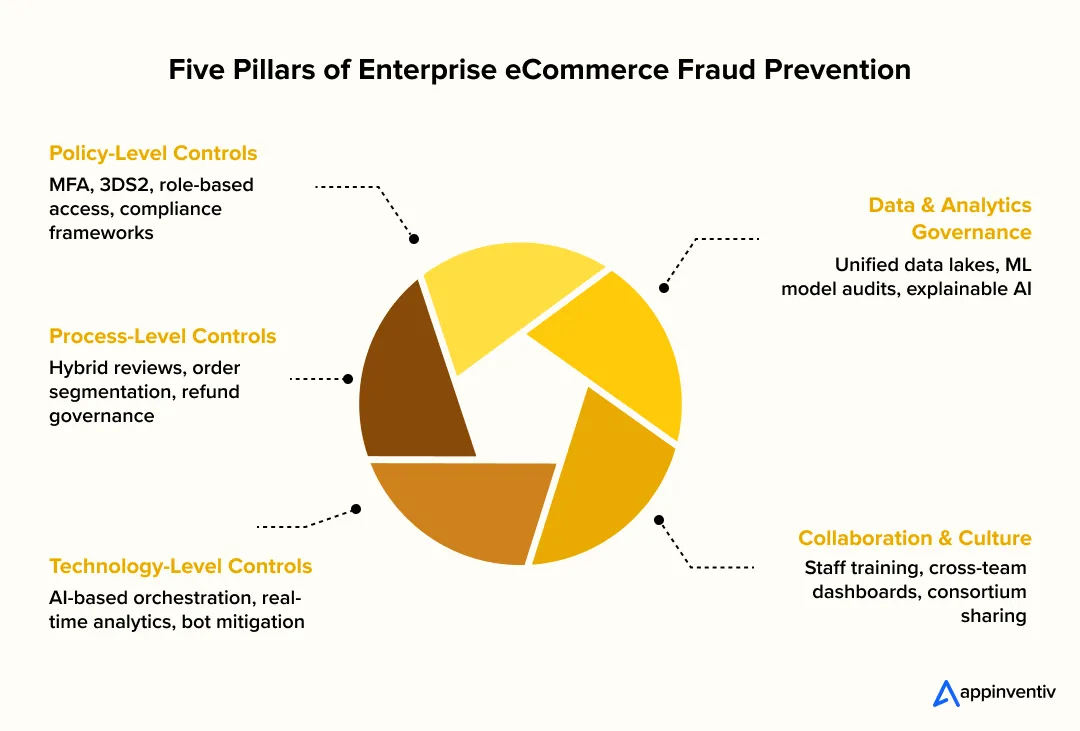
The following eCommerce fraud prevention best practices represent five essential pillars that top global businesses are now employing to safeguard their businesses and maintain customer trust.
A. Policy-Level Controls: Constructing the Governance Framework
Prevention starts with clear policies: who’s responsible, what risks are owned, what’s your compliance posture?
- 2FA, MFA, 3DS2: Protect login, checkout, and other high-value transactions with multi-factor authentication.
- Role-based access: Limit data access to reduce insider threats.
- Chargeback SLAs: Establish timelines for disputing false claims.
- Regulatory Compliance: Stay up to speed on PCI-DSS, GDPR, PSD3, and SOC 2.
B. Process-Level Controls: Simplifying Enterprise Operations
Operational discipline ensures policies translate into consistent action without complicating the checkout process. Key fraud prevention best practices include:
- Regular audits: Keep fraud filters updated to avoid stale thresholds blocking legitimate orders.
- Hybrid review models: Automate most transactions and use human judgment for high-risk or ambiguous cases.
- Order segmentation: Classify transactions by risk level to tailor your response.
- Refund and return governance: Use verification and digital receipts to prevent abuse.
- Escalation workflows: Establish clear communication among fraud, compliance, and support teams.
Strong governance makes fraud prevention a continuous part of decision-making, not just a reactive measure.
C. Technology-Level Controls: Scaling Intelligence and Speed
Fraud detection in enterprises requires intelligent systems that grow with the volume of transactions and adapt to ever-changing threats. Basic rule-based systems are no longer adequate. Advanced fraud prevention uses AI and machine learning in eCommerce, with real-time analytics, for effective and scalable fraud management.
- AI-Driven Data Orchestration
Fraud detection starts with organizing your data. AI platforms pull together information from everywhere—transaction history, customer behaviours, payment data—and unify it. Real-time analysis spots weird patterns, flags sketchy activity instantly, and keeps learning from each transaction. The system gets sharper over time.
- Behavioural Analytics and Device Fingerprinting
Behavioural analytics tracks how users actually interact with your site. Typing speed, how they navigate pages, and what device they’re using. When someone’s behaviour suddenly shifts from their normal pattern, the system catches it, even when fraudsters try mimicking legitimate activity. Device fingerprinting tracks specific details like IP addresses and operating systems, helping identify when the same fraudster tries hitting you repeatedly.
- Real-Time Transaction Monitoring
Stopping fraud requires watching transactions constantly, not reviewing logs next Tuesday. Real-time monitoring analyzes purchase volumes, transaction frequency, and geographic weirdness. Transaction size suddenly jumps from $50 to $5,000? User’s location bounces between New York and Nigeria in 10 minutes? Alerts fire off immediately, blocking unauthorized transactions before they go through.
- Bot and Credential Detection
Automated bots and credential stuffing attacks pose serious threats. Machine learning algorithms examine login patterns, IP reputation, device consistency to spot and block bots as they operate. This proactive defence stops account takeovers and unauthorized access before damage happens.
- System Integration for Unified Detection
Fraud detection tools need to talk to your existing platforms through proper eCommerce ERP integration, CRM connections, and payment gateways. A unified platform gives you visibility across all touchpoints instead of checking five different dashboards. Faster responses, more accurate fraud identification. Integrated systems streamline detection and reporting, making decisions clearer across departments.
- Machine Learning Models
Fraud tactics evolve constantly, so detection systems must evolve too. Machine learning models analyze both historical and live data to refine their algorithms, adapting as new fraud methods emerge. These models predict potential fraud based on shifting transaction patterns, staying ahead of criminals instead of reacting after losses pile up.
These advanced eCommerce fraud prevention methods, powered by AI and automation, help enterprises handle the complexity and scale of modern eCommerce. With Appinventiv’s expertise in eCommerce fraud prevention software development, enterprises can build customized platforms that adapt to emerging fraud tactics, protect revenue, and maintain compliance with industry standards.
D. Data & Analytics Governance: Creating an Intelligent Fraud Nerve Center
Clean, unified data speeds up fraud detection. When data is well-governed, fraud solutions can learn faster and identify discrepancies more accurately.
- Unified Data Lakes: Collect payment, behaviour, and identity data across systems for thorough analysis.
- Machine Learning Governance: Continuously train models to adapt to new fraud trends, minimizing bias and false positives.
- Feature Engineering Pipelines: Leverage real-time data like transaction speed, geolocation, and device reputation to refine predictions.
- Explainable AI: Ensure transparency in model decisions for audits and compliance.
By treating fraud data as a strategic asset, businesses can shift from merely detecting fraud to predicting it, easing operational challenges and reducing compliance risks.
E. Collaboration & Culture: Bolstering the Human Firewall
A secure, progressive environment among teams, vendors, and industry networks is paramount to long-term fraud prevention.
- Cross-team Collaboration: Share dashboards to monitor the risk indicators in real time across all teams.
- Consortium Data Sharing: It enables intelligence networks to share global threat data and enhance detection.
- Staff training: Employees must be trained on social engineering, phishing, and insider threats to reduce human vulnerabilities.
- Partner audits: Auditing third-party integrations regularly for security standard alignment.
Companies can build at least the frontiers with teamwork and knowledge transfer so that a robust internal defence system secures them.
Strategic Takeaway
Leading organizations treat fraud management as an integrated, end-to-end system that transcends silos. They can address these threats before they scale by aligning policy, process, technology, data, and culture. This protects revenue, maintains conversions, and preserves customer trust at any scale.
Also Read: Comprehensive Guide To Estimating Your App Development Cost
Now that you know a bit about the best practices for fraud prevention in eCommerce, let’s understand the indicators and red flags for fraud management in eCommerce enterprises.
Key Indicators and Red Flags To Look For
Here’s the catch: fraud doesn’t necessarily make a lot of noise. It tends to blend in with good customer behaviour. What distinguishes companies that get ahead from those always playing catch-up? The power to detect small, quirky things that don’t quite add up.
Your systems should be looking for things like:
- Uncommon transaction speed: If someone’s buying multiple things in seconds, or the same payment method’s getting slammed over and over, something’s wrong.
- Billing and shipping mismatch: This one pops up all the time with stolen credentials or when a person’s using proxies to mask their actual location.
- Failed payment attempts: May be legitimate, but too often, it’s card testing or bots running through stolen credential lists.
- Multiple orders from one IP or device: Unless your customer is really keen on your products, this tends to indicate automated scripts or sophisticated fraud schemes.
- Unusual cross-border activity from old accounts: When an account that’s remained silent for months suddenly reactivates and begins putting up high-value international orders? Account takeover, pure and simple.
The issue is that catching one of these signals on its own doesn’t say a whole lot. The real problem is collecting these weak signals and stringing them together into an accurate risk score.
It then needs to correctly identify the fraudsters without inadvertently blocking your good customers who happen to be shopping from a coffee shop in another town.
Fragmented data creates blind spots. Connect fraud monitoring across payments, CRM, and ERP platforms.
Technologies Powering Modern eCommerce Fraud Prevention
The strength of fraud management for eCommerce businesses lies in its technology stack. Modern eCommerce fraud prevention software development requires an ecosystem that combines intelligence, scalability, and automation to manage risks in real time.
Here are a few technological stacks that can help manage fraud:
- AI and Machine Learning
AI models enable predictive risk scoring by analyzing behavioural, transactional, and device data. Machine learning algorithms adapt continuously to new fraud patterns, helping enterprises prevent emerging threats with minimal manual intervention.
- Data Lakes and Advanced Analytics
Centralized data repositories consolidate inputs from multiple systems such as PSPs, CRMs, and ERP platforms. This unified view enhances anomaly detection and eCommerce analytics, ensuring better performance benchmarking across the entire system.
- Blockchain and Smart Contracts
Blockchain app development technology for secure transactions provides immutable transaction verification and auditable trails. For high-value or cross-border commerce, smart contracts add an extra layer of trust by executing only after compliance and payment conditions are validated.
- APIs and Orchestration Layers
Well-designed API integration for fintech systems connects payment gateways, order management systems, and CRMs into one cohesive fraud management architecture. This orchestration ensures consistent data flow, enabling faster and more accurate decision-making.
- Automation and RPA
Robotic Process Automation (RPA) accelerates fraud response by automatically flagging suspicious patterns, generating reports, and initiating chargeback reviews. Automation reduces analyst workload and improves fraud resolution timelines.
Suggested Architecture Flow:
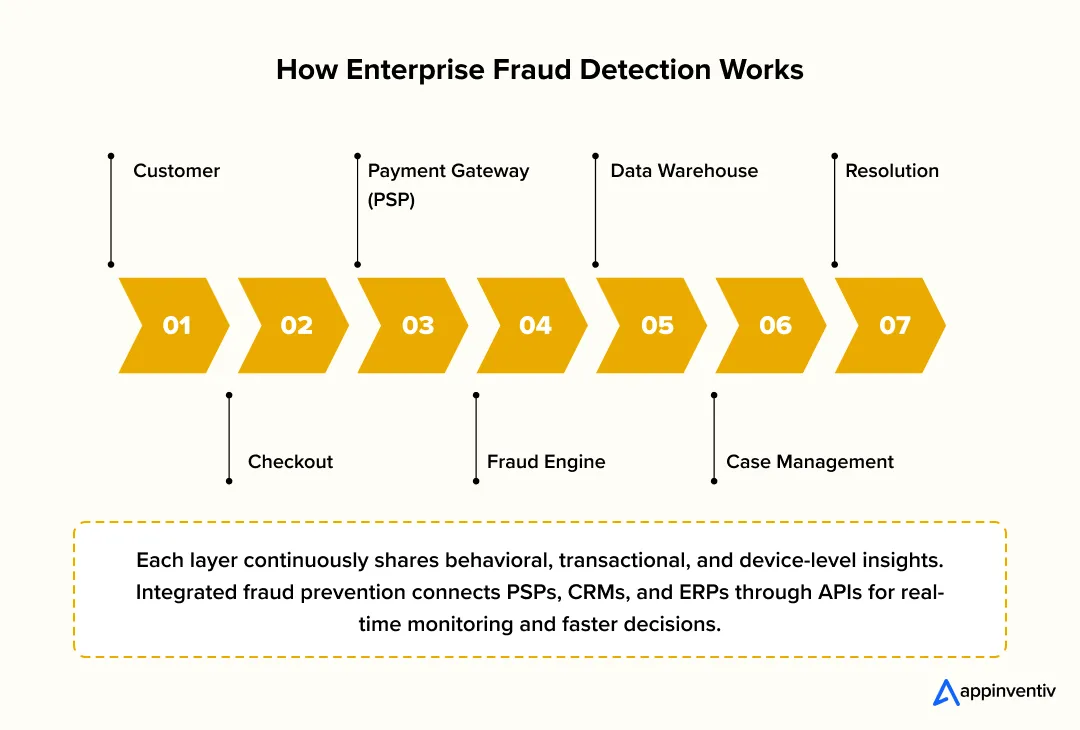
Checkout → Payment Gateway (PSP) → Fraud Engine → Data Warehouse → Case Management System
Enterprises investing in eCommerce fraud prevention software development gain not only stronger protection but also operational efficiency through intelligent orchestration. The result is a seamless, compliant, and future-ready eCommerce fraud prevention solution built for scalability.
Also Read: The Comprehensive Guide To eCommerce App Development
Building an Enterprise Fraud Prevention Framework
Creating a working fraud prevention software for eCommerce or a system at an enterprise scale isn’t something you do over a weekend. It requires a phased approach that balances speed, accuracy, and compliance.
This is a feasible 90-day plan that gets you from “where are we now?” to fully operational.
Phase 1 (0–30 Days): Audit and Visibility
The first month is about getting your arms around what you’re working with. What does fraud look like in your organization today? Where are the vulnerabilities? You can’t do anything about it if you can’t see it, so this stage is about shining a light.
Key Actions:
- Create a map of each and every transaction touch point, determine where your data is trapped in silos, and map integration gaps in your payment systems, CRMs, and ERPs.
- Run a baseline e-commerce fraud analysis and prevention in eCommerce transactions to identify your riskiest areas.
- Achieve some quick wins in eCommerce credit card fraud prevention and other types of online fraud by implementing simple velocity rules, Address Verification System (AVS), Card Verification Value (CVV) verification, and bot filtering. These will not fix all of it, but they will stem the most nakedly obvious threats.
- Ensure you’re up to speed on compliance with PCI DSS and data protection standards. Better to identify holes now than in an audit.
Objective: At month one’s end, you should have a very clear view of your vulnerabilities and some quantifiable fraud KPIs to monitor improvement in the subsequent phases.
Phase 2 (31–60 Days): Pilot and Fine-Tuning
Having gained sight of what is occurring, it is time to pilot some solutions. This phase is for eCommerce fraud prevention tools and techniques and ensuring new tools do indeed operate within your ecosystem without inadvertently blocking legitimate customers or inserting friction.
Key Actions:
- Pilot machine learning-driven fraud scoring on a tiny fraction of your transactions (perhaps 10–20%). Get a sense of how well the detection is working before you implement it everywhere.
- Implement multi-factor authentication (MFA) for high-risk transactions and whenever anyone attempts to update account information.
- Begin automating chargeback processes. Hunting for evidence and submitting disputes manually is a waste of time that no one needs.
- Monitor how your rules are performing and tweak detection thresholds according to what you’re discovering from the pilot.
Objective: Confirm that your AI models truly function, reduce false positives that irritate clients, and prepare everything for broader deployment.
Phase 3 (61–90 Days): Scale and Govern
This is where fraud prevention in eCommerce is no longer a project, but an integrated part of the way your business works. Systems become deeply integrated, insights are shared across departments, and you make continuous improvement a habit.
Key Actions:
- Deploy AI-powered orchestration on all your payment channels and digital touchpoints.
- Bring fraud performance metrics directly into your customer experience dashboards and management reports. This stuff doesn’t need to exist in silos.
- Establish regular monthly KPI check-ins. Target chargeback percentages, how frequently you are rejecting valid orders, and general approval percentages.
- Establish a fraud governance committee. Task them with policy changes, compliance checks, and ensuring teams remain up to date on fresh threats.
Objective: Within day 90, you will have scalable, proactive fraud protection that evolves as new threats arise and regulations shift.
A guided roadmap such as this makes fraud prevention in eCommerce a continuing process, not a special project. Before you reach 90 days, you’re not only lowering your vulnerability to fraud. You’re establishing the foundation for smart, long-term resiliency that continues to pay dividends year in and year out.
A structured rollout helps reduce risk faster and prepares teams for emerging threats.

Emerging Fraud Risks and Future Trends
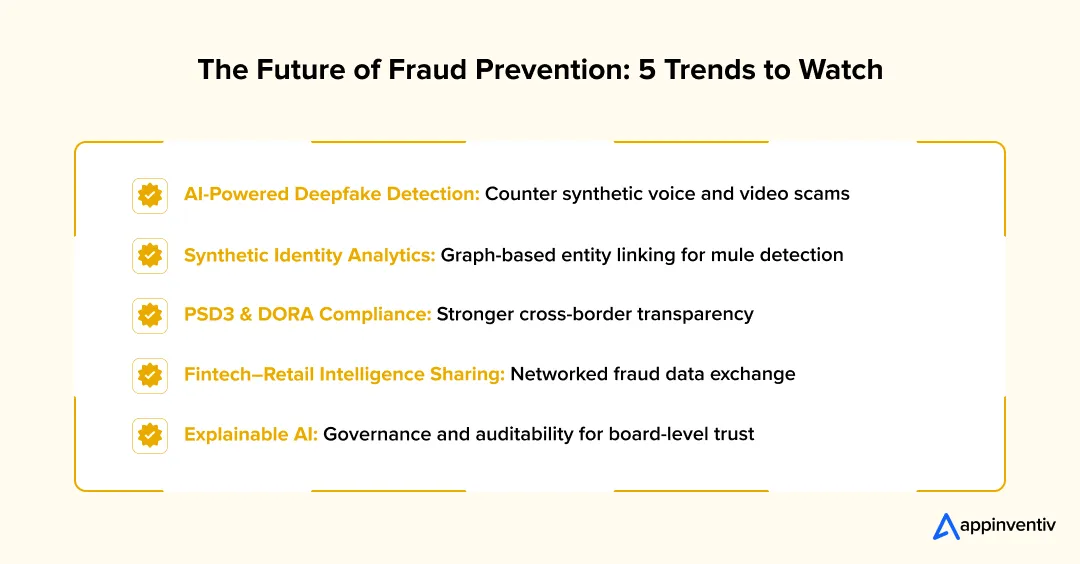
Fraud is becoming harder to recognize. Many attacks now look like normal customer activity, and traditional rules often miss them. Businesses are responding with stronger monitoring, tighter governance, and broader intelligence sharing.
AI Is Changing How Fraud Works
Fraudsters no longer rely only on stolen credentials.
- Deepfake voices are being used to bypass verification checks.
- Synthetic identities can appear legitimate during onboarding.
- Customer support teams are becoming frequent targets.
- Many companies are expanding their fraud management programs to spot unusual behavior earlier.
Identity Fraud Is Becoming More Organized
Criminal activity rarely comes from a single account anymore.
- Mule accounts are often linked across multiple devices and identities.
- Graph analytics helps uncover hidden account relationships.
- Retailers and financial institutions are spending more on identity monitoring.
- Detection efforts now focus on behavior, not just transaction data.
Regulations Are Raising the Bar
Compliance requirements continue to expand across global markets.
- PSD3 increases expectations around payment security.
- DORA places greater focus on operational resilience.
- Audit requirements are becoming more detailed.
- Risk decisions need clear documentation and traceability.
Data Sharing Is Becoming a Competitive Advantage
A fraud pattern spotted by one company can affect many others.
- Retailers are sharing anonymized threat data more frequently.
- Payment providers are building larger intelligence networks.
- Cross-industry visibility helps identify emerging threats sooner.
Boards Want More Visibility Into AI Decisions
Automated decisions now receive greater scrutiny.
- Regulators want clear explanations behind risk scores.
- Internal audit teams are reviewing AI-driven decisions more closely.
- Transparent governance is becoming part of day-to-day operations.
The next phase of retail fraud prevention will rely on stronger collaboration, clearer oversight, and smarter fraud management tools. Companies that adapt early will be better prepared for new attack patterns and changing compliance requirements.
How Appinventiv Helps Enterprises Build Secure eCommerce Platforms
One pattern shows up in almost every fraud conversation. The business already owns security tools. The payment gateway has fraud checks. The team reviews suspicious orders. Reports arrive every week. Yet fraud still slips through, why?
The answer is usually buried between systems. Customer data sits in one platform. Payment data sits in another. Teams work from different dashboards. Nobody sees the complete picture at the same time.
We’ve seen this repeatedly across the 400+ eCommerce platforms our teams have delivered over the last nine years.
Retail brands such as Adidas, 6th Street, and BodyShop trusted Appinventiv to build digital commerce experiences that customers could use with confidence. Those projects demanded secure payment flows, reliable performance, and compliance standards that could support growth without creating friction at checkout.
Some clients need stronger transaction monitoring. Others need better visibility across payment systems, ERP platforms, customer data, and operational workflows.
Our work in eCommerce app development services often includes:
- PCI-DSS compliant payment environments
- AI-driven fraud monitoring
- Payment gateway integrations
- ERP and CRM connectivity
- Automated review and escalation workflows
Today, Appinventiv supports retailers through 25+ payment partnerships, a 99.50% transaction reliability SLA, and commerce experiences that have improved conversion rates by up to 40%.
The goal is simple. Help businesses spend less time chasing fraud signals and more time growing revenue.
If strengthening fraud management for eCommerce businesses is part of your roadmap, our team can help you build the systems, workflows, and controls needed to support that growth.
Speak With Our Commerce Experts
Frequently Asked Questions
Q. How to prevent eCommerce fraud?
A. Businesses can combat eCommerce fraud by implementing layered security controls such as multi-factor authentication, AI-powered risk scoring, and real-time transaction monitoring. Policy checks and audits on a regular basis also assist, as does maintaining compliance with standards such as PCI DSS and GDPR. It’s all about having multiple barriers working in conjunction.
Q. How to integrate eCommerce fraud prevention?
A. You can integrate fraud prevention into your payment gateways, CRMs, and ERP systems directly with APIs and orchestration layers. This provides you with single-platform visibility across all transactions and automates risk scoring at all points in the customer journey, so nothing falls between the cracks.
Q. How can eCommerce businesses detect fraudulent transactions early?
A. Early identification in fraud management for ecommerce businesses is all about behavioural analytics, device fingerprinting, and speed checks. AI-driven models scan for unusual patterns in location history, transaction values, and user activities to point out suspicious activity before anything gets approved.
Q. What steps should businesses take after identifying a fraudulent transaction?
A. The moment you’ve identified a fraudulent transaction, act quickly. Instantly stop the order, alert your payment processor, preserve all the logs as evidence, and initiate the chargeback or dispute process. Then, a post-incident analysis will be conducted to determine how it occurred and plug those security loopholes.
Q. How important is PCI DSS compliance for eCommerce platforms?
A. PCI DSS compliance is a complete necessity for protecting payment information. It mandates practices such as encryption, access controls, and ongoing monitoring that prevent cardholder data compromises. And, it generates customer trust when individuals know you are serious about security.
Q. What is eCommerce fraud, and why is it a growing concern for online businesses?
A. eCommerce fraud refers to any unauthorized or deceptive activity that results in financial loss during online transactions. Common examples include card-not-present (CNP) fraud, account takeover, phishing, refund fraud, return fraud, gift card fraud, and unauthorized purchases. As digital commerce expands, fraudsters continue to exploit security weaknesses, making payment fraud, chargebacks, and customer trust major concerns for businesses.


Fast 2-minute response, fully NDA-protected.

eCommerce Integration: Connecting ERP, CRM, PIM, and Other Core Business Systems
Key takeaways: Centralized eCommerce architecture distributes accurate product data simultaneously across all your global sales channels. ERP, CRM, PIM, OMS, POS, etc. are the core integration types forming your eCommerce architecture. Security and compliance must anchor your payment architecture when operating across multiple regulatory jurisdictions. The cost of eCommerce platform integration ranges between $40,000 and…

Why Australian Retailers Are Investing in Unified Commerce Platforms in 2026
Key takeaways: Unified commerce platform development in Australia is now central to peak trading resilience, not a discretionary upgrade. The Australian unified commerce opportunity is valued at AUD 44 billion, with early adopters seeing revenue growth of 20% or more. Real-time inventory and customer data are prerequisites for reliable AI deployment in retail. Addressing governance…

How Much Does It Cost to Build an eCommerce Marketplace App Like Poshmark?
Key takeaways: Poshmark-like marketplaces enable unlocking new sources of revenue through transforming social interaction into low-capital-intensity repeat purchases. A marketplace app would cost between $40,000 and $400,000 to develop, depending on its features, platform and enterprise scalability needs. Special implementation, beginning with tests or single categories, confirms supply, demand, and monetization in 6-12 months. Trust,…