































Digital Maturity Assessment for Australian Enterprises: Where You Are, Where You Need to Be

 Share -



- 01Digital Maturity vs Digital Transformation: What Enterprises Often Confuse
- 02Core Areas Every Digital Maturity Assessment Should Evaluate
- 03The ARC Framework: A Practical Enterprise Lens for Digital Maturity
- 04Appinventiv’s Case in Action: Real-World Examples of Digital Mature Organisations
- 05Understanding Australia’s Digital Maturity Assessment Framework
- 06What Are the Signs That Indicate My Enterprise Has a Digital Maturity Problem?
- 07The Hidden Cost of Low Digital Maturity
- 08The 5 Levels of Enterprise Digital Maturity Assessment for Australian Enterprises
- 09How Capability and Alignment Scores Determine Enterprise Digital Maturity
- 10How Australian Enterprises Should Conduct a Digital Maturity Assessment
- 11What Are the Common Mistakes Enterprises Make During Digital Maturity Initiatives?
- 12What Digitally Mature Australian Enterprises Are Doing Differently
- 13The Future of Digital Maturity in Australia
- 14How Appinventiv Supports Enterprise Digital Maturity in Australia?
- 15FAQs

Key takeaways:
- Digital maturity has evolved from a transformation metric into a core indicator of operational resilience, governance readiness, and long-term enterprise scalability across Australia.
- AI adoption is exposing weaknesses in data quality, governance, and operational agility that digitisation spending alone cannot fix.
- CPS 230, CPS 234, the SOCI Act, and Privacy Act reforms are increasing the cost of operating with fragmented or ungoverned digital infrastructure.
- A structured Digital Maturity Assessment for Australian Enterprises helps benchmark readiness, prioritise modernisation investments, and reduce transformation risk.
- The DTA’s Digital Maturity Assessment Framework is increasingly influencing how enterprises evaluate digital capability and operational alignment.
Australian enterprises are investing aggressively in cloud migration, AI enablement, automation, and customer experience modernisation. However, buying sophisticated software does not automatically fix deep-rooted operational problems.
Many organisations still struggle with disconnected systems, trapped data, and manual workarounds. Adding new technology on top of fragile, legacy foundations often creates more risk than reward, particularly when facing strict mandates like CPS 230 and updated privacy laws.
Executive boards need a clear, objective picture of what is actually working. They need to know if their technology infrastructure is genuinely ready to scale emerging tools and capable of meeting strict local compliance demands.
This is where a digital maturity assessment for Australian enterprises becomes critical. It bypasses vendor hype to objectively evaluate the hard reality of your architecture, data governance, and daily processes.
This blog details how to benchmark your operational baseline, uncover hidden technical debt, and sequence a modernisation roadmap that delivers tangible commercial value.
Gain a structured view of interoperability, AI readiness, cybersecurity maturity, and operational scalability.

Digital Maturity vs Digital Transformation: What Enterprises Often Confuse
Digital transformation in Australia is about technology adoption. Digital maturity is about how well technology is embedded into the organisation’s actual way of working – its governance structures, data architecture, workforce capability, and decision-making processes. These are different things, and they require different interventions.
The table below captures the distinction in operational terms:
| Dimension | Digitally Transformed | Digitally Mature |
|---|---|---|
| Technology adoption | Systems deployed | Systems embedded into operations |
| Data | Data collected | Data governed, trusted, used for decisions |
| Process | Workflows digitised | Workflows redesigned around digital capability |
| AI | Pilots underway | AI scaled with governance frameworks |
| Cybersecurity | Controls deployed | Resilience embedded in architecture |
| Leadership | Sponsoring initiatives | Accountable for outcomes |
| Compliance | Managed separately | Integrated into operating model |
Core Areas Every Digital Maturity Assessment Should Evaluate
A credible Digital Maturity evaluation for Australia covers considerably more than technology infrastructure. It needs to assess the operating model, governance structures, workforce capability, and data architecture simultaneously because maturity gaps in any one dimension constrain the entire enterprise. Here are the key digital maturity dimensions and metrics to track:
Technology, Cloud and Interoperability
Technology and infrastructure maturity remains foundational. This includes cloud readiness, legacy system modernisation exposure, integration architecture, API maturity, and vendor dependency risk. However, infrastructure alone rarely determines maturity outcomes.
Data Maturity and AI Readiness
Data capability has become equally critical. AI initiatives are exposing weaknesses in data ownership, interoperability, quality control, and governance consistency across Australian enterprises. The Data Maturity Assessment Tool (DMAT) is increasingly being used to evaluate whether enterprise data environments are reliable enough for automation and AI-driven decision-making.
Cybersecurity and Resilience
Measure structural alignment against strict mandates like CPS 234. Security must operate as an embedded operational enabler through zero-trust architecture, rather than acting as a reactive gatekeeper.
Process Automation and Workforce Capability
The assessment should also evaluate process automation maturity, leadership alignment, workforce capability, customer experience consistency, and governance. Most transformation failures occur where these dimensions evolve independently rather than together.
The ARC Framework: A Practical Enterprise Lens for Digital Maturity
Many assessment framework for enterprises fail because they evaluate technology capability in isolation. Operational maturity is shaped by how architecture, resilience, and organisational capability evolve together. Weakness in any one layer eventually constrains scalability, governance, and AI readiness across the enterprise.
To address this, Appinventiv uses a simplified three-layer operational assessment lens during enterprise modernisation engagements.
| Layer | Focus |
|---|---|
| Architecture | Interoperability, API maturity, cloud resilience |
| Resilience | CPS 230 alignment, Zero Trust maturity |
| Capability | Workforce readiness, governance maturity, AI scalability |
Appinventiv’s Case in Action: Real-World Examples of Digital Mature Organisations
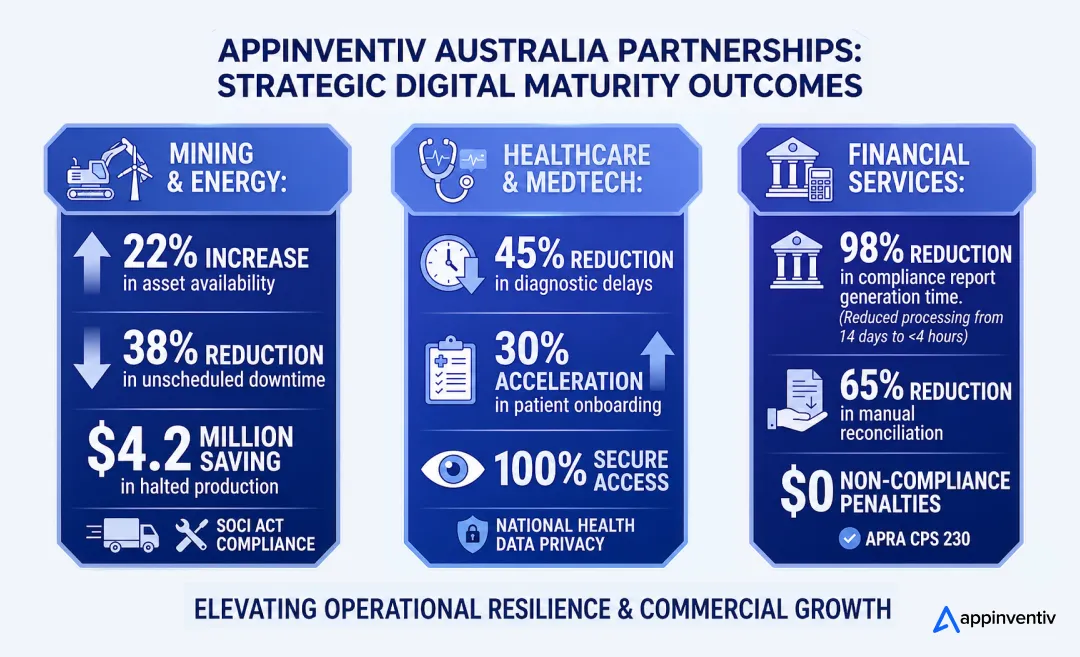
Bridging the gap between an initial capability evaluation and actual operational resilience requires a highly practical engineering strategy. We collaborate with executive boards across multiple sectors to dismantle legacy debt and deploy secure, compliant platforms. The following scenarios demonstrate how targeted architectural upgrades resolve complex industry roadblock and what enterprise-grade outcomes look like in practice.
Mining
We recently partnered with a major resources company operating across remote Pilbara sites. Acting as their digital product engineering partner, our delivery teams engineered a secure data convergence layer between their IT and operational technology networks. This architecture enabled predictive maintenance models that identify heavy equipment failures before physical breakdowns occur.
The solution delivered:
- 22% increase in asset availability
- 38% reduction in unscheduled downtime
- $4.2 million saving in halted production
Healthcare
A large hospital network struggled with isolated legacy patient management software. Our engineering teams overhauled this infrastructure by deploying a secure API abstraction layer. This integration allowed external medical specialists to access clinical histories instantly without compromising the core database. The resulting architectural shift reduced diagnostic delays significantly and ensured total compliance with national health data privacy regulations.
The measurable metrics of the solution:
- 45% reduction in diagnostic delays
- 30% acceleration in patient onboarding times
- 100% secure data access visibility for external medical specialists
Finance
A mid-market bank faced mounting pressure from manual regulatory reporting workflows. We partnered with their executive team to build intelligent data pipelines that extract and reconcile information directly from legacy core banking systems. This automated reporting guaranteed real-time CPS 230 compliance, completely eliminating the operational bottlenecks and heavy resource costs associated with manual risk assessments.
The outcome?
- 98% reduction in compliance report generation time (from 14 days to under 4 hours)
- 65% reduction in manual data reconciliation overheads
- 0 non-compliance penalties during subsequent APRA reviews
Understanding Australia’s Digital Maturity Assessment Framework
The APS digital maturity assessment framework organises evaluation across three primary pillars. Each covers both capability and alignment dimensions.
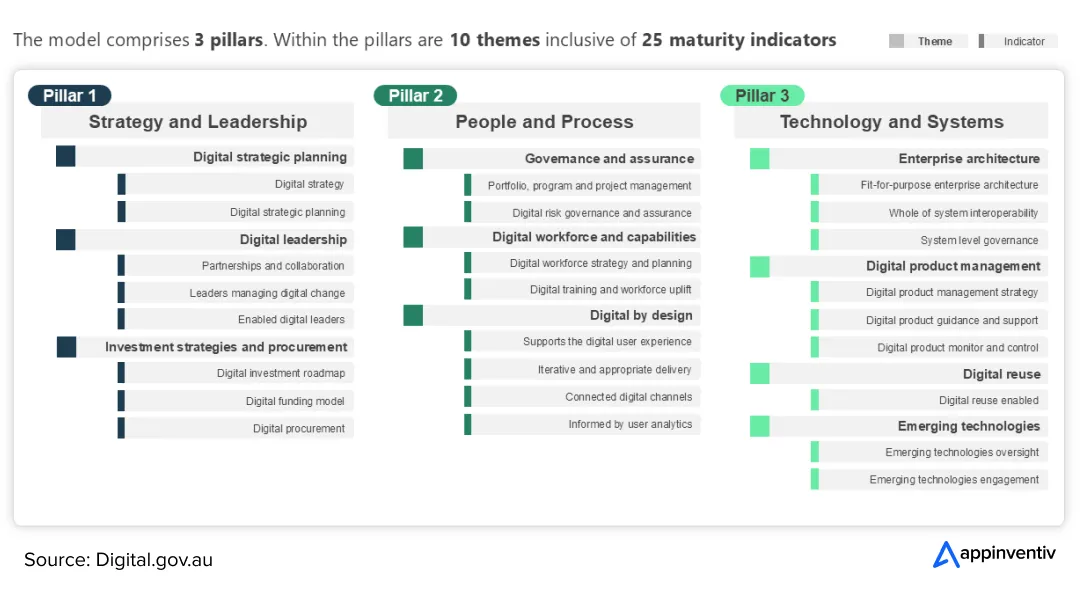
Pillar 1 — Strategy and Leadership
Covers digital strategy clarity, leadership capability, investment governance, procurement modernisation, and transformation governance. Enterprises that score poorly here typically run technology programs without clear business outcome alignment – a condition that produces activity without improvement.
Pillar 2 — People and Process
Addresses workforce capability uplift, governance and assurance mechanisms, user-centric delivery principles, digital-by-design culture, and analytics-led decision-making. Operational immaturity surfaces most commonly here, even in organisations with technically sophisticated infrastructure.
Pillar 3 — Technology and Systems
Evaluates enterprise architecture, interoperability, digital product management practices, emerging technology adoption, and platform reuse. This is where technical debt, shadow IT, and integration fragmentation are most visible to an experienced assessor.
Appinventiv Insight
The critical message from this framework is straightforward: digitally mature enterprises evolve strategy, process, workforce, and technology simultaneously, not sequentially. Organisations that invest in technology while neglecting leadership alignment and workforce capability routinely underperform their modernisation investment.
The 10 Digital Maturity Themes Enterprises Should Benchmark Against
| Pillar | Theme | Enterprise Relevance |
|---|---|---|
| Strategy & Leadership | Digital strategy and planning | Transformation alignment |
| Strategy & Leadership | Digital leadership | Executive ownership |
| Strategy & Leadership | Investment and procurement | Scalable modernisation |
| People & Process | Governance and assurance | Risk and compliance maturity |
| People & Process | Workforce and capabilities | Skills transformation |
| People & Process | Digital by design | User-centric operations |
| Technology & Systems | Enterprise architecture | Legacy modernisation |
| Technology & Systems | Product management | Continuous delivery |
| Technology & Systems | Digital reuse | Platform scalability |
| Technology & Systems | Emerging technologies | AI readiness |
Using the Data Maturity Assessment Tool (DMAT) alongside these themes gives leadership a granular view of where the enterprise generates value from its data assets versus where data quality and governance gaps are limiting outcomes.
Transform your technical capabilities into a scalable, compliant operational framework.

What Are the Signs That Indicate My Enterprise Has a Digital Maturity Problem?
Recognising structural friction is the first step toward remediation. When expensive technology fails to deliver agility, the root cause usually lies in foundational maturity deficits. Identifying these red flags allows boards to correct failing strategies before technical debt compounds.
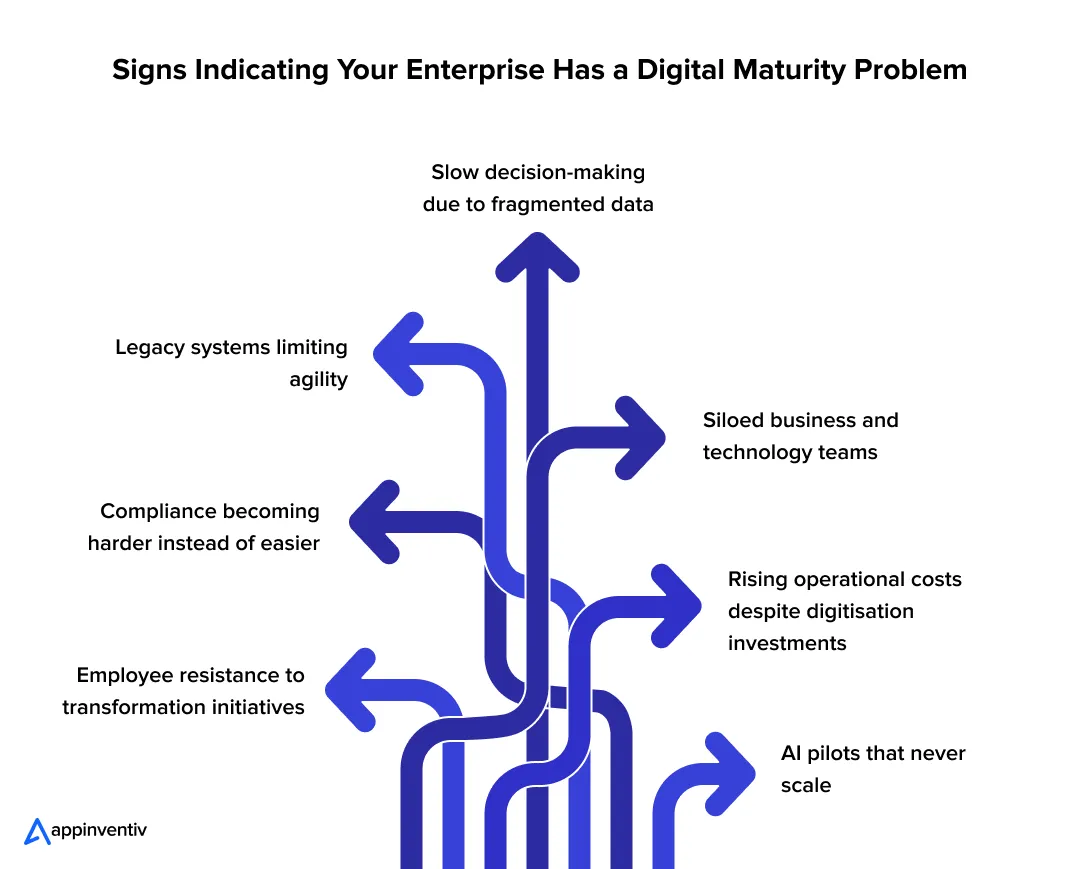
AI pilots that never scale
Organisations often launch impressive machine learning proofs of concept that stall before reaching production. This happens because the underlying data fabric is too fragmented to support continuous model training. Without clean data pipelines, artificial intelligence in Australia remains a costly science experiment.
Rising operational costs despite digitisation investments
Procuring modern cloud platforms should theoretically reduce overall ownership costs. If IT budgets keep expanding alongside new software rollouts, the enterprise is likely accumulating technical debt. Layering new tools over legacy monoliths forces staff to maintain two parallel operating models.
Siloed business and technology teams
Technology divisions need to function as strategic partners. When they act purely as isolated order takers, shadow IT spreads quickly. Business units end up purchasing unvetted software independently, creating a fractured enterprise architecture that cannot respond to market changes cohesively.
Slow decision-making due to fragmented data
If executives still rely on manual spreadsheet extracts for board reporting, the enterprise lacks a unified data ecosystem. High-performing organisations use a single source of truth to navigate market volatility. Fragmented data keeps the entire business reactive instead of predictive.
Legacy systems limiting agility
Relying on aging codebases stops the rapid deployment of new digital products. When a minor customer portal update demands weeks of backend regression testing, the business loses market agility. These legacy dependencies act as a hard operational ceiling on growth.
Compliance becoming harder instead of easier
Meeting Australian mandates like CPS 230 should not demand exhaustive manual audits every quarter. If proving data sovereignty feels difficult, the architecture lacks secure by design principles. Mature setups automate this reporting through deeply embedded governance frameworks.
Employee resistance to transformation initiatives
Technology deployments routinely fail when staff refuse to adopt the new workflows. This usually happens because transformation programs ignore human-centric process redesign, forcing clunky interfaces onto the workforce. A mature approach pairs new digital tools with practical capability uplift.
The Enterprise Diagnostic Checklist
Not sure where you stand in your digital maturity level? You can use this rapid diagnostic tool to gauge immediate structural vulnerabilities. Answering ‘no’ to several of these questions strongly indicates a pressing need for a formal digital capability maturity assessment model.
|
The Hidden Cost of Low Digital Maturity
The financial impact of low digital maturity rarely appears as a single technology failure. It accumulates gradually through operational inefficiency, delayed decision-making, rising compliance costs, integration complexity, and stalled innovation capability.
The visible cost usually emerges across the organisation in the following forms:
- slower product delivery cycles
- delayed AI adoption
- higher vendor management overhead
- inconsistent cybersecurity enforcement
- prolonged regulatory reporting
- operational recovery delays during incidents
Technical debt compounds these issues further. For Australian enterprises operating under CPS 230, CPS 234, and SOCI obligations, operational immaturity increasingly creates direct governance and resilience exposure as well.
In short, the cost of delayed maturity modernisation is no longer purely technical. It is operational, financial, regulatory, and increasingly strategic.
The 5 Levels of Enterprise Digital Maturity Assessment for Australian Enterprises
Digital maturity benchmarking against maturity tiers provides a clear roadmap for investment. Without knowing exactly where your architecture and governance practices sit on this spectrum, modernisation efforts become expensive guesswork.
This five tier framework gives leadership a clear picture of the current state and a credible benchmark for where the organisation needs to be.
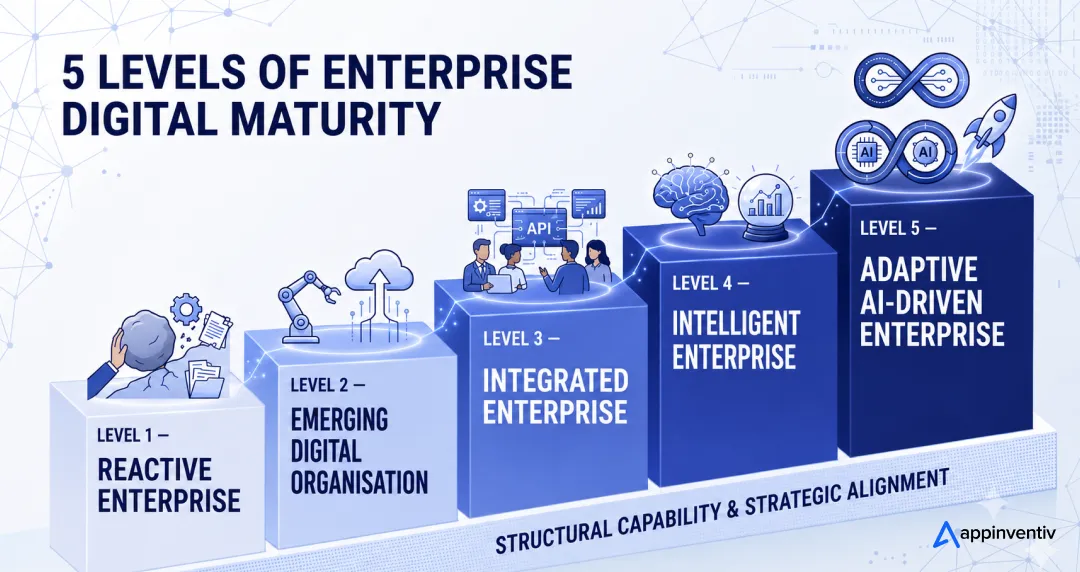
Level 1 — Reactive Enterprise: Manual workflows, legacy infrastructure, siloed systems, spreadsheet-driven operations, and periodic reporting rather than real-time visibility.
Level 2 — Emerging Digital Organisation: Initial cloud migration underway. Department-level automation. Basic analytics adopted but not integrated into operational decision-making.
Level 3 — Integrated Enterprise: Systems connected through APIs. Standardised workflows. Cross-functional data visibility. Formalised cybersecurity controls and consistent governance across functions.
Level 4 — Intelligent Enterprise: AI-assisted decision-making embedded in core operations. Predictive analytics informing resource allocation and risk management. Mature cybersecurity posture with continuous monitoring.
Level 5 — Adaptive, AI-Driven Enterprise: Autonomous optimisation across business processes. AI governance formally embedded and audited. Resilience engineering built into architecture decisions, not retrofitted after incidents.
| Capability Level | Core Characteristic | Systems & Data | Governance & Security |
|---|---|---|---|
| 1. Reactive | Manual, legacy-heavy operations. | Siloed, spreadsheet-driven data. | Ad hoc, high-risk posture. |
| 2. Emerging | Fragmented departmental digitisation. | Basic cloud use, disjointed data. | Localised, inconsistent policies. |
| 3. Integrated | API-connected, standardised workflows. | Cross-functional data sharing. | Unified, secure-by-design. |
| 4. Intelligent | Predictive, AI-assisted decisioning. | Real-time, clean data lakes. | CPS 234 compliant, mature. |
| 5. Adaptive | Autonomous, self-optimising ecosystem. | Dynamic, resilient platforms. | Zero Trust, automated compliance. |
How Capability and Alignment Scores Determine Enterprise Digital Maturity
Digital Maturity Assessment in Australia evaluates two dimensions simultaneously: what the organisation can do, and how consistently it does it across the enterprise. The following scoring framework allows risk and technology officers to pinpoint operational vulnerabilities accurately.
| Maturity Domain | Weight | Core Evaluation Criteria |
|---|---|---|
| Strategy Maturity | 15% | Leadership alignment, digital roadmap clarity, and strict investment governance. |
| Operational Maturity | 20% | Workflow automation depth, process standardisation, and cross-functional integration. |
| Technology Maturity | 20% | Cloud readiness, API maturity, and underlying infrastructure scalability. |
| Data & AI Maturity | 20% | Structural data quality, formalised AI governance, and advanced analytics readiness. |
| Cybersecurity & Resilience | 25% | Zero Trust architecture readiness, CPS 230/234 alignment, and incident response capability. |
This scoring matters because many enterprises have mature tools operating inside immature operating models. Mature scoring models increasingly distinguish between data readiness and AI maturity, recognising that scalable AI depends on governance maturity, operational controls, and enterprise adoption capability, not infrastructure alone.
For instance, scoring a 4 in Strategy but a 2 in Cybersecurity immediately signals to the board that while the executive vision is clear, the underlying operational resilience remains highly vulnerable to regulatory penalties. This diagnostic approach allows leaders to recalibrate their technology budgets with absolute precision.
How Australian Enterprises Should Conduct a Digital Maturity Assessment
The Digital Maturity Process requires a structured, sequenced approach. The most common failure mode is starting with technology and working backward. Every assessment worth conducting starts with business outcomes.
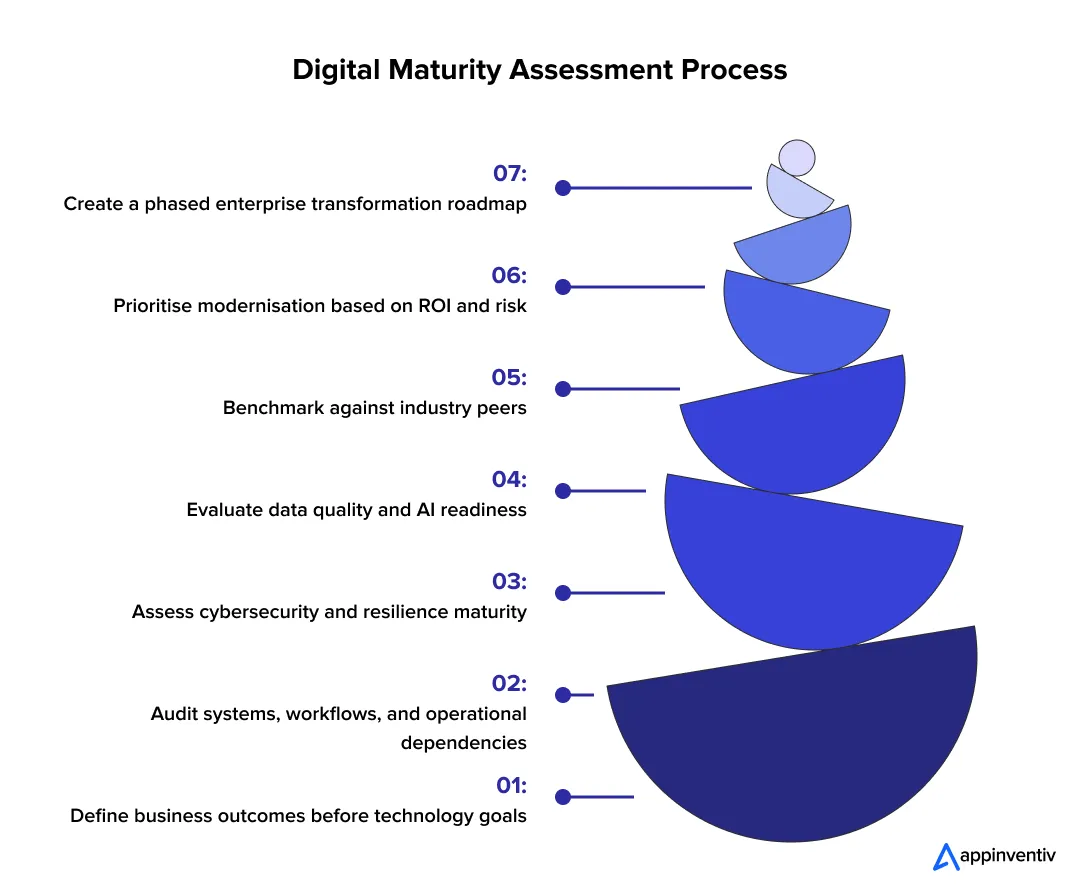
Define Business Outcomes Before Technology Goals
Establish clear commercial objectives upfront, such as reducing operational overheacds or automating compliance workflows. Technology choices must always serve the underlying business case.
Map Systems, Workflows and Operational Dependencies
Trace the active operating model to expose hidden integration gaps. Pinpointing manual workarounds and undocumented shadow IT ensures an accurate baseline of existing system liabilities.
Audit Cybersecurity and Resilience Maturity
Evaluate existing technical infrastructure against mandatory standards like CPS 234 and the SOCI Act. Embedding Zero Trust protocols ensures continuous operations during external disruptions.
Assess Data Quality and AI Readiness
Inspect the data fabric to ensure unstructured data silos do not stall predictive modelling. This guarantees sovereign control over customer information before scaling artificial intelligence initiatives.
Benchmark Capability Against Industry Peers
Apply standard capability scoring metrics to allow comparison against direct sector competitors. Identifying market performance gaps helps executive boards recognise the true operational cost of technical inaction.
Target Modernisation Based on ROI and Risk
Focus capital allocation on specific legacy applications causing high compliance friction or slowing down critical product delivery, as not all operational gaps carry equal consequences.
Execute A Phased Enterprise Transformation Roadmap
Build a strictly sequenced execution plan that balances immediate operational wins with long-term structural health. This ensures aging infrastructure is retired systematically as modern platforms come online.
What Are the Common Mistakes Enterprises Make During Digital Maturity Initiatives?
Transformation programs routinely fail when leadership treats structural maturity as a basic software procurement exercise. Identifying these common operational missteps allows executive boards to stop wasting capital on fragmented deployments that fail to deliver genuine business agility or regulatory compliance.
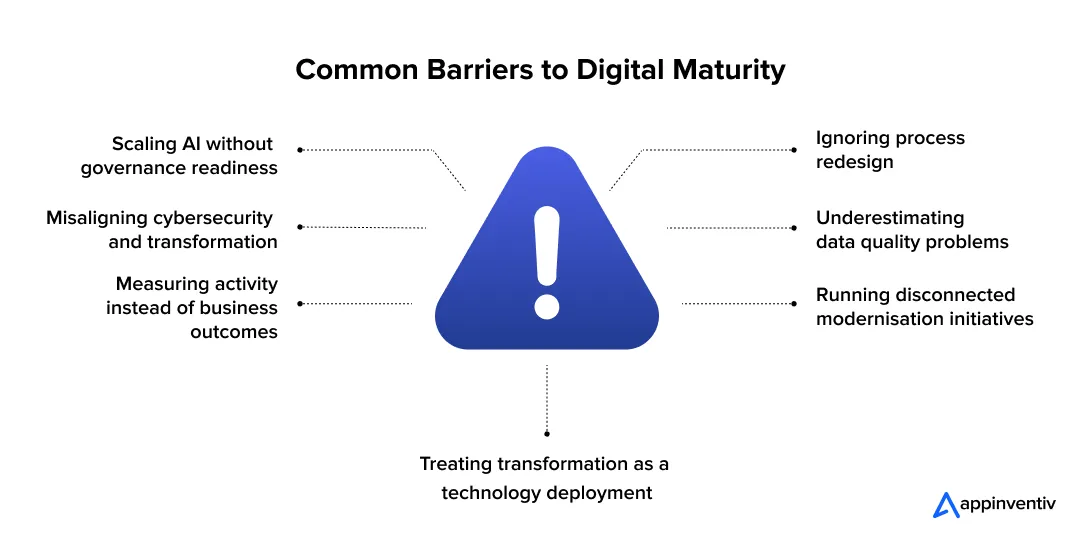
Treating transformation as a technology deployment
Buying new software does not automatically change how a business operates. Organisations frequently procure expensive cloud platforms while leaving their outdated operating models completely intact. This approach yields zero actual agility and often frustrates the workforce.
Ignoring process redesign
Applying modern technology to a broken process simply automates inefficiency. If you do not critically evaluate and redesign the underlying workflow before deploying new software, you inevitably force staff to develop complicated manual workarounds just to complete their daily tasks.
Underestimating data quality problems
Data migration is rarely straightforward. Enterprises consistently underestimate the deep technical debt hidden within their legacy databases. Attempting to build advanced analytics or machine learning tools on top of unstructured, fragmented data guarantees the project will stall.
Running disconnected modernisation initiatives
Allowing individual departments to fund and drive their own IT projects creates massive shadow IT risks. These disconnected initiatives lead directly to overlapping software licences, fractured data silos, and a sprawling, unmanageable enterprise architecture.
Scaling AI without governance readiness
Pushing artificial intelligence pilots into live production without strict data guardrails creates severe compliance exposure. We observe enterprises attempting to scale AI before they establish the formal boardroom governance required to manage algorithmic bias or guarantee data sovereignty.
Measuring activity instead of business outcomes
Tracking deployment speed or budget adherence provides a false sense of project success. Real digital maturity is measured by tangible commercial outcomes. You must track metrics like structural cost reduction, faster product delivery times, and the successful automation of regulatory reporting.
Misaligning cybersecurity and transformation
Treating security as a final checkpoint rather than an embedded design principle severely delays project delivery. When cybersecurity teams are excluded from the initial transformation planning phases, the resulting systems almost always fail rigorous CPS 234 audits.
“The IBM Cost of a Data Breach Report 2025 continues to show that organisations with mature security automation and governance frameworks recover substantially faster from major cyber incidents than enterprises operating with fragmented security environments.”
Turn your assessment strategy into a secure, phased delivery plan with Appinventiv

What Digitally Mature Australian Enterprises Are Doing Differently
The role of digital maturity assessment in digitalisation becomes obvious when you analyse Level 4 and Level 5 organisations. The true differentiator is rarely the software they purchase. Instead, it is their strict operating model discipline. Leading enterprises execute specific strategies to accelerate digital maturity in 2026:
- Architecting platform-first operating models: They stop buying standalone tools for every departmental issue. They build unified platforms where core capabilities are shared and governed consistently across the entire business.
- Embedding structural resilience: They engineer APRA-aligned resilience directly into their enterprise architecture from the design phase, ensuring core operations survive vendor outages or cyber incidents.
- Funding scalable data ecosystems: They establish formal data governance and clear lineage. This creates the secure foundation required to support artificial intelligence at an enterprise scale.
- Executing continuous modernisation: They abandon massive, finite IT overhauls. Technology teams focus on continuous, iterative platform updates to maintain market agility and avoid accumulating new technical debt.
- Securing executive sponsorship: Boards actively drive the transformation agenda. They tie every technological upgrade directly to measurable risk reduction and commercial growth rather than tracking mere deployment timelines.
The Future of Digital Maturity in Australia
Strategies to Accelerate Digital Maturity in 2026 and beyond are being shaped by AI-native operating models, hyperautomation, and sovereign digital infrastructure requirements. Enterprises building toward Level 4 and 5 maturity now will be better positioned for what follows.
- AI-native enterprises are designing processes around AI capability from the outset, requiring different architecture, data governance, and workforce capability than most current transformation programs are building toward.
- Hyperautomation is extending automation into complex, judgement-dependent workflows, but only where process standardisation and data governance are already mature.
- Zero Trust architectures are becoming a baseline expectation under APRA and SOCI obligations.
- Sustainability-linked digital maturity is an emerging dimension, as ESG reporting obligations create new data infrastructure demands connecting directly to enterprise architecture decisions.
- Australia’s national AI strategy, infrastructure modernisation agenda, and increasing demand for sovereign digital ecosystems are all reinforcing the same reality: operational maturity will increasingly determine enterprise adaptability.
Organisations investing in genuine operational maturity today will absorb these shifts far more effectively. Those that have not will face accelerating remediation costs.
How Appinventiv Supports Enterprise Digital Maturity in Australia?
Most enterprise modernisation programs do not fail during platform selection. They fail during operational transition. Legacy dependencies, fragmented governance models, integration instability, and inconsistent adoption across business units create significant delivery risk once modernisation begins at scale.
This is where execution capability becomes critical.
At Appinventiv, enterprise modernisation programs are approached through an operational maturity lens rather than isolated software delivery. We serve as a strategic digital product engineering partner in Australia, helping mid-market and ASX-listed corporations dismantle operational silos and transition into secure, AI-ready businesses.
Across Australia, our delivery programs of digital maturity assessment for Australian enterprises have supported navigating:
- legacy platform modernisation
- cloud-native migration and transformation
- enterprise application engineering
- operational workflow digitisation
- AI readiness initiatives
- cybersecurity-aligned modernisation
- interoperability and integration challenges
Our engineering and consulting framework integrates strict local regulatory expectations seamlessly into every system design. We ensure your software upgrades naturally satisfy stringent federal guidelines, protecting your operations from compliance risks and security vulnerabilities.
We operate as an approved ICT supplier on the Queensland Government ICTSS procurement panel and the Local Buy arrangement. Holding strict ISO 27001, ISO 9001, and SOC2 certifications, our delivery teams of 1600+ tech experts ensure a 99.50% security compliance SLA with 96% client retention rate and 35% proven efficiency gains in Australian enterprises.
This enterprise-grade infrastructure ensures your data sovereignty, operational resilience, and platform scalability remain completely uncompromised as your organisation matures.
So, why wait? Transform your technical capabilities into a scalable, compliant operational framework today. Request an Architecture Audit.
FAQs
Q. What is a digital maturity assessment?
A. A digital maturity assessment for Australian enterprises is a structured evaluation of an organisation’s capability across strategy, technology, data, process, cybersecurity, and workforce dimensions. It produces a scored baseline of current state, identifies gaps relative to industry benchmarks, and informs a prioritised modernisation roadmap; distinct from a technology audit in that it assesses the operating model as a whole.
Q. Why does your company need this assessment now?
A. The convergence of AI adoption pressure, APRA regulatory obligations, SOCI Act requirements, and Privacy Act reforms means the cost of operating with immature digital infrastructure is rising. A Digital Maturity Assessment in Australia provides the evidence base leadership needs to make informed investment decisions before regulatory or competitive consequences force reactive remediation.
Q. What is the role of a digital maturity assessment in the digitalisation process?
A. The role of digital maturity assessment in digitalisation is to provide an honest baseline that prevents misaligned investment. Without it, organisations fund transformation programs without knowing which gaps matter most or which investments are compounding value versus creating new complexity.
Q. How does AI maturity differ from digital maturity?
A. Digital Maturity: Digital maturity measures how effectively an organisation operates across technology, governance, data, security, and business processes.
AI Maturity: AI maturity is narrower. It evaluates whether an enterprise can safely deploy, govern, and scale AI initiatives across the organisation.
Many Australian enterprises have moderate digital maturity but low AI maturity. They may possess cloud platforms and analytics capability but still lack trusted data foundations, formal AI governance, workforce readiness, or scalable AI operating models.
In practice, AI maturity depends on digital maturity. Enterprises with fragmented data, weak interoperability, or immature governance often struggle to move AI beyond isolated pilots.
Q. How do you measure and improve your organisation’s digital maturity in 2026?
A. Measurement starts with a structured assessment across strategy, technology, data, process, cybersecurity, and workforce dimensions, calibrated against the APS Digital Maturity Assessment Framework and sector benchmarks. The Data Maturity Assessment Tool (DMAT) is particularly useful for data and AI readiness. Continuous benchmarking, rather than a one-time assessment, is what sustains improvement over time.
Q. What are the best practices for a digital maturity assessment?
A. The best practices for a digital maturity assessment are:
- Define business outcomes before assessing technology.
- Evaluate capability and alignment as separate dimensions.
- Include cybersecurity and data governance explicitly.
- Benchmark against industry peers rather than only internal historical state.
- Engage executive stakeholders in findings rather than treating the assessment as a technology team exercise.
Q. How long does a digital maturity transformation usually take?
A. The assessment itself takes four to eight weeks for a large enterprise. Transformation is typically structured across three horizons: 4 to 6 months for foundational capability uplift; 6 to 9 months for integrated platform maturity; and 9 to 12+ months for intelligent enterprise capability.
Q. How much does a digital maturity assessment typically cost?
A. Investment varies based on organisational complexity and scope. For a mid-to-large Australian enterprise, a formal, comprehensive digital maturity assessment typically ranges from AUD 70,000 to AUD 300,000.
For major ASX-listed corporations with extensive technical debt and complex multi-region dependencies, highly specialised engagements requiring months of deep architectural evaluation can scale from AUD 300,000 to AUD 700,000 or more.


Fast 2-minute response, fully NDA-protected.

Key takeaways: State regulations shape your cloud choices, security configurations, and system layouts long before code is written. Saudi laws demand built-in protections across mobile applications, cloud software, machine learning platforms, and corporate tools. Early design planning cuts code rewrites, network threats, buyer procurement delays, and long-term engineering budgets. Separate business sectors require distinct technical…

Enterprise Regulatory Risk Management in Australia: Challenges, Strategies, and Solutions
Key takeaways: Policy documents no longer protect you. Regulators now demand hard technical proof that your operational controls actually work. Manual spreadsheets and yearly audits create dangerous blind spots. Legacy setups simply break under intense CPS 230 and FAR pressure. High-performing enterprise risk management frameworks in Australia hardwire boardroom strategy directly into the technical architecture…

Key takeaways: Network perimeter controls are necessary but insufficient. Access architecture must be rebuilt around identity as the primary security layer. Static access models, identity silos, MFA dependency, and ungoverned machine identities grow more expensive with every delay. APRA CPS 230, the Essential Eight, Privacy Act reforms, and the SOCI Act create a compliance environment…