






























Enterprise Identity Management in Australia: Why and How Businesses Are Rebuilding Access Architecture

 Share -



- 01Why Identity Has Become the Primary Enterprise Attack Surface in Australia?
- 02Why Legacy IAM Architectures Are Failing Modern Enterprises
- 036 Core Pillars of Modern Enterprise Access Architecture
- 04What Are The Modern Enterprise Identity Stack Australian Organisations Are Building in 2026
- 05Australia’s Regulatory Pressure Is Accelerating Identity Modernisation
- 06Industry-Specific Identity Security Challenges Across Australian Enterprises
- 07Key Signs Your Enterprise Identity Architecture Needs Modernisation
- 08The Business Impact of Weak Enterprise Identity Management in Australia
- 09Emerging Identity Security Trends Australian Enterprises Must Prepare For
- 10How Australian Enterprises Can Build a Future-Ready Identity Security Framework: A Step by Step Process
- 11Why Appinventiv Is the Strategic Technology Partner for Identity-Centric Security Transformation
- 12FAQs

Key takeaways:
- Network perimeter controls are necessary but insufficient. Access architecture must be rebuilt around identity as the primary security layer.
- Static access models, identity silos, MFA dependency, and ungoverned machine identities grow more expensive with every delay.
- APRA CPS 230, the Essential Eight, Privacy Act reforms, and the SOCI Act create a compliance environment where identity governance is non-negotiable.
- Successful transformation requires executive sponsorship, structured delivery, and a tech partner with regulatory fluency to design architecture that holds up under scrutiny.
As Australian enterprises expand across hybrid work environments, SaaS ecosystems, cloud-native infrastructure, and third-party vendor networks, traditional perimeter-based security models are becoming ineffective. In this distributed environment, identity is the only constant perimeter.
The necessity for robust enterprise identity management in Australia is driven by a harsh reality: nearly 9 out of 10 cyberattacks now start with compromised credentials. According to the ASD Annual Cyber Threat Report 2024–2025, identity fraud remained the top reported cybercrime, with business costs for large enterprises surging by 219% to an average of over AUD 202,700.
Attackers are opting to “log in” rather than “break in,” leveraging a massive underground market of initial access brokers who trade in stolen Australian session tokens and passwords. For local leadership, the stakes are high, with average cybercrime costs for businesses rising significantly year-on-year.
Forward-thinking CIOs are moving away from fragmented legacy tools toward a unified enterprise identity management system development in Australia. This evolution treats every access request, from a C-suite executive to a machine-to-machine API, as a potential risk requiring continuous verification. By prioritising identity & access management for Australian enterprises, organisations are building the governance required to navigate the complexities of 2026’s regulatory and threat landscape.
This blog examines the transition from perimeter-based security to identity-centric architecture, outlining how Australian organisations can integrate Zero Trust, automate lifecycle management, and satisfy evolving local compliance mandates in 2026 and beyond.
Third-party access. Machine identities. Stolen credential. Find the gaps legacy IAM systems fail to detect and where you are exposed.

Why Identity Has Become the Primary Enterprise Attack Surface in Australia?
In the current Australian threat environment, the most significant risk to an enterprise is no longer a sophisticated piece of malware, but a legitimate set of credentials in the wrong hands. Therefore, understanding the threat landscape is the precondition for any meaningful architectural response.
The Collapse of the Traditional Network Perimeter
The decentralised nature of modern work has permanently fragmented the network. With Australian staff accessing sensitive data via unmanaged home networks and a sprawling array of SaaS platforms, the concept of a “trusted internal network” has vanished. This transition to a hybrid, multi-cloud ecosystem has increased the surface area for identity-based attacks, as every cloud console, API, and remote access point now serves as a potential doorway for unauthorised entry.
Credentials Are More Valuable Than Malware
A valid credential does not trigger the alerts that malware typically does. Threat actors operating inside an environment with legitimate credentials can persist for weeks without detection, because their activity resembles normal user behaviour.
Modern techniques like MFA fatigue, where users are bombarded with push notifications until they approve one, and sophisticated session hijacking are bypassing traditional two-factor protections.
The Rise of Non-Human Identities
A critical yet often overlooked vulnerability is the explosive growth of non-human identities (NHIs), including service accounts, bots, API keys and Agentic AI uses across Australian enterprises. These identities often outnumber human users by 10 to 1 and frequently hold excessive, “zombie” privileges.
Most legacy IAM platforms were not designed to manage this scale of machine-to-machine authentication. Without centralised governance, these identities often accumulate:
- excessive privileges,
- unmanaged secrets,
- stale credentials,
- and inconsistent access policies.
This creates serious risks of identity security for Australian enterprises, particularly in sectors operating critical infrastructure, industrial systems, and distributed operational technology environments.
As enterprise ecosystems become increasingly automated, identity governance is evolving into a continuous operational discipline rather than a static access-control process.
Why Legacy IAM Architectures Are Failing Modern Enterprises
Legacy identity and access management systems were built for static workforces and defined network edges. Maintaining these architectures in 2026 and beyond means carrying security debt that compounds with every cloud adoption, workforce change, and new vendor relationship.
According to Gartner’s 2026 IAM Predictions, unified identity visibility has become a prerequisite for survival, yet many organisations remain trapped in fragmented environments that create unmanaged access paths attackers exploit at scale.
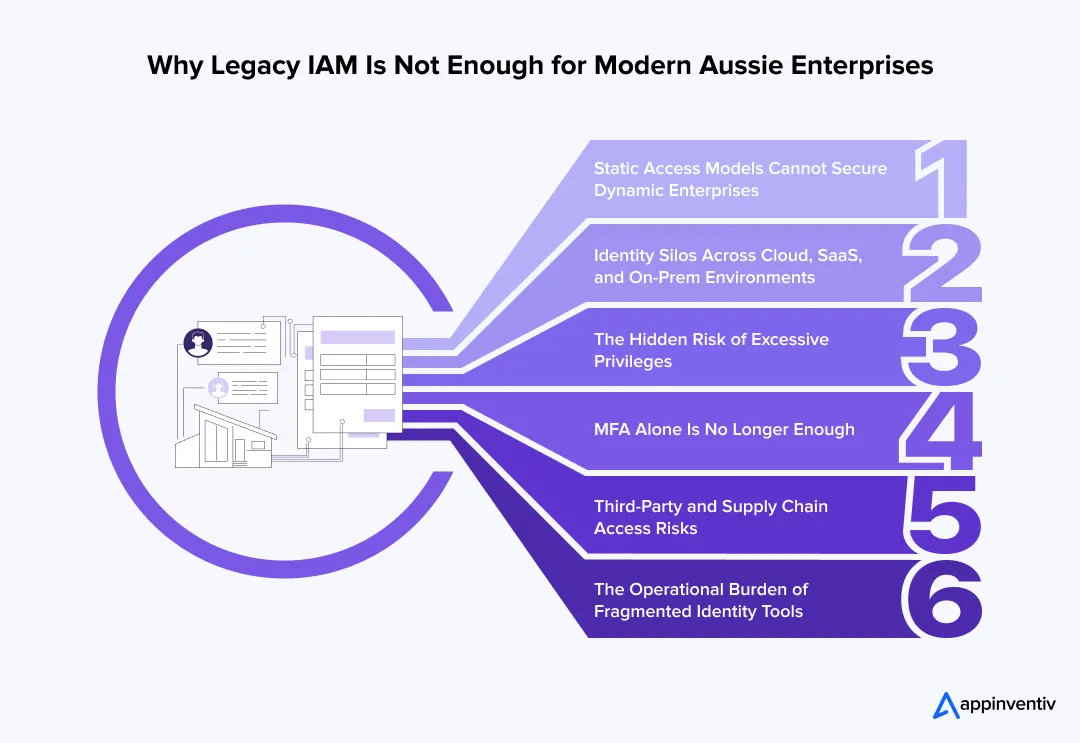
Let’s have a look at the specific technical and operational friction points, from static privilege models and fragmented silos to the inherent weaknesses of traditional MFA, that make legacy IAM a liability in today’s distributed enterprise.
Static Access Models Cannot Secure Dynamic Enterprises
Legacy IAM assigns access at provisioning time and rarely revisits it unless a specific event forces a review. In practice, employees accumulate permissions across role changes. Contractors retain access after engagement ends. Privilege creep becomes endemic.
Identity Silos Across Cloud, SaaS, and On-Prem Environments
Most large Australian enterprises have identity stores distributed across Active Directory, cloud IAM layers, and individual SaaS directories. These silos create inconsistent policy enforcement and significant gaps in visibility. When an employee leaves, deprovisioning their Active Directory account does not revoke their SaaS access. The governance gap between systems is where access control failures originate.
MFA Alone Is No Longer Enough
Multi factor authentication (MFA) remains necessary, but it is no longer sufficient. Push-based MFA can be defeated through fatigue attacks. Real-time phishing proxies intercept tokens in transit. SIM swapping compromises SMS-based authentication. Enterprises that have deployed MFA and consider the authentication problem solved are operating on an outdated model.
Third-Party and Supply Chain Access Risks
Vendor and contractor access introduces identity risk that is structurally different from internal employee risk. Supply chain attacks, where a vendor’s compromised account accesses the primary enterprise environment, have become a primary concern for Australian security teams and regulators. APRA CPS 230, effective July 2025, imposes specific obligations on regulated entities regarding third-party access governance.
Here is a brief table outlining the key differences between Legacy IAM and modern identity architecture in Australia
| Legacy IAM | Modern Identity Architecture |
|---|---|
| Static authentication | Continuous verification |
| Human-centric | Human + machine identities |
| Periodic review | Real-time governance |
| MFA-centric | Adaptive trust |
| Siloed tooling | Identity fabric |
Case Study 1: Unmanaged Vendor Access in a Financial Services Firm
We worked with a mid-sized Australian financial services organisation that had accumulated over 340 active vendor accounts across its production environment. More than 60% of those accounts had not been reviewed in over 18 months. Several belonged to vendors whose contracts had ended.
Within six weeks of deploying a structured third-party identity governance program, the organisation reduced its active vendor footprint by 40% and established automated deprovisioning tied to contract management workflows. The audit finding that had been open for two years was closed.
6 Core Pillars of Modern Enterprise Access Architecture
Modern architecture moves beyond simple login portals to create a resilient “identity fabric” that connects disparate systems. This evolution focuses on six critical pillars – Zero Trust, unified orchestration, identity threat detection (ITDR), adaptive trust, passwordless systems, and real-time observability, to secure the enterprise against 2026’s sophisticated threat landscape.
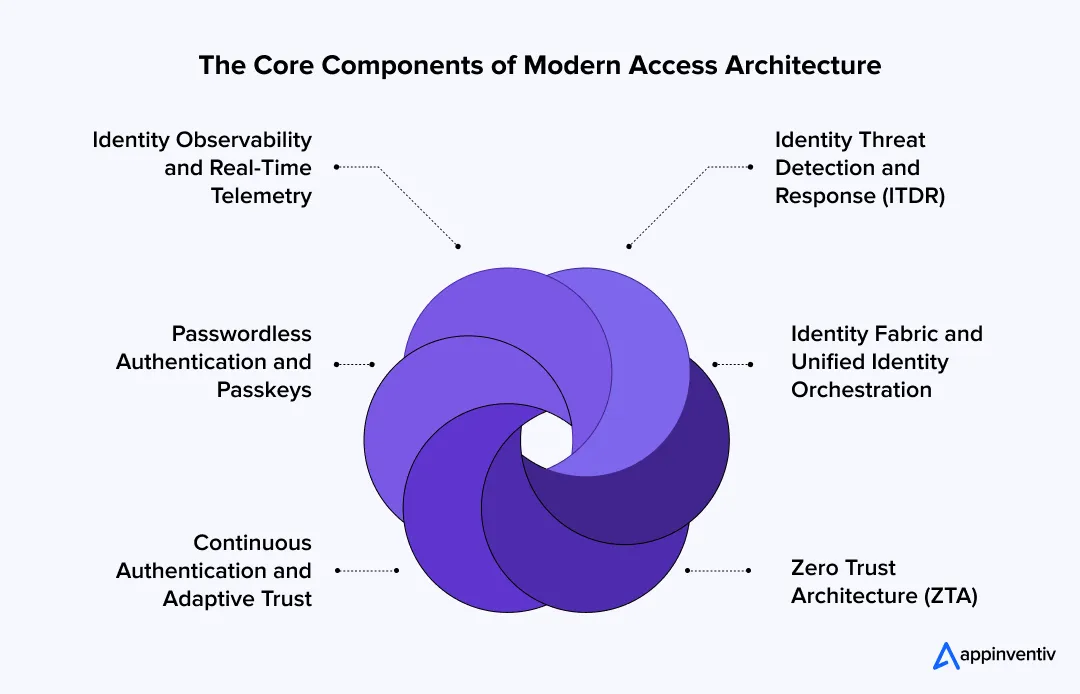
Zero Trust Architecture (ZTA): Zero Trust architecture in Australia removes implicit trust from the network, requiring continuous verification for every user and device, regardless of location.
Identity Fabric and Unified Identity Orchestration: An identity fabric unifies fragmented tools into a single layer, ensuring consistent security policies across cloud, SaaS, and on-premises environments.
Identity Threat Detection and Response (ITDR): ITDR focuses specifically on protecting identity infrastructure, detecting credential misuse and lateral movement that traditional endpoint tools often miss.
Continuous Authentication and Adaptive Trust: Access is no longer a one-time event; adaptive trust models continuously monitor session risk, stepping up authentication if behavior shifts.
Passwordless Authentication and Passkeys: By removing passwords, enterprises eliminate the primary vector for phishing, replacing them with secure, biometric-based FIDO2 passkeys and device-bound factors.
Identity Observability and Real-Time Telemetry: Real-time telemetry provides deep visibility into identity health, allowing security teams to discover “zombie” accounts and excessive permissions before exploitation.
What Are The Modern Enterprise Identity Stack Australian Organisations Are Building in 2026
Enterprise identity management system development in Australia is moving beyond single-vendor IAM platforms toward an integrated stack of purpose-built capabilities. Organisations investing in this architecture are doing so with long-term operational resilience and audit readiness as primary design criteria.
The components that comprise a modern enterprise identity stack are well established. What differs is how they are integrated, sequenced, and governed. Here is a brief table outlining these components:
| Capability | Primary Function | Australian Compliance Driver |
|---|---|---|
| Identity Governance & Administration (IGA) | Role definition, access certification, policy management | Privacy Act 1988, APRA |
| Privileged Access Management (PAM) | Governs admin and elevated access, session recording | Essential Eight ML2/ML3, APRA |
| Machine Identity Security | Certificates, API keys, secrets lifecycle management | SOCI Act, ISO 27001 |
| Just-in-Time (JIT) Access | Eliminates standing privileges; time-bound elevation | Essential Eight, APRA CPS 230 |
| ITDR / Behavioural Analytics | Risk scoring, anomaly detection, SOC integration | ASD Essential Eight |
| Workload Identity / CI-CD | Governs pipeline credentials and build system access | ISO 27001, SOC2 |
Australia’s Regulatory Pressure Is Accelerating Identity Modernisation
Regulatory frameworks across Australia are converging on identity security as a core operational resilience requirement. Compliance is no longer a justification for identity investment. It is a baseline expectation that informs how architecture is designed, evidenced, and sustained.
| Regulatory Framework | Identity Security Implication |
|---|---|
| ASD Essential Eight (ML2/ML3) | Requires structured PAM, phishing-resistant MFA, and application control |
| APRA CPS 230 (effective July 2025) | Third-party access governance; operational resilience obligations |
| Privacy Act 1988 (reform pending) | Access logs and identity data now within scope of privacy obligations |
| SOCI Act 2018 (amended) | Risk management programs must include access control governance for CII operators |
| ASD Zero Trust Guidance | Identity positioned as primary control boundary for enterprise security |
| Cyber Insurance Underwriters | PAM, MFA, and ITDR now standard underwriting assessment criteria |
Here , two points are worth emphasising for enterprise leaders.
- First, cyber insurers are now explicitly evaluating identity posture during underwriting. Organisations that cannot demonstrate PAM controls, phishing-resistant MFA, and identity monitoring face higher premiums, reduced coverage, or outright exclusions. Identity investment has a measurable effect on total insurance cost.
- Second, APRA CPS 230 creates obligations that most organisations have underestimated. The third-party access governance requirements alone, governing how vendors and contractors access regulated systems, implicate identity architecture decisions that many APRA-regulated entities have not yet addressed.
Talk to Appinventiv’s identity security team to find out where your gaps are.

Industry-Specific Identity Security Challenges Across Australian Enterprises
While the fundamental principles of identity and access management for Australian enterprises remain consistent, the application varies significantly by sector. In 2026, there is a move away from “one-size-fits-all” IAM toward industry-aligned identity fabrics that account for unique user populations and technical environments.
A generalised identity architecture may satisfy baseline controls without addressing the specific risks that matter most. Whether it is managing the lifecycle of thousands of transient contractors or securing life-critical medical devices, the identity layer must be invisible yet omnipresent, tailored to the unique industry challenges:
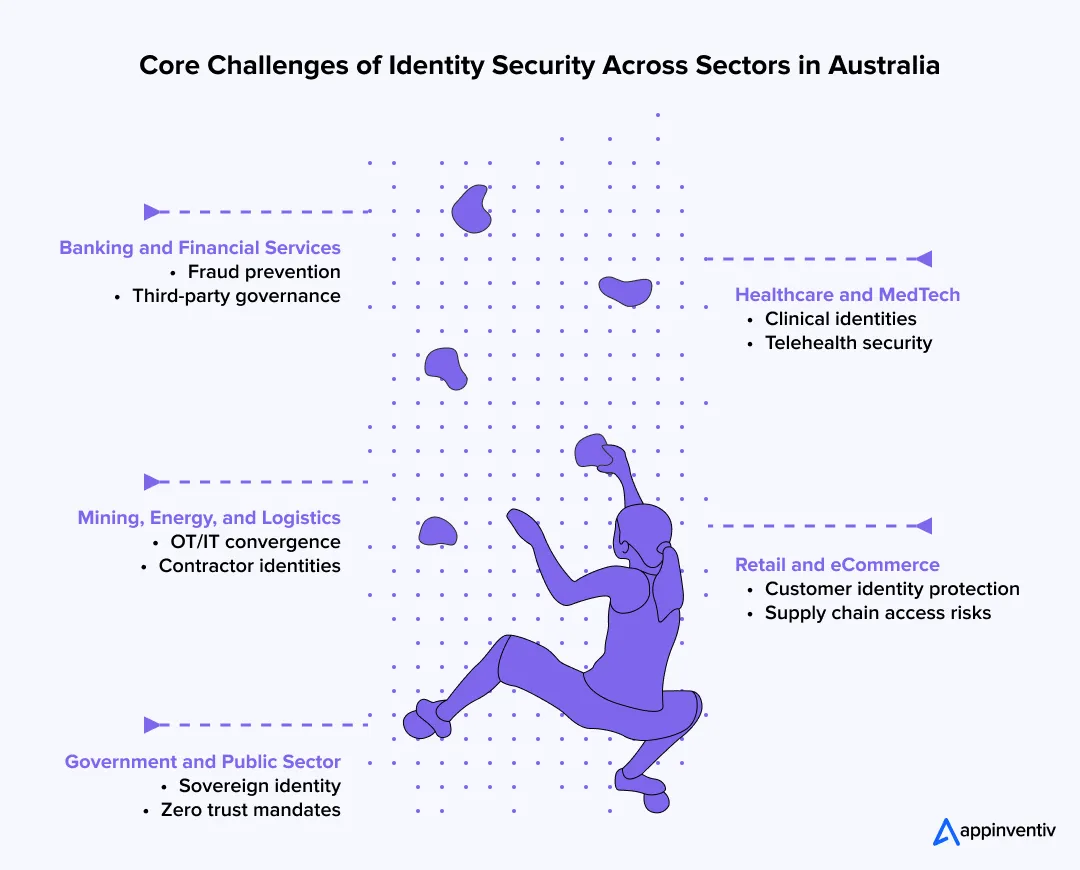
Banking and Financial Services
The financial sector faces an industrial-scale challenge with synthetic identity fraud and sophisticated account takeovers. With the Australian fraud detection market projected to reach $ 9.2 Billion by 2034, banks are integrating behavioural biometrics and real-time risk scoring into their identity stacks.
The goal is to move beyond static KYC (Know Your Customer) checks to a continuous “Know Your User” model that can detect deepfake-enabled fraud during high-value transactions.
Healthcare and MedTech
In Australian healthcare landscape, the friction between security and clinical speed is acute. Clinicians cannot afford to wrestle with complex MFA during a code blue. Consequently, hospitals are adopting “tap-and-go” proximity-based authentication and clinical-grade SSO.
Mining, Energy, and Logistics
The primary challenge in Australia’s heavy industries is the convergence of IT and Operational Technology (OT). As the IT/OT convergence market growing rapidly, mining and energy firms are struggling to govern identities across remote sites and autonomous fleets.
Securing the “identity” of a remote drill rig or a contractor in the Pilbara requires specialised PAM solutions that can operate in low-bandwidth environments while preventing unauthorised access to critical physical infrastructure.
Retail and eCommerce
For Australian retailers, identity is the gateway to both security and personalisation. While 26% of executives worldwide have prioritised AI-driven personalisation in retail, this must be balanced against supply chain access risks. Retailers are increasingly using “identity mesh” architectures to manage thousands of seasonal staff and third-party logistics partners, ensuring that temporary access is automatically provisioned and revoked to prevent “identity bloat.”
Government and Public Sector
The public sector is leading Australia’s transition to a comprehensive Zero Trust model, mandated by the ASD’s 2024-2025 cyber strategy. This involves a massive effort to move away from legacy silos toward a sovereign digital identity system.
The focus is on “never trust, always verify” for every citizen interaction and internal agency request, ensuring that government data remains secure even as the workforce becomes increasingly distributed.
Key Signs Your Enterprise Identity Architecture Needs Modernisation
Organisations that have not recently conducted a structured identity risk assessment are often carrying a risk profile that does not reflect their current environment. Several observable conditions indicate that identity architecture has not kept pace with operational or threat landscape changes.
The following conditions, taken individually, warrant attention. Taken together, they indicate an architecture that requires structured remediation.
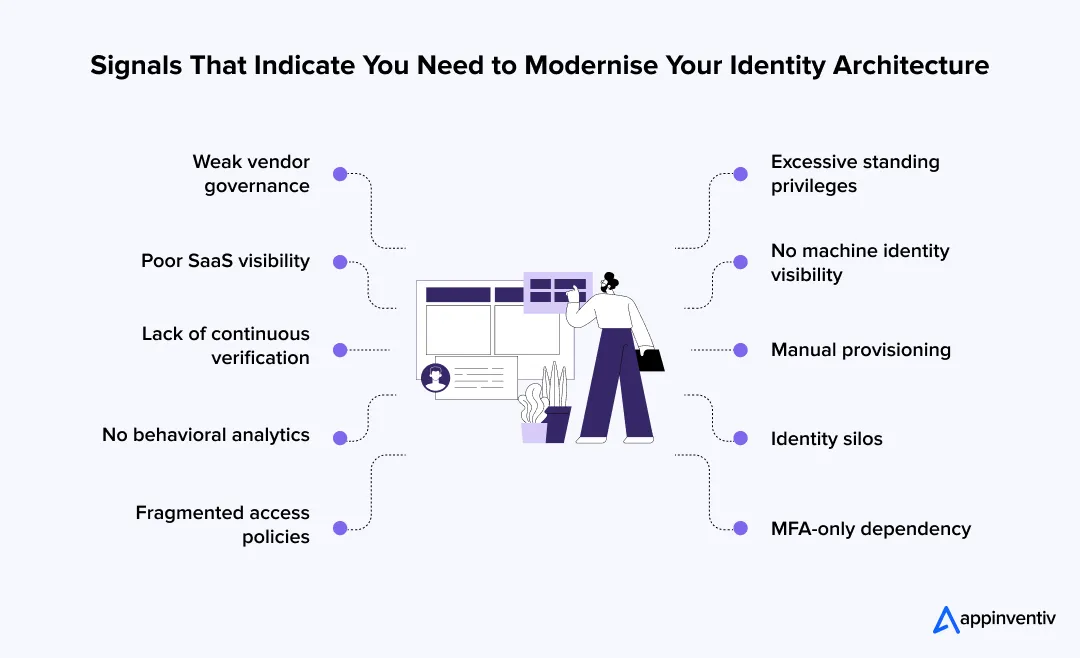
- Excessive standing privileges: accounts holding elevated access on a permanent basis with no current business justification.
- No machine identity visibility: the organisation cannot enumerate its full identity footprint, including service accounts, API keys, and certificates.
- Manual provisioning processes: ticket-based approvals and spreadsheet tracking that cannot scale with modern enterprise operations.
- Identity silos: deprovisioning in Active Directory does not trigger revocation across SaaS and cloud platforms.
- MFA-only dependency: no behavioural analytics, continuous verification, or risk-adaptive step-up beyond the MFA prompt.
- Weak vendor governance: third-party accounts are not reviewed, scoped, or automatically deprovisioned.
- No behavioral analytics: access patterns are not monitored for deviation from established baselines.
- Fragmented access policies: different teams enforce different access rules with no unified governance layer.
The Business Impact of Weak Enterprise Identity Management in Australia
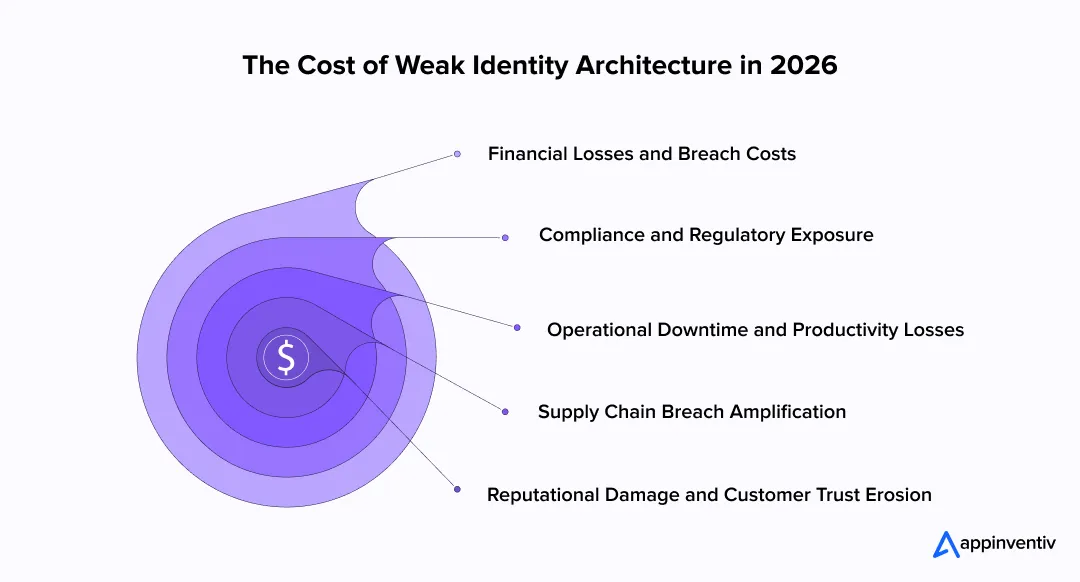
For Australian enterprises, the fallout of a data breach is reaching record levels. According to the 2024 IBM Cost of a Data Breach Report, the average cost of a breach for Australian businesses has surged to AUD 4.26 million, a 27% increase since 2020. When these breaches are traced back to identity failures, such as compromised credentials or excessive privileges; the recovery time is significantly longer, often taking an average of 266 days to identify and contain. This “identity tax” impacts every facet of the business, from direct legal penalties to long-term erosion of shareholder value. Let’s explore these losses in details:
Financial Losses and Breach Costs
The immediate financial drain of an identity breach extends beyond ransomware payments. Organisations face a surge in detection and escalation costs, which IBM identifies as the most expensive portion of a breach in Australia. This includes forensic audits, crisis management, and the massive undertaking of rotating thousands of compromised credentials and session tokens across a fragmented architecture.
Compliance and Regulatory Exposure
With the Australian government’s Privacy Act reforms, the penalties for “inadequate” access controls have become punitive. Regulators now look for systemic failures in identity governance. Fines can reach up to $50 million, or 30% of a company’s adjusted turnover, making a weak identity stack one of the largest unmitigated legal risks on a modern balance sheet.
Operational Downtime and Productivity Losses
Identity breaches often lead to “access gridlock.” When an identity provider is compromised, security teams often have to force global password resets or disable MFA tokens, bringing an entire workforce to a standstill. The ASD Annual Cyber Threat Report highlights that large Australian enterprises are seeing a 219% rise in self-reported cybercrime costs, driven largely by the operational paralysis that follows sophisticated business email compromise (BEC) and identity theft.
Supply Chain Breach Amplification
Weak identity controls don’t just affect your business; they turn your enterprise into a “pivot point” for attacking your partners. As seen in recent third-party cloud provider compromises in Australia, an adversary using a single stolen vendor credential can infiltrate multiple downstream clients. This leads to contractual breaches and “trust contagion,” where partners revoke your access to protect their own environments.
Reputational Damage and Customer Trust Erosion
The most enduring impact is the “trust deficit.” Contextual references to the Optus, Medibank, and Latitude Financial breaches serve as a grim reminder for Australian boards. Latitude Financial, for instance, set aside $53 million for remediation and incurred costs following its 2023–2024 breach. Beyond the money, the brand damage is often permanent.
Appinventiv delivers a structured identity risk assessment tailored to your unique business gap, helping you save from potential losses and and penalties.

Emerging Identity Security Trends Australian Enterprises Must Prepare For
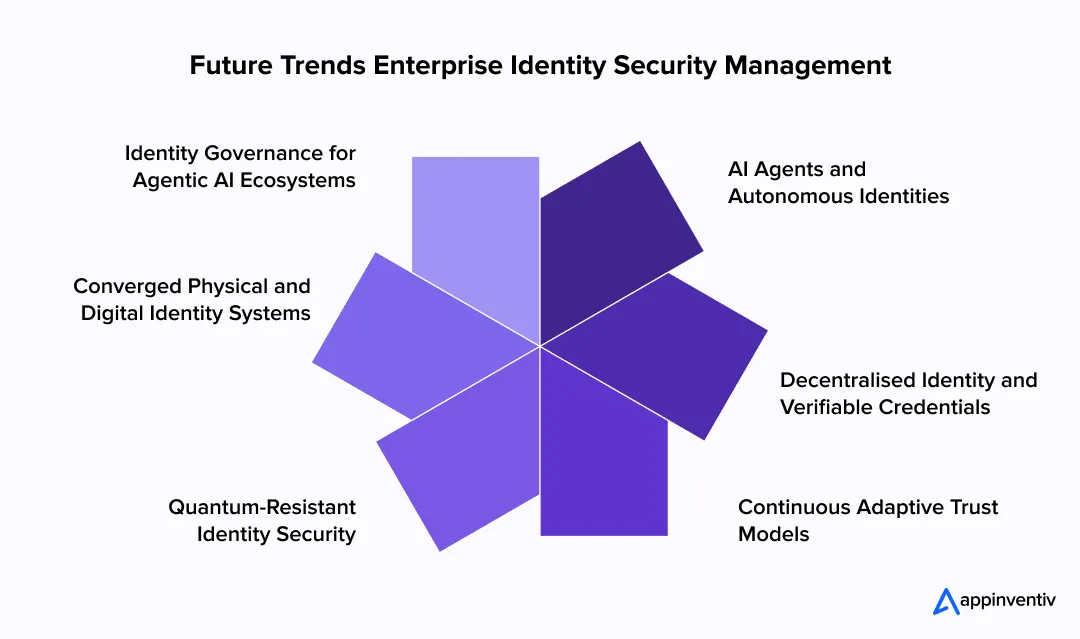
The 2026 identity landscape in Australia is defined by a shift toward “agentic” and “quantum-aware” security. These emerging trends represent a “decisive break” from the past, where trust must now be cryptographically proven and continuously defended across both human and machine interactions.
AI Agents and Autonomous Identities
Agentic AI systems in Australia operate with credentials that grant them access to enterprise systems, but they do not produce the behavioural patterns that conventional analytics tools use to detect anomalies. Governing AI agent identities requires purpose-built frameworks. Australian enterprises deploying AI automation are creating these identities now, often without adequate governance.
Decentralised Identity and Verifiable Credentials
Driven by the Australian Digital ID Act 2024, private sector entities can now participate in a national system of accredited identity providers. This move toward decentralised models allows users to control their own data through “Verifiable Credentials,” reducing the need for organisations to store high-risk personal documents and lowering the overall “data breach surface.”
Continuous Adaptive Trust Models
Static authentication is being replaced by models that evaluate risk in real-time. If an AI agent or employee attempts an action that deviates from their established behavioral baseline, the system automatically triggers a “step-up” authentication or restricts access until the risk is mitigated.
Quantum-Resistant Identity Security
With 2030 set as a mandatory transition window, 2026 has become the “Year of Quantum Security” for proactive Australian enterprises. Leadership teams are now prioritising Post-Quantum Cryptography (PQC) readiness, identifying high-risk identity systems that use vulnerable encryption and replacing them with quantum-resistant alternatives to prevent “harvest now, decrypt later” attacks.
Identity Governance for Agentic AI Ecosystems
As AI agents begin to communicate “AI-to-AI” without human intervention, new protocols like the Model Context Protocol (MCP) are emerging. Governing these machine-to-machine dialogues is the new frontier of risk, requiring identity frameworks that can audit the “intent” and “authorisation” of autonomous code in real-time.
Appinventiv Australia’s team can scope a phased delivery roadmap aligned to your regulatory obligations and risk profile.

How Australian Enterprises Can Build a Future-Ready Identity Security Framework: A Step by Step Process
Enterprise identity management system development in Australia is no longer a “set and forget” project. It is a continuous evolution that must balance high-assurance security with a friction-free user experience. The transition usually happens in stages as organisations move from fragmented IAM environments toward adaptive, intelligence-driven identity governance models.
Across enterprise modernisation programs, there are typically five distinct maturity stages that shape enterprise identity management in Australia.
| Identity Maturity Stage | Enterprise Characteristics |
|---|---|
| Reactive IAM | Basic authentication controls with fragmented visibility and manual provisioning |
| Centralised IAM | Consolidated workforce authentication and standardized access governance |
| Identity Fabric | Unified identity orchestration across cloud, SaaS, on-prem, and third-party ecosystems |
| Adaptive Identity | Continuous risk evaluation using behavioral analytics, telemetry, and adaptive trust models |
| Autonomous Identity Governance | AI-assisted policy enforcement, machine identity governance, and real-time access remediation |
Most enterprises today operate between the centralised IAM and identity fabric stages, while threat environments are already evolving toward autonomous identity ecosystems driven by AI agents, machine identities, and continuous trust validation.
The steps to implement enterprise identity management system in Australia mentioned roadmap below reflects how organisations can modernise identity architecture progressively without disrupting existing operations.
| Phase | Key Actions |
|---|---|
| 1. Identity Risk Assessment | Enumerate all human, machine, and AI agent identities; assess access rights against business justification; surface architectural gaps |
| 2. Discover and Classify | Build a complete identity inventory across cloud, on-prem, and SaaS; identify ungoverned machine identities |
| 3. Consolidate Silos | Implement an identity fabric to enforce consistent policy above existing systems without requiring a big-bang migration |
| 4. Risk-Adaptive Controls | Integrate behavioural analytics, risk scoring, and step-up authentication to replace static policy rules |
| 5. Secure Third-Party Access | JIT provisioning for vendor access; automated deprovisioning tied to contract management; privileged session recording |
| 6. SOC Integration | Feed identity telemetry into security operations for correlation with endpoint and network signals |
| 7. Passwordless Transition | Deploy FIDO2 passkeys for workforce authentication; eliminate the credential theft attack surface |
| 8. Continuous Governance | Automated access reviews, dormant account detection, and time-bound access grants replace periodic audit cycles |
Case Study 2: A Phased Identity Transformation for a State Government Agency
We supported a state government agency managing over 8,000 identities across a hybrid environment that had accumulated significant architectural debt over a decade of unplanned cloud adoption.
Rather than a full platform replacement, we implemented an identity fabric layer above existing systems, delivered Zero Trust access controls for high-risk roles in the first phase, and integrated identity telemetry with the agency’s SOC in the second.
By the end of phase two, the agency had met its Essential Eight Maturity Level 2 obligations for privileged access and MFA, passed its ASD assessment, and reduced identity-related helpdesk tickets by 35%.
Why Appinventiv Is the Strategic Technology Partner for Identity-Centric Security Transformation
Solving the crisis of enterprise identity management in Australia requires an experienced tech partner who understands the intersection of legacy re-architecture and modern AI-driven governance.
Appinventiv in Australia provides the delivery depth and local compliance expertise necessary to transform identity from a fragmented liability into a resilient, high-assurance enterprise asset.
Australian enterprises choose to hire enterprise identity management developers in Australia from Appinventiv because we understand that identity is the foundation of digital trust. Whether you are a mining giant integrating IT/OT identities or a financial institution aligning with APRA CPS 230, our approach is grounded in commercial pragmatism and execution depth.
As a premier digital product engineering partner in Australia, we don’t just implement tools; we engineer sovereign, secure systems that satisfy the rigorous transparency requirements of the Australian market.
We are an approved supplier on the Queensland Government ICTSS and Local Buy LGA procurement panels, and our entry into the Federal Digital Marketplace in 2025 further validates our commitment to Australian sovereign security. We have spent over 11 years navigating the complexities of APAC’s regulated environments.
Our team of over 1,600 tech experts has deployed 3,000+ digital assets, maintaining a 99.5% security compliance SLA. They help you move from strategy to production-ready systems, ensuring your identity architecture is not just compliant, but a catalyst for secure, scalable innovation.
Talk to Appinventiv Australia’s identity security team today. We will scope your program, identify your highest-priority risks, and build a roadmap that is executable and compliant from day one.
FAQs
Q. How does enterprise identity management work in Australia?
A. Enterprise identity management in Australia combines identity governance, access control, privileged access management, and authentication technology to ensure the right individuals and systems access the right resources under the right conditions.
Q. How do you build an enterprise identity management system in Australia?
A. Building an enterprise identity management system in Australia begins with a structured identity risk assessment and a full inventory of existing identities across human, machine, and application categories. Architecture is then designed around specific compliance obligations, cloud environment, and operational risk profile.The steps to implement enterprise identity management system in Australia always begin with discovery and governance before technology deployment. Regulatory alignment should be designed in from the outset, not retrofitted.
Q. What are the biggest identity security risks for Australian enterprises?
A. The most significant identity security risks for Australian enterprises include credential theft and phishing as leading initial attack vectors; MFA fatigue and bypass techniques that defeat conventional multi-factor controls; excessive standing privileges that amplify the damage of any compromised account; ungoverned machine and non-human identities; unstructured third-party access; and AI-enabled attack techniques including voice cloning and deepfake-based identity fraud.
Q. How much does enterprise identity management cost in Australia?
A. The cost of enterprise identity management system development in Australia ranges between AUD 70,000 and AUD 700,000 or more. The cost varies based on environment scope, integration complexity, and compliance requirements.
For instance, foundational implementations for mid-sized enterprises typically range from AUD 70,000 to AUD 400,000. Comprehensive programs for large enterprises with complex environments can range from AUd 400,00 to AUD 700,000 or more.
Q. What are the biggest challenges of implementing enterprise identity management in Australia?
A. The most common challenges include legacy system integration where older applications do not support modern authentication protocols; managing identity silos across cloud, SaaS, and on-premise environments without disruptive migrations; governing third-party identities outside the enterprise’s direct control; maintaining compliance with multiple overlapping regulatory frameworks simultaneously; and sustaining governance post-implementation as access environments change continuously. Organisations also frequently underestimate the scale of their non-human identity footprint, which compounds the complexity of initial discovery.
Q. What are the key benefits of access and identity management for Australian enterprises?
A. The benefits of access and identity management for Australian enterprises span security, compliance, and operational efficiency. Structured identity governance reduces the risk of credential-based breaches, shrinks the blast radius of any compromise, and provides the audit evidence that regulators and insurers require. Operationally, automated provisioning and deprovisioning reduce IT overhead and accelerate onboarding. Organisations with mature identity programs also report faster incident response times and measurably lower cyber insurance premiums.
Q. What is enterprise identity management and why is it important?
A. Enterprise identity management is the organisational process for identifying, authenticating, and authorising individuals or groups to have access to applications, systems, or networks. It is critical because identity has become the primary attack surface for 2026’s credential-based cyber threats.


Fast 2-minute response, fully NDA-protected.

Key takeaways: State regulations shape your cloud choices, security configurations, and system layouts long before code is written. Saudi laws demand built-in protections across mobile applications, cloud software, machine learning platforms, and corporate tools. Early design planning cuts code rewrites, network threats, buyer procurement delays, and long-term engineering budgets. Separate business sectors require distinct technical…

Enterprise Regulatory Risk Management in Australia: Challenges, Strategies, and Solutions
Key takeaways: Policy documents no longer protect you. Regulators now demand hard technical proof that your operational controls actually work. Manual spreadsheets and yearly audits create dangerous blind spots. Legacy setups simply break under intense CPS 230 and FAR pressure. High-performing enterprise risk management frameworks in Australia hardwire boardroom strategy directly into the technical architecture…

Digital Maturity Assessment for Australian Enterprises: Where You Are, Where You Need to Be
Key takeaways: Digital maturity has evolved from a transformation metric into a core indicator of operational resilience, governance readiness, and long-term enterprise scalability across Australia. AI adoption is exposing weaknesses in data quality, governance, and operational agility that digitisation spending alone cannot fix. CPS 230, CPS 234, the SOCI Act, and Privacy Act reforms are…