































Cloud Migration Strategy for Enterprises in Australia: Benefits, Implementation Process and Tools

 Share -


- 01What Are the Cloud Migration Types and Which Model Fits Your Organisation in Australia?
- 02The 7Rs of Cloud Migration: The Decision Framework That Matters
- 03Compliance Requirements of Cloud Migration Strategy for Enterprises in Australia
- 04Key Benefits of Cloud Migration for Australian Enterprises
- 05Cloud Migration Implementation Process in Australia: Step-by-Step
- 06How Long Does Enterprise Cloud Migration Take in Australia?
- 07How Much Does Cloud Migration Cost in Australia?
- 08What Are the Challenges of Cloud Migration in Australia and How to Address Them
- 09The Future of Cloud Migration in Australia
- 10How Appinventiv Supports Cloud Migration in Australia
- 11FAQs

Key takeaways:
- The Australian Government’s Whole-of-Government Cloud Policy, effective 1 July 2026, requires all APS agencies to adopt cloud for new digital initiatives and decommission legacy systems.
- The 7Rs framework – Rehost, Replatform, Refactor, Repurchase, Retire, Retain, Relocate – is the industry-standard decision model for choosing the right migration strategy.
- Cloud migration costs in Australia range from approximately AUD 70,000 for small-scope engagements to over AUD 700,000 for large government or regulated enterprise programmes.
- A well-executed cloud migration strategy for enterprises in Australia reduces infrastructure costs, shortens time-to-market, and creates the technical foundation needed for AI and automation workloads.
Most cloud migration decisions in Australia don’t begin with a board resolution. They begin with something far more mundane: a system that’s too slow on a Monday morning, a patch cycle that eats three days every quarter, or a critical integration that simply will not work with newer platforms. These small frustrations accumulate into a strategic problem that leaders eventually cannot ignore.
According to an IDC whitepaper commissioned by Microsoft, public cloud spending in Australia is forecast to reach AUD 22.4 billion in 2026, up from AUD 12.2 billion in 2022; an 83% increase. That growth is not speculative; it reflects enterprises across banking, healthcare, logistics, retail and the public sector actively replacing on-premise infrastructure with cloud environments that are faster to scale, easier to secure and better suited to modern workloads.
But growth figures only tell part of the story. The more telling signal is regulatory momentum. The Australian Government’s Whole-of-Government Cloud Computing Policy, taking effect on 1 July 2026, mandates that all Australian Public Service (APS) agencies adopt cloud for new digital initiatives and put legacy systems on a decommissioning schedule. For private sector organisations, this sends an unambiguous message: cloud-native is no longer an aspiration; it is the baseline.
This blog is for CIOs, CTOs, technology leaders and IT managers who need a grounded understanding of what a cloud migration strategy actually involves. This Cloud migration strategy for enterprises in Australia covers the 7Rs decision framework, compliance obligations under APRA and the Privacy Act 1988, cost benchmarks, implementation process, and a candid look at the challenges most programmes run into. It also covers what good cloud migration consulting in Australia looks like and what to look for when you’re ready to hire cloud migration consultants in Australia to support delivery.
Speak to our certified cloud architects in Australia to map out a clear, compliant strategy for your enterprise.

What Are the Cloud Migration Types and Which Model Fits Your Organisation in Australia?
A cloud migration strategy is a documented plan that defines how an organisation will move its applications, data, infrastructure and workloads from on-premises systems or from one cloud environment to another into a target cloud platform.
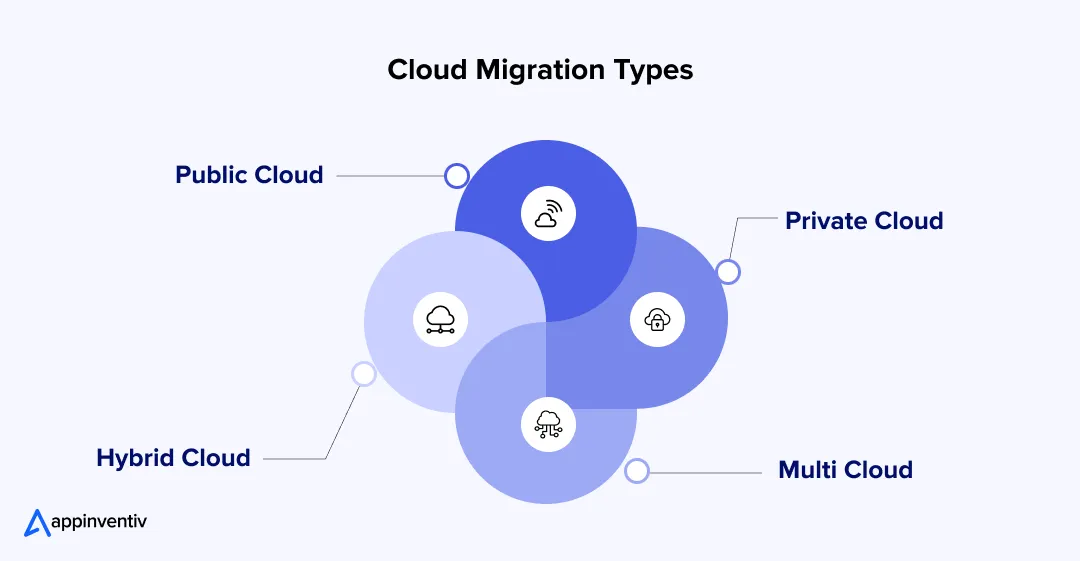
However, before mapping out a migration strategy, it helps to understand the different cloud deployment models available. Each suits a different profile of organisation, depending on compliance requirements, workload sensitivity, cost tolerance and technical maturity.
Public Cloud
In a public cloud model, infrastructure is owned and operated by a hyperscaler, Amazon Web Services (AWS), Microsoft Azure or Google Cloud Platform (GCP), and shared across multiple tenants. Australian regions are available in Sydney (AWS ap-southeast-2, Azure Australia East), Melbourne (Azure Australia Southeast), and Brisbane (AWS ap-southeast-4, GCP). For most enterprise workloads that do not involve highly sensitive data, public cloud offers the best combination of cost, scale and capability.
Private Cloud
A private cloud dedicates infrastructure to a single organisation, either hosted on-premises or in a co-location facility. It is more expensive to operate but provides the control and isolation required for workloads subject to strict data sovereignty rules; for example, certain defence, law enforcement or medical record applications.
Hybrid Cloud
Most large Australian enterprises run hybrid architectures: some workloads in public cloud, some retained on-premises, connected via private network links or SD-WAN. This is the dominant model for APRA-regulated entities, which often cannot move payment systems or certain customer records to public cloud without additional safeguards.
Multi-Cloud
A growing number of Australian organisations, particularly those with board-level concerns about vendor lock-in, are distributing workloads across two or more public cloud providers. Multi-cloud strategy adds operational complexity but provides resilience, negotiating leverage and the ability to use best-of-breed services from different providers.
The 7Rs of Cloud Migration: The Decision Framework That Matters
The 7Rs framework is the industry-standard model for deciding what to do with each application or workload during a cloud migration programme. Choosing the right approach for each application is an important part of any cloud migration strategy for enterprises in Australia.
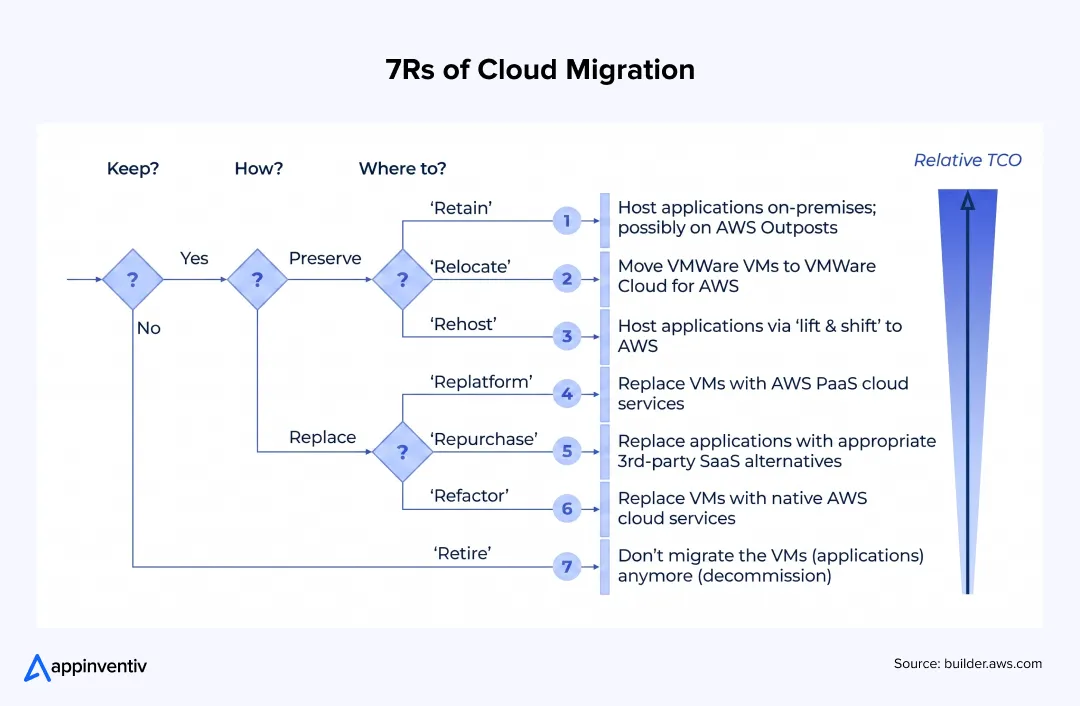
The table below explains each strategy, when to apply it, and provides Australian enterprise examples drawn from Appinventiv’s delivery experience.
| Migration Strategy | What It Means | When to Use It |
|---|---|---|
| Rehost (Lift & Shift) | Move workloads to the cloud with no changes | Legacy apps with tight timelines and low modernisation budget |
| Replatform (Lift, Tinker & Shift) | Move with minor optimisations e.g. swap DB engine, adopt managed services | Apps that benefit from cloud-native services but cannot be re-architected quickly |
| Refactor / Re-architect | Redesign the application to be cloud-native, often as microservices | High-value apps where scalability and speed are business-critical |
| Repurchase | Replace legacy app with a cloud-based SaaS product | Commoditised functions (HR, CRM, ERP) where build vs. buy tips to buy |
| Retire | Decommission applications that are no longer needed | Redundant, duplicate, or rarely-used systems identified during discovery |
| Retain | Keep applications on-premises for now | Systems with regulatory constraints, latency sensitivity, or near-end-of-life that are uneconomical to migrate |
| Relocate | Move infrastructure to cloud without changing the OS, app or data | VMware environments moving to VMware Cloud on AWS or Azure VMware Solution |
Most Australian enterprise migration programmes apply a mixed-strategy approach; rehosting the majority of workloads for speed, replatforming a subset to gain managed service benefits, refactoring the small number of high-value applications where cloud-native architecture creates genuine competitive advantage, and retiring the systems that should have been switched off years ago.
Appinventiv Insight
During a recent engagement with an Australian financial services organisation, Appinventiv’s cloud migration consulting team conducted a workload discovery across 180 applications. The assessment categorised 60% as candidates for rehost, 22% for replatform, 8% for refactor, and 10% for retirement. Decommissioning those 18 redundant applications alone reduced the migration scope by 10% and freed significant licensing budget before the programme had moved a single production workload.
Prepare your enterprise for a smooth cloud transition with a practical checklist covering pre-migration planning, migration execution, and post-migration optimisation.

Compliance Requirements of Cloud Migration Strategy for Enterprises in Australia
Compliance is not a late-stage consideration in Australian cloud migration programmes. It is a design constraint that shapes every architectural decision from day one. Organisations that treat it as an afterthought consistently face rework, delayed go-lives and, in regulated sectors, regulatory enquiry.
The table below maps the most relevant Australian regulatory frameworks to their cloud migration obligations.
| Framework / Regulation | Who It Applies To | Key Cloud Migration Obligation |
|---|---|---|
| Privacy Act 1988 (Cth) + Privacy and Other Legislation Amendment Act 2024 | Most private and public sector entities handling personal data | Data must be stored within Australia or in countries with equivalent protection unless exceptions apply; breach notification within 72 hours |
| APRA CPS 234 (Information Security) | All APRA-regulated entities: banks, insurers, super funds | Cloud providers assessed as material service providers; third-party risk management; annual security control testing |
| APRA CPG 234 (Guidance) | Same as CPS 234 | Practical guidance on cloud risk classification, vendor due diligence, and incident response obligations |
| ASD Essential Eight | Federal government agencies; strongly recommended for private sector | Patch OS, restrict admin privileges, application control, MFA – all must be maintained post-migration |
| APS Whole-of-Government Cloud Policy (eff. 1 July 2026) | All Australian Public Service agencies | Cloud-first for new digital initiatives; legacy systems to be decommissioned on a defined schedule |
| NSW Privacy and Personal Information Protection Act (PPIPA) | NSW state government agencies | Personal information must not leave NSW or Australia without approval; relevant for cloud deployments in NSW Health, Transport, Education |
| ISO 27001 / SOC 2 Type II | Enterprise vendors and cloud service providers | Expected by enterprise procurement teams; demonstrates controls over access, availability, processing integrity, confidentiality |
The APS Whole-of-Government Cloud Policy: What It Means in Practice
Effective 1 July 2026, the Australian Government’s Whole-of-Government Cloud Computing Policy requires all APS agencies to adopt cloud for new digital initiatives. For agencies yet to start, this creates an immediate urgency.
For private sector organisations supplying services to government, it signals that cloud-native capability is becoming a procurement prerequisite; not just a differentiator.
Practically, this means APS agencies need to accelerate discovery and workload assessment activities, establish cloud landing zones aligned with the Australian Government Information Security Manual (ISM) and the ASD Essential Eight, and put legacy decommissioning schedules in place. Suppliers and integrators who can support this work need to hold appropriate government panel approvals.
Data Residency and Sovereignty
Federal and state regulations require sensitive data to remain on Australian soil. AWS, Azure and GCP all operate local regions in Sydney, Melbourne and Brisbane that satisfy Australian data residency requirements for standard workloads. However, cloud architecture must be explicitly designed to enforce these boundaries through region locking, data classification tagging, and egress controls.
Key Benefits of Cloud Migration for Australian Enterprises
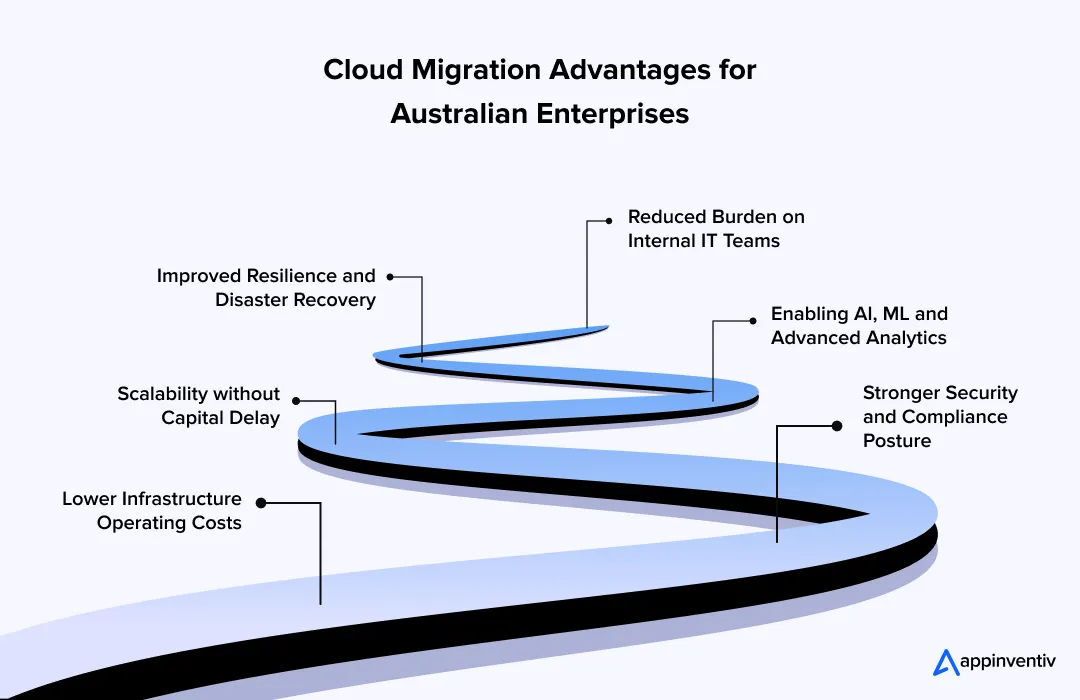
When Australian organisations move through a well-planned cloud migration programme, the operational improvements tend to show up across several dimensions simultaneously rather than in one dramatic change. Here are the benefits that matter most to enterprise leaders in 2026.
Lower Infrastructure Operating Costs
On-premises data centre costs like hardware refresh cycles, facilities, licensing, and specialist staffing accumulate in ways that are easy to underestimate. Cloud migration shifts capital expenditure into operational expenditure and introduces consumption-based pricing. Combined with FinOps disciplines like rightsizing and reserved instance purchasing, most Australian enterprises achieve 20–40% reductions in infrastructure spend within 18 months of migration.
Stronger Security and Compliance Posture
Cloud hyperscalers invest billions annually in security capabilities that most individual organisations cannot match on their own. Migrating to AWS, Azure or GCP provides access to identity and access management, encryption at rest and in transit, Security Information and Event Management (SIEM) integration, and automated compliance monitoring; all aligned with Australian frameworks including the ASD Essential Eight, APRA CPS 234 and the Privacy Act.
Scalability without Capital Delay
For Australian retailers managing peak trading periods, logistics businesses handling demand spikes, or healthcare systems responding to crisis events, the ability to scale compute in minutes rather than months is operationally transformative. Cloud elasticity removes the planning buffer organisations have historically maintained in on-premises hardware, reducing both cost and the risk of under-provisioning during critical periods.
Enabling AI, ML and Advanced Analytics
Most AI and machine learning workloads are impractical to run on legacy on-premises infrastructure because of GPU requirements, training data volumes and the pace at which models need to be updated. Cloud environments provide native access to managed AI services, including AWS SageMaker, Azure AI Foundry and Google Vertex AI, that Australian enterprises can use without building and maintaining specialised infrastructure. For organisations planning GenAI or predictive analytics programmes, cloud migration is a prerequisite rather than a parallel initiative.
Improved Resilience and Disaster Recovery
Cloud-native architectures support multi-zone and multi-region redundancy that is difficult and expensive to replicate on-premises. For Australian organisations, particularly those in sectors where uptime is a regulatory obligation (financial services, healthcare, critical infrastructure), cloud migration significantly reduces recovery time objectives (RTO) and recovery point objectives (RPO) against realistic failure scenarios.
Reduced Burden on Internal IT Teams
One underappreciated cloud migration benefit for Australian enterprises is the shift in how IT teams spend their time. When managed cloud services handle patching, monitoring, capacity planning and infrastructure provisioning, internal engineers can redirect their effort toward product and platform improvements that directly drive business value. This is particularly meaningful in the current Australian technology labour market, where skilled infrastructure specialists are both scarce and expensive.
Cloud Migration Implementation Process in Australia: Step-by-Step
Understanding the cloud migration implementation process in Australia helps leadership teams set realistic expectations, allocate resources appropriately, and avoid the programme management failures that cause most cost and time overruns.
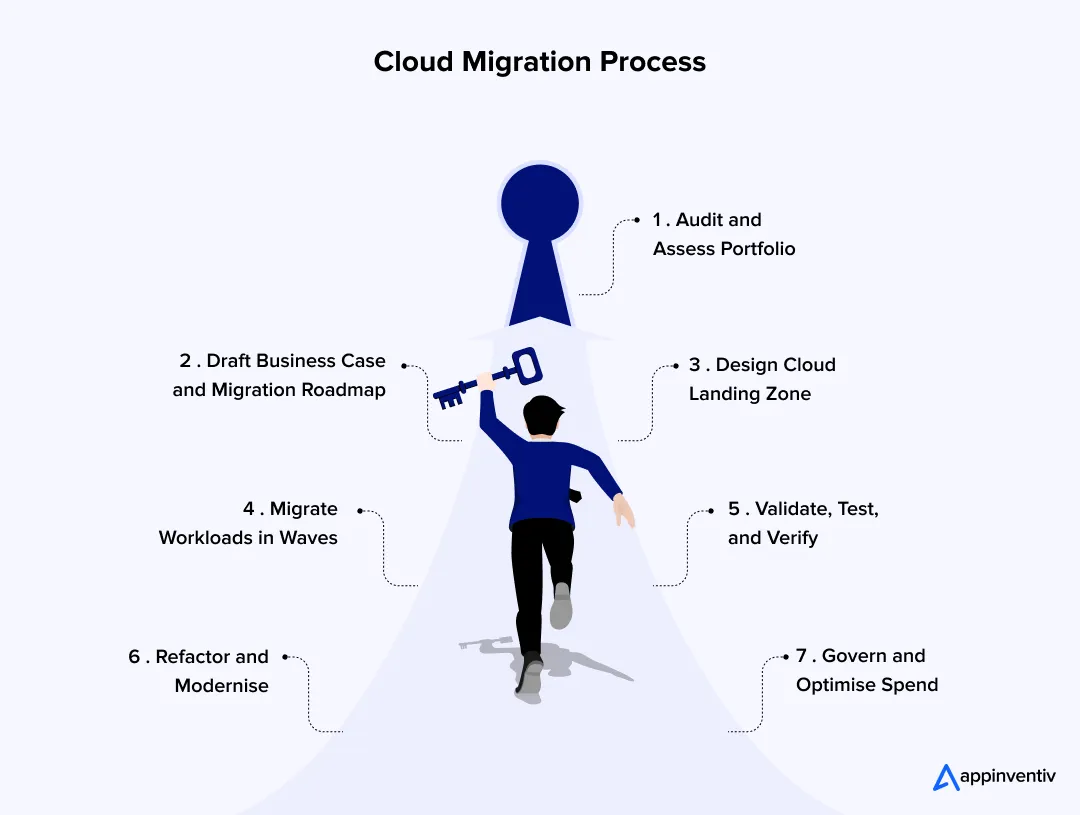
Audit and Assess Portfolio
Every migration begins with understanding what you have. This means cataloguing all applications, databases, integrations and infrastructure components; then assessing each one for performance, dependency, usage, data classification and regulatory status.
In Australian enterprise environments, this phase frequently surfaces two things: more applications than anyone expected, and legacy integrations that are undocumented. Skipping or rushing this phase is the most common cause of migration overruns.
Draft Business Case and Migration Roadmap
Once the portfolio is understood, the next step is building a business case that connects migration decisions to measurable outcomes – cost reduction, risk reduction, speed to market, or AI readiness. A well-structured roadmap also defines go/no-go criteria for each wave and establishes rollback protocols before production workloads are touched.
Design Cloud Landing Zone
A cloud landing zone is the governed, pre-configured foundation in which workloads will run — network topology, identity and access management, security controls, logging, and compliance guardrails. For Australian enterprises, landing zone design must reflect data residency requirements, APRA or Privacy Act obligations, and ASD Essential Eight controls.
A poorly designed landing zone creates compliance debt that is expensive to unwind after migration.
Migrate Workloads in Waves
Workloads migrate in phased waves, starting with lower-risk systems to build team confidence and surface unforeseen issues before mission-critical applications are moved. Each wave includes pre-migration testing, cutover execution, post-migration validation, and a defined hypercare period during which the original environment remains available for rollback.
Validate, Test, and Verify
Once workloads are staged in the target cloud environment, your team must execute a rigorous testing and quality assurance phase before full decommissioning. Your testing strategy must include:
- Security testing: Scan the newly deployed environment for vulnerabilities and test access controls, ensuring compliance with APRA CPS 234.
- Performance testing: Run load, latency, and capacity tests to ensure the system handles peak data volumes while operating in the cloud.
- Data integrity validation: Use checksum processes to ensure zero data corruption or loss during transfer.
Refactor and Modernise
For workloads targeted for replatform or refactor, migration is the starting point rather than the destination. This phase involves re-architecting applications for cloud-native services, containerising workloads, adopting Infrastructure as Code (Terraform, AWS CloudFormation), and integrating CI/CD pipelines for automated deployment. Modernisation work is staged and prioritised based on business value, not technical preference.
Govern and Optimise Spend
The first 90 days after go-live are typically when the real optimisation work begins. Workloads are rightsized as actual usage patterns become clear. Reserved instances or savings plans replace on-demand pricing where usage is predictable. Security controls are refined. Observability tooling like AWS CloudWatch, Azure Monitor, Datadog, or Dynatrace gives teams visibility into performance and cost in real time. FinOps disciplines are embedded into the operating model so cloud spend remains accountable and continuously optimised.
Let our team of 1600+ tech architects help you build a secure, highly scalable, and future-ready AWS/Azure foundation.
How Long Does Enterprise Cloud Migration Take in Australia?
The timeframe for a cloud migration depends on the complexity of your systems and the amount of data involved. A typical timeline range is as follows:
| Migration Scale | Typical Timeframe | Key Characteristics |
|---|---|---|
| Small Workloads | 2 to 4 Months | Rehosting basic web apps and small databases with little system downtime. |
| Mid-Sized Businesses | 4 to 9 Months | Replatforming a mix of apps and databases with advanced security setups. |
| Large-Scale Enterprise | 9 to 18+ Months | Rearchitecting core, legacy, and highly regulated systems across multiple cloud regions. |
How Much Does Cloud Migration Cost in Australia?
Cost is one of the first questions leadership teams ask and one of the hardest to answer accurately without a workload assessment. Migration cost depends on scope, complexity, the migration strategies applied, compliance requirements, and the level of modernisation involved. Here is an indicative range based on our decade-long delivery experience in the APAC region:
| Migration Scope | Indicative Cost (AUD) | Key Cost Drivers |
|---|---|---|
| Small business (10–50 workloads, simple infra) | $70,000 – $200,000 | Assessment, rehosting, basic security configuration |
| Mid-market (50–200 workloads, some legacy apps) | $200,000 – $350,000 | Workload dependency mapping, replatforming, compliance uplift |
| Large enterprise (200–500+ workloads, regulated) | $350,000 – $500,000+ | Application refactoring, APRA/Privacy Act compliance, FinOps, change management |
| Government / critical infrastructure | $500,000 – $700,000+ | Sovereign cloud requirements, Essential Eight alignment, multi-agency coordination |
What Are the Challenges of Cloud Migration in Australia and How to Address Them
Cloud migration programmes fail in predictable ways. Understanding the most common challenges of cloud migration in Australia before you start is more valuable than reading case studies about what went wrong after the fact.
Legacy Application Complexity
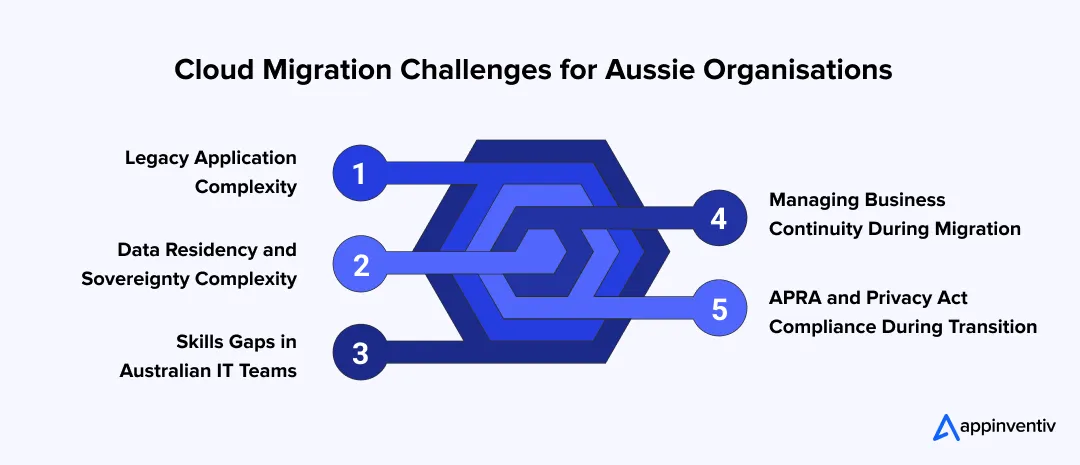
Australian enterprises carry significant legacy application debt. Many core systems were built in the 1990s or early 2000s on architectures that assumed a fixed, on-premises deployment model. These applications often have undocumented integrations, bespoke middleware and data models that were never designed for portability. The risk is not that these applications cannot be migrated (most can), but that the dependency discovery takes far longer than planned.
Solution: The mitigation is a thorough discovery phase using automated tools (AWS Migration Evaluator, Azure Migrate, or CAST Highlight) to map dependencies before any migration decisions are made.
Data Residency and Sovereignty Complexity
Australia’s data sovereignty requirements are more nuanced than they appear. While most workloads can be deployed to Australian cloud regions without issue, some categories of data, particularly in financial services, healthcare and defence, have additional restrictions on where they can be processed or who can access them. This creates architecture constraints that need to be resolved at design time, not during migration execution.
Solution: You must select local multi-zone sovereign cloud regions (e.g., AWS Sydney/Melbourne or Azure Australia East) and implement strict data-at-rest encryption.
Skills Gaps in Australian IT Teams
AWS, Azure and GCP certifications take time to acquire, and the supply of experienced cloud migration engineers in Australia remains tighter than demand. Organisations that attempt to run large migration programmes entirely with existing internal teams frequently find that staff are stretched across operational responsibilities and migration work simultaneously, with both suffering.
Solution: The practical answer is a blended model: internal staff own the programme governance and retained domain knowledge, while specialist cloud migration consultants in Australia provide migration execution capacity and architectural expertise.
Managing Business Continuity During Migration
For organisations where systems underpin customer-facing services such as banks, healthcare providers, retailers, logistics operators, the risk of service disruption during migration is real.
Solution: The mitigation is not to minimise migration windows but to invest heavily in pre-migration testing, parallel running, rollback automation and cutover rehearsals. The organisations that manage continuity best treat each migration wave as a production incident drill with a named incident commander, defined escalation paths and pre-prepared rollback playbooks.
APRA and Privacy Act Compliance During Transition
The transition period, when data exists in both on-premises and cloud environments simultaneously, is often the highest-risk point for compliance obligations. Data in transit must be encrypted. Access controls must be enforced consistently across both environments. Audit logging must be maintained without gaps.
Organisations operating under APRA CPS 234 must ensure their third-party risk management obligations are met before cloud providers handle regulated data. Compliance teams need to be involved from the first day of the programme, not called in at go-live.
Talk to Appinventiv’s cloud architects about your specific environment, compliance obligations and programme timeline. We offer a no-obligation initial assessment at any stage of your cloud journey.

The Future of Cloud Migration in Australia
As technology advances, the future of cloud migration Australia-wide will focus on data sovereignty, edge-cloud computing, and AI integration:
- Integration of Edge and Cloud: Industries like mining and agriculture are connecting edge devices to cloud platforms to process data in real time, even in remote locations.
- Sovereign Data Centers: Global providers are building more sovereign regions within Australia, giving enterprise clients more options for keeping data local.
- AI-Driven Infrastructure: Cloud architecture will increasingly rely on automated scaling, allowing companies to run complex AI models in Australia without building their own physical data centers.
- Sustainability and green cloud: Australian enterprises with ESG reporting obligations are increasingly factoring cloud carbon efficiency into their infrastructure decisions. The major hyperscalers publish sustainability data and offer carbon-tracking tools.
How Appinventiv Supports Cloud Migration in Australia
Appinventiv is a digital product engineering company in Australia with over 11+ years of APAC delivery experience across enterprise technology programmes. Our cloud expertise spans strategy, architecture, migration execution, modernisation, and managed optimisation, delivered by a team of over 1,600 technology professionals, with on-the-ground capability in Sydney, Melbourne and Brisbane.
Our Credentials in the Australian market
Appinventiv holds AWS Advanced Tier Partner status with triple competency recognition in DevOps, Migration, and Well-Architected Review. We are recognised as an approved ICT supplier across all levels of the Australian Government, including engagement through Queensland Government’s Local Buy programme, enabling government agencies to procure cloud migration services in Australia directly through panel arrangements.
Appinventiv was named among APAC’s High-Growth Companies by Statista and the Financial Times for three consecutive years and has been recognised as a Deloitte Technology Fast 50 winner in 2023 and 2024.
What we bring to the cloud migration strategy for enterprises in Australia:
- Governance-first architecture: Security, APRA compliance and Privacy Act obligations are designed into the cloud landing zone, not retrofitted after go-live.
- 7Rs workload assessment: Every application is assessed against the 7Rs framework before migration decisions are made, ensuring the right strategy is applied to the right workload.
- Phased delivery with rollback assurance: We run wave-based migrations with documented cutover playbooks, defined rollback procedures and hypercare support for each production go-live.
- FinOps integration from day one: Cloud cost management is embedded into programme delivery, not treated as a post-migration concern.
- Australian compliance alignment: Our architects are trained in APRA CPS/CPG 234, the Privacy Act, ASD Essential Eight and the APS Cloud Policy and they design migration programmes that satisfy these obligations without creating operational overhead.
- Modernisation beyond migration: Where refactoring or replatforming creates genuine business value, our teams deliver application modernisation, containerisation and DevSecOps integration alongside migration execution.
Beyond cloud migration, Appinventiv supports Australian enterprises with AI development, legacy system modernisation, enterprise software engineering and managed cloud operations, giving Aussie organisations a single, accountable partner across their technology transformation journey rather than a fragmented set of specialists who have never worked together.
If you are planning a cloud migration programme in Australia, whether you are at the early discovery stage or ready to execute, our cloud architects are available for a no-obligation assessment conversation.
So, why wait? Accelerate your migration journey safely now. Discuss your project vision with our team under strict NDA and discover how we deliver up to 35% efficiency gains for Aussie innovators.
FAQs
Q. What is a cloud migration strategy for enterprises in Australia?
A. A cloud migration strategy is a documented plan that defines how an organisation will move its applications, data, infrastructure and workloads from on-premises systems into a cloud environment or from one cloud platform to another. It covers the business case, workload assessment, compliance obligations, sequencing, cost projections, rollback planning and the operating model for running workloads once migration is complete. A strong strategy is the difference between a controlled programme and an expensive recovery exercise.
Q. How does cloud migration work?
A. Cloud migration works in phases. Organisations begin with a discovery and portfolio assessment to understand their current environment, then build a business case and migration roadmap. They design a cloud landing zone that meets their security and compliance requirements, then migrate workloads in phased waves, typically starting with lower-risk systems and progressing to mission-critical applications.
Each wave includes pre-migration testing, cutover execution, post-migration validation and a hypercare period. After migration, the focus shifts to optimisation, governance and FinOps to ensure the cloud environment performs and costs what was expected.
Q. How do I plan a cloud migration in Australia?
A. Planning a cloud migration in Australia starts with a clear-eyed assessment of your current environment: what applications you have, how they depend on each other, what data they handle, and what regulatory obligations apply. From there, you apply the 7Rs framework to determine the right migration strategy for each workload.
You design a cloud landing zone that reflects Australian compliance requirements — APRA, Privacy Act, ASD Essential Eight, and where relevant the APS Cloud Policy. You sequence workloads into migration waves based on business criticality and dependency order. You build rollback plans before you touch anything in production. And you engage a cloud migration consulting partner in Australia who has delivered comparable programmes in regulated Australian environments, not just globally.


Fast 2-minute response, fully NDA-protected.

How to Build a DESC-Compliant Azure Architecture in the UAE Without Data Residency Risks
Key takeaways: Azure UAE data residency compliance is not just about choosing UAE North or Central; logs, backups, APIs, identity flows, and monitoring paths also need control. DESC-aligned Azure architecture should be planned before deployment or migration to avoid audit issues, delayed approvals, and expensive rework. Enterprises must map the full data journey across storage,…

How Cloud Services Accelerate Product Development for Businesses
Key takeaways: Cloud product development changes the speed, cost, and risk profile of modern software delivery. The cost of cloud product development ranges between $40,000 and $400,000 or more. Cloud platforms give you instant access to AI/ML, edge computing, and advanced analytics without dropping tons of money upfront. Appinventiv supports enterprise cloud product development through…

Green Cloud - How Cloud Adoption Helps Improve Sustainability/ESG Goals of Enterprises
Key takeaways: Adopting green cloud solutions lowers energy consumption, cuts emissions, and reduces operational costs. Companies like UEM Edgenta and Bharti Airtel have seen measurable improvements in sustainability and efficiency. AI Enhances Green Cloud Efficiency. AI optimizes energy use, predicts demand, and minimizes waste in cloud infrastructure. Your Green Cloud Roadmap. Start with an infrastructure…