

































Enterprise Regulatory Risk Management in Australia: Challenges, Strategies, and Solutions

 Share -



- 01Understanding Enterprise Regulatory Risk Management in Australia
- 02The High-Stakes Regulatory Landscape Driving Enterprise Pressure in Australia
- 03Why Traditional Compliance Models Are Breaking Down in Australia?
- 04What Are the Top Enterprise Regulatory Risk Challenges in Australia?
- 05Proven Strategies to Overcome These Challenges and Design a Regulatory Risk Management Framework
- 06Strategic Blueprint of a Modern Enterprise Risk Management Framework (ERMF)
- 07Regulatory Risk Capability in Practice: Real World Scenarios from Australian Enterprise Delivery
- 08Emerging Regulatory Risk Trends Enterprises Must Prepare For
- 09Industry-Specific Regulatory Risk Implications in Australia
- 10How Appinventiv Helps Enterprises Modernise Regulatory Risk Management
- 11FAQs

Key takeaways:
- Policy documents no longer protect you. Regulators now demand hard technical proof that your operational controls actually work.
- Manual spreadsheets and yearly audits create dangerous blind spots. Legacy setups simply break under intense CPS 230 and FAR pressure.
- High-performing enterprise risk management frameworks in Australia hardwire boardroom strategy directly into the technical architecture for continuous validation.
- Effective regulatory risk management strategies for Australian enterprises require comprehensive visibility across extended vendor networks and daily operations.
- Long-term enterprise regulatory risk management in Australia relies on live system monitoring rather than reactive legal scrambling.
When APRA issued an enforceable undertaking against a major Australian financial institution in 2024, the breach involved not a missing policy but a failure to demonstrate that documented controls were actually working. That distinction matters more than most boards still assume.
The signal has been reinforced across the regulatory landscape. In August 2024, the Federal Court ordered Mercer Superannuation to pay $11.3 million in ASIC’s first greenwashing enforcement action.
The takeaway is clear? Regulators are no longer assessing compliance primarily through statements of intent. They are testing whether governance, controls, and operational claims can withstand scrutiny.
That shift is now embedded into Australian regulatory expectations as
- APRA’s CPS 230, enforceable from 1 July 2025, requires entities to demonstrate operational resilience under disruption scenarios, not simply maintain contingency plans.
- The Security of Critical Infrastructure Act has expanded obligations across thirteen critical sectors.
- Privacy Act reforms have tightened accountability around data handling and harm thresholds.
- With the Financial Accountability Regime (FAR) now live across banking and insurance, executive liability has become materially more direct.
For many organisations, the real regulatory risk is no longer non-compliance on paper. It is operational fragility hidden behind compliant governance.
Enterprise regulatory risk management in Australia has moved beyond a back-office compliance discipline into a board-level operational capability tied directly to resilience, technology architecture, vendor governance, and executive accountability.
This blog examines the structural pressures reshaping enterprise risk operations, why conventional models are breaking down, and what a defensible, modern enterprise risk management framework now requires.
From Mercer’s AU$11.3 million greenwashing penalty to rising APRA resilience expectations, regulators are testing whether controls work in practice.

Understanding Enterprise Regulatory Risk Management in Australia
Enterprise risk management frameworks in Australia have moved from a legal and compliance function into a board-level operational discipline. For enterprise leaders, it now sits at the intersection of operational continuity, cyber resilience, third-party governance, and reputational integrity.
At a practical level, modern enterprise regulatory risk management in Australia typically brings together:
- Operational resilience → critical operations, disruption tolerances, incident readiness
- Cyber and data governance → CPS 234 alignment, privacy obligations, security oversight
- Third-party and vendor risk → cloud providers, SaaS ecosystems, material service providers
- AI and emerging technology governance → accountability, explainability, responsible use controls
- Board and executive accountability → FAR obligations, governance assurance, decision traceability
Rather than operating as separate programs, these domains increasingly function as part of a connected governance risk and compliance framework in Australia.
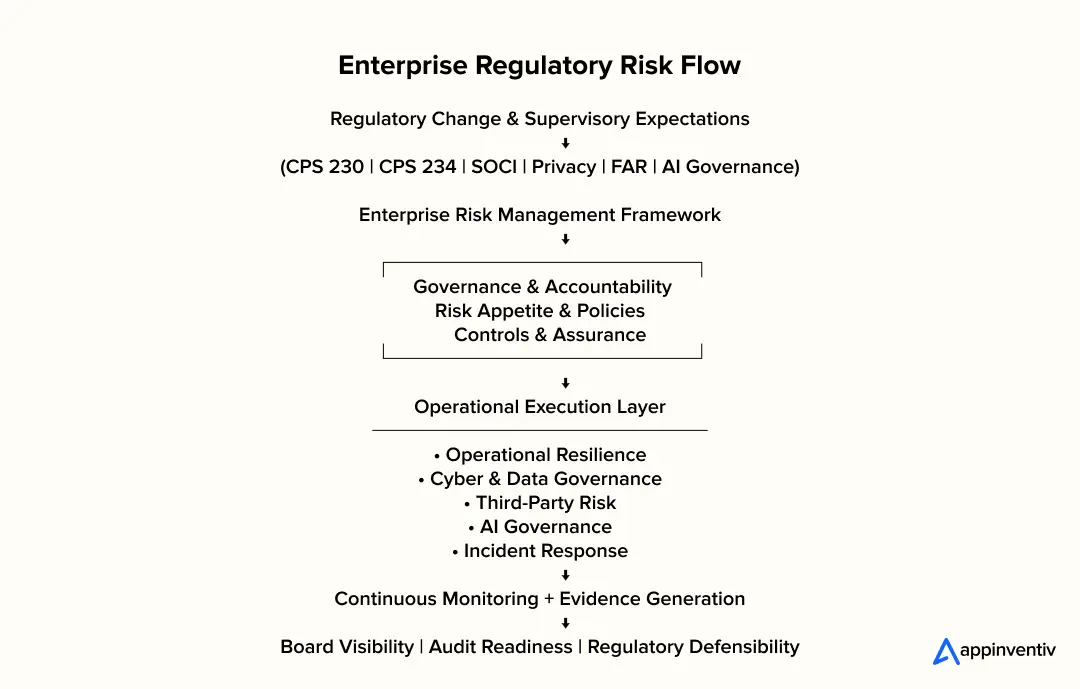
The High-Stakes Regulatory Landscape Driving Enterprise Pressure in Australia
Australian enterprises face a multi-framework compliance environment where obligations from APRA, ASIC, ACCC, SOCI, Privacy Act 1988, and FAR operate simultaneously. Each carries distinct enforcement mechanisms and the regulators are coordinating more actively than they have before.
APRA CPS 230 and Operational Resilience
CPS 230 consolidated two previous APRA standards into a single, more demanding operational risk framework effective 1 July 2025, with further amendments from 1 July 2026 for non-traditional service provider arrangements. Key obligations include: 72-hour incident notification, material service provider registers, tested business continuity arrangements, and board-level accountability for critical operations.
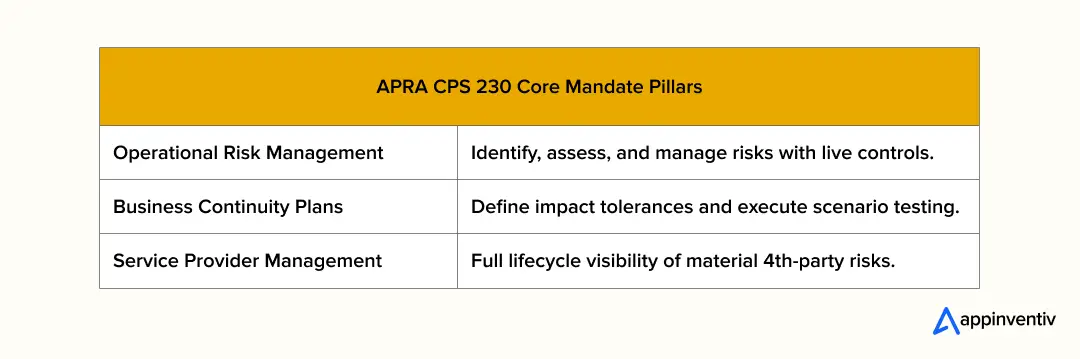
CPS 234, SOCI Act, and Cyber Governance
CPS 234 requires information security capabilities commensurate with risk magnitude. APRA’s supervisory posture has moved from self-attestation acceptance toward demonstrated control effectiveness. For SOCI Act entities across 11 critical infrastructure sectors, Critical Infrastructure Risk Management Programmes and mandatory ASD incident reporting add further obligation layers that frequently overlap with CPS 234.
Privacy Act Reforms, FAR, and AI Governance
Privacy Act reform proposals introduce a direct right of action, GDPR-scale penalties, and removal of the small business exemption. FAR accountability statements create personal executive exposure. ASIC and the ACCC are actively scrutinising AI deployment in Australia – explainability, algorithmic pricing, and automated decisioning are live enforcement concerns, not future ones.
Why Traditional Compliance Models Are Breaking Down in Australia?
Relying on manual governance leaves executive teams severely exposed to regulatory action. Organisations often struggle to manage continuous operational threats using tools designed for yearly reporting. Modernising these legacy structures is no longer an optional upgrade, but a strict requirement to protect both corporate value and individual board liability across the Australian market. Here is why:
- The Inefficiency of Spreadsheets: Tracking complex obligations across isolated, manual files guarantees version control issues. You cannot maintain an accurate, real-time view of enterprise-wide exposure using disconnected data.
- The Failure of Point-in-Time Audits: Annual or biannual review only captures a single snapshot in time. It provides limited protection for continuous-delivery software environments that change on a daily basis.
- The Vulnerability of Static Governance: Updating risk logs just in time for a quarterly committee review ensures you will miss sudden vendor outages. You will not spot critical control failures before they escalate into major operational breaches.
The cost of maintaining these legacy models is rising while their effectiveness is declining.
What Are the Top Enterprise Regulatory Risk Challenges in Australia?
The challenges in compliance and risk management in Australia are no longer confined to regulatory interpretation. It comes from fragmented systems, accelerating regulatory change, third-party exposure, and governance models struggling to keep pace with operational complexity.
The Velocity of Regulatory Change
CPS 230 amendments, Privacy Act reforms, evolving SOCI obligations, new FAR guidance, and AI governance expectations are all moving at once. Regulatory risk management strategies for Australian enterprises must account for multi-framework compliance pressure that changes faster than most governance models can absorb. Regulatory change management has become a specialised operational capability, not a task assigned to a legal team.
Data Silos and Fragmented Governance
Risk data sitting across separate applications in finance, operations, IT, legal, and compliance (each with different taxonomies and reporting cycles) makes enterprise-wide risk visibility impossible without significant manual reconciliation. The challenges in compliance and risk management in Australia are frequently amplified by this structural fragmentation. Governance blind spots are typically discovered during audits or regulatory incidents, not before.
Third-Party and Vendor Ecosystem Complexity
Under CPS 230, material service provider governance is a first-order prudential obligation. A thorough regulatory risk assessment for Australian enterprises that maps vendor ecosystems typically surfaces cloud dependencies, offshore data flows, and fourth-party risks that were previously invisible to the risk function. The remediation programme that follows is rarely small.
GRC Talent Crunch and AI Governance Gaps
Australia faces a shortage of GRC professionals with combined regulatory knowledge, technical literacy, and enterprise governance experience. Compliance roles doubled since 2010, but candidate supply has not kept pace. Separately, AI adoption is outpacing AI governance readiness; shadow AI usage, explainability gaps, and data handling risks are accumulating faster than enterprise governance frameworks can address them.
Proven Strategies to Overcome These Challenges and Design a Regulatory Risk Management Framework
Addressing regulatory risk at enterprise scale requires decisions about governance architecture, operating models, technology investment, and capability development; in that order. Regulatory risk management planning for Australian enterprises that starts with technology purchases typically produces the wrong outcomes.
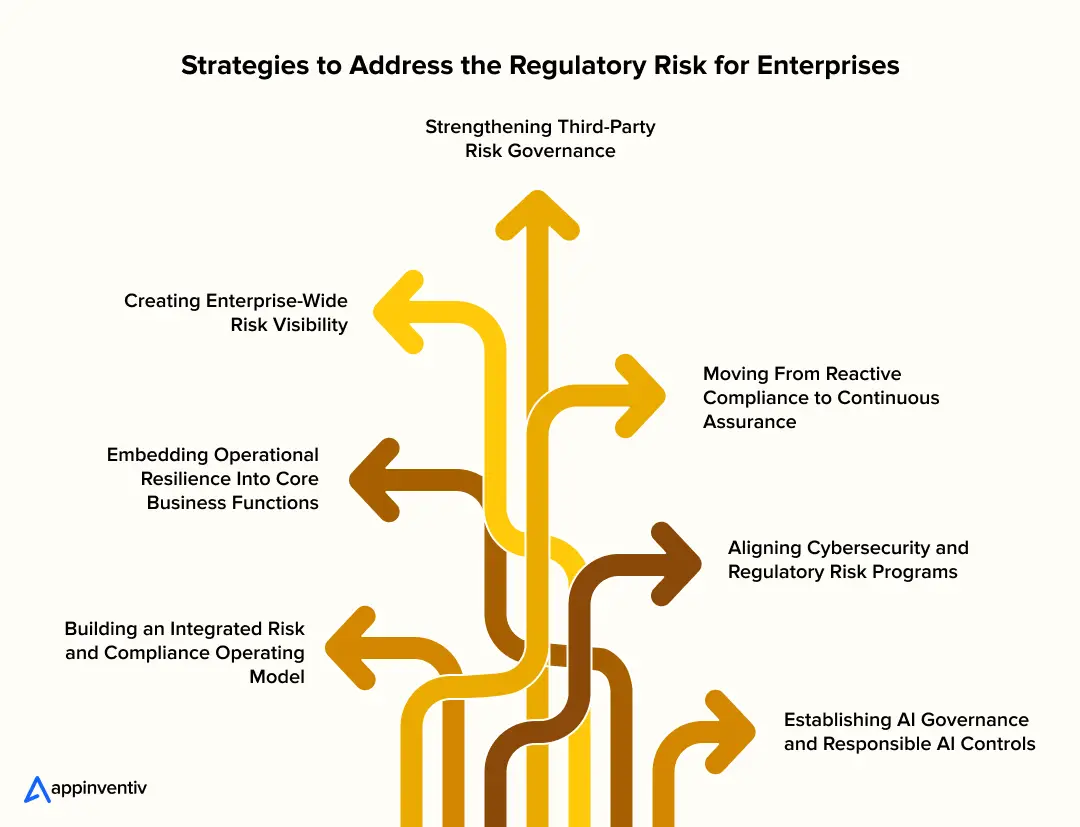
Building an Integrated Operating Model
Keeping risk and compliance in separate silos guarantees duplicated effort and massive operational blind spots. Merge these functions into a single operating architecture. You need a shared control taxonomy and a unified data infrastructure to establish one clear source of truth for your corporate risk posture.
Embedding Resilience Into Core Operations
You cannot run operational resilience as a side project. Under mandates like CPS 230, business units must own their processes directly. They need to identify critical operations, map every dependency, and define hard tolerance thresholds. Central compliance teams simply cannot do this work alone. They require active frontline ownership backed by the right governance platforms.
Creating True Enterprise Visibility
You cannot manage what your systems obscure. Proactive risk management requires consistent data capture across every business unit, fed into a common reporting platform. Once you standardise these dashboards against your specific Australian regulatory obligations, leadership teams can finally spot vulnerabilities before they trigger a compliance breach.
Strengthening Third-Party Governance
Managing vendor risk requires aggressive operational oversight rather than a procurement checklist. You must maintain a live inventory of all material service providers and map their downstream dependencies. This means monitoring external performance constantly and keeping tested exit strategies ready for immediate execution if a critical partner goes offline.
Moving From Reactive Compliance to Continuous Assurance
Stop relying on the exhausting cycle of preparing, auditing, and remediating. For organisations facing CPS 230 and CPS 234, regulators now expect continuous control monitoring alongside automated system testing. Real-time exception management is no longer just a maturity goal. It is a strict supervisory expectation.
Establishing AI Governance and Responsible AI Controls
AI governance frameworks need to address the full lifecycle of AI systems; from procurement and deployment through monitoring, audit, and decommissioning. Key components include documented model governance, bias and fairness assessments, explainability controls, data lineage documentation, and regular performance reviews.
Aligning Cyber and Regulatory Programmes
Cyber security and regulatory teams often run completely separate agendas without sharing critical data. We help enterprises close this operational gap. Linking these disciplines eliminates duplicated controls, speeds up incident response, and ensures vital security telemetry feeds directly into board-level risk reports rather than staying trapped inside a security operations centre.
Also Read: Cybersecurity Breach Cost in Australia 2026
A 6-Step Framework for Future-Ready Regulatory Risk Operations
The following framework outlines the steps to implement regulatory risk management in Australian businesses:
| Step | Action | Outcome |
|---|---|---|
| 1 | Identify critical operations and risk dependencies | Clarity on what must never fail and why |
| 2 | Consolidate risk visibility across enterprise systems | Single source of truth; no governance blind spots |
| 3 | Automate monitoring and compliance workflows | Scale compliance capacity without proportionate headcount growth |
| 4 | Strengthen incident response and scenario testing | Tested playbooks; APRA-defensible resilience evidence |
| 5 | Operationalise continuous assurance | Live control monitoring replacing annual audit cycles |
| 6 | Build technology-enabled risk culture | GRC platforms, AI-assisted monitoring, embedded risk ownership |
Strategic Blueprint of a Modern Enterprise Risk Management Framework (ERMF)
Transforming your risk posture from a static policy into an active operational asset requires aligning your software architecture with automated governance models. Modern enterprises increasingly embed governance, monitoring, and compliance logic directly into technology environments and delivery workflows. Here is a blueprint of a modern governance risk and compliance framework in Australia:
Designing Risk Framework
Australian enterprises must translate overlapping obligations into a framework that manages regulatory complexity without creating operational friction. Modern enterprise risk management frameworks in Australia increasingly connect:
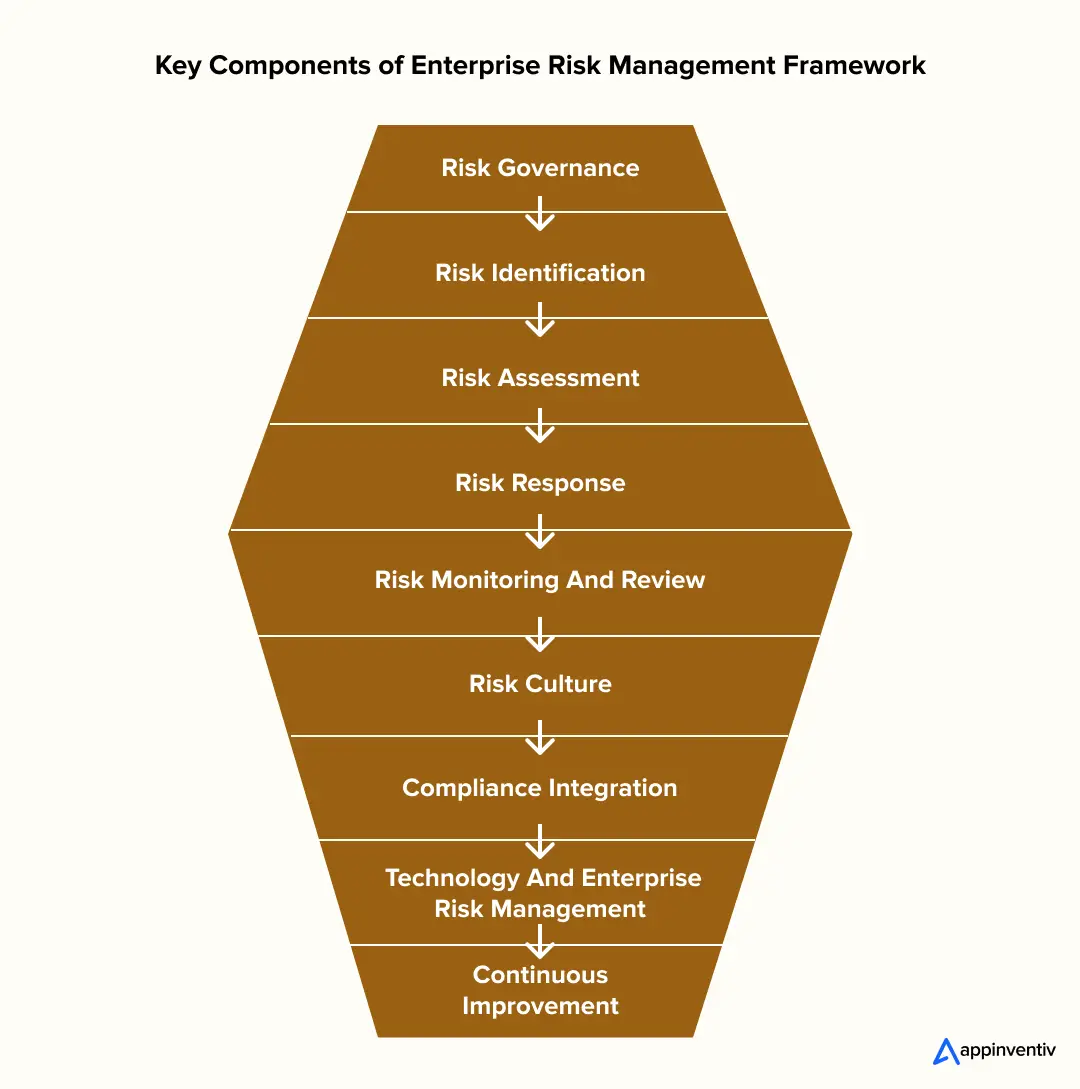
Aligning Frameworks with Australian Expectations
High-performing enterprises adapt general risk standards like ISO 31000 into prescriptive local mandates by embedding compliance checks directly into their cloud infrastructure and software development lifecycles. This ensures that any change to the production environment is automatically validated against defined regulatory constraints.
The Modernised Three Lines Model
The traditional three lines model must move away from slow, manual hand-offs toward an automated, platform-driven ecosystem:
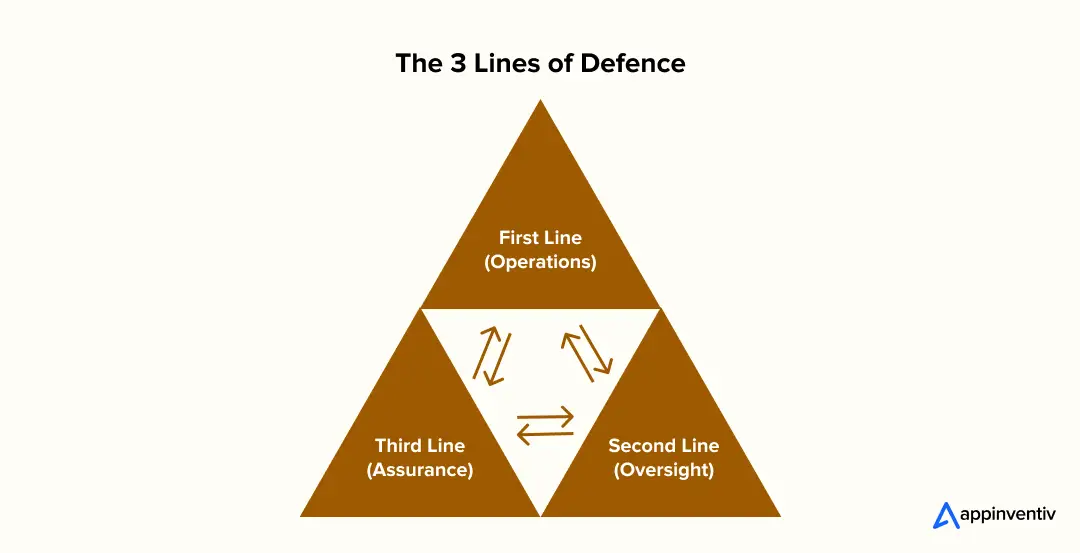
- First Line (Operations): Engineering and product teams own risk directly, utilising automated code analysis and secure development lifecycles to catch vulnerabilities before deployment.
- Second Line (Oversight): Risk officers monitor operations via unified compliance dashboards fed by live telemetry, tracking control drift in real time rather than reviewing outdated logs.
- Third Line (Assurance): Auditors leverage immutable system logs and automated records, replacing disruptive, sample-based manual audits with continuous validation.
Shifting to Dynamic Risk Intelligence
Effective regulatory risk management planning for Australian enterprises requires moving away from static spreadsheets and embracing live risk intelligence networks.
| Legacy Static Approach | Modern Dynamic Approach |
|---|---|
| Manual spreadsheet logs | Automated control tracking |
| Point-in-time assessments | Continuous telemetry feeds |
| Retrospective reporting | Predictive risk alerts |
Connecting GRC systems directly to infrastructure monitoring tools allows the architecture to assess control effectiveness automatically. If a critical service fails or a database encounters a configuration issue, the corporate risk posture updates instantly, giving executives the real-time visibility needed to step in before a regulatory breach occurs.
Regulatory Risk Capability in Practice: Real World Scenarios from Australian Enterprise Delivery
Building enterprise regulatory capability creates measurable operational outcomes, not just cleaner audit documentation. The enterprise risk management framework examples below reflect the kinds of governance, resilience, and technology modernisation work enterprises increasingly undertake as regulatory pressure intensifies.
When Governance Models Create More Complexity Than Control
Many organisations create governance layers faster than they create accountability. Different business units maintain separate control libraries, compliance teams interpret obligations independently, and operational leaders struggle to connect policy expectations with day-to-day execution.
Common pressure points:
- Competing governance models across business units
- Operational workflows drifting away from compliance requirements
- Separate ownership of CPS 230, SOCI, and Privacy obligations
Case Example: Governance Simplification for a Mid-Tier Australian Insurer
Appinventiv supported a multi-entity insurance organisation preparing for CPS 230 readiness while managing existing CPS 234 and Privacy obligations through disconnected governance processes. Risk teams maintained separate control inventories across cyber, operations, and compliance functions, creating duplicated evidence requests and inconsistent ownership.
We helped the client establish a consolidated governance model, redesign risk ownership structures, and implement a unified control taxonomy aligned to critical operations and tolerance thresholds. Within one operating cycle, leadership gained clearer board reporting, reduced duplicated compliance effort, and improved traceability across regulatory obligations.
Resilience Programs Need Continuous Visibility, Not Quarterly Confidence
Quarterly reviews rarely surface operational weaknesses early enough. Teams need live visibility into critical operations, service-provider performance, and incident readiness before disruption or regulatory review exposes the gaps.
Common pressure points:
- Reactive risk operations
- Reporting timelines misaligned with notification obligations
- Limited visibility into third-party dependencies
Case Example: Operational Resilience Modernisation for an Australian Financial Services Group
A financial services company engaged Appinventiv to strengthen operational resilience capability ahead of evolving CPS 230 requirements. The organisation relied on quarterly reporting processes spread across operational, vendor, and incident systems, leaving executives without a reliable enterprise-wide view of critical service performance.
Our teams designed a centralised resilience monitoring environment integrating operational metrics, vendor data, and incident signals into a single governance layer. The client moved from periodic reporting toward continuous operational visibility, improved dependency mapping across material service providers, and strengthened board-level reporting readiness for regulatory review.
Mature Risk Operations Depend on Better Systems, Not More Manual Oversight
Many enterprise risk functions still spend excessive time collecting evidence, reconciling spreadsheets, and preparing reports. That model struggles as cyber, resilience, privacy, and AI governance obligations continue to expand.
Common pressure points:
- Manual reporting workloads consuming specialist capacity
- Oversight models struggling to scale
- Talent shortages across risk and compliance functions
Case Example: GRC Modernisation for an Australian Critical Infrastructure Operator
Appinventiv worked with a critical infrastructure organisation that managed regulatory reporting through fragmented tooling spanning incident systems, operational platforms, and vendor performance environments. Risk teams spent significant time assembling evidence rather than analysing exposure.
We helped modernise the operating environment through an integrated GRC ecosystem connecting operational data, incident workflows, and compliance reporting layers.
We can help you assess where fragmented governance, operational resilience, and risk workflows may be limiting regulatory readiness across your enterprise.

Emerging Regulatory Risk Trends Enterprises Must Prepare For
Regulatory risk management planning that only addresses current obligations will be behind before it is fully implemented. The trends shaping compliance pressure over the next two to four years are already visible in consultation papers, international frameworks, and enforcement patterns.
Continuous Compliance
Continuous compliance models are replacing periodic attestation in financial services and progressively across other regulated sectors. Organisations with live monitoring infrastructure will absorb this transition with limited disruption. Those relying on annual audit cycles will face significant operating model changes under regulatory pressure rather than on their own timeline.
Third-Party Resilience
Third-party resilience is attracting sustained international regulatory attention. APRA’s material service provider requirements are among the most detailed in the APAC region. Comparable frameworks are developing in healthcare and government procurement contexts, with direction toward mandatory fourth-party visibility.
ESG Enforcement, Data Sovereignty, and Quantum-Era Cyber Risk
Several emerging pressures now sit outside traditional compliance programmes but increasingly influence enterprise regulatory exposure.
Australian enterprises should monitor:
- ESG governance moving into active enforcement territory. ASIC actions against Mercer (AU$11.3M), Vanguard (AU$12.9M), and Active Super (AU$10.5M) demonstrate that unsupported sustainability claims now attract meaningful financial and reputational consequences.
- Stronger data sovereignty and privacy obligations as reforms reshape expectations around data handling, accountability, and cross-border information management.
- Quantum-era cybersecurity planning becoming a strategic issue, particularly for financial services, government, and critical infrastructure organisations managing long-life cryptographic environments.
The Australian Signals Directorate has already identified quantum computing as a future cryptographic risk horizon. For some enterprises, the practical question is no longer whether post-quantum planning belongs on the roadmap, but how soon foundational assessments should begin.
Industry-Specific Regulatory Risk Implications in Australia
Regulatory pressure is not evenly distributed. The weight, velocity, and character of obligations differ significantly across sectors, and enterprise risk strategies need to account for those distinctions.
Banking and Financial Services
CPS 230, CPS 234, FAR, AML/CTF, climate risk disclosure, and ASIC market conduct supervision operate simultaneously. The cost of regulatory compliance management in Australia is most acutely felt here. Third-party risk management under CPS 230 is a particular pressure point for institutions with complex fintech and cloud provider ecosystems.
Healthcare and Critical Infrastructure
Healthcare enterprises navigate Privacy Act sensitive information obligations, My Health Records Act requirements, and emerging TGA scrutiny of AI clinical tools. Critical infrastructure operators under SOCI face CIRMP obligations, ASD incident reporting, and OT security challenges in legacy infrastructure environments. Enterprise regulatory risk management solutions in Australia for this sector must account for geopolitical cyber risk dimensions alongside standard compliance obligations.
Government, Public Sector, and Other Industries
Government entities face ISM, PSPF, Essential Eight maturity requirements, and Privacy Act obligations alongside digital transformation compliance implications from cloud migration and AI deployment. Technology strategy consulting in Australia increasingly needs to account for government-specific compliance architectures.
Insurance and Wealth Management
The insurance sector faces tightening oversight via CPS 230, climate disclosure mandates, and heightened claims-handling scrutiny. Effective insurance risk management requires balancing capital adequacy with complex macroeconomic shifts and frequent natural catastrophe events. To protect policyholders, modern insurance risk management frameworks must integrate robust operational resilience with advanced actuarial data modeling to proactively identify, assess, and mitigate systemic underwriting and solvency threats.
Manufacturing, retail, and professional services are also navigating material obligations such as supply chain transparency, algorithmic pricing scrutiny, AML/CTF requirements for certain service types, and ACCC enforcement of consumer protection laws. The principle is consistent: regulatory risk is an operational reality for every enterprise operating at scale in Australia, regardless of sector.
How Appinventiv Helps Enterprises Modernise Regulatory Risk Management
Modern regulatory risk capability depends on more than policy design. Australian enterprises increasingly need technology environments that support continuous assurance, operational resilience, audit readiness, and scalable governance without creating additional operational friction.
Most organisations do not struggle because they lack awareness of regulatory obligations. They struggle because risk data sits across disconnected systems, compliance workflows remain heavily manual, and operational teams cannot produce defensible evidence quickly enough under scrutiny.
At Appinventiv in Australia, we work with enterprises undergoing platform modernisation, operational transformation, and complex systems integration where regulatory expectations directly influence architecture, governance, and delivery decisions.
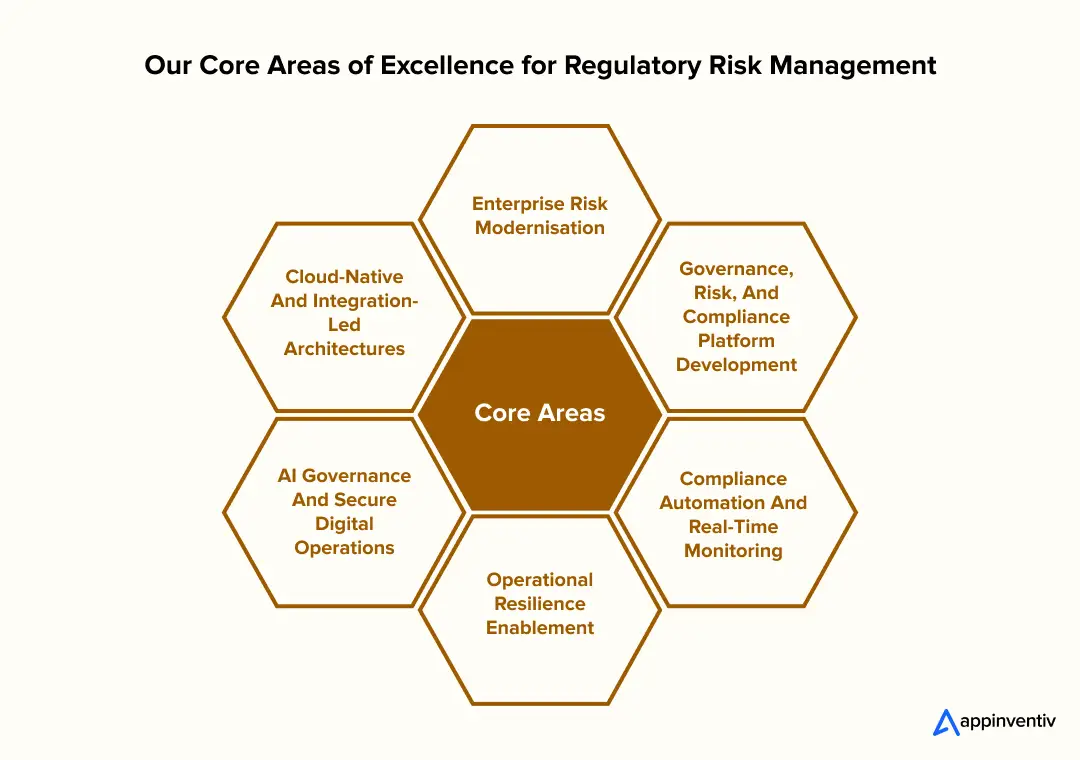
Our work typically supports capability areas such as:
- Enterprise risk modernisation, including technology foundations for operational resilience, governance visibility, and integrated risk operations.
- Governance, Risk, and Compliance platform development, connecting risk registers, operational data, vendor oversight, incident workflows, and reporting layers into unified environments.
- Compliance automation and real-time monitoring, reducing manual reporting effort and improving evidence readiness across evolving regulatory obligations.
- Operational resilience enablement, including critical service mapping, workflow orchestration, tolerance monitoring, and dependency visibility.
- AI governance and secure digital operations, supporting responsible adoption through stronger data controls, explainability considerations, and oversight mechanisms.
- Cloud-native and integration-led architectures, designed around long-term ownership, auditability, scalability, and Australian enterprise security expectations.
What Makes us Your Trusted Tech Partner in Australia
In our 11+ years of APAC delivery experience, we have successfully delivered 3000+ secure digital assets across 35+ industries. Our team of 1600+ operate within security standards supported by ISO 27001, ISO 9001, and SOC2 controls, alongside a 99.5% security compliance SLA.
For organisations evaluating enterprise regulatory risk management solutions in Australia, the objective rarely centres on adding another compliance tool. The larger challenge involves building operational capability that scales across regulatory change, technology complexity, and evolving board accountability requirements.
Because ultimately, sustainable enterprise regulatory risk management in Australia depends on how effectively governance, technology, and operational execution work together under real-world pressure.
Ready to build regulatory resilience into your enterprise operations? Connect with Appinventiv’s team today.
FAQs
Q. What is enterprise regulatory risk management in Australia and why does it matter?
A. Enterprise regulatory risk management in Australia is the systematic process of identifying, assessing, governing, and monitoring risks arising from regulatory obligations across the organisation. The scope covers compliance risk, operational risk, cyber exposure, third-party governance, AI accountability, and data sovereignty. It matters because Australian regulators, particularly APRA, ASIC, and the OAIC, assess organisations on whether controls are demonstrably functioning and whether critical operations can withstand disruption, not merely on whether policies are documented.
Q. What are the biggest regulatory compliance challenges for Australian enterprises?
A. The challenges in compliance and risk management in Australia consistently cluster around four operational realities: the pace of simultaneous regulatory change across CPS 230, FAR, Privacy Act, and SOCI; fragmented enterprise systems that prevent consolidated risk visibility; underdeveloped third-party governance programs now under direct regulatory scrutiny; and a constrained domestic talent pool for experienced regulatory risk and cyber governance professionals. Each challenge compounds the others when addressed in isolation.
Q. How do businesses implement enterprise regulatory risk management strategies?
A. Effective regulatory risk management strategies for Australian enterprises begin with a diagnostic mapping existing controls against current obligations and identifying gaps at both the framework and operational level. From there, the priority is consolidating risk reporting into a unified governance view, automating control monitoring, and building the incident response capability that CPS 230’s operational resilience requirements demand. Technology investment in GRC platforms delivers the most value when accountability structures are defined before deployment decisions are made.
Q. What are the best practices for regulatory risk management planning for Australian enterprises?
A. Regulatory risk management planning for Australian enterprises that produces durable outcomes relies on three consistent practices: treating risk appetite alignment as a continuous board conversation rather than an annual document review; connecting third-party risk governance directly to operational resilience planning, with material service provider obligations under CPS 230 as the structural anchor; and investing in live monitoring infrastructure early enough that continuous assurance replaces point-in-time audit cycles before regulators require it.


Fast 2-minute response, fully NDA-protected.

Key takeaways: State regulations shape your cloud choices, security configurations, and system layouts long before code is written. Saudi laws demand built-in protections across mobile applications, cloud software, machine learning platforms, and corporate tools. Early design planning cuts code rewrites, network threats, buyer procurement delays, and long-term engineering budgets. Separate business sectors require distinct technical…

Digital Maturity Assessment for Australian Enterprises: Where You Are, Where You Need to Be
Key takeaways: Digital maturity has evolved from a transformation metric into a core indicator of operational resilience, governance readiness, and long-term enterprise scalability across Australia. AI adoption is exposing weaknesses in data quality, governance, and operational agility that digitisation spending alone cannot fix. CPS 230, CPS 234, the SOCI Act, and Privacy Act reforms are…

Key takeaways: Network perimeter controls are necessary but insufficient. Access architecture must be rebuilt around identity as the primary security layer. Static access models, identity silos, MFA dependency, and ungoverned machine identities grow more expensive with every delay. APRA CPS 230, the Essential Eight, Privacy Act reforms, and the SOCI Act create a compliance environment…