
































Custom Digital Asset Management Software Development in Australia: Features, Benefits, and Use Cases

 Share -



- 01Understanding the Role of Digital Asset Management (DAM) Software
- 02Core Pain Points Australian Enterprises Face Without Custom DAM
- 03Key Features of Custom Digital Asset Management Software Development in Australia
- 04Advanced Capabilities Shaping Next-Generation DAM Platforms
- 05What Are The Core Benefits of Custom Digital Asset Management Software Development
- 06Industry-Specific Use Cases of Custom DAM Software
- 07Use Cases for DAM for Different Departments
- 08Build vs Buy: Should Businesses Develop a Custom DAM Platform or Buy an Off-the-Shelf Solution?
- 09How to Develop and Deploy Digital Asset Management Software in Australia?
- 10How Much Does It Cost to Build Enterprise Digital Asset Management Software in Australia?
- 11Future Trends in Digital Asset Management Software Development
- 12How Appinventiv Delivers Custom Digital Asset Management Software in Australia?
- 13FAQs

Key takeaways:
- Australia’s DAM market is growing at 16.52% CAGR. But market growth does not solve the underlying problem of content sprawl. Architecture does.
- Traditional and Off-the-shelf DAM platforms introduce data sovereignty risks that are structurally incompatible with APRA, Privacy Act, and sector-specific compliance obligations for many Australian enterprises.
- Custom digital asset management software development in Australia delivers higher long-term ROI when asset volumes, integration complexity, or compliance requirements exceed what generic platforms can accommodate.
- The cost to build a DAM platform ranges from AUD 70,000 to AUD 700,000+, depending on scope – an investment that typically recovers and generates ROI within two to three years.
Digital assets have outgrown the boundaries of file servers and shared drives. Across Australian enterprises, the volume of images, video, regulated documents, and AI-generated content now runs into hundreds of thousands of assets per organisation and growing. Yet most of that content sits in fragmented repositories, duplicated folders, ERP systems, customer platforms, and unsanctioned cloud tools that were never designed to serve at enterprise scale. Over time, this creates duplication, governance gaps, inconsistent branding, and security exposure.
Traditional storage platforms address surface-level problems. They provide storage, basic tagging, and permission controls. What they rarely address is the architecture required to integrate with an enterprise’s existing systems, conform to Australian data sovereignty obligations, or scale to the volume and variety of assets a complex organisation actually generates.
Custom digital asset management software development in Australia takes a different approach. Rather than configuring an organisation around a vendor’s product logic, a bespoke DAM platform is built around the organisation’s workflows, governance requirements, and long-term content strategy. For enterprises operating under APRA frameworks, the Privacy Act 1988, ASD Essential Eight, or sector-specific compliance requirements, that distinction matters significantly.
This blog covers what a modern DAM platform does, where generic tools fall short, what drives development cost, and how Australian businesses across industries are using custom-built systems to extract measurable value from their digital content.
Disconnected repositories often create unnecessary costs, compliance risks, and operational bottlenecks. Explore what a unified DAM strategy could look like for your organisation.

Understanding the Role of Digital Asset Management (DAM) Software
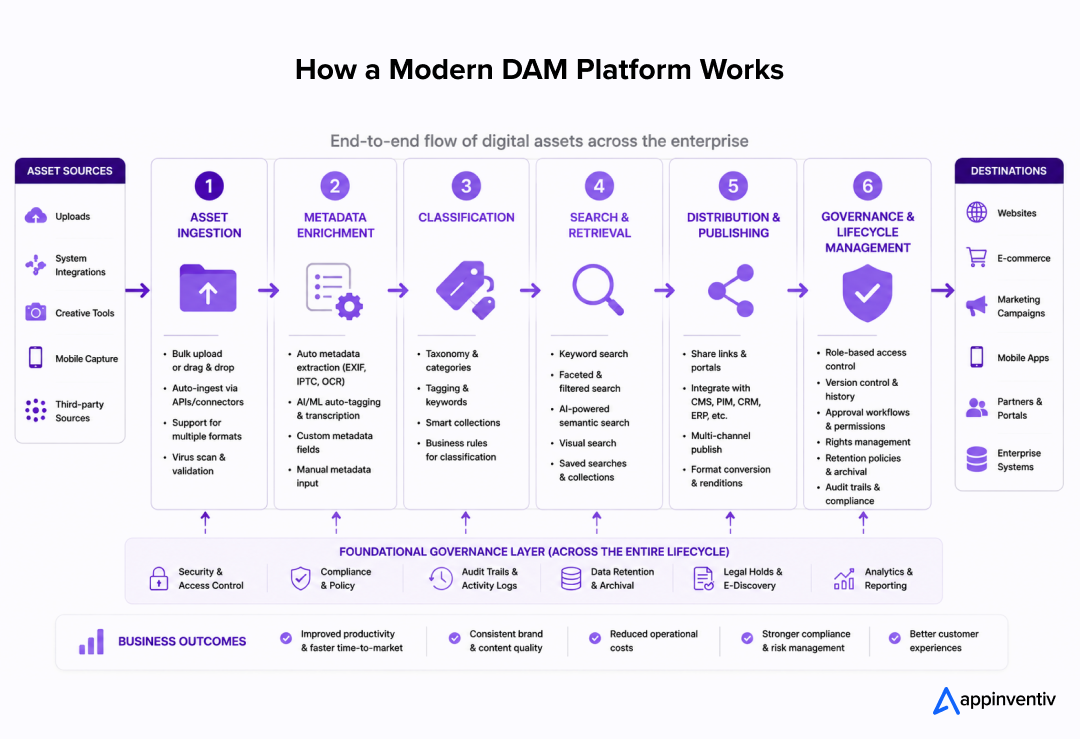
A digital asset management platform is not a glorified cloud drive. At its core, it is an intelligent content infrastructure layer that handles asset ingestion, enrichment, classification, retrieval, distribution, and lifecycle management as a coordinated system rather than a collection of unrelated functions.
Unlike traditional storage systems, DAM solutions are designed to create structure around enterprise content. They help ensure the right assets reach the right users while maintaining visibility, compliance, and control.
Types of Digital Assets a DAM Platform Manages
- Brand and creative assets: logos, style guides, campaign imagery, vector files
- Rich media: video content, audio files, 3D models, animations
- Product content: imagery, specifications, datasheets, packaging artwork
- Marketing collateral: presentations, brochures, templates, email assets
- Regulated documents: compliance records, policy documents, audit materials
- AI-generated content: synthetic imagery, copy variations, generated media assets
How a Digital Asset Management Platform Works?
A DAM platform orchestrates the entire asset lifecycle, from ingestion and classification to distribution and governance. This structured approach enables organisations to manage growing content volumes without compromising efficiency or compliance.
| Stage | Function |
|---|---|
| Asset Ingestion | Bulk upload, API push, automated capture from creative tools and DAM integrations |
| Metadata Enrichment | Auto-tagging via AI, manual taxonomy, rights and expiry attribution |
| Classification | Folder hierarchy, faceted taxonomy, collection grouping, AI-driven categorisation |
| Search and Retrieval | Full-text, visual similarity, metadata-filtered, and natural language search |
| Distribution and Publishing | Direct channel delivery, CDN integration, shareable link portals |
| Governance and Lifecycle | Version control, expiry workflows, rights management, audit trail logging |
DAM vs. Traditional Storage: A Capability Comparison
| Capability Area | Custom DAM Platform | Traditional File Storage |
|---|---|---|
| Searchability | AI-driven tagging, semantic search, cognitive metadata | Basic file name and manual folder hierarchy |
| Version Control | Automated tracking, audit trails, instant rollbacks | Manual file duplication (e.g., “Final_v2_Real.pdf”) |
| Access Governance | Granular Role-Based Access Control (RBAC), timed access | Broad folder-level permissions, high risk of leakage |
| Workflow Integration | API-first connectivity with ERP, PIM, and CMS tools | Disconnected, requiring manual upload and download |
| Compliance | Automated regional compliance, digital rights tracking | No native compliance tracking or usage monitoring |
Core Pain Points Australian Enterprises Face Without Custom DAM
According to IMARC, the digital asset management market size in Australia is poised to reach $429.0 Million by 2034, from $104.2 Million in 2025, exhibiting a growth rate of 16.52% from 2026 to 2034.
This massive adoption of custom digital asset management software development in Australia is rarely about features. It is about operational failure modes that cost money, create compliance exposure, and erode competitive positioning over time.
Data Sovereignty and Compliance
Meeting stringent local privacy laws remains a primary board-level concern. Relying on overseas SaaS products complicates compliance with frameworks like the Australian Privacy Principles, APRA CPS 234 for financial institutions, or TGA guidelines in healthcare.
Custom enterprise digital asset management software development in Australia ensures all intellectual property resides securely within domestic data centers, maintaining absolute data sovereignty.
Siloed Operations and Workflow Bottlenecks
Disconnected enterprise systems choke operational velocity. When a company’s ERP, MarTech stack, and Product Information Management (PIM) tools do not communicate, teams resort to manual file transfers. This friction slows down time-to-market for campaigns and products, creating a heavy administrative burden and redundant labor costs across business units.
The Lost Asset Epidemic
Poor metadata architecture makes asset discovery nearly impossible at scale. When employees cannot locate existing media, they commission duplicate work. This financial drain compounds over time, draining departmental budgets simply to recreate assets that already exist but remain buried in unsearchable network drives.
Cybersecurity Vulnerabilities
Decentralised, loosely managed environments present a massive attack surface. The rising threat of intellectual property theft, unauthorised external access, and targeted ransomware requires hardened infrastructure. Aligning asset management protocols with the Australian Cyber Security Centre Essential Eight framework demands the granular control only a proprietary system can provide.
Key Features of Custom Digital Asset Management Software Development in Australia
The features that distinguish a custom-built digital asset management platform from a standard SaaS product are not basic. They are architectural decisions that determine how well the system scales, integrates, and performs under the governance requirements of an Australian enterprise.
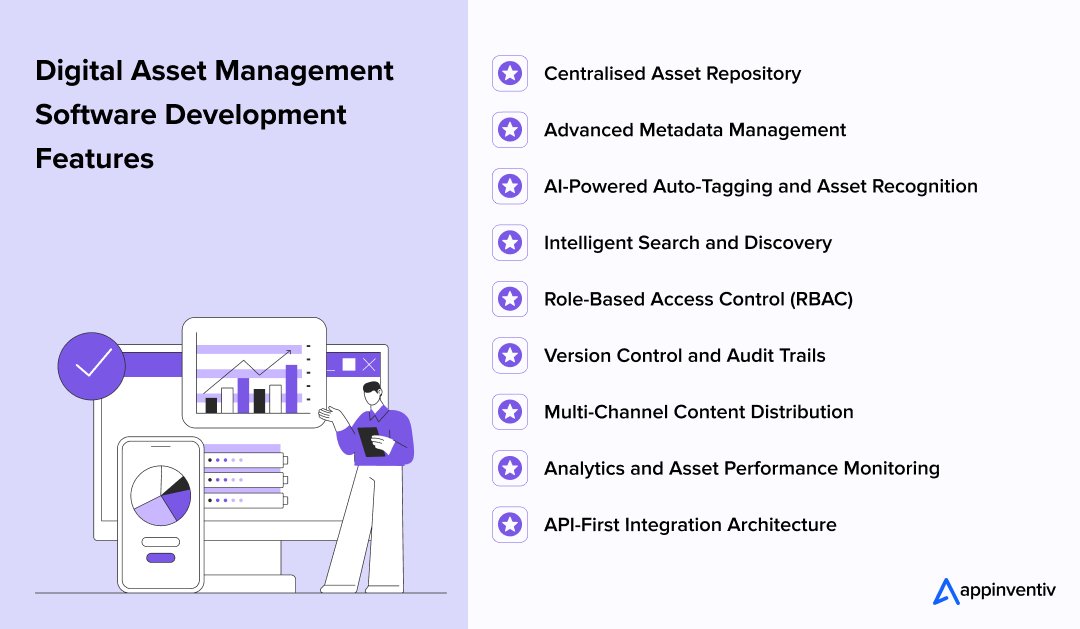
Centralised Asset Repository
A unified, searchable repository with configurable folder taxonomy, collection management, and multi-format support. All teams access one source of truth regardless of geography or function.
Advanced Metadata Management
Custom schema design, mandatory field enforcement, controlled vocabulary lists, and cross-asset metadata inheritance. Metadata architecture is what makes assets findable at scale.
AI-Powered Auto-Tagging and Asset Recognition
Machine learning models that analyse image, video, and document content at ingestion, applying tags, detecting objects, identifying faces (with appropriate governance), and flagging duplicates automatically.
Intelligent Search and Discovery
Natural language query support, visual similarity search, faceted filtering, and saved search configurations. Search behaviour trained to organisational taxonomy and asset vocabulary.
Role-Based Access Control (RBAC)
Granular permission structures aligned to organisational hierarchy and data classification levels. Users see, edit, and distribute only what their role permits with full audit logging of every access event.
Version Control and Audit Trails
Full version history with rollback capability and immutable audit logs for every asset modification, access, and distribution event. Supports regulatory audit readiness and legal discovery requirements.
Multi-Channel Content Distribution
Assets rarely live in isolation. Direct integrations with CMS, e-commerce platforms, social publishing tools, and CDN infrastructure allow users to format and push content directly to downstream channels. The system dynamically resizes and converts file formats on the fly to meet endpoint requirements.
Analytics and Asset Performance Monitoring
Usage tracking, download frequency, channel performance attribution, and asset lifecycle analytics. Enables data-driven decisions about which content investments are delivering commercial value.
API-First Integration Architecture
RESTful API layer enabling bidirectional integration with ERP, PIM, CRM, and MarTech systems. Custom DAM platforms are connectable infrastructure, not isolated repositories.
Advanced Capabilities Shaping Next-Generation DAM Platforms
Modern asset infrastructure now requires cognitive capabilities to manage the exponential growth of content. Integrating artificial intelligence and automated provenance tracking elevates a platform from a passive repository to an active operational layer. These advanced functions provide the scalability necessary to manage synthetic media and programmatic content distribution effectively.
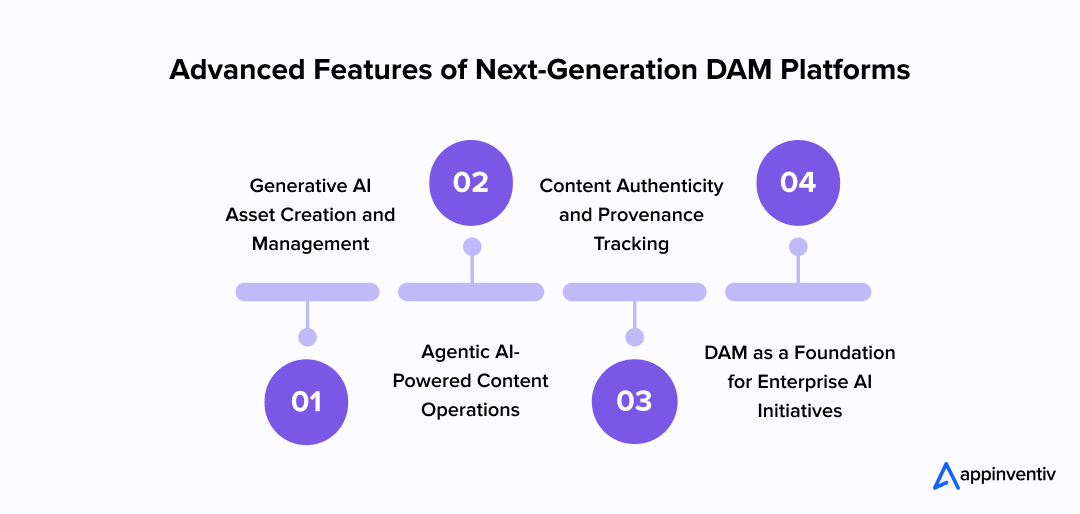
Generative AI Asset Creation and Management
Platforms now integrate generative models directly into the workspace. Users can prompt the system to create slight variations of existing approved assets, extending campaign shelf life. The architecture strictly quarantines these synthetic files until they pass human compliance reviews.
Agentic AI-Powered Content Operations
Businesses in Australia are moving beyond simple automation toward agentic workflows. As noted in the Gartner digital asset management reviews for 2026, autonomous agents can now monitor channel performance and proactively format, distribute, and update assets across external endpoints without requiring human initiation.
Content Authenticity and Provenance Tracking
With the rise of deepfakes, verifying the origin of an asset is crucial. Custom platforms implement cryptographic provenance tracking, aligning with global C2PA standards. This ensures that media used in corporate communications, legal filings, or public campaigns maintains an unbroken, verifiable chain of custody.
DAM as a Foundation for Enterprise AI Initiatives
A well-structured repository serves as the training ground for private enterprise AI models in Australia. By feeding clean, perfectly tagged, and legally cleared proprietary data into custom Large Language Models, organizations can generate highly accurate, brand-safe insights and collateral.
What Are The Core Benefits of Custom Digital Asset Management Software Development
The benefits of a digital asset management platform built for enterprise scale extend beyond content access. They affect time-to-market velocity, compliance posture, cost of content operations, and the organisation’s capacity to leverage its own IP.
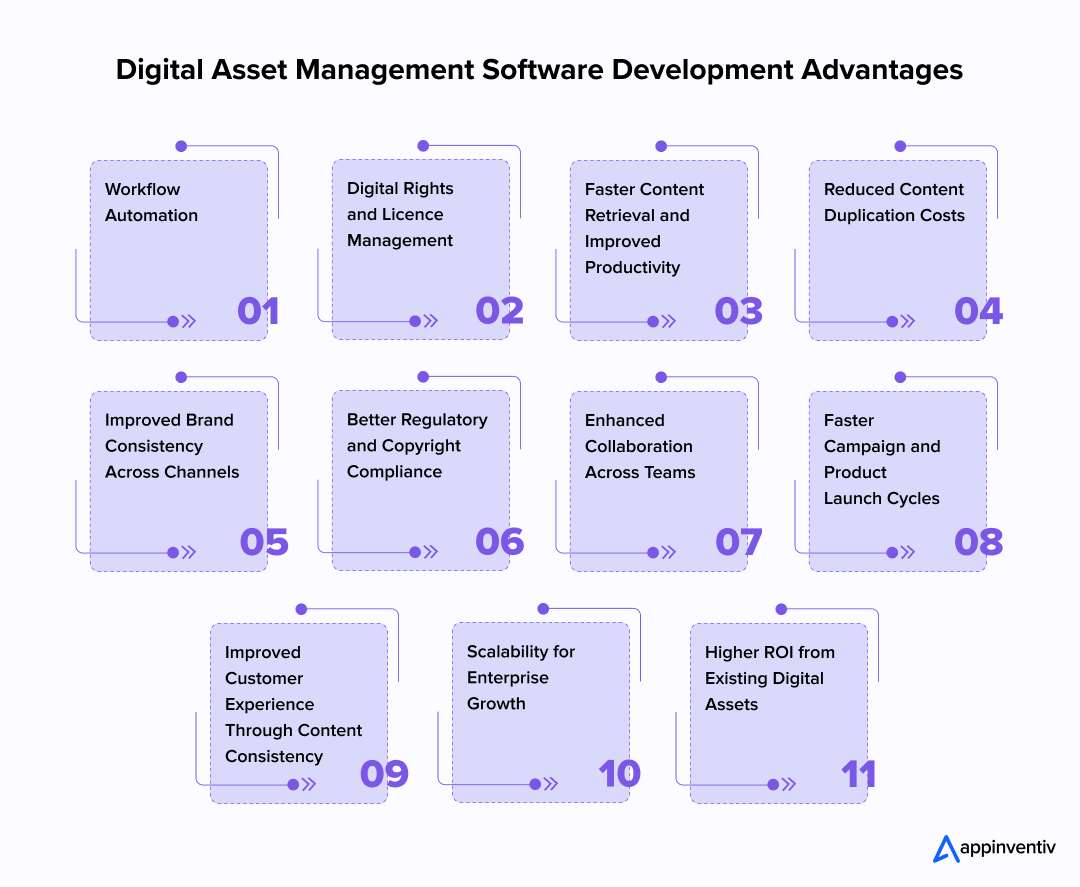
Workflow Automation
Routine approval processes slow down asset deployment. The system automates these administrative steps by routing new uploads to specific stakeholders for compliance and brand review. Once approved, the software automatically transitions the asset into the active repository and alerts relevant teams.
Digital Rights and Licence Management
Using expired stock imagery or unapproved talent photos invites severe legal penalties. Custom solutions hardcode digital rights management directly into the asset profile. The system actively restricts the downloading of expired content and triggers automated alerts before commercial licenses lapse.
Faster Content Retrieval and Improved Productivity
Custom DAM software allows teams to locate the right asset in seconds rather than minutes or hours. Across a large organisation, that retrieval efficiency compounds into material productivity gains.
Reduced Content Duplication Costs
Reliable findability eliminates the need to recreate assets that already exist. Asset reuse rates improve significantly when the system makes existing content discoverable.
Improved Brand Consistency Across Channels
When all channels draw from a single governed repository, brand drift – inconsistent logos, outdated imagery, off-spec colour usage – is structurally eliminated rather than managed manually.
Better Regulatory and Copyright Compliance
Built-in licence management, rights expiry enforcement, and immutable audit trails give compliance teams the evidence they need for regulatory submissions and third-party audits.
Enhanced Collaboration Across Teams
Shared taxonomy, cross-team visibility, and workflow automation reduce the friction between creative, legal, marketing, and product functions, particularly across distributed Australian operations.
Faster Campaign and Product Launch Cycles
Removing asset search and approval delays from launch timelines directly accelerates speed-to-market. Enterprises consistently report shorter campaign production cycles after DAM adoption.
Improved Customer Experience Through Content Consistency
Customers interacting with an enterprise across digital, retail, and service touchpoints receive consistent, current content; a direct reflection of operational content governance.
Scalability for Enterprise Growth
Custom-built platforms scale horizontally with storage infrastructure, user volumes, and integration scope without the licence-per-user cost cliffs that constrain SaaS platforms as organisations grow.
Higher ROI from Existing Digital Assets
Better discoverability, reuse tracking, and performance analytics mean organisations extract more value from the assets they have already invested in producing.
Industry-Specific Use Cases of Custom DAM Software
Different sectors carry distinct requirements for asset handling, regulatory compliance, and distribution. A custom architecture adapts to these specific vertical demands rather than forcing businesses into generic operational models. From managing clinical trial documentation to distributing omnichannel retail campaigns, bespoke solutions align directly with core revenue and compliance activities.
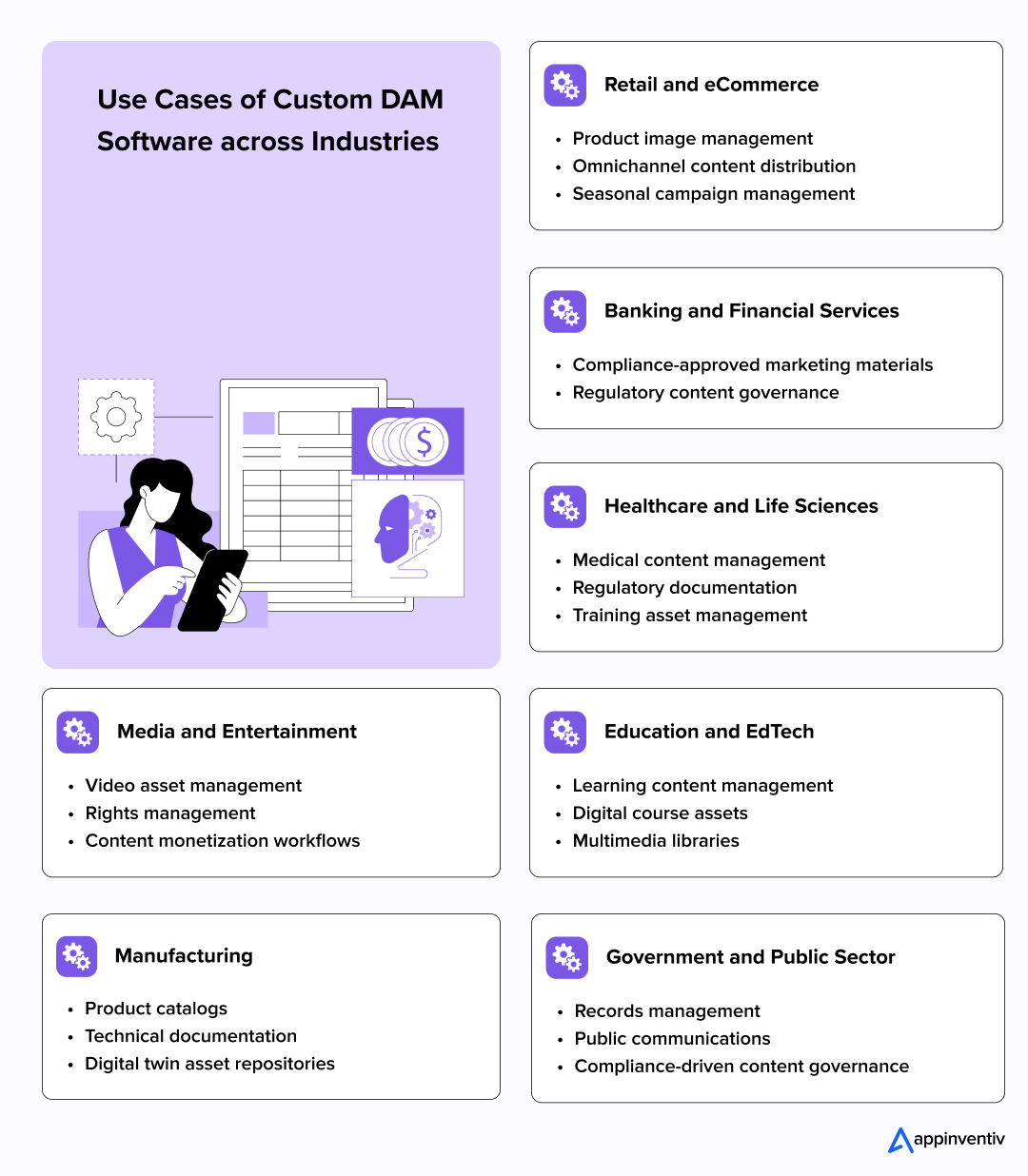
Retail and eCommerce
The modern AI powered retail industry in Australia relies entirely on visual merchandising. Digital asset management system use cases in retail involve handling thousands of product SKUs, managing high-resolution lifestyle imagery, and distributing seasonal campaign content across global storefronts seamlessly.
Healthcare and Life Sciences
Strict regulatory frameworks govern medical communications. Healthcare providers use custom platforms to securely manage patient education videos, technical device schematics, and TGA-approved marketing materials, ensuring nothing reaches the public without strict medical and legal sign-off.
Banking and Financial Services
Financial institutions operate under intense scrutiny. Banks leverage these platforms to govern APRA-compliant disclosure documents, securely distribute investor relations materials, and manage brand assets across a vast network of branch locations and digital banking applications.
Media and Entertainment
Broadcasters deal with massive file sizes and complex licensing agreements. They utilise custom architectures for heavy video asset management, controlling distribution rights for syndication, and orchestrating content monetisation workflows across streaming platforms.
Manufacturing
Industrial firms require precision. Manufacturers rely on asset platforms to store complex 3D digital twin models, update technical maintenance documentation globally, and ensure regional distributors have immediate access to accurate, localised product catalogs.
Education and EdTech
Universities and digital learning providers manage massive volumes of educational property. They deploy custom DAM systems to organise lecture recordings, govern interactive digital course assets, and provide secure multimedia libraries for faculty and student access.
Government and Public Sector
Public institutions must maintain absolute transparency and security. Government agencies utilise proprietary systems for historical records management, public communications governance, and ensuring all digital property meets stringent federal accessibility and archiving mandates.
Use Cases for DAM for Different Departments
| Team | Primary DAM Use Case |
|---|---|
| Marketing | Campaign asset management, brand consistency, channel distribution |
| Design | Creative file versioning, feedback workflow, asset handoff |
| Sales | Proposal templates, pitch decks, approved collateral access |
| Engineering | Technical documentation, product specifications, CAD assets |
| Legal | Contract templates, compliance-approved communications, rights records |
| Finance | Branded financial reports, investor presentation management |
Whether managing product content, regulated documentation, or multimedia libraries, the right DAM architecture should align with your operational model.

Build vs Buy: Should Businesses Develop a Custom DAM Platform or Buy an Off-the-Shelf Solution?
The build-versus-buy decision is not a technology choice. It is an enterprise strategy decision. Understanding where off-the-shelf platforms create constraints versus where they are fit-for-purpose determines where custom development delivers a defensible return.
When an Off-the-Shelf DAM Makes Sense
Organisations with fewer than 10,000 assets, standardised workflows, and no complex integration requirements often find that a commercial DAM product covers their needs adequately. For early-stage content operations or businesses without dedicated content infrastructure teams, the onboarding speed and managed maintenance model of a SaaS platform can be the right starting point.
When Custom DAM Development Delivers Greater Value
Custom development becomes the rational choice when the organisation’s data sovereignty obligations make overseas SaaS storage untenable, when the existing technology stack requires deep bidirectional integration that vendor APIs cannot support, when content operations are complex enough that the vendor’s workflow model forces workarounds, or when asset volumes and user scale create cost structures that make per-seat SaaS pricing economically unsustainable.
| Criteria | Custom DAM | Off-the-Shelf DAM |
|---|---|---|
| Data sovereignty | Full control, local hosting, sovereign cloud | Vendor-determined, often offshore |
| Integration depth | Native API integration with any enterprise system | Pre-built connectors only |
| Workflow flexibility | Fully configurable to organisational process | Constrained to vendor model |
| Compliance posture | Built to exact regulatory requirements | Generic, requires configuration |
| Scalability cost | Infrastructure cost scales linearly | Per-seat fees multiply with growth |
| Total cost of ownership | Higher upfront, lower long-term | Lower upfront, higher long-term |
| Vendor dependency | None – full IP ownership | High – roadmap dependent |
| AI customisation | Custom models trained on organisational data | Vendor AI features only |
For Australian organisations operating at scale, managing regulated content, or running complex multi-system content environments, custom development consistently delivers better long-term economics and a stronger governance posture.
How to Develop and Deploy Digital Asset Management Software in Australia?
Successful DAM initiatives are built around governance, integration, and long-term operational ownership rather than technology alone. The development process should focus on aligning content operations, compliance requirements, and business workflows before any code is written.
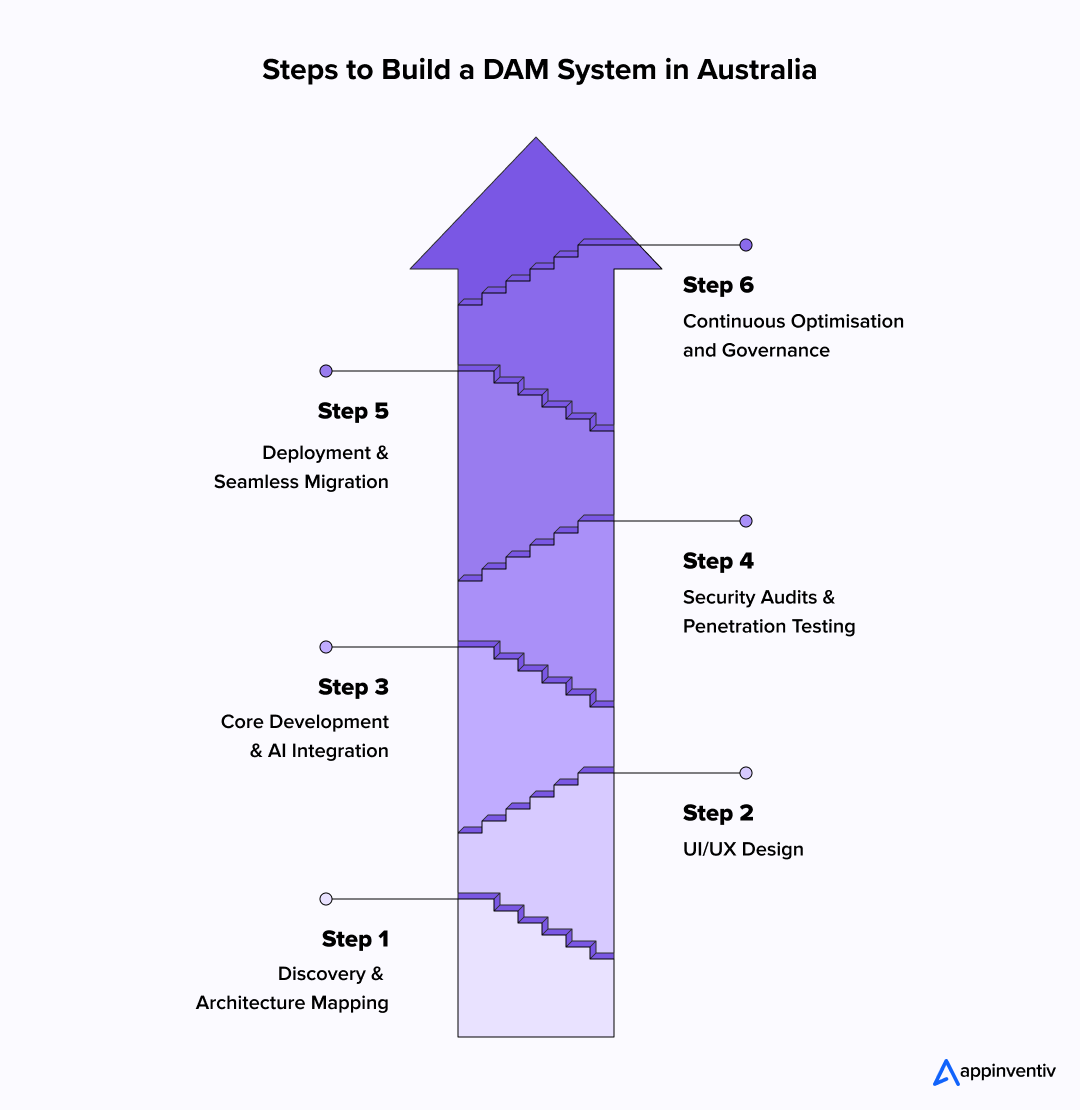
1. Discovery and Asset Governance Planning
The first step is understanding how digital assets move across the organisation. This includes assessing existing repositories, user groups, approval processes, compliance obligations, and integration dependencies.
At this stage, you need to typically define:
- Asset governance policies
- Metadata standards and taxonomy structures
- Access control requirements
- Data residency considerations
- Future scalability needs
Without a clear governance model, even the most sophisticated DAM platform can become another content silo.
2. User Interface and Experience Design
Once business requirements are established, the platform architecture is designed around operational workflows and user experience. Key decisions include:
- Cloud, on-premise, or hybrid deployment
- Storage architecture
- Integration framework
- Search and discovery model
- User journeys for different departments
The objective is to ensure assets remain accessible without compromising security or compliance.
3. Custom Development and Integrations
Once the architecture is designed, it is time to develop the actual platform, including repositories, metadata engines, workflow automation, security controls, and search capabilities. At this stage, integrations are also established with enterprise systems such as:
- ERP platforms
- CRM solutions
- CMS environments
- PIM systems
- Marketing technology stacks
- Identity and access management tools
This creates a connected content ecosystem rather than another standalone application.
4. AI Enablement and Security Validation
As asset volumes grow, automation becomes increasingly important. AI capabilities such as auto-tagging, intelligent search, content recognition, and metadata generation are implemented alongside governance controls. Before deployment, the platform undergoes:
- Security audits
- Penetration testing
- Access control validation
- Compliance reviews
- Performance testing
This ensures the platform can operate securely within enterprise environments.
5. Deployment, Migration, and User Adoption
At this stage, existing assets are migrated into the new DAM environment while preserving metadata, permissions, and version history.
User training and change management activities are equally important during this phase to encourage adoption and minimise operational disruption.
6. Continuous Optimisation and Governance
DAM implementation is not a one-time project. As business requirements evolve, organisations need to continually refine metadata structures, workflows, integrations, security policies, and Gen AI use cases to maintain long-term value and governance effectiveness.
A mature DAM platform should evolve alongside the organisation’s content strategy, compliance landscape, and digital transformation initiatives.
How Much Does It Cost to Build Enterprise Digital Asset Management Software in Australia?
The development cost of digital asset management solutions is not a fixed number. It varies depending on the platform complexity, integration scope, compliance requirements, and AI capability. On average, the DAM software development cost ranges from AUD 70,000 to AUD 700,000 or more.
Here are the core factors that influence the investment:
Factors Influencing Development Costs
- Platform Complexity: Asset volume, metadata schema depth, number of asset types supported
- AI and Automation Requirements: Auto-tagging, visual search, agentic workflow features
- Integration Scope: Number of enterprise systems, API complexity, bidirectional data flows
- Compliance Requirements: Data residency constraints, audit trail depth, regulatory reporting
- Storage Infrastructure: On-premises, sovereign cloud, or hybrid architecture
- User Volume and Permissions: Number of roles, permission complexity, external portal requirements
Estimated Development Cost Range
| DAM Type | Estimated Cost Range (AUD) | Typical Scope |
|---|---|---|
| Basic DAM Platform | 70,000 – 150,000 | Core repository, metadata management, RBAC, basic search |
| Mid-Level Enterprise DAM | 150,000 – 300,000 | Workflow automation, multi-system integration, AI tagging |
| Advanced AI-Powered DAM | 300,000 – 700,000+ | Full AI suite, agentic features, complex compliance architecture |
Cost vs. Long-Term ROI Considerations
The upfront investment in custom digital asset management platform development in Australia needs to be assessed against the total cost of ownership over a five-year horizon. Organisations that have modelled this consistently find that the compounding costs of content recreation, licence fees, compliance remediation, and productivity loss in unmanaged environments exceed custom development costs within 1 to 3 years.
McKinsey analysis indicates that enterprises with high-performing technology infrastructure achieve up to 35% higher revenue growth than peers – an outcome that content infrastructure directly supports.
Share your project vision with our DAM experts and get a custom quotation tailored to your specific needs.

Future Trends in Digital Asset Management Software Development
The DAM platforms Australian enterprises invest in today will need to serve a content environment that looks materially different in three to five years. Understanding where the market is heading powers architecture decisions made now.
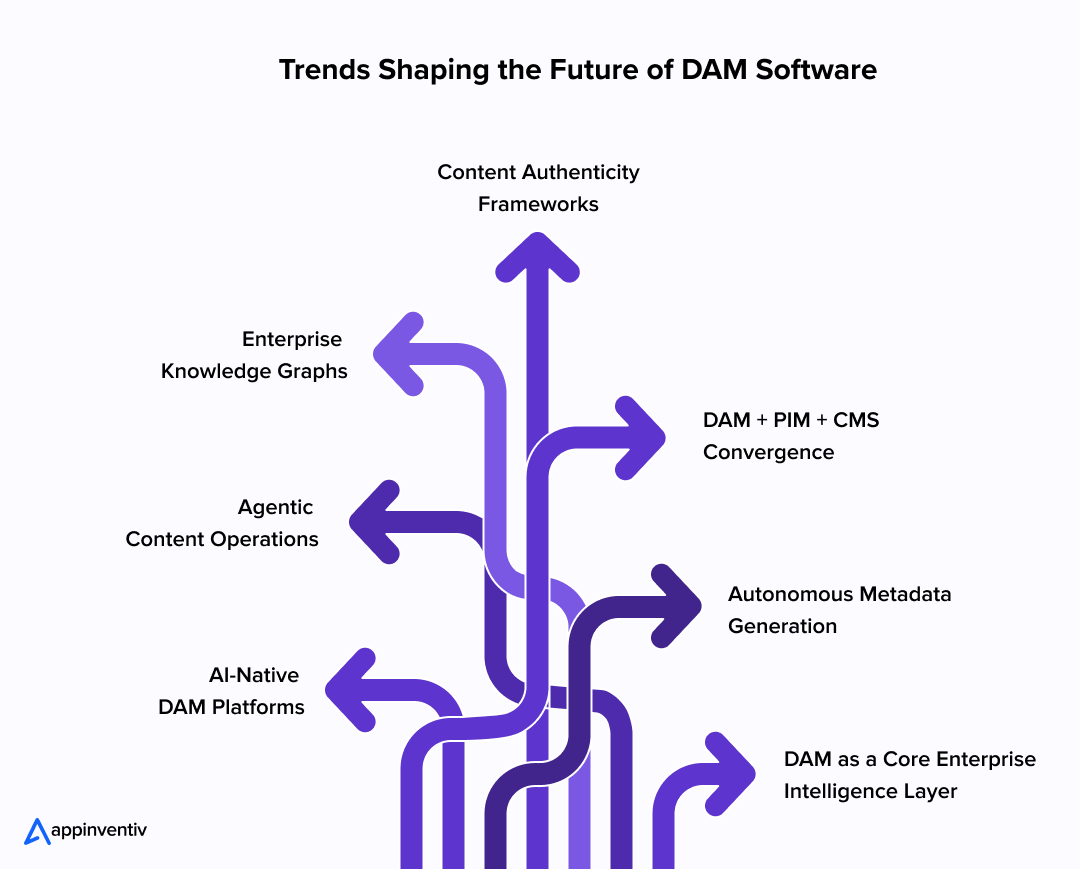
AI-Native DAM Platforms
Platforms where AI is not a bolt-on feature but the core operating layer, handling ingestion, classification, search, and distribution decisions autonomously.
Agentic Content Operations
AI agent platforms managing end-to-end content workflows: briefing, creation, tagging, approval routing, publishing, and performance tracking with human oversight at governance checkpoints only.
Enterprise Knowledge Graphs
DAM platforms extending into knowledge graph infrastructure, connecting assets to products, campaigns, people, and business events to enable semantic retrieval across the enterprise content layer.
Content Authenticity Frameworks
Regulatory and industry-driven frameworks requiring provenance verification for AI-generated content, particularly relevant for financial services, healthcare, and public sector communications.
DAM + PIM + CMS Convergence
The previously distinct boundaries between digital asset management, product information management, and content management systems are converging into unified content operations platforms.
Autonomous Metadata Generation
AI systems that generate and maintain metadata schemas dynamically as new asset types and content categories emerge, eliminating manual taxonomy management at scale.
DAM as a Core Enterprise Intelligence Layer
Forward-thinking enterprises are repositioning DAM not as a content library but as a structured data asset that feeds AI models, informs commercial decisions, and surfaces operational intelligence across the organisation.
What Australian Enterprises Should Prepare For
The shift from passive content storage to active content intelligence infrastructure is already underway in leading organisations. Enterprises that build with an AI-ready architecture, sovereign data controls, and open integration standards now will be significantly better positioned to adopt the next generation of platform capabilities without rebuilding from scratch.
How Appinventiv Delivers Custom Digital Asset Management Software in Australia?
Digital assets are increasingly becoming operational assets. Their value extends beyond marketing and communications into compliance, customer experience, product development, workforce enablement, and AI transformation.
As asset volumes continue to expand, traditional repositories struggle to provide the governance, discoverability, and scalability enterprises require. This is why custom digital asset management software development in Australia is gaining momentum among organisations seeking greater control over digital operations. At Appinventiv, we help enterprises design and develop DAM platforms aligned with governance requirements, security expectations, integration ecosystems, and long-term growth strategies.
With 3,000+ digital assets deployed across 35+ industries and a 90% client retention rate achieved, our team stands by you throughout the project lifecycle right from discovery and architecture design to integration and even post-launch governance.
We also hold ISO 27001, ISO 9001, and SOC2 certifications and are approved on the Queensland Government ICTSS and Local Buy LGA procurement panels. These recognitions make us a trusted software development company in Australia for government and regulated enterprise clients.
Whether your requirement is a greenfield DAM platform, a legacy system modernisation, or an AI capability layer added to an existing content infrastructure, our team of 1600+ tech experts brings the architecture, security, and compliance expertise to bring your vision to life.
Connect with us to scope your digital asset management platform development today.
FAQs
Q. Why use digital asset management software in Australia?
A. Australian enterprises use custom DAM software to centralise digital content management, enforce data sovereignty under the Privacy Act 1988 and sector-specific frameworks, eliminate productivity loss from content sprawl, and maintain brand consistency across multi-channel operations. The specific driver varies by industry, but the operational inefficiency of unmanaged content environments is consistent across sectors.
Q. How long does implementing a digital asset management system take in Australia?
A. The timeline for custom digital asset management software development in Australia typically ranges between 4 and 12+ months. For example:
- A basic DAM platform can be delivered in 4 to 6 months.
- A mid-level platform with multiple integrations typically requires 6 to 9 months.
- Advanced AI-powered DAM platforms with complex compliance requirements generally take 9 to 12+ months from discovery to full production deployment.
Q. What are the biggest challenges in digital asset management platform development?
A. The most common challenges are metadata architecture design, legacy data migration quality, integration complexity with existing enterprise systems, user adoption, and maintaining governance discipline as the asset library grows. Projects that invest adequately in the discovery and architecture phase consistently experience fewer delivery risks.
Q. How does AI improve digital asset management software?
A. AI improves DAM platforms through automated metadata tagging at ingestion, visual similarity search, duplicate detection, intelligent content recommendations, agentic workflow routing, and anomaly detection in access patterns. Over time, AI models trained on organisational content and taxonomy become more accurate and reduce the manual overhead of content operations teams.
Q. How do digital asset management systems integrate with existing enterprise tools?
A. Custom DAM platforms are built with an API-first architecture that enables bidirectional integration with ERP, PIM, CMS, CRM, MarTech platforms, and CDN infrastructure. Integration scope is defined during the discovery phase and is one of the primary factors that determine overall development complexity and cost.
Q. What are some digital asset management system examples in Australia?
A. Australian organisations commonly use DAM platforms such as Adobe Experience Manager Assets, Bynder, Aprimo, Brandfolder, and OpenText Media Management to centralise, organise, and govern digital content. Larger enterprises often choose custom DAM solutions to meet specific requirements around compliance, integrations, data sovereignty, and workflow automation.


Fast 2-minute response, fully NDA-protected.

Beyond Customer Portal Development: Building Connected Digital Services
Key takeaways: A portal without CRM, ERP and billing integration leaves your staff doing the connecting. Start with customer tasks, then integrate only the systems those tasks actually need. Name one system of record for each data type before choosing APIs or middleware. Plan integration, security and privacy obligations at the start, not after the…
CRM Software for Local Government: From Community Requests to Better Service Delivery
Key takeaways: A council CRM should sit around existing systems as a service layer, not replace them. Integration with ERP, rates, property and GIS systems prevents another data silo and duplicate entry. Start with one high-volume service, pilot it with residents, then scale on measured results. Track resolution time, SLA compliance, self-service rates and cost…

The Ultimate Guide to CRM for Insurance: Features, Cost, Top Platforms, Integration & More
Key takeaways: CRM for insurance connects sales, service, and claims into one governed system, distinct from the policy administration system. Core features span pipeline management, policy visibility, claims tracking, commission management, AI analytics, and compliance controls. Cost ranges from roughly USD 15,000 for configuration to USD 150,000 and beyond for custom development at enterprise scale.…