































AI in FinTech Australia: 12 Use Cases, Benefits, and Regulatory Shifts

 Share -



- 01How AI Technologies Are Transforming the FinTech Landscape
- 0212 High-Impact AI Use Cases and Benefits in the Australian FinTech Industry
- 03How to Implement AI in FinTech: From PoC to Production
- 04How AI Is Transforming the FinTech Value Chain?
- 05What Are the Challenges of Implementing AI in FinTech and How to Solve Them?
- 06AI Governance and Regulatory Considerations for FinTechs
- 07What Is the Future of AI in the FinTech Industry?
- 08Turn AI Adoption Into Measurable FinTech Value with Appinventiv
- 09FAQs

Key takeaways:
- Australian Fintech institutions are getting the best returns by targeting specific bottlenecks, mainly real-time fraud checks on the NPP, CDR-based loan approvals, automated APRA reporting, and tailored superannuation advice.
- Advanced algorithms fail on fractured legacy systems. Real progress depends on cleaning up backend data, connecting core APIs, and using models you can actually explain to an auditor.
- With APRA’s CPS 230/234 mandates, ASIC oversight, and the Privacy Act actively enforced, compliance can’t be an afterthought. It has to be built directly into the software architecture.
- The competitive advantage will come from operationalising AI at scale, turning experimentation into measurable improvements in risk, efficiency, customer value, and decisions.
The Australian financial services sector is no longer just experimenting with artificial intelligence. It is embedding it directly into core enterprise operations. According to a recent report, 72% of surveyed financial institutions are already using agentic AI to assist with complex underwriting and decision support.
However, for C-suite executives and IT directors at the banks and lending firms, this rapid adoption is exposing a critical infrastructure gap. While 75% of these institutions cite faster or real-time decision cycles as a core benefit of AI, a staggering 67% admit their underlying data is either not ready or only partially ready to support AI-driven decisioning. In fact, a mere 3% consider their data fully “AI-ready,” with fragmented systems and poor data quality acting as the leading barriers to scale.
Enterprise leaders are navigating a storm of mounting pressures: fractured legacy systems, the demand for unified customer views, and tightening regulatory scrutiny surrounding the Consumer Data Right (CDR) and upcoming APRA mandates like CPS 230. In this high-stakes environment, AI is no longer an experimental luxury. It is the foundational infrastructure required to survive. But deploying the right AI use cases successfully requires more than just ambition; it requires closing the data readiness gap to ensure secure, compliant, and highly scalable financial operations.
In this blog we will break down all the needed information related to AI in FinTech in Australia – benefits, use cases, and look at what’s coming next in the future of AI in the finance industry.
Deploying AI on fractured legacy systems doesn’t just stall ROI. It creates huge compliance blind spots. Don’t wait for your next CPS 230 audit to fix your underlying data architecture.

How AI Technologies Are Transforming the FinTech Landscape
The integration of artificial intelligence into Australian financial services is rewriting the operational playbook. Rather than simply layering new tools on top of legacy infrastructure, forward-thinking institutions are re-architecting how data flows, how risk is managed, and how customer value is delivered across the ecosystem.
From Rule-Based Automation to Adaptive Intelligence
For years, digital transformation in banking relied on rigid, deterministic logic. Today, the sector is transitioning toward systems that continuously learn, predict, and act autonomously.
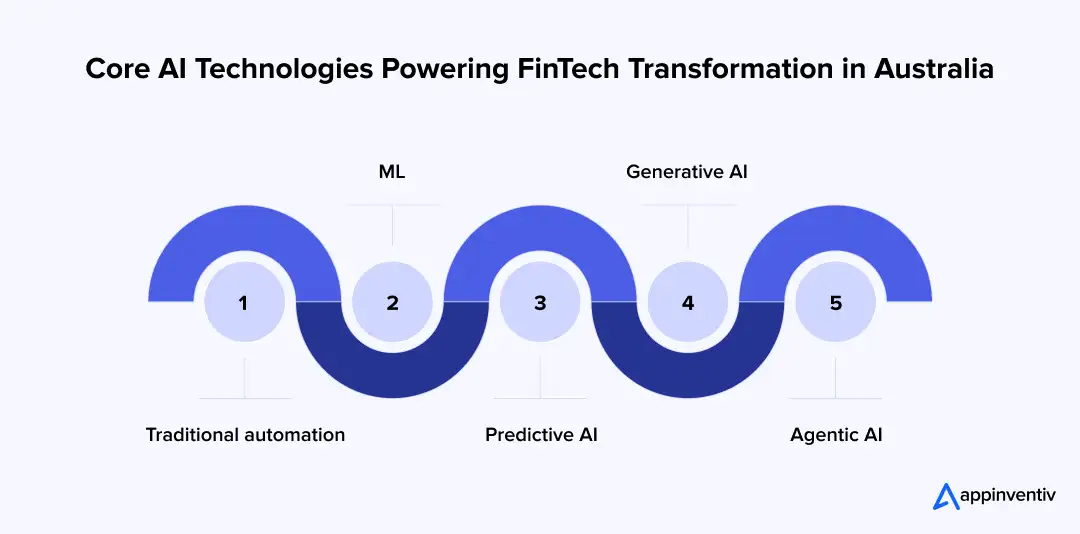
- Traditional Automation: Relies on strict “if-this-then-that” programming to handle high-volume, routine tasks like standard data entry. It remains static and breaks when encountering unprogrammed edge cases.
- Machine Learning (ML): Identifies dynamic patterns within complex, unstructured datasets without explicit programming. It forms the foundation for modern real-time fraud monitoring and credit risk assessment.
- Predictive AI: Uses historical trends and statistical algorithms to forecast future outcomes, helping institutions anticipate cash flow shifts, credit defaults, or customer churn before they occur.
- Generative AI: Focuses on content synthesis and processing, from summarising complex regulatory updates to generating synthetic data for safe model training.
- Agentic AI: Represents the current frontier in enterprise capabilities. Rather than simply responding to prompts, agentic AI in the Australian Fintech sector operates with context-aware autonomy to execute multi-step workflows.
Where Australian Financial Institutions Are Seeing AI Value
For financial institutions, the strongest AI opportunities tend to fall into four enterprise outcomes:
| Business Priority | AI Contribution |
|---|---|
| Risk reduction | Deploying real-time AI powered fraud detection, anti-money laundering (AML) monitoring, cyber threat intelligence, and dynamic credit-risk scoring. |
| Operational efficiency | Automating high-friction internal workflows such as document processing, complex bank reconciliation, and continuous RegTech compliance reporting. |
| Customer growth | Shifting to hyper-personalisation through AI-driven financial assistants, tailored wealth management advice, and proactive, smart product curation. |
| Decision intelligence | Empowering leadership with real-time insights, macroeconomic forecasting, institutional portfolio monitoring, and predictive liquidity analysis. |
Unlocking long-term value across these four pillars requires bridging the gap between advanced algorithms and enterprise-grade infrastructure.
For FinTech leaders, that makes the next phase less about adding another AI feature and more about identifying where intelligent automation can create measurable improvements in risk, cost, customer value and decision-making.
12 High-Impact AI Use Cases and Benefits in the Australian FinTech Industry
For enterprise leaders, moving from theoretical AI models to production-ready deployments requires solving specific, high-stakes operational problems. Here is a breakdown of how the most prominent AI use cases in the FinTech industry in Australia are currently driving measurable value.
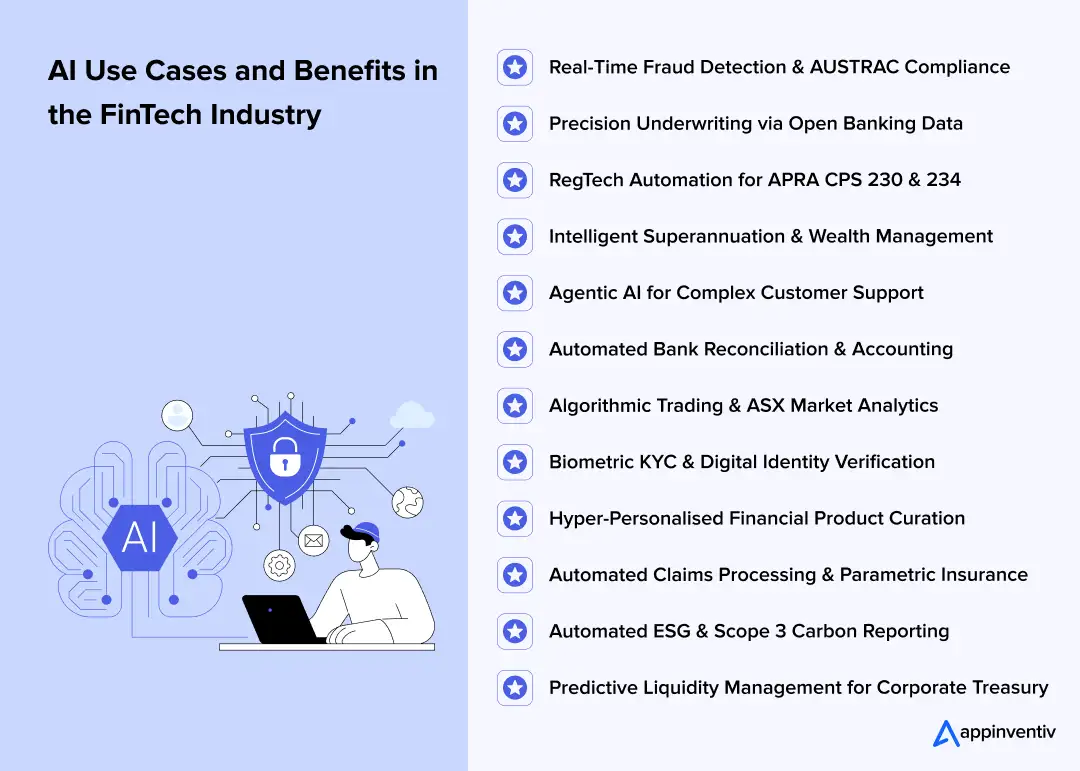
1. Real-Time Fraud Detection & AUSTRAC Compliance
- Business Problem: The adoption of the New Payments Platform (NPP) and instant PayTo transactions means funds settle in seconds. Legacy rule-based security engines cannot evaluate instant transactions effectively, often resulting in high false-positive rates and delayed fraud detection.
- How AI Works: Machine learning algorithms ingest millions of historical and live data points such as device behaviour, IP location anomalies, and sudden deviations in spending habits to assign a dynamic risk score in milliseconds.
- AI Application: Financial institutions are deploying these models to comply with the 2026 AUSTRAC Tranche 2 AML/CTF reforms and the Scams Prevention Framework, identifying sophisticated money laundering rings and structuring behaviours that traditional software misses.
- Benefits: Drastically cuts the cost of manual investigations, reduces customer friction caused by frozen accounts, and mitigates the risk of massive regulatory fines.
- Considerations: AUSTRAC requires high explainability. “Black-box” AI models that cannot justify why a transaction was flagged will fail an audit. Institutions must ensure their AI architecture provides transparent, auditable reasoning.
2. Precision Underwriting via Open Banking Data
- Business Problem: Traditional credit bureau checks are slow and inherently backward-looking. They often penalise “thin-file” customers, such as gig economy workers or new migrants, shrinking a lender’s addressable market.
- How AI Works: Predictive AI models ingest vast amounts of alternative, unstructured data such as utility payments, direct debits, and real-time cash flow metrics to build an accurate, holistic profile of a borrower’s true financial health.
- AI Application: Leveraging CDR integrations, lenders can pull a continuous, secure feed of a customer’s spending habits across multiple banking platforms to power instant loan approvals.
- Benefits: Expands the lending market safely, reduces default rates through more accurate risk profiling, and compresses the loan origination lifecycle from days to minutes.
- Considerations: Privacy is paramount. Institutions must strictly adhere to the Privacy Act and CDR consent frameworks, ensuring data is only retained and analysed for its authorised purpose.
3. RegTech Automation for APRA CPS 230 & 234
- Business Problem: APRA’s CPS 230 (Operational Risk Management) and CPS 234 (Information Security) mandates have fundamentally raised the bar for compliance. Compiling quarterly risk reports and monitoring third-party vendor vulnerabilities manually is no longer sustainable.
- How AI Works: Natural language processing (NLP) and generative AI in the Australian FinTech industry instantly parse changing regulatory text, cross-reference it against internal policy documents, and automatically flag operational compliance gaps.
- AI Application: Enterprise risk teams are replacing manual spreadsheet audits with continuous AI-driven monitoring dashboards that track operational resilience and third-party supply chain risks in real-time.
- Benefits: Eliminates the exhausting “quarterly scramble” for APRA reporting, reduces compliance overheads, and provides the board with an accurate, real-time view of operational risk.
- Considerations: The cost to implement AI in FinTech for compliance is offset by the avoidance of APRA penalties, but the system still requires a “human-in-the-loop” to sign off on final regulatory submissions.
4. Intelligent Superannuation & Wealth Management
- Business Problem: The Australian superannuation market is highly consolidated and intensely competitive. Funds struggle to provide highly personalised financial advice to millions of members at scale, leading to low member engagement and higher churn.
- How AI Works: Robo-advisors powered by machine learning assess a member’s age, risk tolerance, market volatility, and ESG preferences to dynamically optimise portfolio allocations.
- AI Application: Super funds are integrating AI to deliver hyper-personalised retirement projections and proactive investment nudges directly through their mobile apps, simulating the experience of a private wealth manager.
- Benefits: Democratises elite wealth management, increases member retention, and drives higher voluntary contributions through targeted, contextual advice.
- Considerations: The provision of financial advice in the nation is heavily regulated by ASIC. AI models offering explicit financial recommendations must operate within strict licensing boundaries to avoid compliance breaches.
5. Agentic AI for Complex Customer Support
- Business Problem: Local contact centres face high turnover rates, soaring operational costs, and frustrated customers tired of navigating rigid phone menus or unhelpful, scripted chatbots.
- How AI Works: Agentic AI uses advanced large language models (LLMs) connected directly to the bank’s core APIs. It does not just converse; it understands intent, retrieves account data, and autonomously executes backend workflows.
- AI Application: Tier-1 banks are deploying AI agents capable of handling complex requests, such as initiating a chargeback for a disputed transaction, modifying direct debit limits, or reissuing a lost card without human intervention.
- Benefits: Delivers frictionless, 24/7 resolution for customers, drastically reduces average handling time (AHT), and frees human agents to manage high-value emotional disputes.
- Considerations: Hallucinations pose a severe reputational risk. Partnering with a proven technology provider is essential to build rigid guardrails that prevent the AI from making unauthorised account changes.
6. Automated Bank Reconciliation & Accounting (Xero/MYOB)
- Business Problem: For SME banking clients and large corporate finance teams, matching complex, high-volume transactions across fragmented data feeds at month-end is tedious and prone to human error.
- How AI Works: Machine learning and pattern recognition algorithms ingest bulk invoice data, bank feeds, and historical ledgers to auto-categorise and reconcile payments, even when reference numbers are missing or amounts are split.
- AI Application: FinTechs are building deeper AI-driven integrations with dominant local accounting platforms like Xero and MYOB, offering business customers a real-time, error-free view of their cash flow.
- Benefits: Saves finance departments hundreds of administrative hours, accelerates the financial close process, and provides extreme accuracy in P&L reporting.
- Considerations: The underlying data must be clean. As enterprise studies show, deploying AI on fragmented legacy data diminishes its reconciliation accuracy.
7. Algorithmic Trading & ASX Market Analytics
- Business Problem: Institutional traders and wealth managers must process an overwhelming volume of global market data, economic indicators, and news sentiment to spot profitable opportunities or mitigate portfolio exposure.
- How AI Works: Complex quantitative models analyse historical pricing data and alternative data sets (like satellite imagery of supply chains or global social media sentiment) to execute trades at speeds impossible for human brokers.
- AI Application: Hedge funds and institutional trading desks operating on the ASX are utilising AI to optimise execution timing, reduce market impact, and identify micro-patterns in order book imbalances.
- Benefits: Maximises portfolio returns, removes emotional bias from trading strategies, and ensures rigorous trade compliance by automatically flagging internal market manipulation (such as spoofing).
- Considerations: Market volatility can cause AI models to act unpredictably if not properly constrained. Robust circuit breakers are mandatory to prevent automated flash crashes.
8. Biometric KYC & Digital Identity Verification
- Business Problem: Mobile onboarding drop-off rates spike when identity verification processes are clunky. Yet, strict Know Your Customer (KYC) laws require foolproof verification to prevent identity theft.
- How AI Works: Computer vision and AI-driven document forensics analyse government-issued IDs for tampering, while liveness detection algorithms track micro-facial movements to ensure a live human is holding the device.
- AI Application: Digital lenders and payment providers can combine AI-powered document verification, biometric liveness detection and identity-data checks with Australia’s identity-verification infrastructure, including the Document Verification Service (DVS) where applicable.
- Benefits: Compresses account opening from days to under two minutes, virtually eliminates synthetic identity fraud, and creates a flawless first impression for new users.
- Considerations: Biometric data is classified as highly sensitive under the Privacy Act. When you hire AI developers for FinTech, they must possess deep expertise in advanced encryption and data sovereignty protocols to ensure this data is never compromised.
9. Hyper-Personalised Financial Product Curation
- Business Problem: Generic cross-selling (like blasting generic credit card offers to all checking account holders) yields low conversion rates and frustrates consumers who expect brands to understand their specific needs.
- How AI Works: Recommendation engines, similar to those used by streaming services, analyse a customer’s transaction history, lifecycle stage, and peer grouping to surface the most relevant financial product at the exact moment of intent.
- AI Application: If an AI model detects multiple large purchases at hardware stores, the banking app dynamically updates its dashboard to offer a home renovation loan. If it detects international airline bookings, it immediately prompts a tailored travel insurance offer.
- Benefits: Dramatically increases cross-sell conversion rates, grows wallet share, and shifts the institution’s perception from a passive vault to a proactive financial partner.
- Considerations: Success relies entirely on a unified customer data view. Institutions must break down internal data silos to ensure the AI engine has a complete, accurate picture of the user’s financial life before making recommendations.
10. Automated Claims Processing & Parametric Insurance (InsurTech)
- Business Problem: Australia’s increasing frequency of severe weather events, from prolonged bushfire seasons to extreme flooding in Queensland and New South Wales, places immense strain on legacy claims teams. Delays in processing not only trigger regulatory scrutiny from ASIC but also severely damage customer trust during times of crisis.
- How AI Works: Computer vision algorithms assess user-uploaded photos or drone imagery to instantly quantify property damage, while predictive models compare the claim against historical repair costs and policy limits to automate approval.
- AI Application: InsurTechs and established carriers are deploying AI to enable straight-through processing (STP) for standard claims. Furthermore, parametric insurance models are using real-time satellite data to automatically trigger payouts the moment a specific weather threshold (like a certain flood depth) is breached, completely bypassing the manual assessment queue.
- Benefits: Accelerates claim resolution times by nearly 75%, significantly lowers the operational cost of AI implementation in InsurTech environments and provides immediate financial relief to policyholders.
- Considerations: AI models handling claims must be entirely free from algorithmic bias that could inadvertently discriminate against certain postcodes or demographic groups. Explainability is a strict compliance requirement.
11. Automated ESG & Scope 3 Carbon Reporting (AASB S2 Compliance)
- Business Problem: Under the new Australian Sustainability Reporting Standards (AASB S2), large Group 1 financial institutions and asset managers are now legally required to disclose their climate-related financial risks. Most critically, this includes complex “Scope 3” financed emissions (the carbon footprint of the companies they lend to or invest in), which requires aggregating massive volumes of fragmented, third-party data.
- How AI Works: NLP and data-ingestion algorithms continuously scan unstructured supplier data, external public registries, and portfolio company reports to calculate an accurate greenhouse gas (GHG) emissions baseline.
- AI Application: Asset managers and commercial banks are replacing manual spreadsheet estimations with AI-driven carbon accounting platforms that provide an audit-ready view of their entire investment portfolio’s climate exposure.
- Benefits: Ensures strict compliance with mandatory ASIC and AASB timelines, prevents accidental greenwashing (which carries severe penalties), and identifies lucrative green-lending opportunities.
- Considerations: The challenge lies in data standardisation. AI is only as accurate as the underlying data, meaning institutions must force their third-party vendors and borrowers to adopt standardised digital reporting formats.
12. Predictive Liquidity Management for Corporate Treasury
- Business Problem: Corporate treasurers at large enterprises face highly volatile macroeconomic conditions, including shifting RBA interest rates and fluctuating global supply chain costs. Relying on static, retrospective cash flow models often results in trapped liquidity or forced, expensive short-term borrowing.
- How AI Works: Machine learning models process global market signals, historical enterprise spending, seasonality, and real-time accounts receivable/payable data to dynamically forecast cash positions across multiple currencies.
- AI Application: FinTech platforms serving institutional clients are deploying AI to offer automated “smart sweeps”, autonomously moving surplus cash into high-yield, short-term investment vehicles overnight, while ensuring sufficient operational liquidity remains available for the next business day.
- Benefits: Maximises interest yield on idle cash, drastically reduces the need for emergency overdraft facilities, and removes manual guesswork from complex corporate treasury operations.
- Considerations: When integrating these tools into an enterprise ERP (like SAP or Oracle), one of the primary challenges is ensuring robust cybersecurity. API connections between treasury AI and core banking systems must be fortified against sophisticated cyber intrusions.
Explore how Appinventiv can help you plan, engineer and scale your next AI-led financial product for the Australian market.

How to Implement AI in FinTech: From PoC to Production
Integrating AI for the FinTech industry should start with the right strategy and end with measurable results. Here’s a step-by-step process that can help businesses unlock AI’s full potential across their financial operations.
| Stage | What to Do | Expected Timeline |
|---|---|---|
| 1. Identify the use case | Prioritise a measurable business problem based on ROI, feasibility and risk. | 2–3 weeks |
| 2. Assess data readiness | Audit data quality, availability, lineage and accessibility across existing systems. | 3–5 weeks |
| 3. Map regulatory requirements | Identify relevant APRA, ASIC, Privacy Act and CDR obligations for the use case. | 2–4 weeks |
| 4. Design the AI architecture | Define models, data pipelines, APIs, security controls and integration requirements. | 4–8 weeks |
| 5. Build and validate the PoC | Develop a controlled prototype and test accuracy, explainability, security and business feasibility. | 4–8 weeks |
| 6. Establish AI governance | Define model ownership, Human-in-the-Loop controls, approval processes, audit trails and escalation paths. | Parallel with PoC |
| 7. Integrate and deploy | Connect the validated AI solution with core banking, CRM, payments or other production systems. | 8–16+ weeks |
| 8. Scale and monitor | Monitor model performance, drift, security, inference costs and business outcomes before expanding usage. | Ongoing |
Also Read: How to Build an AI App in Australia: A Complete Guide
How AI Is Transforming the FinTech Value Chain?
Artificial intelligence is not merely a plug-in feature; it fundamentally restructures how value is created, protected, and delivered. The following table maps the exact shift from legacy, manual processes to continuous, intelligent operations across the financial ecosystem.
This transformation is why leading institutions are increasingly looking to hire AI powered fintech software development services in Australia that can orchestrate these complex, integrated workflows.
| FinTech Stage | Traditional Approach | AI-enabled Approach |
|---|---|---|
| Customer onboarding | Manual verification and slow data entry | Intelligent KYC with instant biometric verification |
| Risk assessment | Rule-based scoring using backward-looking data | Predictive risk models using real-time CDR feeds |
| Lending | Manual underwriting resulting in prolonged approvals | AI-assisted underwriting for near-instant decisions |
| Payments | Static routing and batch processing | Dynamic optimisation for real-time NPP settlement |
| Fraud | Rule-based alerts generating high false positives | Behavioural detection adapting to new threat vectors |
| Customer service | Scripted support and frustrating phone menus | GenAI assistants executing complex, agentic workflows |
| Compliance | Manual reviews and periodic spreadsheet audits | AI-assisted monitoring for continuous RegTech reporting |
| Operations | Spreadsheet workflows and siloed departmental data | Intelligent automation linking front-and-back office |
| Reporting | Periodic analysis lacking real-time visibility | Real-time intelligence and automated reconciliation |
| Decision-making | Historical data driving reactive boardroom strategy | Predictive, continuous insights mapping market shifts |
The result is a more connected financial operating model where AI can contribute at multiple stages rather than operating as a standalone feature.
What Are the Challenges of Implementing AI in FinTech and How to Solve Them?
The journey to AI maturity is fraught with technical and regulatory hurdles. In fact, scaling these systems safely is significantly harder than building the initial pilot. Addressing the challenges of AI adoption in FinTech requires a holistic view of infrastructure, culture, and compliance.
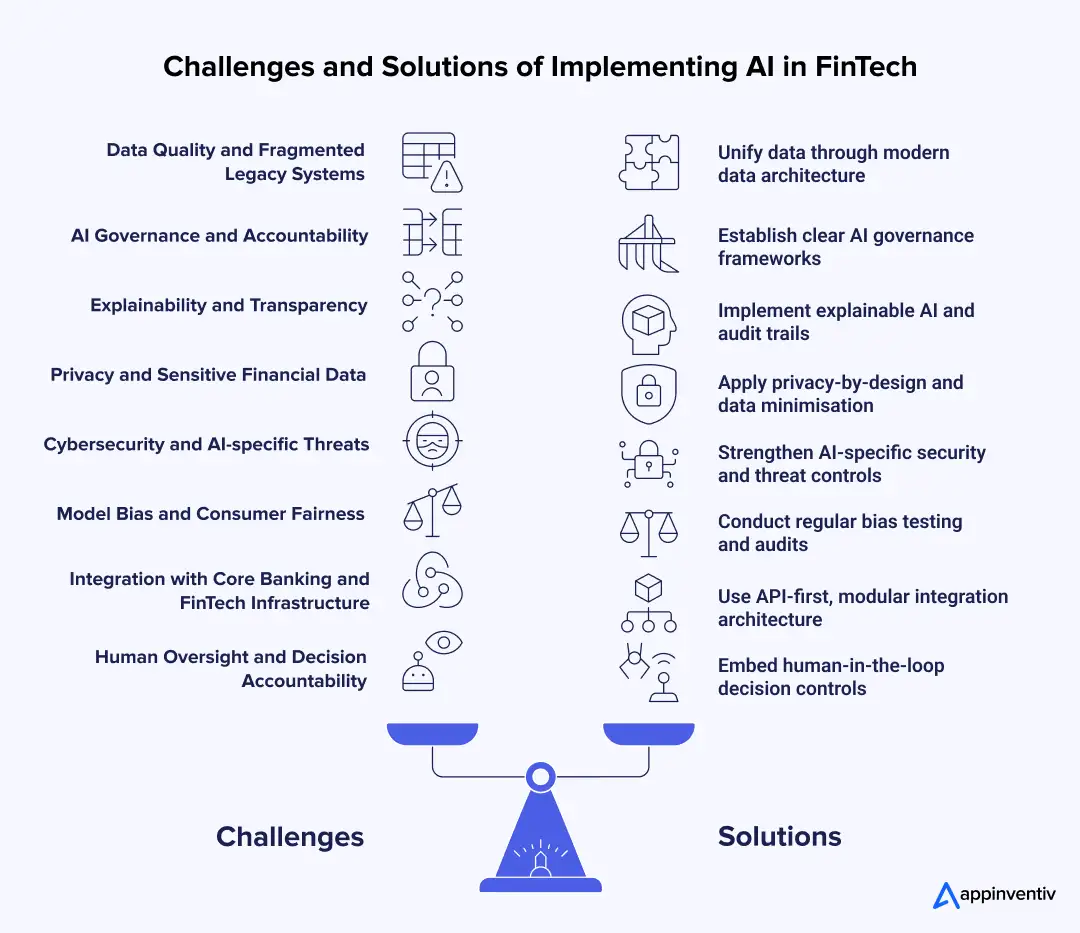
Data Quality and Fragmented Legacy Systems
AI models are only as effective as the data feeding them. In Australia, many legacy banks operate on heavily siloed databases where retail, commercial, and wealth data rarely intersect cleanly.
The solution: Before deploying advanced algorithms, institutions must invest in unified data lakes and robust API gateways that cleanse, normalise, and structure historical data into a single, reliable source of truth.
AI Governance and Accountability
Technology is moving much faster than internal corporate oversight. As ASIC recently warned after reviewing financial services and credit licensees, there is a severe governance gap, nearly half of the reviewed entities lacked policies explicitly addressing consumer fairness in AI usage.
The solution: Boards must establish dedicated AI governance committees that mandate strict reporting lines, ensuring every algorithmic deployment aligns with the institution’s defined risk appetite.
Explainability and Transparency
“Black-box” AI models that yield decisions without a clear logical pathway are fundamentally incompatible with financial regulation. If an algorithm denies a mortgage, the lender must be able to explain exactly why.
The solution: Engineering teams must prioritise explainable AI (XAI) frameworks, mapping out the precise decision trees and data weighting used in every customer-facing output.
Privacy and Sensitive Financial Data
Ingesting vast amounts of consumer behaviour data for machine learning inevitably collides with the Privacy Act and the strict consent parameters of the CDR.
The solution: Implement privacy-enhancing technologies (PETs), such as synthetic data generation and federated learning, allowing models to train on patterns without ever exposing raw, personally identifiable information (PII).
Cybersecurity and AI-specific Threats
AI introduces entirely new attack pathways. As highlighted by APRA, the misuse of autonomous AI agents, prompt injection attacks, and data leakage through LLMs represents a rapidly evolving threat landscape.
The solution: Cyber resilience frameworks must be actively updated to secure non-human actors and probabilistic models, integrating rigorous penetration testing specifically designed for AI vulnerabilities.
Model Bias and Consumer Fairness
Historical financial data is inherently biased. If left unchecked, machine learning models will rapidly amplify these biases, leading to discriminatory lending or pricing practices.
The solution: Regular algorithmic audits must be conducted using diverse testing datasets to proactively identify and neutralise demographic or socio-economic discrimination before the model reaches production.
Integration with Core Banking and FinTech Infrastructure
Bolting sophisticated AI onto rigid, monolithic banking mainframes often causes system latency or outright failure, completely negating the intended ROI.
The solution: Adopt a microservices architecture. By deploying AI capabilities via decoupled APIs, financial institutions can modernise their technical stack iteratively without risking core operational downtime.
Human Oversight and Decision Accountability
Fully autonomous decisioning at scale remains a severe enterprise risk. Regulators expect that a human remains ultimately responsible for high-stakes financial outcomes.
The solution: Embed “Human-in-the-Loop” (HITL) protocols where the AI acts as a co-pilot, flagging risks, synthesising data, and recommending actions while human experts maintain the final sign-off on critical approvals.
AI Governance and Regulatory Considerations for FinTechs
AI adoption in FinTech requires governance to be built into the solution from the start, not added after deployment. Financial institutions need clear controls around how AI models use data, make decisions, interact with customers and remain accountable over time.
| Regulatory Consideration | What Australian FinTechs Should Address |
|---|---|
| APRA expectations for AI risk management | Align AI deployment with existing risk-management, information-security and operational-resilience obligations, including relevant APRA standards such as CPS 230 and CPS 234. |
| ASIC and responsible AI use | Establish clear accountability for AI-assisted financial and credit decisions, particularly where models can affect customer outcomes. |
| Privacy and data protection | Apply the Privacy Act 1988, Reform rules and relevant CDR requirements when collecting, processing, storing or sharing sensitive financial and personal information. |
| Explainability and human oversight | Ensure high-impact AI decisions can be understood, challenged and reviewed by appropriately authorised staff. |
| Model validation and monitoring | Test models for accuracy, drift, bias and unexpected behaviour before deployment and throughout their operational lifecycle. |
| AI audit trails and documentation | Maintain records of model versions, training data, decisions, interventions and approvals to support internal governance and regulatory reviews. |
| Third-party AI and model risk | Assess external AI vendors, foundation models and APIs for security, data handling, resilience, transparency and concentration risk. |
| Operational resilience and incident response | Define controls for AI failures, inaccurate outputs, cyber incidents and service disruptions, with clear escalation and recovery procedures. |
The key principle: Australian FinTechs should treat AI as an enterprise risk and governance issue as much as a technology initiative. This becomes particularly important as organisations move from experimentation towards customer-facing and agentic AI workflows.
What Is the Future of AI in the FinTech Industry?
The focus for financial institutions has shifted decisively from theoretical exploration to operational execution. Moving forward, AI maturity in local financial services will unfold across four key phases:
2024–25: Experimentation and Early Adoption
Financial institutions explored generative AI, copilots, document processing and internal productivity use cases.
2026: AI Deployment and Agentic Workflows
Organisations are moving more AI applications into production, including customer interaction, claims triage, lending, fraud and workflow automation. APRA’s 2026 review confirms that this transition is already underway across regulated entities.
2027+: AI Embedded into Financial Products
AI will increasingly become part of underwriting, payments, wealth management, insurance, risk monitoring and customer journeys rather than sitting as a separate feature.
Long term: AI-native Financial Ecosystems
Financial products and operating models will increasingly be designed around continuous data analysis, intelligent decisioning and agent-led workflows from the outset.
The competitive advantage will therefore shift from having access to AI technology to having the data, architecture, governance and operational workflows required to use it reliably at scale.
For FinTechs, the winners are unlikely to be those that simply deploy the most AI. They will be the organisations that can turn AI into measurable improvements in risk, efficiency, customer value and decision quality while maintaining the trust and resilience expected of a regulated financial system.
Turn AI Adoption Into Measurable FinTech Value with Appinventiv
The transition from isolated AI experimentation to enterprise-grade deployment is the defining challenge for Australian financial institutions today. Scaling artificial intelligence across a highly regulated environment requires more than generic, off-the-shelf software. It demands an experienced Artificial Intelligence development company in Australia capable of bridging the critical gap between advanced data science, legacy banking infrastructure, and stringent local compliance.
Appinventiv, an approved ICT supplier on the Australian Government Digital Transformation Agency (DTA) panel (as well as state panels like QLD ICTSS.1303B), is uniquely positioned to guide this transformation.
Our team of 1700+ tech experts across 5+ delivery centers in Australia is deeply embedded in the regulatory landscape. They engineer solutions that are natively aligned with the Privacy Act, APRA CPS 230/234, and the CDR, ensuring your AI infrastructure is resilient, auditable, and secure by design.
In our 11+ years of APAC delivery experience, we haven’t just theorised about the future of finance; we have built it. We have successfully delivered 3000+ digital assets, including highly complex FinTech and InsurTech platforms for clients like Mudra and Edfundo.
For leading tier-one banks and institutional clients, we have deployed advanced predictive risk models, agentic customer support workflows, and automated RegTech solutions that cut operational overhead while adhering to the highest global security standards (ISO, SOC2, PCI DSS).
So, whether you are looking to modernise core legacy systems to handle real-time NPP settlements, deploy secure RAG (Retrieval-Augmented Generation) pipelines for compliance monitoring, or build hyper-personalised consumer banking apps, Appinventiv provides the end-to-end engineering required to operationalise AI at scale.
The window to build your AI foundation is closing. Stop experimenting and start scaling.
Partner with Appinventiv to modernise your infrastructure, mitigate regulatory risk, and turn artificial intelligence into your strongest competitive advantage in the Australian FinTech market.
FAQs
Q. How Much Does AI FinTech Development Cost?
A. AI FinTech app development cost in Australia generally costs between AUD 70,000 and AUD 200,000 for a basic proof-of-concept and around AUD 400,000 and AUD 700,000+ for enterprise-grade systems. Mid-tier applications with Open Banking integrations cost AUD 200,000 to AUD 400,000, with ongoing model inference fees and data readiness preparation requiring additional capital.
Q. How Can Australian FinTech Companies Implement AI?
A. FinTech companies can implement AI by identifying a high-value use case, preparing the required data, selecting the appropriate AI technology, and gradually moving from a proof of concept to production. The implementation should include secure system integration, AI governance, human oversight, model monitoring and compliance with relevant requirements.
Q. What Are the Benefits of AI in FinTech?
A. The benefits of AI in FinTech include faster fraud detection, improved risk assessment, lower operational costs, personalised customer experiences, automated compliance and better decision-making. AI can also help financial institutions respond more effectively to real-time payments, CDR-enabled data flows and increasingly complex regulatory requirements.
Q. How Is AI Used in the FinTech Industry?
A. AI is used in FinTech to power real-time fraud detection, automate Open Banking underwriting, execute agentic customer support workflows, and manage intelligent superannuation portfolios. Financial institutions deploy these models across core APIs to resolve disputed transactions, assess borrower risk instantly, and dynamically optimise investment strategies.


Fast 2-minute response, fully NDA-protected.

AI Agent Governance: How to Govern Autonomous AI Across Business Systems
Key takeaways: AI agents require controls at the action, identity, data, tool, and workflow levels. Every enterprise agent should have a registered owner, an approved purpose, and a defined risk tier. Access must be based on the agent’s task rather than inherited from a human user or shared service account. High-impact actions need real-time policy…

'I.D.E.A.S.' - The Five Pillar Framework to Ace AI-Native Enterprise Apps in 2027
Key takeaways: AI-native enterprise apps are moving beyond AI agents toward intelligent, adaptive, autonomous and context-aware digital capabilities that can operate across mobile, web, voice, wearables and emerging interfaces. The I.D.E.A.S. framework for AI enterprise apps in 2027 - Interactive Intent, Decisioning Autonomously, Experiential System Design, Adaptive Execution, and Security Layered. Context intelligence and reusable…

Automated Decision-Making in Australia: Benefits, Cost and Implementation
Key takeaways: Automated decision-making combines rules, algorithms, AI and human oversight to improve high-volume decisions. ADM programmes require privacy, security, auditability and accountability to be designed into architecture. ADM implementation costs typically range from AUD 70,000 to AUD 700,000 or more. Implementation starts with decision mapping, then moves through development, testing, controlled pilots and monitoring.…