


































Key takeaways:
- Most enterprises have adopted AI, but many struggle to scale beyond departmental deployments due to fragmented data, infrastructure, and governance.
- Generative AI adoption is widespread, yet production reliability depends on strong retrieval architectures, access controls, and auditability rather than model capability alone.
- Agentic AI is gaining traction, but successful deployments remain tightly governed, task-specific, and integrated with enterprise systems through controlled execution layers.
- AI ROI often remains unclear because organizations fail to establish baselines and track workflow-level metrics such as cycle time, automation coverage, and cost per transaction.
- Legacy systems and inconsistent data pipelines continue to be the biggest barriers to enterprise AI scale, making integration engineering more critical than model development.
- AI governance breaks down at scale without automated controls such as versioning, audit trails, drift detection, and role-based execution permissions.
- Enterprises that treat AI as core infrastructure, supported by shared platforms, MLOps discipline, and benchmark-driven strategy, are achieving faster scaling, lower costs, and measurable business impact.
The state of AI in the enterprise has entered a build phase. Most organizations are no longer experimenting with isolated models. They are wiring AI into production systems, connecting it to real workflows, and expecting measurable outcomes from it.
Over the last two to three years, enterprise AI adoption trends have shifted in a noticeable way. Early pilots that once lived inside innovation labs are now moving into operational stacks.
Recommendation engines are feeding customer platforms. Predictive models are tied into supply chain planning. Fraud detection engines are running alongside transaction pipelines. In many environments, AI is no longer a standalone tool. It is becoming part of the system architecture.
Despite this progress, many organizations still lack clear reference points. Reports exist, but they often mix industries, regions, and definitions. That makes it difficult to judge whether spending levels, deployment maturity, or performance targets are actually competitive.
This guide compiles 20+ enterprise AI benchmarks for 2026 across industries to provide grounded reference points.
Each benchmark is followed by practical context, helping leaders understand where enterprise AI stands today, what signals matter most, and how to turn adoption into reliable execution.
past 12 months, by function,1 % of respondents
Global Enterprise AI Adoption Snapshot in 2026
The state of AI in the enterprise is defined by production deployment, not experimentation. Most large organizations are already running AI inside live systems. The real divide in 2026 is not adoption, but operational maturity.
AI is showing up in customer support workflows, fraud engines, demand forecasting with AI, DevOps tooling, and internal knowledge systems. The question leadership teams now face is not “Should we adopt AI?” but “Can we scale it without breaking governance, budgets, or system stability?”
1. AI Adoption Has Become Mainstream in Enterprises
McKinsey’s 2025 Global AI Survey reports that 88% of organizations use AI in at least one business function.
That number confirms enterprise AI adoption trends have crossed the early-adopter stage. AI is no longer confined to innovation labs or sandbox environments.
function continues to increase.
organizations using AI in 2025
What matters now is integration depth.
Many organizations build AI models from scratch, but the surrounding stack often remains immature. Models may exist, yet data contracts are unstable. Inference services may run, but monitoring is shallow. Outputs may be generated, but not tightly embedded into transactional systems.
Enterprise direction:
Treat AI as part of your system architecture. Connect AI directly to CRM pipelines, ERP events, claims processing engines, and supply chain APIs. Without structured integration and telemetry, adoption rarely compounds into value.
2. Scaling Remains the Real Bottleneck
The same McKinsey research shows that only about one third of organizations report achieving substantial value across multiple business units.
This gap between deployment and scaled impact is where most AI programs stall.
The technical blockers are rarely model accuracy alone. They usually sit in:
- Fragmented data pipelines
- Weak feature stores
- Lack of model version governance
- No structured rollback mechanisms
- Minimal performance observability
Running a model in one workflow is manageable. Scaling across departments requires shared infrastructure. Despite this, recent AI budget allocation trends indicate movement from pilot funding to structured infrastructure investment.
Many of these challenges are reflected in recent AI implementation statistics 2026, which show that deployment success depends more on AI readiness than model accuracy.
Enterprise direction:
Implement disciplined MLOps practices. Enforce version control, drift detection, performance SLOs, and audit logs. Standardize deployment pipelines before expanding AI workloads into new business units.
3. AI Investment Growth Is Accelerating
IDC projects global AI spending to exceed $758 billion by 2029, with sustained double-digit growth. The projected AI investment growth rate confirms sustained expansion beyond early experimentation.
This is not innovation spending. It reflects capital allocation.
Current AI investment trends in enterprises show increasing allocation toward infrastructure and orchestration layers.
Boards are now approving AI investments across infrastructure, compute clusters, vector databases, orchestration frameworks, and governance tooling. AI budget allocation trends show movement from isolated experiments to structured portfolio lines.
Enterprise direction:
Separate experimental AI budgets from production AI infrastructure budgets. Track compute consumption, inference cost per transaction, model retraining frequency, and governance tooling as measurable cost centers. Financial discipline is now part of enterprise AI maturity.
4. AI Is Expanding Across Business Functions
After delivering 300+ AI-powered solutions, Appinventive reported, AI is now most commonly deployed in IT, marketing, service operations, and operational analytics. As AI is helping with the cost optimization in the enterprise across different industries.
However, this cross-functional spread introduces architectural strain.
Each function may select different vendors, models, and data schemas. Without coordination, organizations accumulate isolated AI systems that cannot share signals, features, or governance controls.
Enterprise AI adoption trends are increasingly cross-functional, but infrastructure maturity often lags behind.
Enterprise direction:
Establish centralized AI platform teams. Provide shared feature stores, reusable model services, unified observability dashboards, and enterprise-grade identity controls. Treat AI capabilities as internal utilities, not department-owned tools.
5. Digital Transformation Programs Are Now AI-Driven
Current digital transformation statistics 2026 show that AI-enabled initiatives outperform traditional modernization efforts.
Deloitte’s research shows organizations embedding AI into digital transformation efforts report stronger performance improvement than programs without AI integration.
AI is no longer an overlay to transformation. It is the mechanism enabling automation, prediction, and decision support at scale.
However, transformation impact depends on execution metrics, not narrative claims.
If AI reduces cycle time but increases exception rates, the system has not matured. If automation improves throughput but introduces opaque decision logic, governance risk rises.
Enterprise direction:
Tie AI initiatives to measurable enterprise AI transformation metrics such as:
- Cycle time reduction
- Error rate change
- Cost-to-serve
- Revenue uplift per workflow
- Operational efficiency gains
AI must show up in enterprise AI value realization metrics, not slide decks.
Closing Note:
The current state of AI in the enterprise shows broad adoption with uneven maturity.
Many organizations have deployed models. Fewer have built resilient pipelines, shared governance layers, and cost-aware infrastructure that supports sustained ROI.
The next section examines enterprise AI adoption trends by industry, where maturity gaps become more visible and competitive differentiation is clearer.
Industry-Wise Enterprise AI Adoption Trends in 2026
Enterprise AI adoption trends are no longer uniform. Industries with structured data, clear regulatory guardrails, and measurable cost pressure are scaling faster. Others are still building data foundations before AI can deliver sustained value.
The difference in 2026 is not who is experimenting. It is who has production pipelines running with governance and uptime guarantees. These enterprise AI benchmarks highlight how adoption maturity varies by sector.
6. Healthcare: AI Is Embedding Into Clinical and Operational Workflows
According to Appinventiv, hospitals are scaling rapidly based on updated enterprise AI adoption statistics 2026. Digital health is among the most active sectors for AI deployment, particularly in imaging and clinical decision support.
Hospitals are now extending AI beyond diagnostics. Models are assisting in appointment scheduling, triage routing, EHR data summarization, and capacity planning.
The technical bottleneck is rarely model accuracy. It is integration.
Most health systems still operate on layered EHR architectures that were not designed for continuous model inference. Adding AI requires secure API bridges, patient data anonymization layers, strict access controls, and full audit trails for every prediction made.
Clinical validation workflows also slow scaling. Models must be monitored for bias drift, demographic imbalance, and false negative risk.
Enterprise direction:
Build explainability and traceability into inference pipelines. Log every prediction, input feature set, and version ID. Integrate AI services directly into EHR middleware rather than creating parallel systems.
Healthcare AI without audit-grade logging does not survive compliance review.
7. BFSI: AI Runs Inline With Transaction Systems
McKinsey’s 2025 Global AI shows financial services remain among the most mature enterprise AI adopters.
Banks now run machine learning models inline with payment authorization systems and credit decision engines.
Latency tolerance is tight. AI powered fraud detection models must respond in milliseconds. A model drift event can shift approval rates within hours. That translates into exposure risk.
Production constraints include:
- Drift detection windows
- False positive thresholds
- Regulatory explainability
- Model rollback under live traffic
With AI in Banking many institutions discovered that scaling AI meant upgrading observability stacks, not building new models.
Enterprise direction:
Treat AI monitoring like transaction monitoring. Embed governance, drift detection, and compliance metrics into the same telemetry system. AI risk management benchmarks should sit beside financial risk dashboards.
8. Retail: AI Is Moving From Personalization to Core Operations
Retail AI adoption is no longer limited to recommendation widgets. It is shifting into supply chain and inventory control.
Deloitte’s 2026 Retail Industry Outlook notes that roughly 30% of retailers were already using AI for supply chain visibility in 2025, with adoption expected to exceed 40% in 2026 as investment continues.
What is changing is not just usage, but where AI sits in the stack.
Retailers are feeding AI models with:
- POS transaction streams
- Ecommerce clickstream data
- Promotion calendars
- Inventory feeds
- External demand signals
The complexity is integration.
Most large retailers still operate separate ecommerce, warehouse, and store systems. Identity resolution between channels is often inconsistent. Feature pipelines differ by region. That weakens forecast reliability.
When data contracts drift, demand prediction becomes unstable. Pricing engines lose sensitivity. Personalization quality drops.
Enterprise direction:
Standardize event schemas across channels. Build a shared feature store that serves forecasting, pricing, and personalization models from the same signal layer. AI ROI in retail improves when models influence replenishment, merchandising, and digital engagement simultaneously rather than in isolation.
These developments reinforce ongoing enterprise AI adoption trends toward operational integration. Retail AI scales when infrastructure is unified. It stalls when data remains fragmented.
9. Manufacturing: Industrial AI Requires Data Discipline
75% manufacturing leaders started AI to contribute to operating margin gains by 2026, according to the TCS Future-Ready Manufacturing Study. These trends mirror broader enterprise AI adoption statistics 2026.
Predictive maintenance remains common. Sensors stream telemetry data into failure prediction models.
The scaling issue is variability.
Plants often use different equipment, firmware versions, and data schemas. Without normalization, models trained in one facility underperform in another.
Edge inference adds another layer of complexity. Local gateways may run older model versions while central teams retrain updated models in the cloud.
Enterprise direction:
Industrial data normalization remains central to evolving enterprise AI adoption trends. Standardize telemetry schemas across facilities. Enforce centralized version control and scheduled retraining governance. Success rate of implementing AI in manufacturing rise when plant-level divergence is reduced.
10. Logistics: AI Is Moving Into Core Supply Chain Decisions
AI adoption in logistics is accelerating, but not evenly.
According to ABI Research’s Supply Chain AI Survey, 64% of supply chain decision-makers say AI capabilities are now important or very important in technology purchasing decisions, and 91% report increasing AI investment over the last two years.
Logistics firms already use AI for route optimization and demand forecasting. The shift now is orchestration.
Inventory engines, fleet routing systems, AI in warehouse management and warehouse robotics increasingly exchange signals in near real time.
When those systems are not synchronized, decisions conflict.
Latency misalignment between procurement and fulfillment models creates operational inefficiencies.
Enterprise direction:
Design orchestration layers with structured APIs and shared state definitions. Define latency budgets and ownership rules between systems. Enterprise AI adoption scaling strategies must include cross-system decision governance.
11. Insurance: Interest Is High. Scaled Execution Is Limited.
A 2025 industry report found that about 78% of property and casualty insurers are using or testing generative AI, yet only around 4% have scaled it meaningfully across claims operations.
That difference between experimentation and scale reflects the reality inside most carriers.
AI in Insurance is being used for summarizing claim files, extracting data from PDFs, underwriting with AI, and flagging suspicious activity. These are useful entry points. They reduce manual effort.
The friction appears when AI touches core systems.
Most insurers still run layered legacy platforms. Real-time model scoring requires integration work. Decisions must be traceable. Regulators expect explainable underwriting logic.
That’s why claims automation introduces dependency on formal AI risk management benchmarks. A claims recommendation cannot simply be generated. It must be defensible.
Many organizations discover that scaling AI means upgrading data pipelines and governance processes, not just training better models.
Enterprise direction:
Before pushing AI deeper into underwriting or claims adjudication, ensure model outputs are logged, versioned, and auditable. Tie predictions back to structured data sources. In insurance, scaling depends on system integration and compliance discipline more than algorithm complexity.
12. Energy & Utilities: AI Is Focused on Reliability, Not Hype
Energy companies are increasing AI use in grid operations, forecasting, and asset monitoring. By 2027, 40% of utility control rooms are expected to use AI.
In this sector, AI is not about experimentation. It is about stability.
Utilities run on real-time telemetry. Sensors stream data from substations, transformers, and distribution networks. AI models help predict load shifts, detect equipment issues, and flag anomalies before they turn into outages.
The bar is high. A late prediction affects uptime. A noisy alert wastes field resources. Inference latency and precision matter as much as accuracy.
Many utilities are learning that scaling AI in the energy sector means upgrading data pipelines and monitoring systems first.
Enterprise direction:
Build AI infrastructure that can handle real-time data ingestion and model inference at scale. Connect predictive analytics to operational control systems with clear latency budgets and failure fallback logic. Define AI metrics that tie directly to uptime, improved forecasting accuracy, and maintenance cost reduction and not just pilot success rates.
Closing Note
Industry-level enterprise AI adoption trends in 2026 show one consistent reality.
Adoption is widespread. Scaled, governed integration is not.
Industries with structured data and defined ROI paths are advancing faster. Others are strengthening infrastructure before expanding AI programs.
These patterns collectively reflect the evolving state of AI in the enterprise, where scaling discipline now defines competitive advantage.

Generative AI Adoption Benchmarks in 2026
The state of AI in the enterprise is increasingly influenced by how generative models are embedded into structured workflows.
Gen AI is widely deployed in 2026. However, the difference between leaders and laggards is no longer access to models. It is how deeply those models are wired into production systems.
13. GenAI is Becoming Part of Core Business Workflow
According to the IBM Institute for Business Value 2025 CEO Study, nearly 72% of executives say their organization has adopted generative AI in at least one business function, and a majority expect expanded operational integration in 2026.
What stands out is not just adoption, but where it is happening.
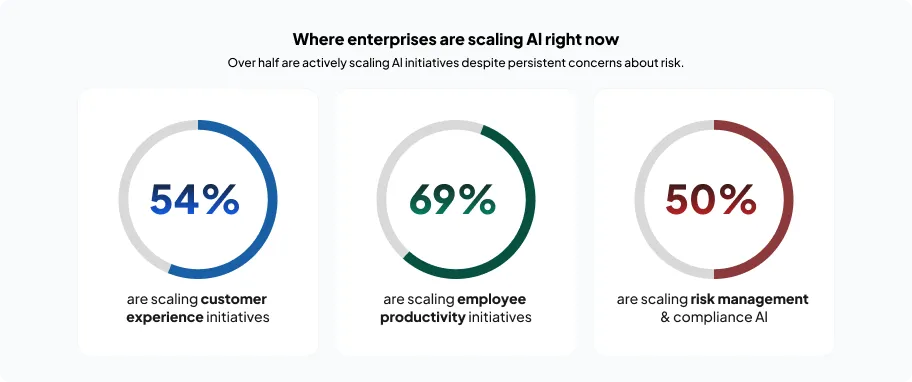
GenAI is being deployed in:
- Customer support response drafting
- Code generation and developer tooling
- Internal knowledge search
- Marketing content operations
- Contract and document review
But production integration is uneven.
In many environments, GenAI still runs through standalone SaaS tools or loosely connected APIs. That works at a small scale. It breaks under enterprise concurrency and governance requirements.
Enterprise direction:
Move GenAI from standalone tools into controlled service layers. Introduce centralized logging, prompt governance, and identity-based access controls before expanding usage across departments.
14. Scaling Requires Retrieval and Context Control
Appinventiv has helped enterprise leaders achieve a 70% faster workflow by building GenAI applications. They also noted that while generative AI adoption is accelerating across enterprises, concerns around data governance, hallucinations, and information security are rising just as quickly.
That shift toward retrieval-based systems adds real technical weight.
- You now have to manage embedding pipelines.
- Design and maintain vector indexes.
- Filter context based on user identity and permissions.
- Log which documents influenced each response.
- Validate outputs before they reach downstream systems.
Without that structure, outputs drift. Trust erodes quickly once incorrect or untraceable answers surface.
Enterprise direction:
When building Gen AI apps, treat retrieval architecture as core infrastructure, not an enhancement. Track source attribution for every response. Introduce evaluation loops that measure accuracy and policy alignment before expanding GenAI into finance, legal, or compliance workflows.
At scale, control matters more than fluency.
15. Cost Management Is Becoming a Core Concern
As generative AI usage increases, inference costs accumulate. Organizations now compare infrastructure performance against AI cost optimization benchmarks to prevent runaway compute costs.
Large-scale deployments must account for:
- Token consumption per query
- Peak concurrency
- Model switching strategies
- Fine-tuning versus prompt optimization trade-offs
Enterprises that do not track unit economics early often discover unexpected budget pressure.
Enterprise direction:
Monitor cost per request and per workflow. Set thresholds for acceptable inference spend. Introduce caching strategies and tiered model usage based on task complexity.
Closing Note
Generative AI adoption in 2026 is real and expanding. What separates successful programs is not enthusiasm. It is infrastructure discipline.
Enterprises that treat LLM systems as governed production services see stronger value realization. Those that treat them as experimental tools often stall.
Agentic AI Adoption Benchmarks in 2026
The next phase of the state of AI in the enterprise is defined by execution-enabled systems rather than passive model responses.
Agentic AI is entering enterprise environments through controlled execution layers, not open autonomy. Budgets are real. Experiments are structured. Most deployments are task-bound, API-driven, and heavily monitored.
16. 88% of Enterprises Have Dedicated AI Agent Budgets
NASSCOM’s 2025 global study reports that 88% of enterprises have allocated or plan to allocate dedicated budgets for AI agents.
Dedicated funding pools reflect emerging AI budget allocation trends tied to automation infrastructure. This matters because agent systems require different infrastructure from traditional ML or GenAI deployments.
Spending is moving toward:
- Orchestration engines
- Tool-use frameworks
- Execution memory stores
- API mediation layers
- Guardrail systems
- Observability tooling
Unlike basic GenAI, agentic systems execute actions. That introduces operational liability. Budget allocation reflects that.
Agentic AI is being treated as a systems engineering initiative, not just a model integration.
Enterprise instruction:
The latest enterprise AI spending report data shows increasing allocation toward orchestration and monitoring systems.
Enterprises should budget separately for execution infrastructure. Account for retry logic, failure handling, concurrency management, and execution audit storage. Model access is the smallest part of the stack.
17. Where Agentic AI Is Delivering Measurable Value
According to the NASSCOM study, early value realization of Agentic AI in enterprise is strongest in:
- IT service automation
- Finance operations
- HR workflow management
- Procurement
- Compliance documentation
These functions share three traits:
- Repetition
- Structured decision trees
- Measurable SLAs
Agentic systems reduce manual intervention count, shorten resolution times, and increase process coverage.
They do not replace enterprise decision-making at scale. They optimize execution layers.
Enterprise instruction:
Tie agent deployments to metrics such as:
- Manual touchpoint reduction
- Workflow completion time
- SLA adherence rate
- Exception frequency
- Automation coverage percentage
If those metrics do not move, the agent is not ready to scale.
18. Over 60% Are Running Structured Agent Experiments
The report indicates that more than 60% of enterprises are experimenting with AI agents in pilot or early production phases.
These are not generic chatbot tests.
They are scoped deployments such as:
- Ticket classification + resolution routing
- Document validation against policy rules
- Multi-step procurement approvals
- Automated compliance checklist verification
In most cases, agents operate within predefined execution graphs. They are not reasoning freely. They are executing bounded state transitions.
Adoption is concentrated in processes that can be decomposed into tool calls and decision checkpoints.
Enterprise instruction:
Before deploying AI agents, model the workflow as a state machine. Define entry conditions, permissible tool calls, exit states, and error states. Autonomous systems without state clarity drift quickly.
19. Types of AI Agents Being Deployed
The NASSCOM study categorizes enterprise agent usage into structured types. In practice, these align to three architectural models.
Task-Level Agents
Single-step execution agents.
Examples: retrieve records, generate structured outputs, update ticket status.
Architecture:
- LLM reasoning layer
- Tool invocation wrapper
- Output validator
Low risk. High repeatability.
Process-Oriented Agents
Multi-step workflow agents.
Examples: intake request → validate → retrieve policy → route → update system.
Architecture:
- Planner component
- Tool registry
- Execution memory
- State persistence
- Timeout and retry controls
Higher complexity. Requires logging of intermediate states.
Decision-Assist Agents
Recommendation-first agents.
They surface actions but require human approval.
Architecture:
- Retrieval pipeline
- Rule engine overlay
- Confidence scoring
- Human checkpoint
These dominate in finance, compliance, and legal environments.
Fully autonomous agents that independently execute across multiple enterprise systems remain rare.
Agent maturity increases with orchestration sophistication. Risk increases with execution depth.
Enterprise instruction:
Start with task-level agents. Graduate to process agents only after you implement execution tracing, rollback mechanisms, and API throttling safeguards.

20. Internal IT and Operations Are “Client Zero”
The report highlights that internal IT operations are the primary deployment zone for AI agents.
Why?
Because these environments offer:
- Structured inputs
- Clear SLAs
- Repeatable workflows
- Lower brand exposure risk
Common deployments include:
- Incident triage
- Access provisioning workflows
- Log analysis automation
- Infrastructure configuration checks
In these environments, agent systems operate like workflow microservices with AI reasoning inserted at decision nodes.
Enterprises are validating reliability internally before exposing agents to customers.
Enterprise instruction:
Treat internal deployment as reliability training. Instrument every tool call. Measure execution latency, failure rates, and rollback frequency.
21. Human-in-the-Loop Remains Standard Practice
The NASSCOM study shows that most enterprises maintain human oversight in agent systems.
Agents can propose, retrieve, and orchestrate.
Humans validate when risk crosses defined thresholds.
This is not hesitation. It is governance.
In regulated industries, unsupervised execution creates compliance exposure.
Agentic AI in 2026 is supervised autonomy.
Enterprise instruction:
Design AI agents with tiered execution authority:
- Low-risk tasks → auto execute
- Medium-risk tasks → conditional execution
- High-risk tasks → mandatory approval
Log decisions, tool calls, and overrides for audit.
Closing Note
Agentic AI adoption in 2026 is disciplined, not explosive.
Budgets are in place. Pilots are widespread. Most systems are task-bound and supervised. The enterprises making progress are engineering agent layers like distributed applications, with state control, tool governance, and observability built in from day one.
Next, we move to AI Governance, Trust, and Risk Benchmarks in 2026, where execution meets regulatory and operational accountability.
AI Governance in 2026: What Actually Breaks When You Try to Scale?
Governance maturity is becoming a defining signal of the state of AI in the enterprise.
Modern deployments rely on structured AI trust and governance benchmarks to maintain reliability. Most enterprise AI systems do not fail during pilots. They fail during scale.
Governance gaps surface only when concurrency rises, execution authority expands, and AI moves into business-critical workflows.
Traceability: Can You Reconstruct Every Decision?
Reconstructing decisions depends on structured AI governance and compliance metrics recorded across execution pipelines.
At the pilot stage, teams manually review outputs. At enterprise scale, that approach collapses.
Production AI systems must support full trace reconstruction. That means:
- Versioned prompts and configurations
- Logged retrieval sources
- Fixed model identifiers
- Tool-call audit trails
- Output-to-input mapping
If a compliance team asks why a recommendation was made, the organization must be able to replay the decision path. Without that capability, AI becomes operationally opaque.
Opaque systems do not scale in regulated environments.
Traceability is not documentation. It is telemetry.
Drift Management: Are You Monitoring Degradation Before It Escalates?
Drift rarely announces itself loudly.
It starts as a slight inconsistency. A tone shift. A minor factual error. A change in policy interpretation. Over time, those small deviations compound.
Enterprise-scale AI requires automated evaluation pipelines:
- Control datasets for regression testing
- Confidence score tracking
- Output variance monitoring
- Retrieval accuracy validation
- Override frequency analysis
If drift detection depends on user complaints, governance is reactive.
At scale, AI systems must be treated like living services, not static releases.
Ownership: Who Is Accountable When Something Breaks?
AI systems cut across teams.
- Infrastructure owns computers.
- Data teams manage pipelines.
- Product defines workflow logic.
- Legal defines risk boundaries.
Without a unified ownership model, escalation slows during incidents.
Mature enterprises define layered accountability:
- Technical owner for uptime and reliability
- Business owner for outcome accuracy
- Risk owner for regulatory exposure
- Data owner for lineage integrity
Scaling requires clarity in responsibility before failure events occur.
Execution Control: How Much Authority Does the AI Actually Have?
The governance conversation changes once AI moves from suggestion to action.
A system that drafts text is low risk. But a system that updates financial records is not.
Execution authority must be structured.
Enterprises are implementing tiered execution models:
- Auto-execute for low-impact tasks
- Conditional execution with validation triggers
- Mandatory human approval for high-risk actions
This requires API scoping, permission segmentation, policy engines, and rollback capability.
Autonomy without boundaries increases exposure exponentially.
Observability: Are You Measuring AI Like a Production System?
Traditional enterprise systems are instrumented. AI systems must be as well.
Beyond latency and uptime, enterprises now track:
- Hallucination rate in structured workflows
- Tool-call failure percentage
- Human intervention frequency
- Escalation incidents
- Cost per execution chain
- Model performance drift indicators
If these metrics are not visible, governance becomes qualitative instead of operational.
Quantification changes behavior.
Risk Classification: Are All AI Systems Treated the Same?
Not every AI deployment carries equal risk. Each risk tier should be supported by standardized AI governance and compliance metrics.
A summarization assistant differs from a credit approval agent.
Leading enterprises now classify AI systems by impact tier:
- Informational
- Advisory
- Operational
- Decision-authoritative
Each tier requires escalating controls.
Uniform governance slows innovation. Risk-tiered governance enables scale without blanket restriction. That’s why organizations increasingly adopt standardized AI trust and governance benchmarks.
AI Governance Control Requirements by System Risk Level
| AI System Category | Primary Risk Exposure | Required Control Mechanism | Core Monitoring Metric | Escalation Trigger Example |
|---|---|---|---|---|
| Informational AI (e.g., internal summarization) | Hallucination, factual drift | Retrieval grounding + output validation layer | Hallucination rate in structured tests | Accuracy below benchmark threshold |
| Advisory AI (e.g., decision recommendations) | Misleading guidance, bias | Confidence scoring + human approval gate | Override frequency | Override rate exceeds baseline |
| Operational Agent (e.g., workflow automation) | Unauthorized execution | Role-based API access + tool-call logging | Failed tool-call ratio | Repeated execution retries |
| Financial Impact Agent (e.g., reconciliation updates) | Monetary exposure | Tiered execution rights + rollback capability | Exception volume per 1,000 executions | Exception spike over SLA |
| Compliance-Linked AI (e.g., policy validation) | Regulatory breach | Version-controlled prompts + audit archive | Audit trace completeness percentage | Missing trace entries |
How Are Enterprises Actually Measuring AI ROI in 2026?
Financial accountability now plays a central role in shaping the state of AI in the enterprise.
In 2026, AI initiatives are evaluated like any other capital investment. If the system does not move measurable operational or financial metrics, it does not scale. The focus has shifted from experimentation to accountability.
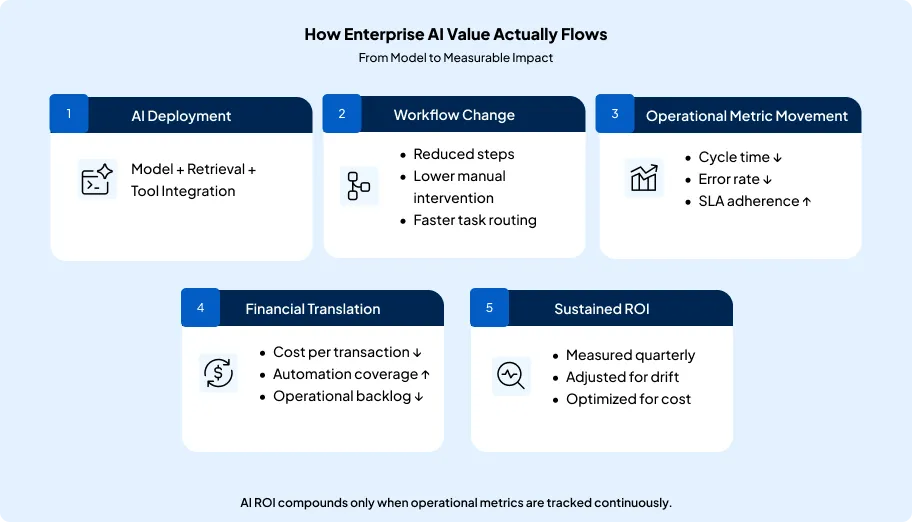
ROI Starts at the Workflow Layer
Most AI programs do not prove value through headline revenue growth. They prove it inside workflows. Financial performance is increasingly measured using standardized enterprise AI benchmarks.
The first improvements typically show up in operational metrics such as average handling time, backlog reduction, SLA compliance, and manual review reduction. When an AI routing engine cuts ticket triage time from several minutes to under a minute, that is measurable. When a reconciliation agent reduces five validation steps to one structured review, that is measurable.
These improvements are often validated through AI productivity impact statistics collected from repetitive operational tasks.
Enterprises that succeed, track structured AI value realization metrics to ensure that performance gains translate into measurable business outcomes.
Productivity Gains Only Matter If You Establish Baselines
Productivity claims are easy to make and difficult to defend.
Organizations that measure properly define a clear “before” state. They calculate the average time per task, the number of review cycles per output, the historical error rate, and the throughput per operator before AI deployment. After implementation, they measure the delta.
Organizations increasingly rely on AI ROI benchmarks for enterprises to justify large-scale deployment.
If task completion time drops by 30%, or if review iterations fall from three rounds to one, those gains are real. If there is no baseline, improvement cannot be quantified.
Reliable measurement depends on comparing historical baselines with updated AI productivity impact statistics.
AI does not automatically increase productivity. It redistributes cognitive and operational load. Enterprises that understand this measure workload shifts, not just speed.
Execution Cost Must Be Measured Alongside Labor Savings
In 2026, infrastructure costs will be visible.
Large language model inference is not free. Vector search pipelines consume storage. Agent orchestration requires compute overhead. Monitoring systems add additional layers.
Mature organizations calculate cost per automated transaction. They account for model usage, concurrency spikes, retry logic, and human oversight time. If an AI workflow saves minutes but increases execution cost disproportionately, long-term ROI becomes unstable.
The real equation is not time saved. It is net efficiency gained after infrastructure overhead.
Revenue Impact Requires Controlled Testing
Linking AI directly to revenue requires structured experimentation.
Enterprises use A/B testing frameworks to compare AI-driven recommendations against control groups. They measure conversion deltas, retention changes, or sales cycle acceleration across defined cohorts. Without experimental controls, revenue attribution becomes speculative.
Revenue ROI from AI exists, but it rarely appears without disciplined rollout design.
Risk Reduction Is Often the Hidden Multiplier
Some of the most durable AI value does not show up as productivity at all.
Improved anomaly detection reduces fraud exposure. Faster policy validation reduces compliance misses. Early alert systems reduce operational escalations. These outcomes prevent loss rather than create visible gain.
Enterprises that quantify avoided incidents begin to see AI as a risk mitigation layer, not just an efficiency engine.
ROI Must Be Monitored Over Time
AI systems degrade without oversight.
Retrieval pipelines drift. Model responses shift subtly. Usage expands beyond planned limits. Costs increase under peak load. That’s why, tracking the AI investment growth rate alongside operational outcomes improves financial planning accuracy.
Enterprises that sustain ROI, conduct periodic reviews of automation coverage, override frequency, cost per execution chain, and performance variance. When metrics slide, they intervene before impact compounds.
AI value is not static. It must be maintained. Sustainable transformation depends on continuously monitored AI value realization metrics.

What Does Enterprise AI Maturity Actually Look Like in 2026?
In 2026, the difference between companies “using AI” and companies scaling AI is not access to models. It is how well the surrounding systems are built. Enterprise AI maturity statistics show up in infrastructure, ownership, monitoring, and cost control — not in demos.
Below mentioned is the enterprise AI maturity model that Many organizations reference to evaluate readiness levels.
Stage 1: Isolated Experiments
This is where most organizations begin.
A team connects to a model APIm someone builds a chatbot. Another team automates part of a workflow, results look promising and leadership gets interested.
But underneath, the setup is thin.
There is no central prompt registry. Logging is inconsistent. Cost tracking is rough. Governance is informal. The project lives inside one function.
Nothing is wrong at this stage. It is necessary. But it is fragile.
Experiments prove possibilities. They do not prove durability.
Stage 2: Production Inside a Department
This phase represents mid-tier progression within the enterprise AI maturity model. At this stage, AI moves into real workflows.
Support teams use it daily. Developers rely on it for code assistance. Operations teams automate routing or reconciliation steps. There is a measurable impact.
Infrastructure improves. Logging is added. Ownership becomes clearer. Someone is now responsible for uptime. Someone tracks model performance. Budgets are more defined.
But the system is still local.
Each department builds its own patterns. Monitoring standards vary. Evaluation methods differ. Tool integrations are inconsistent.
This is where many enterprises stall. AI works, but it does not unify.
Stage 3: Shared AI Platform
A shift happens when leadership realizes duplication is increasing risk.
Platform consolidation marks a critical transition in the enterprise AI maturity model. Instead of separate AI systems in each team, a centralized capability begins to form.
There is now:
- A shared model management layer
- Standardized retrieval patterns
- Common evaluation datasets
- Structured access control
- Unified monitoring dashboards
Agents and automation systems plug into the same orchestration layer. Logging follows a standard. Cost is tracked across workloads.
AI stops being a project. It becomes infrastructure.
This stage requires discipline. It is less exciting than early experimentation, but far more powerful.
Stage 4: Continuous Optimization
The most mature organizations treat AI systems the way they treat distributed systems.
- Models are versioned deliberately.
- Drift is detected automatically.
- Execution costs are monitored in real time.
- Risk tiers define how much autonomy is allowed.
Quarterly reviews are not about whether AI works. They are about whether it is still delivering value at acceptable cost and risk.
At this level, AI is no longer a separate initiative. It is embedded into the operating rhythm.
Where Most Enterprises Sit in 2026
Many organizations are between Stage 2 and Stage 3.
They have production AI. They have measurable wins. But they lack a unified platform layer.
That gap creates:
- Inconsistent governance
- Duplicated infrastructure
- Escalating inference costs
- Fragmented ownership
Enterprise AI maturity statistics shows that moving beyond that point requires architectural decisions, not new models.
What Challenges Are Enterprises Facing in AI Adoption in 2026?
Several AI implementation statistics 2026 highlight that system readiness remains the most consistent predictor of long-term scalability.
Enterprise AI adoption in 2026 is constrained less by model access and more by system readiness. Integration debt, data inconsistency, cost volatility, and governance gaps are slowing scale across industries.
1. Legacy Integration Is More Complex Than Model Deployment
Connecting an LLM to an enterprise stack is easy. Making it reliable inside a fragmented architecture is not.
Most enterprises operate across a mix of legacy ERPs, custom-built middleware, third-party SaaS platforms, and undocumented internal APIs. When AI systems need structured, real-time data access, several friction points appear:
- Retrieval pipelines must normalize data from multiple schemas, often without consistent metadata or version history.
- API endpoints may not support idempotent calls, creating duplicate execution risks when agents retry failed requests.
- Tool-call orchestration can fail silently when downstream services have inconsistent timeout thresholds or rate limits.
- Event-driven architectures may not exist, forcing synchronous integration that increases latency and failure probability.
In agentic systems, this becomes more pronounced. Multi-step execution chains amplify small integration weaknesses.
The bottleneck is rarely the reasoning model. It is the reliability of the surrounding system fabric.
2. Data Quality Issues Surface Under AI Workloads
AI systems expose data issues that traditional systems tolerate.
When retrieval-based architectures rely on internal documentation, policy repositories, or CRM records, problems become visible immediately:
- Outdated documents surface as authoritative responses because indexing pipelines lack temporal filtering.
- Duplicate entries skew vector similarity scores, leading to inconsistent retrieval grounding.
- Poorly structured PDFs degrade embedding quality, reducing answer precision.
- Conflicting data sources create non-deterministic outputs across similar queries.
Unlike deterministic systems, LLM-based responses amplify ambiguity.
To mitigate this, enterprises are introducing:
- Document version tagging and lifecycle management
- Source confidence weighting
- Structured ingestion pipelines with schema validation
- Data freshness scoring before retrieval inclusion
AI does not create data problems. It makes them impossible to ignore.
3. Inference and Infrastructure Cost Volatility
At a small scale, inference cost appears manageable. At enterprise concurrency levels, cost behavior changes.
Organizations face challenges such as:
- Token consumption increases exponentially when prompts expand or context windows grow.
- Embedding storage expands rapidly as document repositories scale, increasing vector database cost.
- Agent retry logic triggering repeated inference calls under partial failure conditions.
- Peak load concurrency requires autoscaling GPU-backed infrastructure, raising unpredictable cloud bills.
Cost visibility must extend beyond “cost per call.” Mature teams track:
- Cost per execution chain (multi-step agent workflows).
- Cost per automated transaction compared to manual processing.
- Concurrency distribution across business hours.
- Token inflation caused by prompt drift.
Without granular observability, scaling creates budget instability.
4. Governance Enforcement Is Harder Than Policy Definition
Many enterprises have AI governance policies. Fewer have enforcement mechanisms embedded in pipelines.
Operational enforcement requires:
- Role-based access control at the tool-call layer, not just at the UI layer.
- Automated validation rules that intercept outputs violating predefined compliance criteria.
- Prompt version locking to prevent unauthorized configuration drift.
- Immutable audit logs capturing model version, retrieval source, and execution outcome.
In agentic environments, governance must extend to execution boundaries:
- Defining which APIs agents are authorized to call.
- Enforcing scope limits on financial or customer data access.
- Implementing rollback mechanisms for failed state transitions.
Policy without enforcement introduces risk exposure under scale.
5. Observability Across Multi-Step Agent Workflows
Traditional monitoring focuses on uptime and latency.
Agentic AI introduces additional complexity:
- Intermediate state tracking across execution steps.
- Tool-call success and failure rates.
- Retry frequency and exponential backoff behavior.
- Latency accumulation across chained actions.
- Output validation pass/fail ratios.
Without deep observability, failures appear as incomplete workflows rather than system errors.
Enterprises are increasingly treating agent orchestration layers like distributed microservices, instrumented with structured logging and trace IDs.
Execution transparency is not optional at scale.
6. Organizational Misalignment Slows Decision Velocity
AI programs often span engineering, operations, legal, compliance, finance, and business units.
Challenges emerge when:
- Infrastructure teams prioritize stability while product teams push rapid feature rollout.
- Legal teams demand explainability controls not yet built into systems.
- Finance teams question inference cost expansion without granular ROI reporting.
- Business units adopt shadow AI tools outside centralized governance.
Without coordinated governance councils and clearly defined escalation paths, scale slows.
AI maturity is as much structural alignment as technical capability.
7. Talent Gaps in Systems Engineering, Not Just AI
Model access is democratized. Systems integration expertise is not.
Enterprises require professionals who understand:
- Retrieval-augmented architecture design.
- Event-driven orchestration systems.
- State machine modeling for agent workflows.
- Drift detection statistical techniques.
- Secure API gateway configuration.
The intersection of distributed systems engineering and applied ML remains scarce.
Scaling AI requires hybrid skillsets, not just prompt expertise.
How Enterprises Should Use These AI Benchmarks in Strategy Planning
Strategic decisions should be guided by structured enterprise AI benchmarks rather than assumptions.
AI benchmarks are not for observation. They are for calibration. In 2026, enterprises should use adoption, maturity, ROI, and governance benchmarks as a structured planning tool — not as industry trivia.
1. Turn AI Adoption Into an Execution Scorecard
Adoption statistics alone do not create advantage. What matters is where your organization sits relative to measurable maturity indicators.
Instead of asking, “Are we using AI?” leadership teams should translate benchmarks into a scorecard:
- What percentage of core workflows are AI-augmented?
- How many AI systems are in production versus pilot?
- What share of AI workloads are governed under a standardized policy?
- What proportion of AI deployments have measurable ROI tracking?
This converts macro adoption data into internal execution visibility.
An AI strategy without measurable checkpoints becomes narrative. A scorecard turns it into operating discipline.
2. Build Scalable AI Foundations Before Expanding Use Cases
Benchmarks show broad experimentation. They also show uneven scale. Budget planning should align with long-term AI investment trends in enterprises.
Infrastructure consolidation should align with enterprise AI strategy benchmarks. Enterprises should use it to pressure-test their foundation:
- Is there a centralized model management layer?
- Are retrieval pipelines standardized across departments?
- Is prompt configuration version-controlled?
- Are cost metrics visible per workflow?
- Are agent orchestration layers reusable?
If infrastructure is fragmented, expansion increases risk and cost.
Strategy planning should prioritize architectural consolidation before launching new AI initiatives.
Scale without foundation creates compounding technical debt.
3. Make Governance Operational, Not Declarative
Governance benchmarks consistently show gaps between policy and enforcement.
Strategic planning should convert governance principles into embedded controls:
- Define risk tiers for AI systems and map them to required controls.
- Implement automated logging of model versions, tool calls, and retrieval sources.
- Introduce structured drift detection and evaluation pipelines.
- Establish role-based execution permissions for agentic systems.
Risk-tier governance models align closely with industry AI risk management benchmarks. Governance should be wired into deployment pipelines, not reviewed after incidents.
If governance is manual, scale will slow under scrutiny.
4. Benchmark Workforce Readiness Beyond Skill Availability
AI maturity is not just technical capability. It is workforce alignment.
Enterprises should evaluate:
- How many teams are trained to work with AI-assisted workflows?
- Are performance metrics aligned with automation outcomes?
- Do engineering teams understand orchestration and monitoring requirements?
- Is there cross-functional alignment between IT, compliance, and business units?
Workforce readiness includes behavioral adoption.
If employees bypass AI tools or do not trust outputs, scale will plateau.
Strategy planning must address enablement alongside infrastructure.
5. Connect AI Investments Directly to Business Outcomes
Adoption benchmarks are useful only if they connect to value.
Strategic planning should require that every AI initiative maps to at least one measurable outcome:
- Cycle time reduction
- Error rate improvement
- Automation coverage increase
- Risk incident reduction
- Revenue uplift under controlled testing
Benchmarks should guide prioritization. If a use case cannot be tied to measurable impact, it should not scale.
This shifts AI from experimentation to accountable capital allocation.

How Appinventiv Helps Enterprises Build Production-Grade AI Systems
Looking ahead, the state of AI in the enterprise will increasingly be measured by operational reliability rather than technical novelty.
Through its dedicated AI division, Inventiv AI, Appinventiv offers enterprise AI development services to help enterprises transition from AI experimentation to reliable, production-grade deployment by building scalable and resilient AI architectures. Each solution is designed with robust data pipelines, secure APIs, and observability layers, ensuring stability, auditability, and performance at enterprise scale.
For generative AI and agentic AI initiatives, Appinventiv focuses on real-world usability and control. GenAI deployments are grounded in structured retrieval frameworks and governed prompt management, while agentic systems are engineered with orchestration layers, execution controls, and human-in-the-loop safeguards to support multi-step automation across business workflows.
We also implement end-to-end MLOps pipelines that enable continuous model monitoring, version control, drift detection, and lifecycle optimization. These pipelines ensure that AI systems remain accurate, reliable, and aligned with evolving enterprise requirements while supporting seamless integration with complex ecosystems such as ERP, CRM, and data platforms.
Appinventiv’s AI consulting services and development delivery approach is reflected in measurable outcomes across industries. Organizations leveraging its AI solutions have achieved 75% faster decision-making, 98% AI prediction accuracy, 10× faster time-to-market, and an average cost reduction of 40%, demonstrating tangible value from production-grade AI deployments.
By combining scalable architecture, disciplined engineering practices, and industry-specific expertise, Appinventiv enables enterprises to operationalize AI with confidence, turning isolated pilots into resilient, high-impact systems that drive measurable business outcomes.
Connect with our experts and start building AI systems designed for measurable business impact.
FAQs
Q. What percentage of enterprises have adopted AI in 2026?
A. AI adoption has become mainstream across enterprise environments. Recent industry findings show that around 88% of organizations are using AI in at least one business function, marking a shift from experimentation to production deployment.
However, adoption alone does not indicate maturity. Many organizations have implemented AI models but still lack standardized infrastructure, governance layers, and integration pipelines. In 2026, the state of AI in the enterprise is increasingly defined by how deeply AI is embedded into workflows rather than how many pilots exist.
Q. How much are enterprises investing in AI in 2026?
A. Enterprise investment in AI continues to accelerate across infrastructure, tools, and governance systems. Industry projections estimate that global AI spending will exceed $758 billion by 2029, with sustained growth through 2026 and beyond.
Most organizations are shifting budgets away from isolated experiments toward production-grade infrastructure. Investments now include:
- Compute clusters and scalable storage
- Vector databases and orchestration layers
- Monitoring and governance systems
- AI lifecycle management platforms
These spending patterns reflect broader AI budget allocation trends, where AI is treated as a long-term operational capability rather than a short-term innovation project.
Q. What ROI are enterprises seeing from AI initiatives?
A. Enterprise ROI from AI is increasingly measured through operational efficiency rather than headline revenue growth. Organizations are seeing value in areas such as:
- Reduced cycle time across workflows
- Lower manual intervention rates
- Improved SLA adherence
- Faster task routing and decision support
For example, many enterprises report measurable gains through structured AI value realization metrics, including reductions in processing time and backlog volumes. The most consistent returns occur when AI is integrated into high-frequency workflows rather than isolated use cases.
These outcomes align with broader AI ROI benchmarks for enterprises, where value compounds over time through repeated automation.
Q. What are the biggest AI adoption challenges in 2026?
A. The largest barriers to scaling AI in 2026 are not model performance issues. Most challenges originate from system readiness and operational complexity.
Common enterprise challenges include:
- Legacy system integration complexity
- Fragmented data pipelines
- Inconsistent governance enforcement
- Rising infrastructure and inference costs
- Limited cross-functional alignment
Many organizations discover that scaling AI requires stronger architecture, monitoring, and integration discipline. These trends are widely reflected in recent AI implementation statistics 2026, where system reliability is a more critical success factor than algorithm design.
Q. How mature are enterprise AI strategies today?
A. Most enterprises currently sit between intermediate and advanced maturity stages. Many organizations have moved beyond pilot projects and into departmental production deployments, but fewer have built fully unified AI platforms.
Typical maturity stages include:
- Isolated experimentation
- Department-level production deployment
- Shared AI platform infrastructure
- Continuous optimization and governance
Industry enterprise AI maturity statistics indicate that many companies remain between Stage 2 and Stage 3, where AI works operationally but lacks centralized governance and cost control.
- What benchmarks should CIOs track for AI performance?
- CIOs should track operational, financial, and governance metrics rather than focusing only on model accuracy. The most effective organizations monitor:
Operational Benchmarks
- Workflow cycle time reduction
- Automation coverage percentage
- SLA adherence improvement
Financial Benchmarks
- Cost per automated transaction
- Infrastructure utilization rates
- ROI per workflow
Governance Benchmarks
- Model drift detection frequency
- Human override rates
- Audit trace completeness
Many enterprises standardize reporting frameworks around AI operational efficiency metrics to ensure performance improvements remain measurable and comparable across departments.
Q. How does Appinventiv help enterprises maximize AI ROI?
A. Appinventiv supports enterprises in transitioning from experimental AI deployments to production-grade systems designed for long-term scalability.
The approach focuses on:
- Designing resilient data pipelines
- Implementing structured retrieval systems
- Building orchestration layers for automation
- Enforcing governance and observability controls
- Integrating AI into enterprise platforms such as ERP and CRM systems
Organizations leveraging these capabilities have achieved measurable results, including faster decision-making, improved operational efficiency, and reduced infrastructure costs. Over time, these improvements contribute directly to measurable AI impact on enterprise revenue, particularly when automation reduces operational bottlenecks and improves customer-facing workflows.
Q. What industries are leading enterprise AI adoption in 2026?
A. Industries with structured data environments and clear ROI pathways are leading AI deployment at scale. These sectors include:
- Healthcare and life sciences
- Banking and financial services
- Retail and ecommerce
- Manufacturing and logistics
- Energy and utilities
In these industries, AI is increasingly integrated into mission-critical workflows such as fraud detection, supply chain optimization, predictive maintenance, and clinical decision support. These patterns reflect ongoing enterprise AI adoption trends, where operational integration drives measurable competitive advantage.