


































White-Label Crypto Exchange Platform Development in the UAE: A Complete Cost and Compliance Guide

 Share -



- 01Why Is the UAE the Right Place to Launch a White Label Crypto Exchange?
- 02What Is a White Label Crypto Exchange Product, and How Does It Work?
- 03White-Label vs. Custom Crypto Exchange in the UAE: Which One Fits Your Launch?
- 04How Much Does a White-Label Crypto Exchange Cost in the UAE?
- 05What Does a Crypto Exchange License Cost in the UAE?
- 06What Compliance Does a UAE Crypto Exchange Actually Need?
- 07How To Build a White Label Crypto Exchange in the UAE?
- 08What Ongoing Costs Should You Plan for After Launch?
- 09What Features Separate a Market-Ready Exchange From a Risky One?
- 10How Can Appinventiv Help You Out?
- 11FAQs

Key takeaways:
- Building a white-label exchange costs AED 55,000 to AED 550,000.
- VARA licensing adds an AED 100,000 application fee plus an AED 200,000 supervision fee yearly.
- Technology takes weeks; VARA approval takes six to twelve months.
- Choose white label for speed, custom for real differentiation.
- Bake compliance into the build from the first sprint.
Something shifted in the Gulf over the past few years. Digital assets stopped being a side conversation and turned into a line item in serious business plans. Chainalysis clocked more than AED 110 billion in on-chain value moving through the country between mid 2023 and mid 2024, most of it institutional.
The question we often keep coming across is rarely whether demand exists. It is how fast you can go live, and how to do it without landing on the wrong side of a regulator that reads its own filings.
White label is how most teams square that circle. Instead of burning a year on a matching engine and a custody stack from scratch, you licence a platform that already works, dress it in your brand, wire in liquidity and compliance, then open the doors in weeks.
This guide lays out the white-label crypto exchange cost in the UAE, the licensing routes across VARA, ADGM, and the DMCC Crypto Centre, the compliance you genuinely cannot skip, and the full build sequence. Figures you can budget against, not vibes.
Tell us your target users, product type, and jurisdiction, and we will map the fastest compliant route to launch.

Why Is the UAE the Right Place to Launch a White Label Crypto Exchange?
Ask anyone who has set up here, and the same three reasons surface:
- The rules are clear,
- The money is real,
- And the talent sits next door.
Dubai set up a regulator built only for virtual assets. Abu Dhabi wrote a digital asset rulebook inside a common-law free zone. The free zones were handing out crypto-ready licences while other jurisdictions were still running consultations.
For you, that adds up to something rare in this industry, the ability to operate in the open, bank your revenue without drama, and give an institutional client a clean answer when they ask who exactly is watching you.
- Regulators with teeth, not press releases. VARA runs virtual assets in Dubai, while the ADGM digital asset framework governs Abu Dhabi under English common law.
- The capital is already onshore. Across MENA, Chainalysis found roughly 93% of value moving in transfers of AED 37,000 or more, which tells you who is actually trading.
- You are not building on an island. The DMCC Crypto Centre packs hundreds of blockchain and Web3 firms into a single free zone, so liquidity desks, auditors, and engineers are a short drive away.
- The unit economics hold. Qualifying free zone income and clean profit repatriation keep year one survivable, and that matters when spreads are paper-thin and marketing is not free.
The runway is poured. What you build on it is the hard part, and where most of this guide lives.
What Is a White Label Crypto Exchange Product, and How Does It Work?
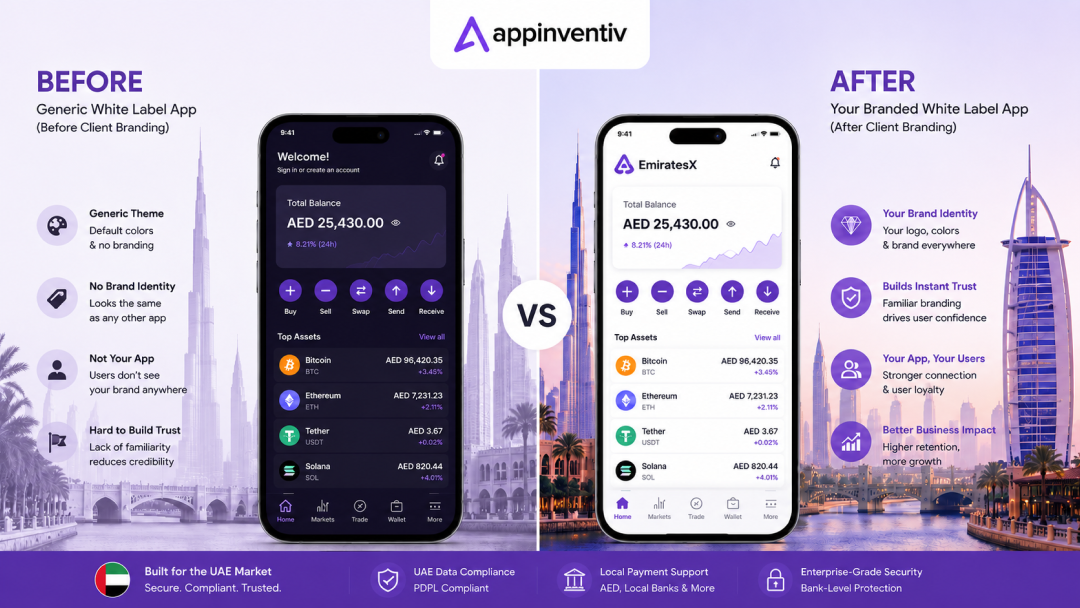
This image might have simplified the meaning for you. A white-label crypto exchange is somebody else’s proven platform wearing your logo. The parts that take the longest to build and the longest to fix, the matching engine, the wallet stack and the admin console, already exist and have survived real trading volume.
You bring the brand, the rules, the liquidity, and the compliance posture. That is exactly why white label crypto exchange platform development travels so well with teams in Dubai, Abu Dhabi, and Sharjah who need to be live before a rival eats their window.
A serious package usually turns up carrying:
- A matching engine and order book tuned for spot, and frequently for peer-to-peer and derivatives on top.
- Wallet infrastructure with multi-currency wallet support, a sane hot and cold split, and custody you can defend to an auditor.
- An admin and risk console for fees, listings, user tiers, and monitoring.
- Hooks for KYC and AML, plus connectors for liquidity, fiat on- and off-ramps, and market data.
Who reaches for it? Startups testing a thesis, brokers bolting crypto onto an existing book, and banks or fintechs piloting a regulated product without signing up for an eighteen-month build. If your edge lives in brand, liquidity, and service rather than in some novel piece of core engineering, white label is usually the smarter opening move.
Many businesses pair their exchange with crypto payment gateway development in the UAE, while others expand into tokenized real estate on-ramps as the market grows.
White-Label vs. Custom Crypto Exchange in the UAE: Which One Fits Your Launch?
This is the decision that stalls more launches than any technical bug: whether to develop a white-label or a custom crypto exchange in the UAE. Boil it down, and you are trading three things against each other: time, control, and how genuinely different your product needs to be. The table sorts it out.
| Factor | White Label | Custom Build |
|---|---|---|
| Time to market | About 6 to 14 weeks | Around 6 to 12 months, often longer |
| Upfront cost | Lower, predictable | Higher, scope-driven |
| Brand and UI control | Full | Full |
| CoreLogic control | Bounded by the provider roadmap | Complete, down to the engine |
| Compliance customisation | Configurable | Fully bespoke |
| Best suited to | Fast, validated launches | Differentiated products at scale |
- Go white label if speed and cost control matter, the model is validated, and you want to prove demand before spending on bespoke engineering.
- Go custom if you need a product no rival can copy in a quarter, full ownership of the core, or unusual compliance flows a template simply will not bend to.
Plenty of Gulf operators do both, in sequence. Launch on white label to grab the market and learn what users truly do, then rebuild the busy paths, matching, custody and risk on a custom stack once revenue justifies it. Low risk early, real usage data before the expensive calls. Hard to argue with that logic.
Tech should be a business multiplier, not a buzzword. My focus is always on helping enterprises apply advanced technologies in ways that are practical, measurable, and built for scale.
Chirag Bhardwaj, Vice President, Technology, Appinventiv.
How Much Does a White-Label Crypto Exchange Cost in the UAE?
Right, the money. A branded, market-ready platform usually lands somewhere between AED 55,000 and AED 550,000 to build, and the white-label crypto exchange cost in the UAE moves on a handful of dials: how much you customise, how you hold assets, how deep your liquidity runs, and how heavy the compliance load sits. Licensing and regulatory capital are separate line items, and the next section handles those.
Here is the white-label crypto exchange development cost breakdown we walk clients through when scoping a launch:
| Cost component | Typical range (AED) | What moves the number |
|---|---|---|
| Core platform licence (white label base) | 55,000 to 220,000, or SaaS monthly | Feature set, spot vs derivatives, seats |
| Branding, UI, and UX | 30,000 to 110,000 | Design depth, web plus mobile, localisation |
| Wallet and custody integration | 35,000 to 130,000 | Multi-currency support, hot and cold setup |
| Liquidity and matching integration | 35,000 to 145,000 | Provider count, order book depth |
| KYC, AML, and compliance tooling | 30,000 to 110,000 | Vendors, Travel Rule, monitoring rules |
| Security, audits, and pen testing | 35,000 to 145,000 | Audit scope, multi-sig, bug bounty |
| Infrastructure and hosting (year one) | 20,000 to 90,000 | Traffic, uptime targets, redundancy |
A lean, cleanly branded spot venue can open near the floor of that range. Pile on deep liquidity, bespoke compliance, and a hardened custody model and you drift toward the ceiling, then past AED 920,000 once custom modules enter the picture.
For a grounded local reference on a full build, our teardown on the cost to build a crypto exchange app in the UAE is a useful yardstick, as is the wider Middle East fintech app development playbook. One hard-won lesson worth tattooing somewhere: freeze your compliance scope before you customise. Reworking KYC, custody, or reporting late is precisely where budgets quietly hemorrhage.
What Does a Crypto Exchange License Cost in the UAE?
Software is half the bill. The crypto exchange license cost in the UAE hangs on which regulator you pick and, more than anything, how you hold client money. Three routes cover most launches, and each fits a different kind of operator.
| Route | Where | Headline fees and capital | Best for |
|---|---|---|---|
| VARA | Dubai | Exchange Services licence: application AED 100,000 plus annual supervision AED 200,000. Minimum paid-up capital is the higher of AED 800,000 with a licensed custodian or AED 1.5M for self-custody. | Retail plus institutional exchange in Dubai |
| ADGM (FSRA) | Abu Dhabi | Tiered application and supervision fees under a risk-based, notification-driven digital asset framework operating in English common law. | Institutional players wanting common law comfort |
| DMCC Crypto Centre | Dubai free zone | Company setup from roughly AED 50,000 for non-regulated proprietary trading and Web3 activity, with a regulated exchange still licensed through VARA. | Startups wanting an ecosystem and speed |
A few things nobody mentions until the application is already underway. Under VARA, your paid-up capital cannot just idle in an operating account. It has to be parked in a regulator-approved form, a UAE bank trust account or a surety bond, and you carry a rolling liquidity buffer pegged to monthly overheads on top of that.
The ADGM digital asset framework shifted to a notification model for recognised assets in mid 2025 and drew a hard line through privacy coins and algorithmic stablecoins, with fresh fiat-referenced token rules landing in early 2026. The DMCC Crypto Centre, for its part, hands you a quick setup and a deep bench of blockchain firms to hire from, which is why so many teams incubate there first.
Bottom line: the licence, not the code, is almost always the longest pole in the tent. Start it early, run it in parallel, and treat the regulator as a stakeholder rather than a speed bump.
We will size the VARA, ADGM, or DMCC route against your model and hand back a clear budget and timeline.
What Compliance Does a UAE Crypto Exchange Actually Need?
In crypto, compliance is not paperwork you file and forget. It is the product. UAE regulators are hands-on; they read what you submit, and they have shown they will pull a licence when a firm cuts corners.
Get this layer right, and everything downstream, banking relationships, listings, institutional flow, gets easier. Get it wrong, and there is rarely a second launch. Here is what a UAE exchange has to stand up to, in plain terms.
| Requirement | What it means on the ground |
|---|---|
| Fit and proper licensing | VARA or ADGM approval, a qualified MLRO and compliance officer, and background checks on beneficial owners. |
| KYC and customer due diligence | Verified identities, enhanced checks on higher-risk users, and screening that keeps running after onboarding, increasingly with blockchain-backed identity checks. |
| AML and sanctions | Live transaction monitoring, sanctions and PEP screening, and suspicious activity reports filed to the UAE FIU through goAML. |
| FATF Travel Rule | Originator and beneficiary details attached to transfers above the threshold are passed from one VASP to the next. |
| Market surveillance | Controls against manipulation, wash trading, and messy listings, with an audit trail that a regulator can open and inspect. |
| Custody and asset segregation | Client assets are ring-fenced from company funds, the bulk in cold storage, and you can produce proof of reserves on demand. |
| Prudential capital and liquidity | Paid-up capital held in an approved form, plus a net liquid asset buffer sized to your overheads. |
| Data protection and cyber | UAE data-protection alignment, encryption, tight key management, and incident reporting when something breaks. |
None of this bolts on cleanly at the end. The exchanges that scale in the Emirates bake compliance into the architecture from the first sprint, which is exactly the discipline behind VARA-compliant blockchain builds in Dubai. The payoff is concrete. A clean regulatory record is the difference between a bank that returns your calls and one that quietly files you under too much trouble.
How To Build a White Label Crypto Exchange in the UAE?
Here is the actual white-label crypto exchange development process we run when taking a UAE exchange from slide deck to live order book. The steps interlock, so shortcutting one tends to resurface as a fire three steps later.
Step 1: Pin Down the Model and the Compliance Perimeter
Before anyone opens a design file, get brutally specific about what you sell and to whom. This one decision drives your licence, your capital, and a good half of the budget.
- Choose the product: spot, peer-to-peer, margin, or derivatives. Each carries a different regulatory weight.
- Name your users and markets, retail, institutional, or both, and where they actually sit.
- Fix how you earn early: trading fees, spreads, listing charges, subscriptions, or a blend.
Step 2: Choose the Jurisdiction and File Early
Kick this off alongside everything else, because approvals run in months, not weeks. Your regulator choice sets capital, custody, and reporting for years to come.
- Match the route to the model: VARA for Dubai, ADGM for Abu Dhabi, DMCC for a free-zone start.
- Get paid-up capital into an approved form before you file, not once they ask.
- Appoint the MLRO and compliance officer up front. Regulators want names, not good intentions.
Step 3: Choosing the Right Development Partner
This phase is the quiet call that decides whether you ship on time and sleep afterwards. Look past the shiny demo and into the delivery record. A partner worth signing shows you regulated, audited work, not a gallery of pretty screens.
A firm blockchain development in Dubai will already know the local regulators by name. The same goes with Abu Dhabi-based experts, or anywhere else you look in the region.
- Ask for proof of compliance-heavy, security-first projects that genuinely reached production.
- Nail down source-code access, escrow, and a clean handover so you are never hostage to a vendor.
- Check the after-launch reality: monitoring, patch cadence, and support in your hours, not a time zone half a day away.
Step 4: Make It Yours, Wallet and All
Now it starts to feel like your product. Branding, experience, and multi-currency wallet support come together here, and careful wallet design is where user trust is quietly won or lost.
- Roll out brand, UI, and UX across web and mobile, localised for UAE users, Arabic included where it counts.
- Configure supported assets, wallet types, and the hot-cold custody split.
- Set fee tiers, listing rules, and an onboarding flow that does not make people rage-quit at the KYC screen.
Step 5: Wire In Liquidity and Tune the Engine
An exchange with shallow books dies quietly, then loudly. Treat liquidity as a first-class feature and design for depth from day one.
- Connect one or several liquidity providers and aggregate the flow.
- Tune the matching engine for latency, throughput, and fills that feel fair to a trader.
- Add market-data feeds and price protection so slippage does not scare people off.
Step 6: Build the Compliance and Risk Layer
This is the layer the regulator will actually open and inspect. It is also where modern platforms lean on AI to catch the patterns that static rules miss.
- Wire in KYC, sanctions and PEP screening, and the FATF Travel Rule.
- Stand-up transaction monitoring, alerting, and case management allow your analysts to actually work.
- Automate reporting so an audit becomes a Tuesday, not a crisis.
Step 7: Harden Security and Bring In Auditors
In this business, a single breach is an extinction event, so security runs through the whole build rather than sitting at the tail of it.
- Commission independent penetration tests and smart-contract audits before go-live, not after.
- Use multi-sig, hardware-backed key management, and cold storage for the bulk of funds.
- Layer on DDoS protection, encryption, and monitoring that never clocks off.
Step 8: Test Hard, Then Pilot Small
Do not fling the doors open to everyone at once. Prove the thing under stress with a small, real cohort first.
- Run functional, load, and failover testing against production-like traffic.
- Invite a closed pilot group and a bug bounty to flush out the ugly edge cases.
- Rehearse incident response until the team knows the playbook cold.
Step 9: Launch, Then Run It Like a Product
Go-live is the starting line, not the tape. The exchanges that win treat operations as a product in its own right.
- Launch in phases, watch the dashboards, and keep support close to the users.
- Iterate on listings, features, and liquidity based on what people genuinely do.
- Plan the migration of the busiest paths to custom infrastructure as volume climbs.
Technology is our tool, but value creation is our purpose. We are relentlessly focused on merging software with next-gen tech to build solutions that deliver measurable and strategic business impact.
Sudeep Srivastava, Director and Co-Founder, Appinventiv.
What Ongoing Costs Should You Plan for After Launch?
The build is a number that you pay for once. Running the exchange is a number you pay every month, and founders who model only the launch get an unpleasant jolt by quarter two.
Budget these from the start.
- License and supervision. Annual regulator fees, VARA supervision at AED 200,000 for the exchange category, plus renewals.
- Compliance and audits. Ongoing KYC and AML tooling, periodic security audits, and reporting that never fully stops.
- Liquidity. Fees or spreads to keep the books deep enough that traders stick around.
- Infrastructure. Cloud, redundancy, and performance headroom as volume climbs.
- Security operations. Continuous monitoring, key management, and incident readiness.
- Support and maintenance. Bug fixes, feature work, and human support in local hours.
- Growth. Marketing and user acquisition, which quietly becomes the biggest line of the lot.
A rough planning rule that has held across builds: expect recurring annual running costs to eat a meaningful slice of your first-year build spend. It keeps the forecast honest, and it keeps the lights on.
What Features Separate a Market-Ready Exchange From a Risky One?
Two exchanges can look identical in a screenshot and behave nothing alike the moment real volume hits. These are the features we refuse to treat as optional for a UAE launch.
| Feature | Why it earns its place |
|---|---|
| Multi-currency wallet support | Users hold and trade a broad basket without ever leaving your platform. |
| Deep, aggregated liquidity | Tight spreads and quick fills are what turn a visitor into a repeat trader. |
| Bank-grade custody | Multi-sig, cold storage, and proof of reserves protect both funds and reputation. |
| Real-time compliance tooling | Keeps you inside VARA and ADGM lines without a human chasing every alert. |
| Elastic architecture | Absorbs volume spikes without buckling during the moments that matter most. |
| Clean admin and reporting | Turns daily operations and audits into routine instead of a scramble. |
Share your model and target market, and our crypto specialists will come back with a clear scope, timeline, and cost.

How Can Appinventiv Help You Out?
For over a decade, we have shipped secure, compliance-heavy platforms across fintech, and that scar tissue shows up in how we approach white-label crypto exchange software development in the UAE. We have built systems where a single control failure was simply not survivable, and we bring that same discipline, now sharpened by deep command over AI, to every exchange we put live. Compliance is not a phase we tack on at the end. It is where we start.
Our white-label cryptocurrency exchange development services span the whole journey: choosing the VARA, ADGM, or DMCC route, structuring capital, customisation, liquidity, security audits, and the post-launch operations that most vendors wave goodbye to.
As a Deloitte Technology Fast 50 company with thousands of digital deliveries behind a team and us on the ground in Dubai, we sit inside the market you are entering, not across an ocean from it.
- Compliance-first by default, with builds aligned to VARA and ADGM rulebooks and modelled on our VARA-compliant work in Dubai.
- End-to-end engineering across blockchain development in Dubai, custody, and matching, not a rebadged template.
- AI-driven risk, fraud, and monitoring are baked into the platform, tuned to the way UAE regulators actually supervise.
- We have an on-the-ground presence through our Dubai engineering team, so you are not managing a build across a wall of time zones.
Whether you want a fast branded launch or a platform engineered to grow into a custom stack later, we meet you where you are and get you live without cutting corners that come back to bite.
FAQs
Q. How long does it take to launch a white-label crypto exchange in Dubai?
A. The technology can be ready in roughly 6 to 14 weeks once your licence path is clear. The longer pole is regulatory approval, which usually takes 6 to 12 months through VARA. In practice, licensing rather than software is the critical path, so the sharp teams file early and build in parallel.
Q. How much does a VARA crypto exchange license cost?
A. For a VARA Exchange Services licence in Dubai, the application fee is AED 100,000, and the annual supervision fee is AED 200,000, based on VARA’s published schedules. Beyond that, budget for corporate structuring, compliance staffing, legal work, and advisory support, which push the real first-year total meaningfully higher.
Q. What is the minimum capital requirement for a crypto exchange license in the UAE?
A. Under VARA, an Exchange Services provider holds the higher of AED 800,000 or 15% of annual overheads when it uses a licensed custodian, or the higher of AED 1,500,000 or 25% of overheads when it holds client assets itself. That capital must sit in a regulator-approved form, such as a UAE bank trust account or a surety bond, and stay there at all times.
Q. Is white-label or custom crypto exchange development better for a UAE launch?
A. White label wins when speed and cost control matter and the business model is already validated, since it gets you live in weeks. Custom wins when you need a product rivals cannot copy quickly, full control of the core engine, or unusual compliance flows. Many UAE founders begin with white label to capture the market, then migrate high-traffic components to custom infrastructure as volume grows.
Q. What ongoing costs come after launching a white label exchange?
A. Plan for annual licence and supervision fees, ongoing compliance and audits, liquidity provision, hosting and scaling, security monitoring, support and maintenance, and user acquisition. Marketing usually becomes the single largest recurring line. A practical rule of thumb is to budget yearly operating costs as a meaningful share of your first-year build spend.


Fast 2-minute response, fully NDA-protected.

Smart Contract Development Cost in the UAE in 2026: Factors, Estimates, and Key Considerations
Key takeaways: UAE smart contract projects range from AED 147K to AED 1.46M+, driven by architectural complexity, testing scope, and security standards. Enterprise budgets must divide core programming from independent audits, system integrations, hosting infrastructure, legal compliance, and ongoing operations. Ethereum, Polygon, Solana, and Hyperledger Fabric require distinct programming languages, software tooling, infrastructure, and transaction…
P2P Crypto Exchange Development: Architecture, Features, Cost & Enterprise Implementation Guide
Key Takeaways Enterprise P2P crypto exchanges require secure blockchain escrow orchestration, multi-chain crypto wallet infrastructure, and real-time compliance monitoring from day one. Stablecoin-powered settlement systems are reshaping cross-border transactions, OTC trading, and regional liquidity movement across digital asset ecosystems. Infrastructure decisions around custody, scalability, and compliance directly affect long-term exchange stability, transaction security, and operational…
Crypto Banking Software Development: Core Architecture for Digital Asset Banking
Key takeaways: Crypto banking software bridges traditional finance and digital assets, enabling banks to offer secure, compliant, and scalable crypto services. Modern crypto banking platforms feature robust custody, multi-asset wallets, real-time compliance, and seamless blockchain integration. Adopting crypto banking solutions accelerates cross-border payments, reduces costs, and enhances financial inclusion. Security, regulatory compliance, and modular architecture…