


































How Much Does It Cost To Build A Neobank App?

 Share -



- 01Neobank App Development Cost Breakdown
- 02Neobank Costs Beyond Application Development
- 03Feature-Wise Neobank App Development Cost
- 04Compliance-Wise Neobank App Development Cost
- 05Infrastructure-Wise Neobank App Development Cost
- 06AI-Powered Neobank App Development Cost
- 07iOS vs Android Neobank App Development Cost
- 08Region-Wise Neobank App Development Cost
- 09Neobank App Development Cost Estimation Formula
- 10Neobank App Development Timeline
- 11Factors Affecting Neobank App Development Cost
- 12Build vs Buy: When Should an Enterprise Use BaaS?
- 13Neobank App Total Cost of Ownership: Hidden Expenses
- 14Transaction Volume and Unit Economics
- 15How to Optimize Neobank App Development Costs
- 16Initiate Your Neobank App Development Journey With Appinventiv
- 17Frequently Asked Questions

Key takeaways:
- Neobank application build costs $40K to $500K+, excluding licenses, sponsor bank setups, card programs, and operating fees.
- Ledger engineering, reconciliation tools, payment orchestration, and system resilience drive app spend beyond user interfaces.
- Selecting BaaS, custom, or hybrid architecture sets system ownership, vendor dependencies, launch speed, and governance upfront.
- Bottom-up, three-point, and parametric estimation turn scope, team billing rates, and technical risks into defensible budgets.
- Total ownership costs exceed maintenance costs due to server growth, vendor fees, compliance, payment processing, regional expansion, and AI workloads.
The cost to develop a neobank app can range from $40K to $500K+, depending on product scope and banking infrastructure. Nubank reached $131 million in customers by December 2025, demonstrating the scale modern digital banking platforms can achieve (Source: US-SEC). At the lower end, a simple MVP may use Banking-as-a-Service. Large enterprise platforms may require custom ledgers, payment orchestration, fraud controls, open banking, and AI features.
Project development costs are influenced by several key technical decisions throughout the project’s life cycle. Teams need to integrate third-party financial APIs, implement KYC and AML workflows, and support peak transaction volumes. Direct labor costs are further influenced by the engineering location and mobile platforms supported. Beyond front-end features, system architecture also plays a major role in determining the final budget. The engineering and testing needed to build event-driven services, real-time risk checks, and high-availability cloud systems are extensive.
Product design, engineering, testing, and initial deployment are all part of the cost of developing a neobank app. This does not include banking licenses, sponsor-bank contracts, card network fees, vendor costs, or other operating costs. These operational costs must be set aside from the beginning by leaders.
Appinventiv engineers neobank transaction controls, ledger architecture, secure payment flows, BaaS integrations, and compliance-ready infrastructure before scale drives costly rework.

Neobank App Development Cost Breakdown
Product scope and backend financial tools determine the total cost of a fintech app. The first table pairs each build tier with expected delivery schedules and technical foundations.
Costs as Per Neobank Complexity
Project requirements shift total financial estimates, and system needs across all product tiers.
| Development Scope | Estimated Cost (USD) | Timeline | Core Capabilities | Infrastructure Model |
|---|---|---|---|---|
| White-Label/BaaS Customization | $40K to $80K | 1 to 3 months | Branding, onboarding, accounts, basic transfers | Pre-built BaaS platform |
| MVP Neobank | $40K to $100K | 3 to 6 months | KYC, accounts, transfers, cards, notifications | BaaS-led |
| Mid-Tier Custom Neobank | $100K to $250K | 6 to 10 months | Multi-currency, advanced payments, analytics, fraud controls | BaaS or hybrid |
| Enterprise Neobank | $250K to $500K+ | 9 to 18+ months | Open banking, advanced fraud, AI, high-scale banking workflows | Hybrid or custom infrastructure |
White-label application rates pay for interface design changes rather than full custom banking systems.
Breakdown of Costs by Development Stage
Individual development stages add distinct expenses from initial system design to final operational launch.
| Development Stage | Typical Share of Build Budget |
|---|---|
| Discovery and Architecture | 9% |
| UI/UX Design | 9% |
| Mobile and Web Development | 17% |
| Backend and Banking Services | 21% |
| Ledger and Core Banking Engineering | 12% |
| Third-Party Integrations | 10% |
| Security and Compliance | 9% |
| QA and Financial Testing | 8% |
| Deployment and DevOps | 5% |
Backend services, user platforms, and core ledger design account for the largest share of project funding. These core components run financial transactions, account ledgers, payment pipelines, and balance records.
Neobank App Types and Their Cost Impact
The customer segment, financial products, and regulatory scope can affect the engineering effort required for a neobank platform.
| Neobank Type | Typical Scope | Cost Impact |
|---|---|---|
| Retail Neobank | Personal accounts, cards, payments, savings, budgeting | Moderate |
| Business Neobank | Business accounts, KYB, multi-user access, expense management, accounting integrations | High |
| Investment Neobank | Brokerage integrations, portfolio management, market data, trading workflows | High to Very High |
| Crypto-Integrated Neobank | Fiat accounts, digital assets, wallets, on/off-ramp integrations, transaction monitoring | Very High |
A business, investment, or crypto-integrated model usually requires deeper financial integrations, stronger transaction controls, and broader compliance workflows than a standard retail platform.
Costs as Per Neobank Platform and Infrastructure Model
Selected infrastructure models set the total neobank platform development cost. This foundational choice dictates how much application code internal engineering teams must write, test, and maintain.
| Infrastructure Model | Key Trade-Offs | Estimated Cost Range (USD) |
|---|---|---|
| BaaS-Based | Faster launch, low infrastructure ownership, moderate customization, high vendor dependency, lower engineering complexity, moderate long-term control | $40K to $80K |
| Custom Banking platform | Longer launch, high infrastructure ownership, very high customization, low vendor dependency, highest engineering complexity, very high long-term control | $200K to $500K+ |
| Hybrid Infrastructure | Moderate launch timeline, shared infrastructure ownership, high customization, moderate vendor dependency, high engineering complexity, high long-term control | $100K to $300K |
Neobank Costs Beyond Application Development
The $40K to $500K development range covers app delivery, but launching a neobank requires separate upfront capital. These non-application expenditures vary by target jurisdiction, financial operating model, and partner contracts.
| Upfront Cost Area | What It Covers | Budget Impact |
|---|---|---|
| Banking or Regulatory Licensing | Application fees, legal work, licensing preparation, and regulatory setup | High and market-specific |
| Sponsor Bank or Banking Partner Setup | Partner onboarding, contractual setup, account infrastructure, and integration requirements | Moderate to High |
| Card Program Setup | Card issuing arrangements, processor setup, network onboarding, and certification | Moderate to High |
| KYC and AML Provider Setup | Provider onboarding, configuration, testing, and compliance workflows | Moderate |
| Compliance and Legal Setup | Policies, legal reviews, regulatory assessments, and governance documentation | Moderate to High |
| Third-Party Platform Setup | BaaS, payment, identity, fraud, data, and other financial technology services | Moderate |
Leadership teams must budget these foundational items separately from app creation fees. A BaaS platform strategy reduces the need for custom backend code, but vendor onboarding fees and recurring service bills still require capital allocation. Enterprise planning models treat initial application estimates like one portion of the broader launch budget.
Also Read: How Fintech Is Transforming Businesses Across Banking, Retail, Healthcare, and Real Estate
Case Study Snapshot:
How Cloud Architecture Cut Banking TCO by 30%
A fast-growing challenger bank with 2M+ users faced rising cloud costs, fragmented AWS and GCP environments, deployment delays, and performance challenges during peak traffic. Appinventiv modernized its cloud architecture, introduced automated resource governance, unified CI/CD, and strengthened predictive monitoring and regional failover. The engagement delivered 30% lower total cost of ownership, 40% faster deployments, and 99.98% uptime, while supporting peak traffic without downtime. The case shows why cloud architecture, resilience, automation, and infrastructure governance should be factored into the broader financial plan from the start.
Feature-Wise Neobank App Development Cost
Features affect development effort through backend workflows, financial integrations, data processing, and testing requirements. The table below shows the typical cost range and engineering impact for each feature group.
| Feature Category | Core Capabilities | Complexity | Indicative Cost Range |
|---|---|---|---|
| Core Banking | Accounts, balances, statements, transaction history, beneficiaries | Medium | $10K to $30K |
| Payments and Cards | Transfers, P2P, card issuing, virtual cards, card controls, payment rails | High | $20K to $60K |
| Financial Management | Budgeting, savings goals, spending analytics, financial insights | Medium–High | $15K to $40K |
| Advanced Banking | Multi-currency, cross-border payments, lending, investments, open banking | High–Very High | $30K to $100K+ |
| Risk and Security | Biometrics, transaction monitoring, fraud detection, device intelligence, step-up authentication | High | $20K to $60K |
Core Banking Features
Account services are the foundation of balances, statements, transaction records and beneficiary management. These features rely on having consistent transaction data and reliable account-state handling throughout channels.
Payments and Card Features
Transfers and card services add payment-rail integrations, authorization flows, settlement logic, and transaction controls. Card issuing and virtual cards can add external processor dependencies.
Financial Management Features
The ability to categorize transaction data, aggregate it and provide reporting logic and customer-specific insights supports managing budgets and spending analytics. The rules for targets, transfers and progress tracking are added to the savings goals.
Advanced Banking Features
Multi-currency and cross-border payments add exchange rate management, new payment channels, and regional regulations. The relevance of these integrations is underscored by more than 16 million active open banking users in the UK, while open banking payments grew 53% in 2025.
Also Read: How Much Does it Cost to Build a Neobanking App like SoFi?
Risk and Security Features
Real-time event processing and risk rules/machine learning models are needed for fraud detection and transaction monitoring. Device intelligence, biometrics and step-up authentication bring identity, security and testing requirements to the table.
Compliance-Wise Neobank App Development Cost
Regulatory requirements expand development effort across external API integrations, system testing, and backend operational applications. The table details specific engineering workloads and relative budget impacts for key regulatory modules.
| Compliance Area | Main Development Impact | Cost Impact |
|---|---|---|
| KYC and Identity Verification | Identity APIs, document verification, biometrics, onboarding workflows | Moderate |
| AML and Sanctions Screening | Screening APIs, watchlists, case management, rule configuration | High |
| Transaction Monitoring | Real-time event processing, detection rules, alerts, investigations | High |
| PCI DSS and Card Security | Tokenization, secure storage, access controls, testing, audit preparation | High |
| Data Protection and Residency | Encryption, access controls, consent, retention, regional data controls | Moderate to High |
| Audit, Reporting, and Compliance Automation | Audit logs, regulatory reports, evidence collection, automated checks | Moderate to High |
Impact of Compliance Scope on Development Cost
Broader regulatory requirements often require additional backend development, third-party integrations, security controls, and quality assurance testing. In 2024, the EEA recorded €4.2 billion in payment fraud transactions, as reported by the EBA and ECB, which highlights the importance of robust transaction controls and fraud monitoring systems in engineering.
There are broad regulatory rules that require development teams to create immutable log records, automated monitoring suites and comprehensive penetration test reports. These additional technical requirements can push neobank development costs toward the upper end of the estimated range.
Infrastructure-Wise Neobank App Development Cost
System infrastructure expenses grow alongside higher transaction speeds, expanding data footprints, strict uptime targets, and external application connections. The table details baseline financial estimates and technical boundaries across foundational hosting tiers.
| Infrastructure Layer | What It Covers | Estimated Cost Range |
|---|---|---|
| Core Banking and Ledger Infrastructure | Double-entry ledger, transaction orchestration, reconciliation, idempotency, transaction history, audit logs | $80K to $250K+ |
| Cloud and Data Infrastructure | Compute, databases, storage, networking, caching, event streaming, data pipelines | $30K to $120K+ |
| Reliability and Resilience | High availability, backups, disaster recovery, failover, observability, incident response | $40K to $150K+ |
| API and Integration Infrastructure | API gateway, service orchestration, authentication, rate limiting, partner integrations | $30K to $120K+ |
Core Banking and Ledger Infrastructure
Double-entry accounting ledgers keep a perfect account balance for each credit and debit. The creation of background transaction workflows, reconciliation scripts and permanent audit logs requires extensive backend programming.
Cloud and Data Infrastructure
Cloud computing in banking allows applications to use dedicated storage clusters, databases, message queues and encrypted network controls. But for high transaction volumes and long retention periods, you need bespoke backend data pipelines.
Reliability and Resilience
Redundant hardware deployments, failover automation, secure cloud backups, and real-time monitoring are all essential for system uptime goals. Stricter recovery time objectives increase the effort required to meet uptime targets through architecture and resilience testing.
API and Integration Infrastructure
API gateways manage incoming user traffic, authentication, protocol routing and third-party developer permissions. To integrate external financial services, specific message queues, access control, and error-handling procedures are necessary.
AI-Powered Neobank App Development Cost
AI in banking introduces additional engineering requirements for data processing, model training, real-time inference, monitoring, and governance. AI architecture is becoming a larger share of banking technology budgets, with 55% of banking executives identifying GenAI or agentic AI as their top investment priority for 2026, according to PwC.
| AI Use Case | Primary Engineering Work | Estimated Cost Range |
|---|---|---|
| Fraud Detection | Risk models, transaction features, real-time scoring, model evaluation | $25K to $75K |
| Anomaly Detection | Behavioral baselines, event processing, anomaly scoring | $15K to $45K |
| Personalized Financial Analytics | Customer data pipelines, recommendation logic, model integration | $15K to $40K |
| Predictive Spending | Transaction classification, forecasting models, prediction APIs | $15K to $45K |
| Customer Intelligence | Profile enrichment, segmentation, behavioral analysis | $15K to $40K |
| AI-Assisted Support | LLM integration, retrieval, guardrails, response evaluation | $10K to $35K |
| Document Intelligence | OCR, document classification, extraction, validation workflows | $15K to $40K |
Case Study Snapshot:
AI Banking Solutions That Delivered Measurable ResultsA leading European bank wanted to automate customer service, improve retention, and optimize ATM operations. Appinventiv deployed a multilingual AI chatbot, a customer churn prediction model, and an ATM cash forecasting solution using 10M+ transactional data points and 80 variables. The solutions reduced manual processes by 35%, improved accuracy by 50%, increased ATM service levels by 92%, and improved customer retention by 20%. The project demonstrates how enterprise AI costs extend across data pipelines, model development, integration, inference, monitoring, and operational workflows.
AI Development Cost Components
These outcomes depend on several AI engineering cost components:
| Cost Component | What It Covers | Cost Impact |
|---|---|---|
| Data Pipelines | Data ingestion, transformation, feature pipelines, training datasets | High |
| Model Development | Model selection, training, tuning, validation | High |
| Model Integration | APIs, inference workflows, application integration | Moderate |
| Inference Infrastructure | GPUs or managed inference, scaling, latency controls | Moderate to High |
| MLOps and Monitoring | Model tracking, drift detection, performance monitoring, deployment workflows | High |
| Evaluation and Security | Accuracy testing, adversarial testing, access controls, audit records | Moderate to High |
| Human Oversight | Review queues, escalation rules, approval workflows | Moderate |
Also Read: 10 Use Cases and Real Examples of Generative AI in Financial Services
iOS vs Android Neobank App Development Cost
Target platform choices set client-side engineering hours, device validation cycles, security checks, and app store deployment procedures. The table compares baseline mobile layer expenditure across platform deployment choices.
| Platform Strategy | Estimated Cost Range | Engineering Effort | Device Fragmentation | Release Management |
|---|---|---|---|---|
| Native iOS | $30K to $80K | High | Lower | App Store focused |
| Native Android | $30K to $90K | High | Higher | Play Store focused |
| Cross-Platform | $40K to $100K | Moderate | Shared code with platform-specific testing | Dual-platform release |
How Platform Strategy Changes Cost
Building a mobile banking app natively for iOS and Android requires separate engineering workflows, increasing the workload for a simultaneous launch. Android device and operating system fragmentation increases the overall scope of testing.
Cross-platform frameworks streamline the application codebase, reducing engineering time during application development. However, native modules are still required for biometric login, secure hardware key stores, device tampering and platform-specific financial instruments. Dual-platform support adds to regression testing, security reviews, release planning and post-release maintenance.
Region-Wise Neobank App Development Cost
Hourly pricing varies across geographic markets; however, when discussing outsourcing fintech development, this does not automatically mean that application spend will be directly tied to hourly pricing. Total project budgets vary by region based on specialized financial industry expertise, architectural complexity, regulatory requirements and team size.
| Delivery Region | Typical Development Rate | Estimated Cost Range for a Full Neobank Build | Cost Position |
|---|---|---|---|
| North America (USA) | $100 to $200+/hour | $150K to $400K+ | Highest |
| Western Europe | $90 to $170/hour | $130K to $350K+ | High |
| Eastern Europe | $45 to $90/hour | $90K to $250K+ | Moderate |
| Middle East | $50 to $100/hour | $80K to $250K+ | Moderate |
| Asia | $30 to $65/hour | $50K to $200K+ | Lower to Moderate |
Neobank App Development Cost Estimation Formula
A credible estimate of the cost to develop a neobank app should connect product scope with engineering effort, external services, security controls, and delivery risk. This approach produces a defensible budget instead of relying on a single market average.
Simple Neobank Cost Estimation Model
First, estimate the engineering effort for the defined scope; then add in infrastructure, external services, security, compliance and a contingency reserve. The ‘blended’ team cost should include the total cost of architects, developers, designers, QA engineers, DevOps experts and other roles that are required.
Total Development Cost = Development Effort × Blended Team Rate + Infrastructure + Third-Party Integrations + Security/Compliance + Contingency
Bottom-Up Estimation Method
Engineers estimate labor hours for individual features, back-end microservices, partner connections, QA testing and deployment tasks. This granular approach provides high accuracy after product backlogs, system architecture diagrams and technical specifications are developed.
TotalBottom-UpEffort=i=1n(TaskEfforti+TestingEfforti+DeploymentEfforti)
Three-Point Estimation Method
Project leaders should develop optimistic, most-likely, and pessimistic estimates for major development activities. This weighted calculation ensures lower operational risk in the bank approvals process, regulatory audits, complex payment processes and technical dependency.
E=O+4M+P6
Where E represents expected labor effort, O represents optimistic effort, M represents most likely effort, and P represents pessimistic effort.
Parametric Estimation Method
Historical delivery metrics are based on measurable indicators such as features delivered, the number of APIs supported, mobile operating systems supported and team size. This data-driven method can support early forecasting in the investment stage of requirements discovery.
ParametricLaborCost=(SystemParameterQuantityHistoricalUnitCost)
Neobank App Development Timeline
Product scope, banking setup, API connections, and regulatory approvals shape project schedules. The table pairs build tiers with estimated delivery schedules.
Development Timelines by Scope
| Scope | Typical Timeline |
|---|---|
| White-Label/BaaS Customization | 1 to 3 months |
| MVP | 3 to 6 months |
| Mid-Tier Platform | 6 to 10 months |
| Enterprise Platform | 9 to 18+ months |
Also Read: FinTech Product Development Playbook: Step-by-step Process, Challenges, Solutions
Appinventiv connects BaaS, core banking, payment rails, KYC/AML, and AI services through governed enterprise architecture.

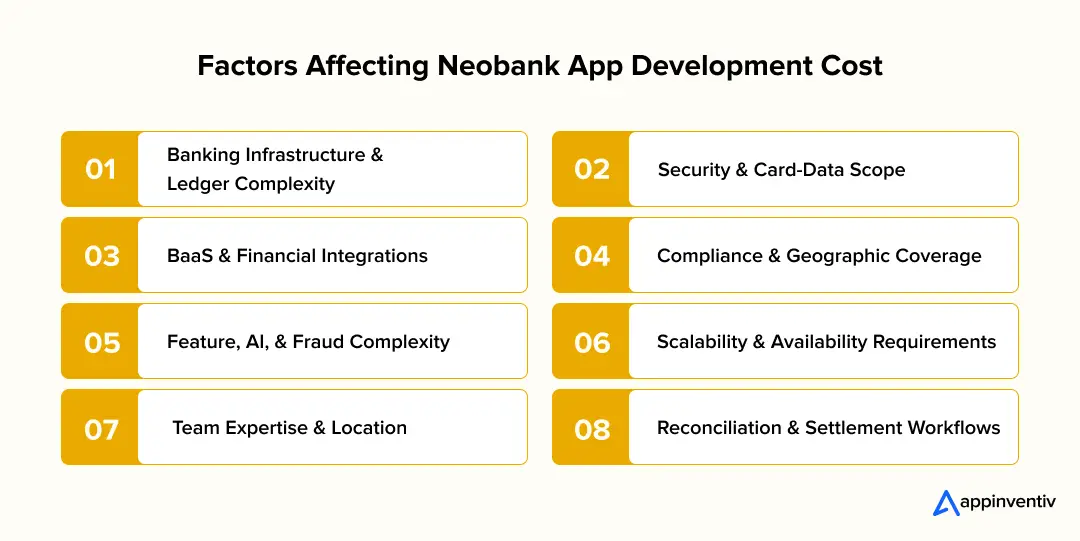
Factors Affecting Neobank App Development Cost
Final budget requirements shift with the depth of financial operations, app requirements, and internal controls. Key architecture decisions dictate core project spending.
Banking Infrastructure and Ledger Complexity
Simple user account levels require less development effort than double-entry accounting ledgers with a multi-account structure and real-time balance tracking. Proprietary ledger logic requires lots of code validation and balancing.
Security and Card-Data Scope
Handling payment card data demands strict access rules, data tokenization, encryption protocols, and security audits. Biometric logins and device fraud tracking expand mobile application and backend workloads.
BaaS, Banking, and Financial Integrations
Connecting external financial vendors adds custom API development, key authentication, error processing, and service certification. Specialized partner technical requirements create extra development and maintenance tasks.
Compliance and Regulatory Requirements
Multi-region deployments make it harder to perform identity checks, apply transaction rules, comply with regulations, and manage data residency. New regulatory requirements may require system updates after launch.
Also Read: How Digital Transformation in FinTech is Shaping the Future of the Industry
Payment Methods and Geographic Coverage
Payment methods such as credit cards, wire transfers, digital wallets, instant-clearing networks, and foreign-currency payments increase testing requirements. Each target region receives its own set of payment rails and payment rules.
Feature and Workflow Complexity
Multi-step financial processes often require additional backend microservices, data validation, and dedicated test suites. Integrating loan modules, investment platforms, multi-currency wallets, and open banking endpoints requires more engineering effort than just regular transfers.
AI, Fraud, and Data Intelligence Requirements
The number of data pipelines, risk rules, model monitoring and automated response alerts is key to a real-time fraud engine. Specialized model-validation workflows and data engineering are needed for advanced customer-centric banking data analytics.
Technology Stack and Platform Strategy
Application architecture impacts engineering time, quality assurance, and application update and maintenance cycles. Building native iOS and Android apps incurs the cost of developers’ person-hours, which is greater than that of shared code.
Scalability, Performance, and Availability Requirements
For high transaction volume, you need to do capacity planning, set up caching layers, implement event-streaming queues, and tune databases. To ensure high uptime, redundant server clusters and automatic failover and disaster recovery are crucial.
Development Team Expertise and Location
Engineers with hands-on expertise in financial transfers, data security, and regulated APIs will be needed for financial app projects. The geographic delivery location can affect hourly rates, but the total project cost also depends on the architecture, financial domain expertise, regulatory requirements, and team composition.
Reconciliation, Settlement, and Transaction Operations
Reconciliation systems compare what is recorded in the internal database with what’s recorded in the bank. Settlement modules handle transaction stages, delays, balance adjustments, and missing entries through dedicated settlement workflows.
Monetization Model and Revenue Workflows
A neobank’s revenue model directly affects its technical requirements. Subscription tiers require entitlement logic and billing; card and payment infrastructure provide interchange revenue, and lending brings in credit assessment, loan servicing, collection and risk workflows. For revenue models that involve partners, there’s also tracking referrals, partner finance API, and settlement logic.
Build vs Buy: When Should an Enterprise Use BaaS?
BaaS eases initial engineering effort by providing you with regulated financial infrastructure via APIs. Leaders pursuing banking digital transformation should select an infrastructure model based on which parts of the product are strategically differentiating.
Choose BaaS When
BaaS is suitable for companies that need quick market entry, localized rollout strategies, and account functions. Account hosting, debit card issuance, payment processing, and basic compliance rules stay with vendor partners, allowing internal app developers to concentrate on user interfaces.
Choose Custom Development When
Proprietary application engineering is ideal for businesses that demand control over the rules, routing, data structures, threat detection, or custom transaction logic involved in a ledger. Custom development typically requires a higher initial investment but gives enterprises greater control over system performance, hosting, governance, and product evolution.
Choose a Hybrid Model When
Hybrid deployments combine third-party financial services with proprietary backend infrastructure. Organisations keep vendor platforms for regulated commodity features and create their own routing engines, data analytics, fraud detection or user management systems.
For strategic alignment, it’s important to consider release timelines, regulatory requirements, vendor lock-in, margins on transactions, customization objectives, and how much control you can maintain over the long haul, in addition to the upfront cost of developing a neobank app.
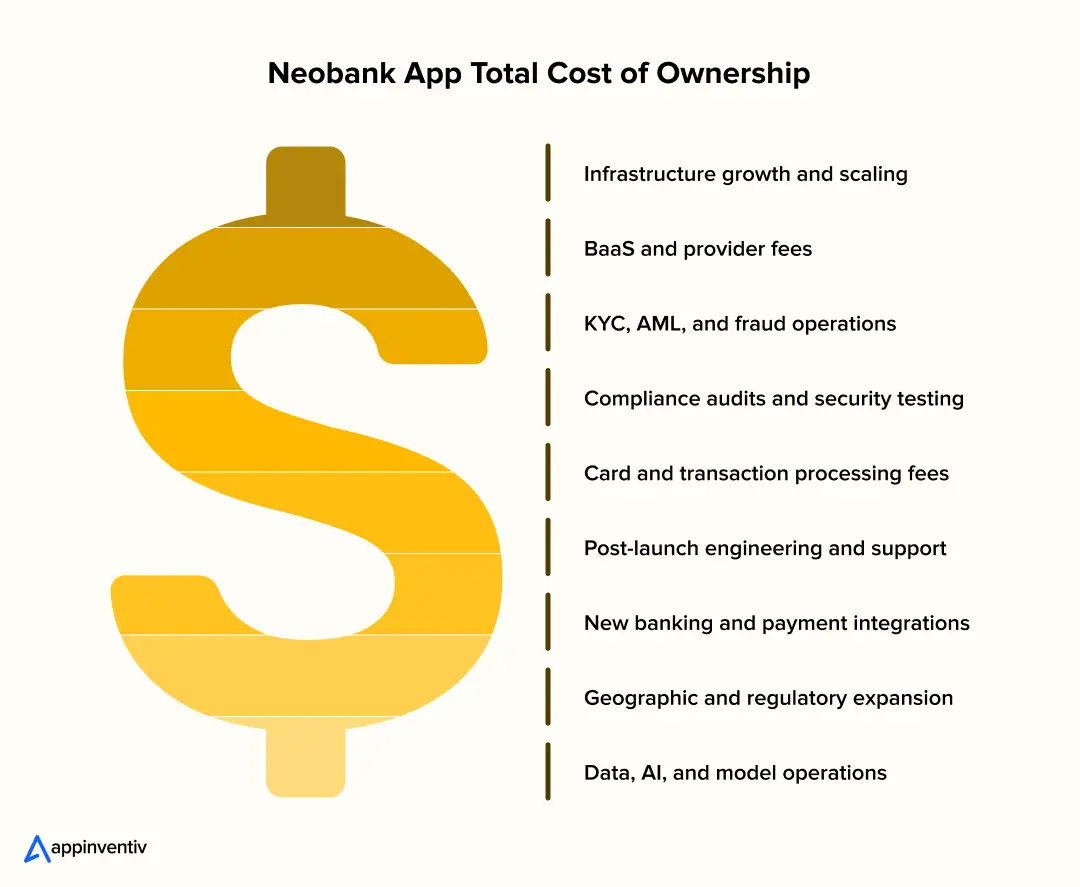
Neobank App Total Cost of Ownership: Hidden Expenses
Running a live neobank adds recurring operating and maintenance costs beyond the initial development budget. Cloud costs, banking, compliance and user operations are ongoing costs to engineering teams.
Infrastructure Growth and Scaling
Compute resources, database storage, system monitoring and network bandwidth charges scale up with the number of transactions. Redundant server clusters increase monthly hosting costs and are necessary to meet strict uptime requirements.
BaaS, Banking, and Third-Party Provider Fees
BaaS platforms, sponsor banks, identity verifiers, payment gateways and card processors levy setup, recurring subscription or per-transaction fees.
KYC, AML, and Fraud Operations
Recurring expenses include app subscription costs and manual operational costs for verifying customer identities, running sanctions checks, screening transactions and investigating flagged activity.
Compliance Renewals and Security Audits
Recurring operational costs include periodic security assessments, penetration testing, compliance certification audits, and vulnerability fixes.
Card, Payment, and Transaction Processing Fees
Network charges are proportional to the number of transactions, such as card approvals, wire transfers, cash withdrawals, and settlement clearing.
Post-Launch Engineering and Support
Engineering supports releases of feature updates, mobile operating system releases, outages, database tuning, security fixes, and code fixes.
New Banking and Payment Integrations
There are continuous monitoring, integration testing and custom application development requirements for connecting new banking partners, payment networks, card issuers or financial tools.
Geographic and Regulatory Expansion
Products need to be launched in new regions with individual sponsor banks, local payment connections, payment identity-verification APIs and regional data-residency controls.
Data, AI, and Model Operations
The use of machine learning in banking introduces recurring costs for data pipelines, model processing, error monitoring, regular model retraining, and automated decision analysis.
Transaction Volume and Unit Economics
The baseline hosting costs, transaction fees, partner payouts, and fraud monitoring costs are determined by overall payment processing activity. Different platforms with similar feature sets have differing operating costs at different transaction volumes.
As evidenced by McKinsey’s report, $2.6 trillion in revenue was generated by $3.8 trillion in payments worldwide in 2025.
Nubank has 131 million monthly active customers, and an average monthly cost per active customer of $0.80 in 2025. This shows the need for enterprise teams to monitor costs per active customer, per transaction, provider fees and infrastructure costs as usage increases.
Unit Cost per Transaction = Total Transaction-Related Operating Costs ÷ Total Transactions
This calculation excludes the cost of payment rails, partnership surcharges, and server load, before margin compression.
Appinventiv maps critical banking dependencies and technical risks before additional markets, payment rails, and AI workloads widen the budget.

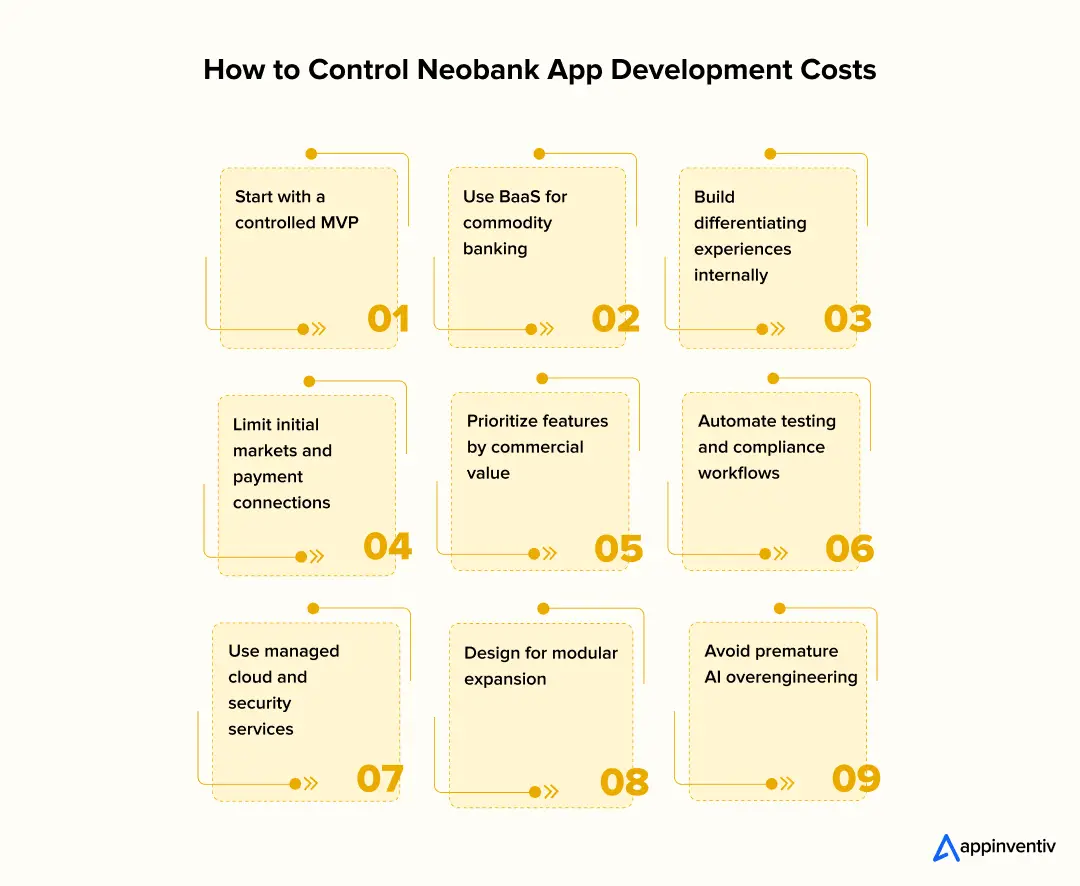
How to Optimize Neobank App Development Costs
Cost management stems from disciplined choices in product scope and system architecture, not from cutting financial safety controls.
- Step 1 – Start With a Controlled MVP
Launch a controlled MVP that keeps initial development costs within budget while supporting core banking operations for the target customer segment. Do not include complex elements such as investment products, credit lines or multi-market transfers in the first release.
- Step 2 – Use BaaS for Commodity Banking Capabilities
Delegate common tasks such as account hosting, debit card issuance and simple payment rails to vendor platforms. This option will save on custom backend engineering hours and integration time. - Step 3 – Build Differentiating Financial Experiences Internally
Implement engineering controls to manage proprietary functionality, including fintech data analytics, customer engagement tools, routing logic, and risk rule engines. This will ensure that app investments prioritize the product’s unique benefits.
- Step 4 – Limit Initial Markets and Payment Connections
Begin small — targeting certain geographic markets and payment channels. More countries mean more vendor relationships, regulatory filings, testing, and operational overhead.
- Step 5 – Prioritize Features by Commercial Value
Focus development efforts on revenue, user adoption, risk reduction, and operational impact. Invest in features that have a high value.
- Step 6 – Automate Testing and Compliance Workflows
Save time on repetitive manual tasks with automated regression testing, API validation tools, balance reconciliation scripts, compliance logs, and security scans. Complex transaction flags are directly supervised by human review teams.
- Step 7 – Use Managed Cloud and Security Services Where Appropriate
Minimize infrastructure engineering through managed database engines, monitoring, a secret management platform, data encryption, and security hardware. Select external services that meet regulatory, uptime, and data privacy requirements.
- Step 8 – Design for Modular Expansion
Design banking microservices, payment connectors, risk-processing engines, and user interface modules as modular components.
- Step 9 – Avoid Premature AI and Infrastructure Overengineering
Apply machine learning models when business or revenue objectives are established. Ensure that server infrastructure resources match the number of users who will access them.
Also Read: How to Modernize Legacy Systems in Banking: Key Strategies and Steps
Initiate Your Neobank App Development Journey With Appinventiv
Assessing neobank app development cost goes beyond plain mobile app development. Appinventiv provides banking software development services, including financial application engineering, banking integrations, banking-as-a-service platforms, cloud architecture, security protocols, machine learning, quality assurance, and maintenance, all delivered by a single delivery team.
Our financial engineering covers transaction processing, third-party banking connections, regulatory architecture, scalable cloud networks, and automated banking workflows.
Our track record includes 300+ banking transformation projects and 10+ years of banking domain expertise across 30+ countries. We have processed 100M+ secure transactions and achieved 98% fraud detection accuracy.
For enterprises launching a new neobank or upgrading an existing platform, we manage architecture, application engineering, security, testing, deployment, and ongoing product support. This delivery model supports transaction integrity and regulatory compliance requirements without splitting work across separate vendor teams.
Let’s connect and get a full neobank cost breakdown before funding approval.
Frequently Asked Questions
Q. How long does it take to develop a neobank app?
A. Neobank development cost and timelines both depend on the final product scope and backend infrastructure requirements, with timelines ranging from 1 to 18 months. Turnkey white-label platforms can be deployed within 1 to 3 months. Simple minimum viable products need 3 to 6 months of active engineering. Custom mid-tier platforms take 6 to 10 months. Full enterprise banking builds demand 9 to 18+ months for complete delivery.
Q. How much does it cost to add AI features to a neobank app?
A. The cost of integrating AI is $10K to $75K for every functional application module based on data complexity. The price of automated customer support tools starts at just under $10K. Intelligent document classification and predictive spending cost $15K – $45K. These advanced real-time fraud detection solutions involve data ingestion pipelines, model training, and automated threat-monitoring processes that run continuously in the background, and they can cost between $25K and $75K.
Q. What tech stack is used for mobile neobank apps and how does it affect cost?
A. Mobile engineers typically build native iOS apps with Swift, Android apps with Kotlin, and cross-platform apps with Flutter. The total front-end app labor for developing separate native mobile applications is $60K to $170K. Cross-platform builds are $40K to $100K, with the same core app built, but custom native code modules written for the biometric hardware controls.
Q. How do security and compliance requirements affect neobank app development cost?
A. Regulatory compliance and data protection requirements can add 15%–30% of the total development budget to development costs. Engineering teams create identity verification workflows, sanctions-screening APIs, real-time transaction-monitoring engines, and PCI DSS card tokenization systems. Multi-region banking regulations and required third-party security evaluations increase back-end development time, security measures and application testing.
Q. What is the typical neobank app development cost in the USA?
A. A neobank app developed for the US market typically costs $150K to $400K+. This cost results from senior developers and specialized fintech engineering talent being highly paid on an hourly basis. Build teams in America provide enterprise banking platforms with core ledgers, regulatory compliance tools, API integrations, and secure payment rails.


Fast 2-minute response, fully NDA-protected.

Cost of Developing a Payment Gateway: A Complete Breakdown
Key takeaways: Custom gateway development requires $50,000 to $500,000 in upfront capital, and enterprise platforms cost more at scale. Core infrastructure, security compliance, and settlement logic consume far more budget than basic checkout screens. High transaction volumes require concurrency controls, failover systems, monitoring tools, and automated reconciliation engines. Platform ownership creates recurring costs for security…

How Much Does RegTech Software Development Cost in the UK in 2026?
Key takeaways: RegTech software development cost in the UK spans £40,000 to £400,000+, with regulatory scope and legacy integration depth driving the cost. High-performance systems deliver a 30% to 50% reduction in manual workloads, protecting enterprises from severe FCA penalties. Advanced AI features generally represent around 25–40% of the total project investment due to the…

Building Next-Generation Digital Payment Systems for Australia's NPP Economy
Key takeaways: Australia's NPP is approaching 1.82 billion real-time transactions annually; BECS decommissioning by 2030 creates a hard migration deadline that cannot be managed through incremental patches. The July 2026 Payday Super mandate makes real-time payment infrastructure a legal compliance requirement. Enterprises without NPP-capable payroll systems are already operating against a regulatory clock. NPP platform…