

































P2P Crypto Exchange Development: Architecture, Features, Cost & Enterprise Implementation Guide

 Share -


- 01How P2P Crypto Exchange Platforms Work and Why Enterprises Are Investing in Them
- 02Types of P2P Crypto Exchanges
- 03P2P Crypto Exchange Software Development Steps: A Complete Process Breakdown
- 04Key Features of P2P Crypto Exchange Platforms: What Modern Systems Include
- 05Enterprise Architecture of a P2P Crypto Exchange
- 06Security & Compliance Considerations in P2P Crypto Exchange Development
- 07P2P Crypto Exchange Development Cost: What Enterprises Should Budget
- 08Biggest Challenges & Solutions in P2P Crypto Exchange Development
- 09Build vs White-Label vs Hybrid P2P Exchange Development: Which Approach Fits Your Business?
- 10Future Trends Shaping P2P Crypto Exchange Development
- 11How Appinventiv Helps Enterprises Build Secure and Scalable P2P Crypto Exchanges
- 12Frequently Asked Questions

Key Takeaways
- Enterprise P2P crypto exchanges require secure blockchain escrow orchestration, multi-chain crypto wallet infrastructure, and real-time compliance monitoring from day one.
- Stablecoin-powered settlement systems are reshaping cross-border transactions, OTC trading, and regional liquidity movement across digital asset ecosystems.
- Infrastructure decisions around custody, scalability, and compliance directly affect long-term exchange stability, transaction security, and operational costs.
- Hybrid exchange architectures now dominate enterprise deployments by balancing decentralized trading flexibility with centralized compliance control.
- High-volume P2P platforms rely on microservices architecture, event-driven processing, and AI-based fraud monitoring for operational resilience.
Crypto exchanges are no longer built only for retail traders. Over the last few years, banks, fintech firms, remittance companies, and digital asset startups have started investing in p2p cryptocurrency exchange development for different reasons. They want tighter control over settlements, payment flows, liquidity access, and transaction costs.
That shift has pushed P2P crypto exchange development into a much larger market. According to Grand View Research, the global cryptocurrency exchange platform market is projected to reach $264.3 billion by 2030, growing at a CAGR of 28.4%.
A P2P exchange allows users to trade digital assets directly with each other. The platform manages escrow, identity verification, trade matching, dispute handling, and wallet interactions in the background.
Stablecoin adoption has accelerated this shift further, with businesses increasingly using USDT and USDC for faster cross-border transactions and reduced banking friction.
Building a P2P crypto exchange still requires strong engineering capabilities across escrow systems, wallet security, AML monitoring, fraud prevention, and high-volume transaction processing.
This guide breaks down the key systems, architecture layers, development stages, security requirements, and cost factors involved in building an enterprise-grade P2P crypto exchange.
Build scalable P2P exchange infrastructure before competitors secure regional liquidity and dominate stablecoin transactions.

How P2P Crypto Exchange Platforms Work and Why Enterprises Are Investing in Them
Building a peer-to-peer cryptocurrency exchange means creating a direct trading model where buyers and sellers interact without handing full asset control to a centralized intermediary.
The platform acts as a transaction orchestration layer. It manages escrow, identity verification, payment confirmation, dispute resolution, settlement workflows, and blockchain analytics.
How P2P Crypto Exchanges Work
A P2P exchange coordinates trade execution, escrow protection, fiat verification, and crypto settlement between two parties through automated workflows.
A typical trade follows this sequence:
- A seller creates a crypto offer with pricing, payment methods, and trade limits
- The matching engine connects the offer with eligible buyers
- The platform locks the seller’s crypto assets in an escrow wallet
- The buyer completes a fiat payment through supported banking rails or PSPs
- Payment proof enters the verification workflow
- The escrow engine releases crypto assets after confirmation
- The transaction enters settlement and audit logs
Modern P2P exchanges also use:
- AML screening engines
- transaction monitoring systems
- multi-signature wallets
- risk scoring models
- automated arbitration workflows
Disputed trades often move into a moderation queue where admins review transaction hashes, payment records, and KYC metadata.
P2P Crypto Exchanges vs Centralized Exchanges
P2P exchanges distribute trade execution and settlement across users, while centralized exchanges manage custody, liquidity, and transactions through a single platform-controlled system.
| Factor | P2P Exchange | Centralized Exchange |
|---|---|---|
| Custody Model | Shared or escrow-based custody | Full platform custody |
| Liquidity Dependency | User-driven liquidity | Centralized order books |
| Trade Settlement | Peer-to-peer settlement | Exchange-managed settlement |
| User Control | Higher asset and payment control | Lower direct control |
| Compliance Complexity | Multi-region payment oversight | Centralized compliance workflows |
| Fraud Exposure | Payment fraud and disputes | Custodial breach risks |
| Operational Scalability | Complex escrow orchestration | Centralized scaling model |
| Infrastructure Ownership | Distributed transaction workflows | Platform-controlled infrastructure |
How Enterprises Benefit From P2P Crypto Exchange Development
Enterprises use P2P exchanges to reduce settlement friction, expand regional payment access, and build new digital asset transaction channels.
Enterprises now use P2P trading systems for:
- stablecoin-based cross-border settlements
- OTC crypto trading
- regional remittance networks
- alternative liquidity access
- merchant payment ecosystems
- fiat-to-crypto onboarding
- Web3 transaction monetization
This model gives businesses tighter control over settlement flows, crypto banking software infrastructure, and regional trading operations.
This demand continues to grow as blockchain’s systematic value drives infrastructure adoption globally. Industry forecasts now project blockchain technology market growth at a 56.6% CAGR through 2029.
Types of P2P Crypto Exchanges
Crypto P2P exchange application development has evolved significantly over the last few years. Early platforms handled simple buyer-to-seller crypto trades. Newer systems now support escrow automation, multi-chain settlements, fiat rails, and institutional liquidity flows.
The structure of the exchange usually depends on one thing: how much control the business wants over custodial and non-custodial wallets, compliance, and transaction processing.
| P2P Exchange Type | How the Platform Operates | Where It Fits Best |
|---|---|---|
| Custodial P2P Exchange | The exchange locks crypto assets in escrow wallets during the trade process. The platform controls custody until the settlement finishes. | Large trading platforms that need stronger compliance checks and transaction oversight |
| Non-Custodial P2P Exchange | Users connect external wallets and keep direct asset ownership. Smart contracts handle escrow and settlement logic. | DeFi marketplaces and privacy-focused trading platforms |
| Hybrid P2P Exchange | Parts of the system stay centralized, usually compliance and dispute management. Wallet interaction and settlements stay partly decentralized. | Businesses that want both regulatory control and a flexible trading infrastructure |
| Fiat-to-Crypto P2P Marketplace | Users pay through bank transfers, cards, UPI, e-wallets, or local payment gateways to buy crypto directly from sellers. | Remittance apps, crypto onboarding businesses, and regional payment networks |
| Cross-Chain P2P Trading Platform | The platform supports trading across different blockchain networks through bridge protocols and interoperability layers. | Multi-chain asset marketplaces and institutional trading ecosystems |
Hybrid models now dominate many enterprise deployments. They give businesses tighter fraud monitoring, cleaner AML workflows, and better liquidity visibility without removing the peer-to-peer trading model completely.
P2P Crypto Exchange Software Development Steps: A Complete Process Breakdown
P2P crypto exchange development involves far more than building a crypto trading interface. Enterprise platforms must coordinate escrow execution, blockchain settlement, wallet synchronization, payment verification, AML monitoring, and liquidity management inside one transaction environment.
Most businesses entering P2P cryptocurrency exchange development focus first on trading features. The harder part starts later. High transaction volume, failed settlements, payment fraud, and regional compliance rules often create infrastructure pressure long after launch.
That is why P2P crypto exchange software development requires a staged engineering process from the beginning.
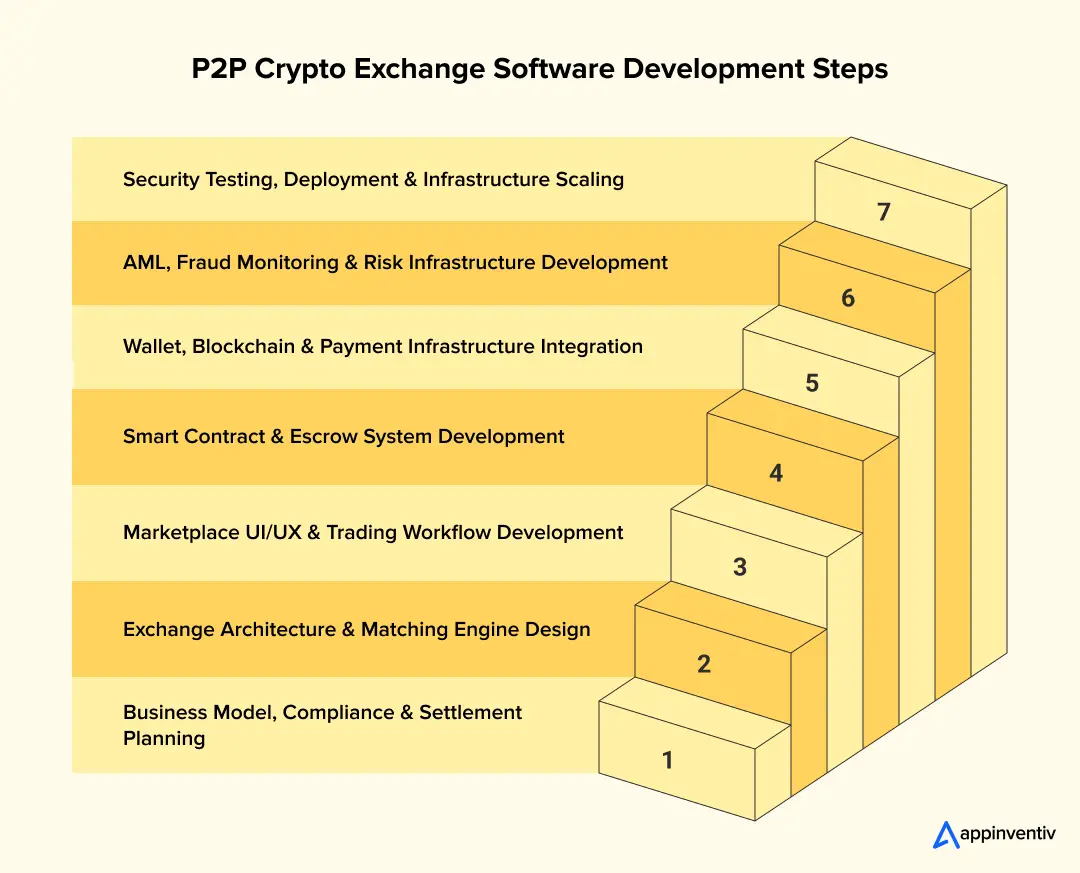
Step 1: Business Model, Compliance & Settlement Planning
The first stage defines how the exchange will operate across users, payment systems, and jurisdictions.
Teams usually decide:
- Custodial vs non-custodial trading architecture
- Supported blockchain networks
- Fiat settlement methods
- Regional compliance scope
- Stablecoin support
- Liquidity acquisition strategy
A platform handling institutional OTC transactions needs different infrastructure from a retail fiat-to-crypto marketplace.
Legal planning also starts early during crypto P2P exchange application development. Most exchanges must support KYC onboarding, AML transaction screening, sanctions monitoring, suspicious activity reporting, and FATF Travel Rule workflows before production deployment begins.
Payment infrastructure planning matters equally. Banking APIs, PSP integrations, UPI rails, SWIFT connectivity, and stablecoin settlement flows directly affect transaction speed and escrow release timing.
Step 2: Exchange Architecture & Matching Engine Design
Architecture planning decides how the exchange processes transactions under heavy trading conditions.
Most enterprise teams now prefer microservices architecture instead of monolithic deployment models. Separate services handle escrow workflows, matching engines, wallet orchestration, payment verification, compliance monitoring, and transaction analytics independently.
This structure improves fault isolation during traffic spikes. The matching engine becomes the core processing layer during P2P crypto exchange software development.
It manages:
- Order sequencing
- Trade matching
- Price execution
- Liquidity routing
- Concurrent transaction processing
High-volume exchanges often use Redis caching and Kafka streams to reduce settlement latency during large transaction bursts.
Database planning also becomes critical while building a peer-to-peer cryptocurrency exchange. PostgreSQL replication, event sourcing, and distributed transaction logs help exchanges recover failed settlements and maintain escrow consistency across services.
Many enterprise teams also follow a broader blockchain implementation strategy during this phase to align scalability, compliance monitoring, node infrastructure, and transaction orchestration before launch.
Step 3: Marketplace UI/UX & Trading Workflow Development
The frontend layer controls user trust during transactions. Most custom P2P crypto exchange development projects focus heavily on:
- Escrow visibility
- Merchant reputation systems
- Payment confirmation workflows
- Real-time order books
- Dispute escalation access
- Wallet balance synchronization
WebSocket infrastructure usually powers live market updates and settlement notifications.
Enterprise exchanges also support multilingual onboarding, geo-specific payment flows, and merchant verification dashboards for regional trading operations.
A weak trading interface often increases failed settlements and payment disputes, even if backend systems remain stable.
Step 4: Smart Contract & Escrow System Development
Escrow infrastructure sits at the center of how to build a P2P crypto exchange securely.
The escrow engine locks crypto assets during active trades and releases them only after payment verification completes. Many exchanges now use smart contracts, MPC custody systems, and multi-signature validation workflows to reduce fraud exposure.
Escrow development normally includes:
- Asset locking logic
- Time-lock release conditions
- Arbitration triggers
- Settlement rollback handling
- Withdrawal restrictions
- Gas fee management
Security reviews happen continuously during this stage. Smart contract auditors test reentrancy attacks, signature validation failures, wallet exploits, and transaction replay vulnerabilities before production rollout.
Cross-chain support also affects escrow complexity. Exchanges supporting Ethereum, Polygon, Solana, and BNB Chain must coordinate settlement logic across multiple blockchain environments.
Step 5: Wallet, Blockchain & Payment Infrastructure Integration
Wallet coordination becomes one of the hardest stages during P2P crypto exchange development.
Enterprise exchanges normally deploy:
- Hot wallets for active trading
- Cold wallets for reserve storage
- MPC wallets for distributed custody
- HSM-backed key management systems
Blockchain integration includes RPC node communication, validator connectivity, transaction broadcasting, blockchain indexing, and smart contract interaction layers.
This stage also relies heavily on APIs in fintech to synchronize wallet infrastructure, payment gateways, banking systems, identity verification services, and escrow workflows inside one transaction environment.
Payment infrastructure must stay synchronized with escrow systems in real time. Delayed payment confirmation often creates settlement disputes within P2P marketplaces.
Most exchanges integrate:
- Bank transfer APIs
- PSP gateways
- Card processors
- eWallet systems
- Stablecoin payment rails
Treasury wallet management also becomes critical during p2p crypto exchange development services for high-volume platforms handling large liquidity reserves.
Step 6: AML, Fraud Monitoring & Risk Infrastructure Development
Compliance systems now operate continuously across the trading lifecycle. Enterprise exchanges monitor:
- Wallet risk exposure
- Transaction anomalies
- Sanctions violations
- Suspicious trading activity
- Merchant fraud patterns
- Payment inconsistencies
Many businesses now use AI-based fraud detection models during P2P crypto exchange software development. These systems monitor behavioral signals, failed settlements, abnormal trade timing, device fingerprinting, and transaction velocity patterns.
Risk engines usually integrate directly with AML monitoring pipelines and SIEM dashboards.
This stage also includes audit logging, regulatory reporting pipelines, and jurisdiction-specific onboarding controls for MiCA, VARA, GDPR, and FinCEN compliance requirements.
Step 7: Security Testing, Deployment & Infrastructure Scaling
Testing starts long before launch. Enterprise teams usually conduct:
- Smart contract audits
- Penetration testing
- API abuse simulation
- Wallet stress testing
- DDoS testing
- Node failover validation
- Disaster recovery testing
Kubernetes orchestration and containerized deployment models now dominate enterprise exchange infrastructure. Autoscaling clusters help exchanges process large transaction spikes during volatile trading periods.
Observability systems like Prometheus, Grafana, and SIEM monitoring platforms track wallet activity, settlement delays, escrow failures, API latency, and infrastructure resource usage in real time.
Post-launch operations continue long after deployment. Most successful exchanges maintain rolling security patches, liquidity monitoring systems, blockchain node upgrades, and fraud investigation pipelines as transaction volume grows.
Key Features of P2P Crypto Exchange Platforms: What Modern Systems Include
Modern P2P exchanges now operate as high-volume transaction systems instead of simple crypto marketplaces. Enterprise platforms must coordinate escrow execution, wallet infrastructure, payment verification, fraud detection, liquidity tracking, and compliance monitoring during every trade cycle.
Each infrastructure layer directly affects settlement speed, dispute handling, transaction security, and operational stability.
Escrow-Based Trade Protection System
The escrow engine controls transaction security during active trades. It locks crypto assets after order confirmation and releases them only after payment verification completes.
Most enterprise exchanges now use:
- Smart contract escrow execution
- Multi-signature authorization
- Escrow state management
- Time-locked settlement conditions
- Automated dispute escalation
- Fail-safe withdrawal restrictions
High-volume platforms often separate escrow orchestration into dedicated microservices to reduce settlement delays during peak transaction activity.
Some exchanges also maintain secondary escrow verification pipelines for large OTC settlements and high-risk merchant accounts.
Real-Time Matching Engine
The matching engine processes trade discovery, order sequencing, liquidity routing, and transaction execution across the exchange.
Enterprise systems rely heavily on:
- In-memory order books
- Low-latency execution engines
- Redis caching
- Kafka event streams
- Concurrent transaction queues
- WebSocket market synchronization
High-frequency trading activity can overload poorly designed matching systems within seconds. That is why most enterprise exchanges isolate trade execution infrastructure from wallet coordination and compliance services.
Many platforms also use event-driven architecture to maintain transaction throughput during large traffic spikes and volatile trading periods.
Multi-Currency Wallet Infrastructure
Wallet infrastructure directly affects custody security and settlement reliability.
Most enterprise exchanges support both custodial and non-custodial wallets across multi-chain ecosystems. Many businesses now partner with cryptocurrency wallet development services providers to deploy MPC custody systems for institutional-grade asset protection.
The infrastructure commonly includes:
- Hot wallets for active liquidity
- Cold wallet reserve storage
- MPC wallet infrastructure
- HSM-backed key management
- Wallet signature validation
- Blockchain node synchronization
Exchanges supporting Ethereum, Solana, Polygon, and BNB Chain must also coordinate wallet activity across different blockchain confirmation models and gas fee structures.
Poor wallet synchronization often creates delayed settlements, failed withdrawals, and liquidity fragmentation across trading pairs.
KYC, AML & Fraud Monitoring System
Compliance systems now monitor trading activity continuously instead of running only during onboarding.
From AML software development to behavioral fraud analytics, enterprise exchanges deploy multiple monitoring layers across wallet activity, payment flows, and transaction execution pipelines.
Most platforms integrate:
- Identity verification APIs
- Sanctions screening engines
- Transaction monitoring systems
- Suspicious activity reporting workflows
- Behavioral risk analytics
- Merchant fraud detection systems
Some exchanges also use machine learning models to detect payment fraud, abnormal trade velocity, account takeover attempts, and suspicious wallet movement patterns in real time.
Risk monitoring systems usually connect directly with SIEM dashboards, audit logging pipelines, and compliance reporting infrastructure.
Dispute Resolution & Payment Infrastructure
P2P exchanges must process failed payments, delayed settlements, chargeback disputes, and fraudulent transaction claims at scale.
Most enterprise platforms use:
- Arbitration dashboards
- Payment evidence systems
- PSP integrations
- Banking APIs
- Transaction audit logs
- Automated dispute routing
Many exchanges also integrate crypto payment gateway infrastructure to support stablecoin settlements, merchant payments, and cross-border transaction processing across different fiat networks.
Payment verification systems must stay synchronized with escrow workflows in real time. Delayed confirmation often creates settlement disputes and frozen transaction states during active trades.
Admin Panel & Liquidity Management Dashboard
Enterprise operators need continuous visibility across exchange infrastructure and trading operations.
Admin dashboards usually monitor:
- Liquidity movement
- Escrow settlement status
- Suspicious transaction activity
- Fee revenue tracking
- Wallet anomalies
- API traffic spikes
- Infrastructure resource utilization
Large exchanges also maintain treasury management systems, operational reporting dashboards, compliance monitoring panels, and real-time risk scoring infrastructure for internal oversight.
Many enterprise platforms now combine observability tools, SIEM monitoring systems, and transaction analytics engines inside unified operational dashboards to improve response time during infrastructure failures and fraud incidents.
Weak escrow architecture and poor liquidity orchestration break exchanges faster than low trading demand ever will.

Enterprise Architecture of a P2P Crypto Exchange
A P2P crypto exchange runs on several infrastructure layers at the same time. Each layer handles a different part of the trading lifecycle, from order execution and escrow management to wallet security and compliance monitoring.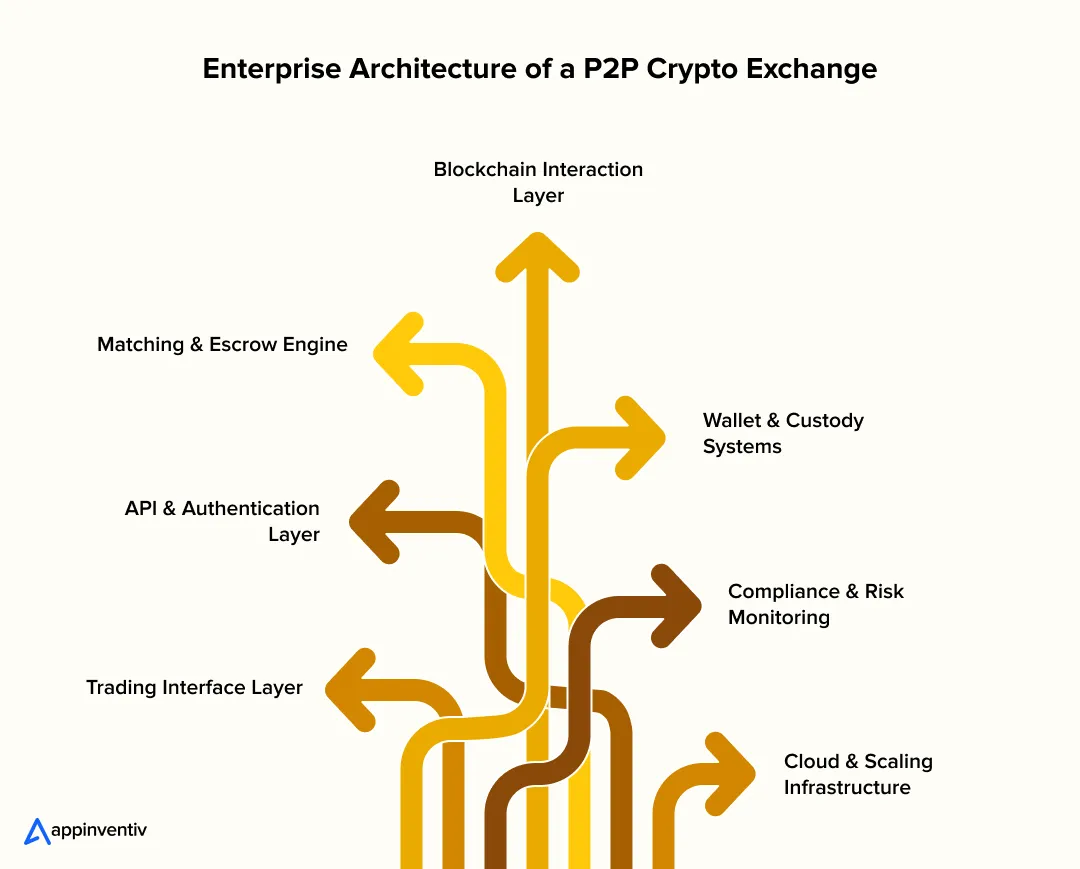
Choosing the Right Tech Stack for P2P Crypto Exchange Development
The technology stack decision, including choices like serverless vs microservices, affects system stability, transaction speed, infrastructure cost, and long-term scalability.
| Layer | Common Technologies | Key Enterprise Considerations |
|---|---|---|
| Blockchain Networks | Ethereum, Solana, Polygon, Avalanche, BNB Chain | TPS, gas fees, interoperability |
| Backend Services | Go, Node.js, Rust, Java | Low latency and concurrent processing |
| Frontend Frameworks | React, Next.js, Flutter | Live order updates and trading responsiveness |
| Databases & Streaming | PostgreSQL, Redis, Kafka | High-volume trade processing |
| Cloud & DevOps | AWS, Azure, Docker, Kubernetes | Autoscaling and failover handling |
| Wallet Infrastructure | MPC wallets, HSMs, vault systems | Institutional-grade custody protection |
| Monitoring Stack | SIEM tools, Prometheus, Grafana | Threat visibility and observability |
Frontend Trading Interface Layer
This layer handles all user-facing trading activity across web and mobile applications.
Core functions include:
- live order book updates
- escrow status tracking
- wallet balance visibility
- trade execution interfaces
- real-time notifications through WebSockets
API Gateway & Authentication Layer
The API layer manages traffic between frontend services, trading systems, wallets, and compliance engines.
Most platforms use:
- JWT authentication
- OAuth 2.0
- API rate limiting
- session management
- traffic filtering
- device fingerprinting
Trading Engine & Escrow Orchestration Layer
This layer controls trade execution and escrow coordination during transactions.
Key components include:
- matching engine logic
- order sequencing
- escrow triggers
- settlement workflows
- event-driven processing queues
High-volume exchanges often use Kafka and Redis streams to reduce execution latency.
Blockchain Interaction Layer
The blockchain layer communicates directly with distributed networks and smart contracts.
It usually manages:
- RPC node communication
- validator interaction
- transaction broadcasting
- smart contract execution
- cross-chain bridge protocols
Also Read: Asset Tokenization on Blockchain: Future of Asset Management
Wallet & Custody Infrastructure
Wallet infrastructure protects user assets during trading and settlement operations.
Enterprise platforms often deploy:
- hot and cold wallet segregation
- MPC custody systems
- HSM-backed key storage
- private key rotation policies
- multi-signature authorization workflows
Compliance, Risk & Monitoring Layer
This layer continuously scans trading activity for suspicious behavior and compliance violations.
Core systems include:
- AML transaction monitoring
- sanctions screening
- audit logging
- fraud analytics
- SIEM integrations
- suspicious activity reporting workflows
Cloud & Scalability Infrastructure
Most enterprise exchanges use microservice architecture and cloud-native infrastructure to support traffic spikes and regional scaling.
Common deployments include:
- microservices architecture
- Kubernetes orchestration
- containerized workloads
- autoscaling clusters
- disaster recovery environments
- multi-region failover systems
How Appinventiv Helped a FinTech Platform Scale a High-Volume P2P Trading Ecosystem
A company leveraging blockchain in fintech and operating across Southeast Asia partnered with Appinventiv to rebuild its P2P crypto trading infrastructure. The existing platform struggled with escrow delays, rising payment disputes, wallet synchronization issues, and transaction bottlenecks during peak trading hours.
Our engineering teams redesigned the platform using microservices architecture, Kubernetes orchestration, and event-driven transaction processing. We also integrated MPC wallet infrastructure, automated escrow workflows, real-time AML monitoring, and AI-based fraud scoring systems.
The upgraded exchange supported:
- 1.8 million+ monthly transactions
- 12 regional payment methods
- multi-chain asset support across Ethereum, Polygon, and BNB Chain
Within eight months after deployment, the platform achieved:
- 42% faster transaction settlements
- 37% reduction in payment disputes
- 99.50% transaction uptime
- 28% lower infrastructure operating costs
The platform now supports large-scale cross-border crypto settlements with real-time compliance visibility and high-volume trading stability.
Security & Compliance Considerations in P2P Crypto Exchange Development
Security failures in a P2P exchange usually affect more than user funds. They can disrupt escrow settlements, expose payment records, trigger regulatory action, and damage platform credibility within hours. That is why enterprise exchanges build security and compliance controls directly into the infrastructure layer instead of treating them as add-on features.
Security Infrastructure Requirements
Modern exchanges protect trading systems through multiple security layers working together during every transaction.
Most enterprise deployments include:
- MPC wallet infrastructure for distributed key signing
- HSM-backed private key storage
- end-to-end encryption for wallet and payment data
- DDoS mitigation layers
- API traffic filtering
- anti-phishing protection
- session anomaly detection
- role-based access controls
Security teams also perform:
- penetration testing
- smart contract audits
- wallet stress testing
- infrastructure vulnerability scans
Many exchanges now follow zero-trust security models where every API request, wallet action, and admin session requires continuous verification.
Global Compliance Requirements
Legal considerations and regulatory compliance implementation grow complex as P2P exchanges operate across multiple payment systems and jurisdictions.
Most platforms must support:
- KYC onboarding workflows
- AML transaction monitoring
- sanctions screening
- Suspicious Activity Reporting
- FATF Travel Rule compliance
- GDPR data handling requirements
- MiCA and VARA regulations
- FinCEN reporting obligations
Compliance systems usually run in real time alongside transaction processing and escrow monitoring.
Also Read: KYC Automation Benefits, Tools, Steps and Use Cases
Building Trust in P2P Trading Ecosystems
User trust directly affects liquidity and platform retention.
Most exchanges strengthen trust through:
- reputation scoring systems
- verified merchant programs
- escrow transparency
- dispute resolution tracking
- transaction verification workflows
- fraud reporting channels
Clear risk visibility and fast dispute handling often matter as much as transaction speed in P2P trading environments.
P2P Crypto Exchange Development Cost: What Enterprises Should Budget
The crypto exchange app development cost changes based on infrastructure depth, compliance scope, wallet architecture, and transaction volume targets. A basic marketplace with standard escrow workflows costs far less than an enterprise trading platform handling multi-region settlements and institutional liquidity flows.
| Platform Type | Estimated Development Cost | Estimated Timeline |
|---|---|---|
| MVP P2P Exchange | $50,000 to $120,000 | 3 to 5 months |
| Mid-Scale Trading Platform | $120,000 to $300,000 | 6 to 9 months |
| Enterprise-Grade P2P Ecosystem | $300,000 to $500,000+ | 9 to 15 months |
Key Factors Affecting Development Cost
Development budgets usually increase with:
- smart contract and escrow complexity
- blockchain node infrastructure
- MPC wallet deployment
- KYC and AML integrations
- liquidity management systems
- cloud autoscaling setup
- multi-chain asset support
- fraud detection infrastructure
- security audits and penetration testing
Also Read: How Much Does it Cost to Develop a Crypto Wallet App?
Hidden Operational Costs Enterprises Often Overlook
Launch cost is only part of the investment. Most exchanges continue spending on:
- infrastructure hosting
- compliance operations
- wallet monitoring
- liquidity provisioning
- node maintenance
- security patching
- transaction analytics
- customer dispute management
Large exchanges also maintain dedicated incident response and fraud investigation teams once transaction volume starts growing.
Biggest Challenges & Solutions in P2P Crypto Exchange Development
Crypto P2P exchange application development involves several technical and operational challenges that become more complex as transaction volume increases. Most platforms struggle with liquidity stability, fraud control, payment verification, compliance exposure, and infrastructure scaling while maintaining secure and uninterrupted trading operations.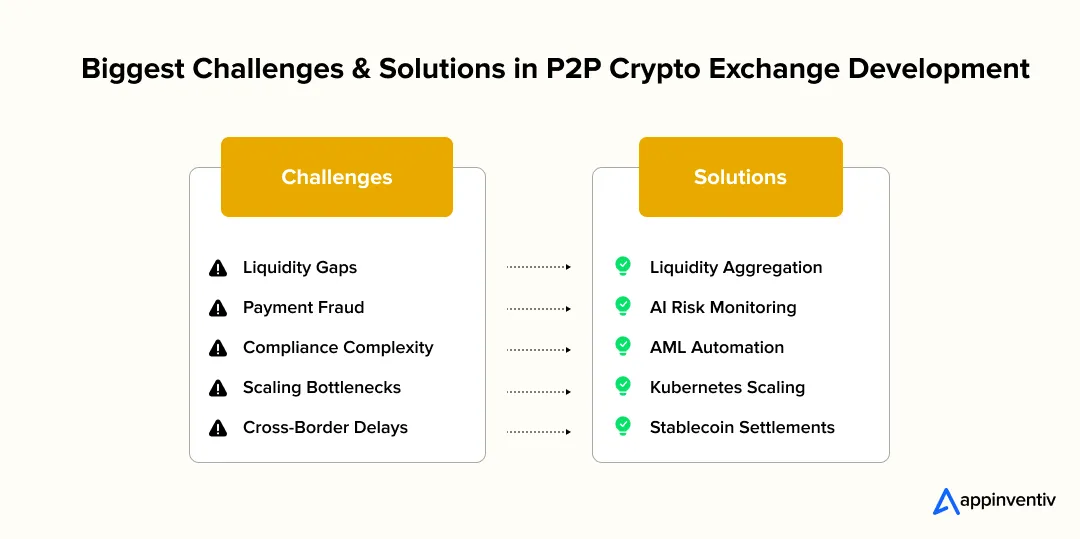
Liquidity Fragmentation & Market Depth Issues
Low liquidity creates delayed settlements, wider spreads, and failed transactions across trading pairs.
Solution:
- integrate market maker networks
- aggregate liquidity pools
- support stablecoin trading pairs
- Use dynamic pricing engines.
Fraud Prevention & Dispute Management
Fake payment confirmations, chargeback fraud, and escrow disputes remain common in fiat-linked P2P trades, making AI agents for fraud detection a growing priority for exchange operators.
Solution:
- Deploy transaction risk scoring
- Use behavioral analytics systems
- implement escrow time-locks
- automate dispute escalation workflows
Regulatory Uncertainty Across Jurisdictions
Compliance requirements change across regions, especially around KYC, AML, and digital asset licensing.
Solution:
- build modular compliance systems
- maintain jurisdiction-specific onboarding flows
- integrate sanctions screening engines
- support audit-ready reporting pipelines
Scalability & Transaction Throughput Bottlenecks
High traffic periods can overload matching engines, blockchain nodes, and wallet infrastructure.
Solution:
- use microservices architecture
- Deploy Kubernetes autoscaling
- Implement Redis caching and Kafka streams
- separate hot and cold wallet operations
Cross-Border Payment Complexity
Regional banking restrictions and payment settlement delays slow transaction completion.
Solution:
- integrate local payment gateways
- support multi-currency settlements
- Use stablecoin payment rails.
- Maintain PSP redundancy across regions.
Many exchanges fail after launch due to operational bottlenecks rather than trading demand. Strong infrastructure planning usually decides long-term platform stability.
Building User Trust in Decentralized Trading Ecosystems
Users avoid platforms that lack transparency, fast dispute handling, or reliable escrow protection. Trust issues often reduce liquidity and repeat transaction volume.
Solution:
- Implement merchant verification systems
- maintain public trade reputation scores
- Provide transparent escrow tracking
- support real-time dispute resolution
- Use transaction audit logs and fraud reporting workflows
Many successful P2P exchanges grow through reputation stability and settlement reliability rather than aggressive user acquisition alone.
Build vs White-Label vs Hybrid P2P Exchange Development: Which Approach Fits Your Business?
Most businesses choose between speed, control, and long-term flexibility during p2p cryptocurrency exchange development. A white-label platform helps teams launch faster. A custom-built exchange gives deeper control over escrow logic, wallet systems, compliance flows, and infrastructure scaling.
| Factor | Custom Build | White-Label | Hybrid |
|---|---|---|---|
| Customization | Full platform control | Limited customization | Custom features on shared infrastructure |
| Launch Speed | Slower rollout | Faster deployment | Moderate setup time |
| Compliance Setup | Easier regional adaptation | Depends on vendor support | Better flexibility |
| Scalability | Built for large transaction volume | Vendor limitations apply | Supports phased growth |
| Security Ownership | Internal security control | Shared with vendor | Shared operational model |
| Infrastructure Control | Full ownership | Vendor-managed stack | Partial ownership |
A P2P crypto exchange script or white-label system fits teams starting with a minimal viable product and rapid market entry.
Many enterprise businesses outgrow them once trading volume increases or compliance requirements become more complex.
Custom P2P crypto exchange development usually makes more sense for businesses planning:
- multi-region expansion
- institutional trading support
- advanced escrow workflows
- proprietary liquidity engines
- custom custody infrastructure
Hybrid models sit in the middle. Teams use prebuilt exchange modules for faster deployment and later replace critical components with custom-built infrastructure.
Build exchange infrastructure ready for stablecoin settlements, AI-driven monitoring, and institutional liquidity operations.

Future Trends Shaping P2P Crypto Exchange Development
P2P crypto exchange software development is changing fast. Earlier platforms focused mostly on crypto escrow and direct buyer-seller trading.
These blockchain technology trends now push systems to handle liquidity automation, cross-chain settlements, real-time fraud analysis, and institutional compliance workflows inside the same infrastructure stack.
A few trends are shaping the next phase of this market:
- AI-based fraud monitoring
Exchanges now track unusual wallet behavior, failed settlements, payment fraud patterns, and suspicious transaction spikes through machine learning models. - Cross-chain trading support
Many platforms now support asset transfers across Ethereum, Solana, Polygon, and BNB Chain through interoperability protocols and bridge infrastructure. - Stablecoin settlement growth
USDT and USDC continue replacing slower banking rails for remittance flows, OTC trading, and international settlements. - Hybrid exchange architecture
Businesses increasingly combine centralized compliance controls with decentralized wallet interaction and liquidity systems. - Digital identity verification systems
DID frameworks and verifiable credentials are starting to reduce repetitive KYC checks across platforms. - Privacy-focused compliance models
Zero-knowledge proof systems allow exchanges to validate compliance conditions without exposing sensitive user data. - Agentic AI-assisted trading operations
Some exchanges now automate liquidity balancing, dispute routing, and transaction monitoring through crypto trading bot development and risk engines.
How Appinventiv Helps Enterprises Build Secure and Scalable P2P Crypto Exchanges
As a leading P2P crypto exchange development company, Appinventiv understands that building these platforms requires more than blockchain development. Businesses need secure escrow systems, payment infrastructure, liquidity management, compliance controls, and high-availability architecture that can support real transaction volume across regions.
As a trusted cryptocurrency exchange development company, Appinventiv helps enterprises build and scale these systems with a security-first and infrastructure-focused development model.
Our fintech engineering teams have delivered:
- 200+ fintech products
- 10+ years of fintech development expertise
- 98% fraud detection accuracy across monitored systems
- 99.50% transaction security SLA
- up to 30% reduction in operational overhead through infrastructure modernization
Our P2P crypto exchange development services support businesses across:
- escrow architecture development
- multi-chain wallet infrastructure
- MPC custody deployment
- AML and transaction monitoring integration
- PSP and fiat payment connectivity
- liquidity engine development
- cloud-native exchange deployment
Our teams build exchanges using microservices architecture, Kubernetes orchestration, event-driven processing, and real-time monitoring systems to support high-volume transaction environments.
Security remains a core part of the development lifecycle.
We conduct:
- smart contract audits
- penetration testing
- API security validation
- infrastructure hardening
- compliance workflow integration
We also help businesses align their exchange infrastructure with regional compliance requirements such as FATF guidelines, KYC regulations, MiCA readiness, and transaction audit reporting.
From architecture planning and escrow automation to post-launch scaling and monitoring, Appinventiv supports the full lifecycle of enterprise P2P crypto exchange development.
Let’s connect and build a future-ready P2P crypto exchange.
Frequently Asked Questions
Q. What is a P2P crypto exchange?
A. P2P crypto exchange development enables users to trade digital assets directly with each other through a platform that acts as the middle layer during the transaction and manages escrow, payment confirmation, and dispute handling. Many exchanges also support bank transfers, wallet integration, KYC verification, and fraud monitoring during the trading process.
Q. How much does it cost to build a P2P crypto exchange?
A. Smaller P2P trading platforms usually start with $50,000. A large exchange with custom escrow logic, multi-chain wallet systems, compliance monitoring, and high-volume infrastructure can go beyond $500,000. Cost mostly depends on transaction scale, blockchain integrations, payment systems, wallet security, and cloud deployment requirements.
Q. What are the core functionalities of P2P crypto exchanges?
A. Most P2P exchanges include trade matching, escrow protection, crypto wallets, payment verification, merchant management, and dispute resolution tools. Enterprise platforms also use AML monitoring systems, sanctions screening, liquidity engines, and fraud analytics to manage trading activity and payment risks across different regions.
Q. Which blockchain is best for developing P2P crypto exchanges?
A. Ethereum remains popular for smart contract development and ecosystem maturity. Solana handles larger transaction throughput with lower latency. Polygon helps reduce gas fees during high trading activity. Many businesses now support multiple blockchain networks instead of depending on one ecosystem for all trading operations.
Q. What are the benefits of P2P exchanges?
A. The benefits of P2P exchanges include direct crypto trading without relying fully on centralized intermediaries. Businesses gain more flexibility around settlements, regional payment methods, and stablecoin transfers. Many companies also use P2P systems for remittance flows, OTC trading, and crypto onboarding in regions with limited banking access.
Q. How can Appinventiv help businesses with P2P crypto exchange development?
A. Appinventiv helps businesses build P2P exchanges with escrow automation, wallet infrastructure, AML systems, payment gateway integration, and cloud-native deployment architecture. Our teams also support blockchain integration, fraud prevention systems, liquidity management, and infrastructure scaling for platforms handling large transaction volumes.


Fast 2-minute response, fully NDA-protected.

Smart Contract Development Cost in the UAE in 2026: Factors, Estimates, and Key Considerations
Key takeaways: UAE smart contract projects range from AED 147K to AED 1.46M+, driven by architectural complexity, testing scope, and security standards. Enterprise budgets must divide core programming from independent audits, system integrations, hosting infrastructure, legal compliance, and ongoing operations. Ethereum, Polygon, Solana, and Hyperledger Fabric require distinct programming languages, software tooling, infrastructure, and transaction…

White-Label Crypto Exchange Platform Development in the UAE: A Complete Cost and Compliance Guide
Key takeaways: Building a white-label exchange costs AED 55,000 to AED 550,000. VARA licensing adds an AED 100,000 application fee plus an AED 200,000 supervision fee yearly. Technology takes weeks; VARA approval takes six to twelve months. Choose white label for speed, custom for real differentiation. Bake compliance into the build from the first sprint.…
Crypto Banking Software Development: Core Architecture for Digital Asset Banking
Key takeaways: Crypto banking software bridges traditional finance and digital assets, enabling banks to offer secure, compliant, and scalable crypto services. Modern crypto banking platforms feature robust custody, multi-asset wallets, real-time compliance, and seamless blockchain integration. Adopting crypto banking solutions accelerates cross-border payments, reduces costs, and enhances financial inclusion. Security, regulatory compliance, and modular architecture…