

































Smart Contract Development Cost in the UAE in 2026: Factors, Estimates, and Key Considerations

 Share -



- 01Smart Contract Development Cost in the UAE in 2026
- 02How Technical Scope Impacts Smart Contract Development Cost
- 03Key Factors Influencing Smart Contract Development Cost
- 04Blockchain Platforms and Their Cost Implications
- 05Smart Contract Security, Audit, and Testing Costs
- 06UAE Regulatory and Legal Considerations
- 07Use-Case-Based Smart Contract Development Costs in the UAE
- 08Enterprise Integration Costs in Smart Contract Development
- 09Post-Deployment Costs to Include in Your Smart Contract Budget
- 10Key Considerations When Choosing a Smart Contract Development Partner
- 11How Can Appinventiv Support Smart Contract Development in the UAE?
- 12Frequently Asked Questions

Key takeaways:
- UAE smart contract projects range from AED 147K to AED 1.46M+, driven by architectural complexity, testing scope, and security standards.
- Enterprise budgets must divide core programming from independent audits, system integrations, hosting infrastructure, legal compliance, and ongoing operations.
- Ethereum, Polygon, Solana, and Hyperledger Fabric require distinct programming languages, software tooling, infrastructure, and transaction fee structures.
- RWA, DeFi, real estate, supply chain, and trade finance implementations require specialized execution logic, API connections, and regulatory frameworks.
- Selecting partners requires verifying live production deployments, security audit records, expertise in enterprise software integration, code documentation, and post-launch support.
The cost of smart contract development in the UAE can range from AED 147K ($40K) to AED 1.46 million+ ($400K+) in 2026. A basic contract with limited business logic sits near the lower end. Complex DeFi protocols, RWA tokenization platforms, and multi-contract systems can push costs far higher.
There is no single market price for smart contract development. The final budget depends on the contract architecture, blockchain, transaction logic, security requirements, and enterprise integrations. A Solidity contract on an EVM network has different development needs from a Solana or Hyperledger Fabric implementation.
The development quote is only one part of the budget. Businesses must account for code audits, remediation, wallet and oracle integration, node infrastructure, deployment, monitoring, and regulatory work. UAE projects can also incur additional compliance costs associated with VARA, SCA, DIFC, ADGM, and AML/CFT requirements. A clear cost model starts by separating smart contract engineering from the wider blockchain product budget.
Map your features, blockchain, integrations, and security requirements before an unclear quote slows your development plan.

Smart Contract Development Cost in the UAE in 2026
The average smart contract development cost in the UAE can range from AED 147K ($40K) to AED 1.46 million+ ($400K+) in 2026. The lower end covers focused contracts with limited business logic and fewer integrations. Higher budgets apply to systems with multiple contracts, complex asset flows, cross-chain functions, financial logic, and enterprise-grade security controls.
The price also changes with the blockchain architecture. Solidity-based development for EVM networks can follow a different cost structure from Solana or Hyperledger Fabric projects. Contract count, testing depth, oracle integration, multi-signature controls, and deployment requirements add engineering work.
Cost by Contract Complexity
| Project Level | Indicative Range | Typical Timeline | Examples |
|---|---|---|---|
| Basic | AED 147K – AED 275K ($40K – $75K) | 2–4 weeks | Tokens, NFTs, escrow |
| Mid-level | AED 275K- AED 550K ($75K – $150K) | 4–8 weeks | Staking, vesting, DAO |
| Advanced | AED 550K- AED 918K ($150K – $250K) | 8–16 weeks | DeFi, multi-contract, cross-chain |
| Enterprise | AED 918K5 – AED 1.47 million+ ($250K – $400K+) | 4–9+ months | RWA, institutional systems, complex protocols |
These figures serve as planning ranges rather than fixed quotes. A staking contract with a single reward mechanism has a different engineering scope from that of a DeFi protocol managing several interacting financial contracts. The same applies to RWA platforms, where token ownership rules, transfer controls, identity checks, and external data feeds can expand the architecture.
Also Read: How Much Does it Cost to Build a Blockchain App in the UAE?
Smart Contract Development Cost vs Full Blockchain Product Cost
A smart contract is only one layer of a blockchain product. The cost to build a smart contract in the UAE is only one layer of a blockchain product’s total budget, and it can create a large gap between the initial estimate and the final project cost.
Contract-only covers the code, testing, deployment work, and related security review for the contract layer.
Contract + dApp adds the user interface, wallet connectivity, backend services, APIs, indexing, authentication, and blockchain data handling.
The enterprise blockchain ecosystem, especially for blockchain integration in Dubai, adds greater integration and operational requirements. These can include ERP connectivity, private node infrastructure, compliance controls, monitoring, identity systems, data services, and multiple smart contracts.
This distinction provides businesses with a more useful benchmark for smart contract pricing in the UAE. It helps separate development spending from the broader cost of building a smart contract there.
Also Read: How Much Does It Cost to Build Software in Dubai?
How Technical Scope Impacts Smart Contract Development Cost
Commercial smart contract development moves through distinct technical phases, with each phase introducing direct expenses. Building production-ready software requires clear business rules, rigorous security testing, independent audits, and dedicated live infrastructure. Industry benchmarks divide budgeting into specification, engineering, testing, security reviews, deployment, and ongoing technical support.
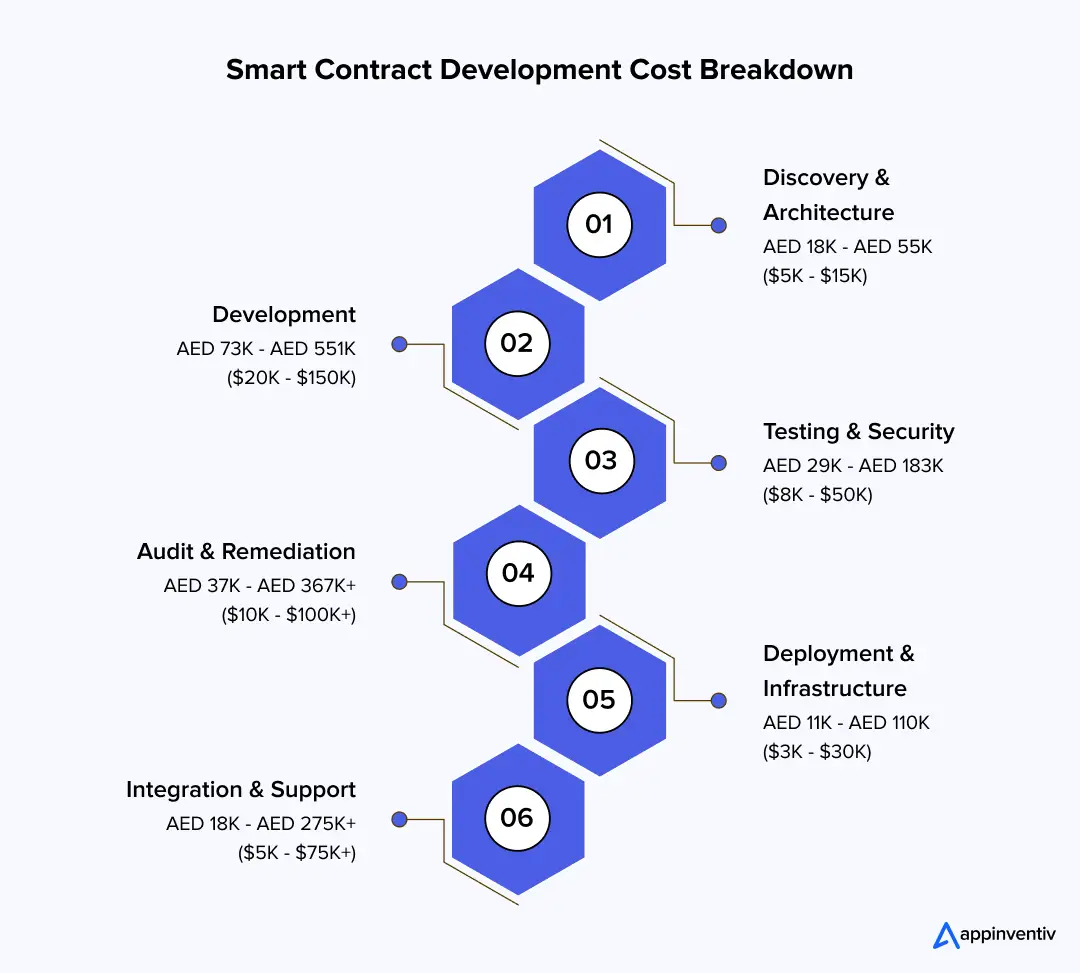
Step 1: Discovery and Architecture
Engineering teams begin by defining business rules, feasibility requirements, and core system boundaries. Software architects assign specific operations to the blockchain, keeping high-volume data within traditional corporate databases.
The team selects network protocols, maps contract interactions, outlines threat models, and specifies security controls. Key requirements include identity verification, asset custody, multi-signature permissions, and external oracle integrations.
Cost Impact: AED 18K – AED 55K ($5K – $15K) for most projects.
Precise structural design prevents costly code revisions during later development and security testing phases.
Step 2: Smart Contract Design and Development
Programmers translate approved business logic directly into executable contract code. Ethereum Virtual Machine projects rely on Solidity, standard code libraries, and structured deployment toolkits.
Development covers state variables, role permissions, custom data structures, event logging, and error handling routines. Financial workflows require automated settlement features, escrow logic, asset transfers, and restricted execution rights.
Cost Impact: AED 73K – AED 551K ($20K – $150K), depending on contract count and logic complexity.
A single-purpose contract requires less programming effort than a multi-contract financial network.
Step 3: Testing and Security Engineering
Rigorous testing verifies contract performance under standard operating conditions and simulated attack scenarios. Quality assurance includes unit testing, integration suites, static code analysis, automated fuzzing, and invariant checks. High-value protocols demand mathematical formal verification and deep penetration testing across connected application points. Test suites validate permission boundaries, failed transaction behaviors, edge conditions, and multi-contract interactions.
Cost Impact: AED 29K – AED 183K ($8K – $50K) based on contract complexity and security scope.
Security requirements scale directly with total financial value locked inside the protocol. Decentralized finance protocols, tokenized real-world assets, and institutional tools demand extensive verification efforts.
Step 4: Audit and Remediation
External security auditors inspect code for software vulnerabilities, architectural flaws, access weaknesses, and reentrancy risks. Development teams repair identified issues and submit revised code blocks for follow-up verification. Pricing reflects the total number of code lines, structural complexity, novel protocol features, targeted blockchains, and review depth. Professional audit fees range from several thousand dollars for basic contracts to over $100,000 for complex protocols.
Cost Impact: AED 37K – AED 367K+ ($10K – $100K+) for an audit and remediation cycle.
Re-audits following major code revisions add extra expense to the technical roadmap. Decision-makers must allocate reserve security funding before the final mainnet deployment.
Step 5: Deployment and Infrastructure
Mainnet launch includes code compilation, network setup, transaction signing, source verification, and live deployment. Organizations must fund network execution fees alongside specialized software infrastructure for monitoring live transaction data. High-volume operations demand dedicated node connections, data indexers, operational alerts, and real-time transaction tracking.
Cost Impact: AED 11K – AED 110K ($3K – $30K) for initial deployment and infrastructure setup.
Chosen blockchain networks directly dictate operational expenses and execution costs. Mainnet execution fees fluctuate with network congestion, and layer-two networks offer distinct cost models. Node maintenance, data indexing, and RPC capacity create ongoing operational costs after initial deployment.
Step 6: Integration and Post-Launch Support
The final phase integrates smart contracts with web applications, digital wallets, identity providers, and corporate databases. Technical teams track live operations, resolve maintenance issues, apply protocol updates, and update connected software tools.
Cost Impact: AED 18K – AED 275K+ ($5K – $75K+) depending on integrations and support coverage.
Enterprise post-launch management expenditures frequently exceed initial contract programming costs. Connecting enterprise resource planning software, custody portals, a crypto payment gateway, and compliance tools requires continuous engineering labor. Regional corporate estimates manage integration work, system maintenance, and regulatory compliance in distinct operating categories.
Key Factors Influencing Smart Contract Development Cost
The cost of a smart contract project is shaped by six areas, from contract logic and blockchain choice to security and compliance.
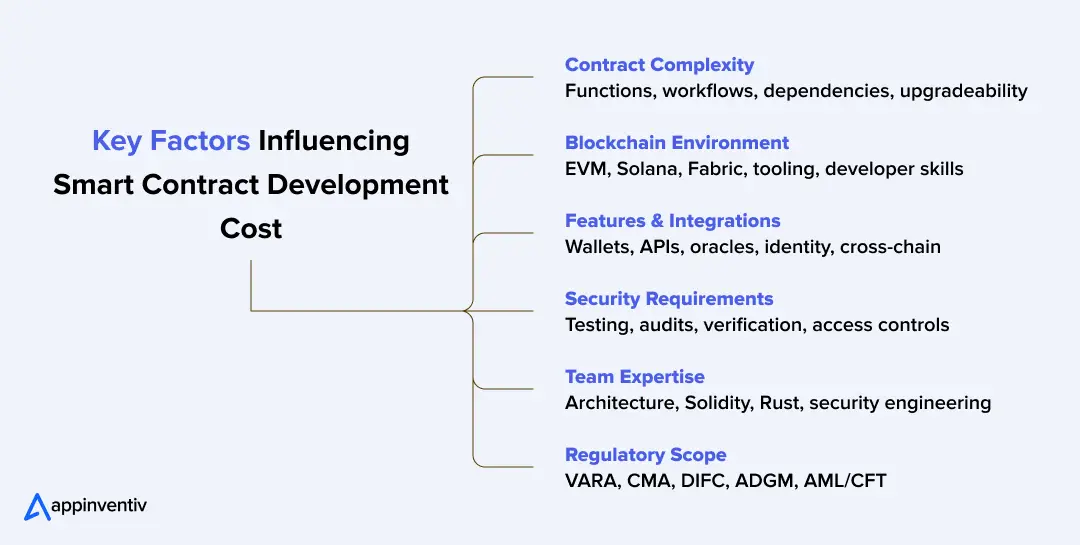
Contract Complexity and Business Logic
Simple contracts handle a narrow set of actions and need fewer development hours. Complex systems connect several contracts, manage conditional workflows, and enforce detailed transaction rules. Upgradeability, contract dependencies, role-based access, and escrow logic add more code and testing work.
Blockchain and Programming Environment
Ethereum Virtual Machine projects rely on Solidity alongside established code libraries and standardized testing frameworks. Solana networks demand Rust programming skills and memory management practices unique to high-throughput platforms. Target deployment networks directly influence software tooling, required infrastructure, mainnet transaction fees, and available developer talent.
Feature and Integration Requirements
Wallets, APIs, identity systems, payment services, and oracle integration each add technical work. Cross-chain functions require extra logic for asset movement, message passing, and transaction validation. Enterprise systems often need middleware to connect smart contracts to ERP, CRM, or internal databases.
Security and Assurance Requirements
Basic administrative contracts present a limited threat surface compared to decentralized finance protocols that manage depositor assets. High-value financial systems demand rigorous access control validations, protected external calls, and strict multi-signature sign-off requirements. Adding formal verification proofs, penetration testing, and third-party security audits increases technical preparation work.
Development Team Expertise
Smart contract development demands engineers who master both standard application architecture and low-level blockchain execution mechanics. Specialized Solidity or Rust programmers write the core smart contracts, and dedicated security engineers detect vulnerabilities before mainnet launch. Enterprise deployments demand experienced software architects capable of linking decentralized modules to legacy IT systems.
Compliance and Regulatory Scope
Tokenization and financial applications can require deeper legal and compliance planning across the UAE. VARA, SCA, DIFC, and ADGM operate under different regulatory frameworks for relevant activities. AML/CFT requirements can affect identity checks, transaction controls, reporting flows, and the design of supporting systems.
Blockchain Platforms and Their Cost Implications
The blockchain you select affects engineering effort, tooling, deployment costs, security work, and the skills needed to maintain the project.
Ethereum
Ethereum uses the Ethereum Virtual Machine (EVM) to execute smart contract code across its network. Solidity remains one of its main development languages, supported by mature testing and development tools.
Ethereum-based projects also need to account for gas costs associated with deployment and transaction execution. These are operational/network costs rather than development labor costs and vary with network conditions and contract execution patterns.
Solana
Solana uses a different execution model from EVM networks. Its on-chain programs are primarily written in Rust, and program state is stored in separate accounts rather than within the program itself.
That architecture changes the development workflow and the skills required for the project. A team moving from Solidity to Solana needs experience with Rust, Solana accounts, instructions, program-derived addresses, and the network’s testing tools.
Hyperledger Fabric
Hyperledger Fabric suits enterprise projects that need a permissioned network with known participants and defined governance rules. Fabric uses chaincode for business logic and supports policies that control transaction endorsement, network changes, and access.
The cost model differs from a public blockchain project. Teams may need to design channels, manage peer infrastructure, configure membership services, and define endorsement policies. Those network responsibilities can make Fabric a better fit for controlled B2B workflows such as trade finance or supply chain records.
Platform Choice and Budget Planning
The cheapest network to deploy on is not always the most cost-effective choice for the entire project. Development language, available libraries, security tooling, infrastructure, audit requirements, and internal engineering skills all affect the final budget.
For UAE enterprises, platform selection should be guided first by the transaction model and governance requirements. The cost estimate becomes more reliable after the team defines the contract architecture, security scope, integration needs, and expected transaction volume.
Smart Contract Security, Audit, and Testing Costs
Security work claims a substantial portion of project funds for contracts managing capital, tokenized assets, or core business rules.
Smart Contract Security Audit Cost in the UAE
Smart contract audit cost in the UAE typically ranges from AED 35K to AED 735K+ ($10K to $200K+). Complex financial protocols and multi-contract setups exceed this range based on system code volume and integration depth.
| Contract Scope | Indicative Audit Range |
|---|---|
| Simple | AED 35K – AED 73K ($10K – $20K) |
| Mid-level | AED 73K – AED 294K ($20K – $80K) |
| Complex | AED 294K – AED 735K ($80K – $200K) |
| Enterprise | AED 735K+ ($200K+) |
Cost Impact: Pricing scales directly with code volume, manual inspection depth, fix verification, and active contract counts.
Security Testing Before Deployment
Testing procedures evaluate regular execution patterns and adversarial attack vectors. Unit test suites validate standalone functions and direct system interactions. Static code scanners, automated fuzzing, and invariant checks expose unusual edge cases. Mathematical formal proofs confirm precise execution for critical high-risk modules. Human engineers review custom business logic to spot flaws automated scanners miss.
Also Read: Cybersecurity Services in the UAE: How to Choose the Right Consulting and Implementation Partner
Common Vulnerability Areas
Smart contract deployments face four major threat categories:
- Reentrancy attack vectors and broken access control structures
- External oracle data manipulation and signature replay exploits
- Proxy upgradeability flaws and administrative key management failures
- Unprotected cross-contract call paths and external dependency risks
Each security risk targets distinct operational components, impacting withdrawal logic, permission settings, price feeds, and administrative overrides.
Audit, Remediation, and Re-Audit
Initial security reports represent a single milestone in the overall protection lifecycle. Engineering teams correct verified vulnerabilities, retest updated code, and submit revised files for final verification. Corporate development budgets require allocation for remediation rounds before mainnet launch. Structural code modifications invalidate earlier security conclusions and require follow-up auditor review.
Get engineering support for Solidity, EVM architecture, testing, integrations, deployment, and post-launch operations from a single delivery team.

UAE Regulatory and Legal Considerations
Smart contract projects across the United Arab Emirates operate under fragmented regulatory frameworks. Compliance requirements depend on specific business activities, asset classes, corporate location, and local jurisdiction.
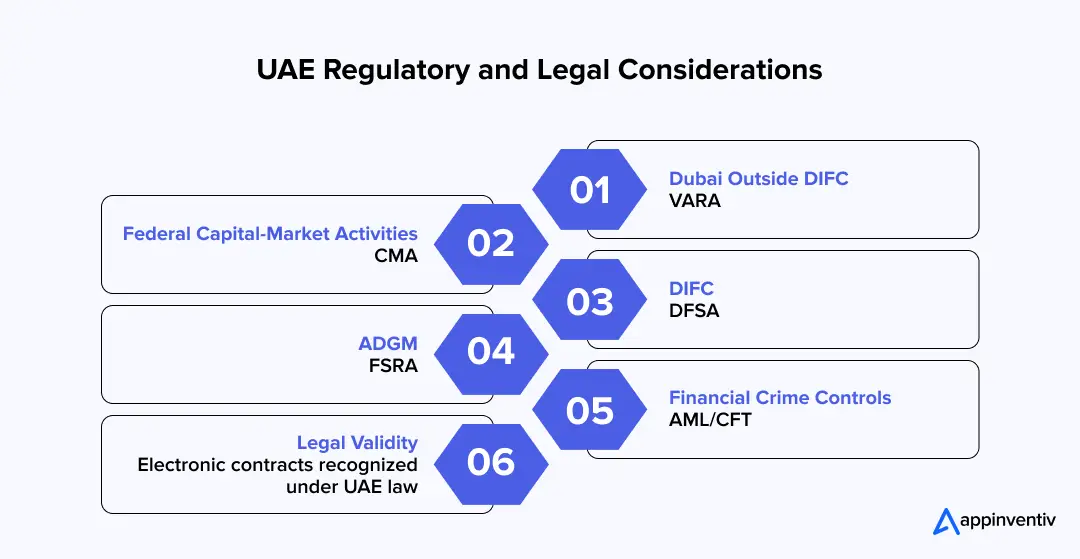
VARA Requirements in Dubai
The Virtual Assets Regulatory Authority governs mainland Dubai and directly affects smart contract development costs in Dubai for tokenization platforms operating outside financial free zones. The VARA framework oversees virtual asset providers, issuance, technical risk controls, and federal compliance rules. Tokenization platforms must build VARA-compliant blockchain solutions that align wallet controls, monitoring protocols, access permissions, and underlying contract code with these rules.
SCA Considerations for Relevant Activities
The Capital Market Authority (CMA), formerly the Securities and Commodities Authority (SCA), regulates relevant capital-market activities at the federal level. Its scope covers activities such as trading platforms, custody, brokerage, dealing, and portfolio management. Executive teams should assess regulatory scope based on the business activity rather than the underlying smart contract alone.
DIFC and DFSA Requirements
The Dubai Financial Services Authority regulates digital asset operations within the Dubai International Financial Centre. Updated DFSA Crypto Token rules took effect on January 12, 2026, expanding supervision across financial token activities. Regulated DIFC smart contracts must embed strict controls that support corporate compliance duties.
ADGM and FSRA Requirements
The Financial Services Regulatory Authority oversees digital assets within the Abu Dhabi Global Market. FSRA guidelines regulate Virtual Assets, Fiat-Referenced Tokens, Digital Securities, and related financial services. The regulator finalized dedicated rules for virtual asset staking in April 2026.
AML/CFT and Tokenization Considerations
Anti-money laundering mandates directly shape application design. Wallet screening, transaction tracking, source-of-funds verification, and reporting flows typically sit within peripheral software systems. VARA rules strictly mandate financial crime prevention, sanctions monitoring, and counter-terrorism controls across connected platforms.
Smart Contract Legal Enforceability in the UAE
United Arab Emirates law establishes full legal recognition for electronic contracts. Federal Decree-Law No. 46 of 2021 grants legal validity and enforceability to agreements executed through automated software systems. Contract enforceability varies based on transaction terms, governing laws, and commercial scope. Enterprise projects require joint legal and technical reviews before software launch.
Use-Case-Based Smart Contract Development Costs in the UAE
A project’s operational use case dictates its underlying business logic, data architecture, external integrations, testing scope, and security requirements.
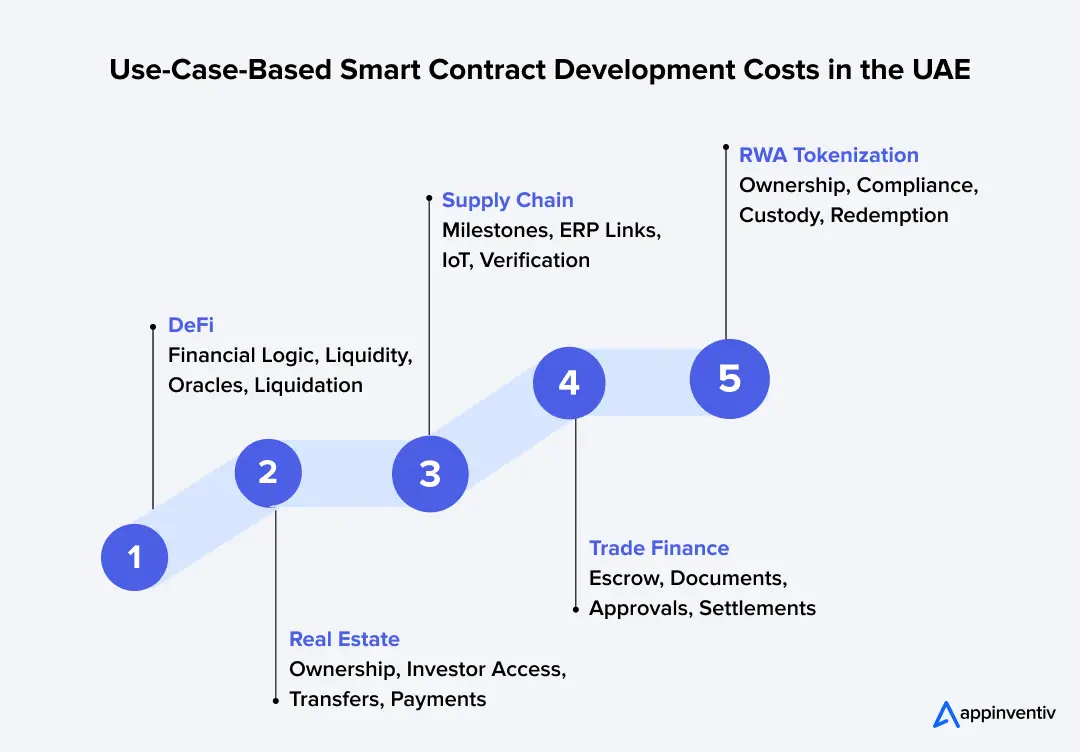
DeFi Smart Contracts
DeFi smart contract development costs scale directly with the complexity of financial functions and the total protocol assets. Lending mechanisms, staking protocols, token swaps, liquidity pools, and automated settlements, similar to what powers crypto exchange app development in the UAE, require multiple interconnected smart contracts. Integrating pricing oracles, validation rules, automated liquidations, and access controls increases the time spent on core engineering.
Also Read: White-Label Crypto Exchange Platform Development in the UAE: A Complete Cost and Compliance Guide
Real Estate Tokenization
A smart contract for real estate in the UAE requires complex asset mechanics that go beyond basic token-minting routines. Ownership registers, transfer restrictions, investor whitelisting, identity checks, and payment distribution logic shape the contract architecture. Software designs must synchronize on-chain asset records with off-chain property management procedures.
In February 2026, Dubai Land Department launched Phase II of its Real Estate Tokenisation Project, which covers the resale of approximately 7.8M real estate tokens on a controlled secondary market.
Also Read: How Crypto Exchange Integration is Shaping the Future of Real Estate Transactions in the UAE
Supply Chain Automation
A smart contract for supply chain in the UAE automates payments and operations based on delivery milestones, inspection logs, and shipment events. Total development costs increase when connecting contracts to enterprise databases, Internet of Things sensors, supplier portals, and verification services. Validating external data sources remains essential, as smart contracts execute actions based on incoming data streams.
Trade Finance
A smart contract for trade finance in the UAE incorporates escrow mechanisms, invoice validation routines, documentation workflows, automated payment triggers, and multi-party sign-offs. Financial institutions demand strict identity verification, role-based permissions, auditing capabilities, and transaction controls.
In January 2024, the CBUAE initiated an AED 50M Digital Dirham payment to China through mBridge, demonstrating a UAE use case for cross-border digital settlement. These requirements increase integration and security testing workloads across core banking systems.
RWA Tokenization
RWA tokenization smart contract cost in the UAE reflects asset minting, ownership records, transfer restrictions, regulatory compliance checks, custody management, and asset redemption logic. Contracts frequently communicate with external identity providers, licensed custodians, fiat payment gateways, and data feeds. Every additional external dependency expands the overall security review requirements and testing surface.
Enterprise Integration Costs in Smart Contract Development
Enterprise smart contracts often sit within an existing technology stack, so that integration work can add to the project scope and budget.
ERP, CRM, and API Integration
Smart contracts can connect to ERP software in Dubai, such as SAP and Oracle, as well as Salesforce, payment platforms, and internal applications, through APIs or middleware. The integration layer handles data exchange, authentication, transaction requests, and responses between enterprise systems and blockchain networks.
On-Chain and Off-Chain Architecture
Only data that benefits from shared verification or blockchain execution needs to sit on-chain. Large documents, private records, and frequently changing data, especially where UAE data residency compliance applies, can remain in enterprise databases. The smart contract can instead store transaction states, hashes, or references.
Legacy System Migration
Modernizing legacy systems through blockchain projects usually starts by mapping existing approvals, payment rules, ownership records, and document workflows. Migrating to smart contracts from legacy systems can occur in stages, limiting disruption and giving teams time to test the new workflow.
Infrastructure and Data Services
Enterprise deployments can require RPC services, indexing, event processing, monitoring, and dedicated node infrastructure. These components support reliable transaction handling and provide internal teams with access to blockchain activity without placing every data requirement within the smart contract.
Post-Deployment Costs to Include in Your Smart Contract Budget
Smart contract spending does not stop after mainnet deployment. Ongoing costs can come from network usage, infrastructure, maintenance, security reviews, and operational support.
Gas, Infrastructure, and Monitoring Costs
Gas fees for smart contracts in the UAE vary by network and usage, as well as by transaction and contract execution costs. Businesses may also pay for RPC access, indexing, node infrastructure, transaction monitoring, logging, and alerting as usage grows.
Maintenance, Upgrades, and Re-Audits
Post-launch maintenance covers dependency updates, integration changes, bug fixes, and approved contract upgrades. Material changes to contract logic can require another security review or partial re-audit before release, adding to the operating budget.
Cost Controls That Protect Security
Keep unnecessary data and computation off-chain to reduce contract complexity and recurring transaction costs. Use vetted libraries, test code before external review, and avoid cross-chain functions that the product does not need. A focused MVP can reduce the initial codebase and audit scope without removing controls required for production security.
Key Considerations When Choosing a Smart Contract Development Partner
Selecting the right IT consulting company in Dubai or in the broader UAE for this work requires evaluating six critical capabilities across execution, security, integration, and ongoing operational governance.
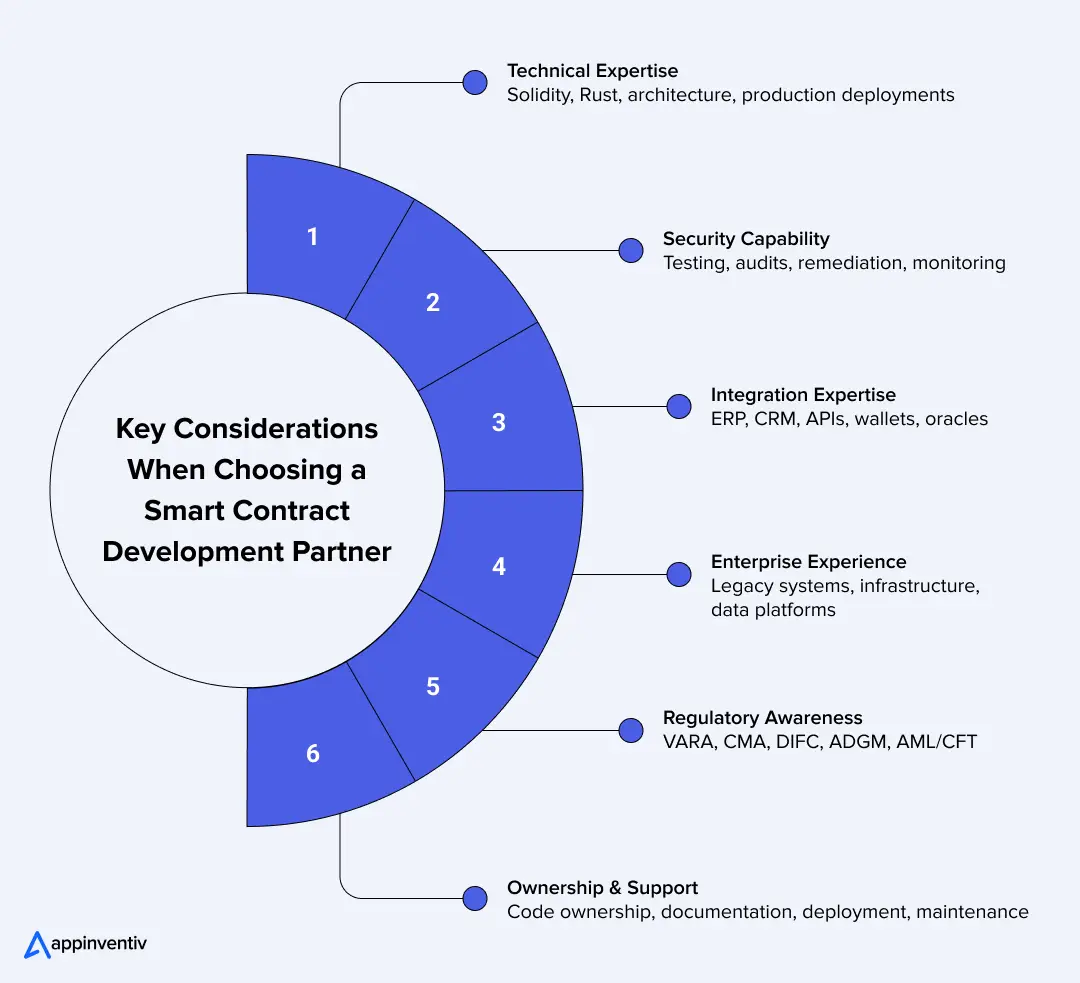
Technical and Smart Contract Expertise
Evaluate the engineering team’s proficiency in contract architecture, Solidity, Rust, token standards, and proxy upgrade patterns. Request verifiable production deployments that demonstrate domain expertise, structural complexity, and underlying network selection.
Security and Audit Capabilities
A thorough smart contract security audit in the UAE covers secure coding, rigorous unit testing, audit coordination, implementation of fixes, and live transaction monitoring. Development teams must detail their usage of static code analysis, automated fuzzing, manual reviews, and privileged access management before mainnet release.
Blockchain and Integration Expertise
A competent technical partner recommends networks aligned with specific performance needs rather than forcing a single protocol. Verify demonstrated capabilities in connecting digital wallets, application interfaces, pricing oracles, identity infrastructure, fiat payment gateways, and cross-chain bridges.
Enterprise Architecture Experience
Enterprise implementations demand clean boundaries separating smart contract logic, backend services, database clusters, and peripheral infrastructure. Prioritize providers with proven experience connecting distributed applications to enterprise resource planning, customer relationship management, custody portals, and identity systems.
Regulatory Awareness
Development partners must align software designs with the specific regulatory jurisdictions of the United Arab Emirates. Technical architectures must support compliance mandates from the Virtual Assets Regulatory Authority, the Securities and Commodities Authority, the Dubai Financial Services Authority, the Abu Dhabi Global Market, and federal anti-money laundering controls.
Source-Code Ownership and Documentation
Commercial contracts must guarantee complete ownership of source code, deployment scripts, system configurations, technical documentation, and administrative keys. Comprehensive documentation and knowledge transfer eliminate long-term vendor lock-in.
Deployment and Post-Launch Support
Post-launch coverage includes deployment verification, live transaction monitoring, infrastructure management, incident response, and protocol maintenance. Establish clear response times, maintenance scopes, and upgrade procedures before executing service agreements.
Portfolio and Verifiable Delivery Evidence
Require independently verifiable proof of completed projects that match the proposed technical complexity. Public contract addresses, third-party audit reports, and live architectural diagrams provide concrete evidence of delivery capabilities.
Development and Pricing Models
Fixed-price structures suit projects with fully defined specifications and fixed delivery scopes. Time-and-materials engagement models offer flexibility as operational requirements evolve, while dedicated engineering teams support long-term initiatives that require continuous development, integration, and platform maintenance.
Turn your cost assessment and technical requirements into a defined delivery scope before competing priorities delay architecture and development.

How Can Appinventiv Support Smart Contract Development in the UAE?
As a smart contract development company, Appinventiv combines blockchain engineering with enterprise product delivery for businesses planning smart contract development in the UAE and wider Middle East. Our regional teams have delivered 1,000+ digital projects across 35+ industries, with 10+ years of experience in the region.
We support the full delivery cycle, from contract architecture and Solidity development to testing, integrations, deployment, and post-launch operations. Our teams can connect smart contracts with ERP systems, APIs, wallets, identity platforms, and existing enterprise workflows.
For regulated projects, we bring experience across government and compliance programs, having executed 12 programs in the region. This helps teams account for jurisdiction, security, data, and operational requirements during project planning.
We have modernized 500+ enterprise workflows and maintain a 95% client satisfaction rate across our regional work. Mission-critical systems can receive SLA uptime of up to 99.90%.
Share your use case, target blockchain, integration scope, and security requirements with our team so we can discuss the right architecture, delivery plan, and project estimate.
Let’s connect and get your smart contract development cost estimate today.
Frequently Asked Questions
Q. How much does smart contract development cost in the UAE?
A. Development expenses in the United Arab Emirates range from AED 146K to AED 1.47M+ ($40K to $400K+). Simple single-purpose contracts require minimal programming labor near the lower threshold. Decentralized finance, cross-chain architectures, institutional tools, and real-world asset platforms require extensive design, testing, audits, and integration work. Final pricing reflects blockchain selection, logic complexity, operational infrastructure, legal compliance, and exact project requirements.
Q. What factors affect smart contract development cost?
A. Total expenditure depends on contract logic, network selection, feature requirements, system integrations, security testing, and engineering talent. Connecting multiple contracts, price oracles, multi-signature permissions, upgrade mechanisms, cross-chain bridges, and corporate software increases development hours. Asset tokenization, banking platforms, and regulated commercial applications require supplemental compliance design, legal analysis, identity checks, and transaction monitoring systems.
Q. Which blockchain platform is most cost-effective for smart contracts in the UAE?
A. No single blockchain network provides the lowest operating expenses for every commercial deployment. Polygon suits Ethereum Virtual Machine applications requiring low execution fees. Solana relies on Rust code and a specialized runtime architecture for high transaction speeds. Hyperledger Fabric supports permissioned corporate networks operating under strict participant controls. Network selection depends on target transaction throughput, governance requirements, system security, software integrations, and operational goals.
Q. Do smart contracts need a security audit, and how much does that cost?
A. Independent security audits remain critical for production contracts controlling capital, digital tokens, or administrative access. Standard 2026 audit pricing ranges from AED 35K to AED 735K+ ($10K to $200K+). Costs depend directly on code volume, contract interactions, review depth, and the required verification of fixes. Decentralized finance protocols and institutional platforms demand extensive security analysis alongside third-party code verification.
Q. Are smart contracts legally enforceable in the UAE?
A. United Arab Emirates Federal Decree-Law No. 46 of 2021 grants full legal recognition to electronic contracts executed through automated software platforms. Smart contracts execute legally binding transactions when properly structured, though enforceability relies on commercial terms, jurisdiction, governing statutes, and regulatory guidelines. Regulated digital asset initiatives require legal validation alongside technical architecture design and compliance structuring.
Q. How long does it take to develop and deploy a smart contract?
A. Simple smart contracts require two to four weeks for initial programming and internal testing. Mid-level implementations take four to eight weeks, whereas complex multi-contract or cross-chain systems require eight to sixteen weeks. Enterprise deployments require several months when incorporating software integrations, external security audits, regulatory reviews, deployment controls, and production infrastructure.
Q. Can legacy contracts be modernized into smart contracts?
A. Organizations can encode suitable, well-defined business rules into smart contracts while retaining existing ERP, payment, identity and document systems for processes that remain off-chain. Enterprise resource planning, customer management, payment gateways, identity platforms, and document databases integrate directly via application interfaces or middleware. This approach streamlines escrow logic, milestone payments, asset transfers, approval paths, and automated financial settlements. Engineering teams migrate business functions in phases, testing each workflow before full operational launch.


Fast 2-minute response, fully NDA-protected.

White-Label Crypto Exchange Platform Development in the UAE: A Complete Cost and Compliance Guide
Key takeaways: Building a white-label exchange costs AED 55,000 to AED 550,000. VARA licensing adds an AED 100,000 application fee plus an AED 200,000 supervision fee yearly. Technology takes weeks; VARA approval takes six to twelve months. Choose white label for speed, custom for real differentiation. Bake compliance into the build from the first sprint.…

P2P Crypto Exchange Development: Architecture, Features, Cost & Enterprise Implementation Guide
Key Takeaways Enterprise P2P crypto exchanges require secure blockchain escrow orchestration, multi-chain crypto wallet infrastructure, and real-time compliance monitoring from day one. Stablecoin-powered settlement systems are reshaping cross-border transactions, OTC trading, and regional liquidity movement across digital asset ecosystems. Infrastructure decisions around custody, scalability, and compliance directly affect long-term exchange stability, transaction security, and operational…

Crypto Banking Software Development: Core Architecture for Digital Asset Banking
Key takeaways: Crypto banking software bridges traditional finance and digital assets, enabling banks to offer secure, compliant, and scalable crypto services. Modern crypto banking platforms feature robust custody, multi-asset wallets, real-time compliance, and seamless blockchain integration. Adopting crypto banking solutions accelerates cross-border payments, reduces costs, and enhances financial inclusion. Security, regulatory compliance, and modular architecture…