

































Fintech App Development in the Middle East: The 2026 Enterprise Playbook

 Share -



- 01Why is the Middle East the Hottest Fintech Market Right Now?
- 02What is Fintech Application Development and Why Does It Look Different in the Middle East?
- 03What Are the Key Fintech Segments in the Region You Should Target?
- 04Fintech Application Development: Types & Use Cases
- 05What Are the Features of a Successful Fintech Mobile App?
- 06What Technology Stack Powers Fintech Development in the Middle East?
- 07What Does a Secure Enterprise Fintech Architecture Look Like?
- 08What Are the Regulatory Requirements for Fintech Apps in the Middle East?
- 09How Do You Build a Fintech App? A Practical Step-by-Step Approach
- 10What Should Businesses Know About Fintech App Development Cost in the Middle East?
- 11What Are the Country-Specific Fintech Opportunities You Should Target?
- 12How Do AI, Blockchain, and Open Banking Reshape Fintech Apps in the Middle East?
- 13What Are the Future Trends Shaping Fintech in the Middle East?
- 14What Are the Biggest Challenges in Fintech App Development in the Middle East?
- 15How Do Enterprises Choose Between Regional Fintech Developers and Global Partners?
- 16How Can Appinventiv Help You Out?
- 17FAQs

Key takeaways:
- Fintech app development in the Middle East is a multi-regulator game, retrofitting compliance later costs 5 to 7 times more.
- Shariah is architectural, not a feature. Murabaha, Ijara, and Mudaraba shape data models from sprint one.
- Budgets run AED 293,000 to AED 2.2M+ across 4 to 16-month timelines, driven by jurisdiction, Shariah, and rail integrations.
- Country anchors decide the build, UAE leads on Digital Dirham, KSA on Shariah super apps, Egypt on InstaPay scale.
- Cybersecurity is board-level, SAMA CSF, NCA ECC-2:2024, and CBUAE InfoSec carry licence-revocation teeth.
Walk into a boardroom in Dubai, Riyadh, Doha, or Manama, and the conversation has shifted. Leaders in the Middle East aren’t asking whether to invest in fintech app development. They’re asking how to ship fast without tripping over a SAMA license, a CBUAE policy update, a NCA cybersecurity directive, or a Shariah compliance gap.
The numbers explain why:
- The MENA fintech market is projected to grow from AED 20.7 billion (USD 5.65 billion) in 2025 to AED 42.1 billion (USD 11.46 billion) by 2031, at a 12.52% CAGR. ( Source: Mordor Intelligence )
- The GCC alone holds roughly 62.75% of regional fintech revenue.
- Fintech funding in MENA jumped 80% year-on-year in 2025 to AED 4.2 billion (USD 1.14 billion), making up 26% of total VC deals in the region. ( Source: Fast company middle East )
- Over 1,000 fintech companies and four unicorns now operate across the Middle East.
But here’s the harsh truth. ME isn’t a single market, don’t treat it like one. A wallet built for the Egyptian unbanked won’t survive Vision 2030 expectations.
A Shariah- aligned investment app calibrated for Riyadh needs rework before it lands in DIFC. Digital Dirham runs on different rails than the upcoming Digital Riyal.
This guide is for enterprise leaders, banking heads, fintech founders, and CTOs planning to build, scale, or modernize fintech application development programs across the Middle East.
Let’s get into it.
Map licensing, compliance, architecture, and costs before development begins.

Why is the Middle East the Hottest Fintech Market Right Now?
The Middle East didn’t stumble into fintech leadership. Governments engineered it. Vision 2030, the FIT Programme, Qatar’s Third Financial Sector Strategic Plan, Bahrain’s open banking framework, and Egypt’s Cashless Payment Law are all pulling in the same direction.
Key signals from the past 18 months:
- The UAE entrenched the Digital Dirham as legal tender under Federal Decree-Law No. 6 of 2025, with retail rollout commencing in Q4 2025 through licensed banks, exchange houses, finance companies and fintechs.
- Saudi Arabia has planned to achieve at least 70% cashless transactions by 2030, and SAMA moved open banking from a sandbox to a fully licensed regime in March 2026.
- Egypt’s financial inclusion rate jumped from 27.4% in 2016 to 77.6% in December 2025, with InstaPay processing 1.1 billion transactions in H1 2025 alone.
- The global Islamic fintech market is forecast to reach AED 1.25 trillion (USD 341 billion) by 2029, with KSA and the UAE among the top five markets globally.
| Country | Anchor Initiatives | Standout 2026 Opportunity |
|---|---|---|
| UAE | Digital Dirham, FIT Programme | Biometric payments, CBDC wallets and cross-border remittance |
| Saudi Arabia | Vision 2030, SAMA Open Banking | Shariah- aligned super apps, BNPL, BaaS, Mada integration |
| Qatar | QFC, Third Financial Sector Plan | Wealth management, B2B treasury, RegTech |
| Bahrain | First GCC sandbox, Bahrain Open Banking Framework | API marketplaces, BaaS, eKYC |
| Egypt | InstaPay, Haweya digital identity | Mobile wallets, microfinance, agent banking |
| Kuwait | Open banking rollout | PFM tools, digital lending, Sukuk-linked apps |
| Oman | Vision 2040, CBO Sandbox | Digital wallets, SME finance, Bayan-aligned eKYC |
The region’s expat populations create the world’s largest single-corridor remittance flows. Smartphone penetration in the GCC sits near saturation. Sovereign wealth funds underwrite product launches.
And regulators have built sandboxes that genuinely shorten launch cycles. All of this shapes the strategic decisions that experts offering enterprise fintech application development in the Middle East make. This, ultimately, maps how each country’s anchor initiative translates into specific build priorities.
What is Fintech Application Development and Why Does It Look Different in the Middle East?
Fintech application development is the end-to-end process of designing, engineering, and launching software that handles money. Three things make it look different here:
- Layered regulators. The CBUAE governs onshore UAE banking, but DIFC and ADGM run their own free-zone frameworks under the DFSA and FSRA. KSA answers to SAMA and the CMA. Qatar splits oversight between the QCB and QFCRA. You’re not building for one rulebook. You’re mapping three or four.
- Sharia. Always Sharia. A meaningful share of GCC consumers actively prefer Halal financial products. Your lending model can’t carry Riba (interest). Your investment screen can’t hold prohibited sectors. Contracts must map to Murabaha, Ijara, Mudaraba, Musharaka, or Tawarruq structures. This isn’t a feature toggle. It’s an architectural decision. Zakat calculation modules are now standard expectations in retail apps in KSA.
- Bilingual is the baseline. Arabic-first interfaces with right-to-left rendering, Hijri calendar support, Arabic OCR for KYC against Iqama, Emirates ID, Bitaqat Hawiya, and CPR cards, and Arabic-tuned NLP for chatbots. Localization beyond language matters too: prayer-time-aware notifications, Ramadan-calibrated promo flows, and Hijri-aligned reporting cycles. Treat localization as a translation pass at the end, and your app will feel ajnabi (foreign). Bake localization and bilingual fintech UI/UX in from day one, and it feels native.
“We don’t treat compliance as a barrier but as a foundation for high-quality, trusted software.”
That principle defines how we approach every regulated build, and it shapes the entire posture toward financial software compliance we’ve refined across a decade of fintech delivery.
What Are the Key Fintech Segments in the Region You Should Target?
Digital payments dominate, contributing 54.12% of the MENA fintech market share in 2025. But the segments adjacent to payments are where most of the new growth sits, and that’s where serious enterprise finance app solutions are being built.
| Segment | Maturity | Where the Demand Sits |
|---|---|---|
| Digital payments and wallets | High (Saturated) | UAE, KSA, Egypt, Bahrain |
| Buy Now Pay Later (BNPL) | Mature (Consolidating) | Tabby and Tamara dominate KSA and UAE |
| Islamic fintech | Strategic | KSA, UAE, Bahrain, Qatar |
| Neobanking and digital banking solutions | Growing | UAE (Liv., Wio), KSA (STC Bank, D360), Egypt (onebank) |
| SME and consumer lending | Fast-growing | KSA (Lendo, Raqamyah), Egypt, UAE |
| WealthTech and robo-advisory | Early-mid | DIFC, ADGM, QFC, Shariah-screened products |
| InsurTech | Early | UAE, KSA |
| RegTech and compliance automation | High demand | Across all GCC, accelerated post-SAMA licensing |
| Cross-border remittance | Mature | UAE-South Asia, KSA-Asia/Africa corridors |
| Blockchain & Crypto (inc. CBDC & Tokenization) | Maturing (Institutional) | UAE (VARA/Dubai, ADGM), Bahrain, KSA |
| AI-Driven Financial Services | Explosive / Inflection Point | UAE (National AI Test Lab), KSA (AI credit scoring, wealth analytics) |
The teams winning in this market aren’t trying to build everything. They pick a vertical, nail compliance, and expand into adjacent services through embedded finance.
Fintech Application Development: Types & Use Cases
Different products carry different cost curves, regulatory weights, and timelines. Walk into a build without knowing which type you’re shipping, and the budget will surprise you in the worst way.
- Digital wallets and digital payment app development: PCI-DSS scope, biometric auth, payment gateway integration with Mada, Aani, Fawry, BenefitPay, NAPS, or KNET. This is the entry-level baseline; the competition is brutal, and the margins are paper-thin.
- Mobile and Neobanking app development: Account aggregation and deposit handling. Heavier regulatory load. Regional templates like Wio and STC Bank have set a high bar for UX that you can’t afford to miss.
- InsurTech App Development: The “forgotten” giant of the GCC. Focuses on automated claims, telematics for motor insurance, and health tech integration. With SAMA and CBUAE tightening the screws on compliance, this is a high-barrier, high-reward play.
- Blockchain & Crypto Asset Platforms: Moving beyond retail speculation. We’re talking institutional-grade custody, asset tokenization, and stablecoin settlement layers. This isn’t about “coins”; it’s about the programmable future of the Digital Dirham and beyond.
- Open Banking & API-Based Development: The “plumbing” of the industry. This is where you build the bridges between legacy banks and agile startups. If you aren’t thinking about the SAMA Open Banking Framework, you aren’t building for the future.
- Embedded Finance App Development: The art of making finance invisible. This is for the “non-fintechs”—retailers, logistics firms, and property giants—integrating lending or payments directly into their existing customer journey. It’s where the “loyalty” battle is truly won.
- Personal Finance Management (PFM) & Financial Analytics: Don’t mistake these for simple “budget trackers.” Modern PFM is a lead-generation engine powered by AI to predict user churn, suggest investment shifts, and provide the “financial wellness” data that banks crave.
- Trading & High-Frequency Platforms: Fractional Sukuk was a start, but the demand has shifted to real-time retail trading of global equities and commodities. The technical anxiety here is latency; if your app lags, your reputation dies.
- RegTech and AML platforms: Real-time transaction monitoring and eKYC. In a region where “Grey Lists” are a constant threat, these systems are no longer “optional add-ons”—they are the baseline regulator expectation for any entity holding a license.
- CBDC Wallets & Merchant Infrastructure: A specialized category for the retail rollout of sovereign digital currencies. This requires deep integration with central bank ledgers, not just a standard payment gateway.
What Are the Features of a Successful Fintech Mobile App?
A great fintech app feels invisible. It just works. Behind the simplicity sits a deliberate stack of features.
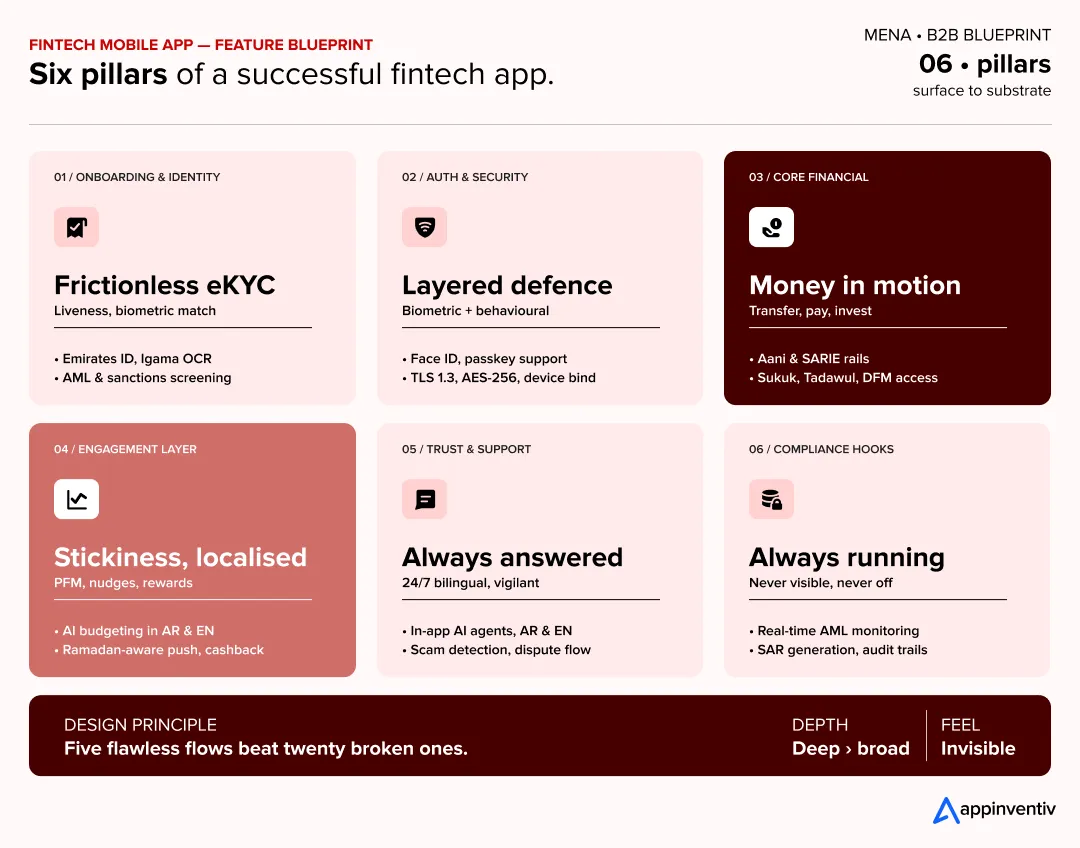
Onboarding and identity layer
- Frictionless eKYC with biometric matching and liveness detection
- Document OCR handling Emirates ID, Iqama, Bitaqat Hawiya, CPR, and Egyptian National ID
- AML and sanctions screening at signup against UN, OFAC, and local lists
- Tiered KYC based on risk score, so low-risk users get fast access
Authentication and security
- Biometric login (Face ID, fingerprint) with passkey support
- Step-up authentication for high-value transactions
- End-to-end encryption (TLS 1.3 in transit, AES-256 at rest)
- Device binding and behavioral fingerprinting
Core financial features
- Real-time balance and transaction history
- Instant peer-to-peer transfers via Aani (UAE) and SARIE (KSA)
- Multi-currency wallets for expat-heavy markets
- QR and NFC checkout, including Mada Pay, BenefitPay QR, and InstaPay QR
- Card management with virtual cards, freeze, and spend limits
- Bill payments tied to local utilities (DEWA, SEWA, ADDC, STC, Mobily, Etisalat, du, Ooredoo, Vodafone)
- Sukuk and stock investment access via local exchanges (Tadawul, DFM, ADX, EGX)
Engagement layer
- Personal finance management and spending insights
- AI-driven budgeting nudges
- Localized rewards (cashback in AED, SAR, QAR)
- Push notifications in Arabic and English with prayer-time and Ramadan awareness
Trust and support
- 24/7 in-app chat with bilingual AI agents
- Card scam detection and call status verification
- Transaction reversal and dispute flow
Compliance hooks (always running, never visible)
- Real-time AML transaction monitoring
- Suspicious Activity Report generation
- Audit-ready logs and immutable trails
- Regulatory reporting connectors
Build these deeply rather than broadly. A neobank with five flawless flows beats one with twenty broken ones every time.
What Technology Stack Powers Fintech Development in the Middle East?
The technology stack for fintech development isn’t where you experiment. Stick with proven tools that audit teams, regulators, and your own engineers will trust at 2 a.m. when something fails.
| Layer | Recommended Tools |
|---|---|
| Mobile frontend | Swift (iOS), Kotlin (Android), Flutter or React Native for cross-platform |
| Web frontend | React, Next.js, Angular |
| Backend | Node.js, Java (Spring Boot), .NET, Go, Python (FastAPI) |
| Architecture | Microservices with API gateway (Kong, Apigee) |
| Database | PostgreSQL, MongoDB, encrypted at rest |
| Real-time data | Apache Kafka, Redis |
| Cloud | AWS Bahrain, Azure UAE North, Oracle Cloud Jeddah, sovereign clouds (G42, STC Cloud), where data residency requires it |
| Identity and KYC | Onfido, Jumio, IDnow, regional providers (ValiFi, IDfy) |
| Payments | Network International, Mastercard Gateway, Checkout.com, regional rails (Mada, Aani, Fawry, BenefitPay) |
| Open banking | Tarabut, Lean Technologies, Fintech Galaxy |
| AI and ML | TensorFlow, PyTorch, AWS Bedrock, Azure OpenAI |
| Security | HSMs for key management, OWASP-aligned scanning, and runtime application self-protection |
Three quick notes worth flagging:
- Data residency. SAMA and the CBUAE often require in-country hosting for personally identifiable financial data. Don’t pick a cloud region without checking your specific regulator’s stance.
- Microservices aren’t free. Smaller teams are better off with a modular monolith until traffic justifies the operational overhead.
- Cloud-based fintech solutions need disciplined key management. Deploying to AWS Bahrain isn’t the same as having a security posture; HSMs, BYOK, and strict IAM are non-negotiable.
What Does a Secure Enterprise Fintech Architecture Look Like?
A secure fintech architecture is built in concentric rings of trust, each ring assuming the one outside it will eventually be breached.
| Ring | Layer | What It Handles |
|---|---|---|
| Outer | Public-facing | Mobile and web apps, partner APIs, open banking surface, WAF, rate limiting, bot detection, TLS termination |
| Middle | API gateway | Authentication, authorization, schema validation and audit logging |
| Core | Microservices | Payments, accounts, lending, KYC, notifications as independent services with their own DB and observability |
| Inner | Data plane | Encrypted databases, HSMs, immutable audit trails, PII tokenization |
Every transaction generates a real-time telemetry stream feeding three parallel pipelines: a fraud detection engine, an AML transaction monitoring engine, and a regulatory reporting feed. None runs as an afterthought; it’s critical-path infrastructure.
Operational reality matters too:
- Multi-AZ failover by default
- Active-active across two regions for tier-one services
- Chaos testing and backup restoration drills
- Incident response playbooks that don’t sit in unread Confluence pages
This is why fintech timelines stretch 40 to 60% longer than equivalent consumer apps. The security architecture isn’t a feature; it’s the spine. Skip it, and the cost shows up later as a fine, a breach, or a withdrawn license.
What Are the Regulatory Requirements for Fintech Apps in the Middle East?
Fintech app compliance and regulations vary sharply by jurisdiction, but a few constants apply everywhere.
| Country | Primary Regulator | Key Frameworks | Sandbox |
|---|---|---|---|
| UAE | CBUAE, DIFC (DFSA), ADGM (FSRA), VARA | FIT Programme, Open Finance Regulation, Stored Value Facilities, Retail Payment Services | DFSA ITL, ADGM RegLab, CBUAE Sandbox |
| Saudi Arabia | SAMA, CMA | Open Banking Framework, Payment Services, Digital-Only Bank Licensing, NCA cybersecurity directives | SAMA Regulatory Sandbox |
| Qatar | QCB, QFCRA | QCB Fintech Strategy, Digital Banking Framework | QCB FinTech Sandbox |
| Bahrain | CBB | Open Banking Rules, Digital Financial Advice, Crypto-Asset Module | CBB Regulatory Sandbox |
| Egypt | CBE, FRA | Banking Law 194/2020, Non-Banking Fintech Law 5/2022, June 2025 PSO/PSP rules | CBE Sandbox, FRA CORBEH Sandbox |
| Kuwait | CBK | Open Banking Framework | CBK Regulatory Sandbox |
| Oman | CBO | National Fintech Framework | CBO Sandbox |
The constants across the board:
- KYC and AML compliance: Identity verification at onboarding, ongoing transaction monitoring, sanctions screening and suspicious activity reporting.
- Data protection: UAE PDPL, KSA PDPL, Bahrain PDPL, Egypt PDPL, Qatar PDPPL, each with its own consent rules and breach notification windows.
- PCI-DSS: Required for any system that touches cardholder data.
- Shariah compliance: Required for any product marketed as Islamic, certified by an internal Shariah board or external advisors.
- Cybersecurity frameworks: SAMA Cybersecurity Framework (CSF) and NCA’s ECC-2:2024 controls are mandatory for licensed financial entities in KSA. CBUAE’s Information Security Standards govern UAE-licensed institutions, while Bahrain’s CBB Cybersecurity Module and Qatar’s QCB Information Security Circular set the bar in their respective markets. These aren’t soft guidelines — they carry licence-revocation teeth
Two recent shifts worth flagging:
- SAMA’s open banking program just transitioned from sandbox to a fully licensed regime in March 2026, raising the compliance bar for anyone targeting KSA.
- The CBE’s June 2025 PSO/PSP licensing rules raised governance and resilience expectations across Egypt’s payment market.
We’ve helped multiple clients build through this exact transition window, and the most common compliance pitfalls we see are still the same ones: retrofitting controls after basic apps costs roughly five to seven times what designing for them on day one does.
How Do You Build a Fintech App? A Practical Step-by-Step Approach
Knowing how to build a fintech app is less about a generic checklist and more about ordering decisions correctly.
Step 1: Define the regulatory perimeter
Start here, or fail later. Your exact license path dictates the entire architecture. You need to decide on day one whether the entity will operate as a full bank, an EMI, a PSP, or if you are simply leaning on a BaaS partner.
Step 2: Choose markets and localization depth
Geography builds your technical constraints. A KSA-first vs UAE-first roadmap completely changes how you handle data residency and language mapping. Pin down the target zone before writing a single line of code.
Step 3: Discovery sprint (2-4 weeks)
Assumptions burn cash. Dedicate this window to aggressive user research and a ruthless competitor teardown. Finalize the regulatory map and lock in a monetization model that actually holds water.
Step 4: Build the compliance backbone
Security isn’t a bolt-on feature; it is the foundation. Embed strict KYC, real-time AML, and immutable audit logging directly into the base code. Sort out your encryption and hardware-level key management before building any front-end features.
Step 5: Ship a focused MVP
Kill the feature bloat. The market doesn’t care about your massive backlog. Strip the product down to just 5-7 deeply built core flows that prove your actual value proposition.
Step 6: Pen test, audit, certify
Break your own system before hackers do. Survive the audits for SOC 2 Type II and PCI-DSS. If you touch Islamic finance, lock down your Shariah certification where applicable. No compromises.
Step 7: Soft launch with closed cohort
Keep the floodgates closed. Control the chaos by running a sandbox pilot if regulators allow. Let a tiny, highly vetted group find the edge cases your QA team missed.
Step 8: Scale, observe, iterate
Launch day is just the starting line. Watch the transaction telemetry closely and push continuous compliance updates. The regulatory winds will shift; your tech has to move with them.
“Ignoring compliance early on leads to costly fixes later. Build compliance into your core architecture to avoid expensive retrofitting.”
This insight, drawn from years of working through the cost dynamics of fintech app development, is the single most expensive lesson teams keep relearning.
Talk to the team that’s shipped secure fintech platforms serving millions across the region.

What Should Businesses Know About Fintech App Development Cost in the Middle East?
The cost of fintech mobile app development in the region ranges from roughly AED 293,000 (USD 80,000) for a simple, single-feature app to AED 1.83 million (USD 500,000) or more for an enterprise-grade fintech platform development program.
The wide range isn’t a hedge. It reflects how dramatically scope and compliance shape budgets.
| App Type | Cost (AED) | Equivalent (USD) | Build Time |
|---|---|---|---|
| Basic payment or wallet MVP | 293,000 to 440,000 | 80,000 to 120,000 | 4 to 6 months |
| Mid-complexity mobile banking app | 550,000 to 920,000 | 150,000 to 250,000 | 6 to 9 months |
| Enterprise fintech solutions with AI, blockchain, or open banking | 1.1M to 1.8M+ | 300,000 to 500,000+ | 9 to 14 months |
| Shariah- compliant Islamic neobank | 920,000 to 1.65M | 250,000 to 450,000 | 9 to 12 months |
| CBDC wallet or cross-border remittance platform | 1.28M to 2.2M+ | 350,000 to 600,000+ | 10 to 16 months |
| Core banking modernization | 1.83M+ | 500,000+ | 12 to 24+ months |
What drives the variance:
- Compliance scope: Multi-jurisdictional licensing adds 15 to 25%
- Shariah certification: Adds 8 to 12% but unlocks an enormous market
- AI and blockchain integration: Adds 20 to 35%
- Bilingual UI/UX: Adds 5 to 10% if treated as first-class from day one
- Third-party integrations: Each rail (Mada, STC Pay, Aani, Fawry, BenefitPay) carries its own overhead
- Ongoing compliance: Allocate 10 to 15% of the annual budget for regulatory maintenance
A note for global businesses targeting the US market through a Middle East base: the region is increasingly used as a build-and-launch hub. A platform built to SAMA, PDPL, and PCI-DSS standards is roughly 70% of the way to meeting US state-level money transmission requirements.
The remaining work focuses on FinCEN registration, multi-state licensing, and packaging SOC 2 Type II evidence. All of these factors influence the strategy laid out in the standards that govern enterprise fintech application development in the Middle East, which expands on each line item with regional cost benchmarks.
Compliance retrofits and architectural rework drive most of it. We plan against all three from day one.

What Are the Country-Specific Fintech Opportunities You Should Target?
Treating the Middle East as a single market is the fastest way to build something that fits nowhere. Here is what we’re seeing on the ground.
What is Driving Fintech App Development in the UAE?
The UAE is the region’s CBDC and advanced payments hub. The Digital Dirham was first issued as legal tender in January 2024 via a cross-border wholesale transaction on Project mBridge. Federal Decree-Law No. 6 of 2025 then formally established it as legal tender on equal footing with cash, with retail rollout commencing in Q4 2025.
The first cross-border CBDC transaction was completed via Project mBridge in January 2024 by the CBUAE Chairman, before the BIS handed the project over to the participating central banks (China, Hong Kong, Thailand, UAE, Saudi Arabia) in October 2024.
The CBUAE confirmed in its January 2025 update that the FIT Programme — spanning nine initiatives, including the Digital Dirham, instant payments platform Aani, and the Open Finance Regulation — was 85% complete, with full integration targeted for the end of 2026.
Where enterprise builders are placing bets in the UAE:
- CBDC wallet apps for retail and commercial customers
- Biometric payment systems and POS-integrated authentication APIs
- Cross-border remittance platforms leveraging Digital Dirham rails
- QR and NFC merchant payment infrastructure (DubaiPay, Aani QR)
- Open digital banking solutions under the CBUAE Open Finance Regulation rolled out in mid-2025
- RegTech automation for AML and KYC in the CBDC ecosystem
- Embedded finance for e-commerce and gig platforms (Talabat, Careem, Noon)
- WPS-integrated payroll fintech and earned wage access platforms (UAE’s Wage Protection System mandates digital salary disbursement)
- AED-pegged stablecoin infrastructure under the CBUAE’s Payment Token Services Regulation (issued 2024)
A 2025 Emirates NBD and PwC report forecasts that the UAE fintech market will grow to AED 21 billion (USD 5.71 billion) by 2029. The UAE is also where most enterprise procurement happens for the broader region. Ship a product approved by Emirates NBD, FAB, ADCB, or Mashreq, and doors across the GCC open faster.
For teams choosing a delivery base, working with a mobile app development company in Dubai with on-ground regulatory experience tends to shorten approval cycles materially.
What is Driving Fintech Application Development in Saudi Arabia?
Saudi Arabia is the largest fintech market in the GCC and the most aggressively engineered one. Vision 2030 set a target of 70% cashless transactions by 2030. SAMA licensed its first open banking fintechs in March 2026, moving the program from sandbox to full regulation.
Build priorities here:
- Shariah- compliant neobanking app development and Islamic super apps
- Digital wallet ecosystems integrating Mada, STC Pay, Apple Pay and Alipay+
- BNPL platforms (Tabby and Tamara are templates; enterprise BNPL is wide open)
- SME lending platforms tied to alternative credit data
- Open banking apps under the SAMA framework
- Cross-border payment infrastructure across GCC and Asian corridors
- Banking-as-a-Service platforms enabling non-bank players
- Digital Riyal-related infrastructure as the CBDC project develops
- ZATCA Phase 2 e-invoicing integration for B2B fintech and corporate payment platforms (mandatory and phased by taxpayer turnover)
- Earned wage access (EWA) and salary advance platforms — the fastest-growing consumer credit segment in the GCC
- Hala, Urpay, Geidea, and Surepay-style merchant acquiring infrastructure beyond Mada
A note on Sharia. KSA holds 38.3% of the Middle East Islamic fintech market. Islamic environment fintech, combining digital innovation, sustainability, and Shariah compliance, is now a major growth driver.
Shariah isn’t optional. It’s the price of entry, and shaping the contract structures around Murabaha and Mudaraba models becomes a critical input into your development strategy of enterprise fintech solutions in the Middle East.
What is Driving Fintech Application Development in Qatar?
Qatar Financial Centre and the QCB are pushing hard on open banking, with Doha establishing itself as a serious fintech hub through events like Web Summit Doha. Qatar’s Islamic fintech market is estimated at QAR 11.3 billion (USD 3.1 billion) for 2024-2025, projected to reach QAR 17.5 billion (USD 4.8 billion) by 2029.
Build priorities:
- Open banking API platforms
- Wealth management and investment apps for HNW segments
- Corporate fintech for B2B payments and treasury technology
- RegTech and compliance automation
- Cross-border platforms tied to GCC trade flows
What is Driving Fintech App Development in Bahrain?
Bahrain was the GCC’s first sandbox leader and remains the easiest market to launch a regulated fintech in. The CBB’s open banking rules predate most regional frameworks, which means infrastructure-layer products mature faster here.
Opportunities:
- Open banking-enabled apps with account aggregation
- Fintech SaaS platforms for compliance and fraud detection
- API marketplaces for banks
- Digital identity and eKYC solutions tied to BenefitPay rails
- Payment gateways for SMEs
- Banking-as-a-Service platforms
What is Driving Fintech Application Development in Egypt?
Egypt is the financial inclusion story. The CBE’s digital transformation push lifted financial inclusion from 27.4% in 2016 to 77.6% in December 2025. InstaPay processed 1.1 billion transactions worth EGP 2.4 trillion (~USD 50 billion) in H1 2025 alone, with users exceeding 16 million. Egypt also issued its first digital bank license to Banque Misr’s OneBank in August 2025.
Where to build:
- Mobile wallets targeting the unbanked and underbanked
- QR-based payment systems integrated with InstaPay and Meeza
- Microfinance and nano-lending apps
- Government payment digitization platforms
- Payment gateways for e-commerce
- Agent banking and offline-capable solutions
- eKYC platforms tied to the new Haweya digital identity framework
What is Driving Fintech Application Development in Kuwait and Oman?
Kuwait is the emerging open banking market in the GCC. The CBK introduced its open banking framework in stages, and fintech regulatory support is steadily increasing. Build priorities include open banking apps, PFM tools, digital lending platforms, and wealth apps tied to local equities and Sukuk.
Oman is moving along its Vision 2040 roadmap. The CBO’s sandbox supports digital wallets, SME finance products, and eKYC platforms aligned with the Bayan customs and identity infrastructure.
We map regulators, licence paths, and architecture for builds in your specific corner of the region, from the UAE to Saudi Arabia.

How Do AI, Blockchain, and Open Banking Reshape Fintech Apps in the Middle East?
These three technologies aren’t side bets. They’re the operating layer for the next generation of Middle East fintech.
| Technology | Where It Shows Up | Regional Anchors |
|---|---|---|
| AI in financial services | Fraud detection, credit scoring, multilingual support, KYC document understanding and AI agents | PwC estimates AED 1.17 trillion (USD 320 billion) AI economic uplift in ME by 2030; CBE behavioral credit scoring with I-Score |
| Blockchain in fintech | CBDCs, Sukuk tokenization, cross-border settlement, KYC validation, smart contracts | Digital Dirham, Project mBridge (post-BIS, central-bank-led since Oct 2024), Project Aber (concluded 2020) |
| Open banking | Account aggregation, payment initiation, embedded finance | UAE Open Finance Regulation 2025, SAMA licensed regime 2026, Bahrain OBF, CBK rollout |
A few notes on what works:
- AI bolted on as a thin LLM wrapper rarely survives an audit. Architectures that treat AI as a first-class component, with explainability and model governance baked in, do exist, and the patterns are clearly visible in practices followed in the region to implement AI in fintech.
- The rising usage of AI agents for finance in the UAE also reflects what’s now actually being approved by regulators.
- Blockchain in fintech only delivers when the use case actually needs immutability or decentralization. Tokenization, settlement, and audit trails qualify. Most other use cases don’t.
- Open banking turns fintech from a single-product play into a platform play. AIS, PIS, and now Confirmation of Funds APIs are the rails on which the next decade of consumer fintech will ride.
What Are the Future Trends Shaping Fintech in the Middle East?
We watch a few signals more carefully than others when planning roadmaps for clients:
- Embedded finance moves from talk to architecture. Talabat, Careem, Noon, Jahez, and Mrsool are embedding wallets, BNPL, and lending. The infrastructure layer (BaaS, payment APIs, KYC-as-a-service) is where enterprise capital is going.
- Tokenization becomes a serious banking conversation. Sukuk tokenization, tokenized deposits, and tokenized real estate are moving from white papers to working pilots in the UAE and Bahrain.
- AI agents quietly replace ticket queues. Banks across the GCC are moving past chatbots to AI agents that handle multi-step requests while staying aligned with regulatory and Shariah constraints.
- Shariah- aligned fintech goes global. Products built in KSA or the UAE today are being exported to Indonesia, Malaysia, the UK, and Sub-Saharan Africa.
- CBDC retail rollout triggers payment infrastructure modernization. Every payment company in the region will need to update its architecture as Digital Dirham retail use expands and the Digital Riyal progresses. This is a once-a-decade infrastructure refresh.
- Cybersecurity in fintech apps becomes a board-level conversation. IBM’s 2025 Cost of a Data Breach Report put the average financial sector breach cost at AED 20.4 million (USD 5.56 million), the second-highest of any industry after healthcare. NCA’s ECC-2:2024, NESA’s UAE IA Standards, CBUAE’s Information Security Standards, and SAMA’s Cybersecurity Framework now have real audit teeth.
The conversations shaping these shifts increasingly happen at 24 Fintech Riyadh, Fintech Surge Dubai, Web Summit Doha, and Token2049. These are some events where regulators, banks, and builders are aligning on what gets shipped next.
What Are the Biggest Challenges in Fintech App Development in the Middle East?
If you only plan for the obvious challenges, the unobvious ones will be expensive.
| Challenge | What Goes Wrong | What Works |
|---|---|---|
| Multi-regulator complexity | Compliance retrofits late in the build | Map all jurisdictions in week one, design for the strictest |
| Shariah compliance | Treated as a feature, not architecture | Engage Shariah advisors during design, not after MVP |
| Data residency | The wrong cloud region was chosen | Verify regulator stance per country, plan for sovereign cloud |
| Bilingual UI/UX | English-first, then translated, broken Arabic flows | Build RTL into the design system from the first wireframe |
| Talent gaps | Local fintech-specialized engineers in short supply | Partner with global teams that have proven regional builds |
| Fast-changing regulation | Static compliance models | Continuous compliance pipeline with regulatory change tracking |
| Fraud sophistication | Card-not-present and synthetic ID fraud are rising | Behavioral biometrics, device fingerprinting and AI-driven monitoring |
| Legacy bank integration | APIs that look modern but behave like 1990s SOAP | Allocate buffer time, bring middleware experience |
| Vendor lock-in | Cloud and KYC providers are becoming hard to swap | Design abstraction layers from day one |
| Localization beyond language | Calendar, currency, holidays missed | Local product input, not just translation |
The single most common pattern in struggling fintech projects: someone tried to copy a Western product into the region without rebuilding for Middle East realities. Customer expectations, regulatory frameworks, and trust signals all run on different rails here.
How Do Enterprises Choose Between Regional Fintech Developers and Global Partners?
This is one of the most common procurement questions we hear. The honest answer depends on three factors: regulatory familiarity, scale, and accountability.
| Factor | Regional Developers | Global Partners with Regional Presence | Hybrid Model |
|---|---|---|---|
| Regulatory familiarity | Strong local relationships | Multi-jurisdiction expertise | Best of both |
| Engineering scale | Limited | Large, scaled teams | Scalable per phase |
| Multi-market capability | Single market focus | Multi-market by default | Phased rollout |
| Global certification standards | Variable | SOC 2, ISO 27001, PCI-DSS standard | Standard |
| Best for | Single-market simple builds | Multi-market enterprise programs | Ambitious enterprise builds |
A few questions worth asking any prospective partner before signing:
- Have you shipped under SAMA, CBUAE, or DIFC oversight specifically? What was the regulator’s feedback?
- How do you build a PCI-compliant scope in your architecture?
- What’s your default approach to Shariah compliance certification?
- Can you walk us through a real audit you supported through closure?
- How do you keep up with regulatory change across multiple countries?
Specific answers (with names, dates, and outcomes) mean a partner doing the work. Glossy generic answers mean a sales pitch. The difference shows up by month three.
How Can Appinventiv Help You Out?
Our teams are proficient in Shariah-compliant development, AML automation platforms, and core banking modernization programs across the Middle East and beyond.
The lesson, distilled to one sentence: in fintech, the most expensive thing you can do is treat compliance and security as a phase. They are the foundation. Everything else is built on top.
What working with Appinventiv as your enterprise fintech software solutions provider looks like in practice:
- Regional depth across the Middle East. On-ground teams familiar with CBUAE, DIFC, ADGM, and VARA frameworks, alongside SAMA, QFCRA, CBB, and CBE expertise. Compliance with PDPL, PCI-DSS, GDPR, and Shariah frameworks isn’t optional in our delivery; it’s foundational.
- Compliance-first architecture practice. We’ve built financial software where compliance lives in source code, not just policy documents. Our fintech consulting services start with a compliance mapping session covering every jurisdiction in scope.
- End-to-end fintech platform development capability. We have done it all, from mobile banking app development and digital payment app development to neobanking, Shariah- compliant Islamic super apps, AML platforms, and CBDC infrastructure.
- Deep AI, blockchain, and cloud capabilities. We deliver AI in fintech (fraud detection, credit scoring, AI agents), blockchain in fintech (CBDC integration, tokenization, smart contracts), and cloud-based fintech solutions (region-locked, multi-region failover, Zero Trust). Whether you need to hire fintech app developers for a focused build or stand up a full platform team, we can scale the engagement.
- ERP and back-office integration. Beyond customer-facing apps, our ERP software development services connect treasury, finance, compliance, and operations into a single system of record.
- Recognized work. Consecutive Deloitte Tech Fast 50 wins (2023, 2024), Statista High-Growth Company APAC 2025, Clutch Spring Global 2025, and Economic Times “Leader in AI Product Engineering and Digital Transformation” recognition. Trusted by KPMG, IKEA, Domino’s, Americana, Adidas, Asian Bank, and Emirates NBD.
Our Actual Work
- We built Mudra, an AI-powered budgeting platform with a chatbot-led learning model.
- We built EdFundo, a financial intelligence hub for kids that secured pre-seed funding of AED 1.83 million (USD 500,000) and prepared for an AED 11 million (USD 3 million) seed round, drawing media coverage from CNN and Khaleej Times.
- We helped an Asian bank build a core banking platform with cryptocurrency wire transactions, leading to over 50,000 crypto transactions on the bank’s rails.
If you’re planning a fintech build in the UAE, KSA, Qatar, Bahrain, Egypt, Kuwait, or Oman, talk to our team about scoping the program. We come prepared with regulatory mapping, architecture views, and a realistic budget envelope, not a sales deck. Inshallah, you’ll see the difference in the first call.
FAQs
Q. How much does enterprise fintech app development cost in the Middle East?
A. Sticker shock is real here. A barebones wallet MVP starts around AED 293,000 ($80,000). If you’re building a serious enterprise platform with AI or blockchain, you’re hitting AED 1.8M+ ($500,000). Shariah- compliant neobanks typically land between AED 918,000 and 2.2M ($250,000–$600,000). Always set aside an extra 10-15% of your budget just to stay on the relentless compliance treadmill.
Q. What are the compliance requirements for building a fintech app in the GCC?
A. The regulatory gauntlet is brutal and non-negotiable. You must lock down strict KYC/AML monitoring, PCI-DSS, and a maze of regional data laws like the UAE or KSA PDPL. You answer directly to heavyweights—SAMA or CBUAE. Pushing an Islamic product? Get Shariah certification. Moving into open banking? You’ll need specific licenses for every jurisdiction. No shortcuts allowed.
Q. Which is the best fintech application development company in the Middle East?
A. Don’t get distracted by cheap vendors; you need battlefield-tested engineering muscle. Appinventiv is the heavyweight in this region, backing our Dubai presence with over 1,600 engineers. We ship PCI-DSS-certified payment engines and core banking setups designed to actually survive intense scrutiny from the CBUAE and SAMA.
Q. How does Appinventiv handle data security and compliance in fintech apps?
A. We hardwire compliance into the code from Day 1—it’s a fortress, not an afterthought. We’re talking TLS 1.3 encryption, region-locked clouds for data residency, and adaptive ML for real-time AML. Before our team writes one line of code, we map the entire architecture against SAMA, PDPL, and Shariah standards to ensure no surprises at launch.
Q. Can AI and blockchain be integrated into fintech apps for enterprises?
A. Yes, and ignoring them is a tactical error. AI straight-up kills fraud and handles complex credit scoring; blockchain secures CBDC integration and cross-border settlements via mBridge. These features add a 20-35% premium to the build cost, but the operational speed and regulatory peace of mind they provide are compounding assets that pay for themselves.
Q. How do enterprises choose between regional fintech developers and global partners like Appinventiv?
A. It comes down to two things: regulatory depth and pure scale. Local shops are fine for single-market experiments. But ambitious, multi-jurisdictional builds require global standards (SOC 2, ISO 27001) paired with regional grit. Always demand receipts. Ask for past work under your specific target regulator—if they can’t show the outcomes, walk away.
Q. How can fintech apps be future-proofed for upcoming UAE regulations and open banking frameworks?
A. Go API-first or get left behind. To survive the CBUAE Open Finance laws, you have to aim much higher than basic PSD2. Prep for Digital Dirham rails immediately. Most importantly, use modular compliance blocks. When regulations inevitably shift, you want to swap out KYC or AML vendors without gutting your entire core system.
Q. What languages and currencies should a Middle East fintech app support?
A. Arabic and English with perfect RTL rendering is just the baseline. To capture massive expat remittance flows, you need Hindi, Urdu, and Tagalog. Support the full GCC currency spread (AED, SAR, QAR) plus USD for global moves. Real localization means prayer-time alerts and Ramadan-calibrated promotions, not just translating text.
Q. How long does it take to build a fintech app in the Middle East?
A. Fintech moves at the speed of regulation, not just code. A wallet MVP takes 4-6 months. An enterprise platform with AI? Settle in for 9-14 months. The “security tax” is real—these builds take roughly 40-60% longer than your average consumer app because the testing rigor is on a different level.
Q. Are there Middle East fintech opportunities for global businesses targeting the US market?
A. Absolutely. Think of the Middle East as a high-speed testing forge. If your tech survives the SAMA/CBUAE gauntlet, you’re 70% ready for US state-level compliance. Launching here first gets you access to sovereign-wealth capital and faster sandboxes. It’s a smarter play than bleeding cash in the fragmented US regulatory maze right out of the gate.


Fast 2-minute response, fully NDA-protected.

Cost of Developing a Payment Gateway: A Complete Breakdown
Key takeaways: Custom gateway development requires $50,000 to $500,000 in upfront capital, and enterprise platforms cost more at scale. Core infrastructure, security compliance, and settlement logic consume far more budget than basic checkout screens. High transaction volumes require concurrency controls, failover systems, monitoring tools, and automated reconciliation engines. Platform ownership creates recurring costs for security…

How Much Does RegTech Software Development Cost in the UK in 2026?
Key takeaways: RegTech software development cost in the UK spans £40,000 to £400,000+, with regulatory scope and legacy integration depth driving the cost. High-performance systems deliver a 30% to 50% reduction in manual workloads, protecting enterprises from severe FCA penalties. Advanced AI features generally represent around 25–40% of the total project investment due to the…

Building Next-Generation Digital Payment Systems for Australia's NPP Economy
Key takeaways: Australia's NPP is approaching 1.82 billion real-time transactions annually; BECS decommissioning by 2030 creates a hard migration deadline that cannot be managed through incremental patches. The July 2026 Payday Super mandate makes real-time payment infrastructure a legal compliance requirement. Enterprises without NPP-capable payroll systems are already operating against a regulatory clock. NPP platform…