


































Mobile Banking App Development Cost: A Complete Pricing Guide

 Share -



- 01Why Understanding Banking App Development Costs Matters
- 02A Comprehensive View of Mobile Banking App Development Costs: Detailed Breakdown
- 03Banking App Development Cost Estimation Formula
- 04Factors Affecting Banking App Development Cost
- 05Hidden Expenses That Affect Mobile Banking App Development Cost
- 06How to Optimize Banking App Development Costs
- 07Initiate Your Banking App Development Journey with Appinventiv
- 08FAQs

Key takeaways:
- The cost of mobile banking app development begins at $40,000 and can climb to $1,000,000 for enterprise-level applications, depending on the scope and infrastructure complexity.
- Features such as AI-powered fraud detection, open banking integrations, biometric authentication, and others significantly increase development effort and overall project cost.
- Adherence to security and regulatory compliances such as PCI DSS, GDPR, KYC/AML and PSD2 incurs additional time, complexity and cost.
- The location of the development team is also one of the factors affecting the final cost. Typically, teams in the US and Western Europe will cost more than teams in Eastern Europe or Asia.
- Annual updates, support, cloud hosting and security patches can cost 15% to 25% of the initial build cost per year.
Before embarking on a banking app project, one of the most difficult questions to answer is how much to spend. The mobile banking app development cost can vary significantly. The price range can be as low as $40,000 for a basic banking application or as high as $1 million or more for enterprise-grade options that include AI, Open Banking, and advanced fraud prevention. The final investment becomes easier to comprehend once you understand the factors that influence the overall cost and development timeline.
In the meantime, customers’ expectations keep changing. Users want one app to cover all their financial needs, like payments, transfers, investments, loans, as well as financial planning, without sacrificing speed and security.
This upsurge in user expectations has led to the rise in demand for seamless and connected digital banking systems. The global digital banking platform market is expected to grow at a CAGR of 19.8% during 2026-2033, reaching $155.4 billion by 2033 (Source: GVR).
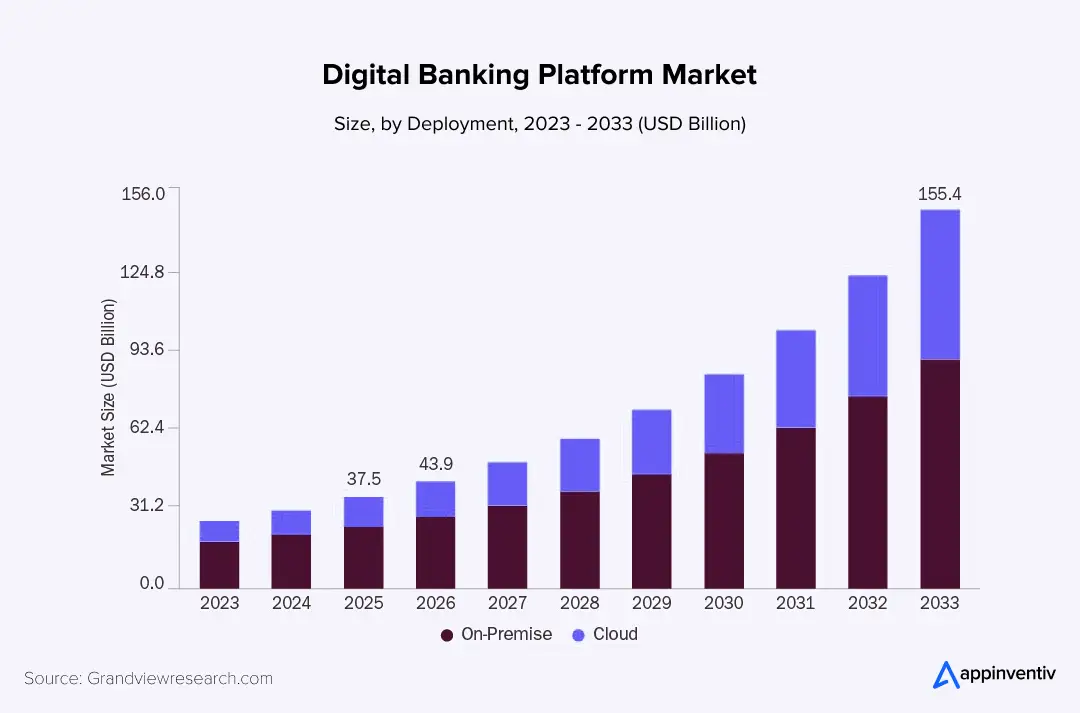
Factors such as rapid adoption of mobile banking, AI-driven financial services, Open Banking, cloud native banking platforms, and investments in secure digital payment infrastructure are some of the continuous growth drivers.
This guide delves into the full cost of mobile banking app development, factors that impact the pricing, hidden costs, and some useful tips to help you optimize your investment.
Let’s dig deeper!
With users increasingly choosing banks based on their digital capabilities, investing in a modern banking app today can drive long-term customer growth.

Why Understanding Banking App Development Costs Matters
Knowing how much it costs to develop a banking app enables businesses to make informed decisions before starting work. Having a clear budget will help focus on the features, technology stack, investments in security and compliance, infrastructure, and other critical integrations with third parties. This also helps to minimize unforeseen costs during the development process.
The table below illustrates how accurate cost planning can reduce financial risks, improve resource allocation, and maximize the return on your banking app investment.
| Investment Planning | Business Value |
|---|---|
| Identify hidden expenses before development | Prevent unexpected cost escalations |
| Prioritize MVP features | Launch with 20-40% lower initial investment |
| Plan scalability from Day 1 | Reduce future redevelopment costs |
| Budget for maintenance and compliance | Improve long-term total cost of ownership (TCO) |
| Build a phased delivery roadmap | Accelerate time-to-market and earlier revenue realization |
A realistic cost estimate helps in long-term planning that is beyond the initial launch. Businesses should consider services for ongoing support, updates, cloud hosting, and future expansion when choosing a financial development partner that aligns with their technical and financial objectives. This results in better project results and ROI.
A Comprehensive View of Mobile Banking App Development Costs: Detailed Breakdown
While a basic budget is a good start, estimating the cost of building a mobile banking app is more complex than it seems. The cost of development varies depending on the features and security of the application, the platforms supported, third-party integration, fintech regulatory compliance, and the size of the engineering team. The different cost areas that affect the total investment are explained in the following sections.
Costs as Per Application Complexity
Development cost is most greatly influenced by the complexity of the application. The more functionality, integration and security features a system requires, the more engineering effort is put into it.
| App Complexity | Scope Description | Estimated Development Cost |
|---|---|---|
| Basic | User registration, account overview, transaction history, balance inquiry, push notifications | $40,000 – $80,000 |
| Standard | Payments, fund transfers, bill payments, QR payments, card management, customer support | $80,000 – $180,000 |
| Advanced | Personal finance management, AI-powered insights, biometric authentication, investment modules, multi-bank integration | $180,000 – $400,000 |
| Enterprise Banking Platform | Digital onboarding, lending, wealth management, fraud detection, analytics, open banking APIs, scalable cloud infrastructure | $400,000 – $1,000,000+ |
The more the functionality grows, the more backend services are needed, the more robust a security architecture must be, the larger a QA team must be and the more comprehensive the testing must be.
Breakdown of Costs by Development Stage
All mobile banking apps go through several phases of development. The different stages have different budgets.
| Development Stage | Activity Description | Estimated Cost Contribution |
|---|---|---|
| Planning | Business analysis, requirement gathering, technical architecture | 8%–12% |
| User Experience (UX) Design | Wireframes, prototypes, UX workflows, user journeys, and interface design | 10%–15% |
| Frontend & Backend Development | Development of mobile applications, APIs, business logic, databases, and backend services | 45%–55% |
| Security & Compliance Implementation | Encryption, authentication, fraud prevention, regulatory compliance controls | 10%–15% |
| Testing & Quality Assurance | Functional, security, performance, compatibility, and usability testing | 10%–15% |
| Deployment & Launch | App Store and Google Play publishing, cloud infrastructure setup, production deployment | 3%–5% |
The development typically takes up almost half of the budget, and security and testing take up a considerable portion due to the sensitive financial data used.
Breakdown of Costs as Per Industry Types
The development cost varies greatly, depending on the financial organizations that are required to have different capabilities.
| Industry | Scope Focus | Estimated Development Cost |
|---|---|---|
| Retail Banking | Consumer banking, transfers, cards, payments | $100,000 – $350,000+ |
| Digital Banks (Neobanks) | Fully digital banking platforms with digital onboarding, payments, and account management | $250,000 – $800,000+ |
| Credit Unions | Member portals, loans, payments, account management | $120,000 – $350,000+ |
| Wealth & Investment Firms | Investment management, portfolio tracking, trading, and financial insights | $200,000 – $600,000+ |
| Corporate Banking | Treasury management, payroll, approval workflows, multi-user access | $300,000 – $900,000+ |
Fully digital banking platforms require a higher investment, with the neobanking app development cost driven by enterprise-grade security, compliance, third-party integrations, and always-on digital services.
Compliance-Wise Mobile Banking App Development Cost
Engineering, documentation, and validation are added for regulatory and security requirements. These activities help ensure product quality, compliance, and approval readiness throughout the development lifecycle.
| Compliance Requirement | Development Focus | Estimated Cost Impact |
|---|---|---|
| PCI DSS | Card payment security and transaction protection | $20,000–$80,000+ |
| PSD2 / Open Banking | Secure APIs, customer authentication, consent management | $25,000–$100,000+ |
| GDPR / CCPA / DPDP | Privacy controls, consent management, data handling | $15,000–$60,000+ |
| ISO 27001 | Information security controls and governance | $20,000–$70,000+ |
| KYC & AML Compliance | Identity verification, fraud monitoring, and sanctions screening | $30,000–$120,000+ |
Features that have to be compliant with the regulations tend to create longer projects due to the amount of paperwork, validation, and security testing that is needed by third parties.
Infrastructure-Wise Mobile Banking App Development Cost
Decisions related to infrastructure can have a direct impact on scalability, reliability, and the cost of operations.
| Infrastructure Type | Scope | Estimated Development Cost |
|---|---|---|
| Cloud-Native Infrastructure | AWS, Azure, Google Cloud deployment | $30,000 – $120,000+ |
| Hybrid Infrastructure | Cloud-based infrastructure integrated with on-premise banking systems | $80,000 – $250,000+ |
| Core Banking Integration & Legacy Modernization | APIs, middleware, and legacy banking system modernization | $100,000 – $400,000+ |
| Microservices Architecture | Independent banking services with containerization | $120,000 – $450,000+ |
| High-Availability Enterprise Infrastructure | Multi-region deployment, disaster recovery, failover systems | $200,000 – $600,000+ |
As banking applications scale to support millions of users, real-time transactions, continuous availability, and multiple banking systems, infrastructure costs increase significantly to ensure scalability, reliability, and operational efficiency.
AI-Powered Banking App Development Cost
With AI becoming a core component of modern mobile banking applications, banks are using AI to improve customer service, strengthen fraud detection, personalize financial recommendations, and automate routine operations. The overall cost depends on the complexity of AI models, data availability, third-party AI services, and the level of customization required.
| AI Feature | Scope | Estimated Development Cost |
|---|---|---|
| AI Chatbot & Virtual Assistant | Customer support, FAQs, account assistance, transaction queries | $20,000 – $70,000+ |
| Fraud Detection & Risk Monitoring | Real-time transaction monitoring, anomaly detection, suspicious activity alerts | $60,000 – $200,000+ |
| Personal Finance Management | AI-driven budgeting, spending insights, savings recommendations | $40,000 – $120,000+ |
| Personalized Financial Recommendations | Product suggestions, investment recommendations, loan eligibility predictions | $50,000 – $150,000+ |
| AI-Powered Credit Scoring | Alternative credit assessment using behavioral and financial data | $70,000 – $250,000+ |
| Document Processing & OCR | Automated KYC verification, document extraction, identity validation | $30,000 – $100,000+ |
| Voice Banking & Conversational AI | Voice authentication, voice-enabled banking commands, multilingual support | $60,000 – $180,000+ |
As more AI capabilities are added, mobile banking app development requires additional work for model training, data engineering, infrastructure, security, and continuous performance monitoring.
We made personal finance management easier, simpler and more fun for the younger generation with our AI-powered, conversational platform for Mudra.
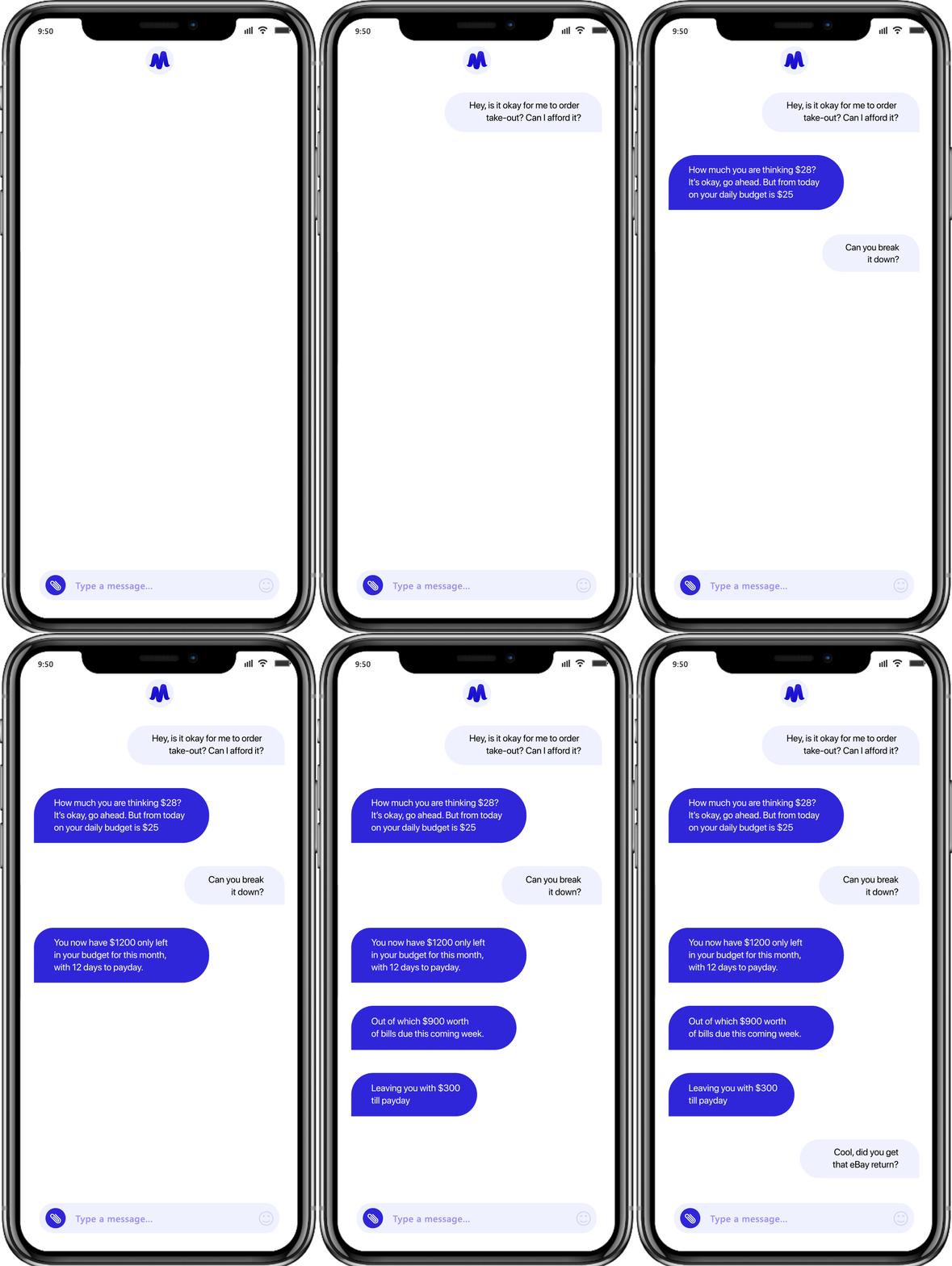
With intelligent spending insights, combined with natural interactions, we built an app that boosted user engagement and automated the usage of everyday budget tracking. The platform enables users to develop financial habits that are improved using custom and real-time messaging without interfering with day-to-day life.
Region-Wise Mobile Banking App Development Cost
The banking app development costs can vary depending on your team’s location. The budget of a project is determined by various factors, such as the hourly rates, fintech skills, compliance experience, and local talent pool.
| Region | Average Hourly Rate | Estimated Development Cost |
|---|---|---|
| North America (USA & Canada) | $120- $250/hr | $250,000- $1,000,000+ |
| Western Europe | $90- $180/hr | $180,000- $800,000+ |
| Eastern Europe | $40- $90/hr | $100,000- $450,000+ |
| Asia (India, Vietnam, Philippines) | $25- $60/hr | $40,000- $250,000+ |
| Latin America | $35- $80/hr | $80,000- $350,000+ |
The development period varies from region to region, but the final cost would also rely on the complexity of the application, security level requirement, regulatory compliance, experience of the development team, etc.
We help you estimate infrastructure, security, maintenance, and integration costs before they affect your development budget.

Banking App Development Cost Estimation Formula
Estimating the cost of a banking application involves evaluating the project’s scope, development effort, and supporting infrastructure. Most software development companies combine feature-based estimation with effort analysis to arrive at a realistic budget.
Feature-Based Cost Estimation
The most common estimation method is to calculate the effort required for each development phase and multiply it by the team’s hourly rate.
Formula
Total Development Cost = (Estimated Development Hours × Hourly Rate) + Infrastructure + Third-Party Integrations + Compliance + Maintenance
Where:
- Development Hours include planning, UI/UX, frontend, backend, APIs, testing, and deployment.
- Hourly Rate varies based on the team’s location and expertise.
- Additional Costs cover cloud infrastructure, security, compliance, third-party services, and post-launch support.
Three-Point Estimation (PERT)
For enterprise banking projects, teams often use PERT to account for uncertainty during project planning.
Formula
Estimated Effort = (O + 4M + P) ÷ 6
Where:
- O = Optimistic estimate
- M = Most likely estimate
- P = Pessimistic estimate
Using these estimation models together provides a more reliable banking app development budget while reducing the risk of cost overruns.
Factors Affecting Banking App Development Cost
The final mobile banking app development cost depends on the product’s features, security, infrastructure, compliance requirements, and the technologies involved. Understanding these factors helps businesses set realistic budgets and avoid unexpected costs as the project moves forward.
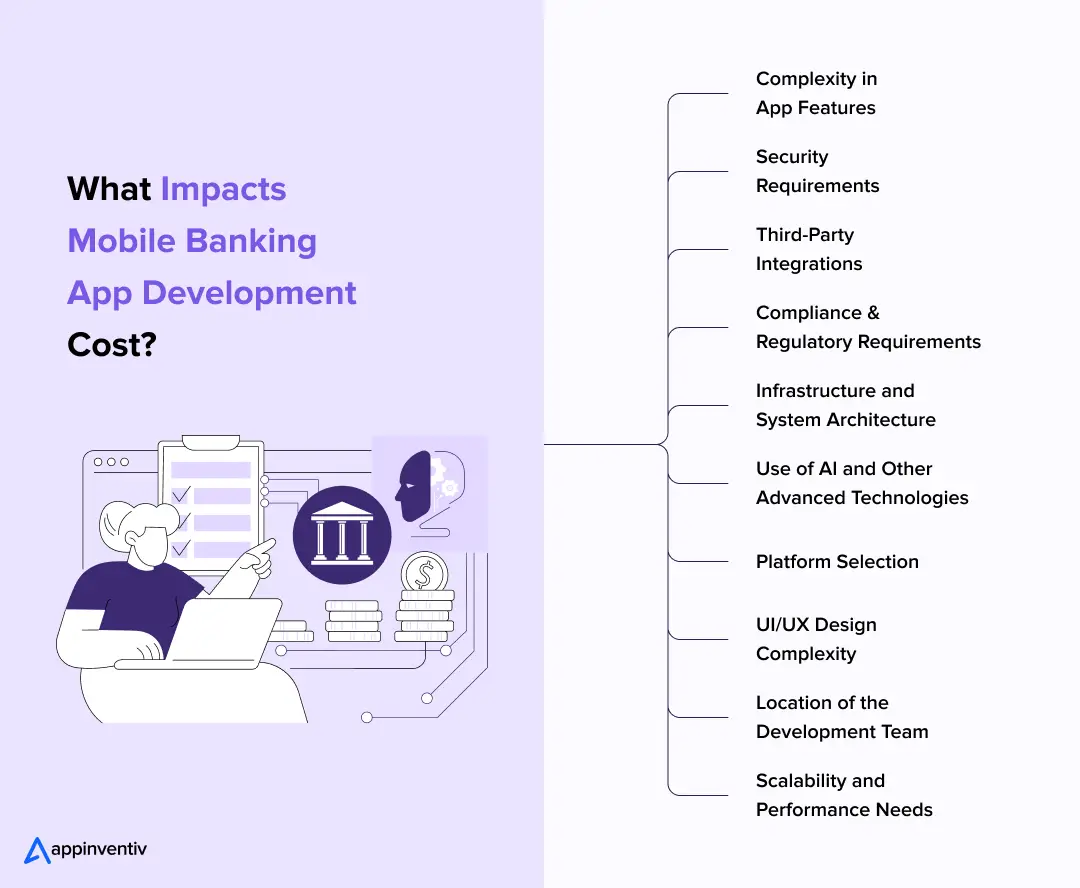
Complexity in App Features
The biggest contributor to the cost to develop a mobile banking app is the scope of functionality. The engineering needed for something as simple as an account access and transaction history application is much less than the effort needed for a digital lending, investment portfolio management, AI-based insights, or personal finance management application.
The most typical feature types are:
- User registration and authentication
- Account management
- Money transfers and bill payments
- QR code and contactless payments
- Personal finance dashboards
- Investment and wealth management
- AI-powered banking chatbots and virtual assistants
Estimated Cost Impact: $40,000 – $500,000+ depending on the features and their complexity.
The greater the capabilities added, the more development time, testing effort and infrastructure will be required.
Security Requirements
Every banking application must have security as an integral part of it, and it affects the banking app development cost. Securely handling customer data, minimizing fraud, unauthorized access, and data breaches are essential for financial platforms.
The common security implementations consist of:
- Multi-factor authentication (MFA)
- Biometric authentication
- End-to-end encryption
- Secure API protection
- Fraud detection systems
- Tokenization
- Secure session management
Estimated Cost Impact: $30,000- $200,000+ (depending on the architecture of the Security).
For enterprise-grade security, further engineering, testing and continuous monitoring of the application are required throughout its lifecycle.
Third-Party Integrations
Many organizations ask how much does it cost to build a banking app, but overlook the effort required to integrate external services. Each third-party API adds more development, testing, monitoring and maintenance.
Typical integrations include:
- Core banking systems
- Payment gateways
- KYC and ID verification providers
- Credit scoring platforms
- Open Banking and other fintech APIs
- CRM for banking
Estimated Cost Impact: $20,000 – $150,000+, depending on the number and complexity of integrations.
Additional validation and support is needed for applications that run on multiple financial ecosystems over a long period of time.
Compliance and Regulatory Requirements
Ensuring compliance-based requirements is a significant factor in any banking app development cost breakdown, as it involves a documented, controlled, and secure engineering process and security checks throughout the lifecycle of the project.
Examples of compliance frameworks are:
Estimated Cost Impact: $30,000- $150,000+ and more, depending on the regulations that are in force.
Meeting regulatory and security requirements requires additional development effort, but it helps ensure the application complies with industry standards and government regulations.
Infrastructure and System Architecture
The backend architecture can affect the performance of a banking application when processing a large number of transactions. It is one of the most significant contributors to the banking app development cost in the USA, where financial institutions typically require highly available, enterprise-scale infrastructure.
Shared infrastructure elements include:
- Cloud-native infrastructure
- Microservices architecture
- Hybrid cloud environments
- Core banking integrations
- Multi-region deployment
- Disaster recovery systems
- High-availability infrastructure
Estimated Cost Impact: $50,000 – 400,000+ depending on the architectural complexity.
Enterprise-grade banking systems need robust systems that can withstand millions of secure transactions per day.
AI Implementation
AI has become a core capability of modern digital banking, making it a significant factor in the overall digital banking platform development cost. The investment required for implementing AI features includes data engineering, model development, infrastructure setup, and ongoing model optimization.
Typical AI functions comprise:
- AI chatbots
- Fraud detection
- Personalized financial recommendations
- Spending analysis
- Credit scoring
- OCR-based document verification
- Voice banking
Estimated Cost Impact: $30,000 – $300,000+ depending on the level of sophistication of the AI.
The more advanced and customized the AI implementation, the greater the investment required for model development, data engineering, system integration, testing, and ongoing infrastructure and operational costs.
Platform Selection
Development effort is directly impacted by supporting multiple operating systems. Their native iOS and Android apps need to be engineered separately, and cross-platform frameworks save development time but can create application limitations.
These are often available on a common platform:
- Native iOS development
- Native Android development
- Cross-platform development
Estimated Cost Impact: +$20,000-$150,000, depending on the number of supported platforms.
The more platforms that are added, the more development, testing, and future maintenance needs increase.
UI/UX Design Complexity
It is possible to measure the impact of design quality on development cost. Navigating banking applications needs to be intuitive, accessible, and provide a secure user experience without friction.
Typical design activities include:
- User research
- Wireframing
- Interactive prototyping
- Custom interface design
- Accessibility optimization
- Design system creation
Estimated Cost Impact: $15,000 – $100,000+, depending on the number of user flows, level of interface customization, accessibility requirements, and the overall complexity of the user experience.
Highly customized interfaces require more design iterations and front-end engineering.
Location of the Development Team
Engineering fees can differ significantly depending on location and experience. Fintech experts tend to charge a premium, and they can usually implement a solution in a more streamlined way with fewer changes.
Some of the key cost factors are:
- Geographic location
- Developer experience
- Fintech expertise
- Security specialists
- DevOps engineers
- AI engineers
Estimated Cost Impact: $30 – $200+ per development hour, depending on team and region.
Engaging banking technology experts can minimize project risks and long-term maintenance costs.
Scalability and Performance Needs
The engineering of applications that are designed to serve millions of users is much more complex than that of those designed for smaller customer bases. Scalability planning impacts both infrastructure and backend architecture.
Some of the typical scalability concerns are:
- High transaction volumes
- Auto-scaling infrastructure
- Load balancing
- Distributed databases
- High availability
- Disaster recovery
Estimated Cost Impact: +$50,000 – +$250,000 depending on traffic & transaction volumes.
Having scalable infrastructure early on allows an organization to grow without having to make significant changes in its architecture.
Hidden Expenses That Affect Mobile Banking App Development Cost
There are several costs that can be incurred during or after development, which can add up to the total project cost. If these hidden costs are accounted for by businesses early on, they can plan more accurately and prevent their budgets from going over.
Platform Expansion Costs
It is common for a business to start with one platform and then grow to another. This adds to the iOS vs Android banking app development cost as platform-specific development, testing, and optimization can contribute to the overall investment.
| Platform Activity | Estimated Cost |
|---|---|
| Native iOS development | $30,000-$120,000 |
| Native Android development | $30,000-$120,000 |
| Cross-platform optimization | $15,000-$60,000 |
| Platform-specific testing | $10,000-$30,000 |
Supporting multiple platforms: greater development effort and increased market reach.
Post-Launch Maintenance and Support
Once the app is launched, it’s just the start. The cost to maintain a banking app includes regular security updates, operating system compatibility, infrastructure monitoring, bug fixes, and feature enhancements throughout its lifecycle.
| Maintenance Activity | Estimated Cost |
|---|---|
| Security updates | $10,000- $40,000 annually |
| Feature enhancements | $20,000- $100,000+ annually |
| Performance monitoring | $5,000- $20,000 annually |
| Bug fixes and support | $10,000- $50,000 annually |
Typically, maintenance costs are about 15% -25% of the project’s total cost.
MVP Enhancements and Product Scaling
Many businesses begin with an MVP, before expanding their offering into a complete banking solution. While the MVP for banking app development cost is lower, adding advanced modules after launch requires additional planning, engineering, and testing.
| Enhancement Activity | Estimated Cost |
|---|---|
| New banking modules | $20,000- $100,000+ |
| Payment feature expansion | $15,000- $60,000 |
| AI-powered capabilities | $25,000- $150,000+ |
| Customer experience improvements | $10,000- $50,000 |
Phased development ensures that the investment is spread out over time and helps to mitigate the costs of the initial construction.
Infrastructure Growth and Scaling
With the growing number of users and transactions, infrastructure requirements are increasing. One such often-overlooked cost when calculating the initial mobile banking app development cost is this extra investment.
| Infrastructure Upgrade | Estimated Cost |
|---|---|
| Cloud resource scaling | $10,000- $60,000 annually |
| Load balancing | $8,000- $30,000 |
| Database optimization | $10,000- $40,000 |
| Disaster recovery expansion | $15,000- $80,000 |
Planning for scalability from the beginning can help reduce the cost and complexity of future infrastructure upgrades.
Legacy System Modernization
When organizations are replacing their legacy banking software, they should also take into account migration costs when estimating the cost to develop a mobile banking app. Transferring customer data and transaction history, including tying in with legacy core banking systems, can call for specialist engineering work.
| Migration Activity | Estimated Cost |
|---|---|
| Customer data migration | $10,000- $60,000 |
| Legacy system integration | $25,000- $150,000+ |
| Data validation and testing | $10,000- $40,000 |
| Production migration support | $15,000- $50,000 |
Migration projects can get complicated if there is a lot of historical data in the legacy systems or if there are custom business workflows.
From digital wallets and loan management to AI features and Open Banking integrations, we’ll estimate your project based on what your business actually needs.

How to Optimize Banking App Development Costs
Cost management is not a cost-cutting exercise. It is concerned with the process of informed decision-making throughout the project life cycle. A roadmap, technology stack, and progressive development can help minimize unnecessary costs, remain secure, compliant, and performant.
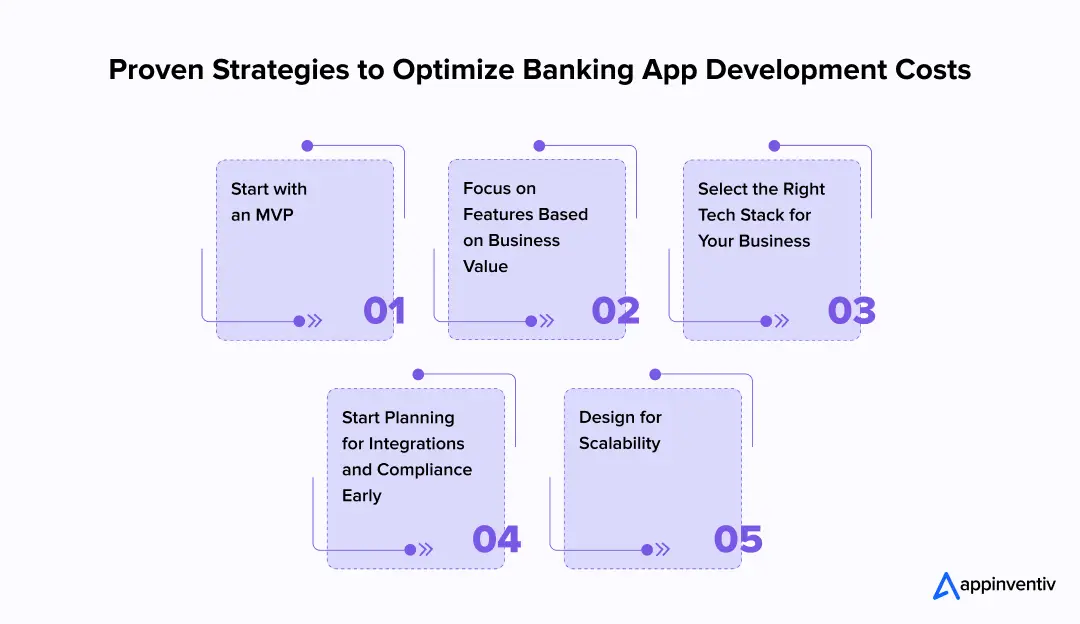
Start with an MVP
It is one of the best ways to control the cost of mobile banking app development by launching it with core banking features rather than a full-featured platform. Start by implementing account management, payment gateways, and fund transfers, and gradually introduce more sophisticated features such as AI integration, lending, or wealth management in subsequent stages.
Cost Benefit: Reduces the initial investment and speeds up time to market.
Focus on Features Based on Business Value
Implement all the vital features you cannot miss and delay less important features for later releases. This helps to avoid wasteful development effort and helps the project to stay on track.
Cost Benefit: Avoids scope creep and cost overruns.
Select the Right Tech Stack for Your Business
Choose technologies that are consistent with your long-term objectives. The ability of a cross-platform framework to cut down on development time and the deployment and operation of cloud-native infrastructure can help lower costs on many projects.
Cost Benefit: Efficiency of development and minimization of infrastructure expenses.
Start Planning for Integrations and Compliance Early
During the planning phase, it is important to identify third-party integration, security needs, and regulatory obligations to prevent expensive redesigns later in the process. It is particularly useful when considering the cost of enterprise banking app development, as compliance and system integrations can be major expenses.
Cost Benefit: Avoids unnecessary rework, delay and unforeseen implementation costs.
Design for Scalability
Design the application so that it can easily handle new users, transactions, and new banking services in the future without significant redevelopment.
Cost Benefit: No need for costly infrastructure changes and architecture modifications when the business expands.
Initiate Your Banking App Development Journey with Appinventiv
Developing an online banking solution is much more than just building a pretty mobile interface. It includes developing a safe, scalable infrastructure that enables the processing of financial transactions, integration with the core banking system, regulatory compliance, and a seamless customer experience. To reduce project risks and shorten time to market, it is important to select a technology partner with firsthand experience in banking and fintech development.
As a reliable banking software development services partner, Appinventiv has been implementing complex banking and financial technology solutions for various global organizations.
We designed the financial backbone of Slice, including the development of a secure wallet system, automatic dividend payouts, and transaction processing capabilities for their fractional real estate investment platform.
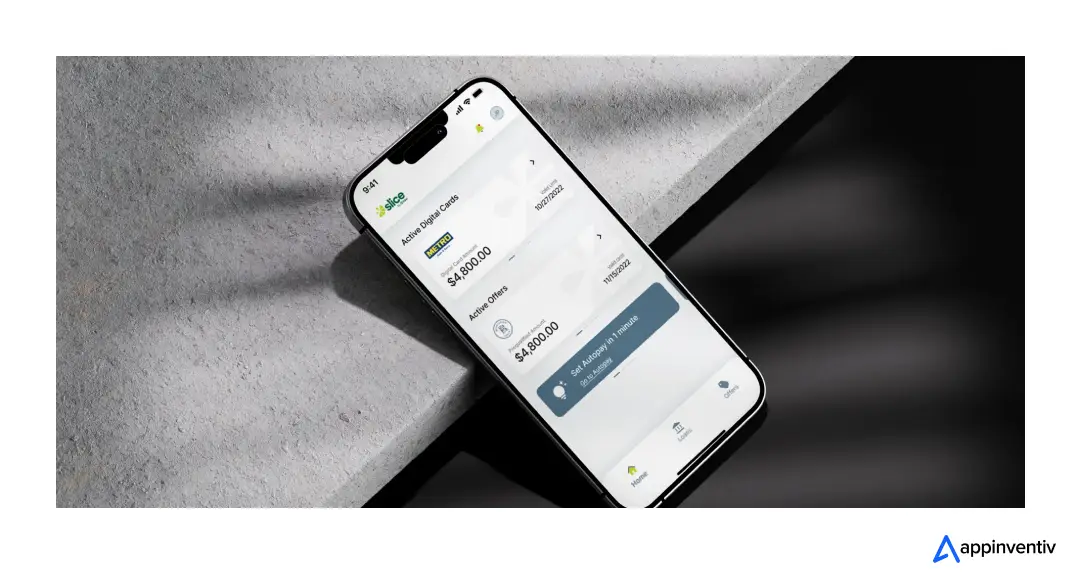
We developed a secure, enterprise-grade financial backend that simplified fractional ownership management and powered a reliable market launch in the UAE.
We also enabled one of the top European banks to transform its banking operations with an AI-powered banking solution that boosted customer retention by 20%, cut manual processes by 35%, and enhanced ATM service levels by 92%.
From developing a retail banking app to building a digital bank, lending platform, investment solution, or AI-powered financial product, Appinventiv’s extensive fintech knowledge and end-to-end expertise provide secure, scalable, and future-proof banking solutions.
Get in touch with our experts, talk about your needs and get a customized quote for your banking app development project.
FAQs
Q. How long does it take to develop a mobile banking app?
A. The timeline depends on the application’s complexity and feature set. A basic banking app typically takes 4 to 6 months, while a feature-rich digital banking platform may require 9 to 18 months. Since the mobile banking app development cost increases with additional features, compliance, and integrations, businesses should align the project scope with their launch timeline and budget.
Q. How much does it cost to add AI features to a banking app?
A. The cost of adding AI features varies by feature, but is typically in the range of $20,000 to +250,000. Simple AI chatbots or document processing may take as little time as 6 to 10 weeks, while more sophisticated functions like fraud detection, credit scoring or personalized financial recommendations can take 3 to 6 months, depending on how long it takes to train, test, and integrate the models into banking systems.
Q. What tech stack is used for mobile banking apps and how does it affect cost?
A. The most common platforms are Flutter or React Native for cross-platform apps, Swift and Kotlin for native apps, and Node.js, Java, or .NET for backend services. Databases are typically PostgreSQL or MongoDB, and cloud infrastructure runs on AWS, Azure, or Google Cloud.
The selected tech stack impacts on the development effort, scalability, maintenance, and licensing expenses. Native technologies tend to be more expensive to develop, but they provide higher levels of performance; on the other hand, the cross-platform solutions can save on initial investment.
Q. How do security and compliance requirements affect banking app development cost?
A. A major cost of mobile banking application development is security and regulatory compliance. Security authentication, encryption, fraud detection, audit logging and regular security testing are mandatory for implementing standards like PCI DSS, GDPR, ISO 27001, KYC and AML.
These requirements can represent a $20,000 to $120,000+ budget component of the overall development budget, depending on the scope of the application and its compliance requirements.


Fast 2-minute response, fully NDA-protected.

Key takeaways: Connected software updates entire banking pipelines from start to finish. This technology cuts manual labor. It sharpens compliance, stops fraud, and pleases clients. AI, RPA, and document tools build scalable bank operations. They integrate directly with your core platform rather than replacing existing infrastructure. Project success requires deep process redesign and API connections.…

How Australian Banks Are Modernising Core Banking Systems: Key Strategies and Challenges
Key takeaways: Regulatory pressure from APRA, CDR, and CPS frameworks is forcing banks to prioritise auditability, resilience, and real-time capabilities. Banks modernising core banking systems are reducing risk by migrating high-value functions first while maintaining legacy ledgers for stability. The cost of core banking modernisation for an Australian bank is shaped by data migration, compliance…

Banking Technology Consulting: A Strategic Roadmap for Core Modernization and Guaranteed ROI
Key takeaways: Banking modernization is now a strategic necessity, not a technology upgrade. Most banks lose value due to legacy complexity, fragmented data, and slow compliance response. Structured banking technology consulting delivers measurable gains in cost, stability, and governance. Core modernization succeeds when roadmaps, risk, and regulatory alignment are clearly defined. ROI comes from reduced…