






























Knowledge Management Systems in Australia: Types, Examples and Benefits for Businesses in 2026

 Share -



- 01What Is a Knowledge Management System and How Does It Work?
- 02What Are Some Common Types of Knowledge Management Systems Businesses Use Today
- 03What Are Some Core Features of Modern Knowledge Management System Development in Australia?
- 04What Are the Top Benefits of Knowledge Management Systems for Australian Enterprises
- 05Why Knowledge Management Has Become a Strategic Priority for Australian Businesses
- 06How C-Level Officers Can Derive Insights from KMS?
- 07What Are the Emerging Knowledge Management Trends Shaping in 2026?
- 08How to Build the Right Knowledge Management System for Your Business in Australia?
- 09Common Challenges When Implementing a Knowledge Management System and How to Overcome Them?
- 10Real-World Examples of Knowledge Management Systems in Australia
- 11How Appinventiv Can Help Build Future-Ready Knowledge Management Systems in Australia?
- 12FAQs

Key takeaways:
- Modern knowledge management systems transform fragmented enterprise information into searchable, governed, and AI-ready knowledge that supports faster business decisions.
- Australian organisations use KMS platforms to improve productivity, preserve institutional knowledge, strengthen compliance, and reduce operational inefficiencies.
- AI-powered features such as semantic search, knowledge assistants, and automated classification significantly improve information discovery and workforce efficiency.
- Successful KMS implementation requires strong governance, seamless integrations, high-quality data, and alignment with long-term business objectives.
Most large Australian organisations are no longer short on data. They are short on access to it. The shift over the past decade has been quiet but decisive: static document stores and shared drives have given way to systems that retrieve, reason over, and contextualise information at the moment a decision is being made. That is the practical difference between a filing cabinet and the operating brain of an enterprise.
The spending pattern confirms where attention is going. Gartner expects software to become Australia’s largest IT spending category in 2026, reaching close to AUD 60 billion, a 13.6% increase on the prior year. Much of that capital is flowing into AI-enabled platforms that depend on clean, governed, searchable knowledge to work at all.
Despite this investment, many large Australian organisations still struggle with data silos and unstructured data. They face the critical loss of tacit knowledge when senior employees retire or leave. Knowledge Management System Development in Australia exists to close that gap.
The blog below covers the main types of knowledge management systems, real examples of knowledge management systems in use, the core features that matter for enterprise buyers, and the governance and compliance realities that shape any serious build.
A well-designed knowledge management platform can improve operational efficiency, support AI initiatives, and reduce organisational risk.

What Is a Knowledge Management System and How Does It Work?
A properly engineered knowledge platform acts as the operational brain of your enterprise, converting fragmented data into actionable intelligence. This reduces cognitive load on your workforce and ensures institutional memory survives employee turnover.
A knowledge management system captures, organises and surfaces both documented and undocumented expertise so the right person reaches the right answer without rework.
Types of Knowledge That Should Be Captured
- Explicit Knowledge: Documented information such as policies, procedures, manuals, contracts, and technical documentation.
- Tacit Knowledge: Knowledge gained through experience, judgement, and expertise that often resides with employees.
- Implicit Knowledge: Practical know-how that can be documented and standardised through operational processes.
- Embedded Knowledge: Knowledge built into organisational workflows, systems, and business processes.
Successfully developing a knowledge management system (KMS) in Australia requires capturing all four knowledge categories rather than focusing solely on documents.
What Are Some Common Types of Knowledge Management Systems Businesses Use Today
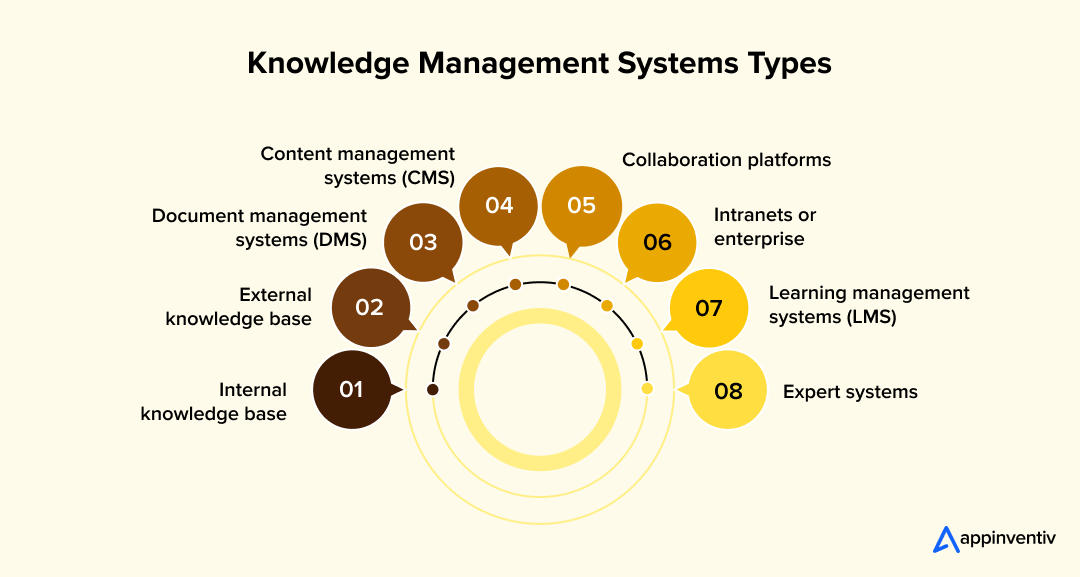
Choosing the wrong category is the most expensive early mistake. The correct infrastructure selection minimises deployment risk and accelerates access to critical information. Typically, the types of knowledge management systems in common use fall into eight broad groups.
1. Internal Knowledge Base
These repositories hold internal company policies, technical manuals, and standard operating procedures. They drive efficient employee self-service. Confluence and Document360 serve as classic knowledge management system examples here.
2. External Knowledge Base
Customer-facing portals streamline self-guided troubleshooting. They provide instant access to product manuals and answer common client queries. This setup acts as a highly effective knowledge management system for customer service.
3. Document Management Systems (DMS)
A DMS tracks the lifecycle of critical company files. It manages automated version control, secure digital storage, and historical audit trails for legal vendor contracts or financial agreements.
4. Content Management Systems (CMS)
These platforms manage public digital content and website marketing assets. A CMS streamlines collaborative authoring and publishing workflows, ensuring strict brand consistency across all active external channels.
5. Collaboration Platforms
Tools like Microsoft Teams function as informal corporate archives. Integrating these channels with a formal database preserves critical problem-solving context hidden within casual daily conversation logs.
6. Intranets or Enterprise Portals
These central entry points aggregate internal news, corporate tools, and essential operational resources. They streamline daily employee navigation across disparate backend business software applications.
7. Learning Management Systems (LMS)
An LMS tracks formal regulatory compliance training and skill benchmarks. Linking it with enterprise knowledge management systems ensures that your educational modules match updated operational guidelines.
8. Expert Systems
These complex applications use custom artificial intelligence to mimic expert human decision-making. They assist technicians by mapping intricate technical decision trees to diagnose complex infrastructure issues.
Also Read: How to Build a Student Management System in Australia
What Are Some Core Features of Modern Knowledge Management System Development in Australia?
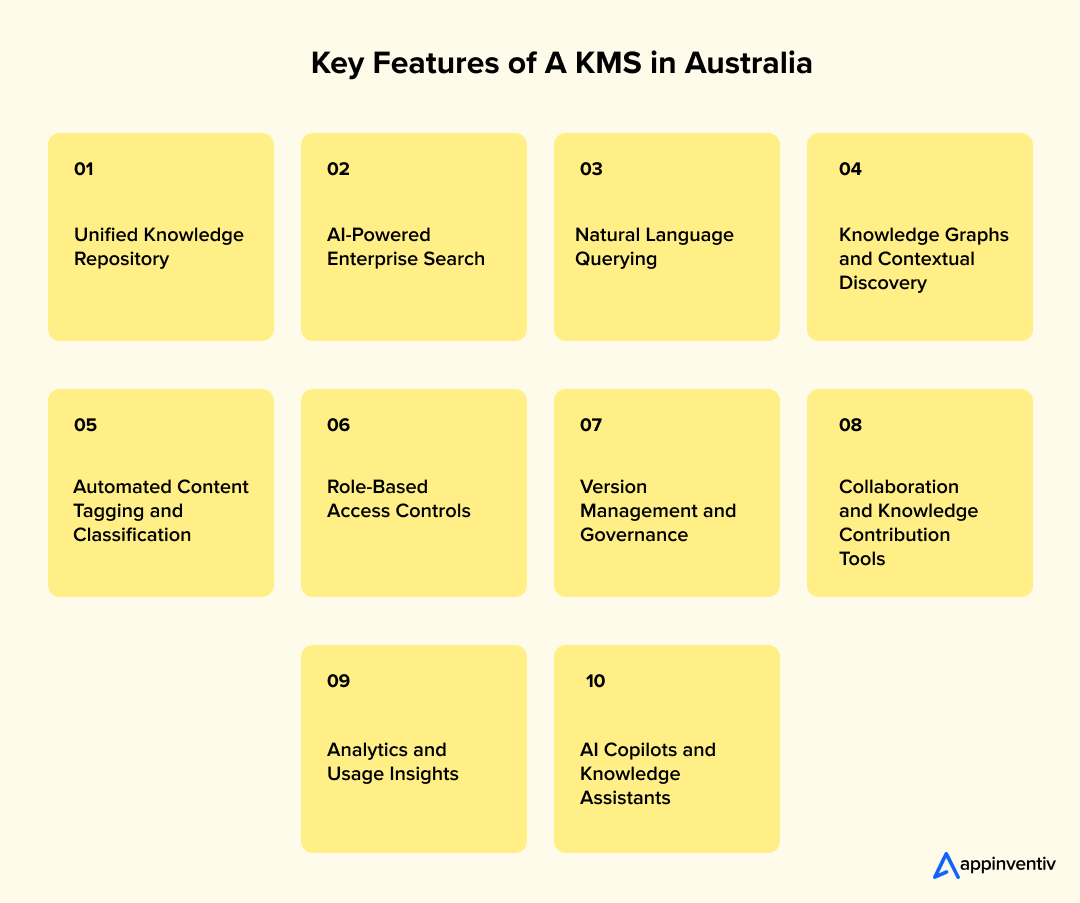
When developing a Knowledge Management System in Australia, its functionalities must address both user friction and stringent cybersecurity requirements. The features that separate a serious enterprise knowledge management platform from a glorified document store are search quality, governance depth and the ability to ground AI in trusted internal content rather than the open internet.
Unified Knowledge Repository
This architecture eliminates data silos by aggregating unstructured content from cloud drives, communication platforms, and CRMs. It forms a single, comprehensive search index.
AI-Powered Enterprise Search
Using vector databases, AI-powered knowledge management systems grasp semantic context. Staff find relevant results using natural concepts rather than exact, rigid keyword phrases.
Natural Language Querying
Employees can ask conversational business questions. The engine extracts answers from validated files instantly, eliminating the need to read through lengthy external technical manuals.
Knowledge Graphs and Contextual Discovery
This system maps deep relationships between files, projects, and active personnel. Reading a contract automatically surfaces related project histories and subject matter expert profiles.
Automated Content Tagging and Classification
Machine learning tags uploads automatically based on detected themes. This preserves knowledge management best practices without requiring manual data entry from busy employees.
Role-Based Access Controls
Granular permission frameworks integrate with your corporate identity provider. This keeps confidential data secure, ensuring strict alignment with regional data governance requirements.
Version Management and Governance
The system logs every single content edit to preserve strict audit trails. Automated alerts flag outdated files for expert review, maintaining high data integrity.
Collaboration and Knowledge Contribution Tools
Inline commenting and single-click drafting tools allow real-time documentation updates. These practical knowledge management tools turn daily work insights into searchable corporate assets.
Analytics and Usage Insights
This feature allows administrators to easily monitor search behavior. Analytics track user engagement and reveal content gaps where employee queries fail to surface helpful answers.
AI Copilots and Knowledge Assistants
Generative AI assistants summarise complex corporate reports, draft rapid client responses, and extract obscure financial metrics, reducing daily research timelines.
What Are the Top Benefits of Knowledge Management Systems for Australian Enterprises
The benefits of knowledge management systems extend beyond operational efficiency. They influence organisational resilience, workforce productivity, customer outcomes, and long-term competitiveness.
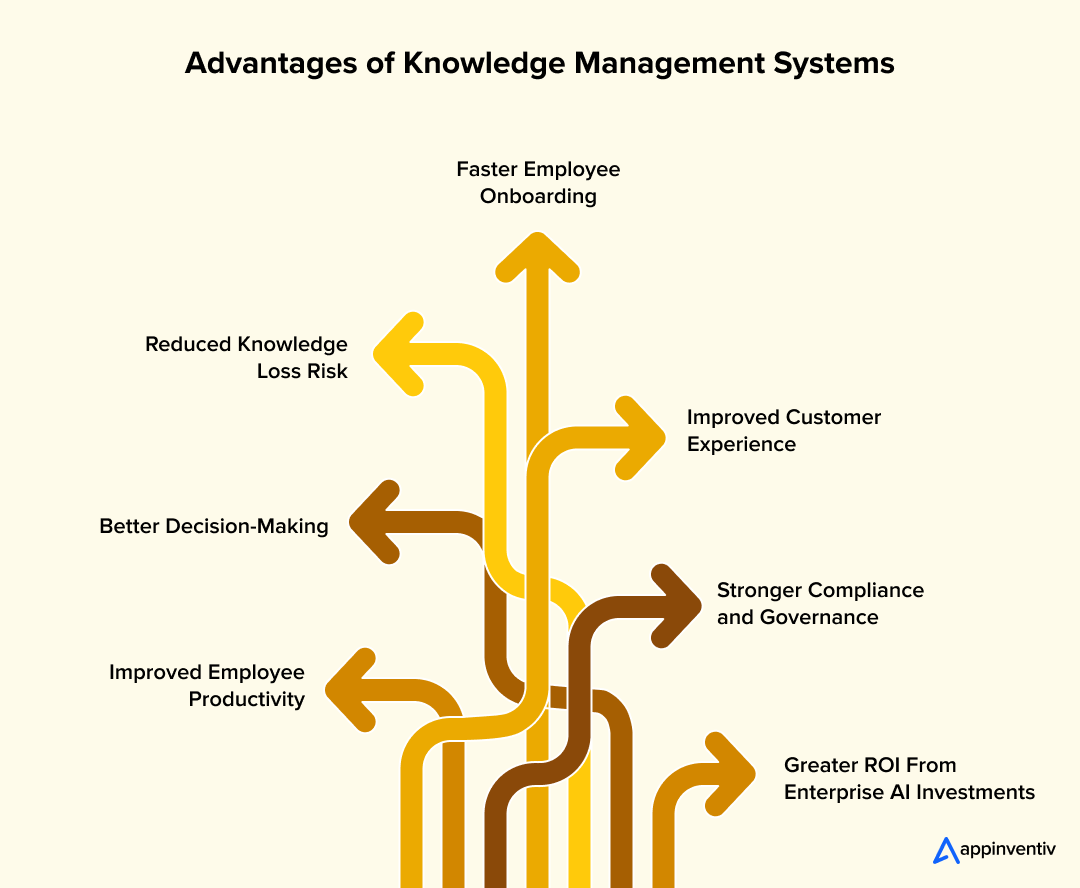
Improved Employee Productivity
Centralised resources reduce time spent hunting across disconnected systems. Employees find verified data quickly, accelerating project execution timelines across the business.
Better Decision-Making
Unified data sets give executives complete contextual visibility. Decisions rely on comprehensive organisational records rather than isolated, fractured departmental opinions.
Reduced Knowledge Loss Risk
Automated data capture secures operational processes when specialists resign. This preserves your training investments and insulates the enterprise from sudden operational shocks.
Faster Employee Onboarding
Centralised standard operating procedures simplify training for new hires. Access to clear documentation shortens onboarding times, reducing the burden on senior team members.
Improved Customer Experience
Equipping support staff with the best knowledge management software drops average handle times. Quick access to technical answers ensures faster issue resolution.
Stronger Compliance and Governance
A single source of truth ensures all staff operate exclusively from the latest approved regulatory frameworks. This strict control minimises the severe risk of compliance breaches under critical regulations like APRA CPS 234, Privacy Act 1988 reforms and so on.
Greater ROI From Enterprise AI Investments
Structured data forms the foundation for advanced corporate AI tools. Properly sorted information guarantees accurate model outputs, eliminating the risk of hallucinations.
Why Knowledge Management Has Become a Strategic Priority for Australian Businesses
The Australian business environment demands agility paired with strict governance. The Privacy Act 1988 updates and the heightened focus on the Essential Eight maturity model require organisations to know exactly where their data resides and who holds access rights.
Disparate legacy systems cannot provide this level of oversight. Businesses invest heavily in knowledge management system development in Australia to replace vulnerable legacy databases with secure, highly scalable platforms.
Furthermore, the hybrid work model necessitates asynchronous access to accurate operational guidelines. When employees operate across different time zones or remote locations, they cannot rely on tapping a colleague on the shoulder for answers.
A centralised, intelligent repository ensures that distance does not degrade operational execution or compliance adherence.
How C-Level Officers Can Derive Insights from KMS?
A mature knowledge management platform adapts to different departmental responsibilities across leadership.
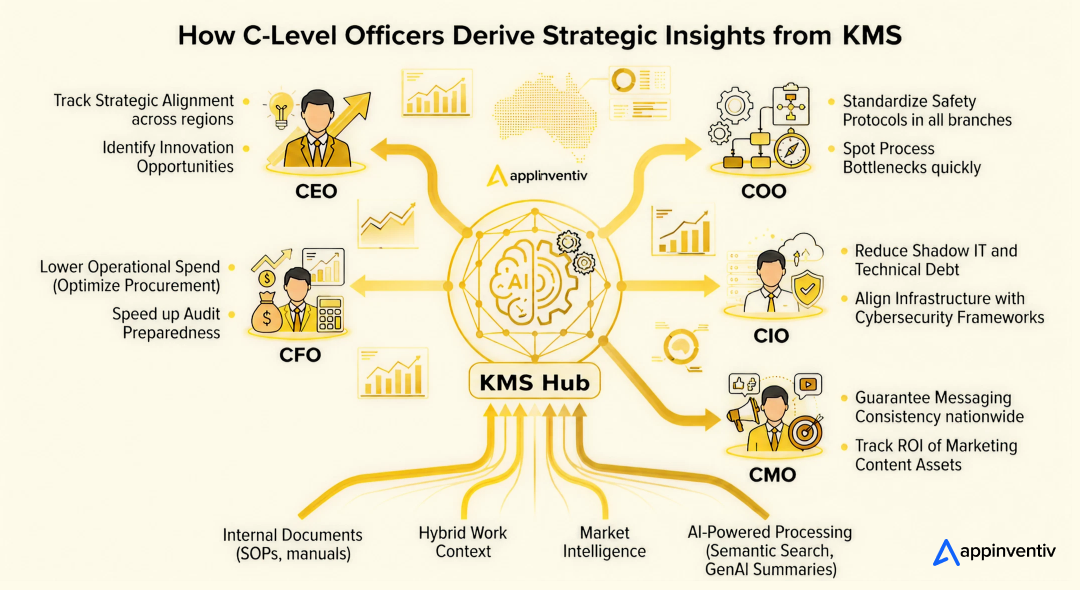
CEOs
CEOs monitor search trends to track how fast new initiatives spread across regions. This data highlights operational bottlenecks or communication gaps early.
CFOs
CFOs use centralised data to identify duplicate software tools and streamline internal procurement. Accessible historical records also accelerate financial planning workflows.
COOs
COOs evaluate operational consistency across different state branches. Content metrics show if remote facilities are following current corporate safety protocols.
CIOs
CIOs build enterprise knowledge management systems to retire risky legacy databases. This reduces technical debt and aligns infrastructure with national cyber security frameworks.
CMOs
CMOs secure all approved brand assets and regulatory messaging guides. This central repository ensures marketing teams maintain messaging compliance across all channels.
What Are the Emerging Knowledge Management Trends Shaping in 2026?
The enterprise technology landscape evolves at a blistering pace. Understanding current technical trajectories ensures that massive new capital investments remain deeply resilient against future technological shifts.
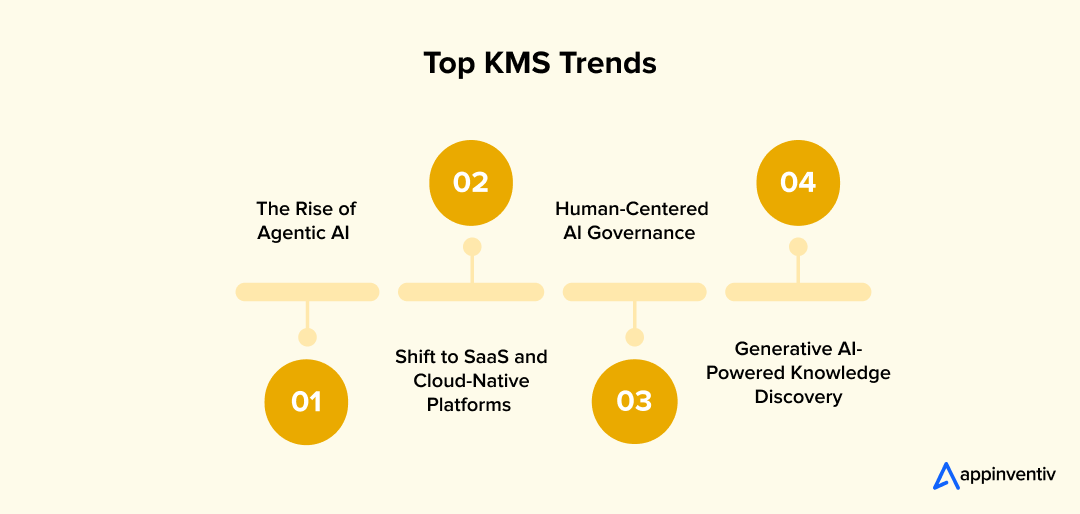
The Rise of Agentic AI: Autonomous AI agents in Australia can cross-reference new regulatory changes against internal manuals. They automatically draft required policy updates for human approval.
Shift to SaaS and Cloud-Native Platforms: Cloud-native knowledge management tools offer seamless integrations. Hyperscalers provide local hosting choices to fulfill strict Australian data sovereignty and privacy mandates.
Human-Centered AI Governance: Firms are building strict approval loops for AI-generated materials. Machine learning assists with quick drafting, but human experts verify final accuracy.
Generative AI-Powered Knowledge Discovery: Modern models synthesise information from multiple source files into brief summaries. This handles complex queries efficiently, reducing employee reading time.
How to Build the Right Knowledge Management System for Your Business in Australia?
Developing a Knowledge Management System (KMS) in Australia requires objective evaluation criteria to select the optimal framework. Follow these foundational steps to guarantee operational alignment.
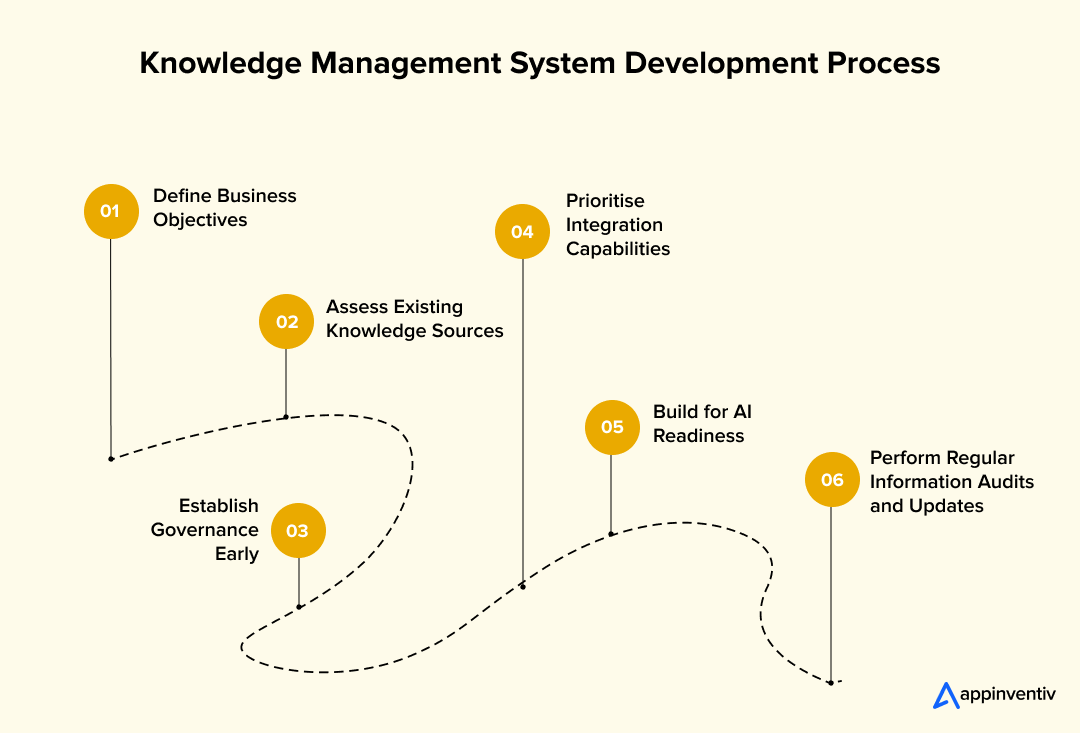
Define Business Objectives
Align technical architecture straight to your commercial targets. Pinpoint operational bottlenecks upfront so calculating the final return on investment becomes a straightforward exercise.
Assess Existing Knowledge Sources
Audit exactly where corporate documents currently hide across old servers. Mapping this fractured landscape prevents messy, expensive data transfers during the core migration.
Establish Governance Early
Draft strict ownership rules long before the launch date. Assign specific domain experts to review material, which keeps legal compliance standards constantly intact.
Prioritise Integration Capabilities
Connect the new repository right into your active CRM and team chat tools. Forcing these systems to talk stops fresh data silos from forming.
Build for AI Readiness
Structure metadata ruthlessly from the very first day. Clean classification feeds accurate machine learning algorithms and powers the semantic search engine properly.
Perform Regular Information Audits
Schedule routine reviews to dump outdated operational procedures. Archiving old files defends platform credibility, ensuring your teams only execute tasks using validated facts.
| Evaluation Criteria | Why It Matters for Enterprise Architecture |
|---|---|
| AI Search Capabilities | Grasps user intent, cutting down wasted retrieval time. |
| Integration Ecosystem | Connects with current operational tools to break down silos. |
| Security Controls | Locks down confidential records via role-based access frameworks. |
| Scalability | Handles massive data volume spikes without system lagging. |
| Analytics | Shows adoption rates and highlights missing internal documents. |
| Governance Features | Forces updates on aging files to retain total accuracy. |
Build a secure, searchable, and AI-ready knowledge ecosystem that enables faster decisions and enterprise-wide efficiency.

Common Challenges When Implementing a Knowledge Management System and How to Overcome Them?
Technical rollouts fail without human alignment. Fixing bad data early and designing intuitive interfaces drives long-term usage. Addressing these hurdles head-on protects the capital investment and lifts overall workforce productivity.
Low User Adoption
Challenge: Staff reject platforms that complicate their normal daily routines. Forcing new login habits usually results in abandoned software tools.
Solution: Embed the repository directly into existing communication channels. Removing friction guarantees employees search and contribute without breaking their workflow.
Poor Content Quality
Challenge: Finding obsolete or contradictory files destroys platform credibility instantly. Users simply stop trusting the database if information proves wrong.
Solution: Enforce strict ownership protocols and automated review cycles. Subject matter experts must verify documents periodically to preserve absolute data integrity.
Information Overload
Challenge: Dumping massive volumes of unstructured data overwhelms the workforce. People cannot find what they need amidst irrelevant departmental noise.
Solution: Build highly personalised, role-specific dashboards. Filtering out unrelated clutter ensures staff only interact with procedures necessary for their specific role.
Data Quality and Legacy Silos
Challenge: Moving cluttered, poorly tagged folders into a modern environment ruins system efficiency. Garbage data fundamentally breaks advanced search functions.
Solution: Run a brutal content audit before migration begins. Standardising metadata and deleting obsolete records ensures peak performance at launch.
Real-World Examples of Knowledge Management Systems in Australia
Examining active platforms proves that architectural theory translates directly into daily execution. These specific examples demonstrate how different sectors secure compliance, train staff, and manage complex operational data safely.
Sentrient
Sentrient operates as an Australian knowledge management system tailored for HR and compliance. It provides a centralised, searchable library for institutional policies. With built-in compliance workflows, it helps organisations maintain strict audit trails, mitigating legal risks during employee onboarding.
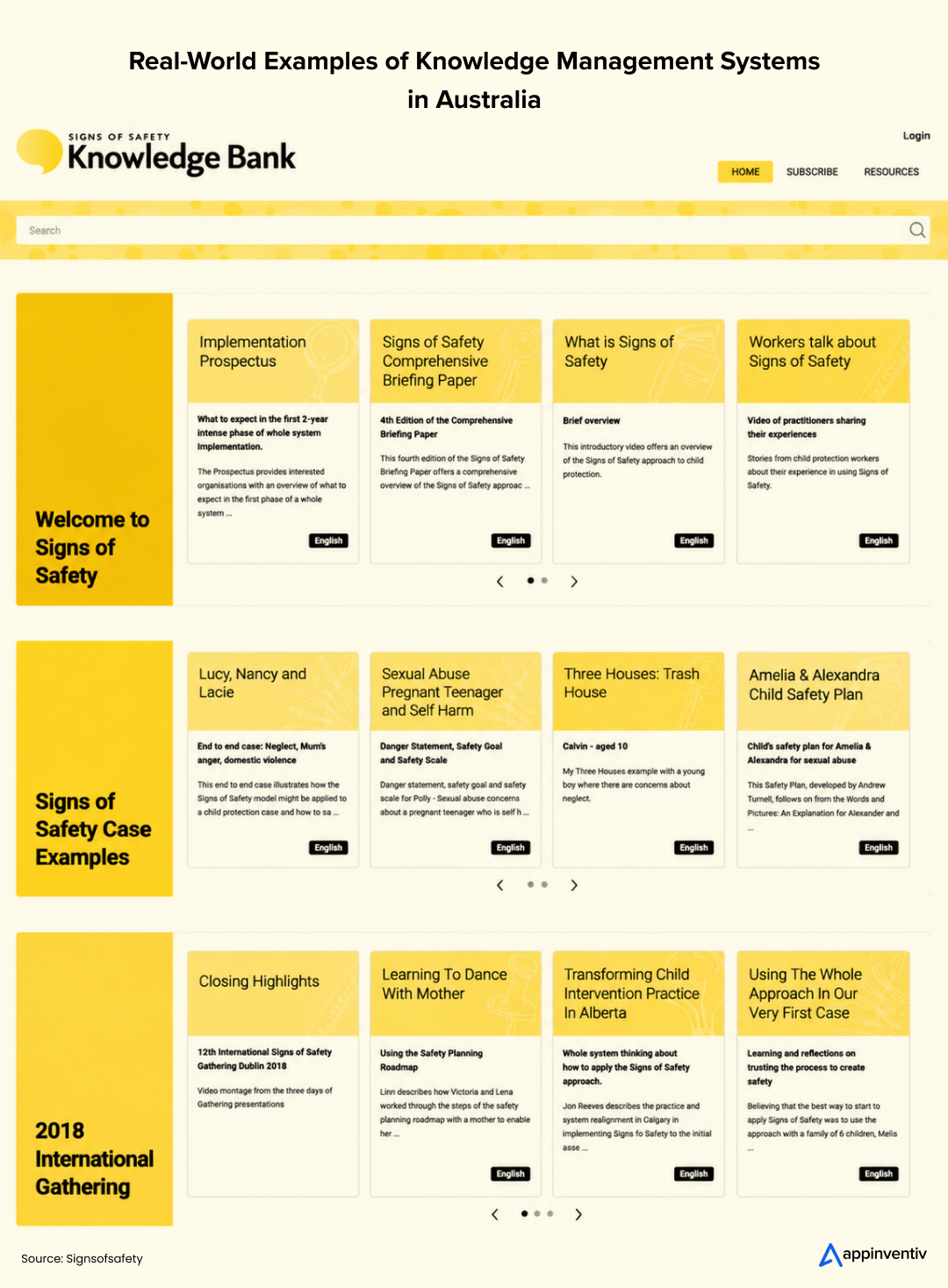
Signs of Safety Knowledge Bank
An online library serving child protection workers. It provides free and subscription-based access to practice tools, assessment frameworks, and learning resources. This strengths-based platform empowers professionals and families to collaboratively create sustainable safety plans for vulnerable children.
Salesforce Agentforce
Operating across Australia, Salesforce Agentforce leverages AI to transform trusted company data like internal knowledge articles into actionable support. It provides conversational answers for employees and customers, personalising engagement while maintaining strict data governance across service, sales, and IT operations.
How Appinventiv Can Help Build Future-Ready Knowledge Management Systems in Australia?
Building a digital brain for your enterprise demands an experienced education app development company in Australia that understands local regulatory realities. Technology deployments often fail because they ignore how human teams actually operate on the ground. Appinventiv bridges the gap between raw artificial intelligence capabilities and daily business execution.
For over a decade of experience across the APAC region, we have guided boards and CIOs through complex infrastructure modernisations. Our team of 1600+ tech experts has deployed over 3000 digital assets in Australia, driving meaningful digital transformation across 35+ industries.
Delivering robust platforms for fast-scaling clients like Rapid Teachers, Mutinail and Lite n’ Easy demonstrates our ability to tailor data architecture to solve highly specific operational bottlenecks. We do not just engineer software; we align technology directly with your commercial targets.
What’s more? Security and governance dictate every phase of our development lifecycle. We hold demanding ISO 27001, ISO 9001, and SOC2 certifications. A strict 99.50 percent security compliance SLA firmly backs our engineering work. It simply means when we handle Knowledge Management System Development in Australia, your proprietary data remains completely protected against external breaches and internal compliance failures.
Operating from 5+ agile delivery centres across the country, our tech architects maintain tight alignment with your internal leadership. This close, transparent collaboration drives our 90% client retention rate.
Whether the goal is a focused internal knowledge base or a full AI-powered platform in Australia, we build for governance, scale and audit readiness. If you are scoping Knowledge Management System Development in Australia, we are your single source of support. Our team can help you move from evaluation to a costed, compliant delivery plan.
FAQs
Q. What is the purpose of knowledge management systems and how does it work?
A. The fundamental purpose of a KMS is to centralise, secure, and rapidly distribute an organisation’s collective intelligence. It works by integrating deeply with existing software to ingest scattered data. The system applies complex machine learning algorithms to index and classify that information properly. It then provides an intuitive search interface so employees retrieve accurate, contextual answers instantly.
Q. How A Knowledge Management System Supports Continuous Learning In Australian Workplaces?
A. A KMS provides immediate, on-demand access to technical documentation and critical procedural updates. Instead of waiting weeks for formal training sessions, employees independently self-serve the exact information they need at the precise moment of execution. This fosters a highly resilient culture of continuous, decentralised skill development and rapid, independent problem resolution on the factory floor or within the office.
Q. We already have an LMS. Why would we also need a separate knowledge management system?
A. An LMS is explicitly designed to deliver highly structured courses and rigidly track compliance training completion. A knowledge platform serves as a dynamic, real-time operational utility. While an LMS teaches broad conceptual skills, the knowledge system provides the highly specific, searchable technical manual needed to execute a daily task. Examples of knowledge management systems focus on immediate operational execution rather than structured academic progression.
Q. Why are Australian businesses investing in knowledge management platforms?
A. Large organisations face strict regulatory pressures, highly complex remote work environments, and the constant threat of technical talent attrition. Investing in the best knowledge management software aggressively secures corporate intellectual property. It ensures rigid compliance through structured audit trails and significantly boosts workforce productivity by completely eliminating information retrieval friction across distributed operational teams.
Q. How much does it cost to build a custom knowledge management system in Australia?
A. The costs to build a custom knowledge management system vary dramatically based on the scale of the deployment, the complexity of necessary backend integrations, and the precise level of custom AI functionality required.
On average, the cost of knowledge management system development in Australia range between AUD 70,000 and AUD 700,000 or more, depending on your unique project requirements.
Q. How long does it take to implement a knowledge management system?
A. Implementation timelines of a KMS in Australia depend heavily on legacy data migration complexity and API integration requirements. A carefully phased rollout, beginning with core repository functions and advancing steadily to complex AI search capabilities, typically spans from 4 -12+ months.


Fast 2-minute response, fully NDA-protected.

How Much Does It Cost to Build a Learning Management System in Australia
Key takeaways: Enterprise LMS investment in Australia typically ranges from AUD 70,000 to AUD 700,000, driven primarily by architecture, integrations, and compliance scope. Privacy Act 1988, APP obligations, TEQSA, ASQA, and ASD Essential Eight significantly influence LMS design decisions. Cloud-native, API-first, and modular platforms reduce long-term total cost of ownership and also drive sustainable outcome.…

How to Build an EdTech App for Australia: Framework, Features, Cost Structure, & Compliance
Key takeaways: AI implementation in Australian EdTech gains ground when it is transparent, governed, and aligned with emerging regulatory expectations. Realistic EdTech app development costs range from AUD 70,000 to AUD 700,000, driven by compliance, scalability, and long-term support needs. Long-term success relies on modular development, continuous optimisation, and proactive compliance management rather than rushing…

How Smart Campuses Are Redefining the Future of Education - Benefits, Use Cases, and Technologies
Digital transformation is roaring across industries, and the education sector is no exception. The integration of cutting-edge technologies like the Internet of Things (IoT), artificial intelligence (AI), machine learning (ML), cloud computing, virtual reality, etc. is increasingly making waves in the education sector. Amidst the hum of these technology trends, the emergence of smart campus…