































How Forward Deployed Engineers Accelerate AI From Pilot to Production

 Share -


- 01Why Enterprises Use the FDE Model
- 02The Forward Deployed Engineering Engagement Model
- 03Enterprise AI Architecture for FDE Projects
- 04Technical Skills of a Forward Deployed Engineer
- 05FDE vs Software Engineer vs Solutions Architect vs AI Consultant
- 06Enterprise Use Cases for Forward Deployed Engineers
- 07Measuring the ROI of Forward Deployed Engineering
- 08Choosing the Right FDE Delivery Model
- 09Choosing a Forward Deployed Engineering Partner
- 10Why Appinventiv for Forward Deployed AI Engineering?
- 11FAQs

Key takeaways:
- IBM’s 2025 CEO study revealed that only 16% of AI projects scaled across entire companies.
- Forward-deployed engineers integrate daily workflows, legacy applications, AI models, security rules, and server infrastructure into a single team.
- Live AI platforms require task checks, access permissions, system tracking, and rollback tools before full rollout.
- Single-team projects eliminate handoffs by managing discovery, coding, system integration, deployment, and operational updates together.
- Leaders select internal, vendor-led, or hybrid engineering teams based on technical skills, timelines, and ownership goals.
The core problem for enterprise AI is no longer proving that a model works. It is making that model work inside real business systems. A successful pilot can still stall once it meets legacy applications, fragmented data, strict access controls, and production workloads.
AI adoption is already widespread. Stanford’s 2026 AI Index found that 88% of surveyed organizations used AI in 2025. An enterprise AI deployment needs more than model accuracy.
Teams must connect APIs, govern data, manage identity, test AI behavior, monitor latency and cost, and fit the system into existing workflows. User adoption creates another hurdle. Few engineering teams have deep expertise across AI, cloud, software, data, and business within a single group.
Forward-deployed engineers close this gap by working directly with enterprise teams. They combine workflow discovery, AI engineering, system integration, security, production deployment, and post-launch tuning within the customer environment.
This model helps move an AI proof-of-concept to production as a secure, measurable capability. For large enterprises, the priority is not another prototype. It is execution that reaches production.
IBM’s 2025 CEO study found only 16% of AI initiatives reached enterprise-wide scale. Build your production path before the gap widens.
Why Enterprises Use the FDE Model
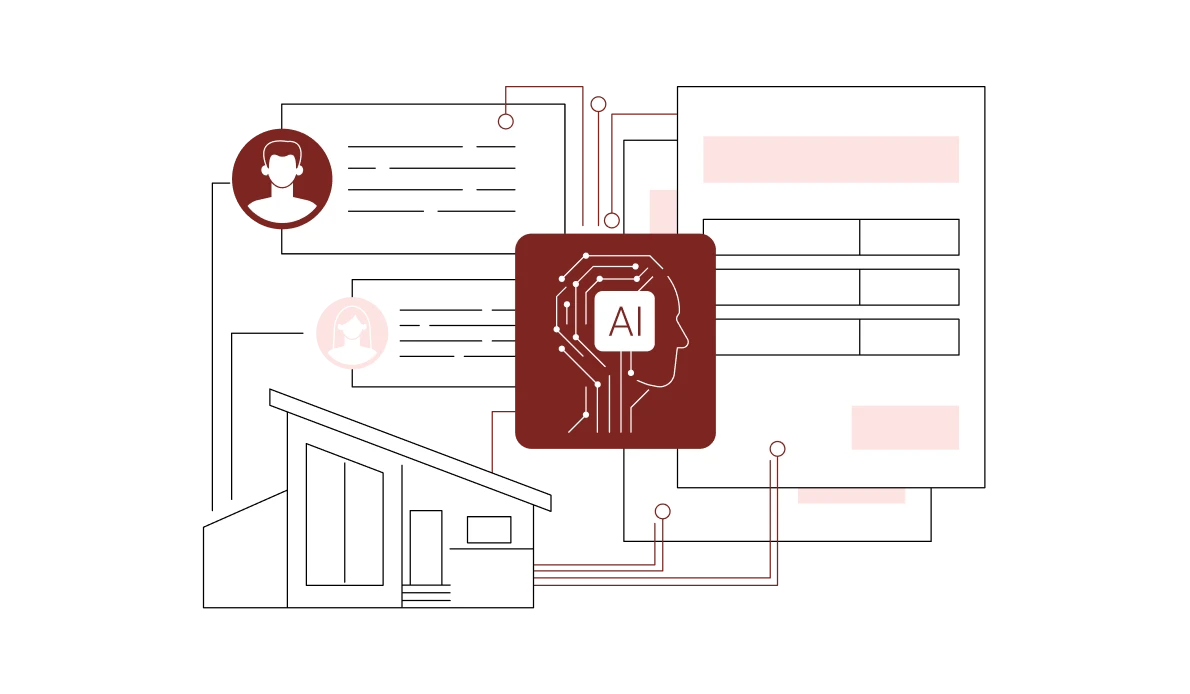
Enterprise AI projects frequently stall after initial testing phases. Models perform well in isolation, but live systems introduce data, security, and workflow constraints that AI consulting services alone cannot resolve. Forward-deployed engineers address these rollout problems by performing direct coding work within customer environments.
The Enterprise AI Pilot-to-Production Gap
Initial tests rely on clean data and small user groups. Live deployment introduces enterprise databases, legacy applications, fragmented file stores, access rules, and heavy traffic.
IBM’s 2025 CEO study found that only 16% of AI initiatives had scaled enterprise-wide, highlighting major AI adoption challenges, while 25% had delivered expected ROI. Technical accuracy alone does not guarantee operational success. Software agents can pass early checks but fail inside active daily workflows.
Search quality drops across inconsistent data sources, and automated tools hit permission limits. Speed drops and daily running costs jump under heavy workloads.
Corporate leaders evaluate tools through operational results. New software must fit daily routines and drive faster processing speeds, lower costs, or higher revenue.
How FDEs Reduce Delivery Friction
Forward-deployed engineers streamline AI integration by connecting operational goals directly to daily coding tasks. They convert user needs into software features without transferring tasks across multiple teams. This direct action eliminates delays between early planning and active development.
Engineers evaluate software interfaces, data permissions, identity tools, and server setups during early builds. Technical issues surface during development rather than during final launch. The same engineering team then updates application features based on direct user feedback. This direct approach removes team transfers and keeps engineering choices focused on actual business needs.
When the FDE Model Fits
This engineering model suits projects requiring enterprise app development across multiple corporate platforms. It supports complex operations, strict security rules, limited internal technical teams, and projects stuck in testing phases.
External engineers add minimal value to basic software tools that require simple setup. Early experiments without clear financial goals also do not need dedicated embedded teams. Organizations with mature technical groups can manage these software deployments internally. Project complexity and custom coding needs dictate whether embedded engineers are necessary.
The Forward Deployed Engineering Engagement Model
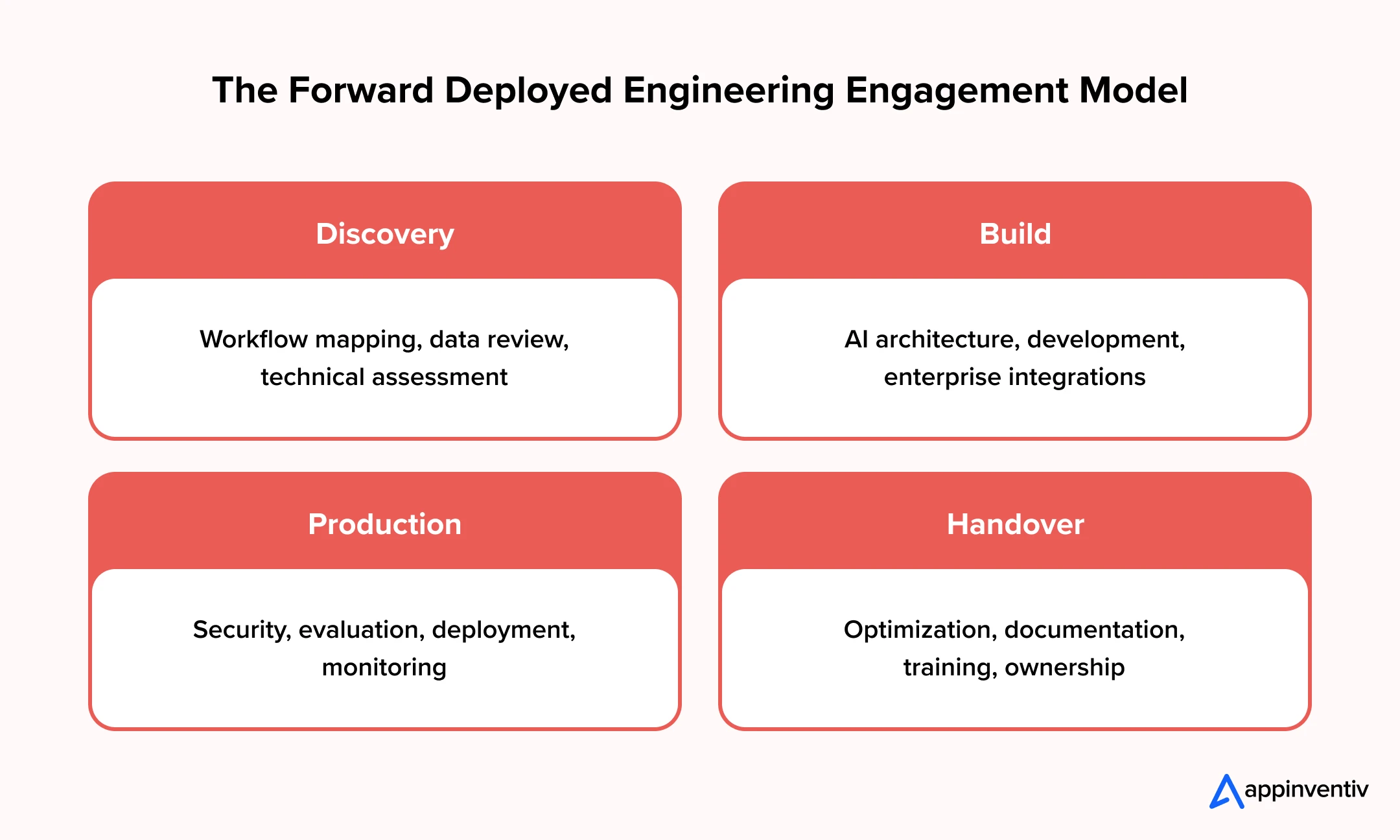
Forward-deployed engineering projects move through four clear phases. Each stage combines business decisions with the practical code work required for production release.
Phase 1: Discovery and Technical Assessment
Engineers begin by reviewing daily operational processes. They work with business leaders, IT staff, security officers, and daily users to map decision points, approval chains, system dependencies, and target metrics. The team then reviews internal databases, software interfaces, legacy applications, identity tools, and security rules.
They evaluate data structures, login methods, speed requirements, and access limits to align with the core enterprise data strategy. Data quality can decide whether a use case is viable. Deloitte found that 55% of surveyed organizations avoided certain GenAI use cases because of data-related issues. This initial work establishes the technical scope, system boundaries, security needs, and project goals.
Phase 2: AI Architecture, Build and Integration
Engineers design the software layout around target operational steps. A standard setup moves data through secure connectors, search tools, language models, business rules, and user interfaces. Through robust application integration, the team writes custom code and links the application directly into corporate databases, sales software, resource planning platforms, and internal services. They write processing scripts, data validation rules, retry protocols, and traffic controls during active development.
Phase 3: Security, Evaluation and AI Production Deployment
Engineers embed security protections before live release. They set user permission rules, single sign-on connections, data encryption, audit trails, and protections against bad inputs.
High-risk workflows should keep human approval before irreversible actions. AI can prepare recommendations or actions, while authorized employees approve transactions, account changes, or sensitive decisions.
The team then tests the software on real-world business tasks to confirm the AI is production-ready before release. They measure task accuracy, search precision, response speed, safety checks, and running costs to set release approvals.
Once verified, engineers set up automated delivery scripts, cloud servers, monitoring tools, and rollback procedures for AI production deployment. Staged software rollouts help minimize daily operational risks.
Phase 4: Optimization, Adoption and Handover
Technical work continues after launch to track user activity and overall platform performance. Engineers monitor task completion speeds, answer accuracy, system errors, running costs, and business output.
Production AI can change as models, source data, prompts, and tools change. Recurring evaluations and drift checks help detect quality regressions before they affect users.
Live operational logs highlight weak search results, bad prompts, or system friction points. Technical teams use these findings to refine code and system settings. The final stage transfers full platform control to internal staff through technical guides, system runbooks, and training sessions.
Mature FDE teams can turn project work into reusable connectors, evaluation tools, deployment templates, and agent patterns for scaling AI projects.
Handover should define ongoing ownership across engineering, product, security, and AI governance teams. Clear ownership prevents production issues from falling between teams after launch.
Enterprise AI Architecture for FDE Projects
Enterprise AI systems integration requires more than a model and an interface. The architecture connects user requests directly to company data, operational platforms, security rules, and system tracking tools. Forward-deployed engineers build these software layers around specific operational constraints.
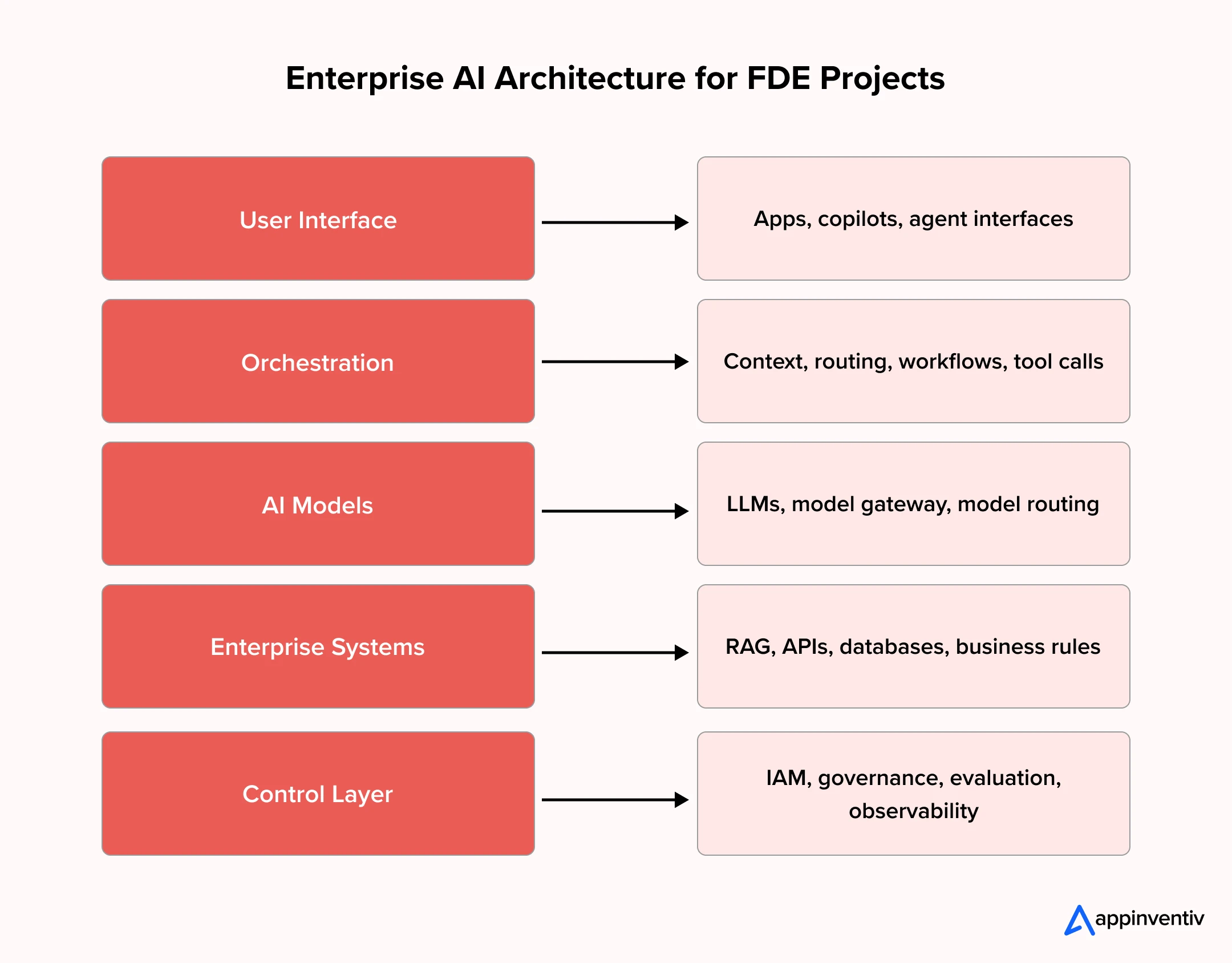
Application or Agent Interface
Staff members interact with software through web apps, chat screens, digital assistants, or embedded tools. This layer handles user prompts, active sessions, and assigned account permissions.
Orchestration Layer
The orchestration engine controls data flow across search engines, business logic, software tools, and underlying models. It manages user context, task sequences, request routing, and autonomous agent steps.
Large enterprises can use the same AI platform across multiple teams. Shared model routing, connectors, evaluation tools, guardrails, and monitoring reduce repeated engineering work across projects.
LLM or Model Gateway
Model gateways connect software applications directly to external language models. They handle vendor access, model selection, traffic limits, usage tracking, and backup options.
Vendor dependency can become difficult to unwind. IBM’s 2026 study found that 71% of surveyed executives said switching their primary AI vendor or model would be difficult.
Different workloads may require different models. Model routing lets teams balance reasoning quality, latency, cost, privacy, and deployment requirements for each task.
RAG, Tools and Business Rules
Using RAG development techniques, search tools pull company records directly into model prompts. Custom interfaces allow AI applications to execute specific system tasks. Fixed business rules handle decisions that require exact, unvarying logic.
Enterprise Data and Applications
This layer links AI applications directly into internal databases, data archives, sales software, resource platforms, and file systems. Dedicated connectors securely transfer information between corporate platforms.
Security, IAM and Governance
Security controls protect every architectural layer. Permission systems restrict access to files and tools. Encryption, key storage, audit records, and policy rules protect sensitive data.
Agentic systems need their own permissions. Each agent should have defined access to data and tools, with sensitive actions restricted to approved users or workflows.
Evaluation and Observability
Evaluation tools check if software actions complete accurately. System tracking logs model calls, load speeds, software errors, and operational costs. These metrics help technical teams catch live issues early.
Technical Skills of a Forward Deployed Engineer
A Forward Deployed Engineer needs broad technical range, but depth matters where production risk is high. The role combines software engineering, AI development services, cloud infrastructure, enterprise integration, and business understanding. That mix lets an FDE make technical decisions within real enterprise constraints.
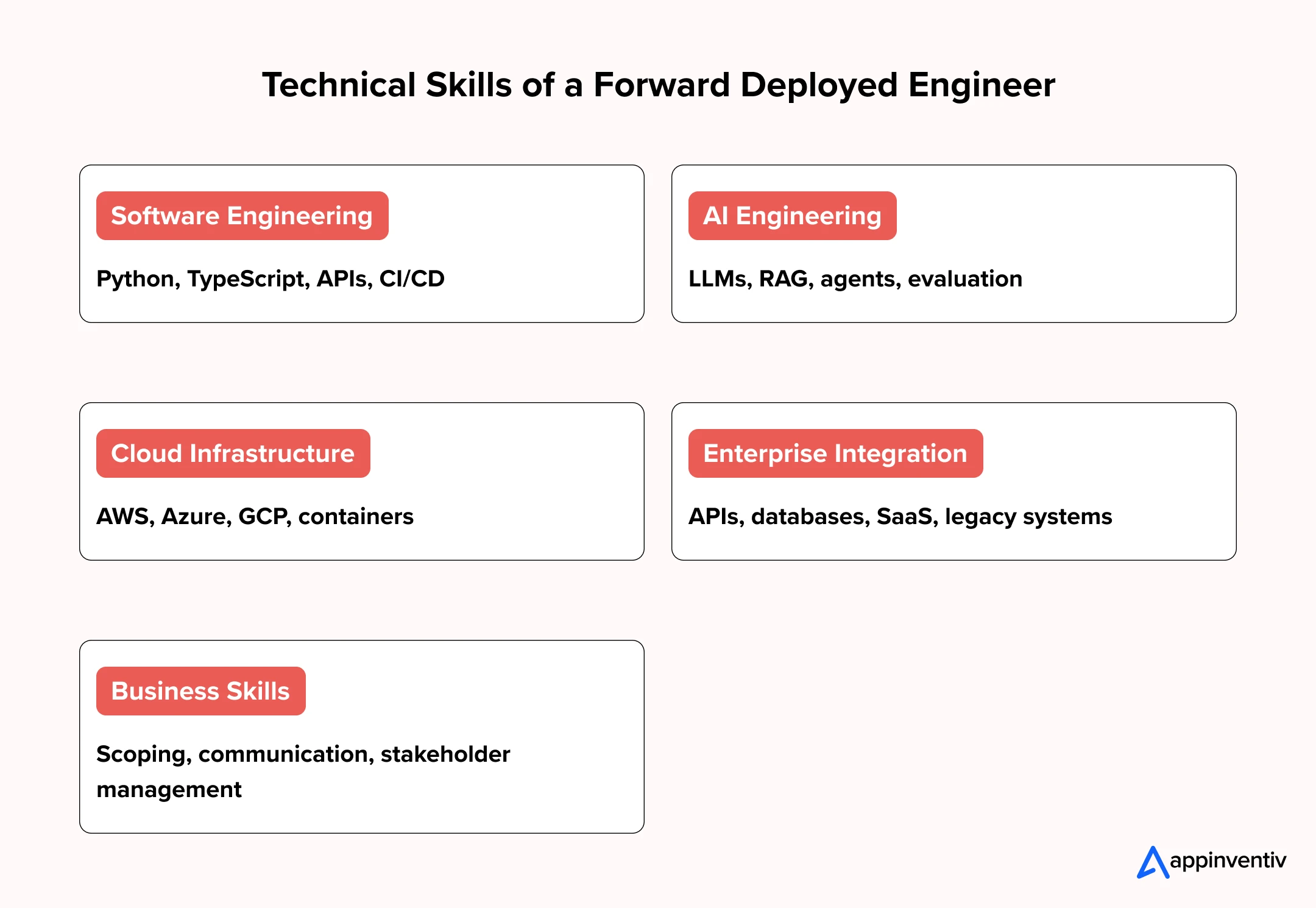
Software Engineering Skills
Strong software engineering forms the base of the role. An FDE should work comfortably with Python, TypeScript, or similar languages and build backend services, APIs, and application logic. They need solid testing practices across unit, integration, and regression tests. Git and CI/CD support controlled development and releases. Knowledge of distributed systems helps with queues, asynchronous jobs, service communication, retries, and failure handling in production environments.
AI and LLM Engineering Skills
An FDE needs practical knowledge of modern AI application development. AI agents are moving into enterprise testing. McKinsey’s 2025 survey found that 62% of respondents were at least experimenting with AI agents. This includes LLM APIs, embeddings, RAG pipelines, vector and hybrid retrieval, agent workflows, and tool calling.
Context engineering matters when applications need to combine instructions, retrieved data, conversation history, and business rules. Engineers should understand structured outputs, prompt design, model selection, and evaluation methods. They must know how changes to models or retrieval logic can affect application behavior.
Cloud and Infrastructure Skills
Enterprise AI systems run inside infrastructure with strict operational controls. An FDE should be comfortable with AWS, Azure, or Google Cloud and understand containers, Docker, and Kubernetes where the workload calls for it. They need working knowledge of cloud networking, IAM, infrastructure as code, and observability. This helps them design deployments that support access control, monitoring, scaling, release management, and production troubleshooting.
Enterprise Integration Skills
An FDE must work across the systems that already run the business. That includes REST and GraphQL APIs, relational and NoSQL databases, ETL and ELT pipelines, enterprise SaaS platforms, event-driven systems, and identity infrastructure. The engineer needs to understand authentication, data transformation, API limits, retries, and system dependencies. This capability allows an AI application to interact with existing CRM, ERP, HR, data, and workflow platforms without replacing them.
Business and Stakeholder Skills
The technical work starts with understanding the business process. An FDE needs to gather requirements, define technical scope, assess trade-offs, and explain engineering decisions to business and technology leaders. They must know which requirements affect architecture and which can wait. Strong stakeholder management keeps technical work aligned with business priorities. Change management skills then help teams adopt the new system and adjust their existing workflows.
FDE vs Software Engineer vs Solutions Architect vs AI Consultant
These roles can overlap, but their focus and ownership differ across an enterprise AI project.
| Dimension | Forward Deployed Engineer | Software Engineer | Solutions Architect | AI Consultant |
|---|---|---|---|---|
| Primary Focus | Customer outcome and production delivery | Product or system development | Technical architecture | Business strategy and AI advisory |
| Working Environment | Embedded within the customer environment | Internal engineering environment | Customer and vendor environments | Client and advisory environment |
| Production Code | Writes and maintains it | Writes and maintains it | May contribute | Usually limited |
| Deployment Ownership | Often owns customer deployment | Usually owns product-side deployment | Defines deployment architecture | Usually advises |
| Customer Interaction | High | Low to moderate | High | High |
| Technical Scope | End-to-end implementation | Product or system components | Architecture and technology decisions | Business and transformation planning |
| Integration Work | High | Depends on product scope | Defines integration design | Usually advisory |
| AI Implementation | Builds and integrates AI systems | May build AI features | Designs AI architecture | Defines use cases and strategy |
| Success Metric | Production adoption and business results | Product quality and system performance | Architecture fit and technical viability | Business and strategic outcomes |
For enterprise AI projects, these roles can work together. The architect can define the technical structure, the consultant can shape the business case, and software engineers can build core capabilities. The FDE connects those decisions to the customer’s systems and production requirements.
Enterprise Use Cases for Forward Deployed Engineers
Forward deployed engineers support software projects that involve active operational workflows, existing business databases, and measurable operational goals. Core projects require custom software development rather than simple platform setup.
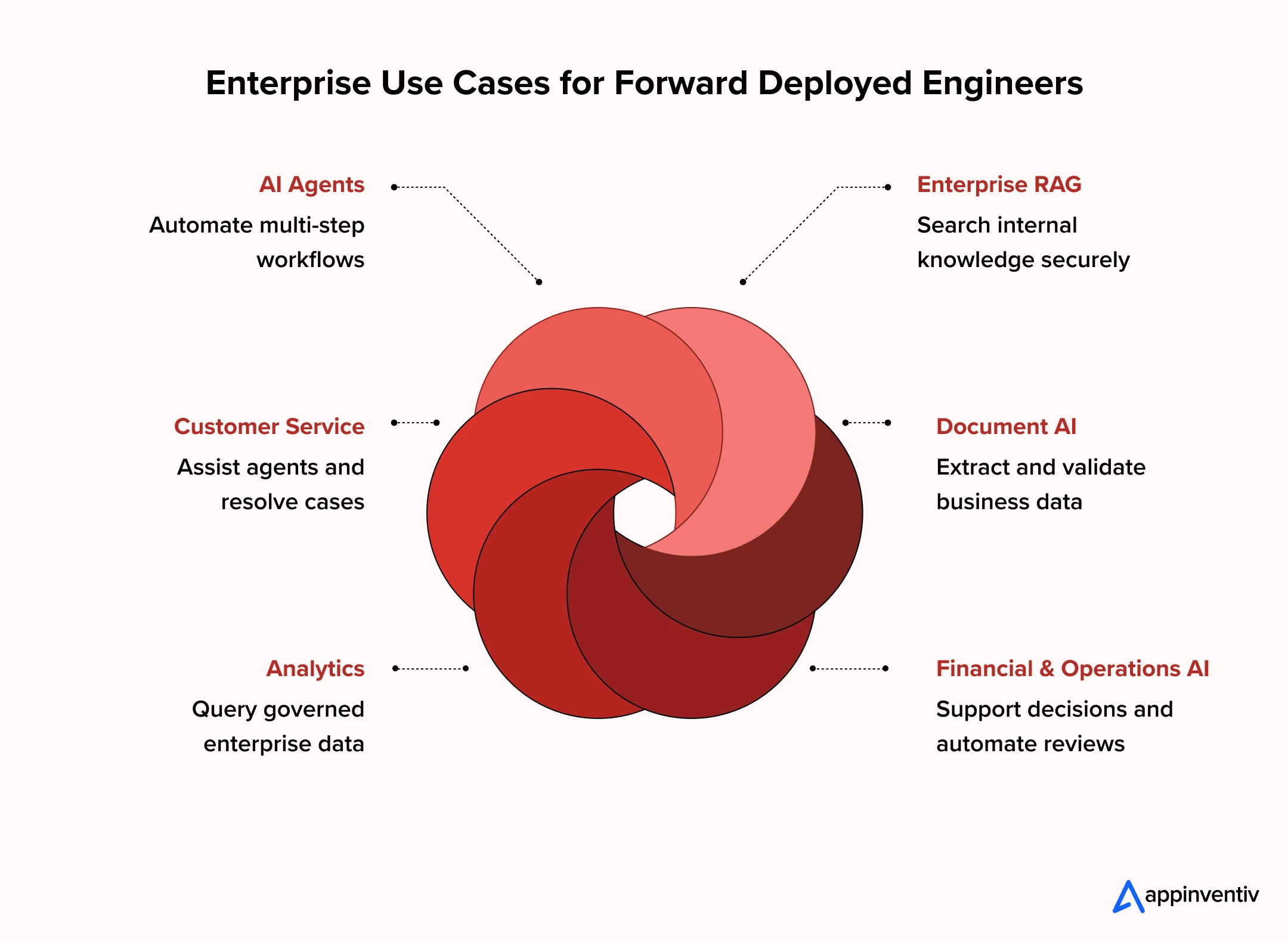
AI Agents for Business Workflows
Deploying enterprise AI agents streamlines corporate operations by enabling workers to verify data, make decisions, and execute actions across multiple software platforms. These engineers link autonomous software tools to internal data feeds, storage platforms, and sign-off systems. An insurance claims tool can read case files, fetch policy terms, and draft actionable next steps. Teams measure success by task completion speed, total processing time, and the number of required manual reviews.
Enterprise Knowledge and RAG Systems
Staff members search internal policy files, operational reports, and training manuals as part of their daily work. Engineers build data search platforms that retrieve approved content based on assigned user permission levels. These platforms link directly into document archives, corporate databases, and security systems. Operations teams evaluate performance by tracking retrieval accuracy, answer precision, and search speeds.
Customer Service and Contact Centers
Support staff process high volumes of service tickets and repetitive user inquiries every day. Engineers attach software assistants to customer management records, reference guides, ticket trackers, and call center platforms. The application summarizes past case logs, offers target replies, and leads support reps through standard procedures. Management tracks success through total resolution times, first-contact fix rates, ticket escalations, and customer feedback scores.
Document Processing and Intelligence
Finance, shipping, and healthcare units process thousands of vendor invoices, legal agreements, and medical forms daily. Engineers combine optical text readers, data extraction tools, and manual approval checkpoints into unified automated pipelines. The software sends clean data straight into central resource planning software and operational databases. Leaders measure impact through document turnaround speeds, field extraction accuracy, data error rates, and manual labor hours.
Data and Analytics Automation
Business groups rely heavily on technical analysts to clean raw datasets before answering simple operational questions. Engineers link natural language software to verified databases, cloud data warehouses, and reporting tools. Staff members query secure company data directly while system controls enforce user security rules. Companies track value through report creation speed, query success rate, total analysis volume, and staff usage rate.
Financial and Operational AI
Finance and plant management teams handle payment auditing, equipment maintenance, purchasing decisions, and inventory balances. Engineers connect smart software directly to resource management platforms, payment gateways, warehouse databases, and sensor feeds. The resulting systems flag account mismatches, assist purchasing choices, and highlight equipment failures. Operations teams judge success by watching total processing speeds, transaction error rates, facility downtime, and operating costs.
Industry-Specific AI Workflows
Healthcare facilities, pharmaceutical labs, and manufacturing plants operate under strict regulatory requirements and rely on specialized legacy software. Common target projects include medical note transcription, lab analysis support, factory floor inspection, and supply chain tracking. Engineers build custom software to meet sector-specific data formats, server configurations, compliance requirements, and operational workflows.
Complex workflows often fail at integration, security, or deployment. Put the engineering capacity behind your highest-value AI initiative.
Measuring the ROI of Forward Deployed Engineering
Forward-deployed engineering investments must tie technical work directly to financial results. Enterprise leaders evaluate project success by tracking delivery speed, system output, financial impact, and user activity together.
The gap between scaling AI in production and financial impact remains wide. McKinsey found that only 39% of respondents reported enterprise-level EBIT impact from AI in 2025.
Delivery Metrics
Teams monitor how quickly code moves from initial planning into active deployment. Useful tracking metrics include planning-to-launch timelines, pilot release speeds, deployment frequency, and total development cycles.
AI Performance Metrics
Operations teams test software accuracy against actual business operations. Useful measures include task completion rates, search precision, false answer rates, system speed, and cost per task. These operational figures prove whether applications produce consistent results at reasonable operating costs.
Business Metrics
Teams connect technical performance directly to corporate financial targets. Leaders measure success by labor hours saved, lower unit costs, sales growth, reduced error rates, and staff productivity.
Adoption Metrics
Software applications need continuous usage to generate clear business value. Operational teams track active users, tool usage frequency, repeat sessions, user manual overrides, and long-term retention. Frequent manual overrides signal output errors, poor workflow design, or a lack of user trust.
Enterprise ROI Calculation
Calculations use a standard ROI formula:
ROI = (Annual measurable benefit − Total AI program cost) ÷ Total AI program cost × 100
Program costs cover engineering hours, cloud servers, model access fees, routine maintenance, compliance reviews, and technical support. Financial benefits include reduced labor costs, faster execution, lower error rates, and new sales revenue.
Choosing the Right FDE Delivery Model
Once an enterprise decides to use the FDE model, the next decision is how to staff it. The choice usually comes down to internal capability, delivery speed, project complexity, and long-term ownership.
Internal FDE Team vs AI Engineering Partner
| Model | Best Suited For | Advantages | Limitations |
|---|---|---|---|
| Internal FDE Team | Large enterprises with established AI and engineering teams | Strong internal control and deep business knowledge | Hiring and team development require time |
| Specialist FDE Partner | Enterprises that need specialist skills or faster delivery | Faster access to experienced AI and engineering teams | Requires clear governance and partner oversight |
| Hybrid Model | Enterprises building internal capability over time | Combines external delivery capacity with internal ownership | Roles and responsibilities need clear boundaries |
An internal team gives the enterprise direct control over engineering decisions and institutional knowledge. A specialist partner provides experienced teams that can navigate the nuances of custom AI solutions without requiring a long hiring cycle. A hybrid model lets enterprises use external expertise for complex delivery while building internal capability alongside the project.
The best model depends on how much control the enterprise needs, how quickly it needs production results, and what technical capability already exists internally.
A successful pilot does not create business value by itself. Build the infrastructure, integrations, and controls needed for live operations.
Choosing a Forward Deployed Engineering Partner
Partner selection must focus on verified delivery capability rather than theoretical credentials. Enterprise leaders need a technical team capable of managing software engineering, system integration, security rules, cloud infrastructure, and daily operations.
- Production Engineering Experience: Look for proof of code running in live environments. Evaluate automated testing, release controls, error handling, monitoring, and ongoing support.
- Enterprise Integration Capability: Review how the team connects applications to databases, sales platforms, event streams, identity services, and legacy software. Check their methods for login security, retries, data formats, traffic limits, and network errors.
- Security and Governance: Inspect security practices within the development process. Verify access management, single sign-on tools, data encryption, key storage, audit records, and compliance procedures.
- Evaluation and Operations: Check how the partner measures performance across initial testing and active release. Track answer accuracy, tool errors, response speed, and operating costs to guide routine maintenance.
- Cloud and Infrastructure Capability: Confirm experience within your cloud platforms, network setups, delivery pipelines, scripts, and recovery plans.
- Ownership and Handoff: Require measurable metrics and detailed architectures from past work. Establish full source code ownership, intellectual property rights, data rules, technical guides, and team training.
Why Appinventiv for Forward Deployed AI Engineering?
Appinventiv brings AI engineering, software development, cloud, and enterprise integration into one delivery team. Its AI practice includes 300+ AI solutions, 200+ data scientists and AI engineers, 150+ custom models, 75+ enterprise AI integrations, and 50+ bespoke LLMs.
- Enterprise AI Engineering Capabilities: Appinventiv’s AI agent development services build AI products, agents, copilots, RAG systems, and custom models across enterprise workflows. Its teams work across discovery, architecture, development, deployment, monitoring, and ongoing support.
- Full-Stack AI and Cloud Engineering: The engineering stack covers LLM integrations, agentic AI, microservices, model deployment, and cloud platforms. Appinventiv works with AWS, Azure, and GCP, as well as technologies such as PyTorch, TensorFlow, Kafka, and AWS SageMaker.
- Enterprise Integration Expertise: Appinventiv connects AI with legacy platforms, databases, APIs, data warehouses, event-driven systems, and enterprise applications. Its integration work covers systems such as Salesforce, SAP, Oracle, and healthcare platforms.
- Security and Compliance: Its AI engineering practice includes governed architectures, access controls, data governance, monitoring, and compliance-focused implementation. The AI development portfolio cites alignment with SOC 2, GDPR, and HIPAA requirements.
- Cross-Functional Delivery: AI architects, ML engineers, data scientists, software engineers, cloud specialists, and MLOps teams work across the delivery lifecycle. That structure fits FDE engagements in which production engineering and business requirements need to remain closely connected.
Let’s connect and turn enterprise AI investment into measurable production value.
FAQs
Q. What is a Forward Deployed Engineer?
A. A Forward Deployed Engineer is a customer-facing engineer who works directly within an enterprise environment. They design, build, integrate, and deploy software or AI systems around specific business workflows. Unlike roles focused solely on architecture or product development, FDEs remain involved throughout the production delivery and operational improvement processes.
Q. What does a Forward Deployed Engineer do?
A. An FDE connects business requirements with technical execution. Their work can include workflow discovery, system assessment, AI application development, enterprise integrations, security controls, testing, deployment, monitoring, and knowledge transfer. The exact scope depends on the complexity and goals of the enterprise project.
Q. How does an FDE help move AI from pilot to production?
A. An FDE addresses the technical work that appears after a successful pilot. They connect enterprise data and APIs, adapt the application to existing infrastructure, add access controls, run task-level evaluations, prepare production infrastructure, and monitor the deployed system. This helps reduce rework between the pilot stage and live enterprise use.
Q. Why choose Appinventiv for Forward Deployed AI Engineering?
A. Appinventiv combines AI engineering with full-stack development, cloud infrastructure, enterprise integration, and MLOps capabilities. Its AI practice reports delivering 300+ AI solutions, 200+ AI and data specialists, 150+ custom AI models, and 75+ enterprise AI integrations. This enables enterprises to work with a single engineering partner across AI development and production delivery.


Fast 2-minute response, fully NDA-protected.
The Multiplier Effect of AI Agents: The Rise of AI Swarms
Key takeaways: AI agent swarms coordinate specialized agents to solve complex problems that may be difficult for a single agent to handle effectively. More agents do not automatically mean better outcomes. Swarms deliver value when work can be divided, executed in parallel, and coordinated toward a shared objective. Enterprise readiness depends on governance. Clear accountability,…
AI Data Integration: How to Connect, Clean and Prepare Data for AI
Key takeaways: AI initiatives fail when fragmented, poor-quality data reaches models without sufficient context, controls or ownership. AI-ready pipelines must connect, clean, enrich, govern and continuously monitor data across its lifecycle. Real-time processing matters when AI decisions depend on current transactions, events, inventory or operational conditions. Data architecture should follow the AI use case, balancing…

AI-Native SDLC: Foundational 90-Day, 5R AI SDLC Adoption Playbook
Key takeaways: Why AI coding tools accelerate coding and software delivery How AI-native SDLC shifts engineering from code to intent, context, and outcomes The role of specifications, AI agents, and continuous verification in enterprise delivery How to redesign engineering teams for human–agent collaboration The platform, governance, and guardrails required to scale AI-native development A practical…