































11+ Greatest Barriers to AI Adoption and How to Beat Them: Your Implementation Roadmap

 Share -



Key takeaways:
- Align AI with Strategy: Define clear, business-aligned AI goals with measurable outcomes to escape “pilot purgatory,” as Microsoft achieved with $13B in AI revenue.
- Address AI Adoption Challenges: Overcome AI adoption challenges like unclear strategy, poor data, skills gaps, and compliance risks through strong governance and clear business alignment.
- Strengthen Data Infrastructure: Tackle data silos and quality issues using governance, integration tools, and cloud platforms, like Amazon’s AWS, driving 35% of sales.
- Invest in People and Culture: Overcome skills gaps and resistance through upskilling and innovation-focused culture, as Unilever boosted productivity by 41%.
- Mitigate Risks Effectively: Address ethics, security, and ROI uncertainty through privacy-by-design principles, governance frameworks, and agile implementation strategies.
Your competitors are already winning. While you’ve been evaluating AI strategies, they’re deploying machine learning systems that slash operational costs, accelerate product development, and capture your market share. The window for competitive AI advantage is rapidly closing, and organizations still treating AI as a future consideration risk becoming irrelevant. The brutal reality: AI laggards don’t just fall behind, they get acquired or disappear entirely.
Yet here lies the challenge: amid substantial hype and genuine potential, countless organizations find themselves trapped within what industry experts term “pilot purgatory.” They run exciting pilot projects that show great promise, but those projects never seem to make it to a full, profitable launch. Why? Because the real work isn’t just in understanding what AI is. It’s in tackling the very real enterprise AI adoption challenges that stand in the way. For many businesses, the path to AI success is less of a straight line and more of an obstacle course.
In this blog, we’ll walk you through eleven of the most significant barriers you’ll encounter and provide a roadmap for how to overcome AI implementation challenges.
Break through pilot purgatory and turn AI adoption challenges into competitive advantages that drive growth.

The Gap Between What Businesses Want and What Actually Happens
It’s estimated that by 2026, 40% of enterprise applications will have task-specific AI agents. This sounds like a clear transformation in business practices. But many companies are still further back in the game, where they have ideas but not yet full practice. They face AI adoption challenges that restrict progress from early experimentation to scalable, production-level deployment.
What usually happens inside companies is fairly consistent. Leadership commits to AI development, teams run pilots, and early results look promising. But when it comes to scaling the pilots to something that alters the way work is done, it slows. The focus remains with pilots that demonstrate technical viability, but not long-term value.
These projects are often a matter of ticking a box, a response to a competitor’s latest move, rather than a genuine attempt to rewire the business for the future.
The stark reality of this disconnect is captured in recent research:
The latest figures highlight this problem. Despite $30- $40 billion spent on generative AI, almost 95% of pilot projects don’t demonstrate a revenue or profit impact. For businesses, that means most AI programs don’t make it from trial to adoption.
For many companies, the problem is not access to AI. It is the gap between what they expect from AI and their actual AI readiness to change. Until this is addressed, AI initiatives tend to be isolated, with limited success that does not translate to the larger business.
11+ AI Adoption Barriers You Must Conquer (With Solutions and Success Stories)
We’ve talked about pilot purgatory, but what actually stops AI projects from working? Some projects fail because of bad planning, while others crash into technical walls. Sometimes teams just don’t want to change how they work. Regulatory issues can also kill projects. Knowing what these roadblocks look like helps you spot them early. That’s how you get from endless pilots to AI that ultimately changes how your business operates.
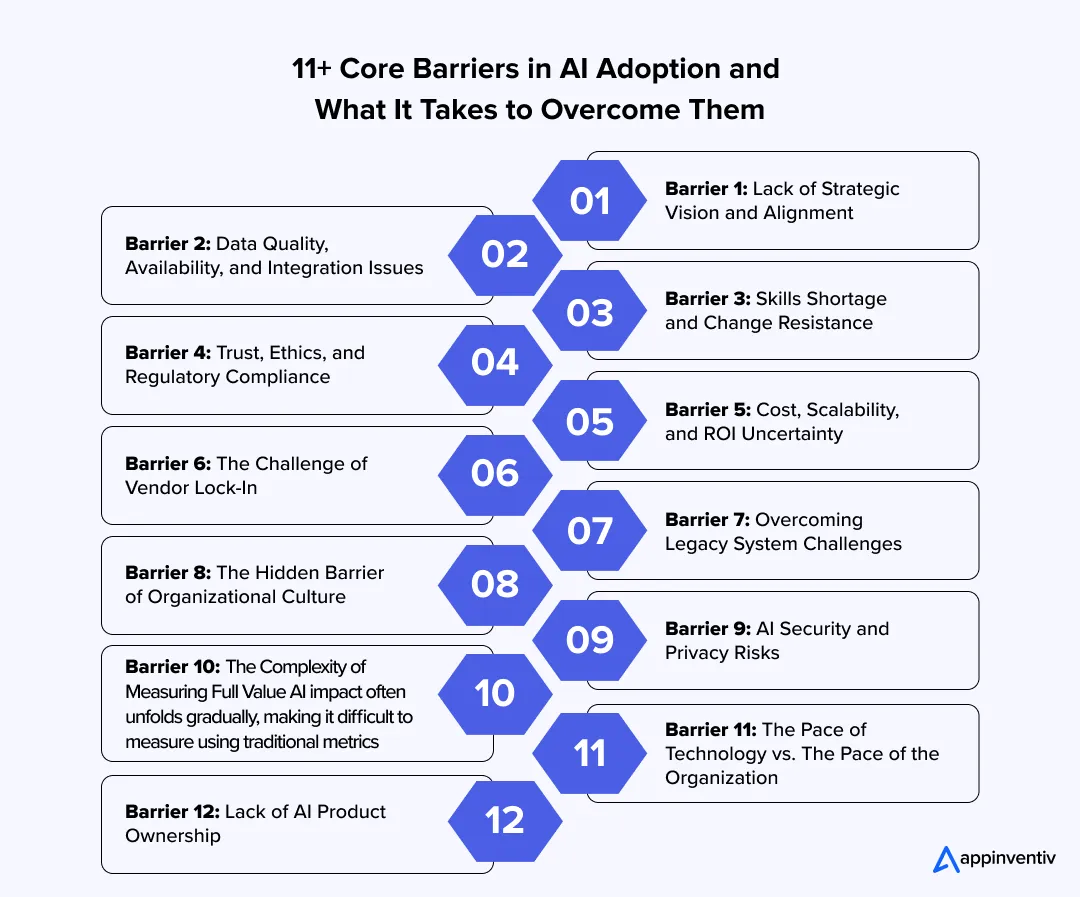
Barrier 1: Lack of Strategic Vision and Alignment
AI initiatives are frequently not tied to a business goal. Projects focus on a few use cases, while the CEO demands business-wide transformation. As time passes, this leads to efforts being repeated, responsibilities being blurred, and money being wasted. Misalignment is one of many AI adoption challenges for enterprises.
Our Approach:
An amorphous AI strategy appears to be working at first. A small number of use cases are mapped to business objectives, short-term dependencies are identified, and the solution proceeds smoothly. It gives an illusion of focus and progress. However, this initial alignment is often superficial; it merely conceals underlying gaps in ownership, prioritization and ongoing accountability that often rear their heads as scale is increased.
We overcome this by following a smooth AI implementation process that progressively uncovers and re-aligns these gaps as initiatives roll out, rather than enforcing hard alignment.
Real World Use Case:
Italgas struggled not with technology but with alignment across business units. In 2024, 18 cross-functional teams worked in four-month sprints, each backed by a C-level sponsor. This structure helped move fragmented pilots into coordinated execution, showing how alignment, not tooling, unlocked scale.
Barrier 2: Data Quality, Availability, and Integration Issues
Data is rarely ready for AI. It sits in silos, varies in quality, and often cannot move across systems. These issues form a major part of enterprise AI adoption challenges, where fragmented data directly limits model performance.
Our Approach:
Early integrations can create a false sense of progress. A few systems connect, dashboards populate, and outputs begin to look usable. This gives the impression that the data problem is solved. In reality, inconsistencies and gaps remain buried until scale exposes them.
We handle this in layers, improving reliability over time instead of forcing a complete fix upfront, especially when introducing AI into legacy systems, where most enterprise AI implementation challenges tend to surface and compound.
Real World Use Case:
Starbucks processes over 90 million transactions each week across 40,000+ stores, supported by 31 million active Rewards users. Their recommendation engine now drives nearly 50% of revenue. This did not come from data volume alone but from years of refining how fragmented data was unified and applied.
Barrier 3: Skills Shortage and Change Resistance
Technology alone does not drive adoption. Teams often hesitate to engage deeply with AI, creating one of the most common obstacles to AI adoption seen across organizations. As highlighted in Deloitte’s State of AI 2026 report, insufficient workforce skills remain the biggest barrier to integrating AI into workflows, yet fewer than half of organizations are making real talent strategy changes, with most (53%) limiting efforts to basic AI fluency training.
Our Approach:
Training programs and easy tools can generate quick interest. Employees begin experimenting, and early usage rises. However, this engagement often stays limited if it does not connect to actual work.
We introduce AI gradually into daily workflows, allowing familiarity to build while addressing deeper AI adoption challenges for enterprises that surface beyond initial training.
Real World Use Case:
Unilever’s workforce programs led to a 41% increase in productivity and a 20% rise in internal collaboration. These results came only after AI was embedded into everyday processes, not during early reskilling phases.
Barrier 4: Trust, Ethics, and Regulatory Compliance
As AI systems integrate into critical business functions, concerns over privacy, data security, and ethics grow. With new regulations like the EU AI Act and India’s DPDPA, regulatory challenges in AI have become more complex than ever. Overcoming these AI governance and compliance challenges requires a proactive approach.
Our Approach:
Initial compliance with basic governance policies can instill confidence. Processes look compliant, and AI risks are managed. But over time, issues of explainability and auditability emerge.
We embed AI-powered data governance into the system itself, and it will adapt to how it is used and resolve AI adoption challenges for enterprises as they arise.
Real World Use Case:
DBS has brought more than 1,500 AI models to fruition in 370 use cases and shortened the time to market from 15 months to less than 3 months. They created SGD $750 million in value through governance in 2024 and are expected to surpass SGD $1 billion, demonstrating that trust frameworks drive scale.
Barrier 5: Cost, Scalability, and ROI Uncertainty
AI investments are difficult to justify when value is not immediately visible. This uncertainty drives ongoing enterprise AI adoption challenges and discussions on AI scalability, costs, and RoI at leadership levels.
Our Approach:
Early pilots often show promising returns. Costs seem manageable, and results appear strong enough to expand. But these early signals rarely reflect the complexity of scaling, where infrastructure, maintenance, and integration costs increase.
We surface these realities over time, helping teams navigate AI scalability challenges without relying on early-stage assumptions.
Real World Use Case:
Unilever targeted €800 million in savings over three years, achieving nearly €200 million within the first year. Individual AI deployments reduced cleaning time by 20%, utility usage by 10%, and saved €100,000 annually per site, proving value before scaling further.
Barrier 6: The Challenge of Vendor Lock-In
Heavy reliance on a single vendor reduces flexibility and increases long-term risk. This remains one of the more strategic AI adoption barriers in enterprises and often shows up during AI maturity assessment as systems start scaling and dependencies become harder to unwind.
Our Approach:
Multi-vendor setups can feel flexible early on. Systems integrate smoothly, and switching appears manageable. Over time, hidden dependencies build within workflows and data layers.
We manage this carefully, maintaining flexibility where it matters while avoiding unnecessary complexity tied to enterprise AI implementation challenges.
Real World Use Case:
BMW’s multi-vendor strategy supported 1,800 active users generating 10,000 searches through its AI system. By combining in-house and external tools, they avoided lock-in while scaling usage across global teams.
Barrier 7: Overcoming Legacy System Challenges
Legacy systems limit how quickly AI can be deployed. Integration becomes slow and resource-heavy, leading to ongoing challenges in AI adoption and deployment — friction that a forward-deployed engineer working inside those same systems is positioned to resolve faster than a remote advisory team.
Our Approach:
Quick integrations can make legacy systems seem AI-ready. Data begins to flow, and early use cases go live. This creates confidence that deeper issues are resolved. In reality, underlying constraints remain.
We address such enterprise AI adoption challenges incrementally, aligning modernization with broader AI adoption challenges for enterprises managing complex systems.
Real World Use Case:
JPMorgan saved $1.5 billion through AI-driven fraud detection and operational improvements. Over 200,000 employees now use its AI tools, while fraud losses dropped by 40%, showing that phased integration can work at scale.
Barrier 8: The Hidden Barrier of Organizational Culture
Cultural barriers can be nuanced. Teams don’t necessarily refuse to use AI, but may slow down its adoption or restrict its use. This makes it one of the common barriers to AI adoption in business.
Our Approach:
Initial involvement with AI co-pilots or chatbots can generate interest. Groups engage and play with scenarios. But this can wane unless it translates to work tasks.
We focus on embedding AI into everyday responsibilities, gradually addressing challenges of AI adoption in business without forcing sudden change.
Real World Use Case:
Walmart cut its production cycle from 24-26 weeks to 6-8 weeks with AI. Their proprietary AI agents also reduced the time to answer employee questions by half, demonstrating the benefits of cultural change. Walmart also ran into agentic AI adoption challenges.
By mid-2025, the company began reshaping its approach, moving away from multiple single-purpose agents and toward a unified “super agent” framework to simplify how AI is built and used across the business.
Barrier 9: AI Security and Privacy Risks
AI systems expand the risk surface as they handle sensitive data across multiple systems. This remains a critical concern for enterprise-scale deployments.
Our Approach:
Initial security controls can make systems appear protected, with risks seeming contained, and compliance looking manageable. Over time, new vulnerabilities emerge as integrations deepen.
We strengthen controls progressively by leveraging AI in cybersecurity, aligning with evolving AI adoption challenges for enterprises instead of relying on static safeguards.
Real World Use Case:
Apple’s AI strategy includes on-device processing using a ~3 billion parameter model, contributing to a 25% stock surge post-announcement. Their approach shows how privacy-focused design can scale without compromising performance.
Also Read: A Guide to Generative AI Security: What Every C-Suite Executive Needs to Know
Barrier 10: The Complexity of Measuring Full Value
AI impact often unfolds gradually, making it difficult to measure using traditional metrics. Gains rarely appear in a single line item. Instead, they spread across productivity, decision speed, and customer experience. This makes it harder to justify investment, especially in use cases of AI for business optimization challenges where outcomes are indirect.
Our Approach:
Early metrics highlight visible improvements such as speed or cost savings. These are easy to communicate, but incomplete. Broader value tends to emerge slowly, often across teams and functions that are not measured together.
We expand measurement in stages, allowing a clearer view of impact over time while addressing AI adoption challenges and solutions without forcing premature conclusions.
Real World Use Case:
Microsoft saw this challenge with its AI-assisted developer tools. GitHub Copilot users were able to complete coding tasks up to 55% faster in controlled studies, yet the real value extended beyond speed. Teams reported fewer context switches, faster onboarding for new developers, and improved code consistency. These benefits were harder to quantify immediately but became visible over time, showing that AI value often compounds outside traditional productivity metrics.
Barrier 11: The Pace of Technology vs. The Pace of the Organization
AI evolves faster than organizations can adapt. This gap creates delays, misalignment, and missed opportunities, reinforcing the need for a flexible AI adoption framework.
Our Approach:
Rapid iterations can give the impression of agility. Teams release frequently and adapt to new tools. However, this speed often hides coordination gaps and inefficiencies.
We maintain flexibility while controlling expansion, helping organizations keep pace without amplifying AI scalability challenges.
Real World Use Case:
Marriott invested between $1 billion and $1.2 billion in technology, deploying AI across 1.2 million rooms and supporting 200 million users. Their phased approach allowed steady adoption while managing complexity at scale.
Barrier 12: Lack of AI Product Ownership
AI projects often start with co-ownership by data, engineering and business. On the surface, it’s “collaborative” but it can be confusing. When issues arise, responsibility becomes unclear, slowing decisions and progress, especially in areas tied to responsible AI implementation.
Our Approach:
Early collaboration often creates momentum. Teams feel aligned, roles seem clear, and initial milestones get completed smoothly. However, as systems grow, unclear ownership leads to delays in decision-making and unresolved dependencies.
We progressively establish ownership while the systems are operational, rather than letting operational issues bring problems to the surface.
Real World Use Case:
Uber initially built machine learning systems for pricing and routing across various teams. As the system grew globally, a lack of ownership resulted in redundant models and inconsistent results in different geographies. Uber subsequently unified its ML systems in a platform named Michelangelo, which streamlined model training, deployment and monitoring, enhancing collaboration and eliminating duplicate efforts.
Partner with an AI consulting team trusted by global enterprises.

Putting It All Together: Your Strategic Framework for AI Success
After navigating through these eleven barriers, you might be wondering where to start. The key is recognizing that these challenges cluster into four distinct categories. By understanding which poses your greatest risk, you can build a robust AI adoption framework that addresses your organization’s specific needs first.
| Category | Barriers | Key Stakeholders | Priority Focus |
|---|---|---|---|
| Strategic Foundation | Vision alignment, ROI challenges, Defining value measurement | CEO, Business Leaders | Develop a clear strategy and define success metrics |
| Technical Infrastructure | Data quality issues, Integration with legacy systems, Vendor lock-in challenges | CTO, IT Teams | Modernize existing systems and improve infrastructure architecture |
| Human Capital | Skills gap, Organizational culture misalignment, Rapid technology evolution | CHRO, Department Heads | Focus on training, upskilling, and effective change management |
| Risk & Governance | Ethical concerns, Data security vulnerabilities | CISO, Legal Teams | Establish strong compliance, governance, and security protection protocols |
Your Prioritization Roadmap
Start Here: Focus on the Strategic Foundation first because, without a clear vision, technical investments will be wasted. Simultaneously address basic risk and governance to avoid costly mistakes.
Scale Here: Once the strategy is clear, prioritize technical infrastructure to move from pilot to production, while investing heavily in human capital to drive adoption.
Critical Success Questions
Before your next AI initiative, ensure you answer:
- Can you articulate exactly how AI will transform your core business processes?
- Do you have the budget, talent, and executive support to scale beyond pilots?
- Have you established governance protocols to manage AI risks appropriately?
- Can you measure AI’s impact beyond cost savings to include strategic value?
The path from AI aspiration to advantage isn’t about overcoming individual barriers; it’s about building an integrated approach. Organizations that treat these eleven barriers as a strategic checklist, rather than isolated problems, successfully transform from AI experimenters into AI leaders. Your competitors face these same challenges. The difference between success and “pilot purgatory” lies in how systematically you address them.
Partner with us to scale AI the right way.

How Appinventiv Helps You Overcome AI Adoption Barriers
Breaking through AI adoption barriers requires more than just technical expertise; it demands a partner who understands your unique challenges and delivers proven solutions. As a leading AI development services provider and Deloitte Technology Fast 50 Award winner for consecutive years (2023 & 2024), we stand as the #1 company in the Digital & Cloud Tech category, making us the ideal partner to accelerate your AI transformation journey.
Why Global Leaders Trust Our AI Excellence:
With over 1,600 tech experts across 35+ industries, we have consistently delivered breakthrough AI solutions for world-renowned brands.
For a leading global banking institution, Appinventiv developed comprehensive AI-powered solutions that transformed customer service operations. This intelligent chatbot system started handling over 50% of customer service requests across mobile, web, and messaging platforms.
Key Results:
- 20% reduction in operational costs through automated query resolution
- 20% improvement in customer retention via 24/7 availability
- Seamless NLP-driven understanding of complex banking queries
- Automated routine tasks: balance inquiries, card activation, bill payments, transaction history
The hybrid AI-human approach ensures immediate assistance for routine transactions while maintaining personalized support for complex decisions, positioning our client as an industry leader in digital banking innovation.
Our certifications include:
- ISO 9001:2008 – Quality Management System certification for consistently delivering services that meet customers’ needs and expectations
- ISO-27001 & CMMI Level 3 – Advanced security and process improvement certifications ensuring enterprise-grade, GDPR-compliant software development
From concept to deployment, we, as a trusted AI consulting company, transform AI adoption challenges into competitive advantages, helping you unlock innovation, enhance efficiency, and scale with confidence in today’s rapidly evolving digital landscape.
Contact us today to break through your AI adoption barriers and unlock transformative growth.
FAQs
Q. What are the biggest challenges in enterprise AI adoption?
A. Here are some of the biggest AI or generative AI adoption challenges in enterprises:
- Data quality and fragmentation
- Legacy system integration
- Talent and skill gaps
- High infrastructure and implementation costs
- Leadership alignment issues
- Workforce resistance to AI adoption
Q. How to overcome data privacy challenges in AI implementation?
A. Begin with comprehensive data governance – identify existing data assets and establish access protocols accordingly. Integrate privacy safeguards directly within AI architectures from project inception, avoiding retrofitted implementations. Methods including data anonymization, cryptographic protection, plus differential privacy techniques, help secure sensitive information while enabling effective machine learning processes. Maintain compliance with regulatory frameworks like GDPR alongside regional privacy legislation.
Systematic security assessments identify vulnerabilities before they escalate into significant incidents. Communicate transparently with customers regarding data utilization practices and provide meaningful control over their personal information. Establishing trust requires considerable time, yet destroying it occurs rapidly.
Q. How do enterprises address AI scalability challenges?
A. Most organizations approach AI scalability through targeted pilot initiatives, subsequently expanding proven methodologies that demonstrate measurable success. Cloud infrastructure proves crucial – enabling dynamic resource scaling adjustments without requiring massive upfront capital investments. Building modular AI system architectures helps significantly, allowing new capability additions without rebuilding existing systems from scratch.
Data pipelines require sufficient robustness to handle rapidly expanding volumes without experiencing system failures. Many companies increasingly invest in MLOps platforms for automating model deployment and monitoring processes. The key involves planning for growth from the outset while maintaining appropriate technical foundations to support expansion as demand increases.
Q. How to overcome AI adoption challenges?
A. The biggest challenges of AI implementation in enterprises are related to fragmented execution. Let’s see how to overcome those:
Lack of strategy alignment → Set business-focused AI objectives
Data quality → Data improvement and integration early
Lack of skills and training → Targeted training and enablement
Legacy systems → Step-wise transformation and integration
Governance issues → Design for compliance
Addressing AI adoption challenges for enterprises requires structured planning, phased rollout, and continuous feedback loops across business and tech teams.
Q. Why do many AI projects fail to scale in enterprises?
A. AI often struggles to scale because it’s stuck in pilot mode with no clear operational integration process. Lack of ownership, data isolation and lack of ROI impede progress. These AI adoption barriers in enterprises result in isolated deployments that stay in pilot mode, and organizations struggle to transform initial success into enterprise-wide value or long-term growth.
Q. What role does data play in AI adoption success?
A. Data is the lifeblood of AI systems, and the quality of the data is critical to the success of the system. Siloed, unstructured or poorly managed data results in biased AI models and insights. Data consistency is one of the top AI adoption challenges in enterprises. Effective data governance, integration and accessibility allow scalable AI, whereas siloed data ecosystems limit accuracy, trust and business impact.
Q. How does Appinventiv help businesses overcome AI adoption barriers?
A. Here’s how Appinventiv can help with AI adoption barriers in enterprises:
Enterprise AI Adoption Strategy: We connect AI directly to enterprise outcomes, shaping a focused enterprise AI adoption strategy that prevents scattered pilots and drives measurable impact.
Scalable AI Systems: We build AI solutions that hold up under real enterprise load, ensuring they perform reliably as data, users, and complexity grow.
AI Transformation Challenges: We help organizations move past AI transformation challenges by structuring delivery in a way that reduces risk and avoids disruption to ongoing operations.
Workflow Integration: We embed AI into existing workflows and legacy systems so adoption happens within current work patterns, not outside them.
Data & Governance: We strengthen data quality and governance, so AI outputs remain consistent, reliable, and fit for decision-making.
Q. What is the cost of AI adoption in business?
A. The cost of AI adoption ranges in complexity and size. Basic systems can cost $50,000-$150,000, enterprise-level systems $200,000-$750,000 or more, and complex AI projects can cost upwards of $1 million. Factors include data preparation, model building, integration and ongoing maintenance. The total cost varies based on use case complexity, existing systems, and scalability needs across functions.


Fast 2-minute response, fully NDA-protected.

AI Data Integration: How to Connect, Clean and Prepare Data for AI
Key takeaways: AI initiatives fail when fragmented, poor-quality data reaches models without sufficient context, controls or ownership. AI-ready pipelines must connect, clean, enrich, govern and continuously monitor data across its lifecycle. Real-time processing matters when AI decisions depend on current transactions, events, inventory or operational conditions. Data architecture should follow the AI use case, balancing…

AI-Native SDLC: Foundational 90-Day, 5R AI SDLC Adoption Playbook
Key takeaways: Why AI coding tools accelerate coding and software delivery How AI-native SDLC shifts engineering from code to intent, context, and outcomes The role of specifications, AI agents, and continuous verification in enterprise delivery How to redesign engineering teams for human–agent collaboration The platform, governance, and guardrails required to scale AI-native development A practical…

AI Agent Governance: How to Govern Autonomous AI Across Business Systems
Key takeaways: AI agents require controls at the action, identity, data, tool, and workflow levels. Every enterprise agent should have a registered owner, an approved purpose, and a defined risk tier. Access must be based on the agent’s task rather than inherited from a human user or shared service account. High-impact actions need real-time policy…