






























How to Choose a Technology Partner for Government Software Development

 Share -



- 0110 Criteria for Choosing a Government Technology Partner in Australia
- 02A Practical 5-Layer Framework to Evaluate Technology Partners
- 03What Should a Government Architecture Review Cover?
- 04How to Assess Total Cost of Ownership?
- 05Red Flags to Watch for When Selecting a Government Technology Partner
- 06Strategic Next Steps: Moving from Procurement to Partnership
- 07Questions to Ask Before Signing a Government Software Development Partner
- 08How Appinventiv Approaches Government Software Development?
- 09Final Checklist: Is Your Technology Partner Government-Ready?
- 10FAQs

Key takeaways:
- Evaluate the partner across five layers: procurement eligibility, assurance, engineering, delivery and long-term ownership.
- Choose a government technology partner on evidence, governance and delivery depth, not development capability alone.
- Match partner evaluation criteria to the security, integration and operational risks of the programme.
- Treat data sovereignty, privacy, accessibility and security as architecture decisions from the beginning.
- Test AI proposals for governance, evaluation, human oversight and operational value before implementation.
Government software programmes carry a different level of accountability from conventional enterprise technology projects. The technology must work for citizens, integrate with existing government environments, protect sensitive information, and remain defensible under audit and procurement scrutiny.
Australia’s Digital Experience Policy came into effect on 1 January 2025 and applies to investments subject to the Investment Oversight Framework. Its supporting standards cover digital inclusion, access, performance and the Digital Service Standard. Existing public-facing services had a further Digital Service Standard implementation date of 1 July 2025.
That changes what agencies should expect from a technology partner for government. Development capability alone is not enough. The right partner should have evidence of government delivery, procurement readiness, security, privacy and data governance, architecture, interoperability, accessibility, responsible AI, delivery capability and long-term support.
The most reliable way to evaluate a partner is to test five areas: procurement eligibility, assurance, engineering capability, delivery governance and long-term ownership. This shifts the selection process from “Who can build it?” to “Who can safely design, deliver, operate and transition it?”
If your department is preparing for a major system upgrade, understanding these foundational evaluation metrics will help you mitigate vendor risk, ensure regulatory alignment, and deliver robust citizen outcomes.
To help you navigate this process, we have outlined the critical criteria and frameworks required to make an informed, risk-averse procurement decision.
Start with a partner assessment before committing to development.
10 Criteria for Choosing a Government Technology Partner in Australia
The right government technology partner should reduce delivery and operational risk while strengthening the agency’s internal capability. Evaluation should cover the complete technology lifecycle, from discovery and architecture through development, migration, launch, security operations and eventual transition. Each criterion below addresses a different risk that can materially affect public-sector software outcomes.
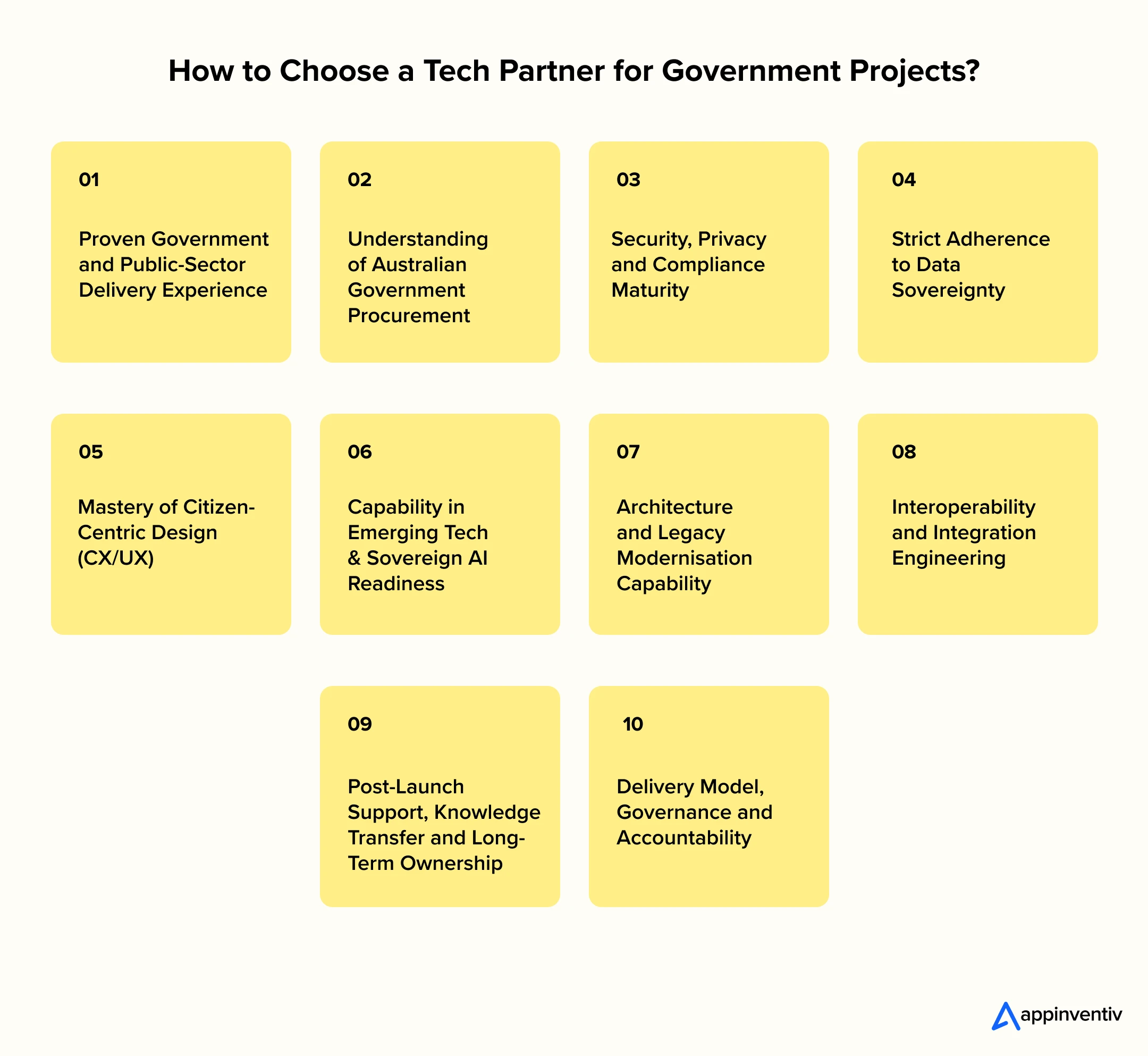
1. Proven Government and Public-Sector Delivery Experience
Public sector environments carry distinct operational realities. Your technology partner must demonstrate a history of navigating departmental approvals, accessibility standards, and public scrutiny.
Look for vendors who have delivered comparable government programmes rather than generic enterprise case studies. Ask whether the software development technology partner has worked with public-sector data, legacy platforms, accessibility requirements, formal governance and multi-stakeholder environments.
Do not stop at logos or high-level case studies. Ask the partner to demonstrate what it actually engineered and how the delivery was governed. Request references that explain:
- The problem being solved
- Existing systems involved
- Security and compliance requirements
- Integration complexity
- Delivery model
- Measurable operational outcomes
- Architecture decisions and major technical constraints
- Migration or modernisation approach
- How risks, incidents and scope changes were handled
- What the agency retained internally after handover
A partner should be able to explain what changed technically, not just present a polished project summary.
2. Understanding of Government Procurement
Government procurement experience affects more than contract administration. A partner should understand how panel arrangements, statements of work, evaluation criteria, security requirements, commercial terms and accountability mechanisms affect delivery.
For federal work, check relevant DTA marketplace arrangements. For state and local programmes, assess the partner’s experience with applicable jurisdictional procurement frameworks.
Firms actively listed on state-based ICT panels or the Whole of Australian Government (WoAG) marketplace often already meet foundational procurement standards, significantly accelerating the engagement process.
The current Commonwealth Procurement Rules took effect on 17 November 2025. For non-corporate Commonwealth entities, the general non-construction procurement threshold is now $125,000, subject to the applicable rules and exemptions.
For partner evaluation, check:
- Relevant panel or marketplace arrangements
- Ability to respond to government statements of work and evaluation criteria
- Security and commercial documentation
- Insurance and subcontracting arrangements
- Contract governance and reporting capability
- Ability to provide transparent pricing and assumptions
3. Security, Privacy and Compliance Maturity
Security should be demonstrated through engineering practices, not presented as a certification list. Evaluate how the partner handles secure development, identity, privileged access, vulnerability management, logging, incident response, penetration testing and security testing throughout the SDLC.
Your vendor must align with the Information Security Manual (ISM) and the Essential Eight framework. They need certified maturity, possessing ISO 27001 and SOC2 credentials, to ensure threat mitigation is engineered directly into the software lifecycle.
For government projects, ask how the proposed architecture supports the agency’s required security maturity rather than assuming the partner’s existing controls automatically transfer to the project.
4. Strict Adherence to Data Sovereignty
Under the Privacy Act and various state records acts, public sector data must remain onshore and strictly governed. Evaluate how a vendor handles cloud infrastructure and data processing. A reliable technology partner should clearly explain:
- Where production data will reside
- Where backups will be stored
- Who can administer infrastructure
- Where support personnel are located
- How cross-border access is controlled
- What happens when data is replicated or processed by third parties
Privacy obligations also vary across jurisdictions. The OAIC notes that the federal Privacy Act does not generally cover state and territory government agencies, which are often subject to their own privacy legislation.
The technology partner therefore needs to understand the agency’s actual jurisdiction and data environment.
5. Mastery of Citizen-Centric Design and Accessibility
Government software cannot be judged only by technical performance. A service can meet its functional requirements and still create barriers for the people expected to use it. The DTA’s Digital Experience Policy introduced standards covering digital inclusion, access and performance, alongside the Digital Service Standard.
It means vendors must prove their capability in designing to WCAG 2.1 AA standards or higher. The design approach should prioritise intuitive navigation, inclusive interfaces, and rigorous usability testing across diverse demographics to prevent digital exclusion of vulnerable user groups.
Assess whether the partner can demonstrate:
- User research
- Accessibility testing
- Service design
- Plain-language interfaces
- Mobile and assistive technology considerations
- Performance monitoring
- Continuous service improvement
This becomes particularly important when modernising a public-facing service used by diverse communities.
6. Capability in Emerging Technology and Responsible AI Readiness
AI should be assessed as an engineering and governance capability, not as a marketing category.
For Commonwealth government agencies, the current Policy for the Responsible Use of AI v2.0 has applied since 15 December 2025. It establishes mandatory requirements covering areas such as accountable officials, transparency, AI strategy, operational controls, use-case accountability, internal use-case registers, staff training and impact assessment for non-corporate Commonwealth entities.
A capable partner should explain an ability to implement intelligent automation and machine learning within strict ethical boundaries. The assessment should focus on whether the partner can establish appropriate data controls, model evaluation, human oversight, transparency, monitoring and risk management for the specific use case. Avoid treating “sovereign AI” or mathematical verifiability as a universal technical requirement.
A practical AI delivery flow is:
Business Need → Data Assessment → AI Suitability → Risk Assessment → Model Design → Evaluation → Human Oversight → Controlled Deployment → Monitoring → Review
The partner should also explain how models can be replaced, retrained or withdrawn without destabilising the wider system.
7. Architecture and Legacy Modernisation Capability
Government agencies rarely start with a clean technology environment. Legacy applications, ageing databases, custom integrations and manual processes often sit alongside newer cloud services.
A strategic technology partner should be able to modernise legacy systems incrementally where replacement carries unacceptable operational risk.
A typical modernisation pathway is:
Legacy Systems → Discovery & Dependency Mapping → Target Architecture → Integration Layer → Modern Services → Data Migration → Controlled Cutover → Validation → Continuous Optimisation
Ask for architecture examples showing how the partner handled dependencies, migration sequencing, rollback, data reconciliation and coexistence between old and new systems.
Architecture due diligence should cover at least five views:
- Application architecture
- Data architecture
- Integration architecture
- Security architecture
- Cloud/platform architecture
8. Interoperability and Integration Engineering
The value of a government platform often depends on how well it communicates with the systems around it.
Therefore, you must evaluate a partner’s capability across APIs, event-driven integration, identity services, data platforms, payment systems, enterprise applications and third-party services.
The architecture should make system boundaries explicit:
Citizen / Staff Channels → Digital Services → API & Integration Layer → Core Systems → Data Platforms → Analytics / AI
A partner that focuses heavily on the front-end while treating integration as a later task can create significant technical debt.
9. Post-Launch Support, Knowledge Transfer and Long-Term Ownership
Launch day is just the beginning of the software lifecycle. Security patches, platform upgrades, policy changes, integration changes and user feedback continue throughout its operating life.
A long-term technology partner should define what happens after implementation. You should access:
- Service-level commitments
- Incident response
- Security patching
- Application monitoring
- Documentation
- Knowledge transfer
- Internal team training
- Technology refresh
- Vendor-exit arrangements
A strong partner should leave the agency with greater visibility and internal capability.
10. Delivery Model, Governance and Accountability
A delivery model should make responsibility visible. Governance structures must clearly delineate who owns specific outcomes. A formal responsibility matrix prevents ambiguity during critical development phases, ensuring that both the agency and the partner remain accountable for their respective domains.
| Area | Agency | Technology Partner |
|---|---|---|
| Business outcomes | Owns | Supports |
| Product priorities | Owns | Supports |
| Architecture | Joint | Joint |
| Development | Oversight | Owns delivery |
| Security | Joint | Joint |
| Data governance | Owns | Supports |
| Testing | Joint | Leads execution |
| Knowledge transfer | Joint | Leads delivery |
| Risk management | Owns programme risk | Owns delivery and technical risks |
| Incident response | Governance/escalation | Technical response |
| Cloud/platform operations | Oversight | As contracted |
| AI governance | Accountability | Technical implementation/support |
| Exit planning | Owns transition decision | Provides transition support |
This model avoids a common failure mode where the agency assumes the partner owns business outcomes while the partner assumes it is responsible only for technical delivery.
Also Read: Application Development Outsourcing in Australia: How to Find the Right Development Partner
A Practical 5-Layer Framework to Evaluate Technology Partners
A useful evaluation framework gives the agency control over the decision. Rather than producing a generic vendor ranking, assess each technology partner for software development against documented evidence and weight the criteria according to programme risk.
Use a five-layer assessment before moving to final commercial negotiations:
| Layer | What to test | Evidence to request | Primary risk addressed |
|---|---|---|---|
| 1. Procurement eligibility | Can the supplier be engaged through the intended pathway? | Panel/marketplace information, procurement documentation, commercial terms | Procurement delay |
| 2. Assurance | Can the supplier meet the programme’s security, privacy, accessibility and AI obligations? | Security evidence, architecture controls, testing approach, relevant certifications | Compliance and assurance risk |
| 3. Engineering | Can it design and build the required system? | Architecture, integration, migration and technical case studies | Technical failure |
| 4. Delivery | Can it manage delivery, dependencies and change? | Governance model, team structure, reporting and escalation process | Schedule and budget risk |
| 5. Ownership | Can the agency operate, evolve or transition the platform? | SLA, knowledge-transfer plan, TCO model and exit plan | Vendor lock-in and operating risk |
The agency can then score suppliers internally using its own procurement methodology and programme-specific weighting. The purpose of the framework is to structure evidence collection, not to create a universal vendor ranking.
Weight criteria according to project risk
Not all digital projects carry the same risk profile. Adjust your scoring matrix based on the specific context of the system being built.
- Citizen-facing service: prioritise accessibility, service design, reliability and security.
- Sensitive data platform: prioritise security, hosting, data governance and integration.
- Legacy modernisation: prioritise architecture, migration, integration and change management.
- AI-enabled government system: prioritise AI governance, data quality, evaluation, security and human oversight.
- Large Commonwealth ICT investment: assess reuse opportunities, whole-of-life cost and alignment with applicable Australian Government Architecture requirements.
This makes the selection process more defensible because the evaluation reflects the actual consequences of failure.
What Should a Government Architecture Review Cover?
Before development begins, ask the shortlisted partner to walk through a target architecture rather than relying only on a proposal document.
A government architecture review should examine:
- Business and service architecture: user journeys, business capabilities and service dependencies
- Application architecture: applications, modules, ownership and lifecycle
- Data architecture: data stores, classification, movement, retention and access
- Integration architecture: APIs, events, identity, third-party dependencies and failure handling
- Security architecture: trust boundaries, IAM, encryption, monitoring and threat controls
- Cloud/platform architecture: environments, scalability, availability, backup and disaster recovery
- Operational architecture: observability, incident response, patching and service management
- Transition architecture: migration stages, coexistence, cutover and rollback
- Exit architecture: portability, documentation, data export and supplier transition
The partner should be able to explain which components are reused, which are new, why each major technology decision was made and what the long-term operating implications are.
How to Assess Total Cost of Ownership?
Development cost alone is an incomplete basis for comparing government technology partners. A lower implementation quote can produce a higher whole-of-life cost if the platform requires expensive licences, complex integrations, manual operations or extensive vendor support.
Request a 3–5 year TCO model covering:
| Cost category | What to examine |
|---|---|
| Build | Development, testing, discovery and implementation |
| Cloud/platform | Hosting, compute, storage, networking and platform services |
| Licensing | SaaS, proprietary software, databases and third-party tools |
| Integration | APIs, middleware, data migration and external services |
| Security | Testing, monitoring, tooling and ongoing assurance |
| Operations | Support, maintenance, monitoring and incident management |
| Data | Storage, migration, retention, backup and transfer |
| AI | Model/API usage, evaluation, monitoring and retraining where applicable |
| Change | Enhancements, upgrades and regulatory or policy changes |
| Exit | Data extraction, documentation and supplier transition |
The objective is not to choose the lowest TCO automatically. It is to make the assumptions and long-term financial implications visible before contracting.
Red Flags to Watch for When Selecting a Government Technology Partner
Identifying vendor risk early in the procurement cycle prevents costly operational failures down the line. Agencies must remain vigilant against partners who overpromise on timelines or lack transparency regarding their architectural methodologies. Recognizing these common red flags will safeguard your project against non-compliance, unexpected technical debt, and severe delivery bottlenecks.
- No comparable public-sector delivery evidence
- A black-box development process
- Unclear data-hosting arrangements
- Security claims without supporting evidence
- Generic case studies with little technical detail
- Promises of unusually fast delivery without discovery
- Heavy dependence on unnamed subcontractors
- No clearly identified delivery leadership
- AI positioning without governance controls
- Proprietary architecture without an exit plan
- No defined post-launch ownership model
- Feature-led proposals with limited outcome measures
- No credible approach to legacy integration
- No TCO beyond the initial implementation
One particularly useful test is to ask the partner to explain what it would not build. Mature teams can usually identify unnecessary complexity, weak assumptions and avoidable technical risk.
Strategic Next Steps: Moving from Procurement to Partnership
The transition from vendor selection to delivery requires structured validation. Before signing long-term contracts, agencies should test the vendor’s technical capability and cultural alignment. Taking a phased approach to onboarding reduces financial risk while ensuring the chosen partner truly understands the operational realities of the department.
Start With a Discovery Phase
Use a paid technical discovery or tightly scoped proof of concept where the programme carries material uncertainty.
This initial engagement allows you to evaluate the vendor’s architectural approach, compliance understanding, and communication cadence before committing to the full development budget. It provides tangible insight into how they handle complex problem-solving.
Verify Procurement Readiness
Prioritise vendors who are approved sellers on the DTA Digital Marketplace or relevant state-level ICT services schemes, such as the NSW Government ICT scheme. These vendors have already passed stringent financial, legal, and operational vetting.
Test the Long-Term Operating Model
Do not evaluate implementation separately from operations. Ensure the partner offers robust post-launch support.
Ask who will monitor the platform, handle vulnerabilities, manage cloud infrastructure, maintain integrations, update documentation and support internal teams after launch.
A useful lifecycle is:
Discover → Architect → Build → Assure → Deploy → Operate → Optimise → Transfer
Bring architecture, modernisation, integration and AI governance together under one accountable delivery model.

Questions to Ask Before Signing a Government Software Development Partner
Interrogating a vendor’s methodology exposes the depth of their engineering and governance maturity. The questions you ask during final evaluations must push past commercial pleasantries and address worst-case scenarios, architectural constraints, and long-term financial liabilities. Use these targeted inquiries to validate their government-led capability before signing the contracts.
Technical Questions
- What architecture would you recommend for this specific environment and why?
- How will legacy systems be integrated without disrupting current public services?
- How will application scalability be handled during sudden spikes in citizen demand?
- How will vendor lock-in be reduced through the use of open standards and APIs?
Security Questions
- How is security embedded into your daily development and deployment pipelines?
- Who explicitly owns security responsibilities across the application and infrastructure layers?
- How are vulnerabilities managed, documented, and patched post-launch?
- How is highly sensitive citizen data handled during testing and production?
- How are threat modelling, SAST, DAST, SCA and penetration testing incorporated into delivery?
Delivery Questions
- Who will actually work on the project, and what is their level of public sector experience?
- How are technical risks and project delays escalated to the steering committee?
- How are scope changes controlled and documented to prevent budget overruns?
- What happens commercially and operationally if delivery milestones slip?
Commercial Questions
- What is explicitly included in the baseline development scope?
- What specific scenarios or requests create additional costs?
- What are the ongoing support, hosting, and maintenance costs post-launch?
- Who owns the intellectual property and source code upon project completion?
- What is the estimated 3–5 year total cost of ownership?
AI Questions
- What AI components are actually necessary to solve the business problem?
- How are algorithmic models evaluated for bias, accuracy, and security?
- How is human oversight implemented in automated decision-making workflows?
- What operational protocols trigger when AI output is incorrect or contested?
- How will the AI implementation be assessed for impact and risk?
How Appinventiv Approaches Government Software Development?
Choosing a digital product engineering partner in Australia ultimately comes down to evidence: relevant delivery experience, secure architecture, integration capability, governance and the ability to support the platform beyond launch.
Appinventiv’s 11+ years of software engineering approach brings these requirements together through government-aware development, secure architecture, legacy modernisation, responsible AI, integration engineering and local governance.
The focus is on building software around the agency’s operating environment, security obligations, data requirements and long-term ownership model rather than treating government programmes as conventional enterprise builds.
Let’s get a closer look at our capability of software engineering for the public sector:
Government-Aware Engineering
We approach government software programmes around the operational and governance requirements of the agency, rather than treating them as conventional enterprise applications.
Our team of 1700+ tech architects works across discovery, architecture, development, testing, deployment and post-launch support, with governance built into each stage. This gives government stakeholders clearer visibility into decisions, risks, dependencies and delivery progress
Secure and Sovereign Architecture
We treat data location, access control, auditability and security architecture as design decisions made early in the programme.
The engineering approach can be aligned with the agency’s required privacy, security and hosting obligations rather than retrofitting controls before launch.
Legacy Modernisation and Integration
Government environments often need modernisation without disrupting critical services. We assess existing applications, dependencies and data flows before defining the migration path.
Our approach combines API-led integration, staged modernisation and controlled migration so that agencies can replace or modernise legacy components without unnecessarily destabilising the wider ecosystem.
AI and Intelligent Automation
We assess AI against the actual business problem first. Where it is appropriate, we incorporate model evaluation, human oversight, data governance and monitoring into the architecture.
This keeps AI as part of a governed software system rather than treating it as an isolated feature.
Local Governance With Scalable Engineering Capability
Our commitment to executing at the highest level is validated by our operational footprint in Australia. We have successfully delivered 3000+ digital assets across the country, transforming operations in 35+ industries while maintaining a 90% client retention rate. Our development practices are backed by a 99.50% security compliance SLA, encompassing ISO and SOC2 standards, leading to measurable efficiency gains of up to 35% in Australian enterprises.
Panel Approval and Market Standing
Appinventiv Software is a vetted and trusted partner across multiple jurisdictions. We are listed as an approved Queensland Government ICTSS.1303B Panel Member (Q-7218) and are on the ICTSS.2403 ICT Professional Services arrangement. Furthermore, we are approved on the Federal Australian Government Digital Transformation Agency (DTA) Software and ERP Marketplace. This WoAG arrangement allows federal agencies to engage us with absolute confidence.
For an agency assessing a technology partner for government software, these arrangements address procurement eligibility.
If your agency is seeking a local technology partner capable of driving secure and compliant software development, contact our advisory team today to schedule a technical discovery session.
Final Checklist: Is Your Technology Partner Government-Ready?
Before signing with a local technology partner, use the checklist below to test whether the supplier is prepared for the full lifecycle of government software delivery.
☐ Relevant government/public-sector experience
☐ Understands Australian procurement
☐ Evidence of security engineering and relevant assurance
☐ Appropriate hosting and data-residency strategy
☐ Legacy modernisation capability
☐ Strong API/integration engineering
☐ Accessibility and service-design capability
☐ Transparent delivery governance
☐ AI governance and engineering capability
☐ Clear IP and ownership arrangements
☐ Knowledge-transfer plan
☐ Long-term support model
☐ Vendor-exit strategy
☐ Evidence-backed claims and references
☐ Architecture review covering application, data, integration, security and cloud
☐ Observability, resilience and disaster-recovery approach
☐ 3–5 year TCO model
☐ Reuse assessment where applicable
☐ Clear source-code, data and documentation transition arrangements
Making the final decision becomes significantly less risky when every box on this checklist is validated with hard evidence.
FAQs
Q. How to choose the right technology partner for software development?
A. Start by evaluating comparable delivery experience, architecture, security, procurement readiness, integration capability, accessibility, governance, AI capability and post-launch support. Then weight each criterion according to the risks of the specific government programme.
Q. What are the engagement models for a technology partner for government software development?
A. Common engagement models include project-based delivery, dedicated engineering teams, managed services, technical discovery engagements and longer-term technology partnerships. Government agencies should select the model based on governance needs, internal capability, programme complexity and expected operating responsibilities.
Q. What should government agencies consider when choosing a technology partner?
A. Agencies should consider security, privacy, data residency, procurement eligibility, architecture, interoperability, accessibility, delivery governance, commercial transparency, knowledge transfer and vendor exit. The weighting should reflect the programme’s specific operational and regulatory risks. For Commonwealth programmes, agencies should also consider applicable Australian Government Architecture policies, including reuse requirements, and the current government AI policy where AI is involved.
Q. What are the essential traits of a good software development partner?
A. The essential traits are technical depth, transparency, accountability, security maturity, integration expertise, strong communication and the ability to take ownership beyond the initial implementation.
Q. What should I consider before choosing a software development partner?
A. Before choosing a software development company, assess the partner’s relevant experience, proposed architecture, delivery team, security controls, commercial model, IP arrangements, support commitments and approach to knowledge transfer. Validate major claims through references, documentation and technical discussions before contract signing.


Fast 2-minute response, fully NDA-protected.
CRM Software for Local Government: From Community Requests to Better Service Delivery
Key takeaways: A council CRM should sit around existing systems as a service layer, not replace them. Integration with ERP, rates, property and GIS systems prevents another data silo and duplicate entry. Start with one high-volume service, pilot it with residents, then scale on measured results. Track resolution time, SLA compliance, self-service rates and cost…

The Ultimate Guide to CRM for Insurance: Features, Cost, Top Platforms, Integration & More
Key takeaways: CRM for insurance connects sales, service, and claims into one governed system, distinct from the policy administration system. Core features span pipeline management, policy visibility, claims tracking, commission management, AI analytics, and compliance controls. Cost ranges from roughly USD 15,000 for configuration to USD 150,000 and beyond for custom development at enterprise scale.…

Distributed Energy Resource Management System: Use Cases, Development and Implementation Costs
Key takeaways: Australian grids require robust software to manage minimum system load events effectively. DER integration software aggregates, monitors, and dispatches varied grid edge hardware securely. CSIP-Aus and AEMO compliance dictate strict architectural and cybersecurity software foundations. DERM development and implementation costs typically range from AUD 70,000 to 700,000 +. Successful DER programmes start with…