































How AI Is Transforming the Australian Insurance Industry in 2026: Opportunities, Challenges, and Future Trends

 Share -



- 01The State of AI Adoption in the Australian Insurance Industry in 2026
- 027 Opportunities for AI in the Insurance Industry in Australia, Transforming the Value Chain
- 03What Are The Business Benefits of AI in Insurance
- 04What Are the Key Challenges Slowing AI Adoption Across Australian Insurers and Their Solutions
- 05The 2026 Regulatory Horizon: Preparing for the Transparency Deadline
- 06What is the Future of AI in the Insurance Industry?
- 07How to Implement AI in Insurance for Australian Enterprises?
- 08How Appinventiv Can Help Insurers Build Responsible and Scalable AI Solutions?
- 09FAQs

Key takeaways:
- AI in the insurance industry in Australia has crossed from experimentation into operational deployment, with claims automation, fraud detection, and dynamic pricing delivering measurable returns.
- APRA’s April 2026 letter is a direct instruction to boards and executive management: AI governance, lifecycle ownership, and explainability are current compliance obligations enforced under existing prudential standards, not future expectations.
- The December 2026 transparency deadline for Automated Decision-Making will require every insurer using AI in pricing or claims decisions to document and explain algorithmic reasoning.
- Agentic AI represents the next material capability shift for the sector. The transition from generative AI to agentic systems that orchestrate complete workflows will compress operational timelines.
The Australian insurance market entered 2026 under pressure from several directions at once. Premiums remain elevated after years of claims inflation driven by severe weather events. Floods across Queensland and the Hunter Valley, followed by high-frequency bushfire seasons in Victoria and South Australia, have kept loss ratios structurally higher than historical norms. The cost-of-living squeeze has made affordability a genuine concern for both personal and commercial lines customers. And the competitive threat from InsurTech entrants (many of them AI-native by design) has intensified at exactly the moment established carriers are grappling with legacy system constraints.
Against this backdrop, AI in the insurance industry in Australia has moved from a technology investment to a strategic operating decision. The shift is not theoretical. IMARC Group data shows the Australian InsurTech market reached $376.7 million in 2025 and is projected to reach nearly $4.19 billion by 2034 at a CAGR of 30.68%, reflecting the pace at which digital transformation in Australia is reshaping the sector.
A joint 2026 report by the CSIRO and the Insurance Council of Australia positions artificial intelligence as the best lever available to improve customer outcomes. Those who cling to outdated tech risk losing market share fast.
This blog unpacks how AI in the insurance industry in Australia is creating new operating possibilities, the implementation challenges that are slowing responsible adoption, and the regulatory and technological trends that will define the next phase of transformation.
Evaluate the use cases, investment, timeline, and ROI of enterprise AI implementation with our experts.

The State of AI Adoption in the Australian Insurance Industry in 2026
The transition from experimental machine learning to operationalised AI marks a structural shift for Australian insurers. For decision-makers, the focus has moved from technical feasibility to scalable governance, ensuring that automated decision-making aligns with APRA expectations, delivers measurable commercial value, and integrates securely with existing core insurance platforms.
Why AI Has Become a Strategic Priority for Insurers
Several structural forces are converging to make AI adoption commercially necessary rather than aspirational. Rising claims costs driven by severe weather, compounding reinsurance price increases, growing complexity in commercial and liability lines, and the sustained operational cost of legacy platform maintenance have compressed margins across the sector. At the same time, customers expect faster claims settlement, more transparent pricing, and digital-first interaction.
Digital visibility adds another layer of pressure.
A June 2026 study revealed that AU insurers vanish from 70% of specific AI search answers. When people ask an AI engine about pet coverage or car discounts, seven out of ten times no brand gets recommended. This represents a massive missed opportunity for digital acquisition. Finding a way to capture that market share requires a smarter approach to data.
What APRA’s April 2026 Letter Means for Insurers
In April 2026, APRA issued its most significant communication on AI to date, drawing on a targeted supervisory review of large banks, insurers, and superannuation trustees conducted in late 2025.
The regulator found that AI adoption is accelerating across all its regulated industries, with entities moving from experimentation toward operationally embedded and customer-facing applications. However, the governance arrangements required to manage that deployment safely have not kept pace.
APRA identified specific and repeatable gaps: weak post-deployment monitoring, unclear lifecycle ownership for AI models, insufficient board-level technical literacy, inadequate contingency planning for single-provider concentration risk, and limited visibility into how third-party and fourth-party AI components behave at runtime.
The regulator made clear that it is not introducing new AI-specific prudential standards. Instead, it is enforcing existing obligations under CPS 230, CPS 234, CPS 220, and CPS 510 against AI-related conduct.
The practical message is unambiguous: any insurer that cannot demonstrate mature AI governance arrangements, including lifecycle ownership, model performance monitoring, and explainable decision outputs, is exposed to supervisory action.
Full details are available in the APRA Letter to Industry on Artificial Intelligence.
Where Australian Insurers Stand on the AI Maturity Curve
AI adoption in Australia is uneven. The maturity table below reflects where most Australian carriers currently sit, and the trajectory forward.
| Maturity Stage | Characteristics | Common Examples in the AU Market |
|---|---|---|
| Experimentation | Pilots, chatbots, document summarisation, copilots | Customer service bots, policy Q&A tools |
| Operational AI | Production deployment in core workflows | Claims automation, fraud scoring, underwriting assist |
| Predictive Insurance | Risk modelling, dynamic pricing, behavioural data | Climate risk pricing, telematics-based motor |
| AI-Native Insurance | Agentic workflows, autonomous decision support | End-to-end claims orchestration, embedded insurance |
Most established Australian insurers currently occupy the Operational AI tier, with selective capability in Predictive Insurance. The AI-Native tier remains largely the domain of InsurTech entrants with clean data architectures and cloud-native platforms.
7 Opportunities for AI in the Insurance Industry in Australia, Transforming the Value Chain
Across the Australian insurance value chain, AI is being deployed in a growing set of high-value applications. The use cases below represent areas where AI for insurance industry in Australia is generating measurable operational return, not future-state possibilities.
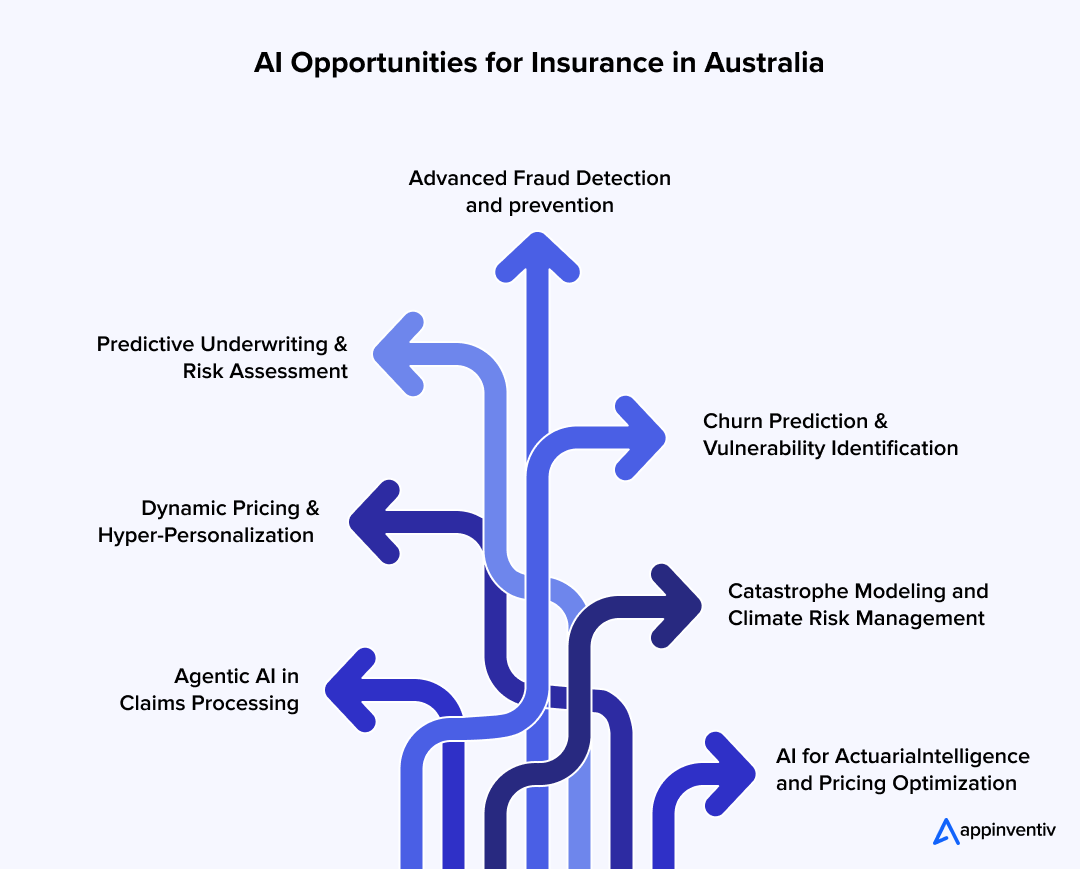
Agentic AI in Claims Processing
Old claims systems require humans to push paper from one desk to another. Agentic AI changes the game by actively solving problems. An autonomous agent can take a notice of loss, check policy limits, ask repair shops for quotes, and negotiate a basic settlement. The system operates inside tight rules. If a claim looks weird, it gets sent to a human adjuster immediately.
Dynamic Pricing & Hyper-Personalisation
Static yearly renewals feel outdated. Modern data pipelines pull information from connected devices and weather APIs constantly. This means AI in the insurance industry in Australia can adjust risk profiles in real time. Customers get prices that match their actual daily behaviour. This kind of personalised pricing builds loyalty and keeps the risk portfolio healthy over time.
Predictive Underwriting & Risk Assessment
Manual underwriting relies on basic demographic groups. Predictive models look at thousands of unique data points. They analyse satellite pictures of roofs and local economic data. Underwriters can finally price risks that used to look too complicated to touch. Commercial policies benefit heavily. Systems evaluate a business supply chain to build custom coverage exactly when needed.
Advanced Fraud Detection and Prevention
Fraud networks use fake identities and doctored photos constantly. Old rules based software flags too many innocent people. That frustrates good customers. Modern AI for fraud prevention neural networks to spot hidden relationships inside massive datasets. These systems score a claim in a fraction of a second. They catch the fraud before any money goes out the door.
Churn Prediction and Vulnerability Identification
Winning new customers costs too much money. Smart models study how customers interact with the company. They notice if someone complains about a premium increase and flag them as a churn risk. The General Insurance Code of Practice also demands that carriers help vulnerable people. AI tools analyse phone calls for signs of financial stress. They route those specific customers to a specialised support team right away.
Catastrophe Modeling and Climate Risk Management
Relying on old weather patterns is dangerous today. Insurance companies now mix deep learning with advanced meteorology data. They run thousands of disaster simulations. This lets them allocate capital better and buy the right reinsurance. Knowing the exact flood risk for a single street corner helps carriers manage their total exposure much more safely.
AI for Actuarial Intelligence and Pricing Optimisation
Actuaries usually waste hours cleaning up messy spreadsheets. AI automates that data cleanup easily. The math team can then focus on actually optimising prices. Machine learning programs run millions of simulations overnight. They find the exact price point that keeps the business profitable while staying competitive against other firms.
Identify the underwriting, claims, fraud, and customer experience use cases that deliver measurable returns.

What Are The Business Benefits of AI in Insurance
The benefits of AI insurance in Australia extend across three dimensions that matter to Australian businesses: operational efficiency, customer experience, and strategic positioning. The following reflects outcomes observed in production deployments, not modelled projections.
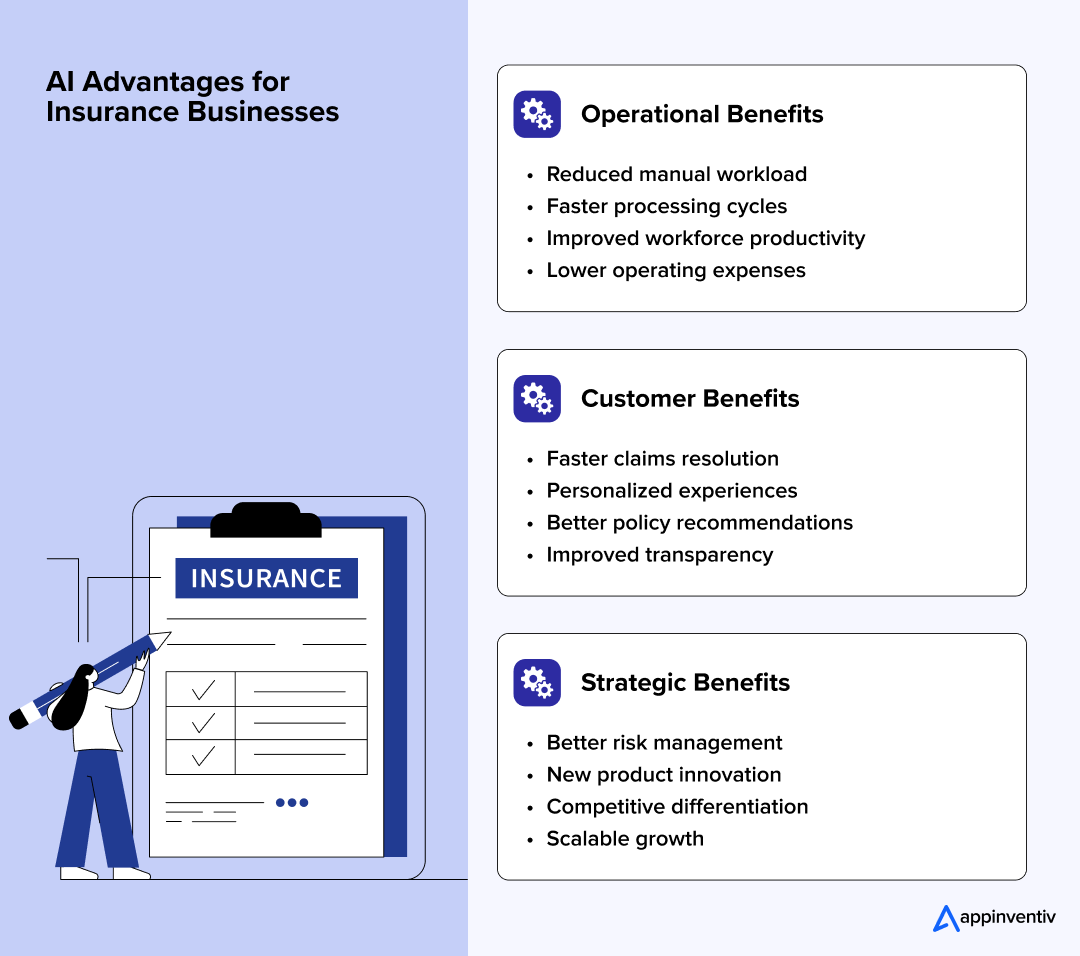
Operational Benefits
Using AI for insurance industry in Australia removes friction from daily work. Less manual data entry means policies get issued faster. Routine claims close in hours instead of weeks. Workforce productivity goes up. That translates straight into lower operating expenses. Staff members stop doing copy paste tasks and spend their time sorting out complex disputes.
Customer Benefits
Policyholders want speed and clear answers. Fast payouts during a natural disaster build massive trust. The benefits of AI in insurance industry processes are obvious when a customer gets a claim approved instantly. Systems also suggest the right coverage changes when a customer hits a new life stage. Natural language tools turn confusing disclosure documents into simple summaries anyone can read.
Strategic Benefits
Executives gain superior risk management tools. Modeling unmapped risks lets a carrier enter new markets safely. This level of tech maturity acts as a huge competitive advantage. As legacy stacks get modernised, the business handles way more transactions without hiring hundreds of new people. Scalable growth becomes a reality rather than just a buzzword.
What Are the Key Challenges Slowing AI Adoption Across Australian Insurers and Their Solutions
The challenges of AI adoption in insurance are not primarily technical. They are architectural, organisational, and regulatory. Understanding the source of friction is essential for building an AI adoption roadmap that delivers real results.
Legacy Systems and Data Silos
Big insurers still run on ancient customised platforms. These old systems trap data. You cannot feed real time data into a modern neural network if it lives on a mainframe.
The best fix involves setting up a data fabric. API layers extract information from old systems and put it into a clean central hub. This allows new tools to work without ripping out the entire core system on day one.
AI Governance and Regulatory Compliance
The APRA CPS 230 standard puts the spotlight on operational risk. Board members hold personal accountability for automated decisions. The main hurdles among the challenges of AI adoption in insurance involve proving to the government that models remain under control.
You can fix this by building compliance dashboards. These dashboards track how models make decisions and require human sign-off before any code goes live.
Data Privacy, Security, and Cyber Risks
AI systems in insurance consume significant volumes of personal data, including health information, financial history, and location data. The Privacy Act 1988 and its associated Australian Privacy Principles impose strict obligations on how that data is collected, processed, and retained.
Companies solve this by using private cloud setups located in Australia. They use methods like federated learning. This trains the model without exposing sensitive customer details to the internet.
Bias, Fairness, and Explainability
AI models trained on historical insurance data can inherit and amplify existing biases, producing systematically discriminatory outcomes for specific demographic groups. In an industry where pricing and claims decisions have direct financial impact on individuals, bias in AI outputs carries both ethical and legal risk, violating anti-discrimination laws.
The December 2026 transparency obligations for Automated Decision-Making will require insurers to explain algorithmic reasoning behind specific decisions, making explainability a compliance requirement. Systems generate scores showing exactly which piece of data caused the final decision. This keeps things fair and legal.
Talent and Organisational Readiness
Embedding AI into core operations requires data engineers, ML engineers, AI risk specialists, and governance professionals who understand both insurance domain logic and AI system behaviour. Most Australian carriers do not have this capability at scale internally.
Companies fix this through change management. They outsource AI development companies to handle the chore.
The 2026 Regulatory Horizon: Preparing for the Transparency Deadline
Rules around artificial intelligence are getting much tighter. Companies must prepare their systems to explain every automated choice clearly. If an algorithm denies a claim, the company must be able to prove exactly why the decision was made.
The December 2026 Mandate
December 2026 marks a regulatory inflection point for Australian insurers. New rules for Automated Decision Making force companies to be transparent. Any system that makes a significant choice about a consumer must provide a clear explanation. Technical architecture has to support this level of openness from the ground up.
The End of the “Black Box”
Saying the math is too complicated no longer works as an excuse. If a premium goes up, the insurer must show the exact reason. If an enterprise cannot map the specific data inputs that led to a payout denial, that system cannot legally run. Total transparency is the new standard.
OAIC Oversight
The Office of the Australian Information Commissioner wants to balance power between big business and normal people. Ethical governance is now a legal requirement. Teams must run impact assessments before launching any new tool. Ensuring that AI for insurance industry in Australia respects privacy rights is a board level responsibility.
What is the Future of AI in the Insurance Industry?
The trajectory of AI trends in the Australian insurance industry points toward a sector that looks fundamentally different in its operating model, product structure, and customer relationship within five years. The organisations shaping that future are making design decisions today.
The “Bionic” Workforce
One of the top AI trends in Australian insurance industry is blending machine speed with human empathy perfectly. It means brokers and adjusters are not disappearing. They are just getting faster. Technology handles the heavy lifting. It reads fifty page medical reports in seconds. This leaves the human worker free to handle complex negotiations.
The Rise of Parametric Insurance
Severe weather makes people need cash fast. Parametric policies use smart contracts to pay out automatically. If a trusted weather API records a specific flood level in a town, the money gets sent instantly. Nobody waits for an adjuster to visit the house. This provides communities with immediate help right when disaster strikes.
Embedded Insurance
Buying coverage will happen automatically at the point of sale. Systems integrate protection into daily activities. A commercial fleet policy might turn on only when the truck engine starts. These AI use cases rely on constant streams of behavioural data. It makes the buying process completely invisible to the end user.
Generative AI in Insurance
Language models do a lot more than writing emails now. The use of generative AI in the insurance industry in Australia helps carriers read complex legal updates. It drafts custom policy language for weird commercial risks. It even creates fake data to test fraud models without using real customer names. This lets companies launch new products incredibly fast.
Agentic AI: The Next Evolution of Insurance Operations
Generative tools make content. Agentic tools take action. This difference matters a lot. A basic bot writes a nice message about a claim. An agentic system evaluates the damage, checks the database, books a rental car, and sends money to the repair shop. Mastering this tech will define who wins the market.
How to Implement AI in Insurance for Australian Enterprises?
Moving an old company to a modern tech stack takes discipline. Leaders must focus on projects that save money immediately. Fixing data issues early prevents massive regulatory headaches later on.
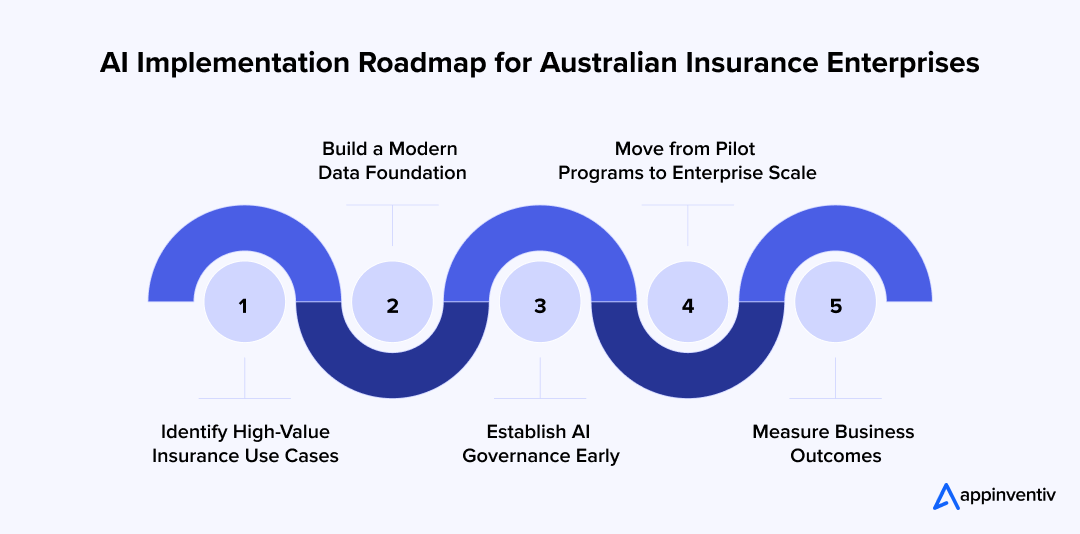
- Identify High-Value Use Cases
Prioritise AI applications where the combination of data availability, process complexity, and commercial impact is highest. Claims triage and fraud detection consistently meet all three criteria in the Australian market.
- Build a Modern Data Foundation
Models die without good information. Set up a pipeline that pulls data out of legacy policy systems and puts it into a secure central hub. Make sure everything gets cleaned and organised according to strict privacy rules.
- Establish AI Governance Early
Create a governance board before going live. Decide how much risk the business can take. Run tests to catch bias early. Document exactly how the model works. This prevents disasters during an external audit.
- Move from Pilot Programs to Enterprise Scale
Pushing a small test into full production requires strong Machine Learning Operations. Standardise the testing process. Use alerts to tell the engineering team if an algorithm starts making mistakes as market conditions shift.
- Measure Business Outcomes
Define success metrics before deployment, not after. Relevant measures include claims cycle time, fraud loss ratio, underwriting accuracy, and customer satisfaction. Governance bodies require evidence-based reporting, not capability narratives.
How Appinventiv Can Help Insurers Build Responsible and Scalable AI Solutions?
Enterprise carriers face a difficult balancing act. Out-of-the-box software rarely integrates cleanly with decades-old custom platforms. At the same time, building everything internally drains resources and delays time-to-market. Accelerating this transformation requires deep technical capabilities paired with strict compliance oversight.
This is where Appinventiv steps in. Our team of 1600+ tech experts carries the core competence in building secure systems that actually work in the real scenarios of the insurance world.
Whether a carrier needs to untangle a fragmented data lake, architect a secure claims triage platform, or implement automated parametric smart contracts, we deliver the best-in-class artificial intelligence development services in Australia to engineer every solution for enterprise scalability and complete audit readiness.
We know that providing FinTech software development services in Australia means understanding APRA rules completely. Therefore, our every deployment aligns with APRA guidelines, ensuring that data sovereignty and algorithmic explainability remain intact.
This commitment to execution is backed by a proven track record of launching over 3,000 digital assets and driving transformation across more than 35 industries. Operating seamlessly through five agile delivery centres across the country, Appinventiv maintains a 90% client retention rate by consistently hitting a 99.50% security compliance SLA. For the organisations adopting these services, this rigorous technical precision routinely translates into a 35% gain in overall operational efficiency.
Ready to build an artificial intelligence capability that satisfies APRA’s governance expectations while delivering measurable commercial outcomes? Contact us to discuss the next phase of your strategic technology roadmap.
FAQs
Q. How do insurance companies implement AI in Australia?
A. AI implementation in Australia typically follows a sequenced approach: identifying high-value use cases such as claims triage or fraud detection, modernising the underlying data infrastructure to support real-time model inputs, establishing AI governance frameworks aligned with APRA’s prudential expectations, and then moving from controlled pilots into production deployment at enterprise scale. The governance step is frequently underweighted in project planning and is where most programmes encounter regulatory friction.
Q. How is AI transforming the Australian insurance industry?
A. AI in the insurance industry in Australia is reshaping every major value chain function.
- In underwriting, machine learning models are generating more accurate risk assessments from broader and more current data sources.
- In claims, agentic AI systems are compressing settlement timelines from weeks to hours for qualifying claim types.
- In fraud detection, network analysis and computer vision are identifying patterns that rules-based systems consistently miss.
- In customer service, AI is enabling personalised policy recommendations and faster, more transparent communication.
Q. What are the biggest AI use cases in insurance?
A. The highest-value AI use cases in insurance Australia are being deployed at scale, including: agentic claims processing, AI-driven dynamic pricing and hyper-personalisation, predictive underwriting and risk assessment, advanced fraud detection, climate catastrophe modelling, churn prediction, and actuarial intelligence.
Q. How are Australian insurers using AI in claims processing?
A. Leading Australian carriers are using AI to automate first notice of loss processing, extract and validate policy data, score incoming claims for fraud indicators, estimate repair and replacement costs using computer vision and external valuation databases, and initiate payment for qualifying straight-through claims.
Q. What are the regulatory considerations for AI in Australian insurance?
A. The primary regulatory framework governing AI in Australian insurance is the existing prudential standard suite: CPS 230 on operational resilience, CPS 234 on information security, CPS 220 on risk management, and CPS 510 on governance.
APRA’s April 2026 letter made clear these standards already apply to AI-related conduct. The December 2026 transparency obligations for Automated Decision-Making add a specific explainability requirement for customer-facing AI decisions. The Privacy Act 1988 and Australian Privacy Principles govern data collection and processing practices across all AI systems.


Fast 2-minute response, fully NDA-protected.

The AI ROI Crisis: Why Enterprises Are Struggling to Prove Value and How to Fix It
Key takeaways: AI ROI is a capital-allocation question. Boards want payback periods and P&L impact. AI ROI challenges rarely have a single cause. Data, legacy systems, use-case choice, ownership and stalled pilots compound each other. Choose two or three outcome metrics per use case, set the baseline first, and report in dollars. Make every further…

Retrieval Augmented Generation in Australia: Architecture, Implementation and Cost
Key takeaways: RAG grounds LLM answers in approved content, improving reliability without retraining a model. Data quality and access permissions decide production outcomes more than the model. Indicative build costs run from AUD 70,000 to 700,000, driven by data and integrations. Measure value against a pre-deployment baseline, separating realised benefits from projected savings. A general-purpose…

The Multiplier Effect of AI Agents: The Rise of AI Swarms
Key takeaways: AI agent swarms coordinate specialized agents to solve complex problems that may be difficult for a single agent to handle effectively. More agents do not automatically mean better outcomes. Swarms deliver value when work can be divided, executed in parallel, and coordinated toward a shared objective. Enterprise readiness depends on governance. Clear accountability,…