


























How Much Does It Cost to Develop a Cryptocurrency Exchange App?

 Share -



- 01Cryptocurrency Exchange Development Cost at a Glance
- 02Crypto Exchange Development Cost by Platform Type
- 03Cost to Build a Cryptocurrency Exchange Per the Development Stage
- 04Cryptocurrency Exchange Development Cost by Features
- 05Factors Affecting Cryptocurrency Exchange Development Cost
- 06Cost of Adding AI to a Cryptocurrency Exchange
- 07Cryptocurrency Exchange Development Cost by Team Model
- 08White-Label vs Custom Cryptocurrency Exchange Development Cost
- 09How to Reduce Cryptocurrency Exchange Development Cost
- 10Cryptocurrency Exchange Development Timeline: How Long Does It Take?
- 11Cryptocurrency Exchange Development Timeline: How Long Does It Take?
- 12How Appinventiv Helps Businesses Build Cryptocurrency Exchange Platforms
- 13FAQs

Key takeaways:
- A cryptocurrency exchange app can cost between $40,000 and $500,000+, depending on its operating model and technical depth.
- A basic centralized exchange generally costs $80,000–$150,000, while an advanced platform may exceed $300,000.
- Security, compliance, liquidity, custody, and trading-engine performance create the largest budget differences.
- A white-label solution reduces initial development time but creates licensing, customization, and vendor-dependency costs.
- AI capabilities can add $30,000–$120,000+, depending on their data, monitoring, and model requirements.
- Development is only one part of the investment. Licensing, liquidity, infrastructure, audits, and operations require separate budgets.
Cryptocurrency exchanges have become a serious business opportunity for fintech companies, financial institutions, and digital asset firms. The United States ranked second in Chainalysis’s 2025 Global Crypto Adoption Index, rising from fourth in 2024. Across APAC, on-chain activity reached $2.36 trillion in the 12 months ending June 2025, up 69% from the previous year. These figures give businesses considering an exchange a clear indication of the scale and geographic reach of crypto adoption.
Yet launching an exchange is not as straightforward as putting a trading screen in front of users. Behind that screen sits a network of wallets, order books, liquidity connections, payment systems, blockchain nodes, and compliance tools. All of them must work together, often while the market is moving quickly.
That is where the cost begins to change. An exchange supporting a few assets and standard spot trading needs a relatively focused build. Add multiple blockchain networks, advanced orders, fiat payments, institutional accounts, or self-managed custody, and the work increases quickly. More engineering is required. Testing becomes heavier. Security controls also become more demanding.
So, how much does it cost to develop a crypto exchange software in 2026? A focused platform may cost between $80,000 and $150,000. A feature-rich centralized exchange can require $150,000 to $300,000. For an institutional-grade platform with advanced custody, trading, and compliance controls, the budget may move beyond $500,000.
That figure still does not represent the complete cost of entering the market. Licensing, liquidity, banking arrangements, legal support, custody services, security audits, and compliance operations require separate investment. In some jurisdictions, these expenses can be just as significant as the technology itself.
This guide provides a practical crypto exchange development cost breakdown. It explains where the budget goes, what raises the final estimate, and which decisions businesses should settle before development begins.
Get clarity on the right architecture, core features, integrations, and development priorities for your first release.

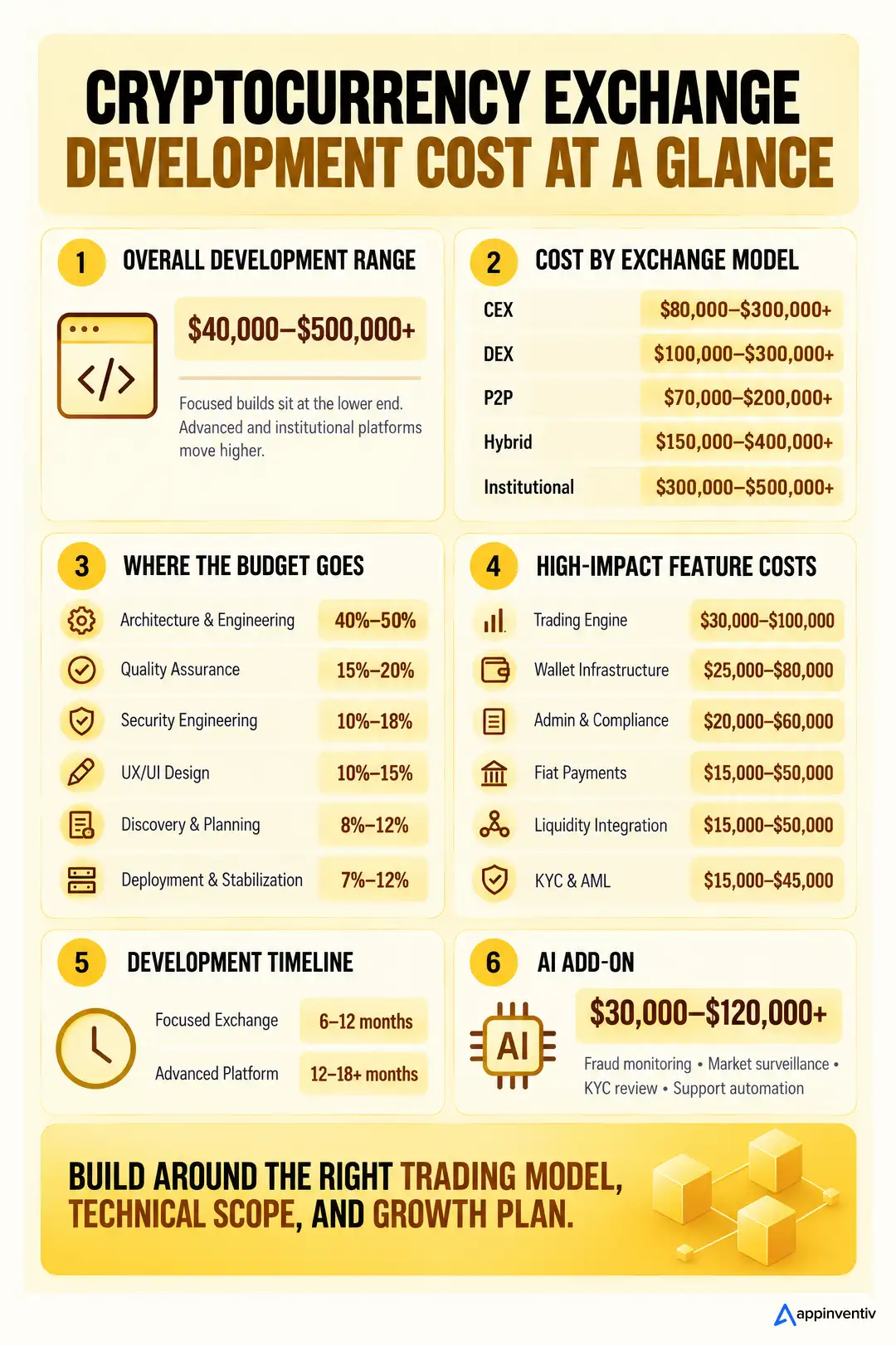
Cryptocurrency Exchange Development Cost at a Glance
The cost of building a cryptocurrency exchange depends on how the business plans to enter the market. A company testing demand in one region will not need the same investment as an institution preparing to handle multiple currencies, markets, and customer types.
The following ranges provide an early planning view:
| Exchange Level | Typical Scope | Estimated Cost | Development Timeline |
|---|---|---|---|
| Proof of Concept | Simulated trading, basic interface, and limited backend | $40,000–$70,000 | 3–4 months |
| Basic Exchange | KYC, wallets, spot trading, deposits, withdrawals, and admin panel | $80,000–$150,000 | 5–7 months |
| Mid-Level Exchange | Multiple assets, liquidity APIs, advanced orders, and reporting | $150,000–$250,000 | 7–10 months |
| Advanced Exchange | High-volume trading, staking, OTC desk, and market surveillance | $250,000–$400,000 | 10–14 months |
| Institutional Platform | Advanced custody, trading APIs, subaccounts, and global operations | $400,000–$500,000+ | 12–18+ months |
These figures cover the technology required to take an exchange from planning to launch. They generally include product discovery, UX design, frontend and backend development, wallet integration, testing, deployment, and early stabilization.
They do not automatically include regulatory licenses, legal support, liquidity reserves, banking arrangements, or ongoing compliance teams. Those costs depend heavily on the jurisdiction and operating model.
A basic exchange stays near the lower end when it supports a limited number of assets, standard spot orders, and third-party custody or liquidity services. The cryptocurrency exchange development cost rises when the business adds proprietary custody, institutional accounts, advanced trading products, more blockchain networks, or operations across several markets.
The important point is that visible features do not determine the entire budget. Two exchanges may look similar to users while relying on completely different custody, security, compliance, and trading infrastructure behind the interface.
Crypto Exchange Development Cost by Platform Type
The exchange model sets the direction for most major technology decisions. It determines how orders are processed, where assets are held, how liquidity enters the platform, and what happens when a trade fails. Naturally, it also changes the budget.
| Exchange Type | Estimated Development Cost | Where the Budget Goes |
|---|---|---|
| Centralized Exchange | $80,000–$300,000+ | Matching engine, custodial wallets, liquidity, reconciliation, and compliance |
| Decentralized Exchange | $100,000–$300,000+ | Smart contracts, liquidity pools, routing, network integration, and audits |
| Hybrid Exchange | $150,000–$400,000+ | Centralized execution, blockchain settlement, and coordination between systems |
| P2P Exchange | $70,000–$200,000+ | Escrow, local payments, fraud checks, disputes, and moderation |
| Broker Exchange | $60,000–$180,000+ | Live pricing, payments, wallet infrastructure, and liquidity |
| Institutional Exchange | $300,000–$500,000+ | High-volume execution, custody, APIs, subaccounts, and reporting |
Centralized Exchange: $80,000–$300,000+
A centralized exchange can remain near the lower end when it supports spot trading, standard orders, a limited asset list, and one external liquidity source. In this case, the team can rely on established providers for several underlying functions.
The budget starts moving upward when the exchange needs its own matching engine, stronger custody controls, several liquidity connections, or the capacity to process large trading volumes. Margin trading, derivatives, staking, and institutional accounts add more rules around risk, settlement, and reporting.
Decentralized Exchange: $100,000–$300,000+
Much of the cost here sits in smart contract development, testing, and independent audits. Liquidity pools, token routing, slippage rules, oracle connections, and transaction-fee calculations also take time to build properly.
Network coverage makes a noticeable difference. Supporting one blockchain keeps the scope relatively contained. A cross-chain exchange needs additional contracts, bridges, wallet connections, and failure controls. That work pushes both the initial budget and future maintenance costs higher.
P2P Exchange: $70,000–$200,000+
The p2p cryptocurrency exchange development cost depends less on trading speed and more on how the platform handles trust between buyers and sellers.
Escrow is only one part of the build. The platform also needs payment evidence, seller ratings, fraud checks, dispute workflows, user communication, and administrator intervention. A single-market product with a few payment methods may stay near the lower range. Costs rise when the business adds more countries, payment options, languages, and local compliance rules.
Hybrid Exchange: $150,000–$400,000+
A hybrid exchange brings two different operating environments together. Orders may be processed centrally for speed, while asset control or settlement remains on-chain.
Making these parts work together is where much of the budget goes. The system must keep balances, ownership records, and trade status consistent across both environments. Multiple blockchain networks or institutional trading volumes make that coordination more difficult.
Broker Exchange: $60,000–$180,000+
Broker exchanges generally require less investment because they do not need a traditional order book. Even so, they need reliable pricing, payment processing, wallet infrastructure, liquidity access, and controls for managing price movements.
The estimate increases when the exchange supports several fiat currencies or local payment methods. Using multiple liquidity providers also requires additional routing and reconciliation work.
Institutional Exchange: $300,000–$500,000+
Institutional platforms carry a higher price because professional traders expect more from the underlying infrastructure. Slow execution, limited reporting, or weak access controls can make the platform unsuitable for serious use.
FIX APIs, subaccounts, approval hierarchies, OTC trading, treasury controls, and custom settlement arrangements all add to the scope. Higher availability targets also require stronger infrastructure, deeper testing, and reliable recovery mechanisms.
Cost to Build a Cryptocurrency Exchange Per the Development Stage
A development estimate should cover the full journey from initial planning to a stable market launch. Quotes that exclude security engineering, performance testing, deployment, or early-stage support may appear lower but often create additional costs later.
| Development Stage | Typical Share of Budget | Where the Money Goes |
|---|---|---|
| Discovery and Planning | 8%–12% | Scope, operating model, jurisdiction requirements, and technical planning |
| UX/UI Design | 10%–15% | Trading journeys, prototypes, account screens, and design system |
| Architecture and Engineering | 40%–50% | Applications, backend, matching engine, wallets, APIs, and integrations |
| Security Engineering | 10%–18% | Custody controls, encryption, access management, and system hardening |
| Quality Assurance | 15%–20% | Functional, performance, security, and recovery testing |
| Deployment and Stabilization | 7%–12% | Production setup, monitoring, release support, and early fixes |
Architecture and engineering usually account for the largest share of the budget. However, the allocation changes with the exchange model. A decentralized platform may spend more on smart contracts and audits, while an institutional exchange may require greater investment in execution performance, reporting, and infrastructure resilience.
Businesses should compare proposals based on included responsibilities, not only the final amount. A lower quote may leave custody integration, security audits, production monitoring, or post-launch stabilization outside the agreed scope.
Cryptocurrency Exchange Development Cost by Features
Features do not affect the budget equally. Some require a few user-facing screens. Others sit close to funds, trades, and customer identities, which brings heavier engineering, security, and testing work.
A basic exchange may cover account creation, KYC, spot trading, wallets, deposits, withdrawals, and an admin panel. Once the scope moves into multiple networks, advanced orders, fiat support, staking, or AI-led monitoring, the overall crypto exchange development cost rises quickly.
Registration and Account Security: $8,000–$20,000
The range depends on login methods, multifactor authentication, device checks, session controls, account recovery, and role-based access.
KYC and AML Workflows: $15,000–$45,000
A simple third-party verification flow stays near the lower end. Ongoing screening, risk scoring, manual review queues, and regulatory reporting require a larger investment.
Crypto Wallet Infrastructure: $25,000–$80,000
Wallet costs vary with the number of supported networks and the chosen custody model. Hot and cold wallet management, key approvals, fee handling, and withdrawal controls add further work.
Also Read: An Ultimate Guide to Blockchain Wallets
Trading and Matching Engine: $30,000–$100,000
Standard spot trading costs less than a high-volume engine supporting advanced orders. Latency targets, execution rules, order-book depth, and failover requirements all influence the estimate.
Market Data and Trading Charts: $10,000–$35,000
Real-time prices, live order books, trading history, technical indicators, and external market feeds determine the depth of this feature.
Fiat Deposits and Withdrawals: $15,000–$50,000
The cost depends on the number of currencies, banking partners, payment methods, settlement rules, transaction limits, and reconciliation requirements.
Liquidity Integration: $15,000–$50,000
Connecting one provider is relatively straightforward. Multiple providers require routing, price comparison, fallback logic, settlement tracking, and more detailed reconciliation.
Admin and Compliance Panel: $20,000–$60,000
The scope may include account reviews, transaction holds, withdrawal approvals, fee controls, audit logs, compliance cases, and separate permissions for internal teams.
Staking and Earn Features: $20,000–$70,000
Costs rise with the number of supported protocols, reward rules, lock-in periods, withdrawal conditions, and reporting requirements.
AI-Based Monitoring and Support: $30,000–$120,000+
Fraud scoring, market surveillance, document review, and support automation require data preparation, workflow integration, evaluation, monitoring, and human oversight.
These figures represent feature-level contributions within a complete product build. They should not be added mechanically, as several capabilities share the same backend, interfaces, and security controls.
The wallet system, matching engine, compliance workflows, and liquidity connections usually have the greatest impact on the crypto exchange development cost. Their scope should be defined as complete workflows rather than broad feature labels. This gives businesses a far more dependable estimate.
Factors Affecting Cryptocurrency Exchange Development Cost
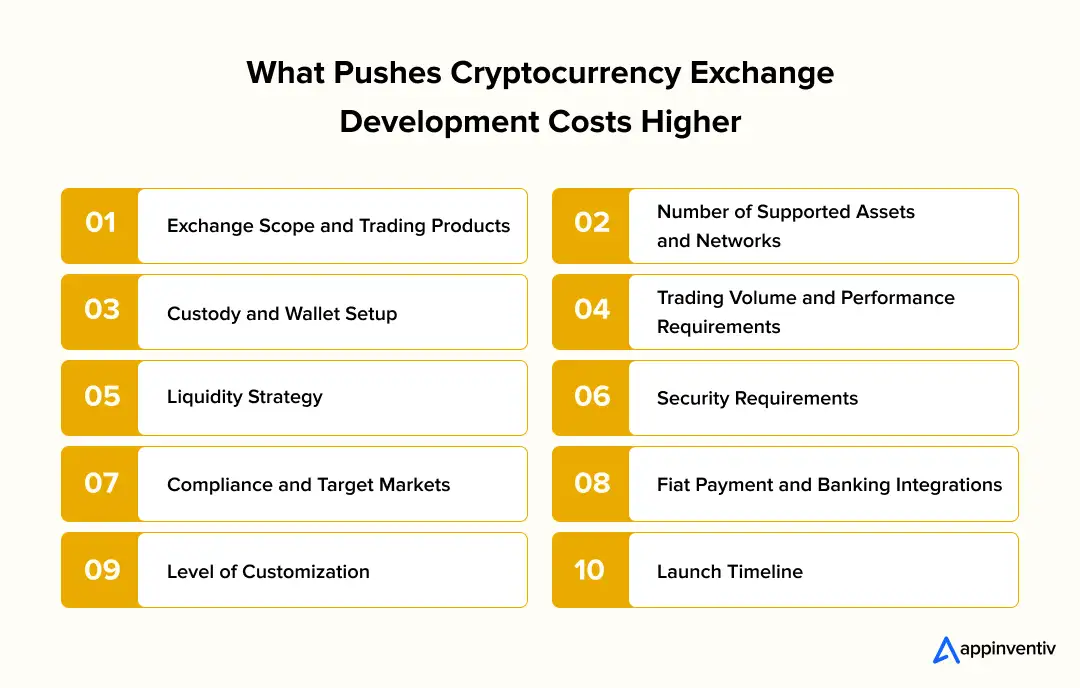
Two exchanges may serve the same market and still carry very different development budgets. The difference usually lies beneath the interface. Custody, trading volume, asset coverage, liquidity, and regulatory scope all shape the work involved.
The following are the main factors affecting cryptocurrency exchange development cost.
Exchange Scope and Trading Products
Spot trading provides a relatively controlled starting point. The platform becomes more expensive when the scope includes margin trading, futures, options, staking, lending, copy trading, or an OTC desk.
Each product brings its own calculations and controls. Margin trading, for instance, needs collateral tracking, liquidation rules, interest calculations, and real-time risk monitoring. These are not small additions to an existing order screen.
Number of Supported Assets and Networks
Listing several tokens on one blockchain is easier than supporting several independent networks. Every network has its own address formats, transaction fees, confirmation rules, token standards, and maintenance requirements.
The team must also prepare for network upgrades, forks, delayed confirmations, and unavailable nodes. As asset coverage expands, so does the work required to keep deposits and withdrawals dependable.
Custody and Wallet Setup
The custody model decides how much responsibility the exchange carries for user funds. Using an established custody provider can reduce the initial engineering effort. Building an internal system gives the business more control but requires deeper security expertise.
Hot and cold wallet management, key approvals, withdrawal limits, address screening, and emergency controls add to the budget. The cost rises further when the exchange supports institutional accounts or several blockchain networks.
Working with a crypto wallet development company can help businesses assess custody options, supported networks, and withdrawal controls before finalizing the exchange development budget.
Explore how we built a secure, non-custodial cryptocurrency platform for XCoins, enabling users to manage, trade, and track digital assets. The platform integrates 10+ core workflows, 25+ security and transaction monitoring controls, and 48+ token pairs and digital assets.

Trading Volume and Performance Requirements
A platform built for a small regional launch does not need the same infrastructure as one preparing for millions of orders.
Higher volumes call for faster order processing, better database performance, load balancing, failover, and stronger monitoring. The exchange must also remain stable when market activity rises without warning. Planning for that load later often means reworking the core architecture.
Liquidity Strategy
An exchange with poor liquidity may show wide price spreads and incomplete orders, even if the application works perfectly.
A single provider keeps the initial integration relatively simple. Working with several exchanges or market makers adds price comparison, order routing, fallback rules, settlement tracking, and reconciliation. Businesses must also budget for the commercial side of obtaining liquidity, not only the technical connection.
Security Requirements
Security work changes with the value held on the platform and the type of users it serves. Basic controls may include multifactor authentication, encryption, rate limits, device monitoring, and withdrawal verification.
A larger exchange may also need multisignature approvals, transaction-risk scoring, penetration testing, security operations, and detailed incident procedures. These controls need to be built into the architecture. Adding them shortly before launch usually costs more and leaves gaps.
Compliance and Target Markets
Every new market can introduce different expectations for customer verification, transaction monitoring, data storage, reporting, and consumer protection.
Serving one jurisdiction keeps the compliance scope more focused. A multi-country launch requires local rules to be reflected across onboarding, account limits, disclosures, record retention, and internal review workflows. Legal and financial compliance teams must settle these requirements before developers convert them into system rules.
Fiat Payment and Banking Integrations
Fiat support adds another layer of cost. Bank transfers, card payments, and local payment gateways each carry different settlement times, limits, fees, and failure conditions.
Several banking partners may also require separate APIs and reconciliation processes. Businesses should confirm access to these services early. A completed exchange cannot operate effectively without dependable deposit and withdrawal routes.
Also Read: Crypto Banking Software Development: Core Architecture for Digital Asset Banking
Level of Customization
A familiar interface built with established components will cost less than a highly customized trading experience. The same applies to the backend.
Customization makes sense where it supports the business model, improves execution, or reduces operational work. Rebuilding standard functions simply to appear different can consume budget without adding much commercial value.
Infrastructure and Deployment Architecture
Infrastructure choices affect both the initial build and ongoing hosting costs. A deployment in one cloud region requires less setup than an exchange running across multiple regions with separate recovery environments.
Configuring blockchain nodes, database replication, private networks, backups, and deployment pipelines adds engineering work. Managed services can reduce that effort, while self-managed infrastructure requires more configuration and maintenance. The development estimate should separate this setup work from recurring cloud and service charges.
Launch Timeline
A shorter deadline does not reduce the amount of work. It usually requires a larger team, parallel development, quicker decisions, and additional project coordination.
Some work cannot be compressed safely. Wallet testing, security reviews, third-party approvals, and performance testing still require adequate time. A rushed launch may save a few weeks but create far more expensive issues after real funds enter the platform, thus increasing the overall crypto exchange development cost.
Cost of Adding AI to a Cryptocurrency Exchange
AI can improve selected parts of an exchange, but it should solve a defined operational problem. Adding an assistant simply because the product roadmap mentions AI rarely justifies the expense.
The AI-powered cryptocurrency exchange development cost generally adds $30,000–$120,000 or more to the main development budget. The final amount depends on the use case, available data, model choice, and level of human review.
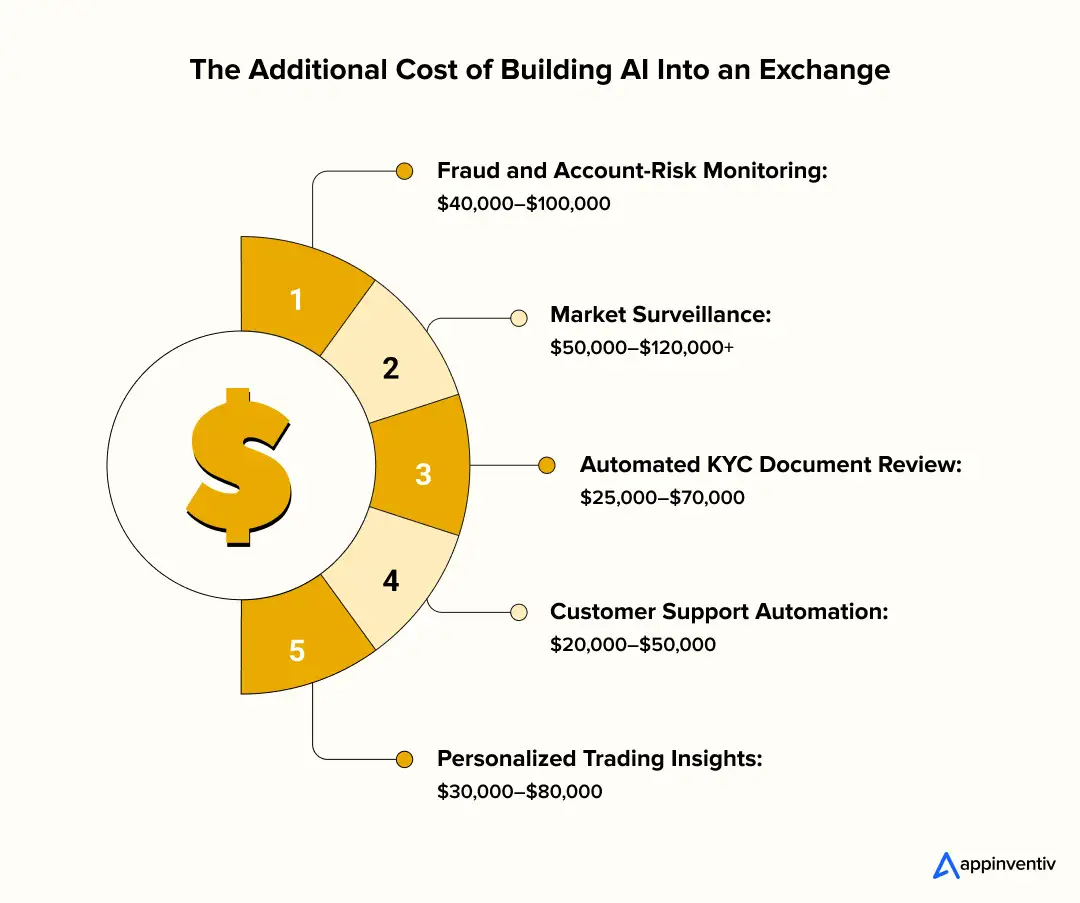
Fraud and Account-Risk Monitoring: $40,000–$100,000
AI can examine login activity, device changes, transaction history, withdrawal behaviour, and other signals that may indicate account takeover or fraud.
The model itself is only one part of the work. The exchange also needs dependable data, risk thresholds, investigation queues, override rules, and a way to monitor false alerts. Without these controls, legitimate users may face unnecessary account or withdrawal restrictions.
Market Surveillance: $50,000–$120,000+
Surveillance systems can flag unusual trading patterns, coordinated activity, wash trading, or possible market manipulation.
The cost rises with the number of markets and trading pairs under review. Compliance teams also need supporting evidence, case histories, and clear reasons behind each alert. A score without context offers little value during an investigation.
Automated KYC Document Review: $25,000–$70,000
AI can extract information from identity documents and compare it with application data. It may also help route uncertain cases to a compliance officer.
This feature requires careful testing across document types, languages, image quality, and user groups. Manual review must remain available where the system cannot reach a dependable result.
Customer Support Automation: $20,000–$50,000
A support assistant can answer routine questions about verification, deposits, fees, order status, and withdrawal timelines. This can reduce pressure on support teams during periods of heavy activity.
However, the assistant should not guess when account access or customer funds are involved. It needs approved information, access controls, conversation records, and a clear route to human support.
Personalized Trading Insights: $30,000–$80,000
AI can organize market data, portfolio activity, and user preferences into more relevant insights. It may help users understand exposure, price movements, or past trading behaviour.
Businesses must draw a clear line between information and financial advice. Consent, suitability, disclosures, and regional regulations may influence how these insights are presented.
The ongoing cost also deserves attention. Models require monitoring, updated data, testing, and periodic adjustment. Third-party model usage may create a charge for every request, while internally managed models require more infrastructure and specialist support.
For most businesses, the sensible route is to begin with one use case tied to a clear operational outcome. Once the exchange has enough reliable data, the AI layer can expand without turning the first release into an expensive experiment.
Cryptocurrency Exchange Development Cost by Team Model
The chosen team model affects the budget, delivery speed, and level of involvement required from the business. A live exchange usually needs product strategists, designers, backend engineers, blockchain specialists, security experts, QA professionals, and DevOps support.
| Development Model | Indicative Budget | Best Suited For |
|---|---|---|
| Freelancers or Small Team | $40,000–$120,000 | Prototypes and tightly limited exchange projects |
| In-House Team | $250,000–$700,000+ annually | Businesses building permanent internal capability |
| Specialized Development Company | $80,000–$500,000+ | Custom exchanges requiring complete delivery ownership |
Freelancers may suit a prototype or an isolated technical module. A market-ready exchange is harder to divide between independent contributors. Wallets, balances, orders, liquidity, security, and compliance systems must work together without gaps.
An in-house team gives the business direct control over priorities and technical knowledge. It also brings recruitment time, fixed salaries, benefits, infrastructure, and retention costs. This approach makes sense when exchange development forms part of a long-term digital asset strategy.
A specialized development company brings the required disciplines under one delivery structure. The initial quote may be higher than that of a small team, but responsibility for product design, engineering, testing, deployment, and early support remains easier to manage.
Businesses should compare the total cost of reaching launch, not hourly rates alone. Team seniority, exchange experience, security ownership, testing depth, documentation, and post-launch responsibility can materially change the final investment.
White-Label vs Custom Cryptocurrency Exchange Development Cost
One of the earliest cost decisions is whether to customize an existing exchange product or build the platform around the business model from the ground up.
A white-label exchange can cost between $30,000 and $100,000 for the initial setup. Once branding, feature changes, third-party integrations, security review, and deployment are included, the development budget may reach $75,000–$250,000.
Custom cryptocurrency exchange development generally costs $80,000–$500,000 or more. The higher investment reflects the work required to design the architecture, trading workflows, backend services, user experience, and integrations around specific business requirements.
| Cost Area | White-Label Development | Custom Development |
|---|---|---|
| Initial Development | $30,000–$100,000 | $80,000–$500,000+ |
| Customization Scope | Limited by the existing product | Built around business requirements |
| Development Timeline | 3–6 months | 6–18+ months |
| Trading Engine | Usually prebuilt | Can be built or configured for the required load |
| Feature Control | Depends on vendor capabilities | Controlled by the business roadmap |
| Integration Flexibility | May require vendor support | APIs and services can be selected freely |
| Source Code Access | May be restricted | Can remain under business ownership |
| Future Changes | Often tied to the vendor | Managed through the product roadmap |
A white-label platform works best when speed matters more than deep differentiation. It can support a focused launch if the existing architecture already matches the required trading model, custody setup, and user journeys.
The lower starting price can be misleading, though. Changes outside the standard product may require additional vendor work. Some providers also restrict source-code access or make it difficult to replace built-in services later.
Custom development requires more investment and effort. In return, the business gains greater control over the exchange architecture, user experience, integrations, performance, and future roadmap.
The right choice depends on how the exchange plans to compete. A business testing a standard market proposition may not need a fully custom build. An enterprise planning proprietary workflows, institutional features, or several product lines will usually need more control than a white-label platform can offer.
Therefore, when understanding how much does it cost to build a crypto exchange, businesses should compare the long-term development implications rather than the setup price alone. The cheaper starting point may not remain cheaper once customization and future product changes begin.
Answer five quick questions about your exchange model, platforms, features, and integrations to receive a preliminary development range.

How to Reduce Cryptocurrency Exchange Development Cost
Lowering the budget does not mean cutting security, testing, or wallet controls. Those decisions usually create larger costs later. The better approach is to narrow the first release and spend on the parts that carry the business model.
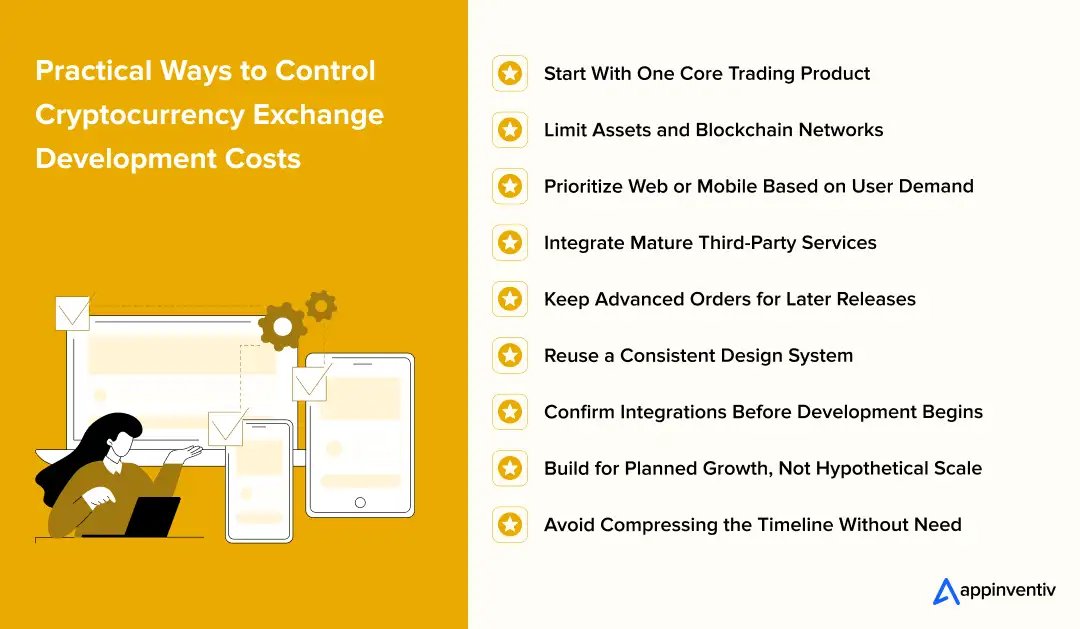
Start With One Core Trading Product
Spot trading gives most businesses a practical starting point. Adding margin, futures, staking, lending, and OTC services in the first release creates several risk, settlement, and reporting workflows.
Launch the core product first. Additional trading services can follow once the platform and operating model have been validated.
Limit Assets and Blockchain Networks
Every supported network adds wallet logic, node connections, fee calculations, confirmation rules, and ongoing maintenance.
A smaller asset list keeps the first build manageable. Businesses can add more currencies and networks when user demand justifies the development effort.
Prioritize Web or Mobile Based on User Demand
Launching web, iOS, and Android together increases design, development, and testing work. Some businesses may need all three. Others can begin with a responsive web platform or one primary mobile application.
The decision should reflect how the intended customers trade, not the desire to appear across every platform from day one.
Integrate Mature Third-Party Services
Custody, identity verification, market data, liquidity, and blockchain infrastructure do not always need to be developed internally.
Using established providers can shorten delivery and reduce initial engineering. The development team should still review API quality, data ownership, security responsibilities, and the cost of replacing a provider later.
Keep Advanced Orders for Later Releases
Market and limit orders may be enough for the first release. Stop-limit, trailing-stop, iceberg, margin, and conditional orders need additional execution logic and testing.
Adding them in later phases keeps the initial matching-engine scope under control.
Reuse a Consistent Design System
A design system provides reusable components for accounts, wallets, trading screens, forms, alerts, and administrative workflows.
This reduces repeated design and frontend work. It also keeps the experience consistent as the platform expands.
Confirm Integrations Before Development Begins
Unclear provider choices create delays and rework. Businesses should confirm likely custody, KYC, liquidity, payment, and market-data partners during product discovery.
Early technical validation reveals API limitations before the exchange architecture depends on them.
Build for Planned Growth, Not Hypothetical Scale
The platform should support realistic launch volumes and a clear growth path. Designing every component for millions of users before demand exists can inflate the budget unnecessarily.
A modular architecture allows the team to strengthen high-load components as trading activity grows.
Avoid Compressing the Timeline Without Need
An unrealistic deadline often requires more developers, parallel workstreams, and extra coordination. It can also reduce the time available for testing.
A phased roadmap gives the team enough room to verify wallets, order processing, integrations, security controls, and recovery procedures properly.
The strongest cost-saving decisions happen before coding starts. A defined launch scope, confirmed providers, and clear performance targets help businesses control the crypto exchange development cost without weakening the product.
Cryptocurrency Exchange Development Timeline: How Long Does It Take?
A basic cryptocurrency exchange may take 5–7 months to develop. A mid-level platform can require 7–10 months, while advanced exchanges may need 10–14 months. Institutional platforms can extend to 12–18 months or longer.
The cryptocurrency exchange development process and timeline depend on the trading model, supported blockchain networks, integrations, and testing requirements. These are planning estimates; the delivery schedule should reflect the agreed scope.
Cryptocurrency Exchange Development Timeline: How Long Does It Take?
A basic cryptocurrency exchange may take 5–7 months to develop. A mid-level platform can require 7–10 months, while advanced exchanges may need 10–14 months. Institutional platforms can extend to 12–18 months or longer. These estimates depend on the agreed scope and the integrations required.
The cryptocurrency exchange development process and timeline also depend on how much the team builds from scratch. Connecting an established custody service involves different work from developing internal wallet controls. A proprietary matching engine adds another substantial workstream.
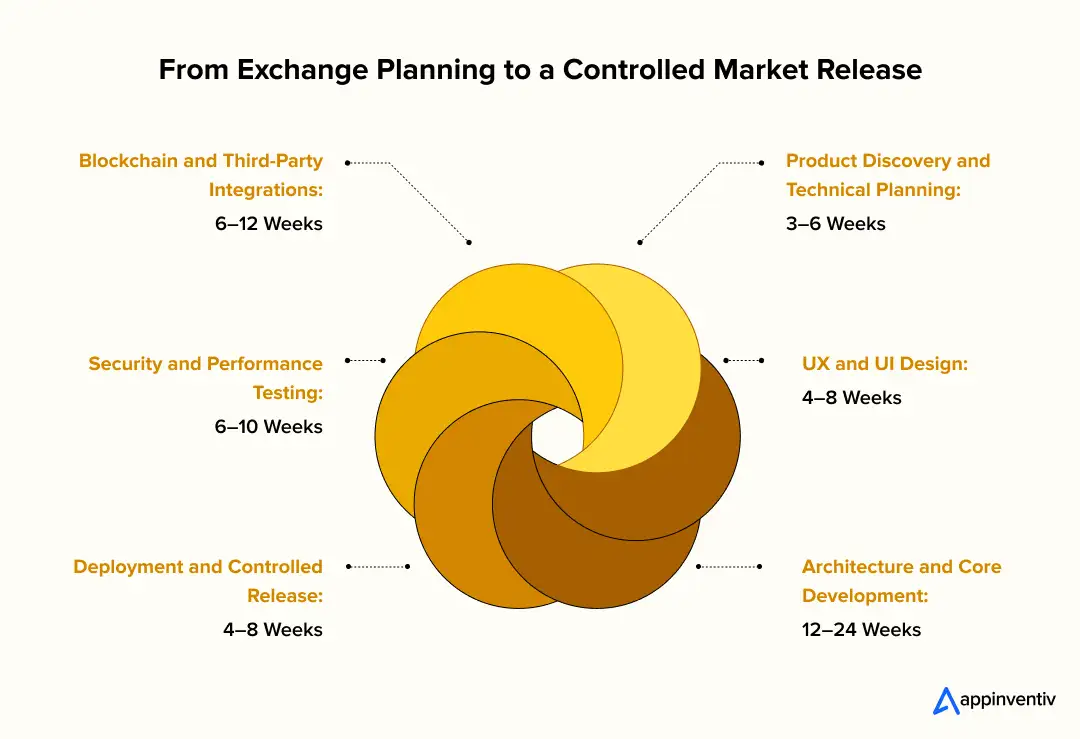
From Exchange Planning to a Controlled Market Release
- Product Discovery and Technical Planning: 3–6 weeks
- UX and UI Design: 4–8 weeks
- Architecture and Core Development: 12–24 weeks
- Blockchain and Third-Party Integrations: 6–12 weeks
- Security and Performance Testing: 6–10 weeks
- Deployment and Controlled Release: 4–8 weeks
These stages overlap, so their durations should not be added together. Design can continue while engineers build approved workflows. Integration work can begin during core development, and testing runs throughout the project.
How the Development Timeline Affects Cost?
The timeline affects how long the business pays for its delivery team, testing environments, and project coordination. If development runs beyond the agreed schedule, the additional cost depends on which specialists remain involved and whether completed work needs revision.
For example, adding margin trading midway through development can extend engineering, design, and testing work. A delay in receiving a provider’s API access has a different effect: some tasks may pause while the team continues elsewhere. Both can move the launch date, but their budget impact will differ.
A shorter deadline can also raise the crypto exchange development cost. Meeting it may require additional engineers, parallel testing, and more coordination. Businesses should ask for estimates tied to specific release dates and scopes. This makes the cost of an accelerated launch or a phased release clear before committing to a schedule.
What Can Extend the Delivery Schedule?
Some delays begin before coding. The team may need custody documentation, payment-provider access, or confirmation of supported networks before completing related workflows. If those decisions remain open, parts of the build may need to pause.
Changes after development begins have a wider effect. Adding a blockchain network, for example, can require new deposit rules, withdrawal handling, monitoring, and test cases. The impact reaches beyond the integration itself.
Businesses can keep delivery more predictable by agreeing on launch requirements early and scheduling additional features for later releases. The release plan should still leave time to test order accuracy, asset movement, and recovery under failure conditions. Compressing these checks to meet a date can create rework and increase the overall crypto exchange development cost.
See how our blockchain development expertise can help you plan and build a secure exchange around your business model.

How Appinventiv Helps Businesses Build Cryptocurrency Exchange Platforms
Building a cryptocurrency exchange means bringing several demanding systems into one product. Wallets, trading, liquidity, identity checks, payments, security, and administrative controls must work together without losing track of funds or transactions.
As a cryptocurrency exchange development company, we support businesses through the complete development journey, from product discovery and architecture to engineering, testing, deployment, and post-launch scaling.
Our teams can develop centralized, decentralized, P2P, hybrid, and institution-focused exchange platforms. The architecture is shaped around the intended trading model, customer base, asset coverage, and expected transaction volume.
During discovery, we help businesses define the first market-ready release. This includes deciding which features need custom development and where established providers can reduce time and technical risk. Custody, KYC, liquidity, market data, payments, and blockchain infrastructure are assessed as part of the wider product architecture.
Security remains part of the build from the beginning. Our teams account for access controls, encryption, wallet approvals, transaction records, withdrawal safeguards, monitoring, and recovery procedures throughout development.
The platform also undergoes functional, integration, performance, and security testing before release. This helps verify that orders, balances, deposits, withdrawals, and external services continue to work under real operating conditions.
For businesses still evaluating how much does it cost to start a cryptocurrency exchange from a technology standpoint, we can convert the product idea into a defined scope, delivery roadmap, and development estimate.
FAQs
Q. How much does it cost to build a crypto exchange?
A. The development cost generally ranges from $80,000 to $500,000 or more. A focused spot-trading platform may stay near the lower end. A custom or institutional exchange with multiple networks, advanced orders, high-volume execution, and complex integrations will require a larger investment.
Q. What is the typical P2P cryptocurrency exchange development cost?
A. The p2p cryptocurrency exchange development cost usually ranges from $70,000 to $200,000. A single-market platform with limited payment options may cost less than a multi-country exchange.
The main cost drivers include:
- Escrow and fund-release logic
- Regional payment integrations
- Buyer and seller verification
- Fraud-monitoring capabilities
- Ratings and reputation systems
- Chat and dispute-management workflows
- Administrative review controls
Q. What does the AI-powered cryptocurrency exchange development cost include?
A. The AI-powered cryptocurrency exchange development cost may add $30,000–$120,000 or more to the base development budget. It can cover fraud detection, account-risk scoring, market surveillance, KYC document review, support automation, or personalized trading insights.
The estimate must also account for data preparation, model integration, testing, human review, and ongoing performance monitoring.
Q. What are the main factors affecting cryptocurrency exchange development cost?
A. The leading factors affecting cryptocurrency exchange development cost include:
- Exchange model and trading products
- Supported assets and blockchain networks
- Custody and wallet architecture
- Matching-engine performance
- Web and mobile platform requirements
- Third-party integrations
- Security and recovery controls
- Expected transaction volumes
- Custom or white-label development
These factors often influence one another. Adding more blockchain networks, for example, also increases wallet, infrastructure, testing, and maintenance work.
Q. What should a crypto exchange development cost breakdown cover?
A. A complete crypto exchange development cost breakdown should cover product discovery, UX/UI design, frontend and backend development, the trading engine, wallets, blockchain integrations, third-party APIs, security engineering, testing, deployment, and early stabilization.
Businesses should also review the exclusions. A low quote may leave performance testing, security reviews, production monitoring, or post-launch fixes outside the agreed development scope.


Fast 2-minute response, fully NDA-protected.

Smart Contract Development Cost in the UAE in 2026: Factors, Estimates, and Key Considerations
Key takeaways: UAE smart contract projects range from AED 147K to AED 1.46M+, driven by architectural complexity, testing scope, and security standards. Enterprise budgets must divide core programming from independent audits, system integrations, hosting infrastructure, legal compliance, and ongoing operations. Ethereum, Polygon, Solana, and Hyperledger Fabric require distinct programming languages, software tooling, infrastructure, and transaction…

White-Label Crypto Exchange Platform Development in the UAE: A Complete Cost and Compliance Guide
Key takeaways: Building a white-label exchange costs AED 55,000 to AED 550,000. VARA licensing adds an AED 100,000 application fee plus an AED 200,000 supervision fee yearly. Technology takes weeks; VARA approval takes six to twelve months. Choose white label for speed, custom for real differentiation. Bake compliance into the build from the first sprint.…

P2P Crypto Exchange Development: Architecture, Features, Cost & Enterprise Implementation Guide
Key Takeaways Enterprise P2P crypto exchanges require secure blockchain escrow orchestration, multi-chain crypto wallet infrastructure, and real-time compliance monitoring from day one. Stablecoin-powered settlement systems are reshaping cross-border transactions, OTC trading, and regional liquidity movement across digital asset ecosystems. Infrastructure decisions around custody, scalability, and compliance directly affect long-term exchange stability, transaction security, and operational…