



































How Much Does It Cost to Build A Crypto Wallet App

 Share -


- 01How Much Does It Cost to Build a Crypto Wallet App in 2026?
- 02How to Estimate the Cost of Crypto Wallet App Development
- 03Cost to Develop a Crypto Wallet App: Breakdown by Components
- 04Cost to Develop a Crypto Wallet: Feature-Wise Breakdown
- 05Key Factors That Affect Cryptocurrency Wallet Development Cost
- 06Compliance and Governance Cost Impact on Crypt Wallet Development
- 07Platform-Based Cost Variation in Crypto Wallet Development
- 08Technology-Based Cryptocurrency Wallet App Development Cost Variation
- 09Crypto Wallet Cost Variation by Location
- 10Types of Crypto Wallet Apps You Can Build
- 11Web3 Wallet vs Crypto Wallet
- 12Build vs Customize Crypto Wallet Platform
- 13How Development Timelines Influence Crypto Wallet Cost
- 14Hidden Costs of Wallet App Development
- 15Understanding Total Cost of Ownership (TCO)
- 16How to Optimize Crypto Wallet App Development Cost
- 17Monetization Strategies for Crypto Wallet Apps
- 18How Appinventiv Helps Build Secure Crypto Wallet Apps
- 19Frequently Asked Questions

Key takeaways:
- Crypto wallet development cost ranges from $50K to $500K+, driven by security design, blockchain choice, and feature depth.
- Security and compliance are major cost drivers, often consuming 20–30% of the budget with ongoing audit and regulatory requirements.
- Multi-chain support and Web3 capabilities increase complexity, requiring separate integrations, contract handling, and deeper testing cycles.
- Development timelines shift cost distribution, with faster builds increasing short-term spend and phased releases spreading long-term investment.
- Total cost extends beyond build, with maintenance, infrastructure, and upgrades often matching or exceeding initial development spend.
Crypto adoption has moved beyond trading. More users now store assets in their own wallets instead of leaving them on exchanges. Control and security drive this shift, and demand for wallet apps keeps rising.
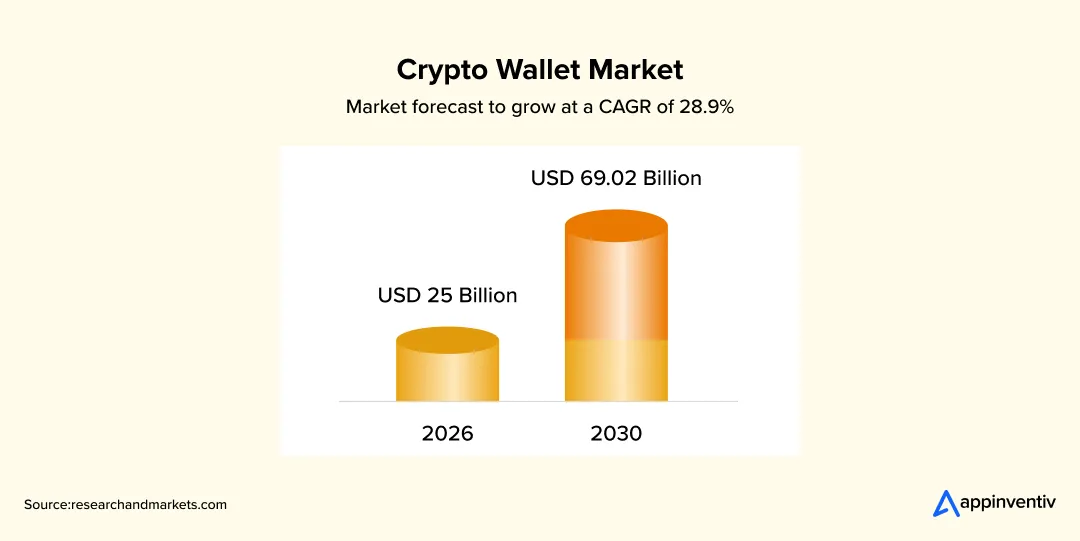
The crypto wallet market is expected to grow from $25 billion in 2026 to over $69 billion by 2030, showing how fast this demand is expanding.
This creates a clear opportunity for businesses. Crypto ownership has already reached around 40% among users in key markets, continuing to drive demand for self-custody wallets.
Many now want to build crypto wallet apps that support payments, tokens, and new Web3 use cases. The first question they ask is about the crypto wallet development cost.
The cost of blockchain wallet development usually falls between $50,000 and $500,000+. A simple wallet with basic send and receive features sits at the lower end of the spectrum. A multi-chain app with staking, swaps, and strong security pushes the cost much higher.
The final number changes based on a few key choices. Security design takes a large share of effort. Blockchain selection adds complexity. Feature depth and integrations increase both time and cost.
Each decision shapes the final budget. A clear view of these factors helps you plan with fewer surprises. Let’s break down the numbers and see where the cost comes from.
User behavior has already changed, and businesses delaying entry risk losing the early wallet adoption advantage.

How Much Does It Cost to Build a Crypto Wallet App in 2026?
The cost to build a crypto wallet app in 2026 ranges widely. Most projects fall between $50,000 and $500,000+. The gap exists for a clear reason. A small wallet with basic transfers takes less time. A full product with multiple chains, staking, and strict security takes much longer.
Each step you add increases development effort, especially as integration complexity grows, and the complexity of blockchain implementation directly determines where your project lands on the cost spectrum. Stronger security needs deeper testing and audits. These choices push both cost and timeline.
Cost Breakdown by App Complexity
| Complexity Level | Estimated Cost | Timeline |
|---|---|---|
| Basic Wallet | $50k – $90k | 2–3 months |
| Mid-Level Wallet | $90k – $200k | 4–6 months |
| Advanced Wallet | $200k – $380k | 6–9 months |
| Enterprise-Grade Wallet | $380k – $500k+ | 9–14+ months |
- Basic wallet: One chain, send and receive, simple layout
- Mid-level wallet: Multiple chains, price tracking, smoother interface
- Advanced wallet: NFT support, staking, token swaps
- Enterprise wallet: Custody systems, compliance checks, audit-ready setup
This gives a working range. The next step is to see how teams arrive at these numbers.
How to Estimate the Cost of Crypto Wallet App Development
Once teams lock a rough budget for crypto wallet development cost, they need a simple way to break it into parts. A clear model helps track where the money goes across build stages, chains, and security layers.
Total Cost = Wallet Complexity × Engineering Rate × Development Phases + Blockchain Setup + Security and Compliance
Each part pushes the final number.
- Wallet complexity drives effort. More features like swaps or staking take more time.
- Engineering rate shifts with team location and experience.
- Development phases cover design, coding, testing, and launch.
- Blockchain setup includes node access, APIs, and network links.
- Security and compliance add work through encryption, key storage, and audits.
A basic wallet with one chain is lighter to build. A multi-chain app with deep features and strict security takes longer and costs more.
Cost to Develop a Crypto Wallet App: Breakdown by Components
A wallet app is built in layers. Each part takes its own time and budget. Costs spread from early design to post-launch support.
| Component | What It Covers | Estimated Cost Range |
|---|---|---|
| Design (UI/UX) | App flow, wireframes, screen layouts | $5k – $20k |
| Frontend Development | Mobile or web interface, user actions | $10k – $50k |
| Backend Development | Servers, APIs, transaction handling | $15k – $70k |
| Blockchain Integration | Chain links, node access, contract setup | $10k – $60k |
| Security Layer | Key storage, encryption and login checks | $15k – $80k |
| QA and Testing | Bug checks, flow testing, stability checks | $5k – $25k |
| Deployment and DevOps | Hosting setup, release process | $5k – $20k |
| Maintenance | Updates, fixes, scaling over time | $10k – $40k per year |
The design phase, which covers wireframes and screen flow, often sets the foundation for the entire build. Understanding app wireframing early helps avoid costly rework in later stages. A small wallet keeps most of these parts simple. A larger product adds work in every row.
Cost to Develop a Crypto Wallet: Feature-Wise Breakdown
Features drive a large part of the budget. Each new function adds logic, testing, and security checks. A simple wallet stays light. A feature-heavy app takes more time across every layer.
| Feature | Complexity | Cost Range |
|---|---|---|
| Wallet Creation and Onboarding | Low | $3k – $10k |
| Private and Public Key Management | High | $10k – $40k |
| Send and Receive Crypto | Medium | $5k – $20k |
| Multi-Currency Support | Medium | $8k – $25k |
| Real-Time Market Data | Medium | $5k – $15k |
| Token Swapping | High | $10k – $35k |
| NFT Storage and Viewing | Medium | $8k – $20k |
| Staking Features | High | $10k – $30k |
| Security Features (Biometric, 2FA) | High | $10k – $35k |
Core features such as wallet setup and transfers take less effort. Features tied to security and DeFi add more work. Each added layer increases both build time and testing effort.
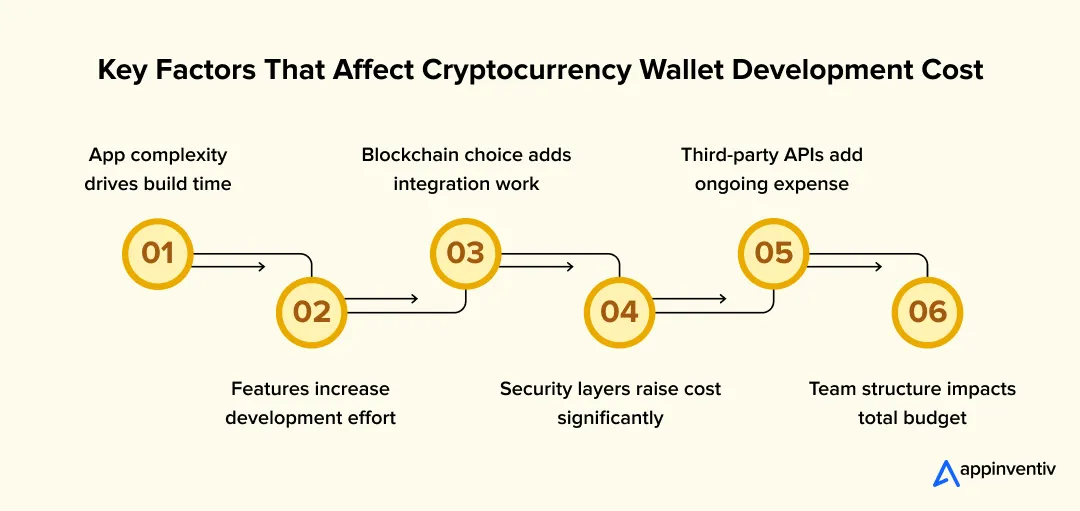
Key Factors That Affect Cryptocurrency Wallet Development Cost
The final cost of a wallet app comes from a few clear technical choices. Each one adds build effort, testing time, and security work.
App Complexity
Cryptocurrency wallet development cost rises sharply with complexity. A basic wallet handles one chain and signs simple transfers. It shows balances and past activity. An advanced wallet adds swaps, NFTs, and staking. An enterprise wallet includes custody logic, user roles, and audit records. Each layer brings more backend work and more cases to test.
Feature Set
Core features cover wallet setup, address creation, and sending funds. Advanced features need smart contract calls, swap routing, and staking flows. Every new feature adds logic and more test paths.
Blockchain Selection
Each chain behaves in its own way. Ethereum uses ERC-20 and ERC-721 tokens with gas fees. Solana uses a different model with faster confirmation. Polygon and BNB follow EVM rules but differ in fees. Multi-chain support means separate SDKs, RPC nodes, and signing flows for each chain.
Understanding the cost of developing a Bitcoin wallet versus an Ethereum or Solana wallet helps teams plan separate budgets per chain. For a concrete benchmark, see MetaMask-like wallet cost.
Real-world blockchain systems already show how architecture decisions directly impact cost, trust, and transaction efficiency.
Appinventiv developed a blockchain-based hotel booking platform that removed intermediaries from the transaction flow.
The goal was to reduce dependency on third parties and improve pricing transparency. The team implemented smart contracts to handle bookings, payments, and validation without manual intervention.
This reduced transaction overhead and improved trust across users. The result was faster booking cycles, lower operational costs, and a more transparent system. Read the full case study here.
Security and Compliance
Private keys need strong protection. Teams use encryption, secure enclaves, or MPC for storage. For a broader look at how blockchain app security is structured, it helps to understand the full security architecture before estimating cost. Custodial wallets add KYC and AML checks, along with audit logs.
UI and UX Requirements
A simple app shows balances and transfers, while a richer app adds charts, token data, and trade screens. The UI/UX design impact on cost is often underestimated at this stage.
High-engagement platforms already show how real-time interaction and system design directly impact user experience and performance.
Appinventiv developed an avatar-based social platform designed for real-time interaction and immersive user engagement. The requirement was to handle dynamic user actions, live state updates, and interactive environments at scale.
The team built a system that supported seamless data sync, responsive UI, and consistent performance across devices. This improved user retention and reduced interaction delays, even under higher load conditions. Read the full case study here.
Third-Party Integrations
Wallets connect to outside services. Fiat on-ramps link bank payments to crypto, and teams planning deeper payment functionality should also review crypto payment gateway development as it directly influences integration cost. Node providers such as Infura or Alchemy handle chain access.
Each integration needs to be set up correctly, and teams unfamiliar with this process should review the API development guide before scoping out third-party costs.
Team Structure
A wallet project needs blockchain engineers, backend developers, and security specialists. An in-house team costs more to maintain. An external team can lower costs but needs a clear scope and steady coordination.
Compliance and Governance Cost Impact on Crypt Wallet Development
Compliance adds a steady layer to the cost of blockchain wallet development and is not a one-time task. Even with market swings, total crypto value still stays above $2 trillion, which increases regulatory focus and risk exposure. It is not a one-time task. It continues as rules change and user activity grows.
| Area | What It Involves | Cost Impact |
|---|---|---|
| KYC and AML Systems | User identity checks, fraud screening tools | $10k – $50k+ |
| Data Protection | User data storage, encryption and regional policies | $5k – $30k |
| Custodial Compliance | Fund handling rules, reporting and access controls | $20k – $100k+ |
| Audit and Reporting | Transaction logs, monitoring systems | $10k – $40k |
| Licensing Requirements | Legal approvals based on region and wallet type | $10k – $100k+ |
Custodial wallets carry more responsibility. They need strict checks, user verification, and full transaction tracking. Teams handling high-volume transactions may also consider OTC exchange development as a complementary product layer.
Non-custodial wallets avoid some of this, but still need strong data protection and audit trails.
Compliance work does not stop after launch. Rules change across regions, and systems must keep up. This adds ongoing cost in updates, legal review, and system changes.
For many teams, this becomes one of the largest cost drivers over time.
Platform-Based Cost Variation in Crypto Wallet Development
The platform you choose directly affects the cost to develop a crypto wallet app, both in dollars and build time. Native apps need separate codebases. Cross-platform apps share code but come with limits. The right choice depends on performance needs and launch speed.
| Platform Type | What It Covers | Estimated Cost Range |
|---|---|---|
| iOS Development | Swift-based app, iPhone optimization, secure storage | $15k – $80k |
| Android Development | Kotlin or Java app, wider device support | $15k – $80k |
| Cross-Platform | Shared code using React Native or Flutter | $20k – $100k |
- iOS apps offer tighter control over hardware and security layers like Secure Enclave.
- Android apps support a wider range of devices but need more testing across versions.
- Cross-platform apps reduce build time by sharing code, though deep blockchain or security features may need native modules.
A single-platform app costs less at the start. Building for both platforms or adding custom native work increases the total budget.
Technology-Based Cryptocurrency Wallet App Development Cost Variation
Technology choices shape both effort and spend. Each layer in the mobile app technology stack adds setup time, testing, and long-term upkeep, which is why stack decisions made early affect total project cost. Simple stacks are easier to manage. Custom setups with deeper security and multi-chain support take more work.
| Technology Area | What It Covers | Estimated Cost Range |
|---|---|---|
| Blockchain Stack | Ethereum, Solana, Polygon, BNB chain setup and SDK use | $10k – $60k |
| Smart Contracts | Token logic, staking flows, swap contracts | $10k – $80k |
| Backend Frameworks | Node.js, Go, or Python services, API layers | $10k – $50k |
| Database | Transaction logs, user data and indexing systems | $5k – $30k |
| Security Technologies | MPC, HSM, encryption systems, secure key storage | $15k – $100k |
| Infrastructure | Cloud hosting or decentralized node setup | $10k – $70k |
- Blockchain stack changes how transactions are built and signed. Each chain needs its own tools and setup.
- Smart contracts add logic for staking, swaps, and token rules, which need audits and testing.
- Backend systems handle requests, sync data, and manage wallet states.
- Security tools like MPC or HSM increase safety but raise build effort.
- Infrastructure costs grow with traffic, node usage, and uptime needs.
Stablecoin transactions alone crossed $4 trillion within a few months and grew by over 80% year-on-year, showing how quickly backend load can scale.
A simple wallet uses fewer layers. A multi-chain wallet with strong security needs a deeper stack and higher spend.
Multi-chain, security layers, and infrastructure decisions can quickly increase cost without the right architecture planning.

Crypto Wallet Cost Variation by Location
Where your team sits changes the budget in a big way. The same wallet can cost very different amounts across regions. Rates vary by talent supply, demand, and local costs.
| Region | Hourly Rate (USD) | Cost Impact |
|---|---|---|
| North America | $100 – $170 | Highest spend, senior-heavy teams, strong process |
| Western Europe | $80 – $140 | High spend, steady delivery, compliance focus |
| Eastern Europe | $40 – $85 | Moderate spend, good engineering depth |
| Middle East (ME) | $50 – $110 | Mixed pricing varies by market and team |
| Australia | $90 – $150 | High spend, smaller talent pool |
A team in the US or Australia will push the budget up fast. Eastern Europe often lands in the middle for both price and output. Middle East pricing shifts from country to country, so quotes can vary. The choice is not only about rates. Time zone overlap, communication, and project size all play a role.
Types of Crypto Wallet Apps You Can Build
Wallet apps come in a few clear types, each with different cost implications. Before diving into costs, it helps to understand blockchain wallet types at a deeper level.
| Wallet Type | What It Means | Common Use Case |
|---|---|---|
| Hot Wallet | Stays online, runs on phone or browser | Quick payments, daily use |
| Cold Wallet | Kept offline, no direct internet link | Long-term storage, safer holding |
| Custodial Wallet | Service holds the private keys | Exchanges, managed user funds |
| Non-Custodial Wallet | User keeps the private keys | Personal control, self-custody |
| Multi-Chain Wallet | Works across more than one blockchain | Managing different tokens |
| DeFi Wallet | Connects with smart contracts and DeFi apps | Swaps, staking, lending |
Custodial apps often operate alongside or within exchanges, so teams building in that space may also want to review the crypto exchange development cost to understand the full picture. Non-custodial apps shift control to the user, which adds more work on key handling. Multi-chain and DeFi wallets need deeper integration, so they take more time to build.
The list above covers the main wallet types used today. There is one more category that often comes up during planning. Teams refer to it as a Web3 wallet. It builds on the same base but adds new capabilities that affect both scope and cost.
Web3 Wallet vs Crypto Wallet
The two terms often get used as if they mean the same thing. They do not. A crypto wallet handles storage and transfers, but it is worth noting that digital wallet apps span a wider category that includes both crypto and traditional finance use cases.
This difference affects both scope and web3 wallet development cost, since Web3 wallets need extra logic, integrations, and security layers.
| Aspect | Crypto Wallet | Web3 Wallet |
|---|---|---|
| Core Purpose | Store and transfer crypto assets | Connect and interact with dApps |
| Functionality | Send, receive, balance tracking | Contract signing, session handling and token usage |
| Use Cases | Payments, storage | DeFi apps, NFTs, Web3 services |
| Complexity | Lower | Higher with more integration work |
| Cost Impact | Lower build cost | Higher build and testing effort |
A crypto wallet handles assets. A Web3 wallet adds interaction with smart contracts and apps. This brings more logic into the system and raises development effort.
Web3 Wallet Development Cost
A Web3 wallet needs more than basic transfer flows. It must manage dApp sessions, sign contract calls, and track state changes. This adds work across frontend, backend, and security.
Most Web3 wallet builds fall between $80,000 and $600,000+.
| Component | What Adds Cost | Estimated Impact |
|---|---|---|
| dApp Connectivity | WalletConnect, browser links, session control | $10k – $50k |
| Smart Contract Support | Signing flows, gas handling, parsing | $10k – $60k |
| Multi-Chain Support | Ethereum, Polygon and Solana setup | $15k – $80k |
| DeFi and NFT Features | Swaps, staking and NFT display | $15k – $70k |
| Security Layers | Key safety, approvals, phishing checks | $20k – $100k+ |
Web3 wallets handle more actions per user. This increases testing effort and security work, which pushes the cost higher.
Build vs Customize Crypto Wallet Platform
Teams asking how much does a crypto wallet cost usually face a simple choice at the start: build from scratch, or start with a ready base. Build everything from the ground up, or start with a ready base and adjust it.
| Approach | Pros | Cons | Best Fit Use Case |
|---|---|---|---|
| Build from Scratch | Full control, custom setup | Higher cost, longer timeline | Complex apps, custom features |
| White-Label Setup | Faster launch, lower spend | Limited control, fixed logic | Quick launch, basic wallet features |
Building from scratch gives you control over how the wallet works. You can define key storage, transaction flow, and chain support. This path takes more time since every part needs to be built and tested.
For a real-world cost reference, see how much it takes to build a multi-chain wallet like Exodus.
A white-label setup starts with a working base. Core features like wallet creation and transfers are already in place. Teams spend time adjusting the interface and adding small changes.
The choice comes down to how much control you need. Working with professional cryptocurrency wallet development services helps you evaluate both paths with the right technical depth.
How Development Timelines Influence Crypto Wallet Cost
The cost to develop a crypto wallet is shaped by timelines more than most teams expect. Speed is not just about delivery. It changes team size, coordination, and how work runs across stages.
A few patterns show up in wallet projects:
- Parallel teams can speed up delivery, but raise short-term spend
- Phased releases keep the early cost lower, but stretch the total timeline
- Security audits and key management checks add fixed steps
- Late design changes often lead to rework and added cost
Timeline Impact Overview
| Delivery Approach | Typical Outcome | Cost Behavior |
|---|---|---|
| MVP-First Rollout | Quick launch with limited wallet features | Lower start cost, higher later spend |
| Scale-Ready Build | Built for multi-chain and growth from day one | Higher start cost, fewer rebuilds |
| Multi-Region Enterprise Launch | Compliance and infra are ready across regions | Highest upfront cost, stable scaling |
A fast launch needs more people working at the same time. A slower path spreads the cost over a longer period. The timeline does not remove cost. It shifts when and how you pay for it.
Hidden Costs of Wallet App Development
Most teams plan for the build and launch, but overlook how much does it cost to build a crypto wallet end-to-end, including what comes after real users start making transactions. This is where extra costs begin to show up and grow over time.
| Hidden Cost Area | Why It Adds Cost Over Time |
|---|---|
| Security Audits | Regular audits are needed as wallet usage and risk increase |
| Smart Contract Issues | Bugs or flaws need fixes and redeployment |
| Blockchain Node Infrastructure | Ongoing node access and uptime monitoring add recurring cost |
| API Usage Costs | Price feeds, on-ramps, and data services charge per request |
| Compliance and Legal | KYC, AML checks and policy updates require ongoing effort |
| Maintenance and Updates | Bug fixes, OS updates, and feature changes continue post-launch |
Security work does not stop after launch. Smart contracts need review and sometimes patching. Node providers and APIs charge based on usage, which grows with users.
Legal and compliance work also continues. Rules change, and systems must adapt. Regular updates keep the app stable and secure. Teams often overlook user engagement tools like push notification strategy, which also carry implementation and ongoing maintenance costs.
These costs do not appear in early estimates, yet they shape the long-term budget.
Understanding Total Cost of Ownership (TCO)
The build cost is only the first part of the spend. Once the wallet goes live, costs continue through hosting, updates, and security work. Over time, these ongoing expenses can match or even exceed the initial build.
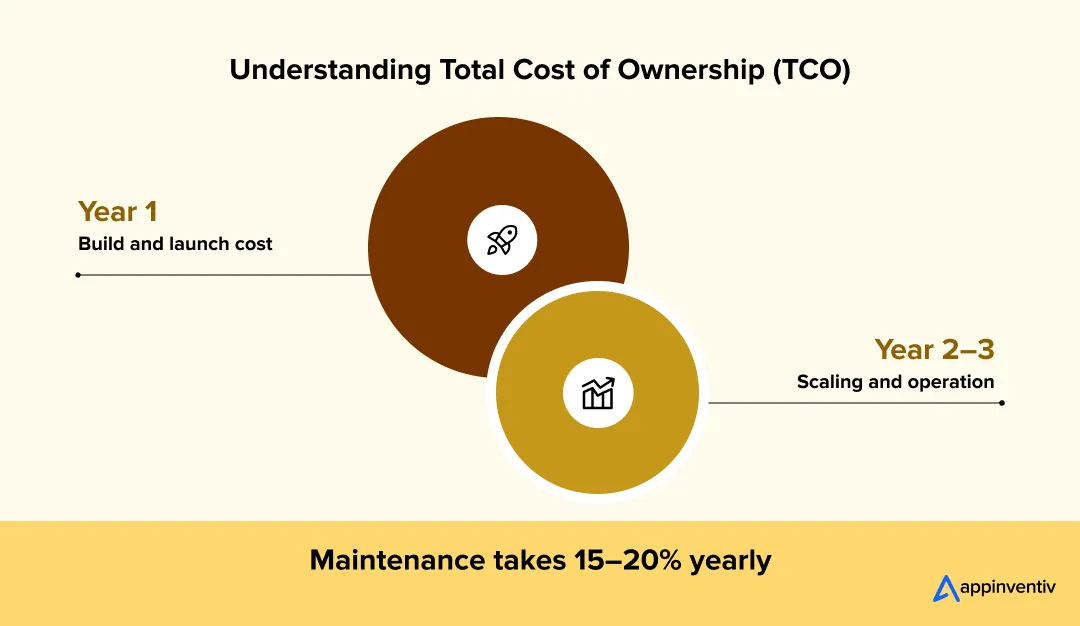
3-Year Cost Curve
Most wallet apps follow a similar pattern over the first three years.
Year 1: 40–50%
The largest share goes into building the product. This includes design, development, blockchain setup, and early infrastructure. Costs stay high during launch and early user growth.
Year 2–3: 50–60%
Spend shifts to operations. Infrastructure grows as transaction volume increases. Teams handling scaling should understand how cloud computing costs contribute to the overall TCO, especially when node access and hosting expand. Security work continues with audits and key management checks.
Maintenance alone can take 15–20% of the initial build cost each year. Scaling infrastructure, such as node access and cloud services, adds to this. Security upgrades and new features also require steady investment.
The pattern stays clear. Early cost builds the wallet. Ongoing cost keeps it secure, stable, and ready for growth.
Delayed execution often leads to higher development, infrastructure, and compliance costs across the lifecycle.

How to Optimize Crypto Wallet App Development Cost
Controlling the cost to develop a crypto wallet app starts with clear choices. Teams that focus on scope and reuse spend less and move faster.
- Start with an MVP
Build core flows first using an MVP-first approach. Wallet creation, key handling, and transfers come first. Staking or swaps can be added later once usage is clear. - Use existing blockchain APIs
Services like node providers and indexers remove the need to run your own full nodes early. This is where Blockchain as a Service tools become a practical cost-saving option for early-stage teams. - Choose cross-platform development
A shared codebase covers iOS and Android. This reduces build effort, though some security parts may still need native code. - Prioritize must-have features
Avoid adding NFTs, DeFi, and analytics in the first release unless required. Each feature adds logic and testing work. - Outsource with a clear scope.
A focused external team can reduce cost. Define features, timelines, and deliverables early to avoid rework. - Reuse modules
Use tested libraries for key management, transaction signing, and API handling. This reduces build time and lowers risk.
Small decisions at the start help control the total budget.
Monetization Strategies for Crypto Wallet Apps
Understanding the cost to build a crypto wallet app helps teams plan a monetization model early. A wallet app can generate revenue in a few direct ways. Most models tie income to user activity and asset movement.
| Strategy | How It Works | Revenue Model |
|---|---|---|
| Transaction Fees | Small fee on each send or receive action | Fixed fee or percentage |
| Token Swap Fees | Charge on in-app swaps via DEX routes | Percentage per swap |
| Staking Commissions | Share of rewards earned from staking pools | Commission on yield |
| Premium Features | Paid access to advanced tools or analytics | Subscription or one-time fee |
| Partnerships & Integrations | Earn from on-ramps, off-ramps, and service providers | Revenue share or referral fee |
Transaction and swap fees form the base income for most wallets. Teams exploring broader revenue models often look at the crypto trading app cost since trading platforms share overlapping monetization logic.
Staking adds a steady stream as users lock assets. Premium features work well for active users who need more data or control.
Partnerships with fiat gateways and third-party services add another layer of income. The model depends on user volume and how often they interact with the app.
How Appinventiv Helps Build Secure Crypto Wallet Apps
As a trusted blockchain app development company, Appinventiv knows that building a crypto wallet needs more than feature delivery. It needs strong architecture, secure key handling, and stable infrastructure from day one.
Appinventiv follows an architecture-first approach. Teams design wallet flows, key storage, and transaction logic before development starts. This reduces rework and keeps the system stable as usage grows.
Security stays at the core of every build. This includes encryption, secure key storage, and regular audits. Systems are designed to handle risk from the start, not after launch.
As a trusted crypto wallet app development company, we bring extensive experience across major blockchain networks. This includes EVM chains, Solana-based systems, and multi-chain setups. Each integration is built with proper signing logic and network handling.
Infrastructure is designed to scale with users and transaction load. This includes node access, cloud setup, and monitoring tools to keep performance steady.
- 200+ fintech products delivered
- 10+ years of fintech experience
- 98% fraud detection accuracy
- 99.50% transaction security SLA
- Up to 30% reduction in operational cost
If you plan to understand the crypto wallet development cost for your build, connect with the team to discuss your requirements.
Frequently Asked Questions
Q. How do features impact crypto wallet development cost?
A. Features shape both time and crypto wallet development cost. A simple wallet handles transfers and balance checks. Add swaps, staking, or NFTs, and the work grows fast. Each feature needs extra logic, more testing, and tighter security checks. Teams also spend time handling edge cases. As features increase, effort spreads across backend, frontend, and testing, which raises the overall budget.
Q. What is the cost of adding multi-currency support to a crypto wallet?
A. Multi-currency support means working with more than one blockchain. Each chain has its own rules, SDKs, and transaction methods. Teams need to connect to different nodes and handle token standards. This adds setup and testing work. In most builds, this can add around $8,000 to $30,000, based on how many chains are included.
Q. How much does security implementation increase wallet development cost?
A. Security is not a small add-on. It takes a large part of the budget. Teams need to protect private keys, set up encryption, and add login checks. Extra layers like biometrics or MPC increase the effort. Testing and audits also take time. In many cases, security work can take around 20% to 30% of the total cost.
Q. What is the cost of integrating third-party APIs in a crypto wallet?
A. Wallet apps depend on outside services for data and access. Price feeds, on-ramps, and node providers all need integration. Each API needs setup and testing. Some also charge based on usage. Initial integration can cost between $3,000 and $15,000 per service, depending on how deeply it connects with the app.
Q. What is the cost difference between custodial and non-custodial wallets?
A. Custodial wallets need more systems. They handle user funds, so they require identity checks, access control, and audit logs. This adds more backend work and compliance effort. Non-custodial wallets give control to users, which removes some layers. In most cases, custodial wallets cost about 30% to 50% more to build.
Q. What is the cost of hiring a blockchain development team?
A. Team cost depends on size and location. A small team can cost $40,000 to $50,000 per month. Larger teams with security experts and senior engineers cost more. Rates are higher in regions like the US and lower in Eastern Europe or Asia. The total spend grows with project scope and timeline.


Fast 2-minute response, fully NDA-protected.

Smart Contract Development Cost in the UAE in 2026: Factors, Estimates, and Key Considerations
Key takeaways: UAE smart contract projects range from AED 147K to AED 1.46M+, driven by architectural complexity, testing scope, and security standards. Enterprise budgets must divide core programming from independent audits, system integrations, hosting infrastructure, legal compliance, and ongoing operations. Ethereum, Polygon, Solana, and Hyperledger Fabric require distinct programming languages, software tooling, infrastructure, and transaction…
White-Label Crypto Exchange Platform Development in the UAE: A Complete Cost and Compliance Guide
Key takeaways: Building a white-label exchange costs AED 55,000 to AED 550,000. VARA licensing adds an AED 100,000 application fee plus an AED 200,000 supervision fee yearly. Technology takes weeks; VARA approval takes six to twelve months. Choose white label for speed, custom for real differentiation. Bake compliance into the build from the first sprint.…
P2P Crypto Exchange Development: Architecture, Features, Cost & Enterprise Implementation Guide
Key Takeaways Enterprise P2P crypto exchanges require secure blockchain escrow orchestration, multi-chain crypto wallet infrastructure, and real-time compliance monitoring from day one. Stablecoin-powered settlement systems are reshaping cross-border transactions, OTC trading, and regional liquidity movement across digital asset ecosystems. Infrastructure decisions around custody, scalability, and compliance directly affect long-term exchange stability, transaction security, and operational…