































Healthcare AI voice agent development: steps, costs, and compliance

 Share -



Key takeaways:
- Choose workflows by reversibility, not call volume. Scheduling, refills, and eligibility verification ship in Wave 1; nurse triage waits until last.
- Lock the latency budget before you choose a model. The turn-time target constrains hosting, retrieval, and orchestration more than any feature list does.
- Treat the stack as a pipeline, not a product. Every stage carries its own failure mode, and speech recognition needs fine-tuning on accented clinical audio.
- Route EHR writes through middleware, never straight into the clinical record. Idempotency keys, a rollback path, and versioned intent-to-action mapping are the design.
- Run shadow mode before go-live, then red-team the ugly calls. Distress, background noise, code-switching, and deliberate attempts to extract another patient’s data.
- Monitor four numbers weekly after launch. Containment rate, escalation reasons, intent-level accuracy, and handle time on escalated calls.
- Budget by tier, then model the run-rate. Build cost tracks integration depth, and every point of containment gain raises the monthly inference bill.
Healthcare AI voice agent development means building a phone system that verifies the caller, completes the task inside your EHR or practice management system, and hands off to a human the moment its confidence drops. This guide answers the four questions teams ask before committing a budget: which workflows to automate first, how the build sequences, what it costs, and what HIPAA demands of the architecture.
The phone is the last unautomated front door in American healthcare. Patients still call to book, refill, and ask what they owe, and the 2025 CAQH Index puts $21 billion in annual savings still trapped inside those manual transactions.
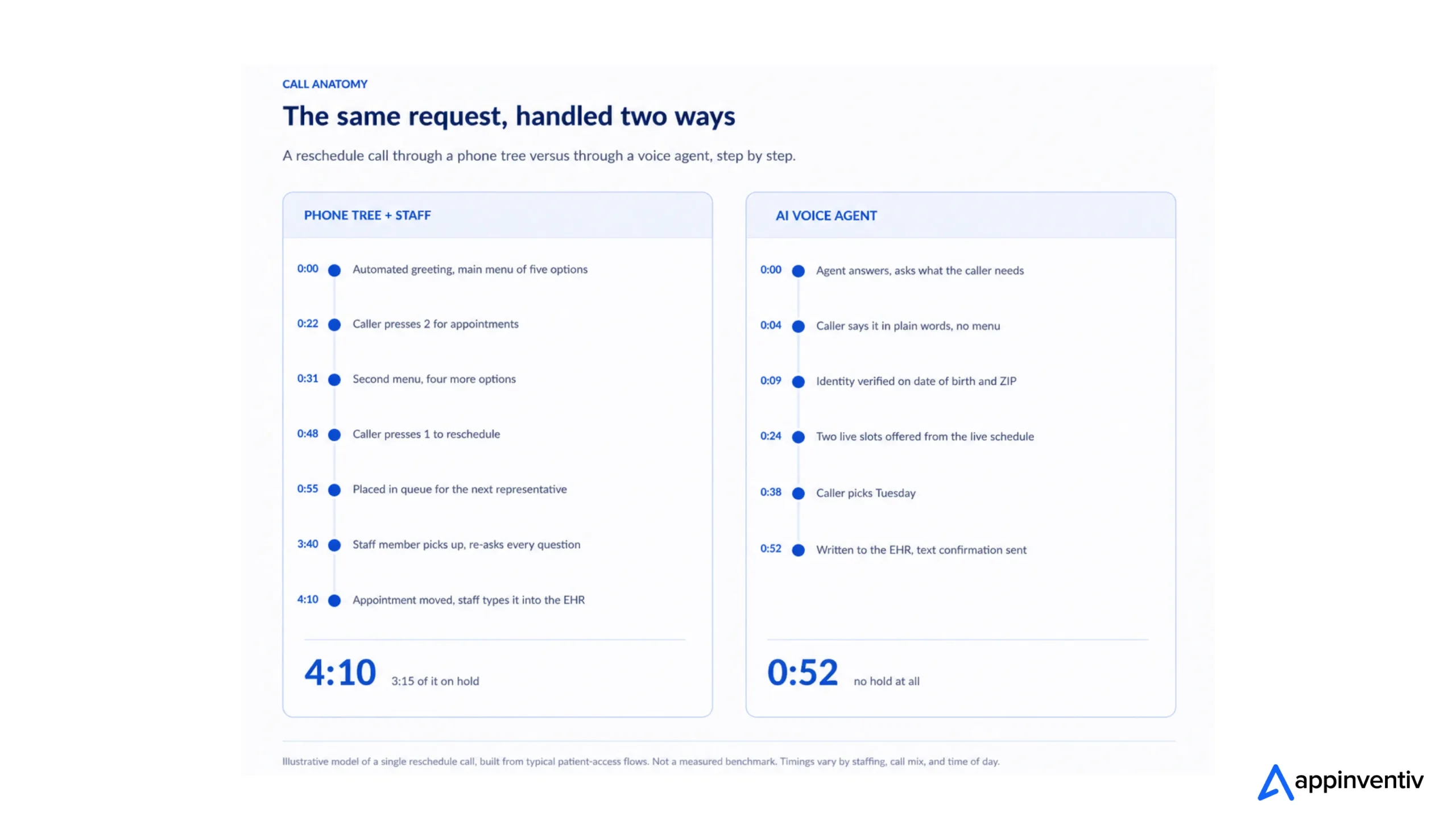
What changed is not the models. These systems finally started finishing calls instead of deflecting them. An IVR answers. A conversational AI voice agent verifies the caller, checks live availability, books the slot, writes it back to the EHR, and escalates the second its confidence drops.
The distance between those two sentences runs about six months and six figures, most of it integration and compliance work rather than AI. Teams that budget for the model and treat the rest as overhead stall at month eight.
Send your call volume — we’ll show you what pays off first.
What does the future of AI voice agents in healthcare look like?
Grand View Research valued the global AI voice agents in healthcare market at $468 million in 2024, projecting $3.18 billion by 2030 at a 37.79% CAGR, with North America holding 54.17% of 2024 revenue. That North American concentration is not an accident. US providers absorb the heaviest administrative load in the developed world, so they see payback fastest.
Look at the broader category and the trend holds. The same firm’s 2025 AI voice agents market report puts healthcare as the fastest-growing end-use segment overall, at a 42.0% CAGR through 2033. Healthcare is outrunning retail, banking, and travel on voice adoption, which almost nobody predicted five years ago.
Read that curve carefully, and you will notice something useful. The AI voice agent in healthcare is not following the chatbot pattern, where adoption stalled at deflection and never reached completion. Voice is going straight to transaction, because the phone was already the transaction channel.
Four numbers explain the pressure:
- 13 hours a week. Physicians and their staff lose that much time to prior authorization alone, and 94% say it drives burnout, per the 2025 AMA Prior Authorization Physician Survey. Agents run status checks and payer callbacks without a human sitting on hold.
- $7.42 million per breach. That is the average cost of a healthcare data breach, and it takes 279 days to identify and contain, per IBM’s 2025 Cost of a Data Breach Report. Purpose-built voice architecture narrows how much PHI is ever in play.
- 39% fewer no-shows. Virtual-care patients missed appointments far less often than in-person patients across 45 studies pooled in a 2025 meta-analysis in BMC Health Services Research. Proactive outbound confirmation and rescheduling handle that at full call volume.
One more signal worth your attention. Deloitte’s 2026 US Health Care Executive Outlook found more than 80% of health care executives expect agentic and generative AI to deliver moderate-to-significant value, while only 15% said their governance had kept pace with the technology. That gap is where projects die. We will come back to it.
How do you build an AI voice agent for healthcare?
Shipping an AI voice agent for healthcare takes six steps, and the order is not negotiable. Teams that jump straight to model selection end up rebuilding the integration layer twice.
Step 1: Which workflows should you automate first?
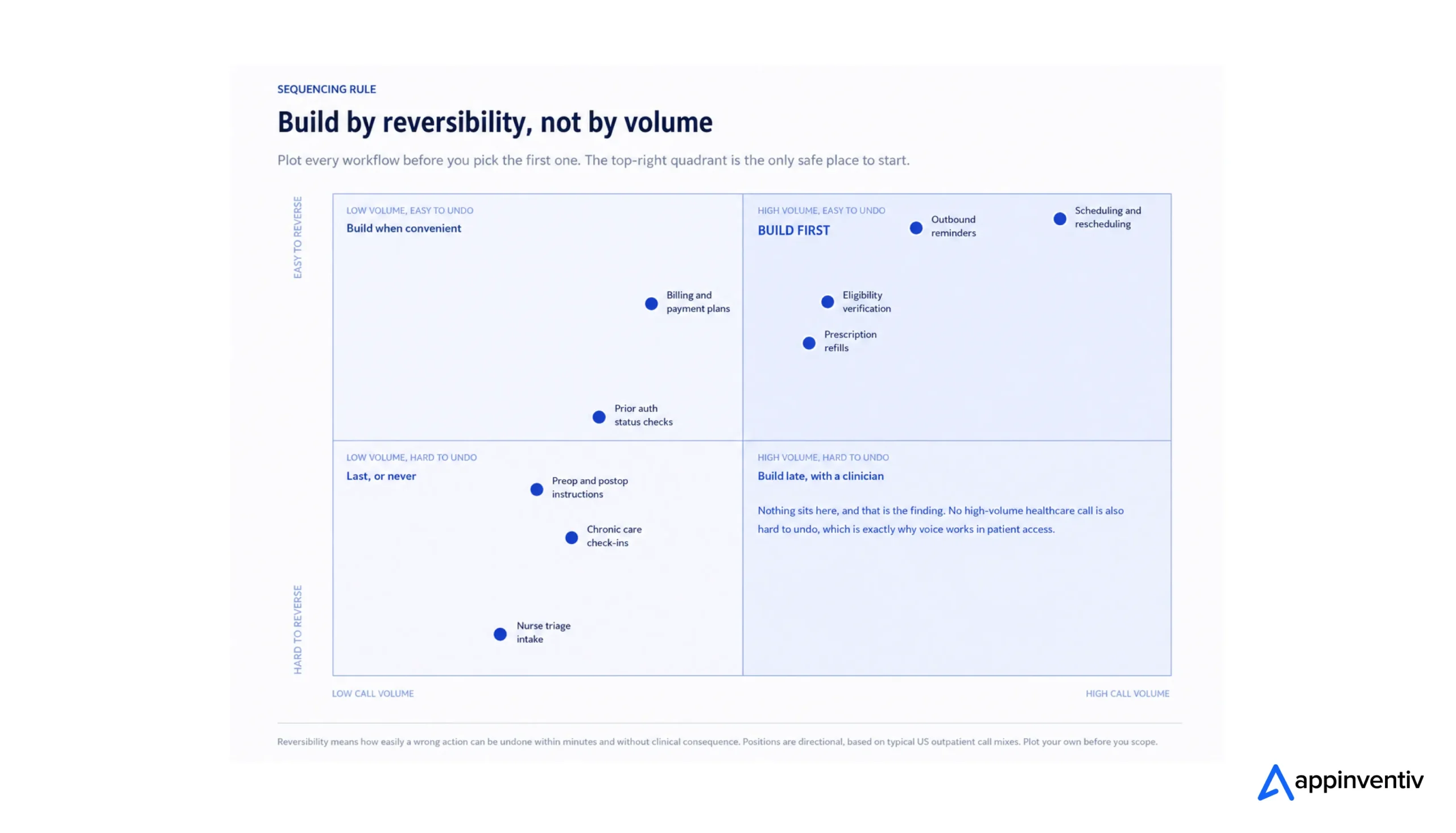
Every healthcare AI voice agent development process starts here, and getting it wrong is expensive. Pick by call volume and reversibility. High-volume, low-clinical-risk, easily reversible tasks go first. Anything that touches diagnosis or medication changes waits.
The top use cases of a medical AI voice agent, ranked by how quickly they pay back:
| Use case | Typical call volume share | Clinical risk | Go-live priority |
|---|---|---|---|
| Appointment scheduling, rescheduling, and cancellation | 30% to 40% | Low | Wave 1 |
| Prescription refill requests and pharmacy routing | 10% to 15% | Low to medium | Wave 1 |
| Insurance and eligibility verification | 10% to 15% | Low | Wave 1 |
| Appointment reminders and no-show recovery (outbound) | Outbound | Low | Wave 1 |
| Billing questions and payment plan setup | 8% to 12% | Low | Wave 2 |
| Preop and postop instruction delivery, plus confirmation | 5% to 8% | Medium | Wave 2 |
| Chronic care check-ins and remote symptom capture | 5% to 10% | Medium | Wave 2 |
| Prior authorization status checks with payers | Staff-facing | Medium | Wave 2 |
| Nurse triage intake and severity routing | 5% to 10% | High | Wave 3 |
Start with Wave 1 across two or three clinics rather than one workflow across the whole system. An AI voice assistant for healthcare earns trust locally before it earns it system-wide, and you learn more from a narrow deployment that runs deep than a wide one that runs shallow.
A note on outbound. A medical AI voice agent does its best work on reminders, recall lists, and lapsed-care outreach, where nobody was making those calls anyway. That is net-new revenue, not cost avoidance, and it is the easiest ROI story to take to a CFO.
Step 2: What features does a healthcare AI voice agent actually need?
Feature lists in vendor decks are mostly noise. An AI voice assistant for healthcare lives or dies on about nine capabilities, and the rest is packaging. These are the ones that decide whether the thing survives contact with real patients:
- Barge-in and interruption handling. Patients talk over the agent. If it cannot stop mid-sentence and listen, the call is already lost.
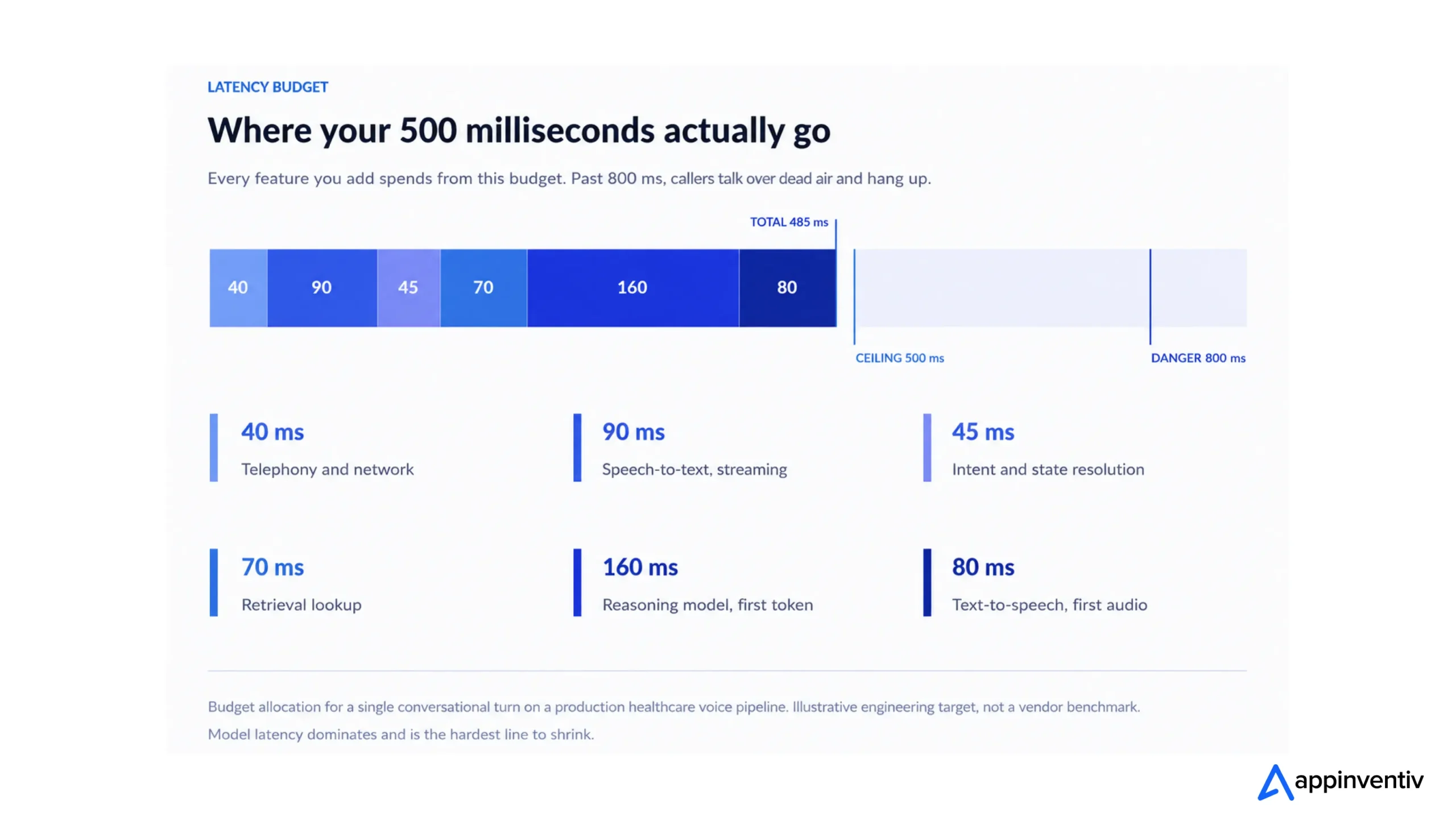
- Sub-500-millisecond response latency. Anything slower and callers say “hello?” into dead air, then hang up.
- Clinical vocabulary tuning. Drug names, ICD-10 references, and provider names need custom lexicons. Generic speech recognition fails hardest exactly where accuracy matters most. Build speech recognition software that is inclusive and compliant with industry standards.
- Accent and dialect coverage. A Boston accent, Spanish-dominant bilingual speech, and AAVE all need to land. This is a patient-safety issue, not a nice-to-have.
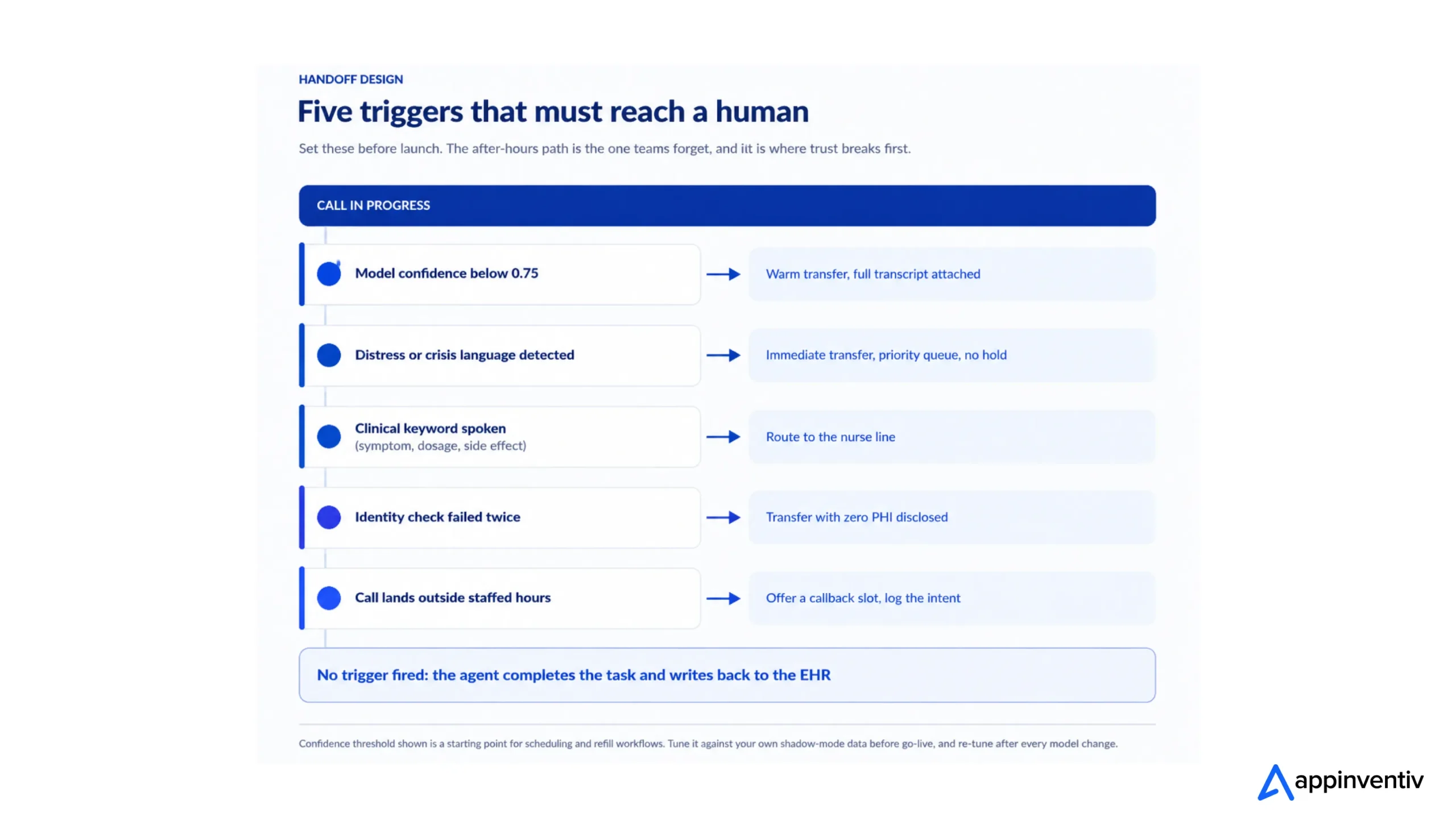
- Confidence-scored human handoff. The agent should escalate on low confidence, distress detection, or any clinical keyword, with full transcript context passed to the staffer.
- Bidirectional EHR write-back. Reading availability is easy. Writing a confirmed appointment, updating a chart note, and firing a task to the right work queue is where projects stall.
- Identity verification. Two-factor patient verification before any PHI is spoken aloud.
- Full-fidelity audit logging. Every turn, every intent, every write, timestamped and tamper-evident.
- Real-time analytics. Containment rate, escalation reason codes, and intent-level accuracy, visible to operations without a data request.
Those nine are table stakes. A custom healthcare AI voice agent earns its budget on the tenth thing, which is always specific to your organization: a payer mix nobody else has, a referral pattern your competitors cannot see, or a clinic-by-clinic scheduling rule set that no packaged product will ever model correctly.
That tenth capability is the entire argument for custom AI voice agent development over a subscription. An off-the-shelf healthcare voice AI platform is tuned for the average provider, while a bespoke medical voice assistant is tuned for yours, which is why most systems that start with a packaged voice bot for hospitals end up commissioning tailored healthcare voice automation within a year.
Fast, HIPAA-compliant voice AI built by a team that’s done it before.

Step 3: Which technology stack should you pick?
An AI voice agent for healthcare is a pipeline, not a product, and a healthcare voice AI platform is only as strong as its weakest stage. Each stage has its own failure mode, and choosing the right AI tech stack early prevents an expensive rebuild at month eight.
| Layer | What it does | Common choices | The gotcha |
|---|---|---|---|
| Telephony and media | Carries the call, streams audio | Twilio Programmable Voice, Amazon Connect, SIP trunk into existing PBX | BAA coverage varies by product tier, not just by vendor |
| Speech-to-text | Transcribes in real time | Deepgram, AWS Transcribe Medical, Azure AI Speech, fine-tuned Whisper | Off-the-shelf models miss clinical entities at higher rates than the headline WER suggests |
| Dialogue orchestration | Tracks state, calls tools, enforces guardrails | LangGraph, Rasa, custom state machine | Free-running LLM agents drift; healthcare needs constrained state transitions |
| Reasoning model | Interprets intent, drafts responses | GPT-class, Claude, Llama, or a fine-tuned open model in your VPC | Zero-data-retention contracts are mandatory, not optional |
| Retrieval layer | Ground answers in your policies and formulary | pgvector, Pinecone, Azure AI Search | Ungrounded models confabulate coverage rules. This is your top liability |
| Text-to-speech | Speaks the response | ElevenLabs, Azure Neural TTS, PlayHT | Voice cloning of real staff creates consent problems. Skip it |
| Integration layer | Reads and writes clinical data | HL7 v2, FHIR R4, Epic and Cerner APIs, custom middleware | FHIR write scopes are frequently the long pole in the schedule |
| Observability and audit | Logs, traces, and compliance evidence | OpenTelemetry, Datadog, immutable object storage | Retention policy must match your state’s, not just HIPAA’s floor |
On accuracy, the research is blunt. Afonja and colleagues, in a 2024 study on ASR models for medical entities in accented speech, found that even models with low overall word error rates make disproportionately high errors on drug names, diagnoses, and lab results, and that fine-tuning on accented clinical speech improved medical WER by 25% to 34% relative. Translation: budget for domain fine-tuning. Generic transcription is not good enough when the word is “hydralazine,” and the alternative is “hydroxyzine.”
Step 4: How do you integrate with the EHR without breaking it?
This is where the rubber meets the road. Read access through FHIR R4 is usually straightforward. Write access is a negotiation with your EHR vendor, your security team, and often your CMIO.
Three practical rules we apply on every engagement:
- Never let the agent write directly to a clinical record. Route through a middleware queue with idempotency keys and a rollback path.
- Mirror, do not migrate. Keep a read-optimized cache for availability lookups so a slow EHR does not add 2 seconds to every turn.
- Version your intent-to-action mapping. When scheduling rules change, you want a diff, not a mystery.
Teams already signing up for healthcare IT services that help them unlock a smart digital agent efficiently should sequence the voice agent after the interoperability work lands, not alongside it. An AI voice assistant for hospitals touches more upstream systems than most people plan for: scheduling, registration, eligibility, the patient portal, and the call recording archive.
Step 5: How do you test before going live?
Shadow mode first. The agent listens to live calls and drafts what it would have said, while humans handle the actual conversation. You compare, you tune, and nobody gets hurt.
Then run a red-team pass built around the ugly cases: callers in distress, background noise, code-switching mid-sentence, hearing-impaired callers, and deliberate attempts to extract another patient’s information. Rigorous HIPAA compliance software testing belongs in this phase, not after launch.
Step 6: What does post-launch monitoring look like?
Track four numbers weekly: containment rate, escalation reason distribution, intent-level accuracy, and average handle time for escalated calls. If containment climbs while escalated handle time also climbs, your agent is punting the hard calls late instead of early. Fix the handoff trigger, not the model.
That six-step arc is the whole healthcare AI voice agent development process, and the gates between steps matter more than the work inside them. Skipping shadow mode to hit a launch date is the single most common reason a pilot gets pulled in week three.
How much does healthcare AI voice agent development cost?
Straight answer: $45,000 to $400,000+ for the build, depending on scope, integration depth, and how much compliance work you already have banked. Ongoing runtime and maintenance land at 18% to 25% of build cost annually, which is higher than standard software because inference and telephony are metered.
The cost of an AI voice agent for healthcare deployments splits roughly 40% engineering, 35% integration, and 25% compliance and validation. That last quarter is the one procurement teams cut first and regret later.
Here is where healthcare AI voice agent development money actually goes.
| Build component | What you get | Cost (USD) |
|---|---|---|
| Discovery, workflow mapping, and compliance design | Call-volume analysis, intent taxonomy, risk assessment, architecture | $12,000 to $30,000 |
| Core voice pipeline (STT, LLM, TTS, orchestration) | Working conversational loop with sub-500 ms turns | $30,000 to $85,000 |
| Clinical vocabulary and accent fine-tuning | Domain-tuned ASR, custom lexicons, bias testing | $15,000 to $45,000 |
| EHR and PMS integration | FHIR or HL7 read/write, middleware, queue, rollback | $25,000 to $90,000 |
| HIPAA security architecture | Encryption at rest and in transit, MFA, RBAC, audit trail, BAA chain | $18,000 to $50,000 |
| Retrieval layer and knowledge grounding | Policy, formulary, and coverage-rule grounding | $12,000 to $40,000 |
| Testing, shadow mode, and clinical validation | Red-team pass, bias audit, clinician sign-off | $10,000 to $35,000 |
| Analytics dashboard and monitoring | Containment, escalation, and accuracy reporting | $8,000 to $25,000 |
Which pricing tier fits your organization?
Most custom AI voice agent solutions for healthcare fall into one of three brackets. Match the tier to your call volume, not to your ambition, and price a custom-built healthcare voice agent against the workflows it will actually own.
| Tier | Scope | Timeline | Cost (USD) |
|---|---|---|---|
| Pilot | One or two workflows, single clinic, read-only EHR | 8 to 12 weeks | $45,000 to $90,000 |
| Production | Four to six workflows, multisite, bidirectional EHR write | 4 to 7 months | $120,000 to $260,000 |
| Enterprise | Full patient-access replacement, multilingual, payer integrations | 8 to 14 months | $280,000 to $400,000+ |
What actually swings the number?
Five variables move the budget for an AI voice assistant for healthcare more than anything else:
- EHR write access. Read-only pilots are cheap. Bidirectional Epic or Cerner integration can add $40,000 to $90,000 on its own.
- Language coverage. Each additional production language adds roughly 12% to 18%, mostly in testing and clinical vocabulary work.
- Compliance starting position. Retrofitting HIPAA controls onto an existing prototype costs multiples of designing them in from day one. If you have not yet done the groundwork for HIPAA-compliant app development that uses AI agents, add it to the plan now.
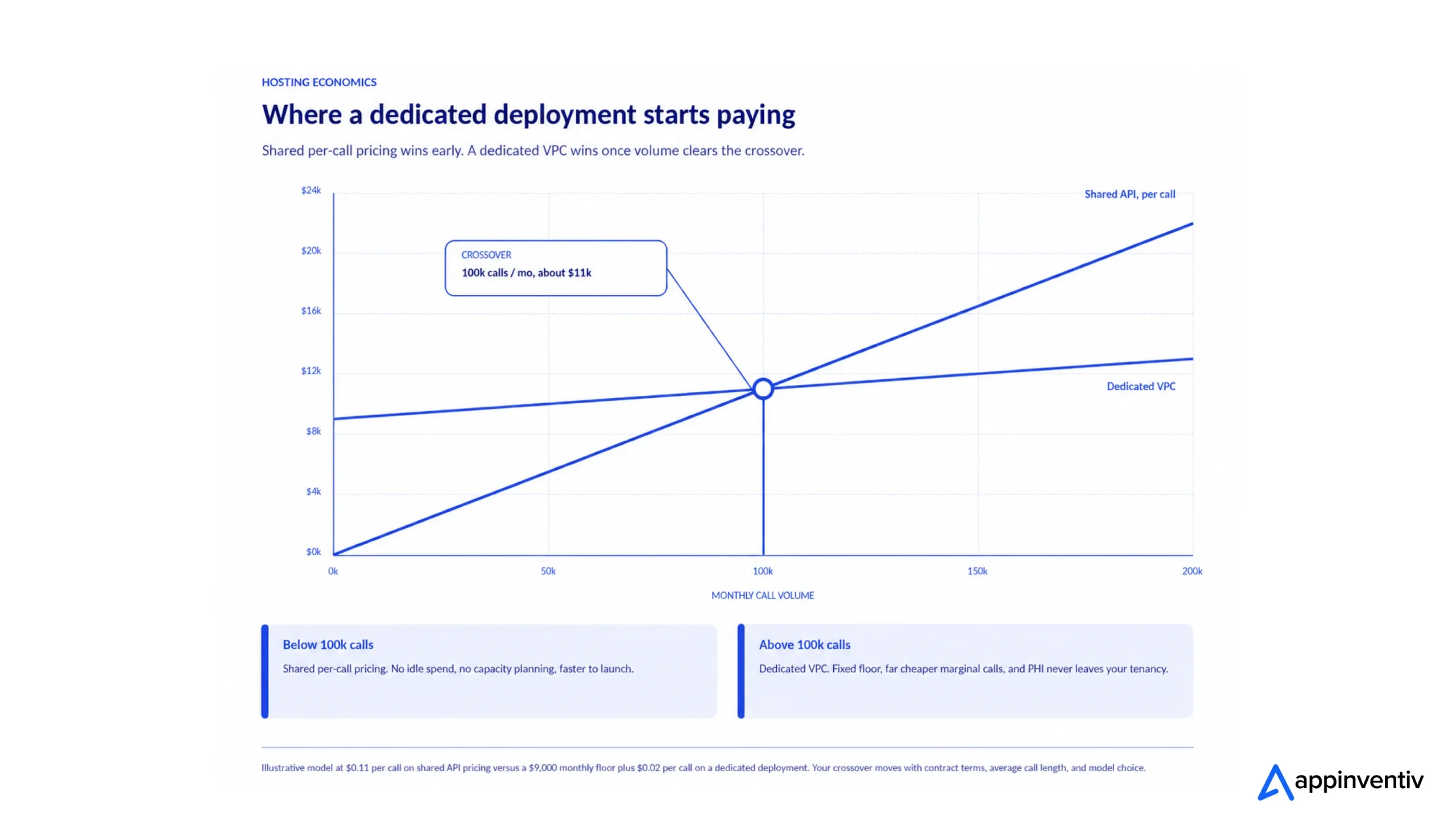
- Call volume. Inference and telephony scale linearly. At 50,000 calls per month, runtime alone runs $6,000 to $14,000.
- Model hosting choice. A dedicated VPC deployment costs more upfront and less per call at volume. The crossover is usually somewhere north of 100,000 monthly calls.
One planning note that catches finance teams off guard. Healthcare AI voice agent development cost is front-loaded on the build, but the run-rate compounds with success. The better your containment rate, the more calls the agent handles, and the higher your monthly inference bill. Model that curve before you sign a three-year budget.
One system for scheduling, billing, and triage — not four vendors.
What are the security considerations for implementing voice AI in healthcare?
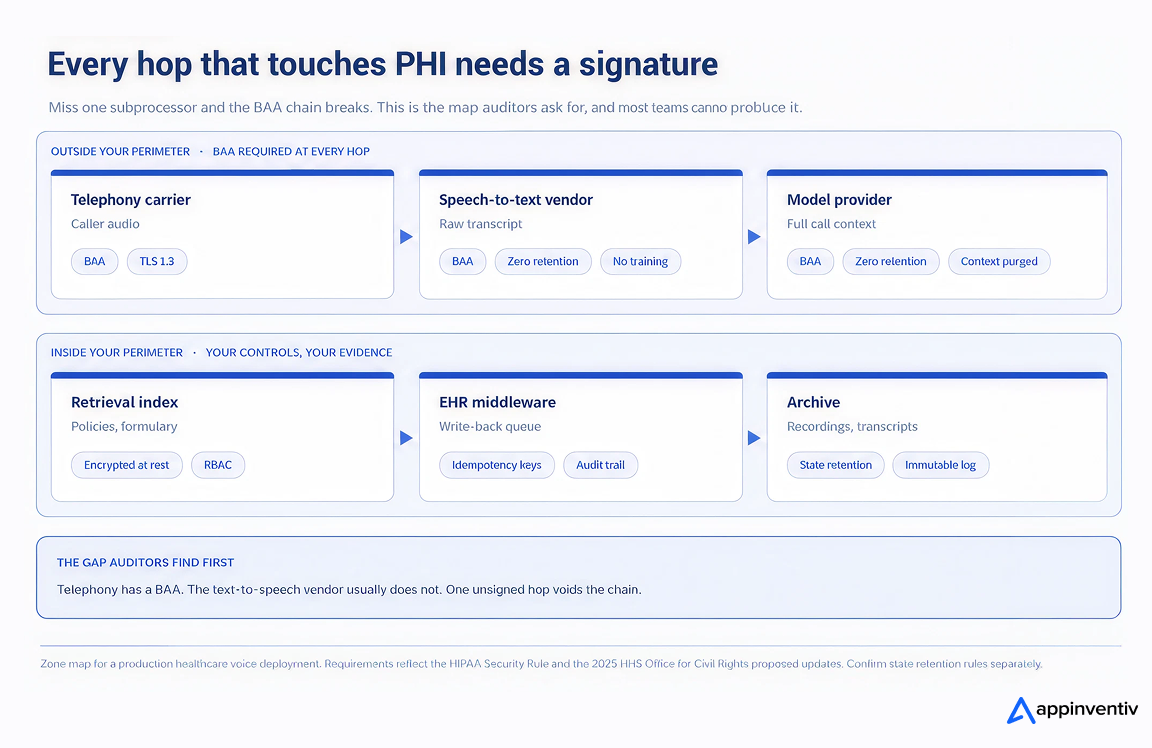
An AI voice agent for healthcare is the highest-risk AI modality you can deploy, and most teams underrate it. Audio is biometric data. Transcripts are PHI. Model context windows are a data-retention question nobody asks until legal does.
HIPAA-compliant voice agents for healthcare are an architecture, not a checkbox a vendor hands you. Implementing AI voice agents for healthcare means proving, at audit time, that every hop in the pipeline was covered.
Which rules actually apply?
| Framework | What it demands of a voice agent | Where teams slip |
|---|---|---|
| HIPAA Privacy and Security Rules | Encryption, access controls, audit logs, minimum necessary disclosure | Treating call recordings as ops data instead of PHI |
| Business Associate Agreements | Signed BAA with every subprocessor in the chain | Telephony has a BAA; the TTS vendor does not |
| Proposed HIPAA Security Rule updates (HHS Office for Civil Rights, 2025) | Mandatory encryption at rest and in transit, MFA, six-month vulnerability scans, annual pen testing | Building to the old “addressable” standard |
| NIST AI RMF and the Generative AI Profile (AI 600-1, 2024) | Confabulation controls, content provenance, incident disclosure | No documented governance artifact when the auditor asks |
| State privacy laws (CA, TX, WA) | Biometric and voiceprint consent, tighter breach windows | Assuming HIPAA preempts state law. It does not |
| TCPA | Consent for outbound automated calls, honoring revocation | Outbound reminder campaigns without documented consent |
| ADA and Section 508 | Accessible alternatives for callers the agent cannot serve | No TTY or relay path |
What goes wrong, and what to do about it
| Challenge | What it looks like in production | The fix |
|---|---|---|
| Confabulated coverage answers | Agent invents a copay or a benefit rule | Ground every policy answer in retrieval; refuse when confidence is low |
| Latency creep under load | Turns stretch past 800 ms at peak; callers hang up | Streaming inference, partial response generation, and edge caching |
| Accent and dialect failure | Higher error rates for non-native speakers | Fine-tune on accented clinical speech and audit WER by demographic segment |
| PHI leakage into model logs | Transcripts land in a vendor’s training pipeline | Zero-retention contracts, PHI redaction before logging, VPC deployment |
| Clinician distrust | Staff bypass the agent and take calls manually | Bring clinicians into shadow-mode review; publish accuracy data internally |
| Escalation dead ends | Agent hands off at 6 p.m. with nobody there | Design after-hours paths explicitly, including callback scheduling |
| Governance gap | No owner, no model registry, no change log | Stand up AI governance before the pilot, not after |
The same discipline that takes care of AI challenges in healthcare can be: constrain the model, ground the answers, log everything, and give a human the wheel the moment confidence drops. Get that right and HIPAA-compliant voice agents for healthcare stop being a compliance argument and start being an operations asset.
A 90-day pilot, one workflow, real results — no guesswork.
How can Appinventiv help you out?
As an AI agent development company, we have spent over a decade building compliance-heavy systems for regulated industries, and we have shipped 300+ AI solutions across healthcare, fintech, and logistics. That experience shapes how we approach a voice AI agent for healthcare: architecture first, model second.
Our AI voice agent development services cover the full path, from call-volume analysis and intent taxonomy through EHR write-back, clinical validation, and post-launch tuning. Every engagement starts with a compliance design session, because retrofitting security is the single most expensive mistake we see teams make.
On the healthcare side, our team providing healthcare AI development services builds custom solutions around your call data, not a template. That team brings 450+ healthcare clients, 500+ digital health platforms, and SOC 2, HL7, and FHIR fluency to the integration layer where most voice projects actually stall. We also handle the adjacent work: AI integration into existing patient-access stacks, healthcare software modernization, and generative AI governance.
“Appinventiv works closely with hospitals, payers, and health-tech teams to build AI solutions that don’t interrupt care, don’t overwhelm clinicians, and don’t compromise compliance.”
Our voice agent work aligns with NIST AI RMF and reduces manual workloads by up to 50% in deployed environments. Whether you need a scoped pilot or full healthcare AI voice agent development from discovery through go-live, we can start from your call data rather than a template.
Talk to a healthcare AI architect about a 90-day voice pilot scoped to your call volume.
FAQs
Q. What is a healthcare AI voice agent?
A. A healthcare AI voice agent is a conversational system that talks with patients or staff over the phone in natural language and completes the task end to end. Unlike an IVR phone tree, it understands free-form speech, pulls live data from the EHR or practice management system, writes results back, and escalates to a human when it hits something outside its scope. The stack behind it typically combines speech-to-text, a reasoning model, retrieval grounding, and text-to-speech, all wrapped in HIPAA-grade security controls.
Q. How much does it cost to build an AI voice agent for healthcare?
A. A single-workflow pilot runs $45,000 to $90,000. A production system covering four to six workflows with bidirectional EHR write access runs $120,000 to $260,000. Full enterprise patient-access replacement with multilingual support and payer integrations runs $280,000 to $400,000 and up. Budget another 18% to 25% of build cost annually for runtime, monitoring, and returning.
Q. What are the benefits of AI voice agents in hospitals?
A. An AI voice assistant for healthcare delivers five benefits consistently: 24/7 coverage without overnight staffing, shorter time-to-appointment because scheduling never queues, fewer no-shows through proactive outbound confirmation, automatic documentation of every interaction, and elastic capacity during flu season or open enrollment without a hiring cycle. There is a quieter benefit too. Staff burnout drops when the repetitive call tier goes away.
Q. Can AI voice agents integrate with EHR and EMR systems?
A. Yes. Read access through FHIR R4 is standard across Epic, Cerner, athenahealth, and most modern systems. Write access is the harder half, requiring scope approval from your EHR vendor and sign-off from security. Route writes through a middleware queue with idempotency keys and a rollback path rather than letting the agent touch the clinical record directly.
Q. How do AI voice agents improve patient engagement?
A. They remove the two things patients hate most about calling a provider: hold music and phone trees. Callers state what they need in their own words at any hour and get it done in one turn. Outbound is where engagement really moves, though, because recall lists, lapsed-care outreach, and postop check-ins finally get made instead of sitting in a queue nobody has staffing for.
Q. Can AI voice agents handle appointment scheduling?
A. Scheduling is the single best first workflow. It is 30% to 40% of inbound volume, it is low clinical risk, and it is fully reversible if the agent gets it wrong. A well-built agent verifies identity, checks live availability against the EHR, books or moves the slot, confirms by text, and writes the record back without a human touching it.
Q. Is an AI voice agent HIPAA compliant out of the box?
A. No. HIPAA compliance is a property of your whole architecture, not of any single vendor. You need signed BAAs with every subprocessor that touches audio or transcripts, encryption at rest and in transit, role-based access control, immutable audit logs, and a documented retention policy. Zero-data-retention terms with your model provider are non-negotiable.
Q. How long does it take to build one?
A. A single-workflow pilot runs 8 to 12 weeks. A production system with four to six workflows and bidirectional EHR write access runs 4 to 7 months. Enterprise deployments spanning patient access, multilingual support, and payer integrations run 8 to 14 months. EHR write-scope approval is almost always the longest pole.
Q. Can it handle Spanish and other languages?
A. Yes, and for most US providers Spanish should be in the first production release, not a phase two. Each additional language adds roughly 12% to 18% to the build, mostly in clinical vocabulary work and bias testing. Code-switching mid-sentence is common in real calls, so test for it specifically.
Q. What accuracy should we expect?
A. Target 92% to 96% intent accuracy on Wave 1 workflows after tuning, with containment rates of 60% to 80% depending on workflow mix. Anything a vendor quotes above that without showing you segment-level data on accented speech deserves a hard follow-up question.


Fast 2-minute response, fully NDA-protected.

AI Data Integration: How to Connect, Clean and Prepare Data for AI
Key takeaways: AI initiatives fail when fragmented, poor-quality data reaches models without sufficient context, controls or ownership. AI-ready pipelines must connect, clean, enrich, govern and continuously monitor data across its lifecycle. Real-time processing matters when AI decisions depend on current transactions, events, inventory or operational conditions. Data architecture should follow the AI use case, balancing…

AI Agent Governance: How to Govern Autonomous AI Across Business Systems
Key takeaways: AI agents require controls at the action, identity, data, tool, and workflow levels. Every enterprise agent should have a registered owner, an approved purpose, and a defined risk tier. Access must be based on the agent’s task rather than inherited from a human user or shared service account. High-impact actions need real-time policy…

'I.D.E.A.S.' - The Five Pillar Framework to Ace AI-Native Enterprise Apps in 2027
Key takeaways: AI-native enterprise apps are moving beyond AI agents toward intelligent, adaptive, autonomous and context-aware digital capabilities that can operate across mobile, web, voice, wearables and emerging interfaces. The I.D.E.A.S. framework for AI enterprise apps in 2027 - Interactive Intent, Decisioning Autonomously, Experiential System Design, Adaptive Execution, and Security Layered. Context intelligence and reusable…