
































How to Build an AI Governance Framework for UK Enterprises: A Practical Implementation Guide and Checklist

 Share -



- 01Understanding the UK AI Governance Framework?
- 02Navigating the UK AI Regulatory Landscape
- 03Why AI Governance Fails in Large UK Enterprises?
- 04The Five Core Pillars of an Enterprise AI Governance Framework
- 05Step-by-Step Process to Implementing an AI Governance Framework in the UK Organisations
- 06Common AI Governance Mistakes UK Enterprises Should Avoid
- 07High-Risk Industry Use Cases: Tailoring Governance to UK Vertical Regulations
- 08The AI Governance Checklist in the UK
- 09How to Future-Proof Your AI Governance Strategy in the UK
- 10How Appinventiv Helps UK Enterprises Embed AI Governance into Enterprise Systems
- 11FAQs

Key takeaways:
- An AI governance framework in the UK enterprises can run day to day turns AI from an unmanaged liability into a controlled, auditable asset.
- Shadow AI and missing inventories are the two most common root causes of governance failure, and both show up as measurable costs.
- The five governance pillars work best built together, not one after another: leadership, inventory, lifecycle risk, technical controls, human oversight.
- A generic UK AI regulation will not serve financial services, healthcare and retail equally well, and design should reflect that from the first draft.
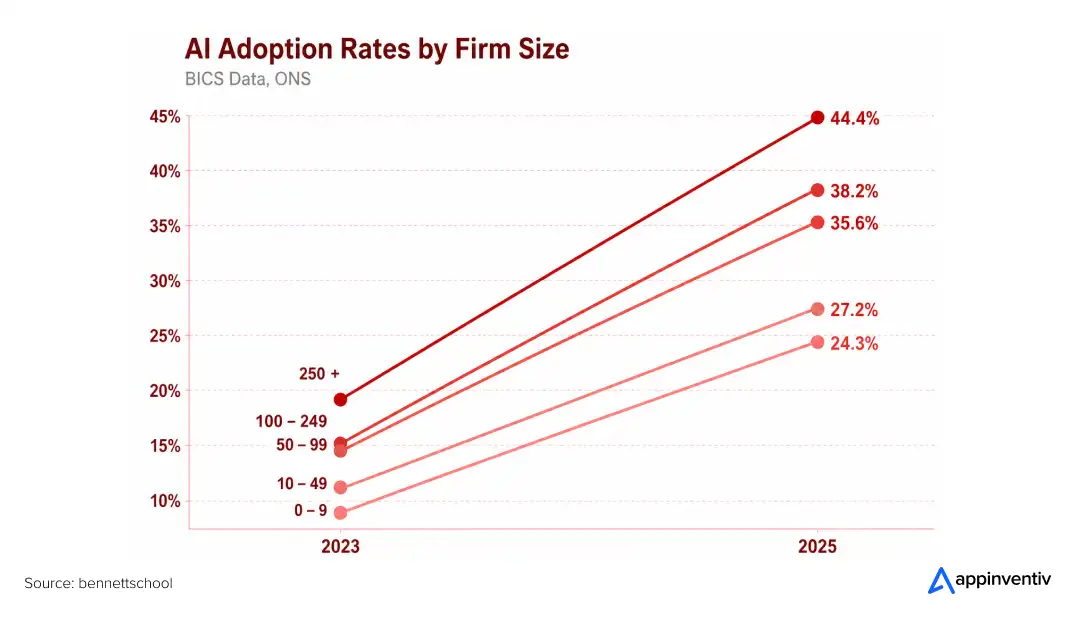
Most UK boardrooms have already had the AI conversation. Far fewer have had the governance one, and that gap is starting to show in the numbers. Large UK firms with more than 250 employees nearly doubled AI adoption between 2023 and 2025, climbing to 44% from under 20%, while smaller firms have crept forward far more slowly, sitting at 26% (Source: Bennett School of Public Policy, University of Cambridge, 2026)
That gap has a price tag attached. IBM’s 2025 Cost of a Data Breach Report found just 31% of UK organisations have a formal AI governance policy in place, and breaches involving heavy “shadow” AI use carried an average premium of £498,000 over other incidents.
At the same time, UK organisations must navigate an evolving regulatory landscape shaped by the Information Commissioner’s Office (ICO), sector regulators such as the Financial Conduct Authority (FCA) and Medicines and Healthcare products Regulatory Agency (MHRA), as well as international obligations like the EU AI Act for businesses operating across European markets.
This is why AI governance in the UK is no longer just a compliance initiative. It has become a strategic business capability. A well-designed AI governance framework in the UK enables enterprises to innovate confidently by embedding accountability, transparency, risk management, and security throughout the AI lifecycle. Rather than slowing innovation, it creates the structure needed to scale AI responsibly while maintaining customer trust and regulatory readiness.
This blog covers what that framework needs, how UK regulation shapes it, and the steps involved in building one.
Enterprise AI success depends on more than powerful models; it requires clear accountability, continuous monitoring, and governance embedded throughout the AI lifecycle.

Understanding the UK AI Governance Framework?
An AI governance framework is the enterprise operating model that governs how AI systems are designed, deployed, monitored, updated and retired throughout their working life. It sits above any single tool or policy document. It defines who owns a decision, what evidence supports it, and what happens when a model behaves outside its intended parameters.
Governance, compliance, security and risk management get used almost interchangeably inside large organisations, and that habit is how accountability gaps open up in the first place. Each discipline does a distinct job, and none of them can quietly stand in for the others.
Here is a brief comparison table for your clear understanding:
| Discipline | Primary Focus | Typical Owner | Key Output |
|---|---|---|---|
| AI Governance | Operating model, accountability, lifecycle oversight | Executive sponsor / governance board | Policies, approval workflows, escalation paths |
| AI Compliance | Meeting statutory and regulatory obligations | Legal / Data Protection Officer | DPIAs, filings, audit evidence |
| AI Security | Protecting models, data and infrastructure from attack or misuse | CISO / security engineering | Access controls, prompt scanning, red-teaming |
| AI Risk Management | Identifying and mitigating operational, reputational risk | Risk function / CRO | Risk registers, impact assessments |
- Compliance answers a narrow question: has the law been met?
- Security asks whether the system can be attacked.
- Risk management asks what could go wrong and puts a number against it.
AI governance framework in the UK pulls all three into one accountable structure, so a control failure actually reaches leadership rather than getting absorbed inside a silo. That’s what responsible AI governance for UK businesses means in practice: one auditable whole, not a patchwork nobody watches together.
Navigating the UK AI Regulatory Landscape
The UK’s approach remains principles-based and sector-led rather than one comprehensive statute like the EU has adopted. That doesn’t mean UK enterprises operate without rules. UK GDPR, the Data Protection Act 2018, and requirements from the FCA, PRA and MHRA already apply in full to AI systems, whether or not those systems were built with that in mind.
DSIT published its Blueprint for AI Regulation in October 2025, built around an AI Growth Lab of sector sandboxes, effectively replacing the standalone AI Bill previously proposed as the near-term vehicle. UK AI regulation is a moving target, which is precisely why an internal framework carries more weight here.
The UK’s 5 Core Principles for Regulatory Approach
- Safety, security and robustness. Systems need to be built and tested on data and infrastructure that holds up under real operating conditions.
- Appropriate transparency and explainability. If a decision materially affects someone, the organisation must be able to explain how the system reached it.
- Fairness. AI in the UK shouldn’t produce outcomes that undermine anyone’s legal rights or introduce discrimination a human decision wouldn’t get away with.
- Accountability and governance. Every AI system in production needs a named owner, reaching board level for anything genuinely high stakes.
- Contestability and redress. Anyone affected by an automated decision needs a real route to challenge it, not a ticket that disappears into a queue.
Key UK Regulators
| Regulator | Role in AI Oversight |
|---|---|
| ICO | Enforces UK GDPR and the Data Protection Act 2018 across personal data used in AI. |
| FCA | Oversees AI in financial services, including model risk, consumer duty and trading controls. |
| PRA | Sets prudential expectations for AI-driven risk models under supervisory statement SS1/23. |
| MHRA | Regulates AI as a medical device where it supports diagnosis or treatment decisions. |
| Ofcom | Oversees AI in content moderation and recommender systems under the Online Safety Act 2023. |
| CMA | Monitors competition impacts of foundation model concentration and AI-driven conduct. |
Data Protection & Automated Decision-Making
UK GDPR Article 22 and the Data Protection Act 2018 restrict solely automated decisions with legal or similarly significant effects. And the Data (Use and Access) Act 2025 has refined those safeguards, not removed them, since most provisions only came into force in February 2026. Any enterprise deploying AI for credit decisions, recruitment screening or claims triage needs a Data Protection Impact Assessment before go-live, not after a complaint lands.
Navigating Dual UK and EU Regulatory Regimes
If you serve EU customers, or run an EU subsidiary, the EU AI Act’s risk-tiered obligations apply alongside UK principles whether the head office likes it or not. The two regimes don’t map cleanly onto each other, and meeting one doesn’t automatically satisfy the other. High-risk systems under the EU framework, think employment decisions or biometric identification, trigger conformity assessments well beyond current UK expectations.
International Governance Standards
To harmonise cross-border requirements, enterprise architectures should align with internationally recognised benchmarks:
- ISO/IEC 42001: The global standard for establishing, implementing, and continually improving an Artificial Intelligence Management System (AIMS).
- ISO/IEC 23894: Offers structured guidance on AI risk management across organisational system engineering processes.
- NIST AI Risk Management Framework: Despite its US origins, gets used widely by UK enterprises as a practical taxonomy for governance obligations.
Why AI Governance Fails in Large UK Enterprises?
Most AI governance failures aren’t technical, they’re structural. Spotting the recurring patterns before AI investment scales further is cheaper than fixing them after a regulator or a breach forces the issue into the boardroom.
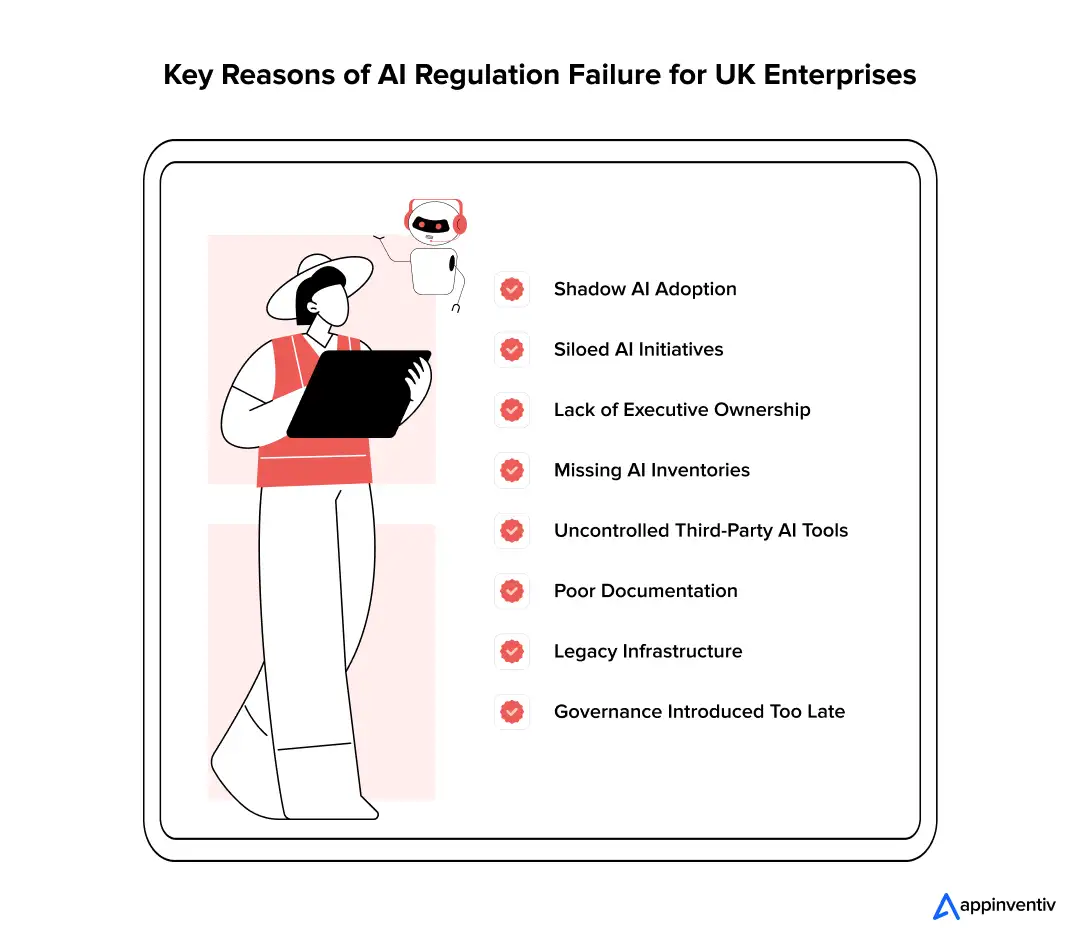
- Shadow AI adoption, employees reaching for whatever tool solves the problem in front of them, with zero visibility for anyone else.
- Siloed AI initiatives running independently across business units, each with its own standards, or none at all.
- Lack of executive ownership, so governance falls between legal, IT and data science, and nobody picks it up.
- Missing AI inventories. Ask leadership how many models are in production and the honest answer is often “we’re not sure”.
- Uncontrolled third-party AI tools embedded inside vendor platforms nobody vetted for this use.
- Poor documentation, making it close to impossible to reconstruct why a model made a call months later.
- Legacy infrastructure not built to support the level of monitoring or access control AI now requires.
- Governance introduced too late, once systems are live and far harder to unwind than at design stage.
These challenges rarely show up alone. Shadow AI and missing inventories tend to feed each other, and legacy infrastructure makes both worse. A structured framework deals with the root cause, one accountable operating model, rather than chasing each symptom separately.
The Five Core Pillars of an Enterprise AI Governance Framework
These five pillars are the minimum structure behind any credible enterprise AI governance framework in the UK. Build them in parallel rather than bolting governance afterwards, and production timelines actually get shorter.
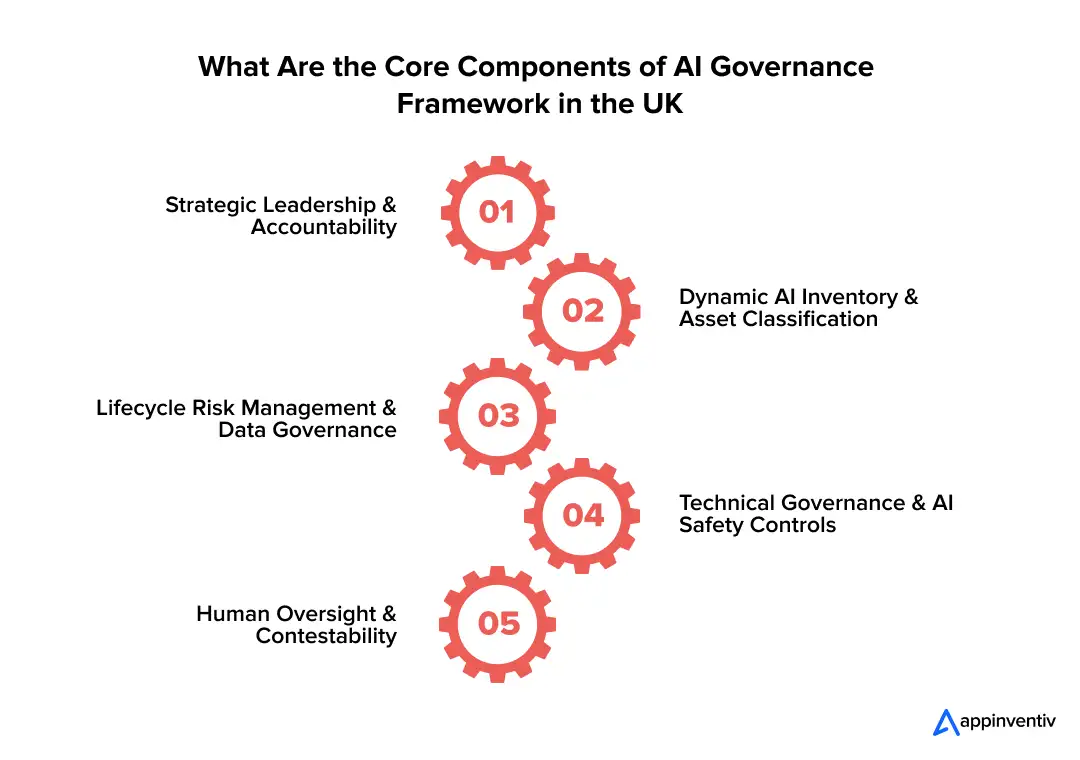
1. Strategic Leadership & Accountability
Someone at C-suite level needs to own AI governance outcomes and answer for them at board level. Skip this step and governance ends up decided by whichever team is closest to a given deployment, which is how one organisation ends up with three different standards for three similar systems.
2. Dynamic AI Inventory & Asset Classification
Every AI system in use, including whatever arrived quietly bundled inside a SaaS renewal, belongs in a live register, classified by risk tier. A spreadsheet refreshed once a quarter can’t keep pace with how fast new AI capability shows up inside tools people already have licences for.
3. Lifecycle Risk Management & Data Governance
Risk assessment needs to happen at design, again before deployment, and then on an ongoing basis, not as a single gate ticked once. Data lineage tracking matters too, so training and inference data can be traced back to its source and consent basis whenever someone asks.
4. Technical Governance & AI Safety Controls
Policy only works if it’s enforceable, which is where engineering controls come in: automated PII redaction, prompt and output scanning, and properly maintained model cards. Manual review has its place, but it doesn’t scale past a handful of systems, and most enterprises run far more than that.
5. Human Oversight & Contestability
There needs to be a defined escalation path letting both employees and customers challenge an automated decision and reach a human reviewer within a set window. This satisfies UK regulatory expectation, yes, but it’s also just sound operational practice regardless of what the law requires.
Step-by-Step Process to Implementing an AI Governance Framework in the UK Organisations
Deploying UK enterprise AI governance across a complex organisation requires a structured engineering roadmap. The sequence below is where most UK enterprises get stuck moving from a policy document to a control that holds up under audit.
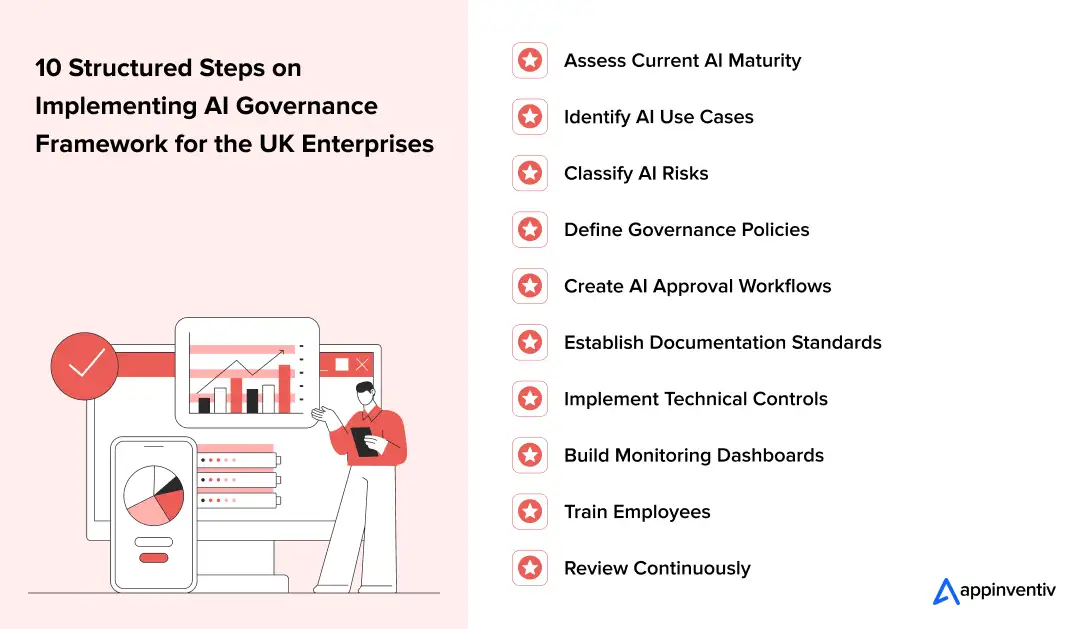
Step 1: Assess Current AI Maturity
Benchmark existing tooling, ownership and documentation against a recognised standard such as ISO/IEC 42001 before drawing up anything new. Most organisations find pockets of good practice sitting right next to pockets of nothing at all, and that unevenness is itself useful information.
Step 2: Identify AI Use Cases
Pull together a single list of every current and planned AI use case, and don’t only count the projects with a name and a budget line. Embedded vendor features and the chatbot a service team adopted without asking IT belong on the same list.
Step 3: Classify AI Risks
Apply a consistent risk tier, typically four levels, based on what would actually happen if a system malfunctioned or was misused. A recommendation engine suggesting the wrong product is not the same category of problem as a system declining a mortgage application.
Step 4: Define Governance Policies
Write acceptable use, data handling and model approval policies specific to each risk tier rather than one blanket document everyone skims and forgets. The same policy covering a low-risk internal tool and a customer-facing credit engine tends to be too loose for one and too heavy for the other.
Step 5: Create AI Approval Workflows
Set a mandatory gate before any new AI system reaches production, with sign-off scaling to its risk classification. Forcing low-risk tools through the same review as regulated financial decisions just teaches teams to route around governance.
Step 6: Establish Documentation Standards
Standardise model cards, data lineage records and decision logs so any system can be audited without reconstructing history from memory. It sounds administrative, but in an audit it’s the difference between a clean answer and an uncomfortable meeting.
Step 7: Implement Technical Controls
Push automated scanning, access controls and compliance checkgates directly into the CI/CD pipeline rather than a manual step someone remembers before release. Controls that depend on memory eventually get skipped, usually during the release where it mattered most.
Step 8: Build Monitoring Dashboards
Track model drift, performance degradation and incident volume in one place, with alerts routed to whoever actually owns the system. Monitoring only reviewed after something breaks isn’t monitoring, it’s a post-mortem with better software.
Step 9: Train Employees
Run training specific to each role rather than a generic all-staff module. Staff who need escalation routes for a flagged output aren’t the same people who need guidance on acceptable use of a writing assistant.
Step 10: Review Continuously
Put fixed review intervals on the calendar rather than waiting for an incident to force the conversation. Regulation moves and models drift, and a framework that was fit for purpose eighteen months ago won’t stay that way on its own.
From governance frameworks and AI architecture to MLOps and LLMOps, build AI systems that remain compliant, secure, and scalable throughout their lifecycle.

Common AI Governance Mistakes UK Enterprises Should Avoid
Even well-intentioned governance programmes can collapse into bureaucratic bottlenecks or leave critical operational blind spots if mismanaged. Identifying common structural pitfalls allows UK leadership teams to proactively engineer safeguards that protect enterprise assets without stalling innovation.
- Building the AI system first and trying to retrofit governance once it’s already live.
- Treating governance as a compliance checkbox rather than something teams actually use day to day.
- Ignoring the risk sitting inside third-party and embedded AI tools nobody formally “bought”.
- Leaving governance without a named owner who answers to the board for it.
- Letting documentation standards slip once the initial audit is out of the way.
- Deploying a system, then treating the go-live review as the last check.
- Writing employee AI policy so vague it can’t guide a real decision in the moment.
- Running without a current, centralised AI asset inventory anyone can point to.
- Never planning how a system gets retired safely, only how it gets launched.
High-Risk Industry Use Cases: Tailoring Governance to UK Vertical Regulations
Standard, one-size-fits-all governance strategies fail when applied to specialised sector requirements. Tailoring controls to match vertical regulatory expectations is essential when deploying enterprise platforms across the UK market.
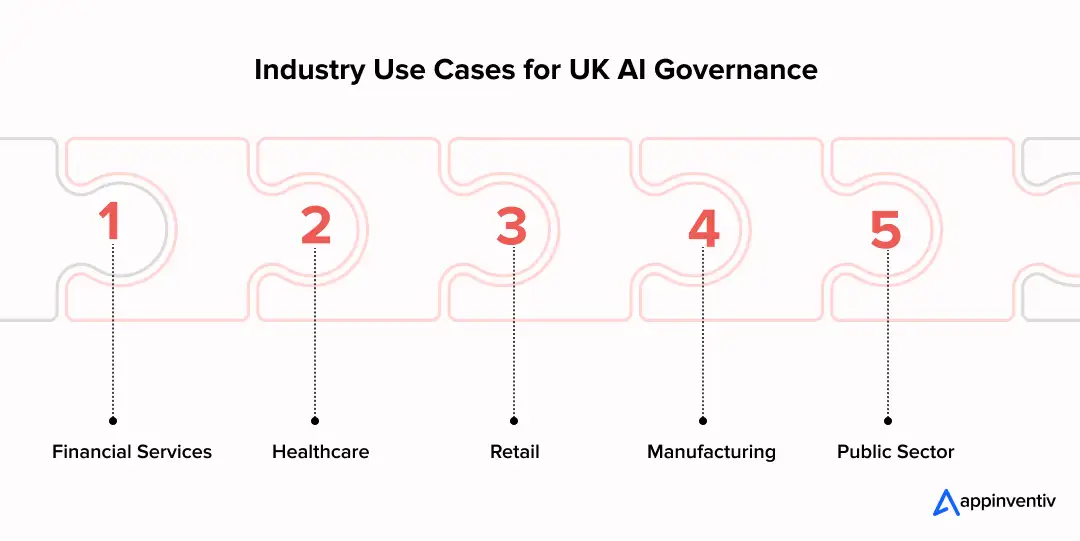
Financial Services
In banking and capital markets, governance revolves around algorithmic transparency, market integrity, and preventing systemic bias. Regulators like the FCA and PRA demand that institutions prove their risk models and automated credit systems do not discriminate or drift during volatile market conditions. Establishing immutable decision logs and counterfactual explainability hooks ensures every automated decision can be audited down to the exact data inputs used.
Healthcare
Deploying automated diagnostic or triage systems under MHRA and CQC oversight leaves zero room for error. Patient safety and strict medical data privacy require air-gapped data pipelines, rigorous clinical validation trials, and mandatory human-in-the-loop checkpoints. Algorithms must function strictly as decision-support tools, ensuring certified clinicians retain final sign-off on diagnostic outputs.
Retail
High-volume retail e-commerce platforms rely heavily on recommendation engines, dynamic pricing algorithms, and automated customer support. Under ICO and CMA scrutiny, retail platforms must prevent discriminatory pricing models and protect customer data privacy. Implementing real-time bias scanning and giving shoppers clear opt-outs for automated profiling helps brands build trust while staying fully compliant.
Manufacturing
Industrial automation and predictive maintenance models operating in physical plants fall directly under Health and Safety Executive (HSE) safety standards. When an algorithm controls heavy machinery or industrial supply lines, software failures carry physical risks. Governance here requires deterministic safety boundaries, real-time telemetry monitoring, and hardcoded physical kill switches that override automated routines instantly during anomalies.
Public Sector
Government bodies and local councils deploying automated systems must answer to strict public accountability standards set by the Central Digital and Data Office (CDDO). Public sector frameworks prioritize openness and contestability. Integrating systems with the Algorithmic Transparency Recording Standard (ATRS) guarantees citizens know when an algorithm impacts public service delivery, complete with clear channels to request human review.
The AI Governance Checklist in the UK
Implementing AI governance in UK organisations requires tracking concrete deliverables. Use this operational checklist to evaluate enterprise readiness across delivery phases.
Evaluate your AI governance maturity before your next AI deployment. Use this checklist to identify governance gaps, strengthen compliance, and prepare your organisation for responsible AI adoption at scale.
Whether you’re deploying generative AI, predictive models, or AI agents, a governance-first approach helps minimise regulatory risk while keeping innovation on track.

How to Future-Proof Your AI Governance Strategy in the UK
The next governance challenge is already visible. Agentic systems and third-party foundation models are moving faster than most review cycles can absorb, and extending the framework now avoids a second, costlier retrofit within eighteen months.
- Governance for agentic AI: Agents taking multi-step action need approval workflows built around chained decisions, since a single output review no longer captures what happened.
- AI copilots: Embedded copilots inside everyday productivity tools expand the AI inventory faster than most registers manage to track.
- Autonomous workflows: End-to-end automation needs kill switches and human checkpoints at defined intervals, not added once something breaks.
- Third-party foundation models: Vendor dependency brings governance obligations that need contractual assignment up front, not quiet assumption later.
- AI assurance: Independent assurance services are becoming the practical way to demonstrate governance maturity to regulators and customers alike.
- Synthetic data governance: Synthetic training data still carries lineage and bias obligations that plenty of current policies haven’t caught up with.
- Continuous compliance automation: Manual quarterly reviews can’t keep pace with weekly model updates, making automated checking closer to a necessity than a nice-to-have.
- Governance built into enterprise architecture: The most resilient organisations treat governance as a design constraint, not a parallel process running alongside it.
How Appinventiv Helps UK Enterprises Embed AI Governance into Enterprise Systems
Governance that lives only in a policy document, separate from the engineering stack it governs, rarely survives real scale. We build AI governance as an engineering discipline embedded into the systems it governs. Here is how our tech squad of 1700+ experts make it possible by delivering governed AI development services in the UK:
Governance Readiness Assessment
We evaluate governance maturity against current UK regulatory expectations and frameworks including ISO/IEC 42001, benchmarking existing AI systems, documentation and ownership against where they need to be before further scaling makes the gaps more expensive to close.
AI Engineering with Governance by Design
We embed governance, monitoring, explainability, privacy and security directly into AI systems throughout the development lifecycle, so controls get enforced in code rather than a manual review squeezed in at the end of a build cycle.
Enterprise AI Modernisation
We transform legacy infrastructure into secure, scalable AI ecosystems capable of supporting compliant generative AI and agentic AI adoption, without carrying forward the technical debt that usually undermines a governance retrofit six months in.
Our capability of implementing AI and ensuring governance for the UK enterprises is backed by our 11+ years of experience and ISO 27001, ISO 9001 and SOC 2 certifications.
In our 11+ years of industry experience, we have successfully delivered over 3,000 digital assets for 35 industries and secured a 90% client retention rate while boasting a 99.5% security compliance SLA.
In practice, that has meant building AI-driven underwriting and claims-triage engines for fintech clients such as Edfundo and Mudra, engineering computer-vision quality inspection for manufacturing clients, and standing up agentic workflow automation for financial services firms.
Share your project vision with us and get a structured roadmap for secure and responsible AI implementation in the uK
FAQs
Q. How can UK enterprises build an AI governance framework in the UK?
A. Enterprises build an effective framework by conducting comprehensive asset inventory scans, establishing a cross-functional steering committee, creating a 4-tier risk classification matrix, and embedding automated technical guardrails directly into CI/CD development pipelines. Partnering with experienced engineering specialists accelerates implementation while ensuring alignment with ISO 42001 and ICO guidelines.
Q. How long does it take to implement an AI governance framework?
A. Initial readiness assessments and policy definition phases typically take 6 to 8 weeks. Establishing technical guardrails, automated data logging, and observability dashboards across core enterprise platforms generally requires 4 to 12+ months, depending on system complexity and infrastructure maturity.
Q. What are the key components of an AI governance framework?
A. The primary components include Strategic Leadership & Accountability, Dynamic Asset Classification, Lifecycle Risk & Data Governance, Technical Governance Controls, and Human Oversight Protocols. Together, these elements ensure full operational visibility, continuous safety, and regulatory compliance across all enterprise systems.
Q. How much does AI governance implementation cost?
A. The cost of AI implementation for UK enterprises vary significantly based on organisation size, existing technical debt, and system scale. On average, it ranges between £100,000 and £400,000 or more.
However, investing in automated governance engineered directly into platforms significantly reduces long-term operational expense. It also eliminates the average £498,000 cost penalty associated with ungoverned shadow AI data breaches.
Q. What is the best AI governance framework for large organisations?
A. Large organisations achieve optimal results by combining international technical standards like ISO/IEC 42001 and the NIST AI Risk Management Framework with localised regulatory frameworks, such as the UK principles-based regulatory guidelines and the EU AI Act.
Q. How does the UK AI framework differ from the EU AI Act?
A. The UK employs a decentralised, principles-based framework enforced by existing sector regulators like the ICO and FCA. In contrast, the EU AI Act is a centralised, highly prescriptive law that categorises systems strictly by risk level and enforces legal mandates with heavy financial penalties across member states.
Q. Which regulators enforce AI compliance in the UK?
A. Enforcement is distributed across sector-specific regulators, including the Information Commissioner’s Office (ICO) for data privacy, the Financial Conduct Authority (FCA) and Prudential Regulation Authority (PRA) for financial services, the MHRA for medical software, Ofcom for online platforms, and the CMA for market competition.
Q. What are the key benefits of the AI governance framework in the UK?
A. The key benefits of UK AI regulation include:
- Mitigates Financial & Regulatory Exposure: Prevents costly data breaches, unmonitored “shadow AI,” and regulatory penalties from enforcement bodies (such as the ICO and FCA) by enforcing strict data protection and access controls.
- Accelerates Time-to-Production: Establishes automated CI/CD guardrails and clear approval workflows, eliminating late-stage compliance reviews and deployment bottlenecks.
- Builds Stakeholder & Customer Trust: Ensures algorithmic fairness, transparency, and explainability, protecting brand reputation and encouraging consumer adoption of automated services.
- Improves Model Reliability & Performance: Continuous observability catches model drift, hallucinations, and performance degradation before they impact business operations.
- Optimises Total Cost of Ownership (TCO): Provides full visibility into AI assets, API dependencies, and infrastructure usage, preventing duplicate initiatives and wasted compute spend.


Fast 2-minute response, fully NDA-protected.

AI Data Integration: How to Connect, Clean and Prepare Data for AI
Key takeaways: AI initiatives fail when fragmented, poor-quality data reaches models without sufficient context, controls or ownership. AI-ready pipelines must connect, clean, enrich, govern and continuously monitor data across its lifecycle. Real-time processing matters when AI decisions depend on current transactions, events, inventory or operational conditions. Data architecture should follow the AI use case, balancing…

AI Agent Governance: How to Govern Autonomous AI Across Business Systems
Key takeaways: AI agents require controls at the action, identity, data, tool, and workflow levels. Every enterprise agent should have a registered owner, an approved purpose, and a defined risk tier. Access must be based on the agent’s task rather than inherited from a human user or shared service account. High-impact actions need real-time policy…

'I.D.E.A.S.' - The Five Pillar Framework to Ace AI-Native Enterprise Apps in 2027
Key takeaways: AI-native enterprise apps are moving beyond AI agents toward intelligent, adaptive, autonomous and context-aware digital capabilities that can operate across mobile, web, voice, wearables and emerging interfaces. The I.D.E.A.S. framework for AI enterprise apps in 2027 - Interactive Intent, Decisioning Autonomously, Experiential System Design, Adaptive Execution, and Security Layered. Context intelligence and reusable…