
























AI-Native SDLC: Foundational 90-Day, 5R AI SDLC Adoption Playbook

 Share -



- 01What Is an AI-Native SDLC? (Without the Jargon)
- 02How an AI-Native Software Development Lifecycle (AI SDLC) Works
- 03Building Effective AI Teams for the AI SDLC
- 04Multi-Agent Separation of Duties
- 05The Platform Harness: The Non-Negotiable Dependency
- 06Part 3: 5R AI SDLC Adoption Playbook
- 07Part 4: The AI SDLC in Action: Three Industry Use Cases
- 08Part 5: Appinventiv Accelerators: Powering Your AI SDLC Transformation
- 09The Executive Focus Now

Key takeaways:
- Why AI coding tools accelerate coding and software delivery
- How AI-native SDLC shifts engineering from code to intent, context, and outcomes
- The role of specifications, AI agents, and continuous verification in enterprise delivery
- How to redesign engineering teams for human–agent collaboration
- The platform, governance, and guardrails required to scale AI-native development
- A practical 90-day 5R roadmap to move from AI-assisted to AI-native SDLC
- What CIOs should measure before scaling AI-native engineering across the enterprise
Every tectonic shift in software engineering promised speed. Waterfall gave way to Agile, manual releases to CI/CD, and monoliths to cloud-native microservices. The traditional Software Development Lifecycle (SDLC) saw people as the engine. Developers read a ticket, typed the code, wrote the tests by hand, and documented afterward (when they found the time). The first wave of AI tooling tried to speed that up with coding assistants inside the editor. Almost like a co-worker that could handle the grass-cutting, ‘donkey’ work.
Initially, it helped, but it didn’t change how the work gets done. It’s a bit like fitting a jet engine to a horse-drawn cart. You get plausible code faster, and you also get longer pull request queues, more technical debt, and a QA team buried in changes nobody has properly checked.
As coding turns asynchronous and multi-threaded, planning, design, review, and maintenance become the biggest bottlenecks. AI did not remove the bottleneck. It moved it.
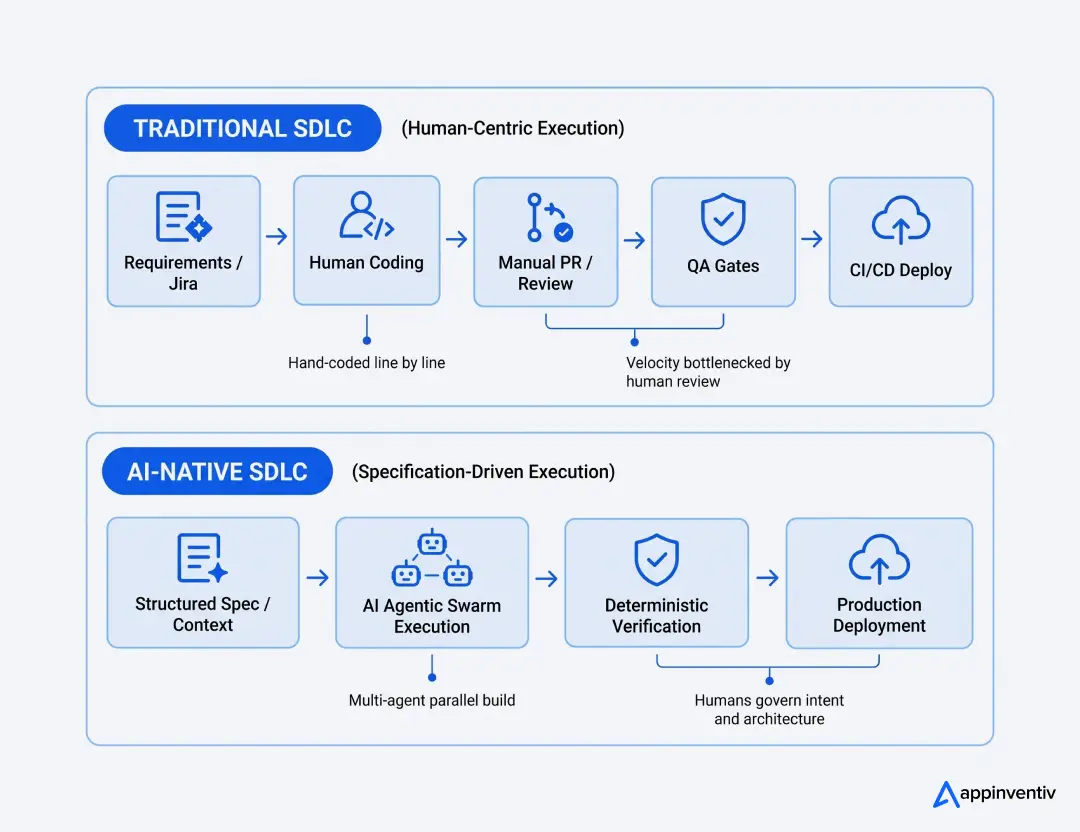
The AI-Native Software Development Lifecycle (AI SDLC) re-engineers the whole delivery apparatus around agentic autonomy. The primary human contribution increasingly shifts from writing source code to defining intent, context, constraints, and verifiable specifications. Think of air traffic control. Controllers don’t fly the planes. They set the corridors, sequence the traffic, and step in when something looks off. Engineers become the control tower, and agents do the flying.
A quick note on terms. AWS publishes a methodology called AI-DLC, and we draw on it while bringing you insights from a broader perspective.
Appinventiv has built a set of accelerators around this model, covering consulting, legacy migration, agent orchestration, and production support.
What is stopping your organization from building your next AI-native software?

What Is an AI-Native SDLC? (Without the Jargon)
An AI-native SDLC is a way of delivering software in which AI agents handle the repeatable work of planning, building, testing, and maintaining, while people own intent, architecture, risk, and approval. Instead of documents and tickets passed from hand to hand, work moves through a connected loop where each stage leaves a record that the next stage can read.
The highway problem. Picture a highway with a toll plaza at the end. For years, the road was narrow, so the toll booths kept up. Then AI coding assistants arrived and widened the road to eight lanes. Cars now reach the plaza faster than ever, but the booths are the same: code review, security checks, testing, release approval. The queue doesn’t vanish. It just moves a mile down the road.
An AI-native SDLC in a mature implementation does not widen the road a second time. It redesigns the whole route. It has more booths, smart lanes for low-risk traffic, automatic tags, and a control room watching the lot.
Traditional vs. AI-native, at a glance
| Traditional SDLC | AI-assisted (most teams today) | AI-native SDLC | |
|---|---|---|---|
| Who writes the first draft | People | People, with autocomplete | Agents, from a human-approved spec |
| Where the delay hides | Everywhere, evenly | Review, QA, release | Shrinks across stages, but verification needs deliberate design |
| What humans spend time on | Typing, chasing, waiting | Typing faster, reviewing more | Intent, architecture, judgment, approvals |
| Source of truth | Tickets and tribal knowledge | Same, plus chat history | Versioned specs and context files in the repo |
| Governance | Meetings and sign-off cycles | Same meetings, more volume | Rules are enforced as the work happens, humans at the gates |
Most enterprises sit between the first and second levels. That’s a fine place to be today. The problem is staying there while competitors move on.
AI-native SDLC requires governance by design, not governance after deployment. This is where the right AI governance partner can help, embedding governance into the SDLC rather than treating it as a separate compliance layer.
The future is that the unit of engineering work moves upward, from writing individual code changes toward defining intent, context, constraints, evaluation, and outcomes, while agents execute increasingly large portions of the implementation.
Need more than a roadmap? We can help integrate AI coding agents, specification-driven workflows, testing, CI/CD, governance, and agent orchestration into your engineering environment.
How an AI-Native Software Development Lifecycle (AI SDLC) Works
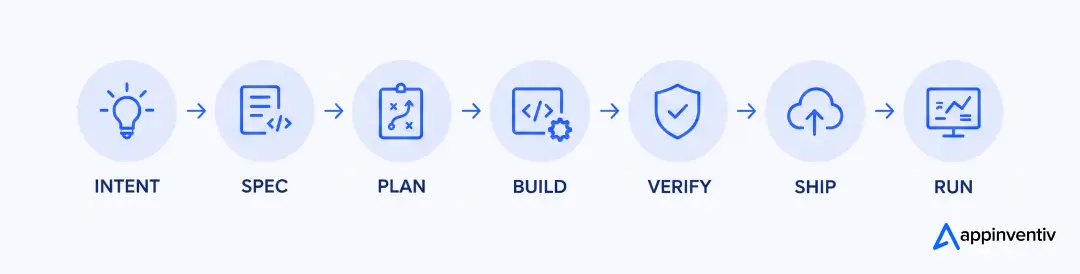
Let us explain this with an example from a film set. A movie doesn’t start with filming. Someone pitches an idea, a screenplay gets written, a schedule gets built, then the crew shoots, an editor cuts, and test audiences react. Their reactions often become the next film’s brief. An AI-native SDLC runs the same way, except the crew is faster and the screenplay is a machine-readable specification. Here is how its architecture pans out from intent to run (see infographic below).
Why 90 days?
Why did we begin the piece with “AI-Native SDLC Adoption: Foundational 90-Day AI SDLC Transformation Plan”? We know that no whole enterprise can change in 90 days. It can’t, and anyone who says otherwise is selling something.
Ninety days is long enough to run a real pilot on real work, collect before-and-after numbers, and fix what breaks. It’s short enough that your executive sponsor is still paying attention and the tooling hasn’t shifted under you. So read this as a 90-day plan to a proven foundation and your first scaled results. Enterprise-wide rollout belongs on the roadmap you’ll fund at the end.
From legacy modernization and platform integration to AI-native planning, development, testing, deployment, and production support, our teams can help you implement the full AI-SDLC operating model.

But first, let us look at how the AI-native software development lifecycle requires effective teams, both Agents and Humans!
Building Effective AI Teams for the AI SDLC
Adding AI tools to a traditional structure yields marginal gains. The AI SDLC needs a human-in-the-loop, agentic-at-scale talent model.
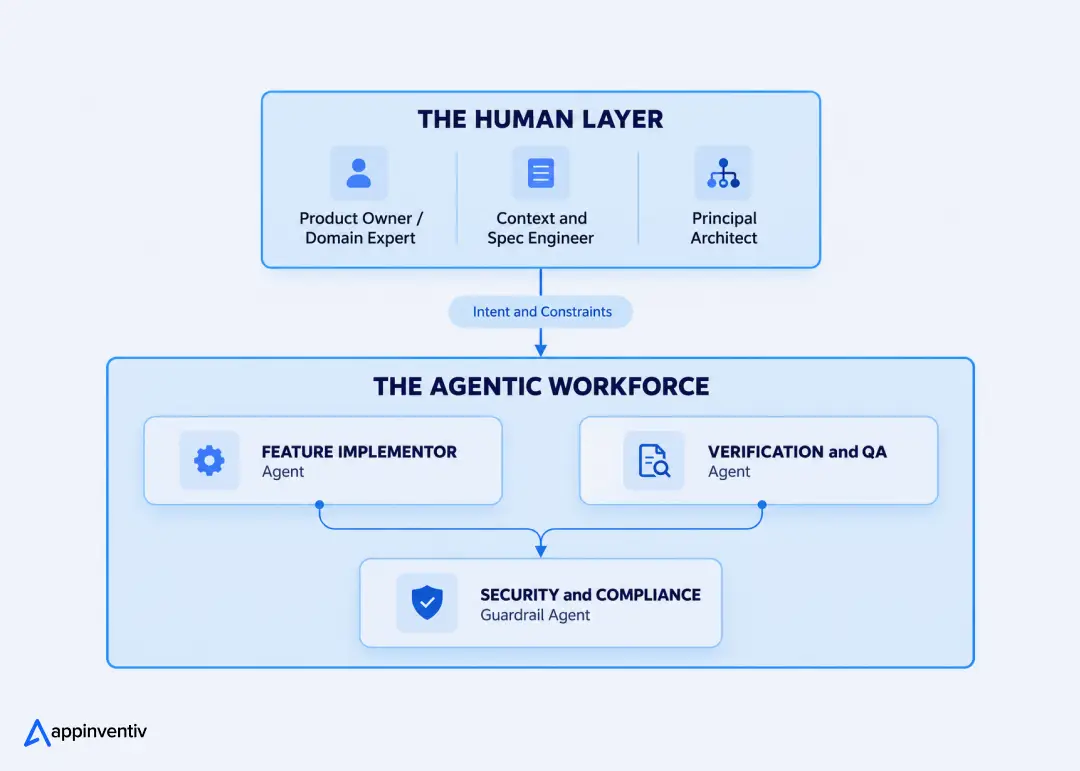
The New Role Architecture
| Legacy SDLC Role | AI-Native SDLC Role | Primary Responsibilities in the AI SDLC |
|---|---|---|
| Junior / Mid-Level Developer | Spec Contributor and Agent Output Reviewer | Drafting specs under senior review, building test cases and evals, reviewing agent output, curating context, running local agent workflows |
| Senior Developer / Lead | AI Architect and Agent Governor | Designing service topology, setting multi-agent guardrails, supervising agent PR output, and resolving architectural trade-offs |
| QA Automation Tester | Validation and Verification Specialist | Writing invariant assertions, validating AI-generated tests, managing synthetic data pipelines, and enforcing zero-trust quality gates |
| DevOps / Infra Engineer | Platform and MLOps Orchestrator | Maintaining vector stores for context indexing, orchestrating LLM toolchains, and managing token costs |
| Product Manager | Intent and Outcome Strategist | Translating market signals and user telemetry into executable specification logic and edge-case parameters |
Multi-Agent Separation of Duties
An enterprise-grade AI SDLC can apply Separation of Duties (SoD) across specialized agents and human approval points.
- Implementation agents generate modules tied directly to specification IDs.
- Verification agents derive tests from the specification and independent quality criteria, reducing the risk of simply reproducing assumptions embedded in the implementation.
The Platform Harness: The Non-Negotiable Dependency
The model is only half the problem. The other half is the platform harness: the context, governance, and orchestration layer that controls what an agent sees, what it can do, when it can act, and how humans supervise it. The same agent behaves differently in two organizations because their harnesses differ. Self-service environments, golden-path CI/CD, evaluation harnesses, governed context via registry and controls, and versioned, access-controlled, and reviewed agent instruction files must be in place before teams are compressed.
Five Pitfalls That May Derail AI Software Development Lifecycle Programs
- Buying licenses and calling it transformation? Tooling without an operating-model change delivers incremental gains at best.
- Letting vibe coding govern production! Scale comes with an evidence-based plan. Keep the vibe for ideation and gate promotion.
- Shrinking teams before building the platform? Compression without a harness is chaos.
- Ignoring verification? Speed without visibility creates instability. Review the running system, not just the diff.
- Treating context as someone else’s problem? Undocumented institutional knowledge sets the ceiling on agent performance.
Part 3: 5R AI SDLC Adoption Playbook
Rolling out an enterprise-wide transformation without a structured framework invites friction, tool sprawl and compliance failures. Appinventiv’s 5R Playbook structures the 90 days into five stages.
Every software team already knows the basic flow: plan, design, build, test, deploy, maintain. An AI-native SDLC keeps that flow. What changes is who does the work at each stage, how the stages connect, and how much of it runs without waiting for a meeting.
The trouble is that “re-engineer six lifecycle stages across the enterprise” isn’t a plan. It’s a wish. So we’ve taken the AI-native lifecycle and turned it into something a leadership team can schedule: the 5R Playbook. The 5Rs are adoption phases, not lifecycle stages. Each one gives you a clear goal, a time window, and a finish line, and the table below shows where each lifecycle stage is first re-engineered.
| 5R phase | Days | Lifecycle stages first re-engineered |
|---|---|---|
| Research | 1-15 | Plan (baselines, backlog, context) |
| Realize | 16-45 | Design and build (spec-first pilot) |
| Review | 46-60 | Test (evals, security, ROI) |
| Rollout | 61-75 | Deploy (scale to more teams) |
| Run | 76-90 | Maintain (operating rhythm) |
You don’t have to learn a new methodology to use it. If you can say “research, realize, review, rollout, run,” you can run the program.
Appinventiv’s AI product engineering team has broken the AI-native lifecycle down this way for one reason: leaders don’t need more theory. They need a sequence they can fund, staff, and measure. The five stages below turn the concept into a 90-day plan, with actions for each window, an exit check at the end of each, and accelerators that shorten the path.
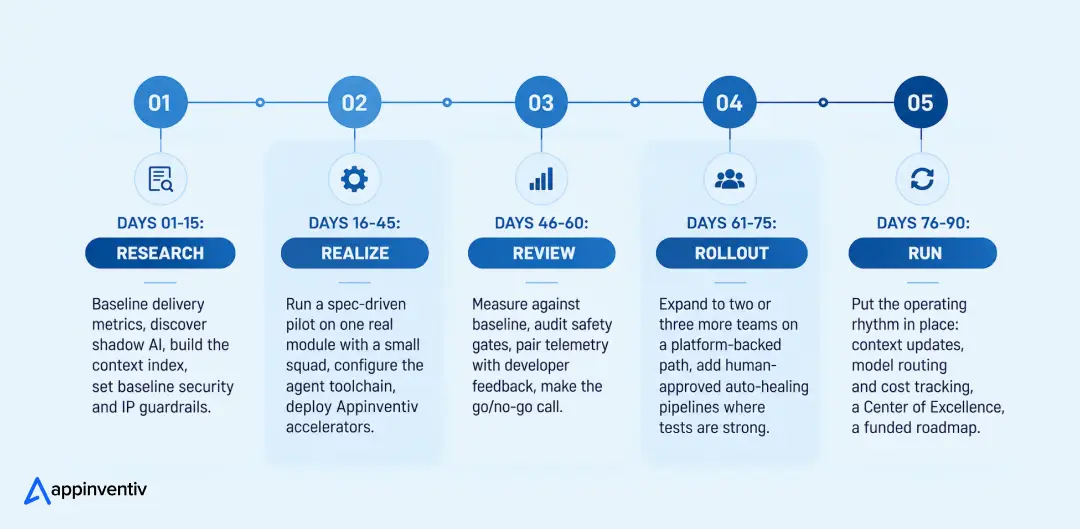
Stage 1: RESEARCH (Days 1 to 15)
The goal here is to audit the delivery engine, quantify current efficiency, set security guardrails, and build the initial context index.
Put DLP (Data Loss Prevention) scanners, repository-level permissions, and appropriate contractual provisions governing whether provider models may train on enterprise data.
Action plan (suggestive, for grasping purposes; real plan is based on your account+requirements)
- Days 1-5: Analyze cycle times, PR velocity, defect density and tech-debt hotspots.
- Days 6-10: Provision the appropriate retrieval and context infrastructure, such as a governed vector store where required.
- Days 11-15: Draft the enterprise AI Usage and IP Policy: approved data-retention requirements, open-source licensing thresholds and explicit agent authorization boundaries. Account for GDPR, HIPAA, and EU AI Act obligations (where applicable).
Exit check: a maturity scorecard, a baseline dashboard, a prioritized use-case backlog, and a named executive sponsor.
Stage 2: REALIZE (Days 16 to 45)
The aim is to run a focused pilot and put Specification-Driven Development into practice.
Action plan (suggestive, for grasping purposes; real plan is based on your account+requirements)
- Days 16-25: Train the pilot team to author executable specifications using standard templates that capture inputs, output schemas, failure modes, performance budgets, and security parameters.
- Days 26-35: Connect implementation agents to repositories, unit-testing harnesses, and CLI tools. Stand up the evaluation harness that scores agent output against contracts.
- Days 36-45: Run two-week pilot sprints spec-first. Log auto-generation rates, spec-to-code accuracy, first-pass review acceptance, and developer sentiment.
Exit check: SDD templates live, context layer connected to at least one domain, eval harness running, pilot team trained.
Stage 3: REVIEW (Days 46 to 60)
Objective: Measure impact, evaluate security, tune context retrieval, and refine human-in-the-loop gates.
Key milestones (suggestive, for grasping purposes; real milestones are based on your account+requirements)
- ROI benchmarking → against the Stage 1 baseline.
- Security and governance audit → of AI-generated artifacts to catch hallucinated dependencies and vulnerabilities before they reach production.
- Context optimization → Tune chunking, embeddings, and retrieval parameters from pilot execution traces.
- The productivity-mirage test → Developers often feel faster, even as measured throughput says otherwise, because time shifts from typing to fixing. Pair telemetry with developer feedback.
- FinOps from day one → Track cost per session and cost per merged PR.
Metrics evaluation matrix (set targets from your own Stage 1 baseline)
| Metric Category | Target KPI | What to compare against | Target direction |
|---|---|---|---|
| Velocity and Output | Cycle time (spec to production) | Stage 1 baseline | Meaningful reduction |
| Quality and Stability | First-pass CI success and change failure rate | Stage 1 baseline | Up and down, respectively |
| Review Load | PR review time and first-pass review acceptance | Stage 1 baseline | Review time stable or falling as volume rises |
| Security and Compliance | Critical and high vulnerabilities per release | Stage 1 baseline | Fewer reaching production |
| Test Quality | Escaped defects and mutation score (coverage reported, never the sole target) | Stage 1 baseline | Fewer escapes, stronger tests |
| Developer Experience | Time on boilerplate and developer sentiment survey | Stage 1 baseline | Less boilerplate, sentiment holding or improving |
Action plan
- Days 46-50: Run retrospectives with pilot architects and engineers. Find where context retrieval underperformed or spec ambiguity caused loops.
- Days 51-55: Define approval tiers. Formatting and comment-only changes can be auto-approved. Agent instruction files, context files, specs, prompts, skills, and MCP configurations are treated as code. Changes to them need human review, with named owners (for example, CODEOWNERS).
Anything touching authentication, payments, data migrations, infrastructure, or agent configuration goes to a human. In production, agents may execute only pre-approved runbook actions (for example, failing over to a standby channel) within set limits, and every such action is logged and reviewed afterward. - Days 56-60: Publish internal use cases on time-to-market, quality, and cost, and make the go/no-go decision.
Exit check: a pilot report with before/after metrics, a governance playbook, a token budget model and a go/no-go decision for expansion.
Stage 4: Rollout (Days 61 to 75)
Objective: Expand beyond the pilot to two or three more teams on a platform-backed path, with human-approved automation where tests are strong.
Key milestones
- Controlled expansion → Extend from the pilot squad to two or three additional teams, backed by a central platform engineering function that owns golden-path CI/CD, self-service environments, the approved registry of skills and MCP servers, and the shared eval harness. Wider rollout follows on the 180-day roadmap.
- CI/CD auto-healing, with a human gate → When test coverage is reliable, an agent analyzes a failing build, proposes a fix, and opens a PR for human sign-off. The agent never merges its own change.
- Role transition → Move QA engineers toward verification and evaluation work. Bring juniors in as reviewers of agent output and builders of test cases and evals, under senior guidance, so the next generation of senior engineers can continue to grow and maintain ownership of specifications.
- Stage expansion → Extend agents beyond coding into planning, AI-first code review, continuous security scanning, and incident triage, one stage at a time, as the review gates prove out.
Action plan
- Days 61-65: Launch enablement programs on Specification-Driven Development, context engineering and multi-agent governance for the incoming teams.
- Days 66-75: Require that features for participating teams be written as machine-verifiable specifications before engineering allocation.
Exit check: multiple squads live, platform services stable, agents active in at least three lifecycle stages on the participating teams, and a clear plan for what happens to roles and capacity as teams change shape.
Stage 5: RUN (Days 76 to 90)
Objective: Establish an operating rhythm, bring compute costs under control, and set up continuous maintenance with human approval of the output.
Key milestones
- Self-updating context pipeline → Background agents continuously re-index code changes, API contracts and operational telemetry.
- FinOps and model routing → Route routine tasks (completions, boilerplate, test scaffolding) to small, fast models and reserve frontier reasoning models for architecture and contract-level logic. Undifferentiated routing is a common source of waste in agentic delivery.
- Continuous maintenance, human-approved → Agents propose security patches, dependency upgrades, and refactors, and open PRs for review. Humans own escalation and policy.
- Adoption scorecard → Track agent-versus-human work share, stage-level flow, gate-rule hit rates, and the currency of skills and context files. If policy-related review comments aren’t falling, a skill isn’t firing or has drifted.
Action plan
- Days 76-80: Put automated LLM routing in place, for example, small models for inline completions and large reasoning models for spec execution, and track cost per merged PR.
- Days 81-85: Stand-up background maintenance: agents identify tech debt, draft refactoring proposals, generate tests, and submit PRs.
- Days 86-90: Formalize an AI SDLC Center of Excellence (CoE) to evaluate new models, agent capabilities, and security frameworks. Close the loop: every incident adds a permanent regression test, and every repeated agent mistake results in a proposed update to the context file, merged through a reviewed PR.
Exit check: an operating model in place, a live dashboard, a quarterly improvement cadence and a funded 180-day roadmap.
Part 4: The AI SDLC in Action: Three Industry Use Cases
A framework is easiest to trust when it is traced through a real flow. Each use case below follows the same pattern: one user story becomes a spec, the spec drives agents, a quality agent verifies the result, deterministic CI/CD ships it, and an SRE agent watches it in production.
Use case 1: Wellness and Fitness Platform
Case profile: A mid-sized wellness operator running yoga, nutrition coaching and mental wellbeing programs across multiple cities, with a legacy mobile app and a disconnected booking system.
The story: “As a member, I want a personalized weekly wellness plan that adapts to my sleep, activity, and mood check-ins, so I can stay consistent without a coach on call.”
How the AI SDLC handled it:
- Spec: The product owner and a compliance specialist authored a single specification covering plan-generation logic, wearable data ingestion, consent capture, and data residency rules. Invariants included: no health data in application logs, explicit consent before any data sharing, and a clinical-escalation path for high-risk mood inputs.
- Build: An implementation agent produced the plan engine, wearable integration (Apple Health and Health Connect adapters), and consent flows. A separate verification agent wrote tests solely from the spec.
- Quality gate: Guardrail agents flagged one logging statement exposing a user identifier. Run: An SRE agent monitored wearable-sync failures and opened a tracked issue when a third-party API changed its schema, causing the pipeline to re-enter with a new intent.
In wellness, the cost of a privacy mistake is trust. Specification-level invariants make compliance a build condition instead of a review comment. With the above AI-native SDLC, orgs can achieve MVP-to-pilot in weeks rather than quarters, a first-pass CI success rate that steadily rises across sprints, and about zero privacy defects reaching staging.
Use case 2: Multi-Location Restaurant and Food-Service Chain
Case profile: A regional restaurant group operating dine-in, delivery and cloud kitchens, with separate legacy systems for ordering, inventory and loyalty.
The story: “As a guest, I want to order from any outlet or delivery channel and see accurate availability, so I am never offered a dish the kitchen cannot make.”
How the AI SDLC handled it:
- Spec: Business and operations leads defined availability rules (ingredient thresholds, prep-time budgets, peak-hour throttling), channel-specific pricing, loyalty accrual logic and performance budgets (p99 order-confirmation latency).
- Build: Agents generated the unified ordering API, real-time inventory sync, a demand-forecast service for prep planning, and the IaC to deploy it. Context agents read the existing POS integration contracts, preventing the agents from breaking legacy behavior.
- Quality gate: Verification agents generated load tests simulating weekend dinner peaks. One race condition between inventory decrement and order confirmation surfaced pre-release and was corrected by the loop.
- Run: Production telemetry fed an SRE agent. When a delivery-aggregator outage caused orders to drop, the agent triaged the issue and executed the pre-approved fallback-channel runbook, which the on-call engineer confirmed within minutes. It then opened a follow-up intent to add retry logic.
Restaurants live on thin margins and peak-hour reliability. Agent-generated load tests protect revenue exactly when it matters most. With AI SDLC, there can be fewer stock-out cancellations, faster rollouts of new menus and promotions, and a release cadence that shifts from monthly to continuous.
Use case 3: Logistics and Supply Chain
Case profile: A third-party logistics provider with fragmented tracking, dispatch, and billing systems built over two decades.
The story: “As a dispatcher, I want live shipment exceptions surfaced with a recommended action, so delays are fixed before customers notice.”
How the AI SDLC handled it:
- The operations managers established the exception categories, escalation thresholds, SLA rules for each customer tier, and the data-freshness budgets.
- The agents developed an event-streaming layer, an exception-classification service, and dispatcher dashboards. By adopting a bounded-domain design and treating ‘tracking’ and ‘billing’ as separate services, the agents kept each service’s context small and accurate.
- Quality gate: Verification agents have created synthetic shipment data that includes edge cases such as customs holds, partial deliveries, and carrier handoff failures.
- The system maintained the agents up to date as the carrier APIs changed by using self-updating context pipelines, and routine classification was sent to smaller models via the FinOps dashboards.
Expected outcomes include earlier detection of exceptions, reduced support load, and more predictable AI computing costs through model routing.
The importance lies in the fact that logistics involves a high degree of integration; through the use of governed context (such as registry and controls) and bounded domains, a mess of outdated systems can be transformed into something agents can reason about.
Part 5: Appinventiv Accelerators: Powering Your AI SDLC Transformation
Off-the-shelf assistants alone cannot transform an enterprise engineering organization. Appinventiv provides proprietary, end-to-end SDLC Accelerators for every phase of the journey: consulting, legacy migration, autonomous engineering execution and production support. Each is tuned with industry-specific patterns for sectors such as healthcare and wellness, fintech, hospitality and food service, retail and logistics, so compliance gates and domain rules are configured rather than reworked.
Accelerators are based on your niche, industry, and software requirements. A quick sync with our SDLC experts can help you figure out the right roadmap. We take a no-obligation, consultative approach and would like to assist you in transitioning from conventional to custom, AI-driven software development. And we are your digital transformation partners through integrations, migrations, QA testing, and support. The journey is complete; the loop is always closed. A starting point can be a quick call.
The Executive Focus Now
An AI-driven SDLC is a structural realignment of how digital products are built, and the window to lead it is narrowing. The 5R Playbook gives leadership a disciplined route. Research the real bottleneck. Realize the foundations: spec-driven development, governed context, evals, and tiny teams. Review with evidence. Rollout with platform backing. Run it as a capability that compounds.
The emerging model of mature AI-native engineering is the current pulse of the market. Organizations that make the shift may not just expect faster developers but also have a delivery engine that treats specifications as assets, context as infrastructure, and human judgment as the scarcest input.
Ready to start your 90-day AI SDLC transformation? Schedule an AI-Native SDLC Discovery Workshop with Appinventiv.


Fast 2-minute response, fully NDA-protected.

AI Data Integration: How to Connect, Clean and Prepare Data for AI
Key takeaways: AI initiatives fail when fragmented, poor-quality data reaches models without sufficient context, controls or ownership. AI-ready pipelines must connect, clean, enrich, govern and continuously monitor data across its lifecycle. Real-time processing matters when AI decisions depend on current transactions, events, inventory or operational conditions. Data architecture should follow the AI use case, balancing…

AI Agent Governance: How to Govern Autonomous AI Across Business Systems
Key takeaways: AI agents require controls at the action, identity, data, tool, and workflow levels. Every enterprise agent should have a registered owner, an approved purpose, and a defined risk tier. Access must be based on the agent’s task rather than inherited from a human user or shared service account. High-impact actions need real-time policy…

'I.D.E.A.S.' - The Five Pillar Framework to Ace AI-Native Enterprise Apps in 2027
Key takeaways: AI-native enterprise apps are moving beyond AI agents toward intelligent, adaptive, autonomous and context-aware digital capabilities that can operate across mobile, web, voice, wearables and emerging interfaces. The I.D.E.A.S. framework for AI enterprise apps in 2027 - Interactive Intent, Decisioning Autonomously, Experiential System Design, Adaptive Execution, and Security Layered. Context intelligence and reusable…