
























How AI Powers Digital Transformation Across Industries

 Share -


- 01How AI Powers Strategic Business Success Through Digital Transformation
- 02AI Governance in Digital Transformation: Managing Risk at Scale
- 03Industry-Proven AI Applications Reshaping Business Operations
- 04What Your Business Gains from AI-Driven Transformation
- 05Solve Critical AI Adoption Barriers in Your Organization
- 068-Step Plan to Implement AI Successfully in Your Business
- 07Risk & Compliance Gates in Implementation Plan
- 08Prepare Your Business for Emerging AI Transformation Trends
- 09Build AI That Scales Without Increasing Risk
- 10Accelerate Growth Through Appinventiv's Expert AI Development Services
- 11Frequently Asked Questions

Key takeaways:
- The global AI market is expanding rapidly and is projected to reach $1.8 trillion by 2030, transforming how businesses operate worldwide.
- AI strengthens decision-making by enabling advanced diagnostics in healthcare and robust fraud detection in financial services.
- Predictive analytics powered by AI help organizations anticipate demand, prevent equipment failures, and achieve higher operational efficiency.
- AI-driven personalization is reshaping customer experiences across retail, eCommerce, finance, and other industries, leading to higher engagement.
- Strategic AI adoption allows businesses to unlock new revenue streams, reduce operational costs by up to 30%, and make faster, data-driven decisions.
Most businesses reach a moment where existing systems start slowing things down. Reports take longer. Decisions feel reactive. Competitors move faster. That is where AI in digital transformation stops being an interesting idea and becomes a practical necessity.
AI for digital transformation is already changing how businesses run. The AI market is growing at 37.3 % each year and is projected to reach $1.8 trillion by 2030. That growth comes from everyday use, not hype.
Hospitals use AI during routine reviews to flag early signs of disease. Banks catch suspicious activity before money moves. Manufacturers spot equipment issues before lines go down. Retailers use AI to personalize offers and adjust demand plans store by store.
Digital transformation with AI is powerful, but it is not plug-and-play. Data privacy, older systems, and limited AI skills often slow things down. Many projects fail because AI is added on top of broken workflows.
When AI is planned properly, it becomes part of how teams work, not a side project. In this blog, we explore how AI in digital transformation is being used across industries, and it can deliver steady, long-term value when executed with care.
Most AI projects stall at step three. Get expert guidance to navigate pilots, data challenges, and team buy-in.
How AI Powers Strategic Business Success Through Digital Transformation
Most organizations notice the shift quietly at first. Decisions get more complex. Data piles up faster than teams can analyze it. Digital transformation using AI has moved past simple automation and now plays a direct role in shaping strategy and long-term growth.
Companies that stay competitive tend to treat AI as a core decision engine, not a side experiment. This defines the AI’s role in enterprise digital transformation.
Related Post: Digital Business Transformation: A Complete Guide
Four Ways AI Digital Transformation Changes Operations
Behind these wins are a few consistent patterns that explain how AI turns potential into measurable results.
- Predictive Analytics helps forecast demand, maintenance needs, and operational risks so teams can act early rather than respond late.
- Intelligent Automation takes over routine work, giving people time to focus on higher-value problems that need judgment.
- Personalization shapes experiences around actual behaviour, which raises engagement and keeps customers coming back.
- Continuous Optimization monitors operations in real time and adjusts as conditions shift, improving performance while controlling costs.
Core Technologies Enabling AI Digital Transformation for Enterprises
Each of these outcomes relies on specific AI capabilities that need thoughtful adoption.
- Machine Learning turns large datasets into accurate predictions and smarter decisions.
- Natural Language Processing allows systems to understand text and speech, powering chatbots, sentiment analysis, and insight extraction.
- Computer Vision automates visual tasks like quality checks, object detection, and identity verification.
- Robotic Process Automation removes repetitive work and, when paired with AI, highlights process improvements.
- Recommendation Systems analyse behaviour to increase conversions, engagement, and marketing effectiveness.
- AI-Powered Analytics uncovers patterns hidden in complex data, replacing guesswork with evidence.
- Autonomous Systems run operations independently, from vehicles to warehouses, reducing cost and human error.
- Speech recognition turns everyday speech into usable text, making voice commands and hands-free work possible.
Results depend on execution. Organizations that move with purpose gain clear advantages, while those that delay struggle to keep pace.
Why These AI Technologies Matter for Business Leaders
- Machine Learning → Predictive accuracy, cost avoidance, demand foresight
- Natural Language Processing → CX cost reduction, faster issue resolution
- Computer Vision → Conversion lift, quality control, fraud prevention
- Robotic Process Automation (RPA) → OPEX reduction, error elimination
- Recommendation Systems → Higher AOV, retention, and engagement
- Predictive Analytics → Risk anticipation and operational stability
- Autonomous Systems → Scalable operations with minimal human error
Now that AI in digital transformation is reshaping how businesses operate, these technologies are delivering tangible outcomes in efficiency, decision-making, and customer experience. To leverage AI effectively, businesses need to focus on the core technologies that power these changes.
AI Governance in Digital Transformation: Managing Risk at Scale
Governed AI enables enterprises to scale innovation without increasing regulatory or reputational risk.
- Establish clear AI accountability ownership across business, risk, and IT.
- Implement model risk management (MRM) to monitor accuracy, drift, and bias.
- Use Explainable AI (XAI) to justify AI-driven decisions to regulators and stakeholders.
- Enforce data consent, minimization, and lineage tracking across AI pipelines.
- Align AI systems with GDPR, HIPAA, CCPA, and emerging AI regulations.
- Apply human-in-the-loop controls for high-impact or sensitive decisions.
- Maintain audit trails and decision logs for regulatory and internal reviews.
Industry-Proven AI Applications Reshaping Business Operations
The role of AI in digital transformation isn’t some universal fix you can drop into any business and expect miracles. It’s more like a Swiss Army knife adaptable to different industries, tackling specific problems, opening doors nobody saw before.
Healthcare, finance, manufacturing, retail, these are just some of the industries affected by AI and digital transformation. Each sector uses AI differently because its challenges are different.

PwC put out a report with some eye-opening numbers. By 2030, China’s looking at a 26% GDP increase from AI. North America? 14.5% boost. These are not small numbers.
Manufacturing, healthcare, finance, and retail are some of these industries where the biggest changes will happen. Between these two regions alone, we’re talking about $10.7 trillion in combined economic impact. That’s nearly 70% of all the global gains AI is expected to generate.
Let’s see what AI and digital transformation in different industries look like:

AI in Healthcare
Digital transformation using AI applications in healthcare uses machine learning, natural language processing, and predictive analytics to make diagnostics sharper, treatments more personalized, and administrative work less soul-crushing. Patient outcomes improve. Operations run smoothly. Hospitals and clinics are seeing tangible results.

The market numbers back this up. As per Statista projects the global AI healthcare market was valued at $28 billion in 2025. By 2030? Nearly $188 billion. That kind of growth doesn’t happen unless the technology actually delivers. Let’s dig into where AI is making the biggest difference.
Enhancing Diagnosis and Treatment
One of the AI in digital transformation use cases is that it tears through massive amounts of patient data to spot patterns doctors might miss. Diagnostic accuracy goes up. Treatment recommendations get tailored to individual characteristics instead of generic protocols. Diseases get caught earlier. Management becomes more effective.
Physicians who were skeptical at first but now rely on AI-assisted diagnostics because it catches things they would’ve only found much later, if at all.
Personalized Medicine and Patient Care
Genetic data used to sit in reports that nobody had time to fully analyze. AI changes that. It examines genetic information and builds treatment plans specific to each patient. Outcomes become more predictable.
Virtual health assistants and chatbots handle patient interactions now. Real-time guidance, remote monitoring, and medication reminders. Patients stay more engaged with their treatment plans. Adherence improves because the technology meets them where they are instead of requiring constant office visits.

Administrative Efficiency and Operational Improvements
Admin work bogs down healthcare workers. Appointment scheduling, billing, and insurance verification—endless paperwork that takes time away from actual patient care. AI automates most of this through natural language processing. Staff can focus on patients instead of forms.
Predictive analytics help with resource allocation, too. Which departments need more staff? When will inventory run low? These questions get answered proactively instead of reactively. Efficiency jumps while administrative burden drops.
Real-World Example:
Health-ePeople built an app that actually uses this AI stuff effectively. They’re not just slapping “AI-powered” on marketing materials. The platform analyzes patient data comprehensively and generates personalized treatment recommendations based on individual health profiles.
What does that mean practically? Patients get care plans designed for them specifically, not generic approaches adjusted slightly. Healthcare providers work more efficiently because the AI handles the heavy lifting on data analysis. The result is better care delivered faster with less wasted effort.
Business Impact:
- Faster and more accurate diagnoses through AI-assisted analytics
- Lower operational costs via automated administration and resource planning
- Governed AI improves patient safety, compliance, and audit readiness
AI in Finance and Banking
Financial institutions are using AI to handle wealth management better, run operations more efficiently, make smarter decisions, and actually personalize customer experiences instead of just claiming they do. Tasks get streamlined. Risks get managed. Services evolve as market demands shift.
Deloitte looked at research on applied generative AI for digital transformation in investment banking and came back with some pretty striking numbers. They’re forecasting a 25% productivity increase for front-office staff at the top 14 global investment banks.
That translates to potentially $3 million in additional revenue per front-office employee by 2026. When you’re talking about those kinds of gains, people pay attention. Here’s where AI is reshaping financial services:
Fraud Detection and Cybersecurity
Artificial intelligence strategies for leading business transformation help banks process millions of transactions daily. AI monitors all of it, constantly scanning for patterns that look off. Someone’s credit card was suddenly used in three countries within an hour? AI flags it before the fraudster gets far.
Machine learning algorithms work through enormous datasets in real time. They catch fraudulent activity that would slip past traditional rule-based systems. Fraud detection rates improve by 30-40% once banks implement good AI systems. That’s real money saved and customer trust maintained.
Customer Service and Chatbots
Chatbots used to be terrible. You’d ask a simple question and get stuck in frustrating loops. Not anymore. AI-powered bots now handle customer inquiries competently. Account balances, transaction history, basic troubleshooting all handled instantly.
Natural language processing lets these bots understand what customers actually mean, not just match keywords. Response times drop from minutes or hours to seconds. Customer satisfaction goes up because people get answers when they need them, not after waiting on hold.
Algorithmic Trading and Risk Management
AI algorithms analyze market data and historical trends, then make trading decisions without needing human approval for every move. Speed matters in stock trading decisions, and AI operates faster than any human could.
Risk management gets sharper, too. These systems predict market swings and adjust portfolios proactively instead of reactively. Financial institutions using sophisticated AI trading systems gain an edge in volatile markets where milliseconds determine profit or loss.
Real-World Example
EdFundo built a financial literacy app aimed at kids, which is honestly a smart market because nobody teaches this stuff in schools effectively. They use AI to deliver interactive courses, quizzes, and even include a prepaid debit card system that makes learning about money hands-on.
The AI component personalizes the learning experience. Content adjusts based on age and progress. Money management lessons adapt to how each kid learns best. It’s not just playing educational videos with children and hoping something sticks.
Their approach worked. EdFundo secured $500,000 in pre-seed funding, and they’re now positioning for a $3 million seed round. Investors clearly see potential in AI-powered financial education that actually engages kids instead of boring them.
Business Impact:
- Improved fraud detection and risk forecasting accuracy
- Faster decision-making across trading, lending, and customer operations
- Explainable AI strengthens regulatory confidence and model accountability
AI in eCommerce
eCommerce runs on data, and AI driven digital transformation turns that data into actual competitive advantages. Operations get optimized. Customer experiences improve through analytics and automation that actually work instead of just sounding good in presentations.
The numbers tell the story. AI in eCommerce was valued at $7.25 billion in 2024. By 2032, we’re looking at $64 billion a 24.34% growth rate year over year. Companies are investing heavily because the returns justify the spend.
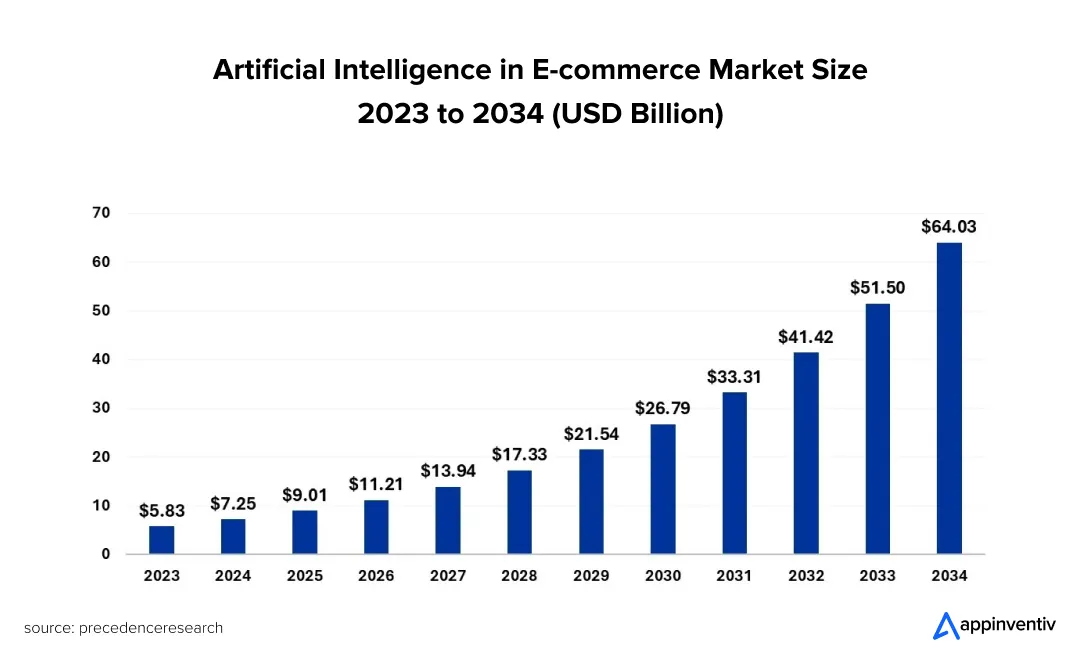
Here’s where AI is making the biggest impact in retail:
Personalized Shopping Experiences
Generic product recommendations are dead. AI analyzes what you browse, what you buy, and what you ignore. Then it suggests products you’ll actually want. Prices adjust in real time based on demand, competition, and what’s selling. Dynamic pricing isn’t new, but AI makes it way more sophisticated with personalized shopping experiences.
Chatbots handle customer questions 24/7 now. Not the frustrating kind that can’t understand basic questions—these actually help. Marketing campaigns get personalized at scale. You’re not blasting the same promotion to everyone and hoping it sticks. Engagement goes up. Conversion rates improve because the message matches what individual customers care about.
Supply Chain Optimization
Predicting product demand used to involve a lot of guesswork and spreadsheets. AI forecasts demand with impressive accuracy by analyzing patterns humans would miss. Inventory planning becomes efficient instead of wasteful.
Warehouses run smarter, too. AI optimizes where goods sit and how pickers move through space. Logistics get refined with route optimization and real-time shipment tracking. Costs drop. Efficiency jumps. Retailers cut their logistics expenses by 15-20% after implementing AI-driven supply chain management.
Predictive Analytics for Inventory Management
Too much inventory? You’re eating holding costs. Too little? Lost sales and angry customers. AI nails this balance by forecasting demand based on historical data plus real-time signals. Stock levels stay optimal. You’re not drowning in unsold products or constantly running out of what people want.
This is where AI delivers immediate ROI. Better inventory management directly impacts your bottom line every single day.
Real-World Example
Adidas built an app that actually uses AI effectively instead of just claiming they do. They analyze trends and predict consumer preferences, which feed into their design process. They’re creating products people want before competitors figure out what’s trending.
On the operations side, AI optimizes its inventory management and streamlines supply chain logistics. Lower costs, better efficiency. Customer-facing, they use AI-powered chatbots and recommendation systems that personalize interactions. Customers engage more. Loyalty builds.
Appinventiv worked with Adidas on revamping its digital presence in the Middle East. The results? 2 million downloads. 500,000 active users. Those aren’t vanity metrics—that’s genuine market penetration in a competitive region.
Business Impact:
- Higher conversion rates through personalized experiences
- Reduced inventory and logistics costs via predictive demand planning
- Pricing and recommendation governance prevents margin leakage
AI in Manufacturing and Industry 5.0
Manufacturing hit a turning point with AI for digital transformation. Industry 5.0 goes beyond automation into something more interesting—production that’s hyper-personalized and factories designed around human workers, not despite them. AI does the heavy analytical work. Predictive maintenance, quality checks, catching defects, and autonomous vehicl systems. The whole production process is getting rebuilt.
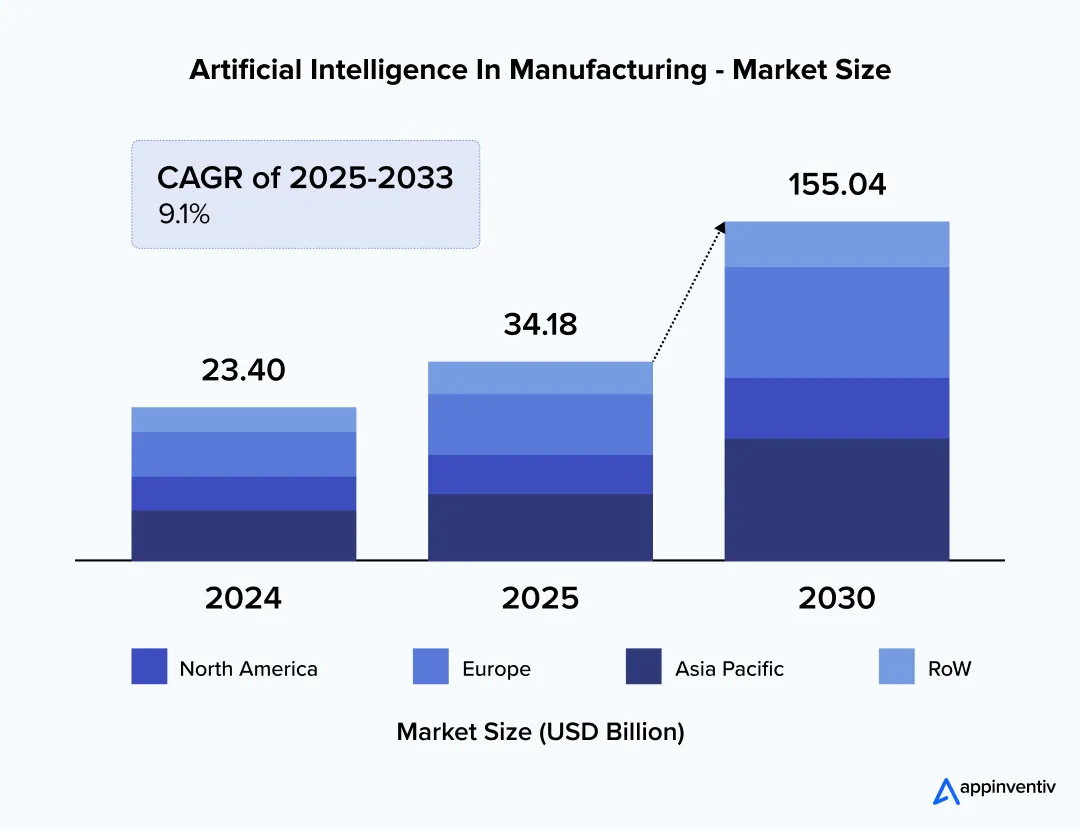
Markets and Markets pegged the global AI manufacturing market at $34 billion in 2025. Where’s it heading? $155 billion by 2030. That’s 35.3% growth annually. Companies are pouring money into this because the returns justify it. Let us show you what’s actually happening on factory floors:
Predictive Maintenance
AI watches real-time sensor data and picks up patterns that signal trouble ahead. A bearing vibrates slightly wrong? AI notices weeks before a human would. Maintenance teams get warnings with time to plan repairs during scheduled downtime instead of scrambling at 2 AM. Unplanned downtime drops, and machinery runs longer.
Quality Control and Defect Detection
Computer vision examines every item with consistent accuracy that beats human inspectors. Speed isn’t comparable AI processes thousands while a person checks dozens. Quality goes up, waste drops. The cool part? These systems keep learning. New defect? AI figures it out. Standards change? The system adapts.
Autonomous Vehicles and Robotics
Walk into a modern factory, and you’ll see AGVs moving materials, drones checking inventory, and robots assembling with precision that humans can’t replicate consistently. They optimize everything on the fly. No breaks, no sick days. Often, they work next to human employees—the robot handles repetitive or dangerous stuff while the person makes judgment calls. Productivity shoots up, though union reps aren’t thrilled.
Real-World Example
Siemens puts AI to work designing gas turbines. AI spots patterns that escape human engineers—not a knock on them, but people can’t crunch millions of data points. Turbines perform better and last longer. Production cycles that took months now take weeks. AI predicts defects before they occur. In a market where everyone fights for slim margins, that’s how you win contracts.
Business Impact:
- Reduced unplanned downtime through predictive maintenance
- Higher production quality via AI-based defect detection
- Controlled automation lowers operational risk and improves safety
Also Read: How AI in Manufacturing is Revolutionizing the Industry: Key Use Cases and Examples
AI in Education
Education has changed dramatically because of the role of AI in digital transformation. What used to be rigid classrooms turned into personalized learning platforms where students actually progress at speeds that make sense for them. Adaptive platforms and intelligent tutoring systems work because they address individual needs instead of treating every kid the same.
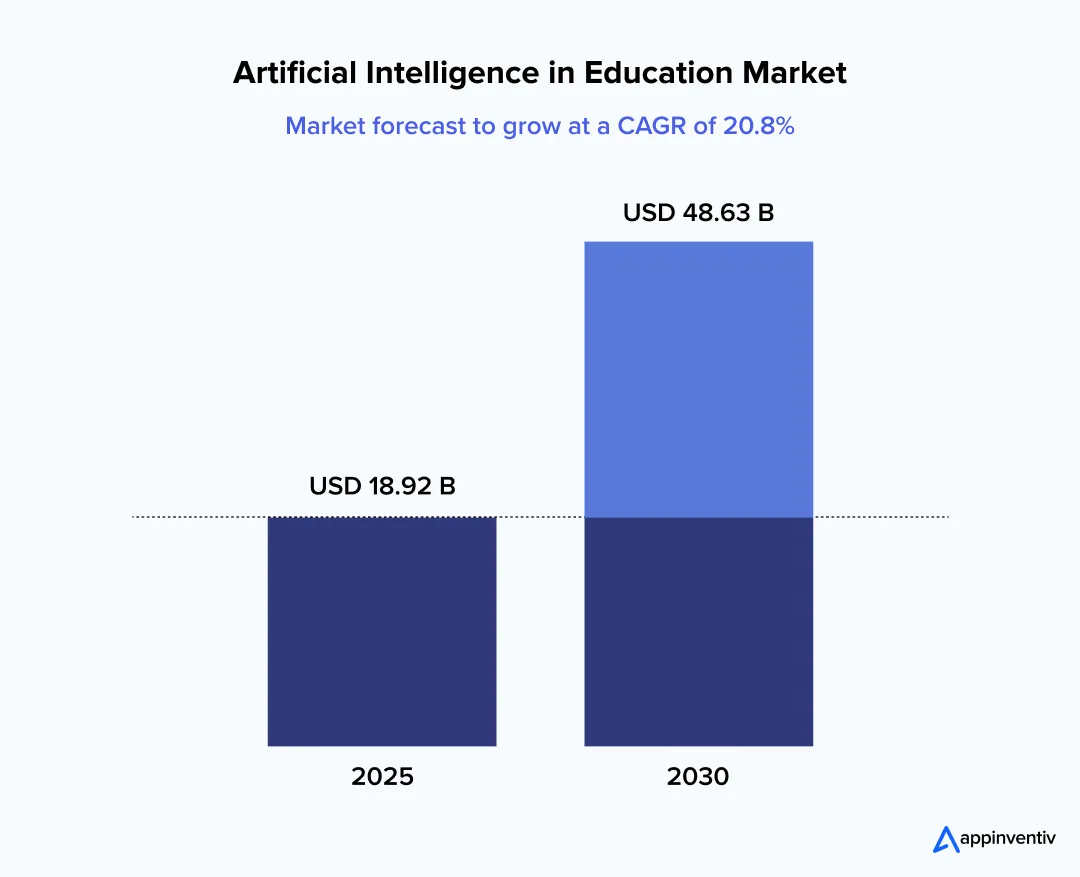
The numbers tell an interesting story. AI in education went from $4 billion in 2023 to $18 billion by 2024. By 2028? We’re looking at $48 billion—that’s 20.77% growth annually. Let us break down where AI is actually making a difference:
Adaptive Learning Platforms
Think of these as platforms that watch and learn from each student. Content gets adjusted. Pacing changes. Difficulty shifts up or down. A kid struggling with fractions? The system pumps the brakes, throws more examples at them, and maybe explains it three different ways. Another kid flying through? Boom, harder material shows up.
This isn’t revolutionary on paper, but in practice, it works because students stay engaged instead of getting bored or lost. Learning outcomes improve when education meets students where they are, not where some textbook says they should be.
Student Performance Analytics
AI tears through data from assignments, tests, and participation patterns. Teachers spot trends they’d never catch manually. Which kids are slipping? Where’s the confusion happening? Who needs to be challenged more?
The big win is early intervention. A teacher notices performance dropping two weeks before it becomes a real problem. Curriculum gets tweaked based on what’s actually clicking versus what consistently confuses everyone. Decisions happen based on data instead of guesswork.
Virtual Teaching Assistants
These assistants answer questions at 11 PM when no real teacher is awake. They grade basic assignments, give immediate feedback, and help with straightforward concepts. Students get assistance exactly when they hit a wall instead of waiting until tomorrow’s class.
Teachers benefit too. Rather than answering identical questions repeatedly or spending evenings grading worksheets, they focus on complex interactions that actually need human judgment. The AI handles the repetitive stuff that doesn’t require nuanced thinking.
Bottom line: AI makes learning adaptive and personalized, which directly boosts engagement and results.
Real-World Example
Gurushala uses AI to personalize learning for teachers and students alike. Content recommendations shift based on individual progress and how each person absorbs information best. Some kids learn through videos, others need text, and some require hands-on work. The AI figures this out through observation.
Administrative tasks get handled by AI too—course management, resource allocation across the platform. Teachers spend less energy on logistics and more on actual teaching. Students receive education shaped for them specifically, rather than generic lessons aimed at some mythical average student.
Business Impact:
- Improved learning outcomes through adaptive, personalized education
- Reduced administrative burden across institutions
- Ethical AI use protects student data and institutional trust
AI in Transportation and Logistics
Digital transformation with AI in logistics and transportation has been completely overhauled. Digital transformation through artificial intelligence has transformed route planning and made freight management way more efficient. Predictive maintenance is cutting vehicle downtime and operational costs in ways that seemed impossible five years ago.

Stratview Research pegged the AI transportation market at $2.89 billion in 2022, jumping to $3.26 billion in 2023. By 2029? We’re looking at $6.3 billion. Let us walk you through what’s actually happening out there.
Route Optimization and Fleet Management
AI algorithms tear through real-time data—traffic snarls, weather shifts, and delivery schedule changes. Then they optimize vehicle routes constantly. Fuel consumption drops. Delivery times get shorter. Fleet management stops being the headache it used to be.
Here’s the thing. Logistics managers who burned hours every day manually tweaking routes. Now? AI does it in seconds, and honestly, the routes beat what even their most experienced planners came up with. Money gets saved, and customers receive packages reliably instead of dealing with delivery windows that constantly shift.
Predictive Maintenance for Vehicles
AI digs into sensor data and old maintenance records to spot trouble brewing. Engine performance dipping slightly? Tire wear patterns looking off? Critical components showing stress? AI catches it early and predicts failures before they strand drivers.
Picture this: a truck’s engine vibrates a bit more than usual. AI flags it immediately. Inspection happens before the driver ends up stuck on the highway with a destroyed motor. Downtime vanishes because repairs get scheduled properly instead of happening as roadside emergencies. Maintenance costs fall since you’re swapping parts before they wreck other systems. Vehicle reliability shoots up, which matters when delivery commitments are on the line.
Automation in Warehousing and Distribution
Robotic systems and AGVs pretty much run warehouse floors now. These AI-powered machines handle inventory management, pick orders, pack boxes, and figure out the smartest use of storage space. Speed increases, errors drop compared to manual operations.
Real-World Example
UPS built something called ORION—On-Road Integrated Optimization and Navigation. It uses AI to map out delivery routes for drivers. The system processes mountains of data: package specs, delivery deadlines, vehicle capabilities, you name it. Then it generates the most efficient routes possible.
Drivers relied on years of experience and gut instinct before. ORION consistently outperforms even veteran drivers because it juggles variables that no human can track all at once. UPS cuts millions from fuel expenses every year while packages arrive faster. That’s real ROI in an industry where profit margins are razor-thin.
Business Impact:
- Lower fuel and delivery costs through AI-optimized routing
- Reduced vehicle downtime via predictive maintenance
- Real-time AI governance improves reliability and SLA adherence
Also Read: AI in Transportation – 10 Benefits and Use Cases for Modern Enterprises
Stop generic tools. Get AI built for healthcare, finance, manufacturing, retail, or logistics challenges.

What Your Business Gains from AI-Driven Transformation
AI-driven digital transformation only starts working when AI is woven into how decisions are made, how work actually happens, and how growth is planned. When companies take an AI-first approach, the shift shows up in everyday moments, not slide decks. Here are some AI-powered digital transformation examples:
- Real-Time Decision Intelligence: Instead of waiting for monthly reports or leaning on instinct during long meetings, AI digital transformation surfaces insight from live data. Your team sees what is happening now. Decisions happen closer to the moment, and course corrections come sooner.
- Data-Centric Operations: Data stops living in reports that few people open. Marketing adjusts based on real responses. Finance plans with current numbers. Operations change processes as patterns appear. HR relies less on assumptions. Work feels more predictable, with fewer late surprises.
- Rapid Adaptability: Change rarely arrives politely. Customer behaviour shifts mid-quarter. Market pressure shows up overnight. AI helps teams react while the window is still open, not after the approval cycle has passed. AI-first organisations move faster because the signal is already clear.
- Organizational Transformation: Tools alone do not drive this shift. Leaders have to support the adoption of AI strategies for business transformation and give teams room to learn. When people start trusting AI as part of their workflow, momentum builds naturally.
- Compounding Competitive Edge: Small gains stack up. Better decisions improve efficiency. Efficiency creates space to test new ideas. Over time, AI-first companies begin operating at a pace others struggle to match.
The upfront investment in AI for business transformation is real. So is the return. Companies that moved early now compete under very different conditions.
Solve Critical AI Adoption Barriers in Your Organization
Most teams get excited about AI during planning sessions. Then rollout starts, systems touch real data, and progress slows. AI for digital transformation works very differently in live operations than it does on slides. The companies that succeed are usually the ones that expect friction and plan for it early.
Here are the challenges teams run into most with digital transformation in AI.
- Data privacy and security
AI relies on large volumes of sensitive data, which raises real risk. Regulations like GDPR and HIPAA leave little margin for error.
Solution: Put practical data governance in place, not policies that sit untouched. Use strong encryption, control access tightly, and be clear with customers about how data is used. Transparency prevents trust issues later.
- Integration with existing systems
Many businesses still rely on platforms built a decade ago. These systems were never designed with AI in mind, and connecting them takes time.
Solution: Start small. Run pilot projects for AI-powered digital transformation solutions that solve one clear problem. Expand as infrastructure improves. Large rebuilds done all at once rarely go as planned.
- Workforce skills and training
AI expertise is hard to find, and relying only on outside consultants gets expensive fast.
Solution: Upskill people who already understand your business. Bring in partners for short-term support and hire specialists only where necessary.
- Bias and ethical risk
AI mirrors the data it learns from, including flaws. That can create real business and reputational damage.
Solution: Set clear ethics guidelines upfront. Review models often and diversify data sources.
AI adoption takes discipline. Teams that plan carefully tend to embed AI naturally instead of forcing it into broken processes.
8-Step Plan to Implement AI Successfully in Your Business
Most AI plans begin with energy and optimism. Then Monday hits. Someone asks how it fits their workflow. Another team cannot find the data. Progress slows. Grounded AI-driven digital transformation strategies help avoid that pattern and keep AI tied to real work, not theory.
- Define your specific problem: Start with something people feel every day. Maybe approvals pile up by Friday. Maybe sales follow-ups get missed after busy weeks. Pick one clear issue so the effort stays focused and measurable.
- Build your data foundation: Before AI enters the picture, look at your data honestly. Is it clean? Is it secure? Can teams access it without asking three people? Fixing this early saves frustration later.
- Start with a pilot project: Integrating AI with digital transformation requires testing before scaling, so skip the big launch. Choose one task and test it as a proof of concept with a small group during normal work hours. Watch what breaks. Fix it. Only then think about scaling.
- Work in short cycles: AI improves through use. Short feedback loops, as suggested in agile methodologies, let teams adjust quickly instead of waiting months to realize something missed the mark.
- Involve all departments: AI touches many roles. Bring in operations, sales, marketing, and support early so solutions match how work really flows.
- Invest in your team: Train people who already understand the business. Add specialists only where gaps exist. Tools work best when people trust them.
- Set clear boundaries early: Agree on data use, fairness, and accountability upfront. These decisions are harder to fix once systems are live.
- Measure and adjust: Look at outcomes, not dashboards. If something does not help, change it quickly.
This approach keeps digital transformation in AI practical, useful, and part of daily work, not another stalled initiative.
Risk & Compliance Gates in Implementation Plan
AI success depends on disciplined governance, not speed alone.
- Data Foundation: Validate data privacy, consent, and security before model use
- Pilot Phase: Test for bias, accuracy, and explainability before scaling
- Scaling AI: Enable audit logs, access controls, and regulatory checks
- Ongoing Monitoring: Track model drift, fairness, and compliance continuously
Most AI projects stall at step three. Get expert guidance to navigate pilots, data challenges, and team buy-in.
Prepare Your Business for Emerging AI Transformation Trends
AI in digital transformation just keeps evolving, with its role in business transformation growing nonstop. Edge computing, explainable AI, stuff we couldn’t do last year—these trends are flipping how companies compete.
Here is what the future of digital transformation with AI looks like:
Multimodal AI
Picture this. AI systems handle text, images, and videos simultaneously rather than processing them separately. They’ll understand context way better because they’re seeing the full picture, kind of like how humans actually experience the world. Current AI that only reads text or only analyzes images? That’s about to feel really limited with Multimodal AI and its applications.
Democratization of AI
Remember when AI required millions in funding and a room full of PhDs? Those days are dying fast. Small businesses are building AI solutions now without massive teams. Non-experts can work with this technology, which is genuinely changing who participates and what becomes achievable.
Explainable AI (XAI)
People got tired of mysterious AI making decisions nobody could understand or defend. Transparency stopped being optional. XAI reveals how models reach conclusions, making them trustworthy enough to actually deploy. Executives reject an AI system purely because it couldn’t explain its recommendations. Black-box algorithms making business-critical calls you can’t justify to regulators? That era is ending.
Also Read: How Explainable AI can Unlock Accountable and Ethical Development of Artificial Intelligence
Digital Humans and Digital Twinning
AI builds digital twins of people and physical objects that function realistically. We’re not talking about animated avatars in presentations. These are working twins that enhance customer service interactions and let you test scenarios before risking real operations or equipment.
Smaller Language Models and Open Source Advancements
Developers are advancing applied generative AI for digital transformation by building compact models that don’t require warehouses full of servers. Open-source platforms are booming simultaneously. Result? AI becomes scalable and affordable instead of staying locked behind Google and Microsoft’s budgets. A startup can compete now without venture capital funding for its computing costs.
Edge AI
Data processing happens on your actual device—phone, IoT sensor, industrial equipment—instead of getting shipped to distant clouds. Real-timed decisions with almost zero delay. Industries where milliseconds determine outcomes? This changes everything. Autonomous vehicles can’t wait for cloud responses. Medical devices need instant analysis. Edge AI solves that.
Where this all heads: AI’s business impact keeps compounding. Decisions get smarter because they’re informed by better data processing. Experiences become genuinely personalized instead of segmented into crude categories. Operational efficiencies that seemed impossible two years back? Companies are achieving them routinely now.
Build AI That Scales Without Increasing Risk
- Deploy AI systems designed for regulatory readiness and auditability
- Ensure explainability, fairness, and accountability from day one
- Scale AI across the enterprise with confidence, control, and compliance
Accelerate Growth Through Appinventiv’s Expert AI Development Services
Most teams reach out to us after they see the limits of manual decisions and disconnected systems. That is where our artificial intelligence development services come in, focused on real outcomes, not experiments.
At Appinventiv, we have delivered more than 300 AI-powered solutions across 35+ industries, working with global brands like Domino’s, IKEA, and Americana to improve how their operations run day to day.
Our team includes 200+ data scientists and AI engineers who have trained and deployed 150+ custom AI models. The impact is measurable. Clients see up to 75% faster decision-making, prediction accuracy reaching 98%, and an average cost reduction of around 40%. These numbers come from production systems already in use.
Recognitions like Deloitte Fast 50 India for two consecutive years and inclusion among APAC high-growth companies by Statista and the Financial Times reflect our enterprise focus. We work across machine learning, NLP, computer vision, and more than 50 purpose-built LLMs. Our 75+ enterprise AI integrations have helped teams move to market up to 10 times faster.
As your digital transformation services partner, we focus on scaling operations smoothly, enabling better decisions across teams, and improving customer experiences without ripping out existing systems. When you are ready, we help turn AI into an advantage you can rely on.
Frequently Asked Questions
Q. How to implement AI in digital transformation?
A. The smartest way to adopt AI is steady, not rushed. Start with a clear goal. Use reliable data and tools that fit your needs. Test with a small pilot, measure outcomes, then expand. Build a capable team, collaborate across departments, and keep ethics in focus so trust keeps pace with progress.
Q. What are the most impactful AI technologies in digital transformation?
A. You can see this playing out across industries already. Hospitals improve diagnoses and tailor treatments. Banks catch fraud and act on market changes faster. Retailers fine-tune supply chains and marketing. Factories predict breakdowns weeks ahead and reduce downtime during peak production.
Q. How does Appinventiv use AI in digital transformation for projects?
A. Appinventiv leverages AI as a core enabler of digital transformation by embedding machine learning, generative AI, intelligent automation, and advanced analytics into business processes and digital products. From AI-led strategy and data modernization to custom AI solutions, conversational AI, and continuous optimization, Appinventiv helps organizations automate operations, enhance customer experiences, and drive measurable business outcomes at scale.
Q. What are the key benefits of AI for digital transformation?
A. For customers, the impact feels personal. AI delivers faster service, relevant recommendations, and support that runs around the clock. Routine questions are handled instantly, while human teams focus on complex cases. That balance builds trust and long-term loyalty.
Q. What is AI in digital transformation?
A. At its core, AI in digital transformation is about weaving intelligence into everyday operations and decisions. It moves beyond basic automation and becomes a steady driver of efficiency, insight, and competitive advantage across the business.
Q. How can AI accelerate digital transformation in business?
A. AI speeds up transformation in practical ways. Teams make decisions using live data instead of delayed reports. Routine work runs automatically, freeing people for higher-value tasks. Potential issues surface early through prediction, not reaction. Operations improve continuously, helping businesses adapt quickly, personalize at scale, and stay ahead.
Q. How does Appinventiv help businesses with AI-driven digital transformation?
A. Appinventiv builds AI solutions around real business needs, not templates. With 3,000+ projects delivered and deep experience in machine learning, NLP, and computer vision, we support teams from early pilots to full rollouts. The focus stays on scale, better decisions, and customer experiences people remember.
Q. How is generative AI for digital transformation changing business operations?
A. Generative AI takes a simple prompt and turns it into useful output, like content, code, or designs. It helps teams build smarter chatbots, generate reports quickly, speed up software development, and personalize customer experiences. For many businesses, it turns work that once took months into something done in days, without sacrificing quality.


Fast 2-minute response, fully NDA-protected.

How to Use AI SDR Agents to Automate Outbound Prospecting and Generate Pipeline
Key takeaways: AI SDR agents replace repetitive manual research with autonomous, signal-driven prospecting and lead qualification workflows. Start with one defined prospecting workflow before expanding AI automation across the wider sales organization. Clear ICP rules, reliable data, and decision boundaries determine whether autonomous prospecting creates useful business value. Custom AI SDR workflows work best when…
AI for Smart Cities: From Connected Infrastructure to Intelligent Urban Services
Key takeaways: AI shifts cities from monitoring infrastructure conditions to predicting disruptions and improving operational responses before failures escalate. The strongest AI use cases in smart cities combine quality data, clear ownership, workflow integration and measurable infrastructure outcomes. Digital twins create greater value when AI supports simulation, optimisation and decisions rather than visualisation alone. Responsible…
How Forward Deployed Engineers Accelerate AI From Pilot to Production
Key takeaways: IBM's 2025 CEO study revealed that only 16% of AI projects scaled across entire companies. Forward-deployed engineers integrate daily workflows, legacy applications, AI models, security rules, and server infrastructure into a single team. Live AI platforms require task checks, access permissions, system tracking, and rollback tools before full rollout. Single-team projects eliminate handoffs…