



































Microservices vs. Monolithic Architecture: Which Is Right for Startups?

 Share -



- 01Monolith vs. Microservices Comparison Table for Startups
- 02What Is Monolithic Architecture?
- 03What Is Microservices Architecture?
- 04How to Choose Between Monolithic vs. Microservices
- 05Why Startups Should Begin With a Modular Monolith
- 06When Microservices Actually Make Sense
- 07A Phased Migration Path: From Monolith to Microservices
- 08Which Architecture Fits Your Startup Today?
- 09How Appinventiv Helps You Make the Right Architecture Call

Key takeaways:
- Simple vs flexible: Monoliths are easier to build early on, microservices give more flexibility later
- One team vs multiple teams: Monoliths work well for small teams, microservices fit when teams grow and split work
- Low effort vs high setup: Monoliths need less infrastructure, microservices need monitoring, APIs, and coordination
- Single data source vs split data: Monoliths keep data in one place, microservices spread it across services
- Scale everything vs scale parts: Monoliths scale the whole app, microservices scale only what’s needed
You usually don’t sit down on day one and decide your architecture. It comes up a few releases in, when things start to feel slower or a simple change takes more effort than expected. That’s when the monolithic vs. microservices conversation typically begins.
In the high-velocity world of product development, architecture is rarely just a technical decision. It’s a business one. For a startup, choosing between monolithic and microservices directly shapes how fast you can pivot, how your cloud costs grow, and where deployment bottlenecks start to impact momentum.
Most founders and technical leaders are often presented with a false choice. Monoliths are seen as “legacy,” while microservices are labeled “modern.” In practice, the bigger mistake is adopting a distributed system before your team has the operational maturity to manage it.
At Appinventiv, after working across 2000+ cloud deployments, one thing we have observed is consistent. Architecture needs to match team maturity, not just ambition. Industry trends reflect a similar shift. According to recent Gartner-backed research, around 74% of organizations are already using microservices, with another 23% planning adoption in the near term, signaling that distributed architectures have become a mainstream standard in modern software development.
This guide breaks down the monolithic vs. microservices decision in a practical way, helping you choose what works for your stage today while keeping your system ready to scale tomorrow.
Get a practical architecture assessment tailored to your startup stage, team size, and scaling goals.

Monolith vs. Microservices Comparison Table for Startups
When teams sit down to discuss monolithic vs. microservices, the conversation can quickly drift into theory. A side-by-side view usually brings it back to reality. The question is not which one sounds more modern. The question is which one fits your stage right now.
Here is a practical comparison of monolithic and microservices architecture through a startup lens.
| Aspect | Monolithic Architecture | Microservices Architecture |
|---|---|---|
| Core Structure | Single codebase where everything runs together | Application is split into multiple independent services |
| Deployment Model | One deployment updates the entire system | Each service can be deployed independently |
| Code Management | One repository, easier to manage for small teams | Multiple repos or services to coordinate |
| Database Setup | One shared database | Separate databases per service |
| Communication | Direct function calls inside the app | API calls over the network |
| Development Speed (Early Stage) | Faster to build and ship Minimum Viable Product (MVPs) | Slower initially due to setup complexity |
| Debugging | Easier since everything is in one place | Harder due to distributed tracing across services |
| Team Fit | Best for small, closely working teams | Works better with multiple teams and clear ownership |
| Infrastructure Needs | Minimal. Fewer moving parts to manage | Higher. Requires orchestration, monitoring, and networking layers |
| Scalability Approach | Scale the entire application together | Scale individual services independently |
| Operational Overhead | Low. Fewer tools and systems to maintain | High. Needs logging, monitoring, and service discovery |
| Failure Impact | One issue can affect the whole system | Failures can be isolated to specific services |
| Data Handling | Centralized and straightforward | Distributed, requires coordination and consistency handling |
| Development Complexity | Lower cognitive load for engineers | Higher due to distributed system challenges |
| Best Use Case | MVPs, early-stage startups, rapid iteration | Growing startups with multiple teams and scaling needs |
| Key Advantage | Speed, simplicity, and clarity | Flexibility, scalability, and team autonomy |
| Key Limitation | Becomes harder to manage as it grows | Adds significant complexity and operational cost |
The real difference between monolithic and microservices architecture is not just technical. It changes how your team builds, deploys, and supports the product day-to-day.
In most early-stage startup scenarios, the monolithic versus microservices decision comes down to a simple trade-off: simplicity now versus flexibility later. The right answer depends less on trends and more on how ready your team is to carry the added operational weight.
Also Read: Serverless Vs. Microservices – Which Architecture Should
What Is Monolithic Architecture?
Early on, most teams don’t overthink architecture. You’re just trying to get something working and out the door. That’s where a monolith fits naturally. Everything sits in one place: your backend, logic, and APIs run as a single system. You make a change, deploy once, and you’re done.
What it looks like in a real startup:
- One codebase that the whole team works on
- A single database for everything
- One deployment flow
- No network calls between services, just direct logic
Why does it work so well early?
- You can build and ship faster
- Debugging is straightforward; nothing is scattered
- Infrastructure stays simple and affordable
- New developers get up to speed quickly
Where things start getting tricky:
- Releases begin to slow as the codebase grows
- Features get tangled with each other
- One issue can impact the whole app
- Scaling just one part becomes difficult
To put it simply, a monolith is like working in a single main building where everything is close and easy to manage. Microservices, on the other hand, are more like separate outbuildings on a farm, each one handling its own job. That setup helps later, but in the beginning, keeping everything together usually makes life easier.
What Is Microservices Architecture?
You usually don’t start with microservices. It comes up a bit later, when releases begin to slow down or when two people are stuck waiting on the same deployment. That is when breaking things apart starts to feel like the next step.
At a simple level, microservices split your application into smaller, independent pieces. Each one handles a specific job and runs independently, connected via Application Programming Interface (APIs). If a monolith is like a single large building where everything sits under one roof and shares resources, microservices feel more like separate units, each doing its own thing but working together.
What it looks like in practice:
- Payments, auth, notifications, and search run as separate services
- Each service is deployed independently
- Data is managed within each service
- Services communicate through APIs
Key benefits:
- Teams can move without blocking each other
- You can release features in parts instead of all at once
- Busy areas can scale without touching the rest
- Ownership becomes clearer across the system
Hidden complexity:
- More infrastructure to set up and maintain
- Debugging takes longer since requests pass through multiple services
- You need solid logging and monitoring from the start
- Things like retries and version mismatches become part of daily work
Microservices give you more flexibility, but they also bring more moving parts. For a small team, that shift can feel heavier than expected if it comes too early.
How to Choose Between Monolithic vs. Microservices
When this debate comes up inside a startup, it usually means something is hurting. Maybe releases feel slower. Maybe the codebase is getting heavier. Or maybe someone read a case study about how a fast-growing company switched to microservices, and now it feels like you are behind. Before you jump, pause.
The monolithic and microservices decision is not about choosing the more “advanced” option. It is about choosing what your team can realistically handle now.
Let’s break it down in plain terms.
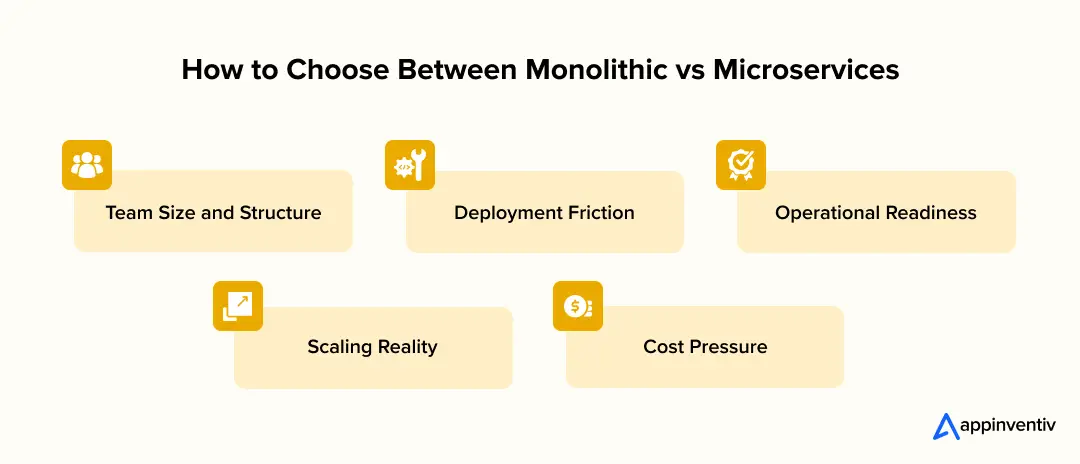
1. Team Size and Structure
Start from here. How many engineers do you actually have? If you are a small team working closely together, a monolith often works fine. Everyone understands the same codebase. Changes move quickly. Coordination is simple.
Microservices shine when you have:
- Multiple teams
- Clear ownership of different business areas
- A need to deploy features independently
In the real world, the shift from monolithic architecture to microservices architecture often follows team growth, not traffic growth. If you do not have separate squads yet, splitting your system might create more overhead than benefit.
2. Deployment Friction
Be honest about your release process.
- Are deployments slow because everything ships together?
- Does one change force a full regression cycle?
- Are engineers nervous every time you hit deploy?
If releases are becoming stressful and tightly coupled, the difference between monolithic and microservice architectures becomes more pronounced. Microservices let you deploy parts independently.
But if deployments are still smooth and predictable, breaking things apart might fix a problem you do not actually have.
3. Operational Readiness
Microservices are not just smaller codebases. They are distributed systems.
That means you now need:
- Centralized logs
- Monitoring and alerts
- Clear service contracts
- Strong CI/CD discipline
- Someone who understands how systems fail over networks
This is where the real advantages and disadvantages of microservices show up. You gain flexibility. You also gain operational responsibility.
If no one on your team is comfortable managing distributed systems, the safer choice might still be a clean, well-structured monolith.
4. Scaling Reality
A common misconception in the monolithic and microservices conversation is that only microservices can scale. That is not true.
Ask yourself:
- Is one specific part of the system under heavy load?
- Are you hitting performance bottlenecks that vertical scaling cannot solve?
- Is database contention slowing you down?
If only one module needs aggressive scaling, extracting that service later may make sense. But most early-stage startups do not hit these limits as quickly as they expect.
5. Cost Pressure
Architecture decisions show up in your cloud bill. With microservices, you are usually paying for:
- More infrastructure components
- More container instances
- More networking and monitoring services
- More engineering hours spent on platform work
The cost comparison of microservices vs. monolithic apps often surprises founders. Microservices are not automatically cheaper. In the early stages, they are usually more expensive.
A Simple Reality Check
You are probably better off sticking with a monolith if:
- You have a small, tight engineering team
- You are still refining your core product
- Deployments are manageable
- Infrastructure budget matters
Microservices begin to make sense when:
- You have multiple teams stepping on each other’s work
- Deployment coupling slows delivery
- Certain domains need independent scaling
- You have the maturity to handle distributed complexity
The truth in the monolithic architecture and microservices architecture debate is this: timing matters more than ideology. Choose the structure that keeps you moving fast now. You can always evolve later.
Where Appinventiv Adds Practical Clarity:
In real projects, this becomes obvious fast. Across 500+ cloud migrations and 2000+ deployments, we have seen teams that delay microservices until real friction appears move 30-40% faster and avoid heavy rework.
In many cases, modularizing the monolith alone significantly reduces deployment and debugging effort. Microservices then follow when scale actually demands it.
In the end, it is about timing. Build for now, evolve when needed.
We analyze your deployment friction, scaling needs, and cost exposure before recommending a migration path.

Why Startups Should Begin With a Modular Monolith
When you’re early in the build phase, speed matters more than anything else. You want to ship, learn, and iterate without getting slowed down by system complexity. That’s where a modular monolith fits well in the monolithic vs. microservices discussion.
It gives you the simplicity of a monolith with just enough structure to grow cleanly.
Instead of splitting everything into separate services too soon, you keep a single codebase and organize it by business areas. Payments, users, and orders each stay in their own space. This keeps things easier to manage today while avoiding the mess that slows teams down later.
Why it works for startups:
- Faster development without extra infrastructure overhead
- Clear boundaries without needing microservices
- Easier debugging and deployment
- Flexibility to move toward microservices later
In the monolithic architecture vs. microservices architecture decision, this approach helps you avoid overengineering early. You stay focused on building the product, while keeping the system ready to evolve when growth actually demands it.
Also Read: Build a top mobile app with a structural app design process
When Microservices Actually Make Sense
Microservices start to make sense when your setup begins to slow you down, not before. In the monolithic vs. microservices decision, timing matters most.
Here are the clear signals:
- Team growth: When you have multiple teams working on different parts of the product and stepping on each other’s work, splitting services helps create ownership.
- Deployment issues: If every release feels risky or one small change requires redeploying everything, microservices can reduce that friction.
- Scaling needs: When specific parts of your system need to scale independently, like payments or search, breaking them out becomes practical.
- Operational maturity: You already have strong CI/CD, monitoring, and teams comfortable handling distributed systems.
In the monolithic architecture vs. microservices architecture discussion, microservices work best when your system and team have clearly outgrown the simplicity of a monolith.
A Phased Migration Path: From Monolith to Microservices
When the monolithic vs. microservices decision becomes unavoidable, a full rewrite might look tempting. In reality, it slows you down and adds risk. A phased approach works far better.
In the monolithic architecture vs. microservices architecture journey, the goal is not to switch overnight, but to evolve without breaking momentum.
Phase 0: Clean the Monolith First
Before splitting anything, fix the structure.
- Organize code into clear domains
- Remove tight coupling
- Define internal APIs and add basic observability
If the monolith is messy, splitting it only spreads the problem.
Phase 1: Start with Low-risk Services
Start with domains that are operationally isolated and technically low-risk.
- Minimal dependencies
- Easier to extract
- Lower impact if something fails
Phase 2: Move High-Impact Domains
Once your platform stabilizes, you can evaluate core services.
This phase often involves:
- Services with heavy load
- Clear business boundaries
- Introduce event-driven communication where needed
Phase 3: Strengthen the Platform
As services increase, platform governance becomes critical.
This stage includes:
- Monitoring and tracing
- CI/CD standardization
- API governance
Cloud Migration also affects cost. The cost comparison of microservices vs. monolithic apps shifts during transition because infrastructure duplication temporarily increases.
You may be running:
- The monolith
- Newly extracted services
- Messaging systems
- Additional monitoring stacks
This overlap must be planned carefully. Otherwise, cloud bills and engineering bandwidth can spike.
In the end, the monolith vs. microservices architecture shift in development works best when it feels gradual. You keep shipping, users stay unaffected, and the system evolves without disruption.
Also Read: How to Choose the Right Enterprise Software Architecture
Which Architecture Fits Your Startup Today?
The monolithic vs. microservices decision need not be dramatic. It needs honesty. The right choice depends on where you are, not where you hope to be in five years.
A Monolith Makes Sense When:
- Your team is small and works closely together
- You are still shaping the product and testing assumptions
- Deployments feel manageable
- Budget and operational bandwidth are tight
- Business rules change frequently
In this stage, simplicity protects momentum. The common disadvantages of monolithic applications usually appear only when structure and discipline are ignored.
Microservices Make Sense When:
- You have multiple teams stepping on each other’s work
- Independent deployments would reduce friction
- Certain domains clearly need their own scaling strategy
- You already have strong CI/CD, monitoring, and ownership models
That is when the real benefits of microservice architecture begin to outweigh the added complexity.
The monolithic architecture and microservices architecture question is not about picking a winner.
Most startups begin with one and evolve toward the other. In the end, the smartest move in the monolithic vs. microservices debate is choosing what keeps your team shipping confidently today while staying flexible enough to grow tomorrow.
Partner with experts who design modular monoliths and microservices that evolve with your product.

How Appinventiv Helps You Make the Right Architecture Call
Most founders do not approach us asking for microservices. They come with a concern. Releases are slowing down. The codebase feels heavier than it used to. Investors are questioning whether the system will scale. That is usually when the monolithic vs. microservices discussion enters the room.
As a mobile app development company working closely with startups and growth-stage businesses, our role is not to push a preferred architecture. It is to understand context.
- How large is your team today?
- How frequently do you deploy?
- Are your business domains stable, or still evolving?
Generally, strengthening a modular monolith resolves the friction. Rarely does it make sense to begin extracting services gradually. Architecture should reflect your stage of growth, not just long-term ambition.
We have guided companies through this shift repeatedly, transforming 500+ legacy processes and executing 500+ cloud migrations without slowing product momentum. With 2000+ cloud deployments and 24/7 monitoring in place, the focus stays on real production performance. And it shows. With 16+ industry awards, Appinventiv’s credibility is backed by both results and recognition.

If you are weighing the monolithic vs. microservices decision and want a grounded, experience-backed perspective, let’s connect. We will review your current architecture, identify genuine bottlenecks, and chart a phased evolution plan that scales without introducing avoidable complexity.
FAQs
Q. What is monolithic architecture?
A. Monolithic architecture is a way of building software where everything runs as a single application. The user interface, business logic, and database interactions all live in one codebase and are deployed together.
In the context of monolithic vs. microservices, this approach keeps things straightforward. There is one deployment process, one main system to monitor, and fewer moving parts to manage. The disadvantages of monolithic usually appear later, when the codebase grows without a clear modular structure or when scaling needs become uneven across features.
Q. What is a microservice architecture?
A. A microservice architecture breaks an application into smaller, independent services. Each service focuses on a specific business function and communicates with others through APIs or messaging systems.
When comparing monolithic architecture and microservices architecture, microservices offer more flexibility in scaling and team ownership. These are key microservice architecture benefits, especially for larger teams. However, they also require stronger DevOps practices, observability, and careful coordination between services.
Q. When should you use microservices and when should you not?
A. The monolithic vs. microservices decision depends more on your stage than on your ambition.
Microservices make sense when:
- You have multiple engineering teams working on clearly defined domains
- Deployment coupling is slowing product releases
- Certain parts of the system need independent scaling
- Monitoring, CI/CD, and operational processes are mature
They may not make sense when:
- Your team is small and closely aligned
- Business rules are still changing frequently
- Infrastructure costs and operational bandwidth are limited
Understanding the real advantages and disadvantages of microservices in your environment is more important than following industry trends.
Q. How do you migrate from a monolithic application to a microservice architecture?
A. Migration should be gradual. Rewriting everything at once often introduces unnecessary risk.
A practical path usually involves:
- Refactoring the monolith into well-defined modules first
- Extracting low-risk services, such as notifications or search
- Introducing APIs and clear service contracts
- Moving toward database-per-service models where appropriate
- Strengthening monitoring and deployment automation
In the monolith vs. microservices architecture in the development journey, evolution works better than disruption. From a business impact monolithic vs. microservices architecture perspective, the goal is to improve scalability and autonomy without slowing delivery.


Fast 2-minute response, fully NDA-protected.

How Much Does It Cost to Develop a Remote Patient Monitoring App in the UAE?
Key takeaways: Feature scope and system integrations, not the app itself, determine your final development cost. DHA, DOH, and MOHAP compliance must be built into your architecture from day one. Wearables, EHRs, and health information exchanges are the biggest technical cost drivers. A successful RPM platform combines continuous monitoring, clinical workflows, and secure interoperability. Early…

How Much Does It Cost to Develop an App Like Herfy in 2026?
Key takeaways: Herfy-like app development costs SAR 150,000 to SAR 1,500,000 ($40,000 to $400,000). Costs rise with rider tracking, POS sync, kitchen displays, loyalty, and branch controls. Saudi apps need Arabic UX, Mada, STC Pay, VAT, and ZATCA-ready invoice flows. Peak loads during Ramadan, Eid, and weekends need strong backend and load testing. A phased…

Key takeaways: The operating model determines survival. The code does not. Compliance under PDPL in the UAE and SDAIA in Saudi Arabia must be engineered into architecture, not added before launch. A serious build costs between AED 147,000 and AED 1,470,000 (USD 40,000 to USD 400,000), depending on scope. The single largest cost most operators…