



























How Much Does It Cost to Develop an On-Demand Beauty Application?

 Share -


- 01Why Should You Invest in On-Demand Beauty App Development?
- 02A Comprehensive View of the Costs Involved in On-Demand Beauty App Development
- 03Factors Affecting On-Demand Beauty App Development Costs
- 04Hidden Costs of On-Demand Beauty App Development
- 05How to Optimize On-Demand Beauty App Development Cost
- 06ROI of Building a Beauty Application
- 07Bring Your Beauty App Vision to Life with Appinventiv
- 08FAQs

For beauty business owners and founders planning an on-demand app: understand the development costs, key features, and investment decisions that shape a scalable beauty service platform.
An evident challenge in on-demand beauty app development is maintaining a balance among user convenience, the beauty service provider and operational costs while avoiding over-allocating features. The average beauty app development cost is $40,000 to $250,000, and for more complex, multi-vendor platforms with advanced automation, real-time tracking, and custom integrations, the price can exceed $500,000. The final investment can vary, depending on the scope, technical requirements and launch strategy of the product.
The budget is impacted by platform choice, integration needs, security specifications, and future expansion plans. This blog discusses the breakdown of this development cost, factors affecting the costs, hidden costs, and the practical ways of optimizing the investment.
Key takeaways:
- Beauty app development typically costs $40,000 to $500,000 or more, depending on the app’s scope, platform, integrations, and complexity.
- Development costs increase with advanced features, multiple user panels, and third-party integrations such as payment gateways, maps, and verification tools.
- Cross-platform MVPs help control initial costs by focusing on essential booking, payment, and admin features before scaling.
- Post-launch expenses include hosting, API usage, maintenance, security, customer support, and app store updates.
- A well-defined business model helps align development costs with monetization goals, launch priorities, and long-term growth.
Let’s assess your business model, app features, and technical requirements to define the right scope and cost.

Why Should You Invest in On-Demand Beauty App Development?
For tech companies assessing new sources of digital revenue, on-demand app development can offer an opportunity to align customer demand with a more consistent service delivery protocol.
A dedicated beauty platform, for instance, can bring appointment scheduling, service provider allocation, payment processing, customer management, and service performance tracking together in one system. This provides businesses with greater visibility into daily operations and a digital foundation to support multi-service, multi-customer, and multi-market expansion.
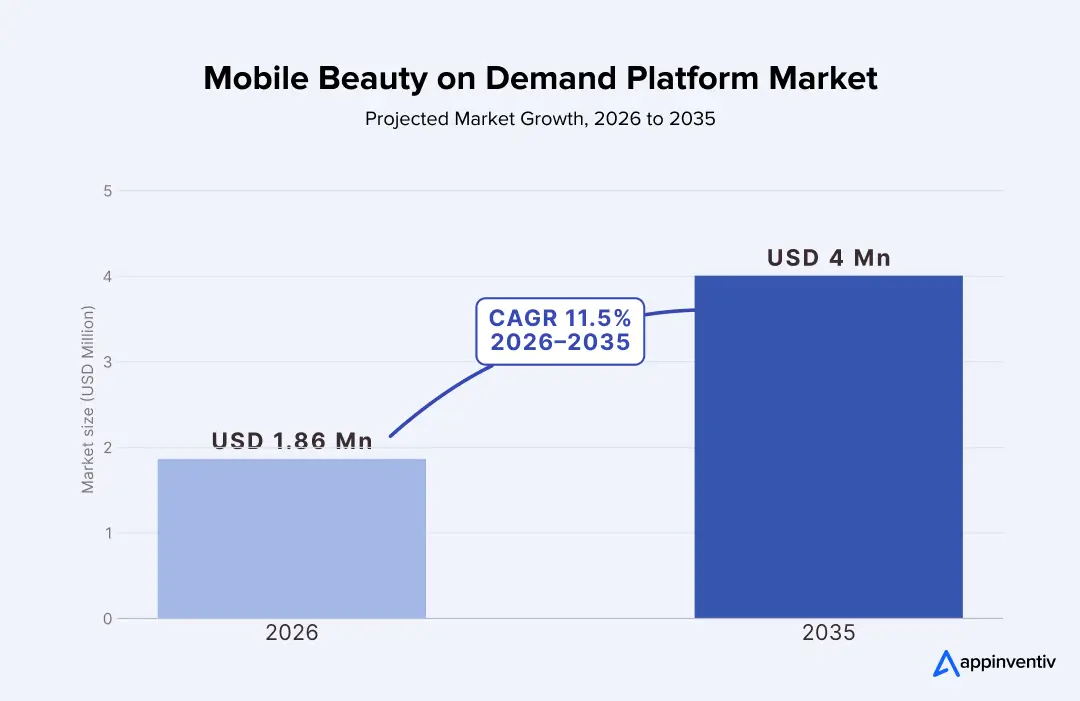
The market outlook further supports this investment. The global mobile beauty on demand platform market is projected to grow from $1.86 million in 2026 to $4 million by 2035, at a CAGR of 11.5% between 2026 and 2035 (Source: Business Research Insights). For businesses planning to enter or expand in this segment, the opportunity lies in translating market demand into a scalable operating model.
An on-demand beauty application can also reduce dependence on manual booking processes, limit scheduling conflicts, and offer service providers with clearer visibility into their appointments. As the platform evolves, businesses can introduce ML-driven recommendations, real-time pricing, and loyalty programmes tailored to customer behaviour and actual usage patterns.
The investment opportunity comes down to the ability of technology to fulfill business goals. A well-thought-out application can become the foundation for the booking system and then integrate new functionality and support the growing volume of transactions as the business grows.
A Comprehensive View of the Costs Involved in On-Demand Beauty App Development
The on-demand beauty services app development cost typically ranges from $40,000 to $500,000, depending on the platform strategy, feature set, business model, and technical complexity. The cost also varies by location, team composition, and delivery timeline. The following breakdown examines the main cost factors businesses should evaluate before investing in an on-demand beauty application.
Breakdown of Cost by Complexity and Scope
The price of an on-demand beauty services app depends on the number of user interfaces, booking workflows, service provider management features, third-party integrations, and customization requirements.
A simple salon booking app will take less effort to develop than a multi-vendor salon booking platform that will connect customers with beauty service providers for their home services. These are estimates for various levels of application complexity in a general $40,000- $500,000 budget.
| Level of Complexity / Scope | Scope Description | Estimated Cost |
|---|---|---|
| Basic | Customer registration, beauty service listings, appointment booking, payment integration and a basic admin panel | $40,000–$70,000 |
| Moderate | iOS and Android apps, business profiles, real-time scheduling, customer reviews, notifications, provider management | $70,000 – $150,000 |
| Advanced | Multiple payment options, loyalty programs, advanced analytics, GPS tracking, advanced multi-vendor marketplace, and multiple price options | $150,000–$300,000 |
| Enterprise | Multiple user applications, AI-powered recommendations, automated provider allocation, custom integrations, advanced analytics, and scalable cloud infrastructure | $300,000 – $500,000 |
The more complex the application, the more engineering hours will be spent developing the application, integration efforts and testing, and infrastructure planning. Businesses should identify the core elements they require before committing to a budget, as they will directly impact the development cost; also, the number of users to be expected will have an impact on that cost.
Feature-Wise On-Demand Beauty App Development Cost
The features directly impact the overall beauty app development effort, integration and testing requirements. Beauty booking app development cost depends on the extent to which it supports simple appointment booking or a more advanced beauty marketplace management system, real-time tracking, and custom safety recommendations.
| Feature | Scope Description | Estimated Cost |
|---|---|---|
| User Registration and Profiles | User accounts, authentication, saved addresses and preferences | $3000-$8000 |
| Beauty Service Listings | Service categories, professional profiles, portfolios, pricing and reviews | $5,000 – $12,000 |
| Appointment Booking and Scheduling | Available time slots, calendar management, rescheduling and cancellation | $6000-$15000 |
| GPS and Real-Time Tracking | Professional location, service area mapping and arrival tracking | $5,000-$12,000 |
| Payment Gateway Integration | Online payment, refund, digital wallet, and transaction management | $4,000 – $10,000 |
| Push Notifications and Reminders | For booking confirmations, appointment reminders or service updates | $2,000-$5,000 |
| Ratings and Reviews | Customer feedback, professional ratings, and review moderation | $2,000–$5,000 |
| Admin Dashboard | User management, service approvals, bookings, commissions and reports | $8,000-20,000 |
| Loyalty and Referral Programs | Reward points, referral codes, discount coupons and promotional offers | $5,000 – $12,000 |
These estimates are for each feature group. The actual total cost will depend on the technology package, third-party integration, and the complexity of each workflow.
Platform-Wise On-Demand Beauty App Development Cost
The platform strategy determines how many applications businesses need to develop, test, and maintain. The cross-platform beauty app development cost may be lower than building separate AI-native enterprise applications for iOS and Android because teams can reuse parts of the codebase.
The following is a list of platform types, scope of development and estimated costs.
| Platform Type | Development Scope | Estimated Cost |
|---|---|---|
| Single Platform (iOS or Android) | Customer app, booking workflows, payment integration, and basic administration | $40,000–$80,000 |
| Cross-Platform App | Shared codebase for iOS and Android, booking, payments, notifications, and provider profiles | $50,000–$120,000 |
| Native iOS and Android Apps | Separate native applications, platform-specific features, and testing | $80,000–$180,000 |
| Multi-Vendor Beauty Marketplace | Customer apps, professional apps, admin dashboard, commissions, and service management | $120,000–$300,000 |
| Enterprise-Grade Beauty Platform | Multiple applications, advanced integrations, analytics, AI capabilities, and scalable infrastructure | $250,000–$500,000 |
The estimates are based on varying degrees of application area. A multi-vendor platform with distinct interfaces for customers, professionals and admins is likely to require more development than a single-platform booking application.
On-Demand Beauty App Development Cost by Location
Hourly rates and project management expenses are influenced by the development team’s location, as is its access to specialized technical expertise. The cost of a project is not just about the hourly rate; it is also about the overall scope of work and the team’s experience.
| Development Location | Indicative Hourly Rate | Estimated Project Cost |
|---|---|---|
| Eastern Europe | $35–$80 | $60,000–$250,000 |
| Western Europe | $60–$120 | $100,000–$350,000 |
| United States | $80–$180 | $150,000–$500,000 |
| Asia | $20–$50 | $40,000–$180,000 |
The above numbers are planning numbers, not market rates. The final price will vary according to the team, project length, complexity of the application, contractual agreement, etc.
Cost Estimation as Per Project Timeline
The development process will vary based on the number of applications, necessary integrations, design difficulty, and testing needs. The longer the project, the more engineering, product management and quality assurance hours that will be needed, which will increase the cost of the project.
| Development Stage | Key Activities | Estimated Timeline |
|---|---|---|
| Discovery and Planning | Requirements gathering, competitor analysis, technical architecture and prioritization of features | 2–4 weeks |
| User Experience Standards | User journeys, wireframes, prototypes, and interface design | 3–6 weeks |
| Core App Development | Registration, service listing, booking, payment and notifications | 8–16 weeks |
| Advanced Features and Integrations | GPS tracking, provider management, analytics and third-party systems | 4-10 weeks |
| Testing and Deployment | Functional, security, performance and app store submission tests are performed | 3–6 weeks |
The process can take up to 3-5 months for a relatively simple application, and up to 6-9 months or more for a multi-vendor marketplace. The total timeline may not necessarily be the sum of each stage, as some stages can be run concurrently.
AI-Driven vs. Non-AI Beauty App Development Cost
Data preparation, integration of AI models, testing, and continuous monitoring are other cost factors that can be incurred during the initial development phase. The AI-driven beauty app development cost can vary depending on the specific AI technology employed, such as third-party APIs or custom models and infrastructure.
| Application Type | Typical Features | Estimated Cost |
|---|---|---|
| Non-AI Beauty App | Booking, payments, provider profiles, notifications, and admin dashboard | $40,000–$120,000 |
| Beauty App with Basic AI | AI chatbot, service recommendations, and automated customer support | $60,000–$160,000 |
| Beauty App with Advanced AI | Personalized recommendations, skin or hair analysis, and intelligent scheduling | $120,000–$300,000 |
| Enterprise AI Beauty Platform | Custom AI models, computer vision, advanced personalization, and multiple system integrations | $250,000–$500,000 |
AI tools examining skin or hair images might require additional security measures, consent management, data management and control, and precision testing. The creation and implementation of custom models can also be more expensive than relying on pre-existing AI services.
Standard Estimation Formula for On-Demand Beauty App Development
Beauty app development rates are typically determined by the number of features, the complexity of integration, the team rates, and the development effort. The following formula can be used by businesses to make a ballpark estimate of their initial budget for their application.
Total Development Cost = (Total Development Hours x Hourly Rate) + Additional Costs
Below are the interpretations used for each component:
- Total development hours: Depends on the number of features, user interfaces, booking workflows, and platform requirements.
- Hourly rate: Depends on the development team’s location, technical skills, and engagement.
- Additional costs: Add-on third-party API fees, cloud storage infrastructure, security testing, app store deployment and initial maintenance.
Factors Affecting On-Demand Beauty App Development Costs
The cost of developing an on-demand beauty app depends on the platform’s scope, technical complexity, business model, and feature requirements. A simple appointment booking app requires less investment than a multi-vendor marketplace with advanced features. Let’s look at the key factors affecting development costs.
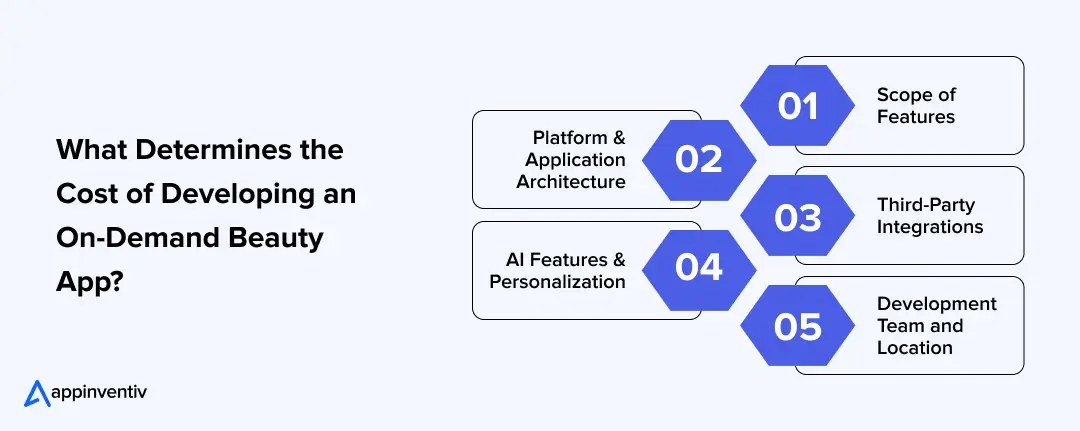
Scope of Features
The level of features dictates the development effort, user workflows and testing needs. It is one of the key beauty app development pricing factors that companies need to consider before they decide on their budgets.
For a basic salon booking app, it might require some essential features such as customer registration, service listings, appointment scheduling, and payment integration. Larger platforms might also need professional onboarding, commission management, loyalty programs and real-time appointment updates.
Common features include:
- Customer registration and profile management
- Beauty service listings and professional portfolios
- Appointment booking, rescheduling, and cancellations
- Payment gateways, refunds, and commission management
- Admin dashboards and service provider management
Estimated cost impact: $40,000- $150,000 for basic to moderately complex applications.
An outline of a feature scope can assist companies in forecasting the cost of creating a beauty application and prevent any unexpected costs that can come up in the course of development.
Platform and Application Architecture
The platform strategy dictates the number of applications, codebases and integrations needed. It also impacts development time, testing efforts and maintenance after development.
The development needs for a single-platform application are less than for two separate native iOS and Android applications. For it to be a multi-vendor marketplace, there may be additional customer, beauty professional or admin interfaces to invest in.
Common platform considerations include:
- Native iOS and Android applications
- Cross-platform development using Flutter or React Native
- Web-based administration and service management dashboards
- Separate customer and beauty professional applications
- Cloud infrastructure, APIs, and third-party integrations
Estimated cost impact: $40,000- $180,000 for single-platform and multi-platform applications, with advanced marketplace solutions costing more.
The platform-wise beauty application development cost depends on the selected technology stack, code reuse, application architecture, and number of interfaces that need to be maintained.
Third-Party Integrations
Third-party integrations involve linking the beauty app with other external services such as payment, location, messaging, and scheduling. Every integration introduces implementation, test and maintenance needs.
A simple booking app could require just payment gateway and push notifications. A home-service bookings on-demand platform will also need mapping APIs, route tracking, SMS services and calendar integration.
Common integrations include:
- Digital wallet and payment gateway integrations
- Google Maps or other location and mapping APIs
- SMS, email, and push notification services
- Calendar synchronization and appointment management tools
- CRM, analytics, and customer support systems
Estimated cost impact: $10,000- $40,000 or more, depending on the number and complexity of integrations.
Integration requirements influence the overall cost to develop a beauty services app, particularly when the platform depends on real-time data exchange across several external systems.
AI Features and Personalization
When implementing AI, the preparation of data, integration of AI models, testing, and continuous monitoring can add to the cost of development. The extra cost will vary, depending on whether existing AI APIs integrations are used or custom models are created.
It’s quite a different ballgame when it comes to a beauty app that makes simple recommendations versus one that gives image-based skin analysis, customized product recommendations, and smart appointment scheduling.
Common AI capabilities include:
- Personalized beauty service recommendations
- AI agents in customer support and booking assistance
- Skin and hair analysis using computer vision
- Intelligent appointment scheduling and professional matching
- Customer behavior analysis and demand forecasting
Estimated cost impact: $20,000- $100,000 or more, depending on model complexity, data requirements, and integration scope.
To include each AI functionality in the first estimate of the beauty app development cost, businesses need to evaluate the potential value of the particular functionality. Further privacy protections and model validation might be needed for custom model development and image analysis.
Development Team and Location
Development rates and overall project costs vary based on the team’s experience, location, and composition. A team with expertise in mobile development, backend engineering, UI/UX design, and quality assurance may charge higher rates but can manage complex requirements with fewer coordination gaps.
Common cost considerations include:
- Developer hourly rates and technical specialization
- UI/UX design and product management
- Backend engineering and API development
- Quality assurance, security testing, and deployment
- Post-launch maintenance and technical support
Estimated cost impact: $20- $180 or more per hour, depending on the team’s location and expertise.
The actual on demand beauty services app development cost primarily relies on the combination of all these factors in the project. It is essential that businesses consider team pricing, scope of delivery, technical knowledge, testing capabilities and post-launch support before making a final decision on the budget.
Our experienced developers help businesses turn beauty service ideas into scalable applications with the right features, integrations, and technology.

Hidden Costs of On-Demand Beauty App Development
Initial development costs include the basic application, but businesses should also consider ongoing costs post-launch. These expenses can come from third-party services, infrastructure, maintenance and platform upgrades.
Some of the “hidden” costs include:
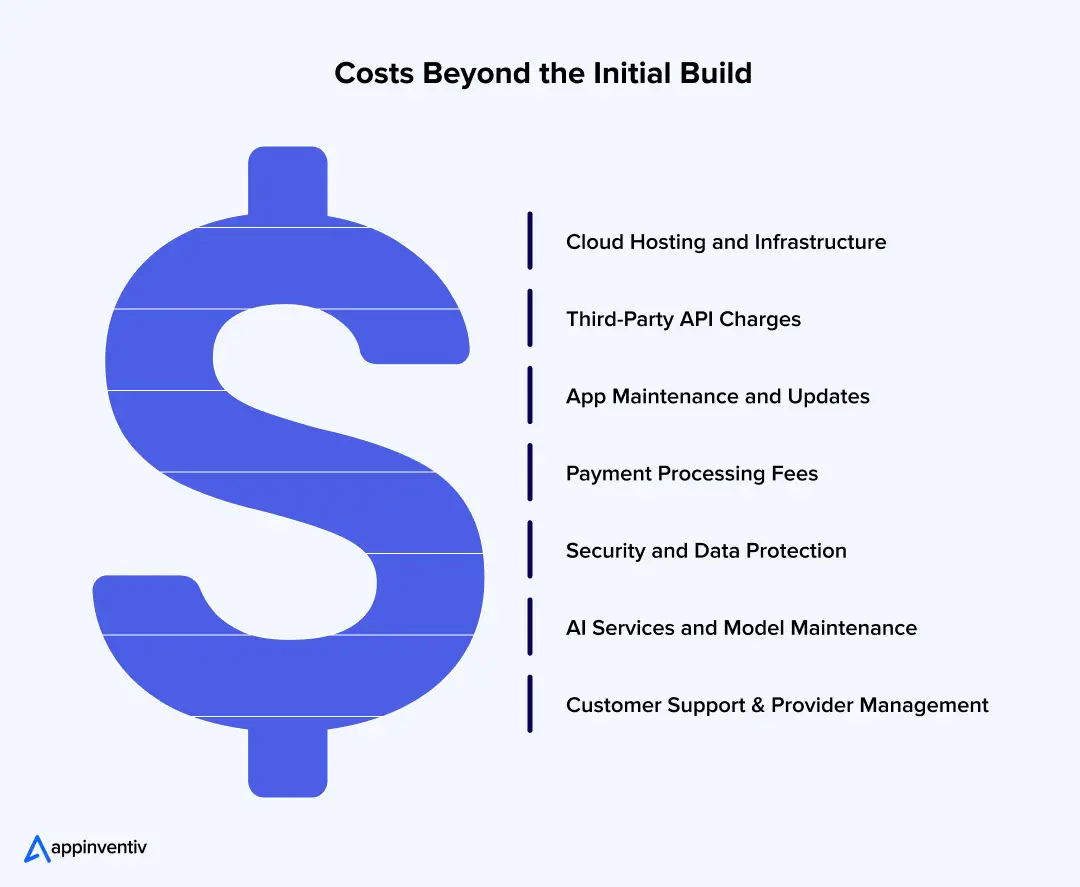
Cloud Hosting and Infrastructure: From $200- $2,000+ per month depending on the use and infrastructure. These costs are involved in the long-term on-demand beauty services app development cost.
Third Party API Charges: If you wish to integrate maps, push notifications, a payment gateway, and external booking, you will be charged subscription fees or per-usage charges, which will raise the feature-wise beauty app development cost.
App Maintenance and Updates: Bug fixes, operating system compatibility, security patches, and feature updates may cost 15–25% of the initial development budget annually, adding to the total beauty booking app development cost.
Payment Processing Fees: Payment providers typically charge transaction-based fees, which vary by provider, region, and payment method.
Security and Data Protection: Security assessments, access controls, encryption technology, and privacy compliance may require additional implementation and ongoing review.
AI Services and Model Maintenance: AI APIs, image processing, model hosting, and usage monitoring can increase operating expenses when the app includes personalized recommendations or image-based analysis.
Customer Support and Provider Management: Customer support, dispute resolution, service verification and providing professional onboarding come at an extra cost on top of software development.
These costs should be considered when creating a budget for a business. A good estimation of initial development and operational costs offers a better perspective of the total cost of ownership.
How to Optimize On-Demand Beauty App Development Cost
To save on development costs, one must determine what features, integrations and infrastructure are adding unnecessary expenses. These choices can save on initial investment and on-going costs while maintaining necessary booking and service management capabilities.
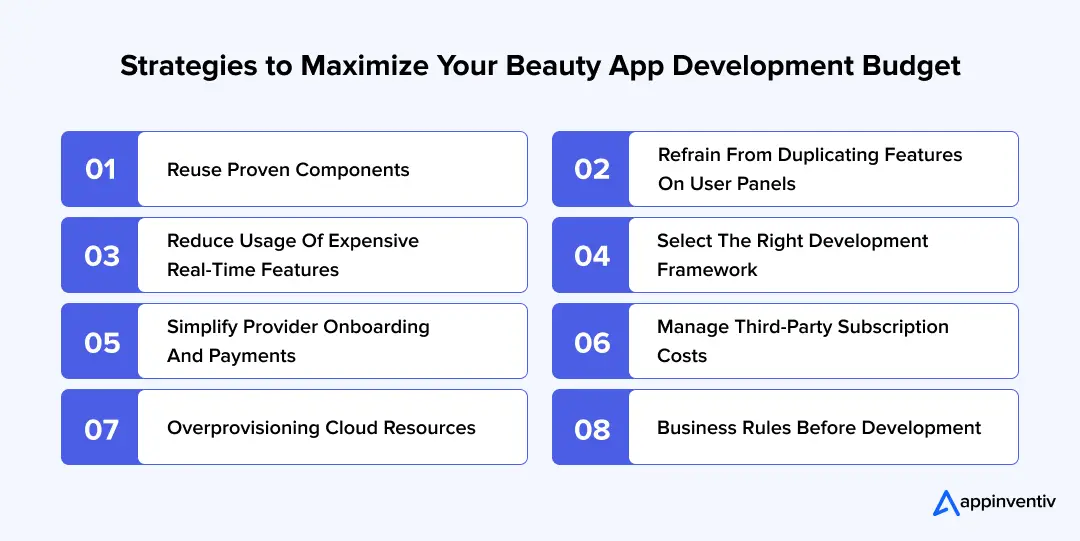
Reuse Proven Components: Payment gateways, calendar systems, maps and push notification features already have proven functionality. They can be reused to save custom engineering hours and keep the beauty app development cost in check.
Refrain From Duplicating Features on User Panels: There are common features on user panels such as profiles, notifications, and booking records that are shared between the customer, beauty professional and admin panel. The use of common modules reduces duplicated development effort and makes maintenance easier.
Reduce Usage of Expensive Real-Time Features: Tracking the provider in real-time, notifying them when they become available and adding real-time chat adds complexity to the backend and infrastructure. To prevent unnecessary expenditure, make the features a priority according to the actual operational requirements.
Select the Right Development Framework: Cross-platform frameworks can help avoid code duplication when launching on Android and iOS. That may reduce the beauty mobile app development cost if the product isn’t built to provide a lot of platform-specific actions.
Simplify Provider Onboarding and Payments: Complex verification workflows, payout rules and commission calculations require further engineering and testing. Use basic provider management and payment rules so as not to pay extra for those customizations.
Manage Third-Party Subscription Costs: APIs for mapping, SMS notification, booking, and payments might have usage or transaction costs. This way, one can compare different pricing levels and track usage to avoid any unexpected costs.
Overprovisioning Cloud Resources: Overprovisioned infrastructure such as servers, database capacities, and cloud log storage results in higher monthly billing. As a platform grows, usage-based infrastructure and frequent monitoring are used to help manage operating costs.
Business Rules Before Development: Many policies, such as cancellations, service areas, provider commissions and refunds, can impact several modules and are frequently changed. The early definition of these requirements minimizes rework and controls the on demand beauty services app development cost.
Simplify service discovery, appointment scheduling, and checkout to help customers book beauty services with fewer steps.
ROI of Building a Beauty Application
The beauty app can generate long-term business value by increasing booking volume, re-booking, optimizing provider utilization and reducing administrative costs. The outcome of the return will be based on the platform’s ability to turn customer demand into completed appointments while maintaining technology expenses and operating costs under control.
- Increased Revenue per Customer: Customer profiles, personalized offers, and convenient rebooking can encourage repeat appointments. Higher booking frequency increases customer lifetime value and creates more opportunities to generate commission revenue.
- Lower Operating Expenses: Automated scheduling, payment processing, provider allocation, and appointment reminders reduce manual coordination. These savings can improve operating margins as the number of bookings grows.
- Improved Provider Productivity: Booking analytics can identify unfilled time slots, cancellation patterns, and high-demand services. Better appointment utilization helps beauty professionals earn more while increasing the platform’s commission revenue.
- Diversifying Revenue: Beyond booking commissions, there are opportunities to generate revenue through provider subscriptions, featured listings, premium memberships, and product partnerships. There’s also a diversity of revenue streams, which lessen the reliance on a single monetization model.
- Scalable Technology Investment: Modular design, reusability, and usage-based cloud allow for manageable spending on supporting new providers, customers, and locations. This means that the business can grow without having to rebuild the platform.
- Measurable Financial Returns: Let’s look at an imaginary beauty company that has invested $150,000 in its development. With these figures, the platform will generate $500,000 in annual revenue, while its annual operating costs are $300,000, thus giving $200,000 in operating profit.
Estimating Beauty App ROI
| Financial metric | Projected value |
|---|---|
| Initial development investment | $150,000 |
| Annual revenue | $500,000 |
| Annual operating expenses | $300,000 |
| Annual operating profit | $200,000 |
| ROI on initial investment | 133.30% |
| Simple payback period | 9 months |
Figures are indicative and based on a $200,000 operating profit, prior to tax and financing costs. ROI (return on investment) is calculated as annual operating profit divided by the initial development investment. The actual returns will be subject to business expenses, provider commissions, maintenance, booking frequency and customer acquisition costs.
Monitoring booking conversion, repeat purchase rates, customer acquisition costs, infrastructure spending, and provider retention rates helps determine which areas are most profitable and where additional investment is warranted.
Bring Your Beauty App Vision to Life with Appinventiv
The on-demand beauty market offers businesses new ways to connect customers with beauty professionals, simplify bookings, and generate recurring revenue. But turning an idea into a profitable platform requires more than a booking interface. You need the right feature set, a clear revenue model, secure payment processing, and a scalable technology foundation that supports business growth.
It is essential to be aware of the investment required in creating a beauty app. It assists you in keeping the important features in mind, budgeting your costs and future planning without going over budget. If you wish to develop a local beauty booking website or go out into a multi-city market, your development strategy must align with your target market and goals.
Appinventiv provides on demand app development services to create a beauty app with a winning concept. From product planning and UI/UX design to app development, third-party integrations, testing, and post-launch support, our team can guide your project at every stage.
Our on-demand projects like KFC, Americana ALMP, ActiDrive, Domino’s, and others reflect our experience in developing digital platforms that streamline service delivery, improve operational workflows, and support business growth.
We focus on building platforms that support smooth bookings, reliable service delivery, and sustainable growth. Start your on-demand beauty app journey with Appinventiv and take the next step toward launching your beauty business.
FAQs
Q. How much does it cost to build a beauty app?
A. Beauty app development costs typically range between $40,000 to $500,000 or more, depending on features, platform choice, integrations, and technical complexity. A basic booking app costs less than a multi-vendor marketplace with AI-powered features.
Q. Does the timeline affect the costing of beauty booking app development?
A. Yes, shorter timelines can increase development costs if they require additional developers, parallel workflows, or extended testing. A well-planned schedule helps manage resources, control expenses, and maintain product quality.
Q. How can Appinventiv integrate AI skin analysis into a beauty app?
A. Appinventiv can integrate AI models that analyze user-uploaded skin images to identify concerns such as acne, pigmentation, and dryness. The app can use these insights to suggest relevant treatments and skincare products, with appropriate privacy safeguards and clear limits on AI-generated recommendations.
Q. Is an AI chatbot useful for beauty booking app?
A. Yes, an AI chatbot can answer service-related questions, recommend suitable treatments, check appointment availability, and assist with bookings. It can also handle routine customer queries around the clock, reducing the workload on support teams.
Q. Can an on-demand beauty app support at-home and in-salon bookings?
Yes, an on-demand beauty app can support both service types through location-based discovery and flexible scheduling. Customers can book home visits or salon appointments, while providers manage availability, service areas, and bookings through dedicated dashboards.


Fast 2-minute response, fully NDA-protected.

How Much Does It Cost to Build a Job Portal like Bayt?
In a landscape rife with challenges, the job industry struggles with issues such as skills shortages, fierce competition, and the ever-changing demands of the market. However, the emergence of platforms like Bayt has provided a lifeline for businesses. Bayt transcends the limitations of traditional recruitment by providing businesses with an innovative talent pool. Leveraging advanced…
How Much Does It Cost to Build a Job Portal like Glassdoor?
In the wake of the COVID-19 pandemic, the recruiting industry saw a dramatic change. It has caused many organizations to lose their projects and businesses to shut down, causing many employees to lose their job roles worldwide. In such a scenario finding a suitable job or recruiting the right talent has become one of the…

How to build an online auction application? Benefits, features, costs
When was the last time you went street shopping and bargained with the vendor to sell their products at a lower price? If you remember that experience, imagine bringing it on a digital platform in a more sophisticated way. Websites and applications like Ebay, BidSpotter, and Auction.com, etc. have been making it easy for the…