


































How Automotive eCommerce Platform Development Is Reshaping Car Sales and Services

 Share -



- 01How is the Automotive Industry Expanding to Online Sales
- 02Types of Automotive eCommerce Solutions
- 03How Automotive eCommerce Helps Businesses Scale Faster: Core Benefits
- 04Key Features of Automotive eCommerce Platforms
- 05Essential Software Integrations for Automotive eCommerce
- 06Comprehensive Use Cases in Automotive eCommerce with Real-World Examples
- 07Cost of Automotive eCommerce Software Development
- 08Addressing Common Challenges in Automotive eCommerce
- 09How Appinventiv Delivers High-Performance Automotive eCommerce Solutions
- 10FAQs

Key takeaways:
- To solve the challenges of disjointed systems and provide smooth customer interactions, modern automotive companies are turning to connected digital platforms.
- An effective automotive eCommerce platform integrates sales, operations, and customer engagement into a single digital arena.
- VIN lookup, fitment tools, and real-time inventory assist customers in locating the exact products with increased accuracy.
- Integrations with ERP, CRM, PIM, and DMS systems keep inventory, pricing, orders, and customer data connected.
- The cost of developing an automotive eCommerce platform varies greatly, from $30,000 to $1,000,000+, depending on the complexity of the platform, integrations, and business needs.
Automotive businesses must meet growing demand for seamless digital buying experiences while managing fragmented sales processes, disconnected systems, and complex partner networks. Many still struggle to deliver a unified customer journey across online and offline channels.
In response, automotive eCommerce platform development has become a strategic focus for OEMs, dealerships, marketplaces, and aftermarket retailers looking to create more integrated and customer-centric sales experiences.
At the same time, AI is accelerating this transformation. A recent McKinsey report suggests that AI can enhance software features, accounting for nearly 70% of the automotive software market, with a particularly strong impact in ADAS and infotainment through capabilities such as end-to-end learning, voice control, and personalization.
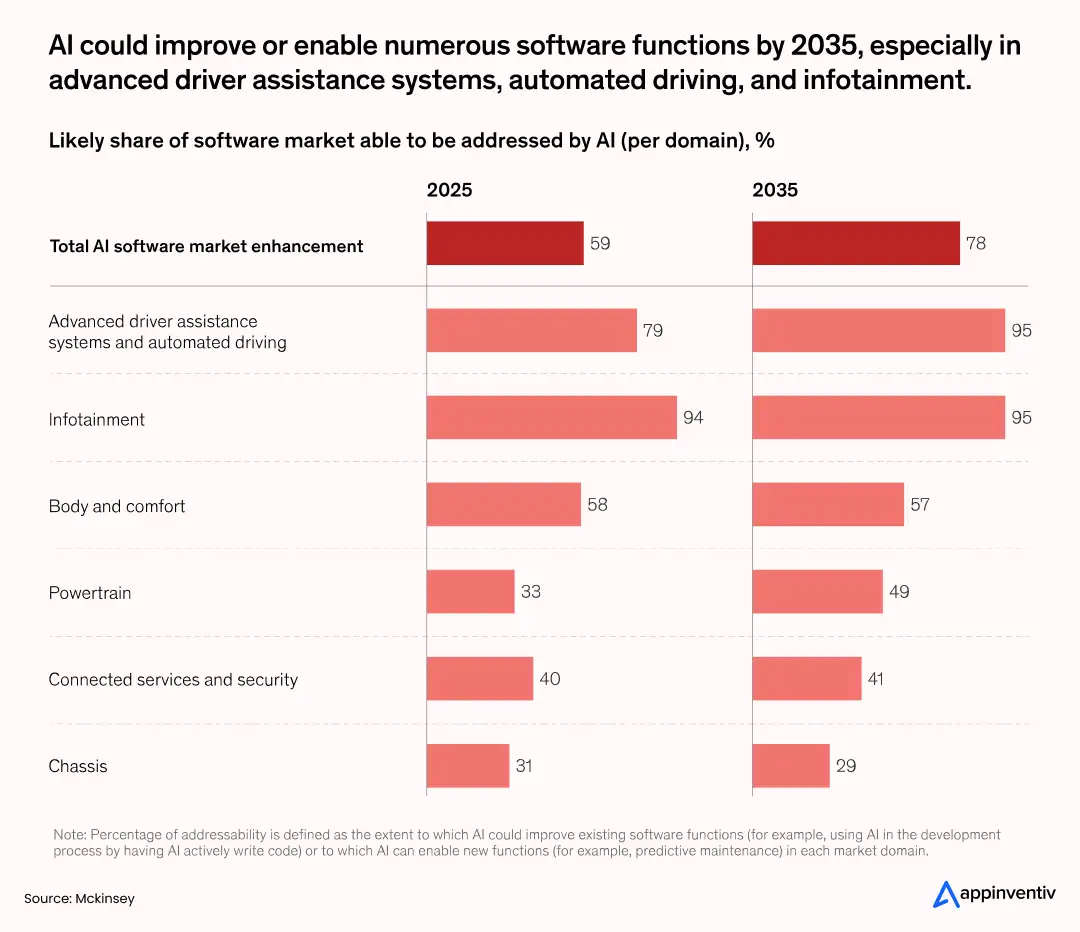
These innovations are increasingly extending into eCommerce platforms, enabling intelligent recommendations, predictive analytics, dynamic pricing, and personalized customer journeys.
This blog examines the growth of online sales in the automotive industry through eCommerce platforms, the various types of solutions they offer, their impact on the market, necessary characteristics, key integrations, real-world examples, development costs, and implementation challenges.
Let’s have a quick look at those, but before that, let’s understand how the industry is expanding online.
Support every interaction with faster search, accurate inventory, and a buying experience designed around convenience and trust.

How is the Automotive Industry Expanding to Online Sales
As consumer expectations continue to evolve around convenience, transparency, and self-service purchasing, the automotive industry is accelerating its digital transformation in eCommerce to meet these changing demands. At present, car buyers handle much of their auto shopping process online, including reading reviews, understanding differences between models, learning about financing options, and even finalizing that part of the transaction before heading to the dealership.
The global eCommerce automotive aftermarket is expected to reach a valuation of $208.16 billion with a CAGR of 20.5% until 2030 (Source: GVR). The expansion is largely due to the trend of consumers shopping online for vehicle parts and accessories, which offers them greater convenience, wider choice and competitive prices.
There are a lot of benefits to using online sales for any automotive company. Through automotive eCommerce platform development, auto businesses can help minimize stock management needs, reduce the need for large showrooms, and extend their market reach to different geographical areas. They also help in building customer trust by providing clear pricing, detailed vehicle specifications, customer reviews, and flexible buying options.
As demand for electric vehicles continues to rise, the surge in digitization has intensified, with consumers increasingly turning to digital channels to do their research, compare and purchase vehicles and other products. This is why automotive eCommerce is growing to be a key growth strategy for both automotive dealerships, OEMs and aftermarket companies.
Types of Automotive eCommerce Solutions
Automotive eCommerce platforms can be configured in multiple ways, such as for vehicle sales, parts distribution, aftermarket services, and B2B procurement. This depends on the target audience, product offerings and operational requirements.
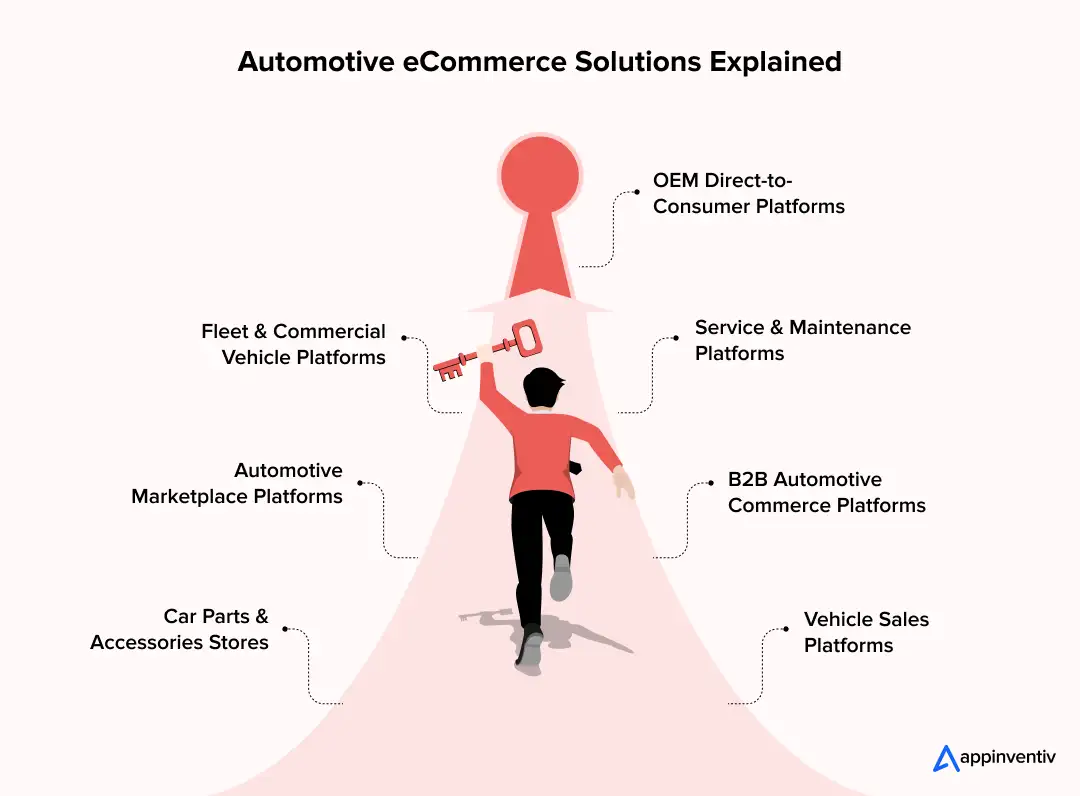
Vehicle Sales Platforms
Allow dealerships and manufacturers to have online inventory management, financing and digital purchase capabilities for new and used vehicles.
Car Parts & Accessories Stores
Make OEM and aftermarket parts, accessories and replacement components available for sale with product discovery by fitment.
B2B Automotive Commerce Platforms
Link suppliers, distributors, manufacturers and dealerships to allow bulk purchasing, inventory management and efficient procurement.
Automotive Marketplace Platforms
Enable multiple vendors to offer vehicles, parts and services in a single marketplace ecosystem.
Service & Maintenance Platforms
Allow customers to make online bookings of repairs, maintenance, inspections and workshop appointments.
Fleet & Commercial Vehicle Platforms
Perfect for fleet operators for easy-to-manage vehicle procurement, parts sourcing and maintenance requirements.
OEM Direct-to-Consumer Platforms
Support manufacturers in direct sales to customers of vehicles, accessories and services whilst retaining full brand control.
How Automotive eCommerce Helps Businesses Scale Faster: Core Benefits
eCommerce in the automotive industry can deliver unparalleled opportunities for scalability, efficiency, and customer engagement. Here’s a closer look at them and several other key benefits of automotive eCommerce platform development:
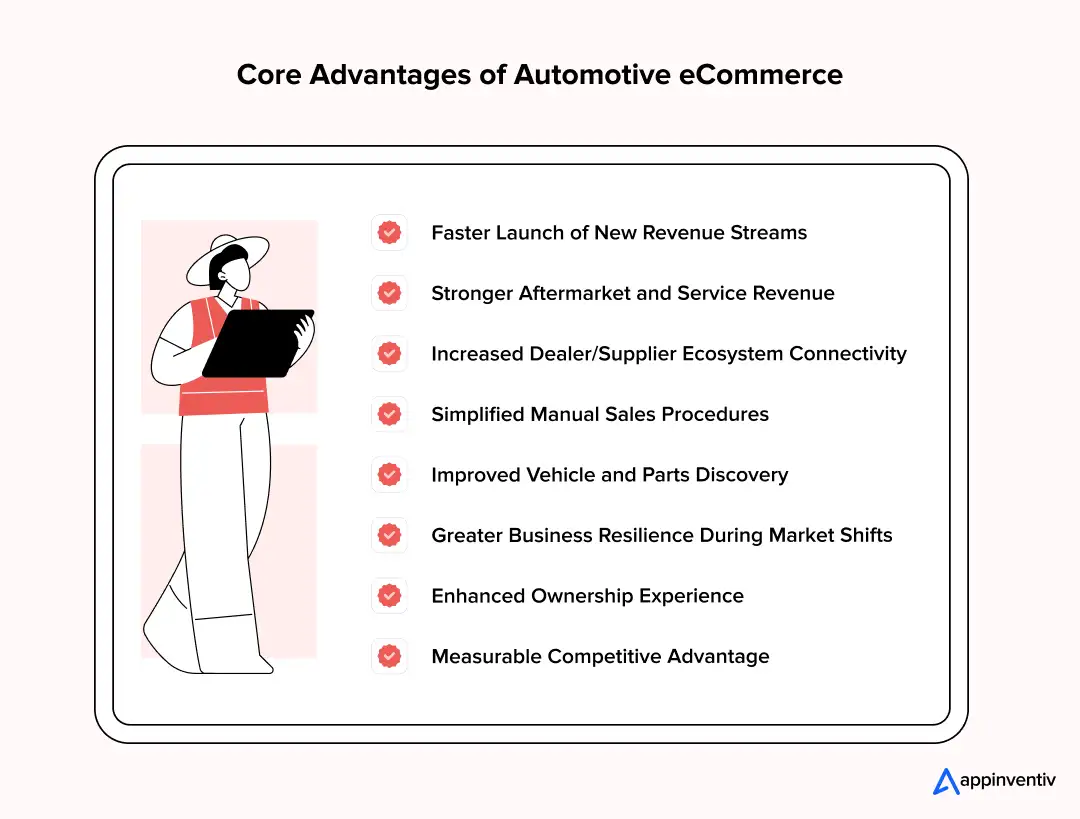
Faster Launch of New Revenue Streams
Businesses willing to invest in automotive eCommerce platform development can easily launch subscription services, digital accessories for vehicles, warranty packages, maintenance plans, and bundles without having to revamp their current infrastructure. This opens new ways of monetisation, other than selling the vehicles.
Stronger Aftermarket and Service Revenue
A well-designed platform keeps customers engaged long after the initial purchase. Businesses can promote replacement parts, scheduled maintenance, upgrades, and service bookings through a single digital channel, helping increase customer lifetime value.
Increased Dealer/Supplier Ecosystem Connectivity
With the advanced automotive eCommerce software development, companies can integrate dealerships, distributors, warehouses, service centers, and suppliers into a single digital ecosystem. This helps to eliminate silos in the automotive value chain and to facilitate coordination.
Simplified Manual Sales Procedures
When companies build automotive eCommerce platform capabilities, they can automate the quotation process, product discovery, inventory synchronization, and order management system workflows. This enables sales teams to concentrate on high-value client interactions and not administrative work.
Improved Vehicle and Parts Discovery
Intelligent search, fitment validation, VIN-based product matching and recommendation engines assist customers in identifying the right product to buy, and fewer products bought result in fewer returns.
Greater Business Resilience During Market Shifts
Infrastructure for digital commerce enables automotive companies to remain relevant to their customers and maintain more predictable business continuity amid supply chain disruptions, shifts in purchasing habits, or variations in showroom foot traffic.
Enhanced Ownership Experience
Modern platforms support digital service histories, maintenance reminders, warranty tracking, and personalized ownership journeys that strengthen customer relationships throughout the vehicle lifecycle.
Measurable Competitive Advantage
One of the most notable benefits of automotive eCommerce platforms is their capacity to provide quicker buying experiences, more insight into customers and more personal interactions, enabling companies to stand out in an increasingly digital automotive industry.
Key Features of Automotive eCommerce Platforms
To run a successful automotive eCommerce business, it is important to have a platform that can handle all the aspects of the eCommerce store, alongside providing a convenient customer experience. Here are some features that can benefit automotive businesses in streamlining operations and boosting online sales.
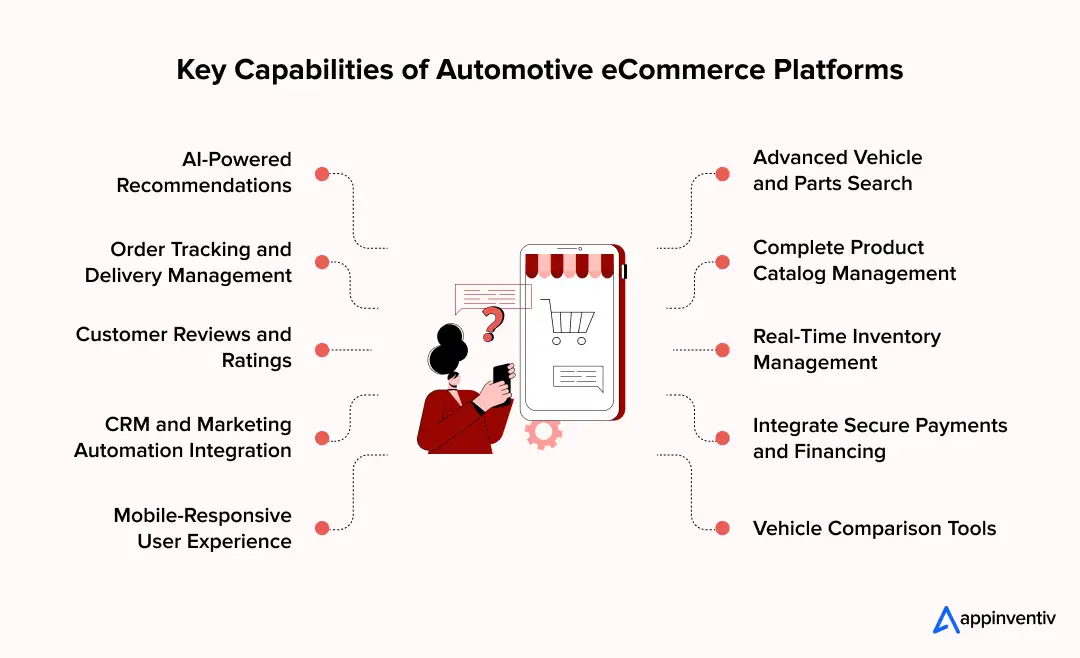
Advanced Vehicle and Parts Search
Enables customers to search for vehicles, spare parts or accessories by make, model, year, VIN, compatibility, price range and specifications.
Complete Product Catalog Management
Create vehicle listings, aftermarket parts and accessories, product variations with descriptions, specifications, images and availability information.
Real-Time Inventory Management
Ensure inventory is in sync between dealership, warehouses and online platforms, so you have the right view of stock and don’t oversell.
Integrate Secure Payments and Financing
Add various payments, financing, EMI calculation, loan pre-approvals and secure checkout process within the platform.
Vehicle Comparison Tools
Enable buyers to compare a number of vehicles or products side by side according to their specifications, pricing, features and performance.
AI-Powered Recommendations
Use customer behavior, purchase history, and browsing patterns to recommend relevant vehicles, upgrades, accessories, and maintenance products.
Order Tracking and Delivery Management
Provide real-time order updates, shipment tracking, delivery scheduling, and service notifications to improve customer satisfaction.
Customer Reviews and Ratings
Build trust by enabling verified customer reviews, ratings, and feedback for vehicles, parts, and accessories.
CRM and Marketing Automation Integration
Connect with CRM systems, email marketing platforms, and loyalty programs to manage leads, personalize engagement, and increase customer retention.
Mobile-Responsive User Experience
Ensure seamless browsing, searching, and purchasing across smartphones, tablets, and desktop devices to support today’s mobile-first customers.
Bring together the tools, integrations, features, and user experiences needed to support every stage of the automotive buying journey.

Essential Software Integrations for Automotive eCommerce
Businesses have to adopt a connected technology ecosystem to manage their inventory, engage customers, fulfill orders, and run sales processes to be successful in the eCommerce automotive industry. The right platforms can be integrated to provide a scalable and efficient online sales environment as well as enhance customer experience.
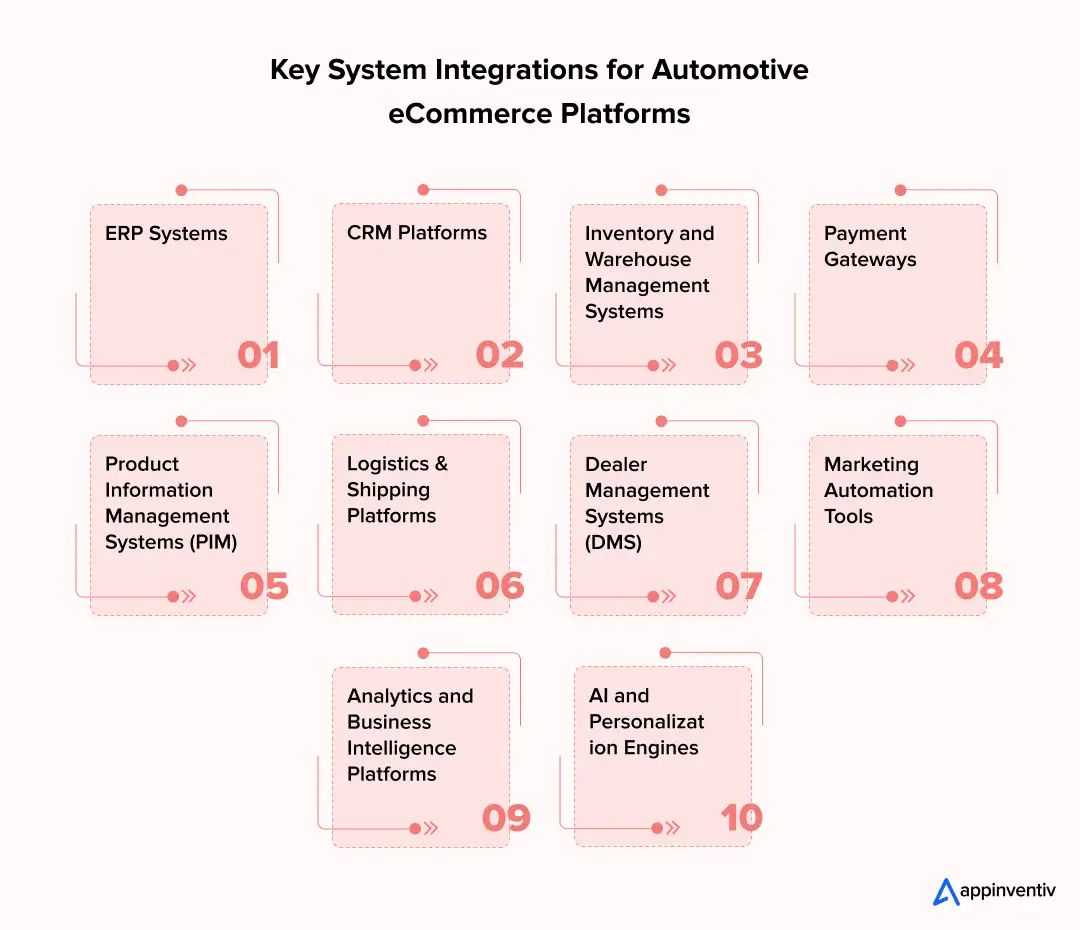
ERP Systems
Integrate ERP with your auto eCommerce system to ensure consistency in inventory levels, order handling, pricing, financial data and procurement throughout the organization.
CRM Platforms
Link CRM systems to monitor leads, manage customer interactions, tailor marketing efforts, and boost customer retention.
Inventory and Warehouse Management Systems
Provide instant visibility of stock from warehouses to dealerships and distribution centres, and automatically update stock and fulfilment processes.
Payment Gateways
Embed a secure payment processor that offers multiple payment methods, financing options, installment plans, and digital wallets.
Product Information Management Systems (PIM)
Manage product data, specifications, images, compatibilities and technical documentation in a centralized way to assure uniformity in the information provided in sales channels.
Logistics & Shipping Platforms
Use automation to simplify shipping calculations, carrier selection, order tracking and delivery notifications to boost customer satisfaction and efficiency of the fulfillment process.
Dealer Management Systems (DMS)
It is a vital automotive eCommerce tool, and a DMS integration works in tandem to ensure that vehicle listings, inventory availability, vehicle pricing, customer information and service operations are synchronized between dealership locations and their online stores.
Marketing Automation Tools
Combine e-mail marketing, customer segmentation, campaign management and lead nurturing in order to assist in acquiring and retaining customers.
Analytics and Business Intelligence Platforms
Track customer behavior, sales performance, inventory trends, and marketing effectiveness through real-time dashboards and reporting tools.
AI and Personalization Engines
Leverage AI to deliver personalized product recommendations, predictive search, dynamic pricing strategies, and customer insights. These capabilities are increasingly becoming a core component of modern eCommerce solutions for automotive dealers looking to improve conversions and customer engagement.
Comprehensive Use Cases in Automotive eCommerce with Real-World Examples
The automotive eCommerce market is versatile, catering to diverse functions beyond just selling new cars. Here are key eCommerce automotive use cases that are shaping the market and which can be explored by businesses looking to make it big in the domain.
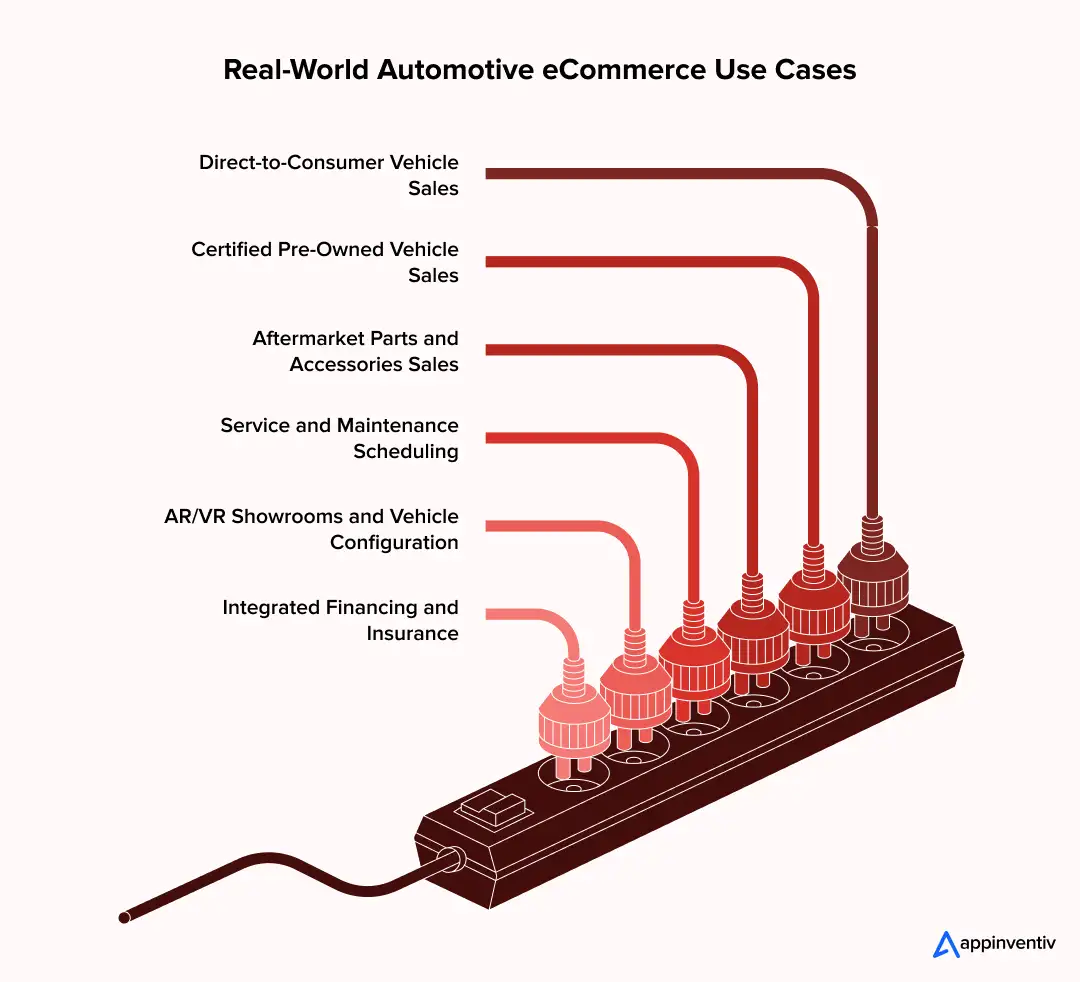
Direct-to-Consumer Vehicle Sales
Automotive eCommerce platforms allow buyers to view inventories, customize cars, view vehicle reservations, and even start their deals online, decreasing friction in the buying process.
Real-life example: Ford Motor allows its customers to design a vehicle, add options and pre-book one of the company’s models, like the Mustang Mach-E and the F-150 Lightning and have it delivered by an authorized dealer after the process of design and customization is completed online.
Certified Pre-Owned Vehicle Sales
Digital marketplaces have facilitated the discovery, comparison and buying of certified pre-owned vehicles with inspection, warranty, and vehicle history reports.
Real-life example: General Motors has a certified pre-owned vehicle program that allows customers to find, compare and research certified Chevrolet, GMC, Buick and Cadillac vehicles online.
Aftermarket Parts and Accessories Sales
Online stores can support OEM manufacturers and vehicle dealerships to generate further revenue by selling the OEM parts, replacement parts and vehicle accessories directly to end-users.
Real-life example: Toyota Motor Corporation offers the public access to authentic parts and accessories for Toyota vehicles and lets the owners buy compatible ones via its eCommerce platform run by its dealers.
Service and Maintenance Scheduling
Automotive eCommerce systems can not merely expand beyond sales, permitting customers to schedule maintenance appointments, manage their service history, and receive automated notifications.
Real-life example: BMW Group provides digital service scheduling via its customer portal and mobile apps, so that customers can book maintenance and repair services online.
AR/VR Showrooms and Vehicle Configuration
Customers can view a vehicle’s features, colors, trims, and interiors remotely with the interactive visualization tools, which boosts customer confidence prior to purchase.
Real-life example: Mercedes-Benz Group offers advanced digital vehicle configurators and virtual showroom experiences, which enable customers to configure and visualize their vehicles online.
Integrated Financing and Insurance
Incorporating financing and protection into the online purchase process streamlines operations and eliminates the need for separate third-party processes.
Real-life example: Toyota Motor Corp. offers customers financing options via Toyota Financial Services so they can consider financing options and vehicle financing during the deal.
Cost of Automotive eCommerce Software Development
Automotive eCommerce platform development costs can range from $30,000 for a basic marketplace to over $1,000,000 for a feature-rich enterprise platform. Final costs depend on the scope of features, integrations, architecture, security requirements, and ongoing scalability needs. Below is an approximate cost breakdown for each stage of the development process.
| Platform Type | Common Scope | Typical Investment |
|---|---|---|
| Basic Online Storefront | Often chosen by smaller dealers or aftermarket businesses that want to start selling online. Projects at this level usually cover product listings, vehicle catalogs, search, customer registration, checkout, and basic website administration. | $30,000–$60,000 |
| Marketplace with Business Integrations | A step up from a standard storefront. Companies typically add inventory controls, customer management tools, finance-related workflows, service booking features, and reporting functions as operations grow. | $60,000–$120,000 |
| Multi-Dealer Commerce Platform | At this stage, the platform becomes more operationally complex. Businesses may need dealer portals, inventory synchronization across locations, mobile applications, and custom dashboards for managing sales activity. | $120,000–$250,000 |
| Enterprise-Grade Automotive Platform | Usually built for larger automotive groups that manage multiple brands, dealerships, or regions. Integrations with ERP, CRM, and other internal systems often account for a significant portion of the budget. | $250,000–$500,000+ |
| Custom Ecosystem with Advanced Technologies | These projects are rarely built from a standard template. Requirements can include vehicle configurators, immersive 3D experiences, AI-powered recommendations, connected vehicle data, and highly customized workflows tailored to a specific business model. | $500,000–$1M+ |
Various Factors Influencing the Cost to Build an Automotive eCommerce Platform
The complexity of the features and business requirements, the more features you are looking for (such as financing workflows, service scheduling, dealer portals, etc.), the more complex the development takes and the more costly it will be.
Third-Party Integrations: Integration with automotive ERP, CRM, DMS, payment gateways, shipping providers, and inventory systems increases the complexity of development and testing.
Marketplace Functionality: More workflows, permissions and management processes will be necessary if the platform must support multiple dealers, vendors or locations.
Mobile Applications: Developing iOS and Android-specific applications, in addition to the web app development, can add to a considerable portion of the overall project costs.
AI and Personalization Features: This involves developing and deploying custom-made AI capabilities and infrastructure, which is a specialized task.
AR/VR Experiences: Virtual showrooms, 3D vehicle configurators, and immersive product experiences demand additional design, modeling, and engineering resources.
Industry Compliance Standards: Additional costs are required for implementing and maintaining payment security, data privacy regulations, and industry-specific compliance standards.
Receive a transparent project estimate based on platform complexity, integrations, user roles, and scalability requirements.

Addressing Common Challenges in Automotive eCommerce
Building a successful automotive eCommerce platform isn’t without hurdles. Hurdles that come from both the development and business model side of things. Here’s a closer look at common challenges and strategies we generally use, and suggestions to tackle them:
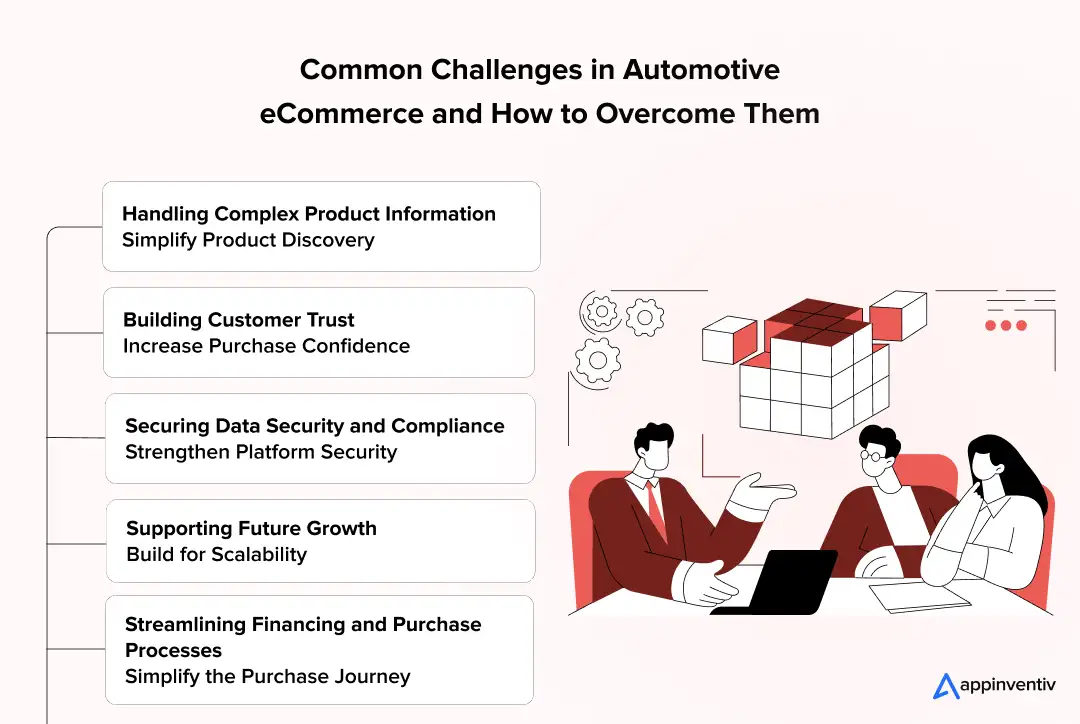
Handling Complex Product Information
There are many more specifications, compatibility, technical details and customization options involved in a car than with the traditional retail product. It can be challenging to communicate this information in a way that is understandable, particularly to first-time buyers.
Solution: To tackle this challenge, businesses can leverage detailed product pages, vehicle comparison tools, interactive configurators, high-quality visuals, videos, and 360-degree product views. These attributes make the decision easier and encourage customers to make a purchase.
Building Customer Trust
Purchasing a vehicle or a high-value automotive part online is a significant financial decision. Many buyers hesitate because they cannot physically inspect the product before making a purchase.
Solution: Clear pricing, trusted reviews, inspection reports, vehicle history reports, virtual consultations and return/exchange policies can help build trust. These trust-enhancing elements are common in automotive eCommerce solutions and help alleviate uncertainty, thereby enhancing conversion rates.
Securing Data Security & Compliance
Automotive eCommerce systems frequently deal with delicate client data, financing details, and online payments. This is appealing to cybercriminals and puts more demands on compliance.
Solution: By using secure payment gateways, data encryption, multi-factor authentication, regular security audits, and PCI DSS and GDPR compliance, users can be assured that their payment information is secure and trusted. Security and compliance should not be an add-on feature for automotive eCommerce software development, but rather an integral part of the entire process.
Supporting Future Growth
Even though a lot of automobile eCommerce sites can work well at first, they have problems as the number of products, potential buyers, and business activities continues to grow. Performance problems are able to impact both client satisfaction and working performance.
Solution: The platform is scalable, flexible with integrations and cloud infrastructure, allowing the business to expand without rebuilding the platform. Careful planning during automotive eCommerce platform development helps businesses accommodate future expansion while maintaining performance and reliability.
Streamlining Financing and Purchase Processes
When you’re buying a car, the processes of financing approval, insurance choices, trade-in assessments, and a lot of paperwork take place. All these extra measures can cause friction between the buyer and seller and result in an abandoned transaction.
Solution: Streamlining the financing process, online approval workflows, digital documentation, and insurance services on the platform makes the customer’s purchasing journey smoother and less effort.
How Appinventiv Delivers High-Performance Automotive eCommerce Solutions
In the future, automotive eCommerce trends will increasingly feature AI-powered personalization, connected vehicle ecosystems, predictive analytics, digital financing, and more frictionless omnichannel buying experiences.
As customer expectations continue to evolve, businesses will need robust automotive software development services that combine all inventory, finances, customer interaction, and after-sales processes into one digital environment. Businesses that invest in scalable eCommerce features early on will be better equipped to seize new revenue opportunities and improve their customers’ loyalty.
Appinventiv supports automotive companies in this transformation by offering them end-to-end digital product engineering, AI integration, cloud-native development, and custom automotive commerce solutions.
Our expertise in the automotive industry extends to a driver assistance app called ActiDrive, which allows drivers to interact with mobile devices without having to grip them, decreasing driver distraction and enhancing safety.
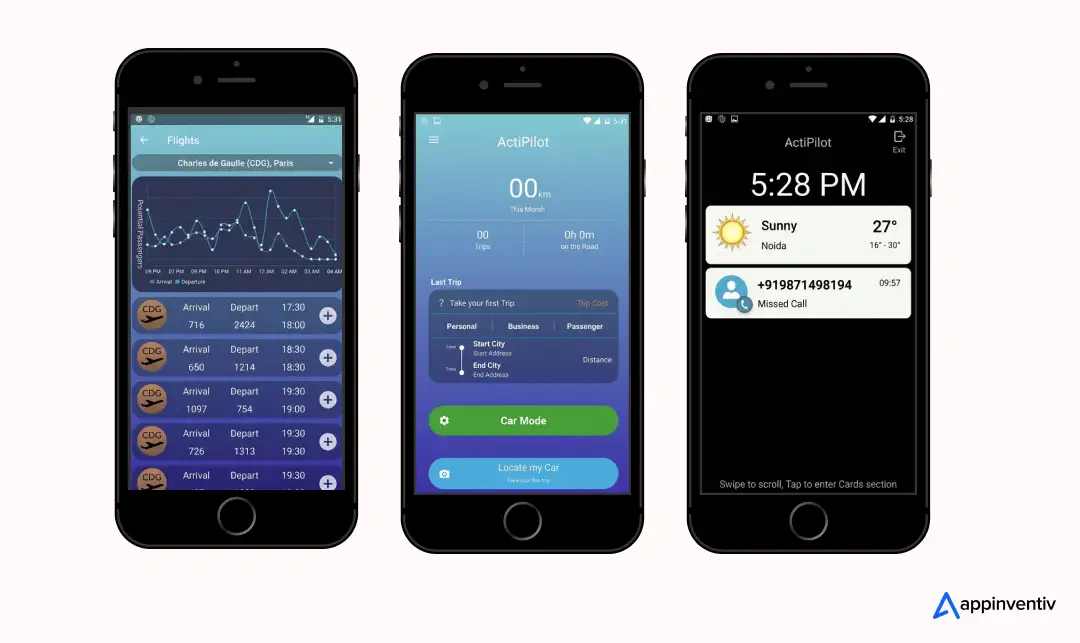
The solution was able to integrate multiple applications, connect devices and provide real-time driving assistance and trip-tracking functionality.
From creating a vehicle marketplace to an aftermarket platform, Appinventiv, as a reputed eCommerce software development company combines deep industry expertise to build future-ready digital experiences. With the use of cutting-edge technologies and scalable architectures, companies can enhance customer engagement, optimize processes, and establish a more competitive market position in the dynamic automotive landscape.
Get in touch with our experts today and share your automotive eCommerce software ideas!
FAQs
Q. How is AI transforming automotive eCommerce platforms?
A. Bringing automotive into eCommerce enables customers to browse, purchase, and even customize vehicles online. It allows automotive companies to showcase their inventory, offer virtual showrooms, and provide detailed product information. Besides vehicle sales, eCommerce platforms are used for selling parts and accessories, scheduling services, and offering online financing options.
Additionally, customers can view vehicle details, compare models, and often complete the buying process entirely online, improving accessibility and convenience. Lastly, some manufacturers and dealerships offer augmented reality experiences, enabling users to visualize cars in their space or explore interior features interactively.
Q. How to build an automotive eCommerce platform?
A. Typically, the automotive eCommerce software development process involves the following steps:
- Business Requirements Analysis: Identify target users, business objectives, product categories, sales processes, and business needs.
- Platform Architecture & UI/UX Design: Design easy user journeys, navigation, wireframes and responsive storefront designs.
- Catalog & Inventory Management Setup: Develop listing, parts catalog, fitment, inventory management and pricing systems in vehicles.
- Core Feature Development: Add key features like search, filters, shopping carts, payment systems, order management and customer accounts.
- Third-Party Integrations: Integrate CRM, ERP, payment system, logistics system, dealer management system and inventory management systems.
- Testing & Quality Assurance: Test performance, security, compatibility and usability prior to deployment.
- Launch & Continuous Optimization: Deploy the platform and always enhance its features according to users and business data.
Q. How much does it cost to develop an automotive eCommerce platform?
A. The automotive eCommerce platform development cost range from $30,000 to $80,000 for a basic platform and up to $100,000 to $300,000+ for eCommerce platforms that are enterprise-grade with marketplace functionality, ERP integrations, extended inventory management capabilities, and AI-powered recommendations.
Final costs vary depending on the complexity of the platform, customizations, integrations, scalability demands and the maintenance needs.
Q. How do automotive eCommerce platforms improve vehicle sales?
A. Automotive eCommerce platforms streamline the vehicle purchase process by offering real-time stock visibility, clear pricing, financing choices, and eCommerce purchase. With research, comparison, and shortlisting options, users can conveniently compare cars, research them, and list their favorites, leading to better engagement and quicker buying decisions.
These applications can also aid companies to create qualified leads, boost conversion figures, and boost sales possibilities beyond the confines of the dealership.
Q. How long does it take to build an automotive eCommerce solution?
A. Typical auto eCommerce platform development takes 3-6 months, while enterprise platforms with complex integrations, marketplace features and workflows take 6-12 months or more. The time depends on the scope of the project, the feature requirements, third-party integrations, compliance requirements and customisation needs required for business operations.
Q. What is the ROI of investing in an automotive eCommerce platform?
A. An eCommerce platform for automotive retailers can yield ROI in a number of ways, including boosting online sales, better lead conversion, lower operating expenses, and higher retention rates.
There are also benefits for businesses, such as improved access to the market, streamlined processes, and enhanced inventory utilization. In the long run, automotive companies can benefit through higher transactions, more efficient customer acquisition and aftermarket sales.


Fast 2-minute response, fully NDA-protected.

eCommerce Integration: Connecting ERP, CRM, PIM, and Other Core Business Systems
Key takeaways: Centralized eCommerce architecture distributes accurate product data simultaneously across all your global sales channels. ERP, CRM, PIM, OMS, POS, etc. are the core integration types forming your eCommerce architecture. Security and compliance must anchor your payment architecture when operating across multiple regulatory jurisdictions. The cost of eCommerce platform integration ranges between $40,000 and…

Why Australian Retailers Are Investing in Unified Commerce Platforms in 2026
Key takeaways: Unified commerce platform development in Australia is now central to peak trading resilience, not a discretionary upgrade. The Australian unified commerce opportunity is valued at AUD 44 billion, with early adopters seeing revenue growth of 20% or more. Real-time inventory and customer data are prerequisites for reliable AI deployment in retail. Addressing governance…

How Much Does It Cost to Build an eCommerce Marketplace App Like Poshmark?
Key takeaways: Poshmark-like marketplaces enable unlocking new sources of revenue through transforming social interaction into low-capital-intensity repeat purchases. A marketplace app would cost between $40,000 and $400,000 to develop, depending on its features, platform and enterprise scalability needs. Special implementation, beginning with tests or single categories, confirms supply, demand, and monetization in 6-12 months. Trust,…














