



























Data Center Energy Management Software Development Guide: Architecture, Benefits & Costs

 Share -


- 01Why Data Center Energy Management Software Is Now a Strategic Investment
- 02Approach to Data Center Energy Management Software Development
- 03Core Capabilities of a Modern Data Center Energy Management Platform
- 04Benefits of Energy Management Software for Data Centers
- 05Real-World Use Cases of Data Center Energy Management Software in Action
- 06Cost Breakdown of Data Center Energy Monitoring Software Development
- 07Data Center Efficiency Benchmark (PUE)
- 08Addressing Efficiency Gaps in Data Centers
- 09DCIM vs Energy Management Software: What Enterprises Should Choose?
- 10The Future of Sustainable Data Centers: What to Look For in 2026 and Beyond?
- 11How Appinventiv Supports Your Data Center Energy Management Software Development Journey
- 12FAQs

- Data center energy management software development starts with audits, architecture planning, and phased execution to ensure scale and reliability.
- Integration and testing connect real-time data and validate performance in live conditions.
- AI systems predict demand and adjust workloads and cooling for better efficiency.
- Costs depend mainly on energy usage, integration complexity, and scalability needs.
- Sustainable data centers rely on software-driven decisions, not just hardware upgrades.
- Custom-built platforms offer better control, flexibility, and long-term cost savings compared to off-the-shelf tools.
The real issue in data center operations is not how much energy is used, but how difficult it is to manage. As AI workloads expand, demand becomes less predictable, cooling loads increase, and real-time visibility turns into a constant challenge.
Data center energy management software development responds to this change and is introduced to provide structure and control to the increasingly difficult-to-manage environments using traditional approaches.
Energy demand from data centers continues to rise at an approximate rate of 12% per year, driven by AI and cloud expansion (Source: IEA). This growth, partially due to AI and the growth of clouds, is not excessive but gradual. The difficulty is the unevenness and dynamism of energy consumption on workloads and infrastructure.
Under these conditions, densely populated systems generate dynamic loads and cooling requirements, which are hard to monitor manually. The ability to monitor, predict and optimise the behaviour of energy in real time is possible through data center energy management software, enabling operators to achieve a consistent control of systems as the scale increases.
In this blog, we will break down how data center energy management software development addresses these challenges, covering its development process, key benefits, cost factors, and the role it plays in building more efficient, future-ready data centers. Let’s dig in.
Design a data center energy management software solution that helps you predict, adjust, and stay ahead of demand.
Why Data Center Energy Management Software Is Now a Strategic Investment
There are no longer predictable patterns in how data center operations run. The energy demand difference is wider than expected, with the arrival of AI in business. After running at normal levels for several hours, the system’s energy demands grow exponentially with little notice. It is this sort of inefficiency that the data center testing aims to resolve.
In the US, data centers account for about 4.4% of total electricity consumption, a share that is expected to rise to 6.7–12% by 2028 (Source: U.S Department of Energy). This aspect is associated with high-density compute environments where racks draw enormous electrical power compared to traditional low and mixed-density rack scenarios and generate more waste heat.
At the same time, energy pricing is no longer sustainable and regulatory expectations are far tighter than before. Teams are doing under a combination of pressures that are not isolated:
- The thermal boundary is pushed by high-density racks, which increases the cooling load.
- Energy costs vary with time, region, and demand.
- Reporting requirements that call for accurate, traceable energy information.
- Narrow scope of enhanced efficiency through hardware upgrades.
A custom energy management platform puts all these pieces together. It cross-references data, detects patterns in real-time, and implements operational adjustments immediately. Over a period of use, this results in a more stable performance with less fluctuation, a better grasp of variances in energy expenditure, and a clearer framework within which to achieve both operational and sustainability goals.
Approach to Data Center Energy Management Software Development
The development of a data center energy management platform is not a one-stage process. It requires a set of well-defined steps in which infrastructure, data systems, and control layers are carefully matched. Here’s a detailed look at those:
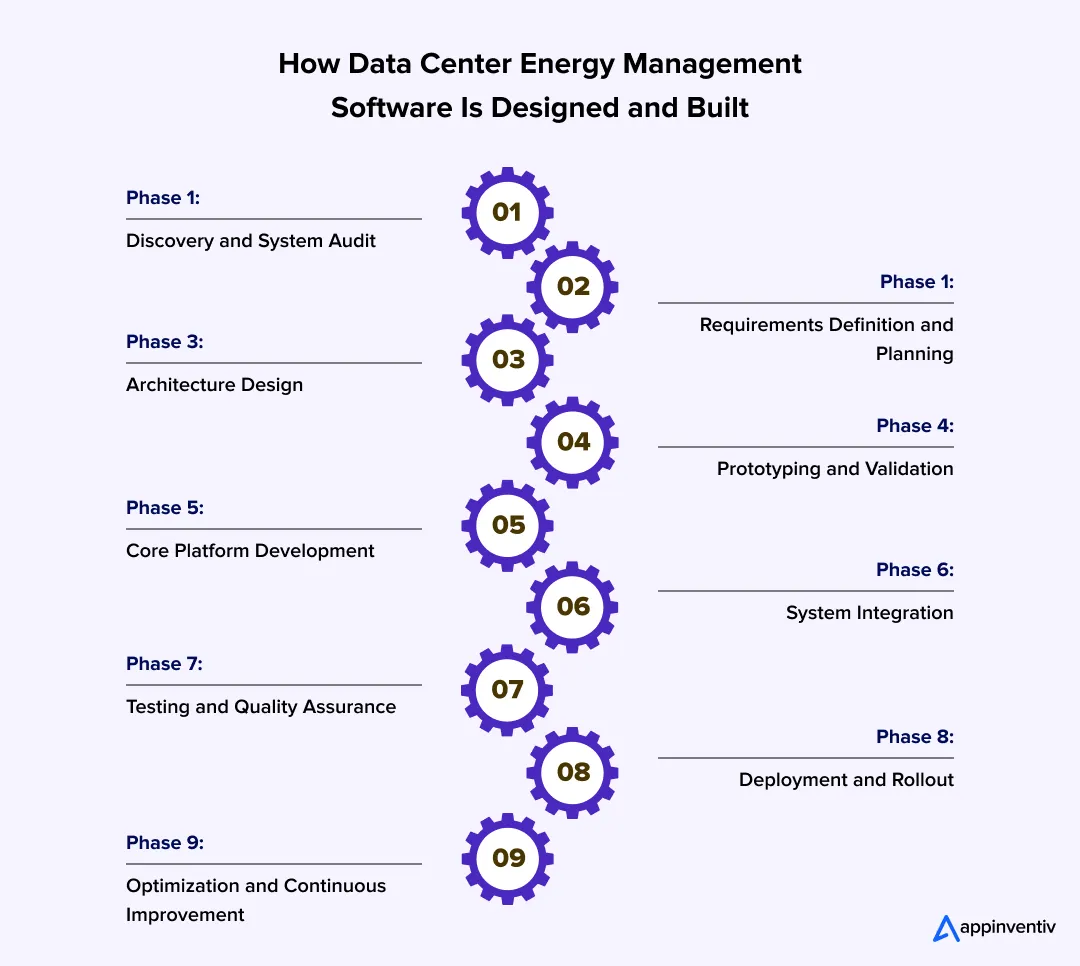
Phase 1: Discovery and System Audit
The first step in the process is a thorough inspection of the existing environment. This involves physically infrastructure mapping, analyzing the existing monitoring mechanisms, and following the energy flow across various systems. The identification of bottlenecks, inefficiencies, and data gaps occurs upfront to set a realistic expectation of requirements that the platform is expected to meet.
Phase 2: Requirements Definition and Planning
Once the audit is complete, technical and operational requirements are formalized. Data granularity, integration points, compliance requirements, and performance criteria are included in this. This means that critical components are solved first instead of trying to solve everything at once.
Phase 3: Architecture Design
The enterprise software architecture is then designed to work with real-time data, high throughput, and future scale. Possible systems include data pipelines, storage, processing framework, and control design. The main objective is to develop a system architecture that can be stable despite the fluctuations in workload and increasing data.
Phase 4: Prototyping and Validation
Prototyping tests important parts before proceeding with full development. The initial data pipeline, sample models, and integration points are validated using real or near-real data. The prototype and initial pipeline development reduce the risk of rework later on.
Phase 5: Core Platform Development
With a validated design, development of the core system begins. This spans backend services, ingestion layers of data, processing engines, and AI models. There remains a focus on building stable, modular components that are able to be extended without breaking existing functionality.
Phase 6: System Integration
Then, once the core components are ready, the platform is integrated with the existing infrastructure. This necessitates connecting IoT devices, PDUs, BMS systems, cooling units, and power controls. Special attention is paid to integration to avoid disruption, especially in live data center environments, where uptime is critical.
Phase 7: Testing and Quality Assurance
Testing is conducted at multiple levels, including functional, performance, and reliability testing. The real world is emulated in scenarios where the system’s performance is observed under load, during load spikes, and under failure conditions. That way, any inconsistencies can be ironed out before proceeding to deployment.
Phase 8: Deployment and Rollout
Finally, the system is introduced into the production environment, either as a whole or as parts. The first system deployment may be limited to a single facility or a fraction of the entire network of systems, after which it is then extended further.
Phase 9: Optimization and Continuous Improvement
After deployment, the platform is enhanced based on real usage. Models are tuned, system performance checked, and interventions made where necessary. The next step is taken in scaling the platform across multiple locations, allowing for a more integrated and aggregated energy management system.
Core Capabilities of a Modern Data Center Energy Management Platform
A modern platform goes beyond basic monitoring and turns energy data into actionable control. Here are some of the major capabilities of a modern data center energy management platform:
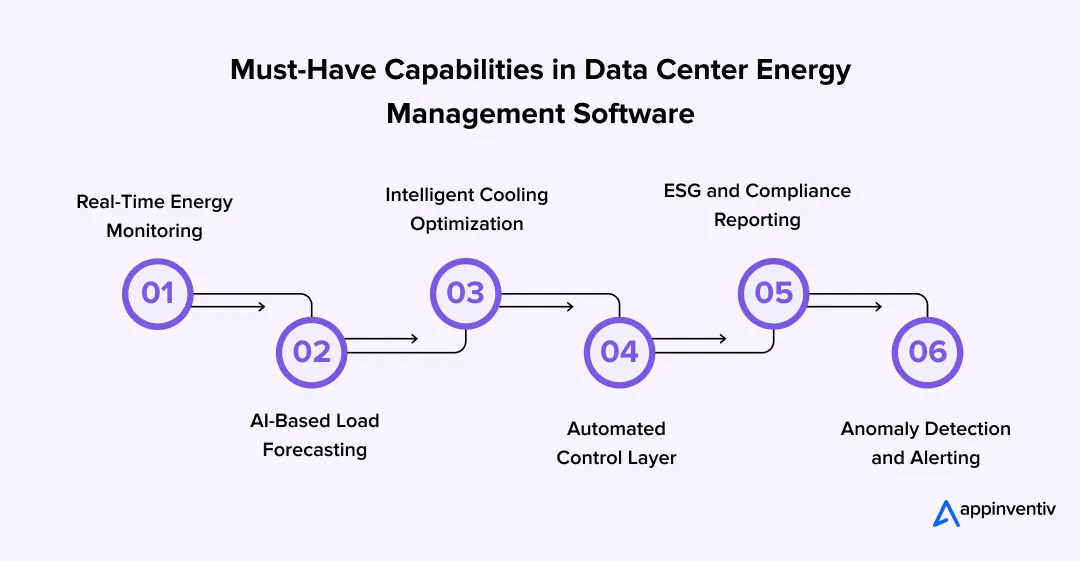
Real-Time Energy Monitoring: Tracking energy consumption at the rack and device level via meters, PDUs and building system inputs, providing a clear understanding of power consumption location.
AI-Based Load Forecasting: Answers with historical and real-time data, predicting the demand patterns through AI to shift the workloads, prevent peak costs, and enhance its capacity utilization.
Intelligent Cooling Optimization: Regulates airflow and cooling systems based on real-time thermal conditions, minimizing energy waste and overheating in crowded places.
Automated Control Layer: Monitors conditions and makes real-time adjustments to workloads, power, and cooling, minimizing manual effort and enhancing stability.
ESG and Compliance Reporting: Tracks energy consumption as well as emissions, ensuring alignment with ISO 50001 energy management systems, ASHRAE TC 9.9 environmental operating ranges, and EU Code of Conduct reporting guidelines.
Anomaly Detection and Alerting: Determines an abnormal energy pattern or system behavior early enough before teams respond to inefficiencies or failure.
Benefits of Energy Management Software for Data Centers
Effective monitoring and control of power, cooling, and server resources is essential for data centers to operate efficiently, reduce costs, and maintain reliable performance. Here are some of the top benefits of energy management software:
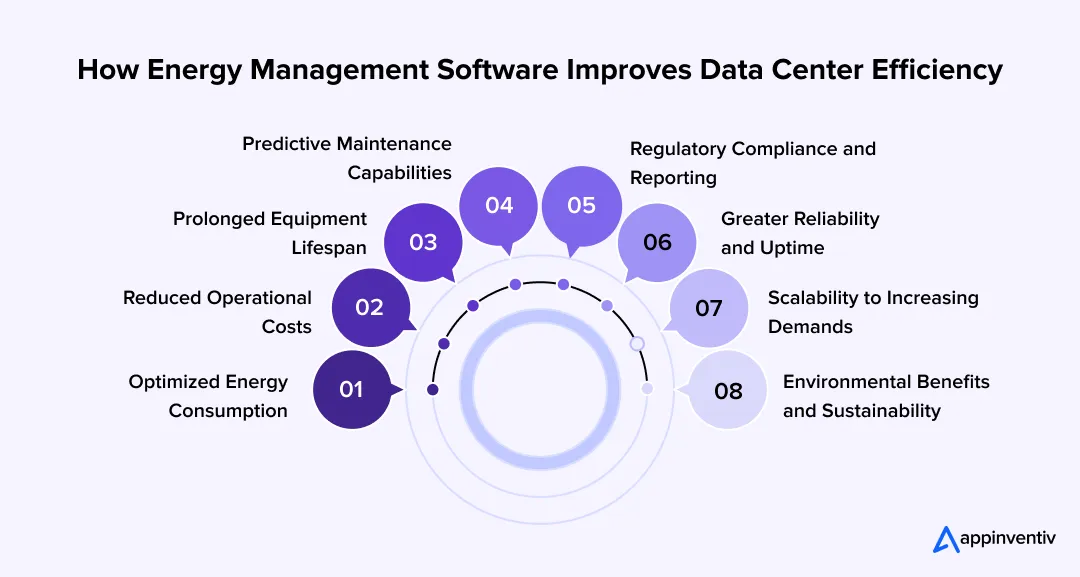
Optimized Energy Consumption
The data center energy management solutions continuously monitor the amount of power used by all servers, cooling devices and other similar devices. According to the information received, inefficiencies are identified, and suggestions on which areas require energy supply redistribution are provided; hence, no resources are spent without assurance that operations are being conducted optimally.
Reduced Operational Costs
Data center power management software is useful to organizations in reducing electricity spending by optimizing server and cooling system loads, and during periods of minimal demand. This cost saving can, in the long term, lead to major cuts in operational budgets, thereby freeing up funds for strategic investments and infrastructure upgrades.
Prolonged Equipment Lifespan
Energy management software development for data centers entails continuous monitoring of changes in power, temperature and system load. This position eliminates hardware stress and overheating, thus avoiding early hardware failure, i.e., servers, storage and other necessary hardware, at an earlier stage and allowing the hardware to operate effectively over a longer period, eliminating replacement costs.
Predictive Maintenance Capabilities
Modern energy management systems can predict likely equipment failures before they occur by applying advanced analytics and machine learning. Early identification of anomalies and risk management through AI can enable maintenance teams to respond promptly, minimize downtime, avoid outages and ensure continuous service for critical use.
Regulatory Compliance and Reporting
Automated reporting capabilities of energy management software allow organizations to align their energy efficiency standards, environmental regulations, and AI sustainability efforts including frameworks such as ISO/IEC 30134 (data center KPIs standard) and EN 50600 (European data center infrastructure standard).
A report on energy consumption, carbon footprint and efficiency indices created with such software can be used to demonstrate accountability to authorities and other stakeholders and to aid corporate environmental objectives.
Greater Reliability and Uptime
The constant tracking and real-time notifications ensure that any anomalies in energy consumption, temperature or equipment performance are corrected instantly. Continuous monitoring of energy use, temperature, and equipment performance reduces outage risks, protects critical workloads, and ensures service quality, with real-time alerts for any failures.
Scalability to Increasing Demands
Data center energy optimization software development enables data centers to scale effectively as server and cloud load capacities grow. It enables facilities to manage increasing demand efficiently while maintaining performance, stability, and energy control across expanding infrastructure.
Environmental Benefits and Sustainability
Energy management software development for data centers reduces redundant power use and enhances cooling systems, thereby reducing the facility’s carbon footprint. These tools will help firms achieve their sustainability objectives and become more environmentally friendly in their operations by increasing efficiency and supporting the integration of renewable energy.
Real-World Use Cases of Data Center Energy Management Software in Action
Practical use cases reveal how data center energy management software goes beyond monitoring to actively manage cooling systems. These real-world applications are aimed at quantifiable efficiency improvements under rigorous operational and thermal constraints.
AI-Based Cooling Optimization in Hyperscale Data Centers
Machine learning models at Google DeepMind are optimized by using real-time data from thousands of sensors in big data centers to optimize cooling. The system measures temperature, power, and equipment indicators to constantly modify cooling actions.
This evolved into full automation, whereby the control systems are operated without human intervention. In production environments, these models delivered around 30 percent reduction in cooling energy while maintaining operational stability.
ML-Based Cooling Optimization of HPC Data Centers
Research published on arXiv presents a physics-guided machine learning framework applied to the Frontier exascale supercomputer. The model forecasts cooling-related power with high accuracy using only 1 year of high-resolution operational data and plots the effects of flow rates, temperatures, and server load on energy use.
The system finds approximately 85 MWh of cooling inefficiency each year and considers safe setpoint changes to reclaim it. Using guardrail constraints, it is possible to reduce this excess energy by up to 96% through small operational modifications, without violating thermal or reliability constraints.
Cost Breakdown of Data Center Energy Monitoring Software Development
The cost of data center energy monitoring software development typically ranges between $80,000 to $800,000+, depending on system complexity, level of customization, and scale of deployment. Enterprise-grade solutions with AI-driven optimization and multi-site monitoring can exceed this range.
Pricing Breakdown by Component
These estimates provide a practical view of how different modules contribute to the overall investment:
| Component | Cost Range | Notes |
|---|---|---|
| Data integration, IoT connectivity | $10,000 – $50,000 | Sensor integration, APIs and real-time data pipelines. |
| Frontend dashboards | $15,000 – $60,000 | Monitoring panel, analytics views, reporting UI. |
| Backend and analytics engine | $40,000 – $150,000 | Data processing, energy analytics, optimization logic. |
| Artificial intelligence and prediction modules | $50,000 – $200,000 | Forecasting, anomaly detection, automation. |
| Testing and quality assurance | $15,000 – $50,000 | Performance, reliability, and security verification. |
| Deployment and maintenance | $20,000 – $100,000 | System monitoring, updates and scaling. |
Price Ranges for Different Project Sizes
These ranges help teams align investment with expected functionality and long-term goals:
| Project Level | Scope | Cost Estimated |
|---|---|---|
| Simple Monitoring System | Basic energy monitoring, basic dashboards, minimal integrations | $80,000 – $150,000 |
| Mid-Scale Platform | Predictive insights, real-time analytics, multiple integrations | $150,000 – $400,000 |
| Enterprise Grade Solution | Multi-site monitoring, AI optimization, automation, and compliance features | $400,000 – $800,000+ |
Cost-Saving Strategies Without Compromising Performance
These strategies assist in managing the expenses without compromising the system reliability and scalability:
Leverage Existing Frameworks: Ready-made IoT and data analytics solutions cut down on the development time and prevent the creation of basic elements.
Always Focus on Essentials: Prioritizing critical monitoring and analytics functions at the first stage of the process will help manage the budget and leave room to extend it in the future.
Optimize Integrations Early: Selecting compatible hardware and standard protocols makes integration easy and avoids costly rework in the future.
Embrace a Modular Architecture: The modular design of the system enables the teams to add features in small blocks, without interrupting the current operations, which keeps the long-term costs predictable.
Factors Influencing the Cost of Data Center Energy Management Software Development
The price of the development of the data center energy monitoring solution is determined by a variety of architectural and functional choices that influence both work and timeframes:
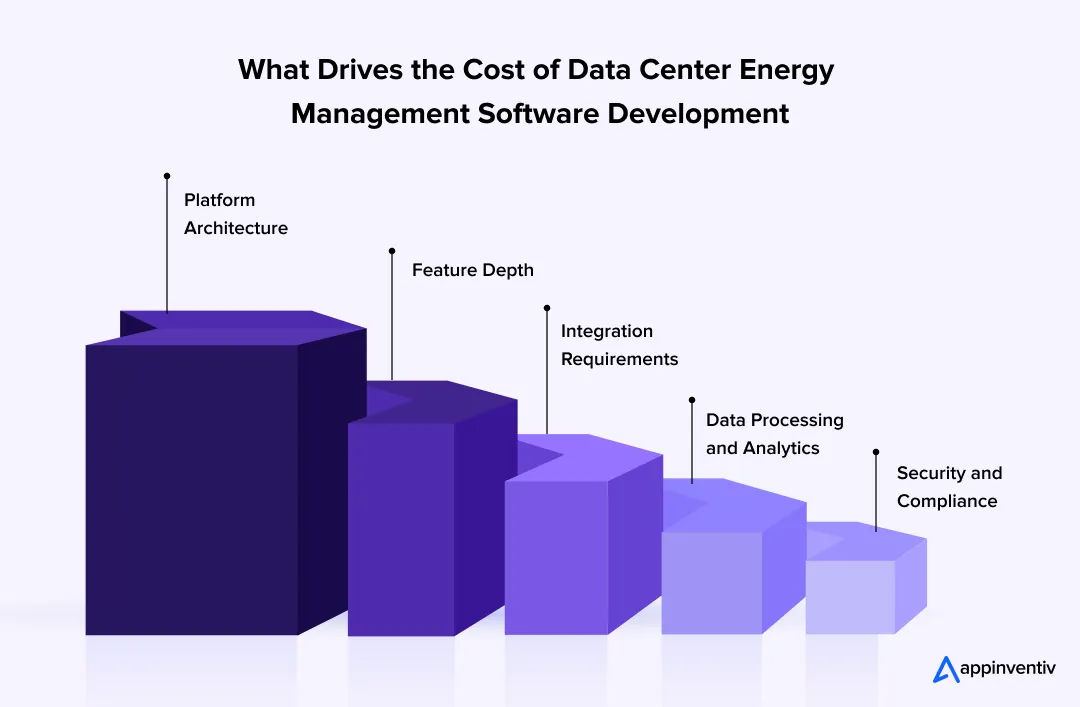
Platform Architecture: The energy management software architecture for data centers plays a central role in determining cost. There are independent monitoring systems, and those combined with IT, power, and cooling systems, making them more complex and difficult to develop.
Feature Depth: Simple platforms focus on energy monitoring and reporting, whereas more sophisticated platforms include predictive analytics, automated controls, and real-time optimization. The use of AI-based forecasting or multi-location dashboards increases development costs.
Integration Requirements: Monitoring software on energy should be linked to servers, sensors, HVAC, and external tools. These integrations, particularly with legacy infrastructure, may significantly increase development time and costs due to their complexity.
Data Processing and Analytics: The processing pipelines and analytics engines must be capable of processing large volumes of real-time data. The complexity of development is impacted directly by the depth of insights, from simple dashboards to advanced optimization models.
Security and Compliance: Enterprise implementations demand effective data security, access control, and industry standards like ISO 50001, ASHRAE TC 9.9, and the EU Code of Conduct for Data center. The layering increases the work of development, but it is necessary to be reliable and trusted.
Data Center Efficiency Benchmark (PUE)
Power Usage Effectiveness (PUE) is the simplest way people understand the efficiency of a data center. It merely compares total facility power with the power consumed by the IT systems.
PUE = Total Facility Energy/ IT Equipment Energy
The nearer this number is to 1, the better the setup is performing. It implies that a higher proportion of the energy is actually being used in computing work rather than being wasted in cooling overheads or power distribution overheads.
In practice, you would tend to find:
- The hyperscale is between 1.1 and 1.3.
- Established enterprise between 1.3 and 1.6.
- Aged settings in most cases exceed 1.7.
Energy Cost Impact / RoI Model
In discussing savings and return on investment, teams tend to begin with a basic baseline comparison of current expenditures and the savings that would result from efficiency improvements.
Savings = Baseline \ Energy Cost x Efficiency Gain
As a matter of fact, even a minor percentage increase does not remain small for long. Load variations in AI-heavy environments vary across the day, so those benefits are likely to accumulate, rather than be fixed.
| Plan your investment in data center energy management with a clear focus on efficiency, cost control, and scalability. Get a tailored estimate and roadmap aligned with your infrastructure needs. |
Addressing Efficiency Gaps in Data Centers
With the evolution of data centers to meet AI workloads, real-time applications, and distributed clouds, energy management systems form inefficiencies that do not necessarily manifest, but gradually cumulatively accumulate. Let’s see how a data center energy monitoring software addresses these efficiencies:
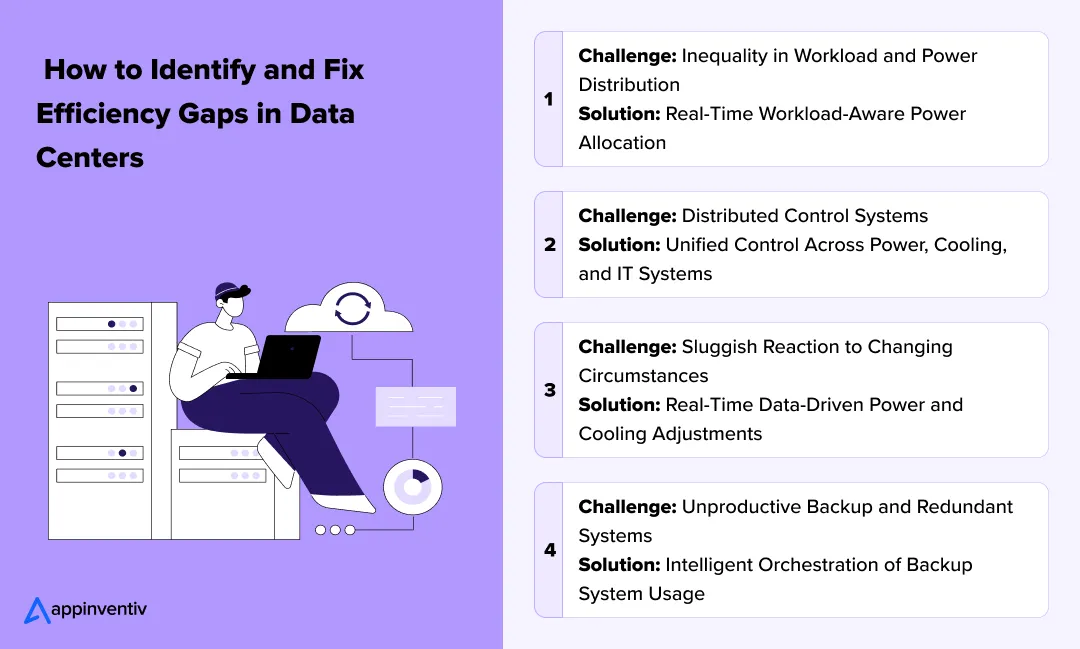
Challenge 1: Inequality in Workload and Power Distribution
One of the core challenges in data center energy optimization lies in aligning power provisioning with actual workload demand. Most of the facilities continue to use peak capacity estimates, thus causing over-allocation in certain areas and underutilization in others, contributing to inefficiency and unnecessary energy consumption.
How can software address this?
Power management systems with workload-awareness profile energy distribution to meet real-time cloud computing demand. They remove overprovisioning and direct energy where it is needed by constantly adjusting power flow according to utilization levels.
Challenge 2: Distributed Control Systems
Natural tools may be disconnected to allow viewing across operations, so power infrastructure, cooling units and IT systems are frequently operated separately. This failure to integrate causes it to be hard to do performance optimization holistically or to react effectively to changing workloads.
How can software address this?
Data center energy management solutions combine these systems into one operation layer. They can coordinate actions, such as adjusting cooling based on server load, by correlating data across domains, making the entire system more efficient and responsive.
Challenge 3: Sluggish Reaction to Changing Circumstances
The environment of data centers is highly dynamic, and most of the systems continue to rely on delayed inputs or manual intervention. This delay may lead to energy peaks, thermal cycling, and decreased working efficiency.
How can software address this?
Data center power management software processes continuous data streams from sensors and infrastructure components. It allows real-time changes to power distribution and cooling, keeping operations stable and reducing unnecessary energy use.
Challenge 4: Unproductive Backup and Redundant Systems
Uptime requires redundant systems, which are frequently not used or are not well managed. Such systems waste energy without intelligent coordination, even when they are not actively supporting workloads.
How can software address this?
Through data center energy management software development, intelligent orchestration tools can be used to optimize the manner and timing of backup systems deployment. This guarantees that there is no overuse of energy to maintain redundancy and balances resilience and efficiency.
DCIM vs Energy Management Software: What Enterprises Should Choose?
As enterprises scale and complexity increases, they require enhanced control over infrastructure and energy consumption. The next question is often raised: Should it be infrastructure visibility or energy optimization?
While many organizations look to build custom DCIM software for better asset tracking and operational oversight, others invest in specialized platforms to gain tighter control over energy performance. The following comparison describes the position of each solution.
| Aspect | DCIM (Data Center Infrastructure Management) | Energy Management Software |
|---|---|---|
| Main Area of Interest | Infrastructure monitoring, asset tracking, and capacity planning | Energy usage tracking, optimization, and cost reduction. |
| Visibility | Gives a single-point perspective of physical and IT resources | Gives in depth information about the power use and efficiency. |
| Analytics Depth | Simple power and capacity reporting | Complex analytics of energy trends, thermal profiles and optimization. |
| Automation | Limited, mostly monitoring-driven | High, with real-time adjustments and predictive capabilities |
| Use Case | Infrastructure control and ensuring operational control | Reduction of energy costs and better sustainability results. |
Which One Should Enterprises Select?
This will depend on the major goal. DCIM is a robust platform for managing assets, tracking infrastructure, and maintaining operational visibility. A high number of businesses prefer to develop their own DCIM application to suit their infrastructure requirements and business processes.
Nonetheless, when a company is interested in energy cost reduction, in creating more efficient data centers, and achieving sustainability goals, custom energy management software for data centers can provide greater direct value. It goes beyond the monitoring stage and allows active optimization of the power and cooling systems.
Practically, the best approach is usually a combination of the two approaches. Enterprises can now combine energy intelligence with their overall infrastructure stack through data center energy management software development, making visibility and optimization work in unison toward achieving quantifiable outcomes.
Build data center energy management software that reduces costs while improving performance across your infrastructure.
The Future of Sustainable Data Centers: What to Look For in 2026 and Beyond?
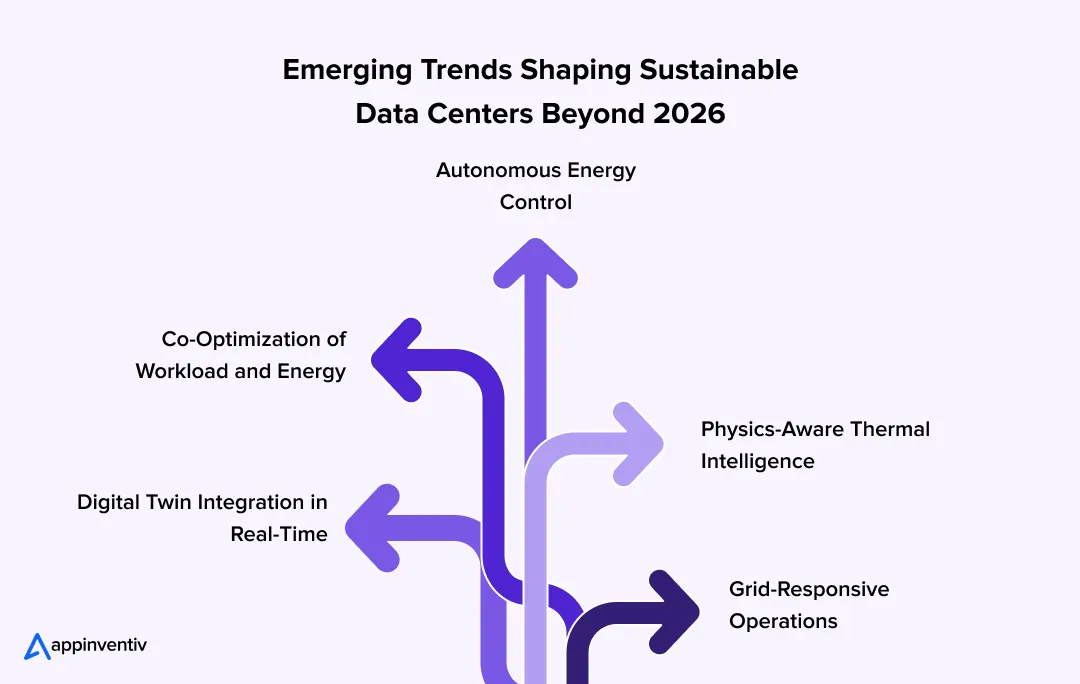
The second level of data center sustainability is being defined at the software level. No longer is it merely a question of monitoring energy or enhancing PUE. Modern data center energy management software is evolving into a control system that integrates power, cooling, and workloads in real time. Some of the key trends that reflect this shift include:
Autonomous Energy Control
More advanced platforms are now integrated into closed-loop systems, with software monitoring conditions, making decisions, and automatically adjusting them. As the autonomous energy management systems market is expected to reach $15.2 billion by 2033, this shift signals a steady move toward fully automated infrastructure control, where energy optimisation is handled continuously rather than manually managed.
Co-Optimization of Workload and Energy
Software is becoming more and more tied to energy signals in scheduling computations. Based on the pricing, grid conditions, or thermal limits, workloads can be shifted to assist in reducing the cost as well as energy strain.
Physics-Aware Thermal Intelligence
Modern systems are integrated with machine learning, thermal, and airflow models rather than using historical data alone. This enables better control of cooling systems, particularly in high-density environments.
Digital Twin Integration in Real-Time
Digital twins simulating real-world conditions are now being integrated into energy management software. The digital twin for data centers market is projected to reach $227.56 billion by 2032, reflecting the rapid adoption of this approach. It is now possible to test changes, make predictions and prevent inefficiencies before they affect live systems.
Grid-Responsive Operations
Data center energy management software is becoming grid-aware, enabling AI systems to dynamically control data center energy use based on current supply and renewable energy availability. This change is supported by IEA 2025 results that indicate that electricity demand is rising 2-3 times faster than overall energy demand, particularly due to data centers and AI loads, and demand-response and grid-conscious scheduling are becoming more important.
How Appinventiv Supports Your Data Center Energy Management Software Development Journey
Energy is no longer an auxiliary variable in data center operations. It influences cost patterns, influences uptime choices, and is rapidly establishing the sustainability perspective of infrastructure assessment. It is here that data center energy management software development begins to be relevant in a more realistic manner. It introduces order to the environment that would otherwise operate under sluggish decision-making, inconsistent information, and reactive solutions.
The difference between high-performing systems and non-high-performing systems lies not in visibility per se but in the speed at which visibility is transformed into action. Pattern adjustment and real-time cooling coordination ensure that costs do not drift and that performance does not slip.
Appinventiv, as your reliable software development services partner, operates at this convergence point of software, infrastructure and intelligence, developing systems that work in real operating environments and not at all just in ideal situations. To learn more about how the systems are assembled, check out our detailed portfolio and get a quick look at our past works.
Also, watch our client testimonials and get a clearer picture of results across various settings.
Get in touch with our experts today!
FAQs
Q. What is data center energy management software?
A. Data center energy management software is developed to monitor, analyze, and control energy use across infrastructure components, including servers, cooling systems, and power units. It gathers real-time information, tracks inefficiencies and enables decision-making based on analytics and automation.
In the long run, it helps lower operational expenses, enhance energy efficiency, and ensure adherence to sustainability and reporting standards.
Q. What are some of the best practices for data center energy efficiency?
A. Here are some of the best practices for managing data center efficiency through software:
- Install Smart Cooling Control Systems: Operate software-controlled cooling systems that react to real-time thermal measurements and adjust airflow and temperature settings in real-time, rather than using preset settings.
- Facilitate Workload Organization and Planning: Use leverage software to allocate workloads based on energy availability and cost indicators, moving non-critical processes to off-peak times or more efficient conditions.
- Combine with Energy-Efficient Infrastructure: Modern, energy-efficient hardware should be used with energy management software, which uses system-level data to optimize the energy consumption of servers, storage, and networks under varying loads.
- Embrace Granular Monitoring and Analytics: Install systems that monitor energy usage at rack and device levels, so that software can identify inefficiencies early and initiate specific corrective measures.
- Apply Continuous Performance Benchmarking Tools: Use software to audit energy consumption on a routine basis, monitor PUE, and compare performance against team targets over time, allowing teams to keep efficiency targets without manual adjustments.
Q. How does AI improve energy efficiency in data centers?
A. Implementing AI in your data center management software helps improve energy efficiency in a number of ways:
- Predictive Load Management: AI-powered data center energy management software utilizes historical and real-time data to predict demand so that the operators are prepared to see spikes rather than respond to them.
- Smart Cooling Adjustments: AI-based models compare thermal patterns and change cooling systems dynamically to minimize overcooling and ensure safe operating conditions.
- Anomaly Detection: The system identifies patterns of irregular energy use early, allowing teams to implement corrective actions before inefficiencies escalate.
- Automated Decision-Making: The use of AI in energy units can allow systems to adjust workload distribution and power use in real-time, minimizing human intervention and enhancing uniformity.
Q. What technologies are used in energy management software development?
A. The data center power management software is based on a combination of the latest technologies to manage real-time data and scale automation:
- Enterprise Internet of Things (IoT) for sensor-based data collection
- Low-latency data processing with edge computing
- Scalable storage and analytics cloud platform
- Prediction and optimization of machine learning models
- Big data frameworks such as Apache Kafka and Spark
- BMS, HVAC, power systems integration APIs
- Digital twins for simulating energy behavior and testing scenarios
Q. How long does it take to develop data energy management software?
A. The data center energy management software development timeline is based on the complexity of the system, integration needs and the automation degree. Implementing a simple monitoring system can take 3-5 months, whereas a full-scale platform with AI-based control systems can take 6-12 months or longer, particularly when implemented across multiple facilities.
Q. Why should enterprises invest in custom data energy management software?
A. Here are some of the reasons why enterprises should invest in custom data energy management software development:
- Better Operational Control: Dedicated data center energy management systems offer greater visibility and control over particular infrastructure requirements.
- Cost Optimization: They assist in minimizing energy waste and better managing peak demand, reducing long-term operating costs.
- Scalability: Multi-site deployments and increasing workloads can be supported by systems without performance problems.
- Improved Compliance: Inbuilt reporting capability facilitates easier compliance with regulatory and ESG demands.
- Integration Flexibility: Custom platforms can be properly integrated with existing systems, which are not as limited as off-the-shelf tools.
Q. How much would a data center energy management software cost to build?
A. The cost of data center energy monitoring software development depends on features, integrations and scale. The simplest system with monitoring can begin at approximately $80,000, and the more technologically advanced system with AI, automation, and multi-site support can range from $300,000 to more than $800,000. Real-time data processing, the integration of control systems, and the need to comply with requirements significantly impact total investment.


Fast 2-minute response, fully NDA-protected.

The Ultimate Guide to CRM for Insurance: Features, Cost, Top Platforms, Integration & More
Key takeaways: CRM for insurance connects sales, service, and claims into one governed system, distinct from the policy administration system. Core features span pipeline management, policy visibility, claims tracking, commission management, AI analytics, and compliance controls. Cost ranges from roughly USD 15,000 for configuration to USD 150,000 and beyond for custom development at enterprise scale.…

How to Choose a Technology Partner for Government Software Development
Key takeaways: Evaluate the partner across five layers: procurement eligibility, assurance, engineering, delivery and long-term ownership. Choose a government technology partner on evidence, governance and delivery depth, not development capability alone. Match partner evaluation criteria to the security, integration and operational risks of the programme. Treat data sovereignty, privacy, accessibility and security as architecture decisions…

Distributed Energy Resource Management System: Use Cases, Development and Implementation Costs
Key takeaways: Australian grids require robust software to manage minimum system load events effectively. DER integration software aggregates, monitors, and dispatches varied grid edge hardware securely. CSIP-Aus and AEMO compliance dictate strict architectural and cybersecurity software foundations. DERM development and implementation costs typically range from AUD 70,000 to 700,000 +. Successful DER programmes start with…