

























Ultimate Guide to Billing Software Development: Costs, Features & Process 2026

 Share -


- 01Custom Billing Software Development: Market Insights and Trends
- 02An Overview of Different Billing and Invoicing Software Types
- 03A Comprehensive View of the Costs Involved in Billing Software Development
- 04Factors Affecting Billing Software Development Cost
- 05Key Features That Make Custom Billing Software Stand Out
- 06Understanding the Billing Software Development Workflow
- 07Addressing Obstacles in Custom Billing Software Development
- 08Create Custom Billing Software with Appinventiv’s Specialized Expertise
- 09FAQs

Key takeaways:
- Custom billing software helps businesses handle complex pricing models, reduce billing errors, and gain better control over revenue workflows as they scale.
- Billing software development costs typically range from $45,000 to $350,000+, depending on features, customization level, integrations, security, and deployment model.
- Subscription, usage-based, and hybrid billing models are driving demand for flexible, cloud-native billing platforms beyond 2025.
- Core cost drivers include functionality depth, compliance requirements, system integrations, and long-term scalability needs.
- A well-architected billing system becomes a strategic financial layer, improving cash flow visibility, compliance, and operational efficiency over time.
Custom billing software plays a direct role in how efficiently a business manages revenue, cash flow, and compliance. As organizations scale, billing operations become more complex, involving multiple pricing models, geographies, tax rules, and integrations with accounting and ERP systems. At this stage, generic, off-the-shelf billing tools often struggle to keep up.
Rather than forcing businesses to adapt their processes to rigid tools, custom billing software is designed around existing operational workflows. It supports tailored billing logic, automates invoicing workflows, reduces manual errors, and shortens payment cycles. More importantly, it gives finance and operations teams better visibility and control over billing data as transaction volumes grow.
From a cost perspective, building a custom billing solution is a strategic investment rather than a short-term expense. Billing software development costs typically range between $45,000 and $350,000 or more, depending on factors such as feature depth, customization level, integrations, security requirements, and deployment model.
This guide breaks down everything decision-makers need to evaluate before investing in billing software development. It covers cost drivers, software types, core features, development workflows, common challenges, and what it takes to build a scalable, enterprise-ready billing system in 2026.
Understand what it takes to build a scalable, futfrure-ready billing system.

Custom Billing Software Development: Market Insights and Trends
According to a report by Straits Research, the global billing and invoicing software market is projected to grow from $5.43 billion in 2025 to $13.94 billion by 2033, registering a compound annual growth rate (CAGR) of 12.5% during the forecast period. This growth is driven by increasing digitization of financial operations, rising adoption of automated billing solutions, and the growing need for accuracy and transparency in revenue management across industries.
Additionally, cloud computing and data analytics in fintech advancements are accelerating market growth as businesses seek more flexible and insightful billing solutions. The market is also fueled by some of the top trends in billing software, including the rise of subscription-based billing models, increased integration with other business systems such as ERP and CRM platforms, and the growing emphasis on artificial intelligence and machine learning to enhance automation and predictive analytics.
These trends highlight a broader shift towards more dynamic and data-driven approaches in financial management.
An Overview of Different Billing and Invoicing Software Types
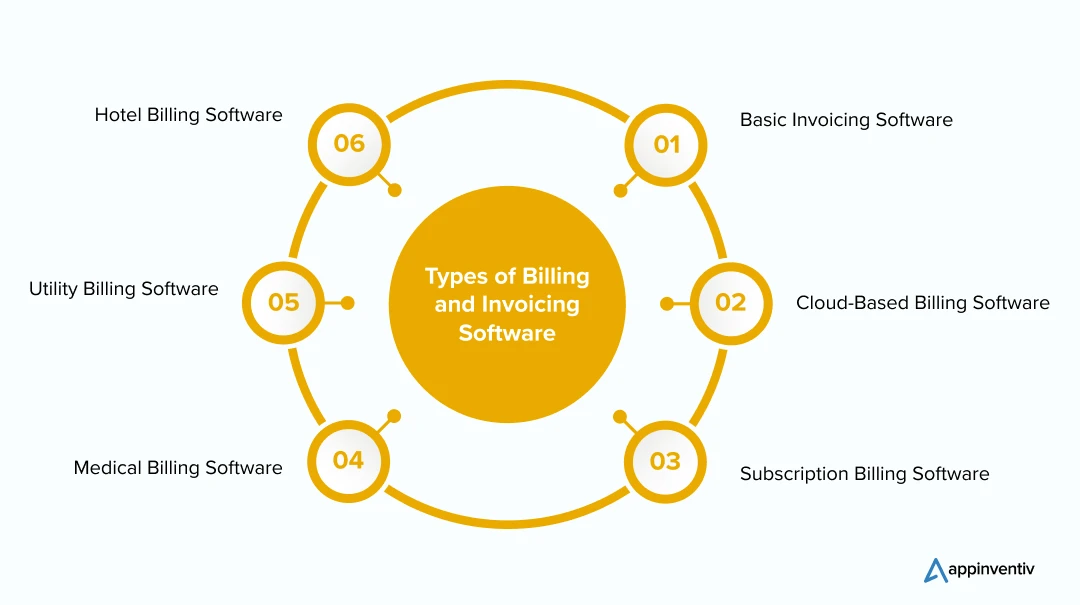
There are different types of online invoicing and billing software, each tailored to meet varying business needs. From basic invoicing tools to comprehensive billing systems, understanding these billing software examples can help you choose the best solution to streamline your financial processes.
Basic Invoicing Software
Basic invoicing software is perfect for independent contractors and small enterprises looking for an easy way to handle their billing requirements. It makes it simple for users to track payments, create and send invoices, and provide simple financial reports.
Simple in design, this kind of software concentrates on the most important aspects of invoicing without incorporating complex features. It’s ideal for people who prefer a straightforward billing system.
Cloud-Based Billing Software
Cloud-based automated billing software allows you to access your billing system from anywhere. With features like multi-user access, automated data backups, and easy connection with other cloud-based products, it’s a great fit for companies with remote workers or different locations.
Subscription Billing Software
Subscription billing software is designed for companies with recurring revenue models, like subscription boxes or membership services. It tracks consumption, maintains subscription plans, and automates billing cycles to guarantee correct invoicing. This software, which supports multiple pricing schemes and billing schedules, helps businesses manage client subscriptions and recurring payments more effectively.
Medical Billing Software
Healthcare providers can utilize medical billing software to expedite patient billing and insurance claim processes. This software ensures adherence to healthcare regulations by managing insurance reimbursements, generating patient invoices, and handling sophisticated medical coding. This software is essential for accurately processing medical claims and cutting administrative overhead expenses in healthcare settings.
Utility Billing Software
Utility billing software serves businesses that supply necessities like gas, electricity, and water. It computes rates, tracks usage, and produces bills for clients.

Utility firms can streamline their billing procedures and ensure accuracy using this software, which oversees various tariff structures and billing periods. It frequently has tools for tracking payments and managing customer accounts.
Hotel Billing Software
Hotel billing software is intended to handle reservations, check-ins, and billing for businesses in the hospitality sector. It can collect payments, automate invoicing, and expedite guest services by integrating with property management systems. This software ensures a seamless and effective operation for hotels and resorts by supporting intricate billing scenarios, such as room costs, amenities, and incidentals.
Now that we have looked into the different types of billing software you can build, let’s jump to the main part of the article – the factors affecting the cost to build a custom billing software.
A Comprehensive View of the Costs Involved in Billing Software Development
Billing software almost never costs what people expect at the start. Not because teams underestimate features, but because billing itself tends to be more complicated than it looks on paper. Revenue rules evolve. Discounts creep in. Compliance gets stricter. Systems that once worked fine start showing cracks.
That is why billing software costs vary so widely. The real drivers are complexity, integration depth, and how much change the system needs to absorb over time.
Cost Ranges Based on Overall System Scope
A billing system is easy to build when rules are simple and stable. Costs rise when those rules start changing frequently or when the system has to work across teams, regions, or products.
- Basic billing software ($45,000–$80,000)
This usually covers straightforward invoicing and payment tracking. It works when billing patterns are predictable and when the system does not need to talk to many others. Many small teams start here and stay here for years. - Mid-scale billing software ($80,000–$180,000)
Costs move up once recurring billing, cloud access, approvals, or integrations with accounting systems are added. At this stage, the system needs to handle variation without manual fixes every month. - Enterprise billing software ($180,000–$350,000+)
These systems are built to withstand pressure. High volumes, multiple regions, audits, and complex pricing all come into play. Most of the cost is tied to architecture and reliability, not just feature count.
How Costs Are Typically Spread Across the Project
Billing software is rarely built in one clean sprint. The budget spreads across stages, whether teams plan for it or not.
Early on, time is spent understanding how billing really works inside the business. This part often feels slow, but skipping it almost always leads to expensive corrections later.
| Development Stage | Typical Cost Share | What This Stage Covers |
|---|---|---|
| Planning and Requirements | 10–15% | Mapping real billing rules, handling exceptions, and accounting for compliance needs before development begins |
| Design and UX | 10–15% | Designing workflows and interfaces. Weak design often leads to manual work, support issues, and delayed billing cycles |
| Development and Integrations | 45–55% | Building billing logic, managing edge cases, and integrating payment gateways, ERP, and CRM systems |
| Testing and Launch | 10–15% | Validating accuracy, performance, and security before the system goes live. Billing errors directly affect revenue and trust |
| Maintenance and Enhancements | 10–20% annually | Ongoing updates to support pricing changes, regulatory shifts, and system improvements over time |
Time and Effort Expectations
Timelines depend on how much validation and coordination the system requires.
- Basic systems are often delivered in a few months
- Mid scale platforms take longer due to integrations
- Enterprise systems extend further because of testing, approvals, and phased rollouts
In most cases, delays come from complexity, not development speed.
Factors Affecting Billing Software Development Cost
There are different factors that impact the cost of billing software, including the complexity of customization, the range of features, and the level of integration required. Evaluating these factors will help you understand how they contribute to the overall expense and guide you in developing a solution that aligns with your financial and operational needs.

Functionality and Features
The range and depth of features greatly influence billing software development costs. Complex features like automated billing, multi-currency support, thorough reporting, and custom workflows cost more than basic functions like invoicing and payment processing.
The total cost rises with the number and complexity of the features you need. Customizing functionalities to meet specific company requirements can also affect the overall custom billing software cost estimation.
You can also read our blog on the cost to build an Accounting Software like Xero to understand the in-depth functionality requirements and cost breakdown.
User Licenses
The cost to build a custom billing software often depends on the number of users and the scale of the organization. Larger businesses or those needing access for many users will incur higher costs due to additional licenses.
Pricing models may be based on user count or transaction volume, and scaling the software to support business growth typically requires extra investment. It’s important to evaluate current and future user requirements for a precise budget for billing software development.
Level of Customization
The cost of developing billing software is significantly influenced by the level of customization required. Tailoring the software to align with your specific needs and company procedures can drive up expenses. Customizations might include integrating with existing systems, creating specialized reports, or implementing unique billing structures. Each of these adjustments adds complexity and can impact the project’s overall cost.
The level of customization required will determine the overall custom billing software cost estimation. Elevated degrees of personalization and inclusion of other sophisticated functionalities can entail greater upfront costs and continuous maintenance requirements.
Deployment Type
The billing software development cost structure is affected by the decision between on-premises and cloud-based deployment. With a subscription or usage-based pricing model, cloud-based solutions usually have reduced upfront costs and may include monthly maintenance and upgrades.
On-premises installations, on the other hand, have greater initial costs associated with software, hardware, and IT infrastructure, in addition to continuing maintenance and upgrade expenses.
Also Read: On-Premise vs. Cloud: A Detailed Analysis
Compliance and Security
The cost of custom billing software development may be impacted by the need to adhere to industry-specific compliance and security standards. Regulations like GDPR, HIPAA, and PCI-DSS frequently call for extra security features and certifications, which drives up the cost to build a custom billing software.
Implementing strong security measures to safeguard confidential financial data involves both development expenses and continuing security management. Ensuring the software complies with legal and regulatory requirements is a major factor that affects the total billing and payment of software development costs.
Size and Location of the Development Team
The size and location of the development team can influence the billing software development cost. Established development agencies with a strong reputation for reliability and support often charge more for their products and services. Additionally, billing software developers based in high-cost regions or advanced technology hubs may have higher pricing range.
Conversely, hiring professionals from Asian regions, such as India, can offer access to a vast, skilled talent pool. India’s well-trained IT professionals and software developers bring high-quality expertise and innovative solutions, often balancing the overall project costs while maintaining exceptional service quality.
Scalability and Upgrades
One crucial factor to consider is the billing software’s capacity to develop in the future. Though they sometimes cost more upfront, scalable solutions that grow with your company save money in the long run by reducing the need for regular replacements.
The overall billing software development cost rises with each update and enhancement required to adapt to evolving business needs or technological advancements. Investing in scalable and upgradable customized billing software development helps ensure that the software continues to meet business requirements over time.
Also Read: Cash Management Software Development Cost Estimation
Key Features That Make Custom Billing Software Stand Out
By incorporating the right features, you can customize your billing software to align seamlessly with your operational workflows, enhance financial processes, and boost overall performance. However, it’s important to note that implementing these features involves certain billing software development costs. Let’s have a look at some of the top billing software features.

Customizable Templates: Create invoice designs that meet your brand and particular requirements to guarantee individualized and expert documentation. Adjust information fields, layouts, and colors as needed.
Recurring Invoices: Set up regular billing cycles for continuing services or subscriptions to minimize manual labor and guarantee steady money flow. Set up quantities and intervals to suit your needs for easy billing.
Multi-Currency Support: Facilitate international commerce and enhance financial accuracy by managing transactions in multiple currencies with real-time exchange rate updates. Use current exchange rates to convert amounts.
Sales Reports: Create detailed reports on income, profitability, and sales performance to learn about the state of your finances and help you make wise decisions. Examine patterns and results across time.
Accounting Software: Integrate with well-known accounting software like Sage, Xero, and QuickBooks for more efficient financial management. Synchronize data to maintain correct and current records.
CRM Systems: Use customer relationship management systems to monitor transactions, get client data, and improve customer support. Keep a unified perspective on the past and relationships with your customers.
Budget Management and Allocation: Effectively track and control financial resources by setting up budgets, allocating funds across various departments or projects, and monitoring expenses. Utilize real-time insights and alerts to ensure adherence to optimize financial planning.
At Appinventiv, we developed Mudra, a state-of-the-art chatbot-based budget management platform designed to address personal budgeting challenges. Following six months of intensive design and development, Mudra was launched in over 12 countries. This groundbreaking application incorporates interactive features to boost user engagement and revolutionize the FinTech industry.

Payment Gateways: Implement different payment gateways, such as bank transfers, PayPal, and credit cards, to provide clients with flexibility and convenience. Ensure that transaction processing is safe and effective.
Auto-Billing: This minimizes the chance of missing billing cycles and reduces manual labor by automatically creating and sending invoices in accordance with predetermined schedules. Set the frequency and timing parameters.
Access Controls: Assign users roles and permissions to ensure that only individuals or users with the proper authority can see or alter sensitive data. Boost data security and efficiently handle user obligations.
Audit Trails: Maintaining thorough logs of all transactions and system modifications for compliance and auditing purposes. This feature helps you maintain accountability and transparency and keep track of who made modifications and when.
Understanding the Billing Software Development Workflow
The billing software development process is a comprehensive journey that starts with defining precise business requirements and progresses through custom design, coding, and iterative testing. Each phase is essential for developing a customized solution that addresses your unique needs and integrates smoothly with your current operations.
Let’s check out the steps involved in billing and invoice software development.

Requirements Analysis and Compilation
To begin with your billing and payment software development, conduct extensive discussions with all relevant parties in order to collect and record specific needs for the billing software. This entails figuring out essential features like billing, handling payments, and meeting reporting requirements.
To customize the software, you must comprehend the user roles, compliance requirements, and business processes. These specific requirements form the basis of all subsequent e-billing software development stages, guaranteeing that the end product satisfies the company’s objectives and purposes.
Architecture Design
Establishing a robust architecture ensures that the software can handle current and future demands efficiently while maintaining high performance and reliability. During the design phase, build precise wireframes highlighting the user interface and overall user experience.
This process involves crafting an architecture capable of meeting projected needs and integrating seamlessly with other systems. Thorough planning and design at this stage can prevent complications later in development and establish clear expectations for all stakeholders.
Also Read: How to Choose the Best Software Architecture for Your Enterprise App?
Coding and Software Development
Based on the previously established requirements and design, start the invoice software development phase by coding the software’s essential features. This step includes implementing features like payment gateways, reporting capabilities, and invoice creation.
Follow best practices and coding standards to guarantee the software’s security, scalability, and maintainability. Frequent code reviews and adherence to development processes contribute to producing high-caliber software that fulfills project goals. Custom billing software cost estimation mainly depends on the extent of modifications and customizations made during this stage.
Integration with Current Systems
Integrate the billing software with other crucial platforms, such as accounting, CRM, or ERP systems, to guarantee smooth data flow and functionality. This could entail using preexisting integration tools or creating unique APIs.
Proper integration is essential for achieving cohesive operations and preserving data consistency across systems. It also enhances accuracy and efficiency in financial reporting and transactions.
Extensive Testing and Quality Assurance
Thoroughly test the software to ensure it works as intended and satisfies all criteria. This involves user acceptance testing (UAT), integration testing, and unit testing to find and fix any problems prior to deployment.
Performance, security, and usability aspects should also be tested to provide a reliable, high-quality product. A rigorous quality assurance procedure reduces the possibility of post-deployment problems and aids in the delivery of a stable software solution.
Deployment and Configuration
Set up the production environment and configure all required components to prepare the software for deployment. Ensure the software is functioning seamlessly before deploying it to the live environment.
This phase entails moving all relevant data and running last-minute tests to ensure everything works as intended. Effective deployment ensures a smooth transition from development to live use, minimizing disruptions in business operations.
Continuous Maintenance and Technical Support
Following deployment, provide ongoing maintenance and technical support to manage issues, update, and address user feedback. Regular maintenance involves monitoring software performance, fixing bugs, and applying security patches.
Technical support assists users with operational issues and ensures the software functions smoothly. Ongoing support is vital for sustaining software reliability and adapting to evolving business needs. Additionally, it’s important to consider that maintenance costs contribute to the overall billing software development cost.

Addressing Obstacles in Custom Billing Software Development
Implementing custom billing software comes with its own set of challenges, from integration hurdles to user adoption issues. Identifying these obstacles early and understanding effective solutions can streamline the deployment process. Let’s have a look at those.

Integration with Existing Systems
Integrating custom billing software with existing systems like ERP accounting or CRM can lead to data inconsistencies and operational issues.
Solution: Plan and test integration points carefully. Utilize standardized APIs and middleware to facilitate seamless integration. Collaborate with an experienced software development services provider to address potential integration challenges.
Performance Optimization
Custom billing software must handle large volumes of data and varying loads efficiently. Performance issues can affect user experience and operational efficiency.
Solution: Conduct performance testing to identify and resolve bottlenecks. Optimize code, database queries, and server configurations to ensure the software performs well under expected loads.
Data Security and Compliance
Custom billing software must safeguard sensitive financial data and adhere to regulations such as GDPR or PCI-DSS. Ensuring security and compliance can be complex.
Solution: Implement encryption techniques, access controls, and regular security audits. Consult with legal and compliance experts to ensure the software meets all necessary regulations and standards.
Complexity of Requirements
Custom billing software needs to align with complex and diverse business requirements. Capturing and accurately defining these needs can be challenging.
Solution: Thoroughly engage stakeholders to gather detailed requirements. Use iterative development and prototypes to refine these requirements, ensuring that the final software effectively meets business objectives.
Create Custom Billing Software with Appinventiv’s Specialized Expertise
Effective billing software is indispensable for businesses, as it automates invoicing processes, boosts accuracy, and ensures timely payments. This automation minimizes errors, streamlines financial management, and accelerates cash flow, which is critical for sustaining operational efficiency. As your business grows, scalable billing software adapts to increased transaction volumes and complex financial requirements, delivering a dependable and flexible solution that evolves with your needs.
Leveraging Appinventiv’s expertise in custom billing and payment software development can significantly transform your business operations. Our experts excel in designing bespoke solutions that perfectly align with your needs and integrate seamlessly with your current systems. With their deep industry knowledge and technical skills, they develop robust, scalable, and secure billing systems that enhance efficiency and accuracy.
Partnering with Appinventiv ensures access to innovative solutions and ongoing support, driving your business forward and making your billing processes more effective and future-proof.
As one of the leading FinTech software development services providers, we have worked with Mudra, EdFundo, and other leading FinTech businesses, showcasing our capability to drive digital transformation and enhance user engagement. Here’s one of our FinTech clients talking about our services:

Revolutionize your billing operations with our bespoke software development services today!
FAQs
Q. How much does it cost to create custom billing software?
A. The billing software development cost can differ significantly depending on a number of factors, such as the software’s complexity, the quantity of features needed, the location of the development team, and the project’s schedule. Custom billing software can cost around $45,000 for an elementary solution, while a sophisticated system with additional capabilities may cost $350,000.
Connect with our experts today to get a complete billing software development cost estimation.
Q. How long does it take to develop billing software?
A. The application’s complexity and the project’s size determine the customized billing software development timeline. While developing a more comprehensive, feature-rich system could take several months to over a year, a simple billing system could be completed in a few weeks to a couple of months. The degree of customization, the requirements for integration, and the experience of the development team are some of the factors that affect the timetable.
Q. How to integrate the billing software with existing systems?
A. A few essential steps must be followed in order to integrate billing software with your present systems:
Identify Needs: Decide which systems (such as accounting or CRM software) you wish to integrate and what particular integration needs you have.
Choose an Integration Strategy: Choose whether to connect the systems using custom connectors, data imports/exports, or APIs.
Plan Data Flow: Determine the data that needs to be synchronized between systems and how you’ll ensure the formats match.
Build the Integration: Implement the integration, which involves coding or configuring software to facilitate seamless data exchange.
Test Everything: Thoroughly test the integration to ensure that data flows correctly and all systems communicate with one another.
Deploy and Monitor: Start the integration and observe its functionality so that any problems can be promptly fixed.
Keep It Updated: Update and maintain the integration regularly to ensure compatibility with any modifications or updates to your systems.
Q. What is a billing software? How it works and why it matters?
A. Billing software is a digital solution that automatically helps organizations create, manage, and monitor invoices. It simplifies the entire billing cycle for businesses by effectively generating invoices, tracking payments, and managing client accounts.
This software interfaces with other company systems, such as accounting tools, CRM, and inventory management, to gather the information required for precise billing. It also allows users to handle numerous currencies, apply taxes, and create invoice templates. Once an invoice is generated, it can be automatically sent to customers via email or other electronic methods.
Additionally, billing software offers real-time payment tracking, enabling companies to process payments via various channels, including digital wallets, bank transfers, and credit cards, send reminders, and monitor payment statuses. Furthermore, it provides thorough financial reports and analytics, which help companies manage cash flow, find past-due invoices, and make wise financial decisions, all of which improve operational accuracy and efficiency.
Q. What are some of the top billing software development benefits?
A. Here are some of the top benefits of e-billing software development:
- Tailored Design: Customized to fit unique business processes.
- Boosted Efficiency: Simplifies invoicing and financial tasks.
- Advanced Analytics: Offers in-depth reporting and insights.
- Cost Reduction: Lowers manual work and administrative costs.
- Increased Precision: Minimizes errors through automation.
- Seamless Integration: Connects smoothly with other systems.
- Scalable Solutions: Grows with your business and its evolving needs.
Q. What are the differences between off-the-shelf vs custom billing software?
A. The key difference in the off-the-shelf vs custom or build vs buy software debate lies in flexibility and fit. Off-the-shelf billing software offers a ready-made, general-purpose solution with standard features, making it quicker and more cost-effective to deploy. However, it often lacks the adaptability needed for specialized workflows. Custom billing software, on the other hand, is built from the ground up to match your exact business requirements, providing greater flexibility, seamless integrations, and long-term scalability. The choice depends on how unique your billing processes are and the level of control and customization you need.


Fast 2-minute response, fully NDA-protected.

Green Software Development: A Complete Guide to Sustainable, Carbon-Aware Systems
Key takeaways: Green software treats energy and carbon as core engineering metrics, not an add-on. SCI measures carbon per unit of work, so systems can scale without being penalized. Three levers drive impact: energy efficiency, hardware efficiency, and carbon awareness. Demand shaping adjusts a service in real time based on grid carbon intensity. AI is…

How Much Does It Cost to Build ESG Reporting Software in Australia?
Key takeaways: ESG reporting software development cost in Australia ranges from roughly AUD 70,000 for a basic MVP to AUD 700,000 or more for an AI-powered enterprise platform. Regulatory timing under AASB S1 and S2 means Group 2 and Group 3 entities should architect for the full phased rollout now to avoid a costly rebuild…
Automotive Software Development in the UAE: Solutions, Costs, and Use Cases
Key takeaways: UAE smart mobility and EV initiatives are accelerating automotive software adoption across the region. The automotive software development cost typically ranges from AED 330,000 to over AED 1.8 million, depending on project scope. Telematics, EV charging, fleet management, and predictive maintenance deliver the highest business impact. AI, IoT, 5G, and cloud technologies are…