

































10 Use Cases And Benefits Of How AI Is Transforming The Smart Homes Sector

 Share -


- 01Role of Artificial Intelligence in Smart Home Systems
- 02How Enterprises Are Investing in AI Smart Homes
- 0310 Real-World Use Cases of AI in Smart Homes
- 04Key Features and Benefits of AI in Smart Homes
- 05Challenges of Implementing AI in Smart Homes and Practical Solutions
- 06How Enterprises Can Build Scalable AI Smart Home Ecosystems
- 07Cost of Building AI-Powered Smart Home Systems
- 08Key Trends in 2026 Reshaping the Future of Smart Home Technology
- 09How Appinventiv Helps Build AI-Powered Smart Home Ecosystems
- 10Frequently Asked Questions

Key takeaways:
- Smart-home systems now react to room activity, energy usage, and occupancy instead of following fixed timer-based rules.
- Property developers are using AI platforms to reduce electricity waste and manage connected residential infrastructure more accurately.
- Edge AI allows cameras, sensors, and voice assistants to process data locally without constant cloud communication.
- Matter support is helping different smart-home devices work together across large residential and mixed-use properties.
- AI agents can coordinate lighting, cooling, appliances, and security systems from a single resident request.
People now live in homes filled with connected devices. Lights track room activity. Cameras monitor entrances all day. Smart thermostats collect temperature and usage data every minute. Most older automation setups still follow fixed schedules and simple commands. They work, but only up to a point.
The role of AI in smart homes changes how these systems behave. A smart home can learn daily routines after a few weeks of usage. It can lower cooling costs before electricity rates rise. It can dim the lights once the rooms stay empty for a certain time.
Security systems can tell the difference between a family member, a pet, and an unknown visitor. Voice assistants now respond to context instead of single-word commands.
This shift has created a major business opportunity for real-estate companies, hospitality groups, OEMs, and prop-tech firms. Industry forecasts now project the autonomous artificial intelligence smart homes market to grow to $171.29 billion by 2035. Smart homes are no longer limited to convenience features.
They now support predictive maintenance, resident experience management, and AI security and energy efficiency in smart homes through machine learning, edge computing, computer vision, and connected IoT infrastructure.
Residential automation demand is rising faster than traditional infrastructure planning across global property markets.

Role of Artificial Intelligence in Smart Home Systems
Older smart homes follow simple rules. A light switches on at a fixed time. The AC turns off after a preset interval. A motion sensor sends an alert after movement. The system follows commands, but it does not understand what is happening inside the house.
AI changes how the system reacts.
A smart home with AI studies daily activity across connected devices. It checks room occupancy, appliance usage, voice requests, camera feeds, and power consumption in real time. Then it adjusts devices automatically. The system keeps learning from repeated behavior.
A family that lowers the room temperature every night at 10 PM will not need to repeat the action forever. After some time, the system handles it on its own.
Core Functions of AI in Smart Homes
AI connects devices and data across the entire home network.
| AI Function | What Happens Inside the Home |
|---|---|
| Sensor Reading | Motion sensors, thermostats, cameras, and smart meters send live data |
| Predictive Automation | The system predicts routines and adjusts settings automatically |
| Context Awareness | Devices react based on occupancy, time, and activity |
| Behavioral Learning | The platform studies usage patterns over time |
| Device Coordination | Multiple devices work together through one control layer |
These functions help the home react naturally instead of following rigid schedules.
How the AI Smart Home Architecture Works
Every AI smart home follows a connected data flow.
Sensors → IoT Devices → Connectivity Layer → Data Processing → AI Models → Automation Engine → User Controls
Each layer handles a different task.
- Sensors collect movement, temperature, humidity, sound, and lighting data.
- IoT devices send telemetry through Wi-Fi, Zigbee, Z-Wave, Thread, or Matter networks.
- Data pipelines process incoming device activity.
- AI models study patterns and detect changes.
- Automation engines trigger actions across devices.
- Mobile apps and voice assistants allow user control.
Many smart-home platforms now process data on local edge devices. This reduces delay and keeps sensitive information inside the home network.
Technologies Used In Artificial Intelligence Smart Homes
Different AI technologies power different smart-home tasks.
| Technology | Role Inside Smart Homes |
|---|---|
| Machine Learning | Studies user routines and device activity |
| NLP | Understands voice commands and speech patterns |
| Computer Vision | Detects faces, packages, and unusual movement |
| Predictive Analytics | Tracks energy usage and device behavior |
| Edge AI | Processes data locally on smart devices |
| Local LLMs | Supports offline voice assistants and private AI interactions |
| Reinforcement Learning | Improves automation through repeated usage patterns |
These systems work together to support faster and smarter automation.
Essential AI Smart Home Ecosystems and Devices
Modern smart homes use centralized AI ecosystems to connect lighting, HVAC systems, cameras, appliances, and voice assistants through one control layer.
| Ecosystem Layer | Function |
|---|---|
| Central AI Hubs | Coordinate connected devices across the home |
| Smart Thermostats | Adjust cooling and heating using occupancy data |
| AI Appliances | Reduce power usage based on daily activity |
| Voice Assistants | Process natural voice commands and routines |
Platforms such as Amazon Alexa, Google Home, Apple HomeKit, and Samsung SmartThings now support cross-device automation across residential properties. Many systems also support Matter, edge AI, and local processing to improve device coordination, response speed, and privacy across connected homes.
Traditional Automation vs Artificial Intelligence Smart Homes
The key factors comparing AI features in smart home appliances show they behave very differently from older automation systems.
| Traditional Automation | AI-Based Smart Homes |
|---|---|
| Fixed Schedules | Learns user behavior |
| Manual Setup | Adjusts settings automatically |
| Devices Work Separately | Devices coordinate together |
| Reactive Commands | Predictive actions |
| Heavy Cloud Dependence | Local and cloud processing |
This shift matters for large residential projects and connected property ecosystems.
Enterprise Impact of AI Smart Homes
Real estate developers and hospitality brands now integrate AI real estate systems across residential infrastructure.
AI helps property operators:
- Lower energy consumption
- Track HVAC performance
- Detect equipment issues early
- Automate maintenance requests
- Manage resident comfort across connected properties
Large property groups now treat automation as part of long-term infrastructure planning instead of an advanced AI-powered home feature. The broader smart home market is expected to reach nearly $1.6 trillion by 2035.
How Enterprises Are Investing in AI Smart Homes
Energy costs keep rising across residential properties. Tenant expectations have changed, too. People now expect connected living spaces that adjust lighting, cooling, security, and appliances automatically. Research already shows that around 45% of U.S. internet households use at least one smart-home device.
This demand has pushed real-estate firms, hospitality groups, OEMs, and prop-tech companies to invest heavily in AI-powered housing systems.
| Business Need | Role of AI Systems |
|---|---|
| High Utility Costs | AI reduces unnecessary HVAC and lighting usage |
| Security Concerns | AI cameras detect unusual movement patterns |
| ESG Targets | Smart systems lower electricity consumption |
| Property Competition | Smart features attract buyers and tenants |
| Resident Experience | Automation improves daily convenience |
Most modern platforms now combine IoT sensors, edge devices, cloud infrastructure, and AI models inside one connected environment.
AI Smart Homes and Connected Infrastructure
AI-powered homes now support larger smart-city projects and digital real-estate systems.
The scale of connected residential infrastructure is growing rapidly. The average connected U.S. household already operates around 17 connected devices.
Property operators use these platforms to:
- Track occupancy levels
- Monitor energy usage
- Automate maintenance reporting
- Reduce equipment downtime
- Manage connected residential units remotely
This shift has changed how developers plan residential infrastructure and long-term property operations.
Business Impact of AI Smart Homes
AI-powered residential systems support operational and financial goals at the same time.
| Business Goal | Enterprise Impact |
|---|---|
| Lower Operating Costs | Reduced energy and maintenance expenses |
| Higher Property Value | Smart home AI features increase market appeal |
| Better Tenant Retention | Personalized living experiences improve satisfaction, a metric often measured with AI-based sentiment analysis. |
| Sustainability Targets | Lower emissions and reduced power usage |
AI-powered villa automation and residential systems are no longer limited to premium housing projects. Large residential towers, mixed-use properties, and hospitality groups now treat connected automation as part of core infrastructure planning.
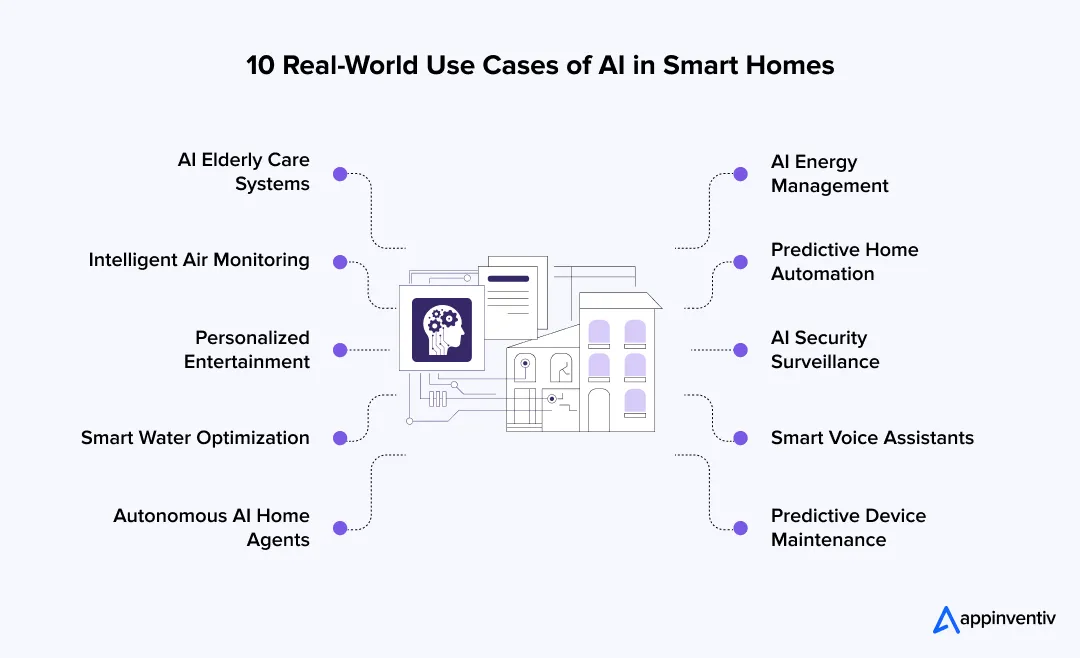
10 Real-World Use Cases of AI in Smart Homes
AI has changed smart homes from rule-based systems into environments that respond to live conditions. Modern platforms study occupancy, energy usage, appliance behavior, and sensor activity in real time, then adjust operations automatically across connected devices.
AI-Driven Energy Management and Dynamic Load Optimization
Energy usage changes constantly inside connected homes. Room occupancy shifts throughout the day. HVAC loads increase during hotter hours.
Appliances pull more power during peak demand periods, where AI demand forecasting helps systems react faster than older setups.
AI systems handle this differently.
A smart home platform studies live telemetry from thermostats, smart meters, occupancy sensors, and connected appliances. Then it adjusts power usage automatically. Cooling drops in unused rooms. Heavy appliance activity shifts outside expensive utility hours. Some systems balance solar energy, battery storage, and grid power at the same time.
How AI Controls Energy Usage
AI systems process telemetry from sensors, thermostats, smart meters, and connected appliances to control energy usage more accurately.
| AI Capability | Function |
|---|---|
| Occupancy-aware HVAC | Adjusts cooling and heating using room activity |
| Peak-load balancing | Reduces electricity usage during demand spikes |
| Smart grid coordination | Responds to utility pricing and grid signals |
| Renewable energy management | Balances solar, battery, and grid power |
These systems rely on reinforcement learning, edge AI, predictive analytics software, and smart meter analytics to improve energy decisions over time.
The result is lower power waste, reduced utility costs, and better sustainability tracking that aligns with broader AI climate change initiatives across connected residential properties.
Predictive Home Automation and Context-Aware Orchestration
Traditional automation systems depend on fixed schedules and manual commands. AI-powered home automation responds to real-time activity in the home and automatically adjusts devices throughout the day.
Modern platforms study occupancy patterns, device usage, voice inputs, and environmental conditions continuously. A smart home with AI can dim lights after rooms stay empty, reduce appliance activity during inactivity periods, or adjust lighting levels based on daylight conditions.
How Predictive Automation Works
AI systems combine sensor data, device telemetry, and behavioral patterns to coordinate automation across connected environments.
| AI Capability | Function |
|---|---|
| Room occupancy prediction | Detects activity patterns across connected spaces |
| Adaptive lighting | Adjusts brightness using occupancy and daylight data |
| Automated appliance coordination | Controls devices based on user activity |
| Proactive automation | Triggers actions before manual commands occur |
These systems rely on contextual intelligence, sensor fusion, and event-driven automation engines to process live environmental data in real time.
The result is faster device coordination, lower manual effort, and smarter AI-powered home automation across connected homes.
AI-Powered Security Surveillance and Threat Detection
Older security systems react after something happens. A motion sensor detects movement, then sends an alert. That approach creates too many unnecessary notifications.
Modern AI surveillance systems handle home protection differently by analyzing real-time patterns. This shift is accelerating fast, with nearly 47% of U.S. internet households already using a home security system or connected security device.
Modern smart-home platforms study movement patterns, entry activity, camera feeds, and occupancy behavior throughout the day. A security camera can now tell the difference between a pet, a family member, and an unknown visitor. Some systems can detect unusual movement near entry points before an intrusion happens.
How AI Improves Smart Home Security
Computer vision and behavioral analytics help security systems react more accurately inside connected homes.
| AI Capability | Function |
|---|---|
| Facial recognition | Identifies residents and approved visitors |
| Anomaly detection | Detects unusual movement patterns |
| Smart access control | Manages connected locks and entry systems |
| Intrusion prediction | Flags suspicious activity near entry points |
Many platforms now run edge vision AI models directly on cameras. Real-time inference systems and object recognition models help reduce false alarms caused by pets, shadows, or weather movement.
Voice AI and Personalized Smart Assistants
Voice assistants have moved far beyond basic command-based interactions inside smart homes. Voice-based interfaces now rank among the most widely adopted AI applications in smart homes globally.
Modern AI assistants now understand natural speech, user intent, and household behavior patterns. A resident can ask the system to “prepare the living room,” and the platform can adjust lighting, temperature, music, and connected devices automatically. Many systems now support multilingual conversations and family-member-specific preferences across connected environments.
How Voice AI Improves Smart Homes
Conversational AI systems process voice data and user context to support faster and more personalized interactions.
| AI Capability | Function |
|---|---|
| Conversational AI | Handles natural spoken interactions |
| Multilingual voice support | Understands multiple languages and accents |
| Personalized household profiles | Stores preferences for different residents |
| Contextual voice understanding | Interprets requests based on user activity |
Most platforms now use transformer-based NLP models, speech-to-intent pipelines, and local voice inference systems to process requests faster. Local processing also improves privacy by reducing cloud dependency for sensitive voice data.
AI-Based Predictive Maintenance for Smart Devices
Most appliances start showing small performance changes before they fail. A cooling system pulls extra power. A refrigerator compressor runs longer than usual. Older smart-home setups usually ignore these patterns.
AI systems watch device activity constantly.
The key factors comparing AI features in smart home appliances include telemetry from HVAC systems, washing machines, refrigerators, water heaters, and smart appliances. The platform studies runtime behavior, temperature shifts, voltage activity, and power consumption in real time.
How AI Detects Maintenance Issues
AI models study device behavior and identify unusual operating patterns across connected equipment.
| AI Capability | Function |
|---|---|
| Appliance diagnostics | Detects irregular device performance |
| Failure prediction | Flag possible breakdown risks early |
| Lifecycle tracking | Monitors long-term equipment usage |
| Equipment health analysis | Studies the power and runtime activity |
These systems use anomaly detection models and sensor telemetry analysis to identify maintenance issues before equipment failure happens.
The result is lower repair costs, reduced downtime, and longer appliance lifespan across connected residential properties.
AI-Enabled Elderly Care and Assisted Living
AI systems now play a growing role in elderly care inside connected homes and assisted living environments.
Traditional monitoring systems depend heavily on manual supervision. AI platforms can track movement patterns, daily activity, medication schedules, and emergency risks automatically. A smart-home system can detect an unusual fall pattern, long inactivity periods, or missed medication routines without direct human monitoring.
How AI Supports Assisted Living
Computer vision and sensor-based monitoring help care systems detect health and safety risks inside residential environments.
| AI Capability | Function |
|---|---|
| Fall detection | Detects sudden body movement and impact patterns |
| Activity monitoring | Tracks movement and daily routines |
| Medication reminders | Sends alerts for scheduled medication intake |
| Behavioral anomaly tracking | Detects unusual inactivity or behavior changes |
These systems use human activity recognition, ambient intelligence, computer vision, and sensor fusion to process movement and environmental data continuously.
Healthcare providers, assisted living operators, and prop-tech firms now use these systems to support aging populations and healthcare-at-home ecosystems across connected residential infrastructure.
Also Read: Smart Hospitals – How Modern Technology Is Enhancing Healthcare Operations
Intelligent Air Quality and Environmental Monitoring
Air quality inside homes changes throughout the day. Cooking activity, humidity levels, dust particles, smoke, and poor ventilation can affect indoor conditions quickly.
AI systems monitor these changes continuously.
Modern smart homes use connected air sensors, HVAC systems, and environmental monitors to track air quality in real time. The system can increase ventilation after detecting rising CO₂ levels, activate purification systems during pollution spikes, or adjust humidity levels automatically during seasonal changes.
How AI Improves Environmental Monitoring
AI models process environmental data to maintain healthier indoor conditions across connected spaces.
| AI Capability | Function |
|---|---|
| AI-based air purification | Activates purification systems after pollution detection |
| Humidity prediction | Adjusts indoor moisture levels automatically |
| Pollution detection | Identifies smoke, dust, and airborne particles |
| Adaptive ventilation | Controls airflow using live environmental data |
These systems use sensor fusion, environmental telemetry, and predictive analytics to support wellness-focused automation and health-aware residential environments across connected smart-home infrastructure.
AI-Powered Entertainment and Lifestyle Personalization
People no longer use smart-home systems only for convenience. Many homes now adjust entertainment settings automatically based on daily habits and room activity.
A connected system can lower lights once a movie starts, reduce outside noise through smart speakers, or change room temperature during long gaming sessions. Some platforms study listening habits and recommend playlists during specific hours of the day. Others adjust ambient lighting based on viewing patterns or occupancy levels.
How AI Personalizes Entertainment Systems
AI platforms study user behavior and device activity across connected home environments.
| AI Capability | Function |
|---|---|
| Personalized media settings | Recommends music and video content using activity history |
| Adaptive ambient controls | Adjusts lighting and sound automatically |
| Mood-aware automation | Changes room settings using occupancy and activity data |
| AI-curated experiences | Coordinates multiple entertainment devices together |
These systems use behavioral learning models, sensor data, and multimodal personalization engines to study household preferences over time.
The result is a more natural entertainment experience across connected living spaces.
AI-Based Water and Resource Optimization
Water waste has become a growing problem across residential buildings and connected housing projects. Small leaks often continue for weeks before anyone notices them.
AI systems help detect these problems early.
Modern smart homes use connected water sensors, smart valves, pressure monitors, and usage analytics to track water activity in real time. A platform can shut off supply lines after detecting abnormal flow patterns or alert operators once unusual consumption spikes appear inside a residential unit.
How AI Improves Water Management
AI systems process sensor data and consumption patterns to manage water usage more accurately.
| AI Capability | Function |
|---|---|
| Smart leak detection | Identifies abnormal water flow and pipe leakage |
| Predictive water management | Tracks usage patterns and consumption changes |
| AI irrigation systems | Adjusts watering schedules using weather and soil data |
| Sustainability intelligence | Monitors long-term resource consumption |
These systems use predictive analytics, telemetry monitoring, and connected IoT sensors to reduce water waste across residential environments.
Large residential communities and smart-city projects now use these platforms to support infrastructure management and long-term sustainability goals.
Autonomous Multi-Device Coordination Using AI Agents
Most smart homes still depend on isolated automation rules. One device reacts to one command. AI agents change how these systems operate.
Agentic AI systems coordinate multiple devices across the home at the same time. A single request like “prepare the house for sleep” can trigger lighting changes, lock doors, lower room temperature, close curtains, and reduce appliance activity automatically. The system keeps learning from daily behavior and adjusts future actions without manual setup.
How AI Agents Coordinate Smart Homes
AI agents process device activity, environmental data, and user behavior to manage connected systems together.
| AI Capability | Function |
|---|---|
| Autonomous orchestration | Coordinates actions across multiple devices |
| Multi-agent systems | Different AI agents manage separate home functions |
| Self-learning automation | Adjusts workflows using repeated behavior patterns |
| AI-driven workflow coordination | Connects lighting, HVAC, appliances, and security systems |
These platforms use autonomous decision engines, contextual intelligence, and live sensor data to coordinate smart-home ecosystems continuously.
This is one of the biggest shifts happening inside connected residential infrastructure today.
Multi-vendor residential ecosystems need centralized AI orchestration to maintain performance, scalability, and infrastructure visibility.
Key Features and Benefits of AI in Smart Homes
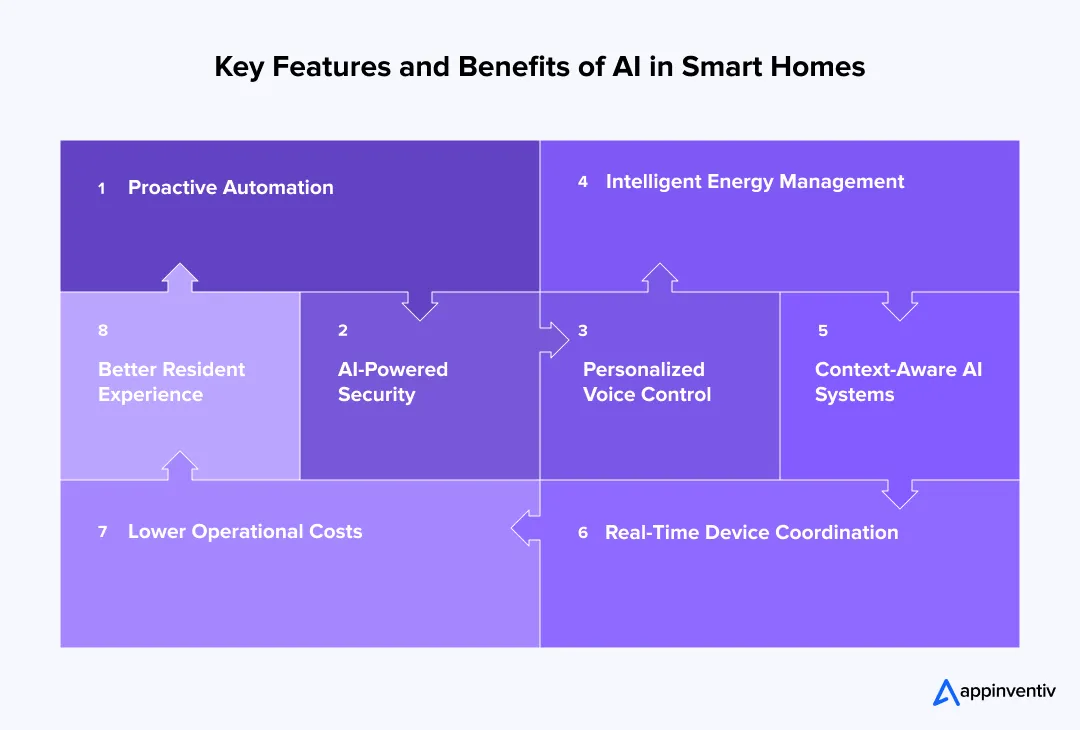
AI smart homes now respond to live activity inside connected environments instead of following fixed schedules. These systems process occupancy data, voice inputs, device telemetry, camera feeds, and environmental conditions throughout the day. The result is faster automation, better infrastructure control, and lower manual effort across residential spaces.
Proactive Automation
AI systems study daily routines and device usage patterns continuously. A connected home can lower cooling in unused rooms, switch off inactive appliances, or adjust lighting before occupancy rises. These actions happen through predictive automation engines and live sensor telemetry.
Enhanced Security
AI-powered security systems process movement activity and camera feeds in real time.
| Security Feature | Function |
|---|---|
| AI-enabled Cameras | Detect faces, movement, and object activity |
| Contextual Alerts | Filter unnecessary notifications |
| Behavioral Recognition | Detect unusual activity patterns |
Many platforms now run edge vision AI models directly on cameras for faster response times.
Voice Control and Personalization
Modern voice assistants use contextual NLP and speech-to-intent processing to understand natural conversations. Intelligent assistants can store household preferences and adjust entertainment, lighting, and temperature settings differently for each resident.
Energy Management
AI systems process smart meter data, HVAC activity, and occupancy levels to reduce electricity waste. Some platforms balance power consumption automatically during peak demand periods through smart-grid coordination and intelligent HVAC balancing.
Contextual Understanding
Visual Language Models (VLMs) and multimodal AI systems combine voice data, camera feeds, and sensor inputs to interpret live environmental conditions across connected homes.
Challenges of Implementing AI in Smart Homes and Practical Solutions
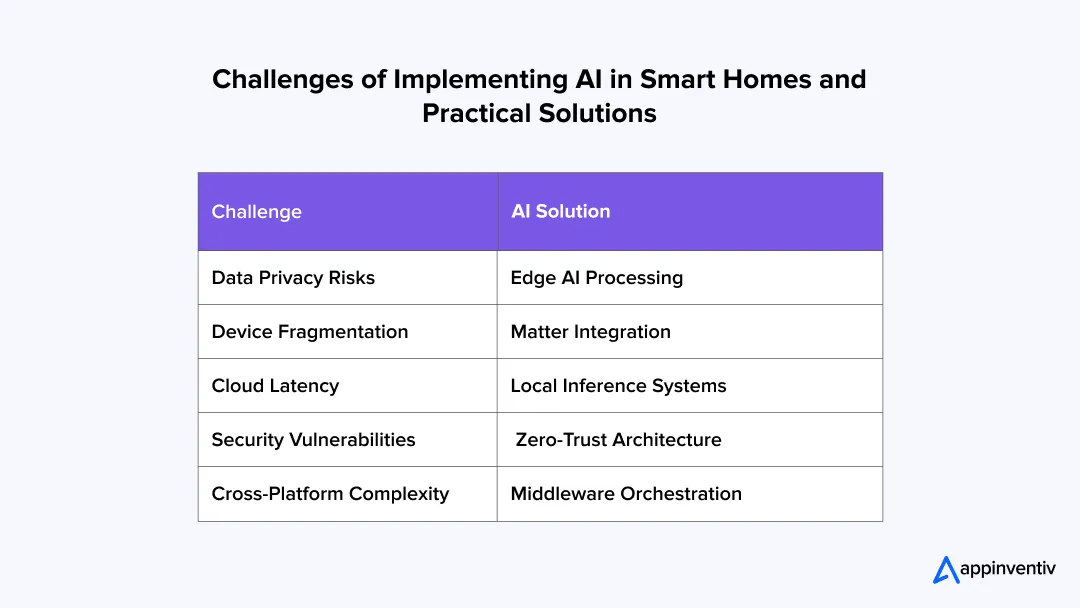
Smart homes collect data all day long. Cameras track movement. Voice assistants process conversations. Smart meters record electricity usage every few seconds. Once hundreds of connected devices operate inside the same property, infrastructure problems start appearing quickly.
Data Privacy and Compliance Risks
Privacy remains one of the biggest concerns in AI-powered homes.
| Privacy Issue | Practical Fix |
|---|---|
| Continuous data collection | Permission-based access controls |
| Voice and camera recordings | Local edge processing |
| Cross-border data storage | Regional data residency policies |
| Personal behavior tracking | Privacy-by-design architecture |
Many residential platforms now follow GDPR and CCPA requirements during system development. Some companies process sensitive data directly on local hubs instead of public cloud servers.
Also Read: How Explainable AI can Unlock Accountable and Ethical Development of Artificial Intelligence
Interoperability and Fragmented Ecosystems
Most properties use devices from different vendors. One platform controls lighting. Another handles HVAC systems. Security devices often run on separate software.
Matter protocol adoption, API standardization, and middleware orchestration platforms now help connect these systems through a shared communication layer.
Latency and Cloud Dependency
Cloud-only automation creates delays during live operations. Security alerts, voice processing, and HVAC controls require faster response times.
Many smart-home platforms now use:
- Edge AI
- Local inference systems
- Hybrid AI architectures
- On-device processing
This reduces latency and improves offline functionality.
Security Vulnerabilities in Connected Infrastructure
Every connected device increases security risk across residential networks.
Modern platforms now rely on:
- Zero-trust architecture
- Encrypted communication
- Identity-based device access
- Secure firmware updates
These controls help reduce unauthorized access across connected residential environments.
How Enterprises Can Build Scalable AI Smart Home Ecosystems
Using AI development services to build an AI-powered smart-home platform requires more than connecting devices through a mobile app. Large residential projects need stable infrastructure, device interoperability, AI governance controls, and long-term scalability planning from the beginning.
Core Development Roadmap
Most enterprise platforms follow a phased smart home integration process.
| Development Stage | Focus Area |
|---|---|
| Infrastructure assessment | Review connectivity, sensors, and existing device ecosystems |
| IoT architecture planning | Define communication layers across gateways and devices |
| AI model selection | Select and build AI models for automation, NLP, and computer vision |
| Interoperability planning | Support Matter and cross-vendor communication |
| Edge and cloud deployment | Split workloads across local and cloud environments |
| AI governance | Define security, compliance, and data handling policies |
Large residential systems often combine Zigbee, Thread, Wi-Fi, Bluetooth, and Matter-enabled devices across the same infrastructure. Poor planning during this stage creates long-term scalability problems later.
Building for Long-Term Scalability
Scalable systems need continuous monitoring and AI lifecycle management across connected environments.
Many enterprises now use:
- MLOps pipelines for AI model updates
- observability platforms for device monitoring
- telemetry dashboards for infrastructure visibility
- AI lifecycle management for retraining and version control
Several companies also use hybrid AI architectures where edge devices process live automation locally, and cloud systems manage analytics workloads.
Build vs Buy Considerations
Enterprises evaluating the smart home AI agent cost for developers usually choose between custom platform development and third-party ecosystems.
| Factor | Build Custom Platform | Buy Existing Platform |
|---|---|---|
| Deployment speed | Longer implementation cycle | Faster rollout |
| Infrastructure control | Full control over architecture | Limited customization |
| AI workflows | Custom automation logic | Predefined workflows |
| Integration flexibility | Easier cross-system integration | Vendor dependency risks |
| Upfront investment | Higher development cost | Lower initial investment |
| Scalability control | Better long-term flexibility | Platform limitations at scale |
The right decision depends on infrastructure goals, operational scale, data ownership requirements, and long-term platform strategy.
Cost of Building AI-Powered Smart Home Systems
The cost of building an AI-powered smart-home platform depends on infrastructure scale, AI complexity, connected device volume, and interoperability requirements.
Smaller projects with basic automation and connected devices usually cost far less than enterprise residential ecosystems with edge AI, predictive analytics, computer vision, and AI orchestration layers.
| Project Scope | Estimated Cost of Smart Home AI Agent |
|---|---|
| Basic AI Smart Home MVP | $50,000–$100,000 |
| Mid-Scale Connected Platform | $100,000–$250,000 |
| Enterprise Residential Ecosystem | $250,000–$500,000+ |
Several factors increase development costs:
- Matter interoperability support
- edge AI infrastructure
- AI agent orchestration
- computer vision systems
- local LLM deployment
- real-time telemetry processing
- security and compliance controls
Large residential projects often combine cloud infrastructure with edge processing systems across cameras, smart hubs, HVAC networks, and connected devices. This increases infrastructure complexity but improves scalability, privacy, and long-term automation performance.
Edge AI, Matter interoperability, and local inference systems now define scalable residential platform performance.

Key Trends in 2026 Reshaping the Future of Smart Home Technology
Smart-home technology trends are changing quickly. Connected devices now exchange live data across lighting systems, HVAC units, cameras, sensors, and voice assistants. AI platforms process this information locally and react in real time inside connected residential environments.
Matter Integration
Matter is changing how smart-home devices communicate. Earlier systems struggled with compatibility across brands and ecosystems. Matter creates a shared communication standard across connected devices.
| Matter Capability | Role in Smart Homes |
|---|---|
| Interoperability | Devices from different vendors work together |
| Unified automation | One platform manages multiple ecosystems |
| Cross-device orchestration | Connected systems coordinate actions automatically |
| Vendor-neutral infrastructure | Reduces dependency on single-device vendors |
This is important for large residential projects and connected housing communities where multiple vendors operate inside the same infrastructure.
Local LLMs and Edge AI
Many smart-home platforms now process AI tasks directly on local hardware instead of cloud servers.
This supports:
- low-latency automation
- offline AI processing
- privacy-focused voice assistants
- faster environmental response
Several systems now use lightweight AI models, on-device inference engines, and edge intelligence across cameras, speakers, and smart hubs. Some companies are testing federated learning models for decentralized AI training.
Agentic and Multimodal AI Systems
AI agents now coordinate lighting, security, HVAC, and appliances together through autonomous orchestration systems.
Modern platforms also combine voice inputs, camera feeds, occupancy data, and sensor telemetry through multimodal AI and Visual Language Models (VLMs). This improves contextual awareness across connected homes.
Also Read: Top AI Trends in 2026: Transforming Businesses Across Industries
How Appinventiv Helps Build AI-Powered Smart Home Ecosystems
Many enterprises struggle once smart-home systems move beyond small deployments. Devices stop communicating properly across vendors. Cloud-heavy systems create delays. Security risks increase as more sensors, cameras, and connected appliances enter the network.
This is where infrastructure planning matters.
Appinventiv helps enterprises build connected residential platforms that support AI-powered home automation, IoT orchestration, edge processing, and real-time device intelligence at scale.
Our teams work across AI engineering, edge AI systems, predictive analytics, intelligent enterprise automation, and AI agent development for connected environments.
Our work includes:
- 300+ AI-powered systems delivered
- 150+ custom AI models deployed
- 100+ autonomous AI agents implemented
- 75+ enterprise AI integration services completed
- 50+ enterprise LLM models fine-tuned
- Teams across 35+ industries
We help enterprises build:
- Scalable edge and cloud infrastructure
- Matter-ready interoperability layers
- Real-time telemetry pipelines
- AI observability systems
- Secure device communication frameworks
- Predictive automation platforms
Across projects, enterprises have reported:
- 50% lower manual operations
- 40% lower operational costs
- 75% faster decision-making
- 2x infrastructure scalability
- 98% AI prediction accuracy
The future of smart home technology is no longer simple automation systems, becoming intelligent environments powered by edge AI, local LLMs, and autonomous AI agents.
Enterprises that invest early in AI in smart homes will shape the future of smart living infrastructure.
Let’s connect and build AI-powered smart homes that are redefining modern residential operations at scale.
Frequently Asked Questions
Q. What is the role of AI in Smart Home Devices?
A. The presence of AI in smart homes helps devices react to daily activities inside the house. A thermostat can lower the cooling after rooms stay empty. Cameras can identify familiar faces. Lighting systems can adjust brightness automatically based on occupancy, movement, and daylight conditions across connected spaces.
Q. What devices or systems can your smart home AI solutions integrate with?
A. AI smart-home systems can connect with HVAC units, cameras, lighting controls, smart locks, occupancy sensors, smart meters, voice assistants, and connected appliances. Many residential projects now combine Matter, Zigbee, Wi-Fi, Bluetooth, Thread, and Z-Wave devices inside the same infrastructure environment.
Q. How to integrate AI into smart home applications with Appinventiv’s help?
A. Appinventiv develops AI and IoT systems for connected residential projects. Our teams build automation platforms, telemetry systems, edge AI infrastructure, and connected device networks for enterprises, hospitality groups, prop-tech companies, and developers managing large residential environments and smart housing systems.
Q. How is generative AI being used in smart homes?
A. Generative AI helps smart homes respond more naturally to voice requests and connected-device activity. A resident can request a nighttime setup, and the platform can adjust lighting, HVAC systems, entertainment devices, and security controls together through local LLMs and connected AI models.


Fast 2-minute response, fully NDA-protected.

Retrieval Augmented Generation in Australia: Architecture, Implementation and Cost
Key takeaways: RAG grounds LLM answers in approved content, improving reliability without retraining a model. Data quality and access permissions decide production outcomes more than the model. Indicative build costs run from AUD 70,000 to 700,000, driven by data and integrations. Measure value against a pre-deployment baseline, separating realised benefits from projected savings. A general-purpose…

The Multiplier Effect of AI Agents: The Rise of AI Swarms
Key takeaways: AI agent swarms coordinate specialized agents to solve complex problems that may be difficult for a single agent to handle effectively. More agents do not automatically mean better outcomes. Swarms deliver value when work can be divided, executed in parallel, and coordinated toward a shared objective. Enterprise readiness depends on governance. Clear accountability,…
AI Data Integration: How to Connect, Clean and Prepare Data for AI
Key takeaways: AI initiatives fail when fragmented, poor-quality data reaches models without sufficient context, controls or ownership. AI-ready pipelines must connect, clean, enrich, govern and continuously monitor data across its lifecycle. Real-time processing matters when AI decisions depend on current transactions, events, inventory or operational conditions. Data architecture should follow the AI use case, balancing…