



































How to Build AI for Real Estate Investment Planning that Survives Compliance, Bias, and Market Volatility

 Share -




Key takeaways:
- Start with research before development.
- Map compliance before choosing the architecture.
- Build the data foundation before training the model.
- Cost can range from $100K to $5M+, depending on scope.
- The biggest challenge is keeping the AI accurate, explainable, and compliant after launch.
Building a real estate investment AI means planning for two industries: real estate and fintech.
And to ensure you do it right, your fund, irrespective of its size, should not only stick to the development phase. Invest in ground research:
- Explore what AI experts recommend.
- Identify possibilities of hallucinations.
- See what kind of data is available in the market.
- Recognize your data sources and teams.
And, here’s the good news: real estate AI isn’t a new market. It used to be $402.19 billion in 2025 and will be over $3 trillion by 2032. That means there’s plenty of data existing in the market for you to leverage.
It can save you from investing in massive data training yourself if that’s something your firm can’t afford yet. But that comes with a price. You will be able to set the tone, personality, and even your brand presence in the AI you build. But you won’t be able to help it behave in every specific way you demand.
You also need the right kind of team that doesn’t assume, but executes based on real data. Zillow did that. Built algorithms that motivated them to buy properties they thought were undervalued. Soon after, their accounts announced monetary losses. Massive monetary losses!
So, before we take into details, let us ask:

How to build an AI for real estate investing?
We built over 300 AI products, and honestly, almost every time any client came to get something fixed or built, they were most suffering from mistakes they had already made. None of them cared about how AI can help well, but more about implementing AI. That’s the reason why most AI projects fail.
Zillow made the same mistake, underestimating the market volatility and leveraging experts who lacked AI expertise.
Let’s take you through the process that can safeguard your real estate AI from backfiring.
Invest in research
Brainstorming is great, but research is something that requires a dedicated budget to do well. Invest in it. Hire people with expertise in executing real-world market research. You need skillsets like real estate domain research, data analysis, AI/ML feasibility, UX research, compliance review, market intelligence, technical architecture, and business strategy.
If it sounds like a headache, outsource. Outsourcing AI requirements, such as market research for sensitive AI solutions, is basically a genius move when you’re not affiliated with core AI experts regularly. This saves money in the long run, as well as your business from frustrated customers or clients.
This is the layer that decides the workflow of the AI tool.
Identify compliance requirements
Your target market will influence the shape and size of your AI investment for the real estate industry. If you’re targeting the US market, tons of local compliance become critical. Same in Europe, but for probably a less diverse market. If you’re going global, well, your AI in real estate investment will look massive.
The non-negotiables that are going to make your development team scratch their heads are:
- Fair Housing Act (US) and its EU equivalents ensure your model doesn’t discriminate on protected attributes, even indirectly through proxies like ZIP codes.
- The General Data Protection Regulation (GDPR) in Europe and the California Consumer Privacy Act (CCPA) govern how you collect, store, and explain decisions made on personal data, and “the algorithm decided” is not a legal defense.
- Rules from the Securities and Exchange Commission (SEC) and the Financial Industry Regulatory Authority (FINRA) apply the moment your AI starts nudging users toward investment decisions, because that crosses into advisory territory.
- Anti-money laundering (AML) and know-your-customer (KYC) requirements kick in for any platform that enables transactions.
- And the European Union’s AI Act, now in force, classifies creditworthiness and property valuation models as high-risk, which means documentation, human oversight, and bias audits are mandatory rather than optional.
Brainstorm an idea and success metrics
Now, it’s time to get your best minds together in a room and start discussing blueprints, goals, tech stack, architecture, etc. Identify whether your priority is to integrate predictive analytics in real estate investing so users can predict stocks of the industry. Or, you’re going towards a more educational direction where your AI just talks about what has already happened.
This is also the stage where you imagine and define success. Implement metrics that measure ROIs. For a real estate investment AI, the metrics worth tracking usually fall into four buckets:
- Accuracy: AVM error rate vs. actual transaction price (industry benchmark is 7–10%), deal score correlation with IC decisions.
- Speed: underwriting time reduction (target 50–70%), screening throughput per analyst hour.
- Trust: false positive rate on deal flags, explainability scores and override rate by senior reviewers.
- Business outcome: deals reviewed per quarter, IC hit rate, time-to-close.
You will have to prepare these numbers in advance. When you meet them after launching the product, that means you met the target.
Pick an architecture
The choice of your architecture decides the life of your tool. And it’s definitely going to influence the cost of building an AI for real estate investing. There are four serious patterns for AI architecture for PropTech and investment software development.
Pick based on data volume, latency needs, and how much customization you actually require.
| Architecture | Best for | Watch out for |
|---|---|---|
| RAG (Retrieval Augmented Generation) | Firms want LLMs to query proprietary deal memos, OMs, lease docs, and internal research. Lower training cost, faster to ship. | Garbage retrieval = garbage output. The vector DB and chunking strategy decide everything. |
| Fine-tuned domain LLM | Teams with 10+ years of proprietary underwriting data want the model to internalize. Better for nuanced valuation calls. | Expensive to train. Expensive to retrain when data drifts. Vendor lock-in risk. |
| Hybrid ML + rules engine | Risk scoring, deal screening, portfolio rebalancing. Combines ML predictions with hard underwriting rules (max LTV, DSCR floors). | Rule maintenance becomes its own problem at scale. |
| Agentic AI orchestration | Multi-step workflows: pull comps, build model, draft memo, route to IC. Where 2026–2027 budgets are flowing. | Governance gap is real. NIST published an agentic profile for a reason. |
Our development projects, throughout the years, have made one thing clear: you can’t pick any of these architectures individually. Stick multiple patterns together based on what you expect from the tool.
CRE lenders using AI in credit decisioning face explainability requirements under ECOA and CRA, and regulators at the OCC, FDIC, and CFPB have all signaled that model risk management frameworks must extend to ML used in credit. If your architecture cannot explain why a deal scored 7.2 instead of 8.4, you have a compliance problem before you have a product.
Build a trail from scratch that keeps an active eye on your architecture. This will turn into your defense against millions of penalties often occurring due to violations of compliance.
Assemble a team and identify your tech stack
Real estate tech stack, especially to build an AI solution, isn’t too diverse. But it doesn’t mean the skill gap doesn’t exist. It should be your priority to ensure you’re not shaking hands with a team that just claims its expertise using fancy names.
Have someone on your side who understands what makes the modern real estate industry run, and guides your choice accordingly. But ensure your tech isn’t only focused on the present; it gives your AI a leverage edge in the coming years.
For a serious build, you’ll need a blend of these roles:
- AI/ML engineers with experience in RAG, fine-tuning, or agentic systems (depending on architecture).
- Data engineers who can build reconciliation pipelines across messy real estate data sources.
- Real estate domain experts like underwriters, asset managers, or analysts who can tell you when the model is wrong.
- Compliance counsel familiar with fair lending, GDPR, and the EU AI Act.
- MLOps engineers for deployment, monitoring, and retraining cadence.
- UX researchers who understand institutional workflows, not consumer apps.
If that sounds hard, there’s no harm in signing up for AI consulting services.
And if you’re going it solo, have these tech expertise in consideration.
| Layer | What it does | Working stack |
|---|---|---|
| Data layer | Storage, transformation, and retrieval | Snowflake or BigQuery, Pinecone or Weaviate for vectors, Airflow plus dbt for orchestration |
| Model layer | Reasoning and prediction | GPT-4o, Claude, or LLaMA for reasoning, plus PyTorch or TensorFlow for custom models |
| Ops layer | Deployment, monitoring, and integration | AWS, Azure, or GCP, MLflow for deployment, Datadog for monitoring |
Onboard our pre-built team that offers an experience of delivering over 300 compliant AI products.

Build the data foundation
Once you have figured out the AI architecture for real estate platforms, your job comes down to building a data foundation. This will require ensuring three things:
- Inventory every source. Tag each one for structure, freshness, and ownership.
- Build a canonical schema where one asset record, one deal record, and one entity record live.
- Then build pipelines that reconcile conflicts: when CoStar shows one cap rate, and RCA shows another, the pipeline picks one and logs the disagreement.
That’s the kind of strategy that would have saved Zillow.
Also, your schema needs to handle asset-level metrics, fund-level rollups, debt stacks, JV splits, capital calls, and the entity hierarchy underneath. If it can’t represent a Class B multifamily asset in a 70/30 JV with a 9% pref, it can’t reason about your portfolio.
Pipelines feed this model continuously. Daily from the fund admin. Quarterly from valuation providers. Event-driven when deals close. Without the pipelines, the data model is a static snapshot, not a living system.
Start training and validating your data models
As you build, train your data models based on historical data like historical deals, macro data, and more. The quality of the data you use for training decides the quality of your article. However, it’s ideal that for the last 12-18 months, you keep the data separate. Don’t use it to train your model.
That can help you identify whether the data you have trained your model on is delivering accurate results or not. This data that you keep aside is called held-out data. However, expect a 15–25% performance gap between training and live deployment on the first iteration. That’s normal.
Here’s the thing, though: accuracy alone isn’t enough for AI applications in real estate investment. Bias testing is critical.
As you know from Zillow’s history, real estate has documented industry-wide bias problems. For instance, AVMs have been caught systematically undervaluing properties in minority neighborhoods and lending algorithms using ZIP codes as proxies for race.
The Fair Housing Act doesn’t care that your model wasn’t trained on protected attributes; it cares whether the outputs discriminate in effect.
Before you ship anything, run your model against:
- Disparate impact tests across protected classes.
- Proxy variable audits checks if removing the ZIP code changes outputs?
- Subgroup performance asks, does the model perform equally well across geographies, asset classes, and deal sizes?
- Adversarial testing questions that what happens when inputs look unusual?
Document everything. When the OCC or CFPB comes asking, “show your work” is the only defense.
Next, you need a human-in-the-loop layer
This is how you ensure your AI doesn’t attract lawsuits the moment you launch it. And honestly, it’s not just an ideal step, but an obligation triggered by the EU AI Act. It mandates that you have human oversight of any AI models that fall under high-risk categories.
ECOA also enables (you can say mandates) human reviewers in credit decisions.
This is how you will have to map out the process.
- Appoint a team that reviews the AI’s output before it reaches a decision-maker.
- Establish confidence thresholds that trigger human escalations. (For example, any deal scoring above 8.5 auto-routes to senior review; any AVM with low confidence flags for manual valuation.)
- There should also be an override mechanism to allow an analyst to correct the AI and ensure that the correction feeds back into retraining.
- Your last question for yourself should be: Where does the audit trail capture human decisions alongside AI outputs?
Next is planning the user interface
The model is not your final destination; delivering it as an experience is. Identify your front-end strategy, whether that means dashboards, analyst workflows, real estate chatbots, or embedded investment copilots. Then integrate the model there, test, ask others to test it out, and improve until you are not at the point where the product looks its best.
If you’re deploying it across as an integration, leverage AI-powered QA as well to check its feasibility against unexpected queries. Eventually, the AI should not deliver false results or 404.
For institutional users specifically, prioritize:
- Explainability surfaces: Ensure every AI output shows its reasoning, sources, and confidence.
- Override controls: Analysts need one-click correction without leaving the workflow.
- Audit visibility: Compliance teams should be able to pull any decision’s full trail in under a minute.
Pilot, monitor, and audit
Don’t go from build to full deployment. Pilot the AI with a small group first: internal analysts, then one fund or one asset class, then portfolio-wide. This is where you catch the 15–25% performance gap between training and live data, and where you find the edge cases your validation missed.
Then build the monitoring infrastructure that keeps the AI working after launch:
- Drift detection monitors if markets shift, cap rates move, comparable sales go stale. Without drift monitoring, your model’s accuracy quietly erodes over quarters.
- Retraining triggers define the conditions that force a retrain (accuracy drops below threshold, market regime change, regulatory update).
- Feedback capture observes every time an analyst overrides the AI; that signal should feed back into the next training cycle.
- Audit logging means every prediction, every override, and every retraining event is timestamped and retrievable.
To stay vigilant against surprise audits, assign a dedicated team to this layer. Keep records of training data, bias test results, model versions, and human override patterns. This will require additional budget and time, but it will safeguard your product against millions in penalties and against the slow, invisible degradation that kills most AI projects before they hit year two.
What are the typical AI development costs for real estate investment?
For a short answer, the cost to build AI for real estate investment planning can be anywhere, starting from as low as $100,000 reaching to as high as $5M. Still, it’s not only the budget that controls the outcome.
- It’s what you’re putting your AI model against,
- What kind of experts are you going for?
- And what are the markets you will target
You can have a $500,000 budget and defeat a $1M+ project if you do it right. The money simply enables you to do what you have already envisioned. It’s how well you plan it, gives you a boost.
We suggest that you consider these parameters in your budget. We have observed that often failed products didn’t bother considering them.
- Data readiness: Clean transaction data sits at the lower end. Scanned PDFs and fragmented sources push you higher.
- Compliance footprint: US-only is the cheapest. Multi-jurisdiction (GDPR, EU AI Act, fair lending) adds $20K–$50K per jurisdiction.
- Architecture choice: RAG is light. Fine-tuned domain LLMs cost more. Agentic orchestration costs the most but does the most.
- Team structure: Blended teams (offshore engineering, onshore AI and compliance leadership) run 30–40% cheaper than fully onshore consultancies, without losing quality.
Now, here’s a sample table that highlights the cost of building AI for REITs against market standards.
| Budget category | $200K build | $750K build | $2M+ build | Share of total |
|---|---|---|---|---|
| Research, compliance scoping, architecture | $24,000 | $90,000 | $240,000 | 12% |
| Data foundation (pipelines, schema, vector DB) | $44,000 | $165,000 | $440,000 | 22% |
| Model layer (RAG, APIs, fine-tuning) | $36,000 | $135,000 | $360,000 | 18% |
| Agentic orchestration and workflow automation | Not included | $105,000 | $280,000 | 14% |
| REIT data model (debt stacks, JV splits, capital calls) | $30,000 | $97,500 | $260,000 | 13–15% |
| UI/UX, integration, QA | $40,000 | $105,000 | $280,000 | 14–20% |
| Compliance, model risk management, audit trail | $26,000 | $52,500 | $200,000 | 10–13% |
| Annual operating cost (separate from build) | $35,000/yr | $130,000/yr | $350,000/yr | 15–20% of build |
The above tentative amounts have some patterns.
- Data foundation takes most of the money, but makes your AI model worth it.
- Compliance can be costly, but are great for future safety, especially in highly regulated markets.
- Agentic orchestration is great, but it can be used best when you have a large user base to handle
Maintenance is an ongoing cost, and a supercritical one
You can’t skip planning your maintenance budget. That will definitely land your AI in trouble someday. Not maintaining it means not putting effort into checking its content quality, understanding its ability to remain compliant, and upgrading it as markets evolve.
The task will consume 15-20% of the budget periodically. But it will keep aligning your AI with updated regulations and market demands.
Do it right from the beginning by leveraging the expertise our AI experts offer. Make it compliant, and future-proof by talking to us.

Why you should get on a call with Appinventiv
We have built:
- Over 300 AI-powered solutions,
- 100+ AI agents,
- 80+ Generative AIs,
- and much more.
We have seen people across industries making mistakes that often turned out to be expensive.
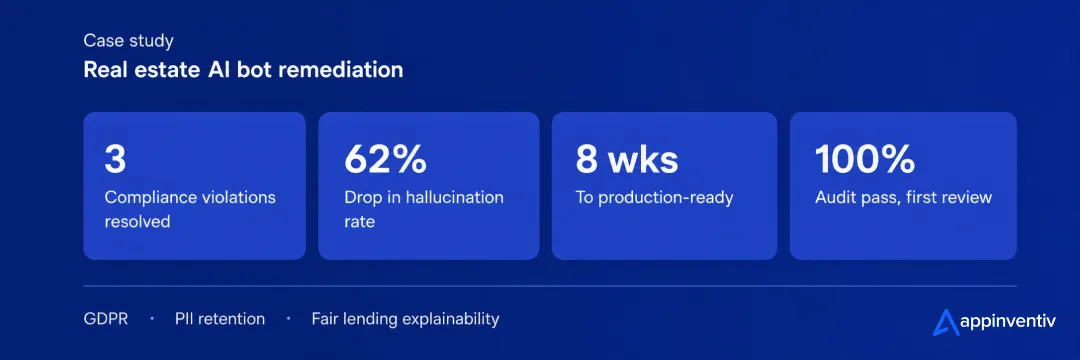
For instance, a brand came to us with a broken AI bot that reportedly violated three major compliance requirements during the testing phase: GDPR consent flows, PII retention, and explainability obligations under fair lending. If the product had been launched in the real world, it definitely would have invited lawsuits.
We helped them. Our team rewrote their inference pipeline, restructured the prompt orchestration layer, and rebuilt the audit logging from the ground up to meet their compliance requirements.
But while we were testing, we also identified gaps in data training standards. Their own chatbot didn’t know their brand well, the retrieval layer was pulling from outdated documentation, the vector embeddings hadn’t been refreshed in eight months, and the model was confidently hallucinating product details that didn’t exist.
Our team had to implement a fresh RAG architecture against their canonical knowledge base, set up an automated re-embedding cadence, and bolt on a fact-grounding layer that cross-checked outputs before they reached the user.
- The conclusion is, if you’re in the stage of brainstorming, we can help you through our AI consulting services.
- If you have already developed a product, let our AI development services help you make it perfect.
- And, in case you have an already existing real estate investment solution, but you want to integrate AI into it, well, we have AI integration experts as well.
Share a word, and we will help you build.
FAQs
Q. How does machine learning enhance real estate investment strategies?
A. Machine learning enhances real estate investment strategies in four ways: deal screening at scale, predictive analytics in real estate investing, real-time portfolio monitoring, and underwriting automation.
It compresses 500-deal review pipelines into 50-deal shortlists, forecasts cap rate movement and rental yield from historical data, and surfaces risk signals continuously instead of through 90-day-stale quarterly reports. The value of AI and machine learning in real estate investment isn’t any single capability — it’s reclaiming the analyst hours that volume work currently consumes.
Q. How can AI improve property valuation accuracy for investors?
A. AI improves property valuation accuracy by running Automated Valuation Models (AVMs) trained on transaction history, market trends, and macroeconomic signals — reducing pricing errors by up to 30% and cutting analysis time by 50%.
For institutional investors, the bigger gain is auditability. AVMs produce the valuation, the comparables weighted, and the confidence interval — a documented trail that satisfies ECOA and CRA model risk management requirements. Accuracy depends on data quality, though. Stale or biased training data produces confident, defensible, wrong numbers — which is how Zillow ended up with $500M+ in write-downs.
Q. How do you choose the right AI architecture for real estate investment platforms?
A. Choosing the right AI architecture for PropTech and real estate platforms depends on four factors: data volume, latency, customization needs, and compliance scope.
RAG suits firms querying proprietary deal memos. Fine-tuned domain LLMs work for teams with 10+ years of underwriting data. Hybrid ML plus rules engines handle risk scoring with hard constraints. Agentic AI orchestration runs multi-step IC workflows. Most institutional builds stack multiple patterns rather than picking one — and compliance often forces the architecture decision before anything else.
Q. What are the key stages of building AI for investment planning platforms?
A. Building AI for real estate investment planning moves through twelve stages: research, compliance scoping, idea and metrics definition, architecture selection, team assembly, data foundation, REIT data model, training and bias testing, human-in-the-loop design, UI planning, and pilot/monitor/audit.
The stages most teams underestimate are bias testing, human-in-the-loop design, and post-launch monitoring. Skipping them is the most common reason real estate investment planning software projects fail in year two.
Q. How can Appinventiv help enterprises build AI solutions for real estate investment planning and PropTech platforms?
A. Appinventiv has built 300+ AI-powered solutions, 100+ AI agents, and 80+ Generative AI deployments, including across PropTech and real estate.
For enterprises building AI in real estate investment, we bring three things most vendors don’t: domain experts embedded from day one, hands-on experience with the architecture patterns institutional teams actually deploy, and a documented track record of shipping compliant AI across GDPR, EU AI Act, fair lending, and SEC obligations.


Fast 2-minute response, fully NDA-protected.

Automated Decision-Making in Australia: Benefits, Cost and Implementation
Key takeaways: Automated decision-making combines rules, algorithms, AI and human oversight to improve high-volume decisions. ADM programmes require privacy, security, auditability and accountability to be designed into architecture. ADM implementation costs typically range from AUD 70,000 to AUD 700,000 or more. Implementation starts with decision mapping, then moves through development, testing, controlled pilots and monitoring.…

AI Red Teaming Attack Strategies: Jailbreak, Crescendo, Base64 & More Explained
Key takeaways: Jailbreak testing must follow the full execution path from prompt and context to retrieval, tools, and enterprise APIs. Crescendo and adaptive attacks expose failures that single-turn testing misses by exploiting conversation history and model feedback loops. Base64 and Unicode tests probe gaps in normalization, tokenization, filtering, and decoding before adversarial input reaches model…

AI Agent Protocols: MCP, A2A, ACP & More Explained
Key takeaways: MCP connects agents to enterprise tools, while A2A lets independent agents delegate tasks without exposing internal logic. The protocol stack now spans agent access, collaboration, UI interaction, open networking, commerce, and machine-to-machine payments. A2A had support from 150+ organizations by April 2026, with 22,000+ GitHub stars and five production-ready SDK languages. Enterprise agent…